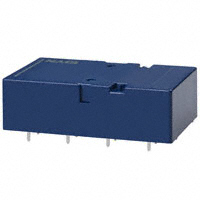
Flat type safety relays
(double contact)
SF RELAYS
Double contact type
FEATURES
1. High contact reliability
High contact reliability is achieved
through the use of a double contact.
2. Forced operation contacts
N.O. and N.C. side contacts are
connected through a card so that one
interacts with the other in movement. In
case of a contact welding, the other
keeps a min. 0.5mm .020inch contact
gap.
3. Independent operation contacts
(4 Form A 4 Form B)
There are 4 points of forced operation
contacts.
Each pair of contacts is free from the
main armature and is independent from
each other. So if a N.O. pair of contacts
are welded, the other 3 N.O. contacts are
not effected (operate properly) That
enables to plan a circuit to detect welding
or go back to the beginning condition.
4. Separated chamber structure
N.O. and N.C. side contacts are put in
each own space surrounded with a card
and a body-separater. That prevents
short circuit between contacts, which is
caused by their springs welding or
damaged.
2 Form A 2 Form B
4 Form A 4 Form B
RoHS compliant
5. High breakdown voltage
High breakdown voltage 2,500 Vrms
between contacts and coil.
6. High sensitivity
Realizes thin shape and high sensitivity
(500 mW nominal operating power) by
utilizing high-efficiency polarized
magnetic circuit with 4-gap balanced
armature.
7. Complies with safety standards
Standard products are UL, CSA, TÜV
and SEV certified. Conform to European
standards. TÜV certified. Complies with
SUVA European standard.
TYPICAL APPLICATIONS
1. Industrial equipment such as
presses and machine tools
2. Elevators and other kinds of
hoisting mechanisms, conveyor
equipment.
ORDERING INFORMATION
SF
D
Contact arrangement
2: 2 Form A 2 Form B
4: 4 Form A 4 Form B
Nominal coil voltage
DC 5, 12, 24, 48, 60V
Note: Certified by UL, CSA, TÜV and SEV
TYPES
Contact arrangement
2 Form A 2 Form B
4 Form A 4 Form B
Nominal coil voltage
5V DC
12V DC
24V DC
48V DC
60V DC
5V DC
12V DC
24V DC
48V DC
60V DC
Part No.
SF2D-DC5V
SF2D-DC12V
SF2D-DC24V
SF2D-DC48V
SF2D-DC60V
SF4D-DC5V
SF4D-DC12V
SF4D-DC24V
SF4D-DC48V
SF4D-DC60V
Standard packing: Carton: 20 pcs.; Case: 200 pcs.
–1–
ASCTB120E 201408-T
�SF Double contact type
RATING
1. Coil data
Contact
arrangement
Nominal coil
voltage
2 Form A 2 Form B
4 Form A 4 Form B
Pick-up voltage
(at 20°C 68°F)
Drop-out voltage
(at 20°C 68°F)
Nominal coil current
[±10%]
(at 20°C 68°F)
Coil resistance
[±10%]
(at 20°C 68°F)
5V DC
100mA
50Ω
12V DC
24V DC
48V DC
60V DC
5V DC
75%V or less of
nominal voltage
(Initial)
41.7mA
20.8mA
10.4mA
8.3mA
288Ω
1,152Ω
4,608Ω
7,200Ω
12V DC
24V DC
48V DC
60V DC
75%V or less of
nominal voltage
(Initial)
100mA
41.7mA
20.8mA
10.4mA
8.3mA
50Ω
288Ω
1,152Ω
4,608Ω
7,200Ω
10%V or more of
nominal voltage
(Initial)
15%V or more of
nominal voltage
(Initial)
Nominal operating
power
(at 20°C 68°F)
Max. applied
voltage
(at 20°C 68°F)
500mW
120%V of
nominal voltage
500mW
2. Specifications
Characteristics
Contact
Rating
Item
Arrangement
Contact resistance (Initial)
Contact material
Nominal switching capacity (resistive load)
Max. switching power (resistive load)
Max. switching voltage
Max. switching current
Nominal operating power
Min. switching capacity (Reference value)*1
Insulation resistance (Initial)
Breakdown voltage
(Initial)
Electrical
characteristics
Between open contacts
Between contact sets
Between contact and coil
Temperature rise (coil) (at 20° 68°F)
Operate time
Release time
Functional
Destructive
Functional
Vibration resistance
Destructive
Mechanical
Electrical
Shock resistance
Mechanical
characteristics
Expected life
Conditions
Conditions for operation, transport and storage*2
Max. Operating speed
Unit weight
Specifications
2 Form A 2 Form B
4 Form A 4 Form B
Max. 30 mΩ (By voltage drop 6 V DC 1A)
Au-flashed AgSnO2 type
6A 250V AC, 6A 30V DC
1,500VA 180W
440V AC, 30V DC
6A
500mW
100mA 5V DC
Min. 1,000MΩ (at 500V DC) Measurement at same location as “Breakdown voltage” section.
1,300 Vrms for 1min. (Detection current: 10mA)
2,500 Vrms for 1min. (Detection current: 10mA)
2,500 Vrms for 1min. (Detection current: 10mA)
Max. 45°C 113°F
(By resistive method, nominal voltage applied to the coil; contact carrying current: 6A)
Max. 30ms (Nominal voltage applied to the coil, excluding contact bounce time.)
Max. 15ms (Nominal voltage applied to the coil, excluding contact bounce time.)
(without diode)
Min. 294 m/s2 (Half-wave pulse of sine wave: 11 ms; detection time: 10μs)
Min. 980 m/s2 (Half-wave pulse of sine wave: 6 ms)
10 to 55 Hz at double amplitude of 2 mm (Detection time: 10μs)
10 to 55 Hz at double amplitude of 2 mm
Min. 107 (at 180 times/min.)
Min. 105 (at 20 times/min.)
Ambient temperature: –40°C to +70°C –40°F to +158°F
Humidity: 5 to 85% R.H. (Not freezing and condensing at low temperature)
180 times/min.
Approx. 38g 1.34oz
Approx. 47g 1.66oz
Notes: *1. This value can change due to the switching frequency, environmental conditions and desired reliability level, therefore it is recommended to check this with the
actual load.
*2. The upper limit of the ambient temperature is the maximum temperature that can satisfy the coil temperature rise value. Refer to Usage, transport and storage
conditions in NOTES.
–2–
ASCTB120E 201408-T
�SF Double contact type
REFERENCE DATA
1. Operate/release time (without diode)
2. Temperature rise
3. Ambient temperature characteristics
Tested sample: SF2D-DC24V (2 Form A 2 Form B)
Quantity: n = 20
Tested sample: SF4D-DC24V (4 Form A 4 Form B)
Quantity: n = 6
Coil applied voltage: 100%V, 120%V
Contact carry current: 6A
Tested sample: SF4D-DC24V (4 Form A 4 Form B)
Quantity: n = 6
Temperature rise, °C
Operate/release time, ms
40
30
Operate time
20
Release time
10
0
Max.
x
Min.
Max.
x
Min.
70
80
Rate of
change, %
30
50
25
Inside the coil
100
50
Drop-out voltage
20
-40 -20
Pick-up voltage
0
15
20 40
10
Contact
60 80
Ambient
temperature, °C
-50
5
0
90
100
110
120 130
Coil applied voltage, %V
DIMENSIONS (mm inch)
100
-100
110
120
Coil applied voltage, %V
The CAD data of the products with a
CAD Data
mark can be downloaded from: http://industrial.panasonic.com/ac/e/
1. 2 Form A 2 Form B
External dimensions
CAD Data
Schematic (Bottom view)
5
6
7
8
9
10
11
12
1
16±0.5
.630±.020
2
1.0
.039
0.5
.020
5.08
.200
12.7
.500
12.7
.500
1.0
.039 3.0±0.5
.118±.020
12.7
.500
53.3±0.5
2.098±.020
0.30
.012
25.0
.984
5
6
7
PC board pattern (Bottom view)
0.48
.019
8
2.54
.100
1
10-1.4 dia. holes
10-.055 dia. holes
2.54
.100
12.7
.500
7.62
.300
2
9
10
11
12
General tolerance: ±0.3 ±.012
Tolerance: ±0.1 ±.004
2. 4 Form A 4 Form B
External dimensions
CAD Data
Schematic (Bottom view)
16±0.5
.630±.020
1.0
.039
5.08
.200
12.7
.500
53.3±0.5
2.098±.020
0.30
.012
33±0.5
1.299±.020
13
5
14
6
15
7
7.62
.300
16
8
0.48 12.7
.019 .500
7.62
.300
2
11
19
5
9
6
10
7
11
8
12
17
18
19
20
PC board pattern (Bottom view)
2.54
.100
10
18
16
0.48
.019
1
9
17
15
2
1.0
.039 3.0±0.5
.118±.020
12.7
.500
14
1
0.5
.020
12.7
.500
13
18-1.4 dia. holes
18-.055 dia. holes
2.54
.100
7.62
.300
12
20
General tolerance: ±0.3 ±.012
Tolerance: ±0.1 ±.004
–3–
ASCTB120E 201408-T
�SF Double contact type
SAFETY STANDARDS
UL/C-UL (Recognized)
File No.
Contact rating
E120782*
6A 250V AC
6A 24V DC
TÜV (Certified)
File No.
Rating
968 EZ 116.03/10 (SF2D) 3A 24V DC
968 EZ 116.02/09 (SF4D) 6A 250V AC
SEV
File No.
12.0520
Contact rating
6A 24V DC
6A 250V AC
* CSA standard: Certified by C-UL
SAFETY STRUCTURE OF SF RELAYS
(unforeseen externally caused circuit or
device breakdowns, end of life incidents,
and noise, surge, and environmental
influences) owing to contact welding,
spring fusion or, in the worst-case
This SF relay design ensures that
subsequent operations shut down and
can automatically return to a safe state
when the SF relay suffers overloading
and other circuit abnormalities
Structure
scenario, relay breakdown (coil rupture,
faulty operation, faulty return, and fatigue
and breakage of the operating spring and
return spring), and even in the event of
end of life.
Operation
Min. 0.5 mm .020 inch
Contact a
1. Forced operation method
(2 Form A 2 Form B,
4 Form A 4 Form B types)
Card
Contact b
Weld
Even when one contact is welded closed, the other
maintains a gap of greater than 0.5 mm .020 inch.
In the diagram on the left, the lower contact “b” have
welded but the upper contact “a” maintain at a gap of
greater than 0.5 mm .020 inch.
Subsequent contact movement is suspended and the
weld can be detected
The two contacts “a” and “b” are coupled with the same card. The operation
of each contact is regulated by the movement of the other contact.
External NO
contact weld
Return
Enables design of safety circuits that allow weld
detection and return at an early stage.
2. Independent operation method
(4 Form A 4 Form B type)
Return
Return
As shown at the top right of the diagram on the left, if
the external N.O. contact welds, a 0.5 mm .020 inch
gap is maintained.
Each of the other contacts returns to N.O. because
the coil is no longer energized.
None of four contacts are held in position by the armature. Even though one
of the external N.O. contacts has welded, the other three contacts have
returned owing to the de-energizing of the coil.
Case separator
1
Card
Contact a
3. Separate chamber method
(2 Form A 2 Form B,
4 Form A 4 Form B types)
2
Body
separator
Contact b
Prevents shorting and fusing of springs and spring
failure owing to short-circuit current.
As shown on the diagram on the left, even if the
operating springs numbered 1 and 2 there is no
shorting between “a” and “b” contacts.
In independent chambers, the contacts “a” and “b” are kept apart by a body/
case separator or by the card itself.
4. 2 Form A 2 Form B contact
4 Form A 4 Form B contact
Structure with independent COM contact of 2 Form A 2 Form B and
4 Form A 4 Form B contacts.
–4–
Independent COM enables differing pole circuit
configurations. This makes it possible to design
various kinds of control circuits and safety circuits.
ASCTB120E 201408-T
�SF Double contact type
THE OPERATION OF SF RELAYS (when contacts are welded)
SF relays work to maintain a normal operating state even when the contact welding occur by overloading or short-circuit
currents. It is easy to make weld detection circuits and safety circuits in the design to ensure safety even if contacts weld.
1) 2 Form A 2 Form B type
Form “b” Contact Weld
If the form “b” contact (No. 1 and 3) welds, the armature becomes non-operational, the contact gaps at the three form “a” contacts are
maintained at greater than 0.5 mm .020 inch. Reliable isolation is thus ensured.
No.4
No.1
No.4
No.1
Example: If the No. 1 contact welds
Each of the three form “a” contacts (No. 2 and 4)
maintain a gap of greater than 0.5 mm .020 inch.
No.3
No.2
Non-energized
No.3
No.2
Energized (when No. 1 contact is welded)
Form “a” Contact Weld
When the form “a” contacts (No. 2 or 4) weld, the armature remains in a non-returned state and the contact gap at the two form “b”
contact is maintained at greater than 0.5 mm .020 inch. Reliable isolation is thus ensured.
No.4
No.1
No.4
No.1
Example: If the No. 2 contact welds.
The two form “b” contact (No. 1 or 3) maintains a gap of
greater than 0.5 mm .020 inch.
No.3
No.2
Energized
No.3
No.2
Non-energized (when No. 2 contact is welded)
Contact Operation Table
No.4
No.1
The table below shows the state of the other contacts when the current through
the welded form “a” contact is 0 V and the rated voltage is applied through the
form “b” contact.
State of other contacts
2
3
4
>0.5
>0.5
>0.5
>0.5
>0.5
>0.5
>0.5
>0.5
1
No.3
No.2
Welded
terminal
No.
Contact No.
Terminal No.
No.1
11–12
No.2
7–8
No.3
5–6
No.4
9–10
1
2
3
4
>0.5: contact gap is kept at
min. 0.5 mm .020 inch
Empty cells: either closed or open
* Contact gaps are shown at the initial state.
If the contacts change state owing to loading/breaking
it is necessary to check the actual loading.
–5–
ASCTB120E 201408-T
�SF Double contact type
2) 4 Form A 4 Form B type
Internal Contacts Weld
When internal contacts (No. 2, No. 3, No. 6 or No. 7) are welded, the armature becomes non-operational and the four form “a” contact
gaps are maintained at 0.5 mm .020inch or greater. Reliable cut-off is thus ensured.
No.8
No.1
No.8
No.1
No.7
No.2
No.7
No.2
Example: If the No. 2 contact welds.
Each of the four form “a” contacts (No. 1, 3, 5, and 7)
maintains a gap of greater than 0.5 mm .020 inch.
No.6
No.3
No.6
No.3
No.5
No.4
No.5
No.4
Non-energized
Energized (when no. 2 contact is welded)
External Contacts Weld
When external contacts (No. 1, No. 4, No. 5 or No. 8) are welded, gaps of 0.5 mm .020inch and greater are maintained between
adjacent contacts and other contacts operate normally by the coil being non-energized.
No.8
No.1
No.8
No.1
No.7
No.2
No.7
No.2
No.6
No.3
No.6
No.3
No.5
No.4
No.5
No.4
Energized
Example 1: If the No. 1 contact welds.
The adjacent No. 2 contact maintains a gap of greater
than 0.5 mm .020 inch. The other contacts, because
the coil is not energized, return to their normal return
state; each of form “a” contacts (No. 3, 5, and 7)
maintains a contact gap of greater than 0.5 mm
.020 inch; each of the form “b” contacts (No. 4, 6, and
8) return to a closed state.
Non-energized (when no. 1 contact is welded)
Example 2:
If external connections are made in series.
Even if one of the contacts welds, the other contacts
operate independently and the contact gaps are
maintained at greater than 0.5 mm .020 inch.
Weld
Energized
Contact gap
min 0.5 mm .020 inch
Non-energized
Contact Operation Table
No.8
No.1
No.7
No.2
No.6
No.3
No.5
No.4
Contact No. No.1 No.2 No.3 No.4 No.5 No.6 No.7 No.8
Terminal No. 20–19 12–11 8–7 16–15 13–14 5–6 9–10 17–18
The table below shows the state of the other contacts when the current through
the welded form “a” contact is 0 V and the rated voltage is applied through the
form “b” contact.
Contact No.
Contact No.
1
2
3
Welded
4
terminal
5
No.
6
7
8
1
2
>0.5
>0.5
≠
>0.5
>0.5
>0.5
>0.5
>0.5
≠
>0.5
>0.5
State of other contacts
3
4
5
6
>0.5
≠
>0.5
≠
>0.5
>0.5
>0.5
>0.5
>0.5
≠
>0.5
>0.5
≠
>0.5
>0.5
>0.5
>0.5
>0.5
≠
>0.5
≠
>0.5
7
>0.5
>0.5
≠
>0.5
>0.5
8
≠
>0.5
>0.5
≠
>0.5
>0.5
>0.5: contact gap is kept at
min. 0.5 mm .020 inch
≠: contact closed
Empty cells:
either closed or open
* Contact gaps are shown at the initial state.
If the contacts change state owing to loading/breaking it is necessary to check
the actual loading.
NOTES
1. For cautions for use, please read
“General Application Guidelines”.
–6–
ASCTB120E 201408-T
�