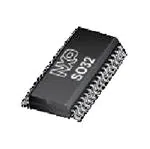
SLRC400
ICODE reader IC
Rev. 3.3 — 23 March 2010
054333
Product data sheet
PUBLIC
1. Introduction
This data sheet describes the functionality of the SLRC400 Integrated Circuit (IC). It
includes the functional and electrical specifications and from a system and hardware
viewpoint gives detailed information on how to design-in the device.
2. General description
The SLRC400 is a member of a new family of highly integrated reader ICs for contactless
communication at 13.56 MHz. This family of reader ICs provide:
• outstanding modulation and demodulation for passive contactless communication
• a wide range of methods and protocols
The transmitter module Section 8.9 on page 24 can directly drive an antenna designed for
proximity operating distance up to 100 mm without additional active circuitry. The receiver
module provides a robust and efficient demodulation/decoding circuitry implementation for
compatible transponder signals (see Section 8.10 on page 28).
All layers of the ICODE1 and ISO/IEC 15693 protocols are supported. The receiver
module provides a robust and efficient demodulation/decoding circuitry implementation for
ICODE1 and ISO/IEC 15693 compatible transponder signals. The digital module
manages ICODE1 and ISO/IEC 15693 framing and error detection (CRC).
A parallel interface can be directly connected to any 8-bit microprocessor to ensure
reader/terminal design flexibility.
3. Features and benefits
3.1 General
Highly integrated analog circuitry for demodulating and decoding label response
Buffered output drivers enable antenna connection using the minimum of external
components
Proximity operating distance up to 100 mm
Supports both ICODE1 and ISO/IEC 15693 protocols
Parallel microprocessor interface with internal address latch and IRQ line
Flexible interrupt handling
Automatic detection of parallel microprocessor interface type
64-byte send and receive FIFO buffer
Hard reset with low power function
�SLRC400
NXP Semiconductors
ICODE reader IC
Software controlled Power-down mode
Programmable timer
Unique serial number
User programmable start-up configuration
Bit-oriented and byte oriented framing
Independent power supply pins for analog, digital and transmitter modules
Internal oscillator buffer optimized for low phase jitter enables 13.56 MHz quartz
connection
Clock frequency filtering
3.3 V operation for transmitter (antenna driver) in short range and proximity
applications
4. Applications
Electronic payment systems
Identification systems
Access control systems
Subscriber services
Banking systems
Digital content systems
5. Ordering information
Table 1.
Ordering information
Type number
SLRC40001T/0FE
SLRC400_33
Product data sheet
PUBLIC
Package
Name
Description
Version
SO32
plastic small outline package; 32 leads; body width 7.5 mm
SOT287-1
All information provided in this document is subject to legal disclaimers.
Rev. 3.3 — 23 March 2010
054333
© NXP B.V. 2010. All rights reserved.
2 of 101
�SLRC400
NXP Semiconductors
ICODE reader IC
6. Block diagram
2;6
26(
��
2'7
��
%0)
�
%� %� %�
��
%(��XS�%(��(��XS�(�
�� �� ��
�� �� �� �� �� �� �� ��
4%6%00)0�-28)6*%')�'328630
�-2'09(-2+�%9831%8-'�-28)6*%')�()8)'8-32�%2(�7=2',632-7%8-32
*-*3�'328630
78%8)�1%',-2)
���&=8)�*-*3
'311%2(�6)+-78)6
463+6%11%&0)�8-1)6
'328630�6)+-78)6
&%2/
:308%+)
132-836
%2(
43;)6�32
()8)'8
��
��
(:77
6)7)8
'328630
43;)6�(3;2
'328630
��
�
-28)66948�'328630
��»����&=8)
))4631
(:((
6784(
-65
'6'���'6'�
+)2)6%8-32�%2(�',)'/
))4631
%'')77
'328630
4%6%00)0�7)6-%0�'32:)68)6
&-8�'3928)6
1%78)6�/)=�&9**)6
4%6-8=�+)2)6%8-32�%2(�',)'/
*6%1)�+)2)6%8-32�%2(�',)'/
'6=483��92-8
&-8�()'3(-2+
���&-8�47)9(3
6%2(31�+)2)6%836
&-8�)2'3(-2+
�
�
7)6-%0�(%8%�7;-8',
R�G�
7-+398
0):)0�7,-*8)67
%140-89()
6%8-2+
'366)0%8-32
%2(
&-8�()'3(-2+
6)*)6)2')
:308%+)
%2%03+
8)78
1908-40) 0, the TimeSlotPeriod starts. If the
FIFO buffer contains data when the end of TimeSlotPeriod is reached, the data is sent. If
the FIFO buffer is empty nothing happens. As long as the TimeSlotPeriod is > 0, the
TimeSlotPeriod counter automatically starts on reaching the end.
This forms the exact time relationship between the start and finish of the command frame
used to generate and send ICODE1 Quit frames.
When the TimeSlotPeriod > 0, the next Frame starts with exactly the same interval
TimeSlotPeriod/CoderRate delayed after each previous send frame. CoderRate defines
the clock frequency of the encoder. If TimeSlotPeriod[7:0] = 0, the send function is not
automatically triggered.
The content of the TimeSlotPeriod register can be changed while it is running but the
change is only effective after the next TimeSlotPeriod restart.
Example:
• CoderRate = 0 0.5 (~52.97 kHz)
• The interval should be 8.458 ms for ICODE1 standard mode
TimeSlotPeriod = CoderRate
Interval = 52.97 kHz
8.458 ms 1 = 447 = 1BFh
Remark: The TimeSlotPeriod MSB bit is contained in the SIGOUTSelect register.
'311%2(
59-8�
59-8�
6)74327)�
874�
Fig 7.
SLRC400_33
Product data sheet
PUBLIC
6)74327)�
874�
���EEO���
TimeSlotPeriod
All information provided in this document is subject to legal disclaimers.
Rev. 3.3 — 23 March 2010
054333
© NXP B.V. 2010. All rights reserved.
19 of 101
�SLRC400
NXP Semiconductors
ICODE reader IC
Table 17.
TimeSlotPeriod
ICODE1 mode
TimeSlotPeriod for TSP1
TimeSlotPeriod for TSP2
standard mode
BFh
1BFh
fast mode
5Fh
67h
Remark: Set bit TxCRCEn to logic 0 before the Quit frame is sent. If TxCRCEn is not set
to logic 0, the Quit frame is sent with a calculated CRC value. Use the CRC8 algorithm to
calculate the Quit value.
8.5.2 Using the timer unit functions
8.5.2.1
Time-out and WatchDog counters
After starting the timer using TReloadValue[7:0], the timer unit decrements the TimerValue
register beginning with a given start event. If a given stop event occurs, such as a bit
being received from the label, the timer unit stops without generating an interrupt.
If a stop event does not occur, such as the label not answering within the expected time,
the timer unit decrements down to zero and generates a timer interrupt request. This
signals to the microprocessor the expected event has not occurred within the given time
(tTimer).
8.5.2.2
Stopwatch
The time (tTimer) between a start and stop event is measured by the microprocessor using
the timer unit. Setting the TimerReload register triggers the timer which in turn, starts to
decrement. If the defined stop event occurs, the timer stops. The time between start and
stop is calculated by the microprocessor using Equation 5, when the timer does not
decrement down to zero.
t = TReLoad value – TimerValue
8.5.2.3
(5)
t Timer
Programmable one shot timer and periodic trigger
Programmable one shot timer: The microprocessor starts the timer unit and waits for
the timer interrupt. The interrupt occurs after the time specified by t Timer (TAutoRestart bit
= logic 0).
Periodic trigger: If the microprocessor sets the TAutoRestart bit, and TReloadValue is
not equal to zero, it generates an interrupt request after every tTimer cycle.
8.5.3 Timer unit registers
Table 18 shows the related flags of the timer unit in alphabetical order.
Table 18.
Associated timer unit registers and flags
Flags
SLRC400_33
Product data sheet
PUBLIC
Register name
Bit
Register address
TAutoRestart
TimerClock
5
2Ah
TimerValue[7:0]
TimerValue
7 to 0
0Ch
TReloadValue[7:0]
TimerReload
7 to 0
2Ch
TPreScaler[4:0]
TimerClock
4 to 0
2Ah
TRunning
SecondaryStatus
7
05h
TStartNow
Control
1
09h
All information provided in this document is subject to legal disclaimers.
Rev. 3.3 — 23 March 2010
054333
© NXP B.V. 2010. All rights reserved.
20 of 101
�SLRC400
NXP Semiconductors
ICODE reader IC
Table 18.
Associated timer unit registers and flags�iGSRXMRYIH
Flags
Register name
Bit
Register address
TStartTxBegin
TimerControl
0
2Bh
TStartTxEnd
TimerControl
1
2Bh
TStopNow
Control
2
09h
TStopRxBegin
TimerControl
2
2Bh
TStopRxEnd
TimerControl
3
2Bh
8.6 Power reduction modes
8.6.1 Hard power-down
Hard power-down is enabled when pin RSTPD is HIGH. This turns off all internal current
sinks including the oscillator. All digital input buffers are separated from the input pads and
defined internally (except pin RSTPD itself). The output pins are frozen at a given value.
The status of all pins during a hard power-down is shown in Table 19.
Table 19.
Signal on pins during Hard power-down
Symbol
Pin
Type
Description
OSCIN
IRQ
1
I
not separated from input, pulled to AVSS
2
O
high-impedance
n.c.
3
I
separated from input
SIGOUT
4
O
LOW
TX1
5
O
HIGH
TX2
7
O
LOW
NCS
9
I
separated from input
NWR
10
I
separated from input
NRD
11
I
separated from input
D0 to D7
13 to 20
I/O
separated from input
ALE
21
I
separated from input
A0
22
I/O
separated from input
A1
23
I
separated from input
A2
24
I
separated from input
AUX
27
O
high-impedance
RX
29
I
not changed
VMID
30
A
pulled to VDDA
RSTPD
31
I
not changed
OSCOUT
32
O
HIGH
8.6.2 Soft power-down mode
Soft power-down mode is entered immediately using the Control register bit PowerDown.
All internal current sinks, including the oscillator buffer, are switched off. The digital input
buffers are not separated from the input pads and keep their functionality. In addition, the
digital output pins do not change their state.
SLRC400_33
Product data sheet
PUBLIC
All information provided in this document is subject to legal disclaimers.
Rev. 3.3 — 23 March 2010
054333
© NXP B.V. 2010. All rights reserved.
21 of 101
�SLRC400
NXP Semiconductors
ICODE reader IC
After resetting the Control register bit PowerDown, the bit indicating Soft power-down
mode is only cleared after 512 clock cycles. Resetting it does not immediately clear it. The
PowerDown bit is automatically cleared when the Soft power-down mode is exited.
Remark: When the internal oscillator is used, time (tosc) is required for the oscillator to
become stable. This is because the internal oscillator is supplied by V DDA and any clock
cycles will not be detected by the internal logic until V DDA is stable.
8.6.3 Standby mode
The Standby mode is immediately entered when the Control register StandBy bit is set. All
internal current sinks, including the internal digital clock buffer are switched off. However,
the oscillator buffer is not switched off.
The digital input buffers are not separated by the input pads, keeping their functionality
and the digital output pins do not change their state. In addition, the oscillator does not
need time to wake-up.
After resetting the Control register StandBy bit, it takes four clock cycles on pin OSCIN for
Standby mode to exit. Resetting bit StandBy does not immediately clear it. It is
automatically cleared when the Standby mode is exited.
8.6.4 Automatic receiver power-down
It is a power saving feature to switch off the receiver circuit when it is not needed. Setting
bit RxAutoPD = logic 1, automatically powers down the receiver when it is not in use.
Setting bit RxAutoPD = logic 0, keeps the receiver continuously powered up.
8.7 StartUp phase
The events executed during the StartUp phase are shown in Figure 8.
7XEVX9T�TLEWI
WXEXIW
X6784(
XVIWIX
XMRMX
,EVH�TS[IV�
HS[R�TLEWI
6IWIX�TLEWI
-RMXMEPMWMRK
TLEWI
VIEH]
���EEO���
Fig 8.
The StartUp procedure
8.7.1 Hard power-down phase
The hard power-down phase is active during the following cases:
• a Power-On Reset (POR) caused by power-up on pins DVDD activated when V DDD is
below the digital reset threshold.
• a Power-On Reset (POR) caused by power-up on pins AVDD activated when VDDA is
below the analog reset threshold.
• a HIGH-level on pin RSTPD which is active while pin RSTPD is HIGH. The HIGH level
period on pin RSTPD must be at least 100 s (tPD 100 s). Shorter phases will not
necessarily result in the reset phase (t reset). The rising or falling edge slew rate on pin
RSTPD is not critical because pin RSTPD is a Schmitt trigger input.
SLRC400_33
Product data sheet
PUBLIC
All information provided in this document is subject to legal disclaimers.
Rev. 3.3 — 23 March 2010
054333
© NXP B.V. 2010. All rights reserved.
22 of 101
�SLRC400
NXP Semiconductors
ICODE reader IC
8.7.2 Reset phase
The reset phase automatically follows the Hard power-down. Once the oscillator is
running stably, the reset phase takes 512 clock cycles. During the reset phase, some
register bits are preset by hardware. The respective reset values are given in the
description of each register (see Section 9.5 on page 40).
Remark: When the internal oscillator is used, time (tosc) is required for the oscillator to
become stable. This is because the internal oscillator is supplied by V DDA and any clock
cycles will not be detected by the internal logic until V DDA is stable.
8.7.3 Initialization phase
The initialization phase automatically follows the reset phase and takes 128 clock cycles.
During the initializing phase the content of the EEPROM blocks 1 and 2 is copied into the
register subaddresses 10h to 2Fh (see Section 8.2.2 on page 10).
Remark: During the production test, the SLRC400 is initialized with default configuration
values. This reduces the microprocessor’s configuration time to a minimum.
8.7.4 Initializing the parallel interface type
A different initialization sequence is used for each microprocessor. This enables detection
of the correct microprocessor interface type and synchronization of the microprocessor’s
and the SLRC400’s start-up. See Section 8.1.3 on page 7 for detailed information on the
different connections for each microprocessor interface type.
During StartUp phase, the command value is set to 3Fh once the oscillator attains clock
frequency stability at an amplitude of > 90 % of the nominal 13.56 MHz clock frequency. At
the end of the initialization phase, the SLRC400 automatically switches to idle and the
command value changes to 00h.
To ensure correct detection of the microprocessor interface, the following sequence is
executed:
• the Command register is read until the 6-bit register value is 00h. On reading the 00h
value, the internal initialization phase is complete and the SLRC400 is ready to be
controlled
• write 80h to the Page register to initialize the microprocessor interface
• read the Command register. If it returns a value of 00h, the microprocessor interface
was successfully initialized
• write 00h to the Page registers to activate linear addressing mode.
SLRC400_33
Product data sheet
PUBLIC
All information provided in this document is subject to legal disclaimers.
Rev. 3.3 — 23 March 2010
054333
© NXP B.V. 2010. All rights reserved.
23 of 101
�SLRC400
NXP Semiconductors
ICODE reader IC
8.8 Oscillator circuit
():-')
37'398
37'-2
������1,^
���T*
���T*
���EEO���
Fig 9.
Quartz clock connection
The clock applied to the SLRC400 acts as a time basis for the synchronous system
encoder and decoder. The stability of the clock frequency is an important factor for correct
operation. To obtain highest performance, clock jitter must be as small as possible. This is
best achieved by using the internal oscillator buffer with the recommended circuitry.
If an external clock source is used, the clock signal must be applied to pin OSCIN. In this
case, be very careful in optimizing clock duty cycle and clock jitter. Ensure the clock
quality has been verified. It must meet the specifications described in Section 12.4.4 on
page 84.
Remark: We do not recommend using an external clock source.
8.9 Transmitter pins TX1 and TX2
The signal on pins TX1 and TX2 is the 13.56 MHz carrier modulated by an envelope
signal. It can be used to drive an antenna directly, using minimal passive components for
matching and filtering (see Section 14.1 on page 85). To enable this, the output circuitry is
designed with a very low-impedance source resistance. The TxControl register is used to
control the TX1 and TX2 signals.
8.9.1 Configuring pins TX1 and TX2
TX1 pin configurations are described in Table 20.
Table 20.
Pin TX1 configurations
TxControl register
configuration
Envelope
TX1 signal
TX1RFEn
0
X
LOW (GND)
1
0
13.56 MHz modulated carrier
1
1
13.56 MHz unmodulated carrier
TX2 pin configurations are described in Table 21.
SLRC400_33
Product data sheet
PUBLIC
All information provided in this document is subject to legal disclaimers.
Rev. 3.3 — 23 March 2010
054333
© NXP B.V. 2010. All rights reserved.
24 of 101
�SLRC400
NXP Semiconductors
ICODE reader IC
Table 21.
Pin TX2 configurations
TxControl register configuration
Envelope
TX2 signal
TX2RFEn
TX2Cw
TX2Inv
0
X
X
X
LOW (GND)
1
0
0
0
13.56 MHz modulated carrier
1
0
0
1
13.56 MHz unmodulated carrier
1
0
1
0
13.56 MHz modulated carrier frequency,
180 phase-shift relative to TX1
1
0
1
1
13.56 MHz unmodulated carrier, 180
phase-shift relative to TX1
1
1
0
X
13.56 MHz unmodulated carrier
1
1
1
X
13.56 MHz unmodulated carrier, 180
phase-shift relative to TX1
8.9.2 Antenna operating distance versus power consumption
Using different antenna matching circuits (by varying the supply voltage on the antenna
driver supply pin TVDD), it is possible to find the trade-off between maximum effective
operating distance and power consumption. Different antenna matching circuits are
described in the Application note Ref. 1.
8.9.3 Antenna driver output source resistance
The output source conductance of pins TX1 and TX2 for driving a HIGH level can be
adjusted between 1 and 100 using the CwConductance register GsCfgCW[5:0] bits.
The values are relative to the reference source resistance (R S(ref)) which is measured
during the production test and stored in the SLRC400 EEPROM. It can be read from the
product information field (see Section 8.2.1 on page 9). The electrical specification can be
found in Section 12.3.3 on page 79.
SLRC400_33
Product data sheet
PUBLIC
All information provided in this document is subject to legal disclaimers.
Rev. 3.3 — 23 March 2010
054333
© NXP B.V. 2010. All rights reserved.
25 of 101
�SLRC400
NXP Semiconductors
ICODE reader IC
8.9.3.1
Source resistance table
Table 22. TX1 and TX2 source resistance of n-channel driver transistor against GsCfgCW
1%28�!�1ERXMWWE��))6
'-6'9-86=
'366)0%8-32
'-6'9-86=
������1,^
()13(90%836
:'SVV(5
:'SVV2-
:'SVV25
XS
8IWX%RE3YX7IP
WCHEXE
WCGSPP
WCGPSGO
:)ZEP6
:)ZEP0
���EEO���
Fig 10. Receiver circuit block diagram
The signal can be observed on its way through the receiver as shown in Figure 10. One
signal at a time can be routed to pin AUX using the TestAnaSelect register as described in
Section 14.2.2 on page 88.
8.10.2 Receiver operation
In general, the default settings programmed in the StartUp initialization file are suitable for
use with the SLRC400 to ICODE label data communication. However, in some
environments specific user settings will achieve better performance.
8.10.2.1
Automatic Q-clock calibration
The quadrature demodulation concept of the receiver generates a phase signal (I-clock)
and a 90 phase-shifted quadrature signal (Q-clock). To achieve the optimum
demodulator performance, the Q-clock and the I-clock must be phase-shifted by 90 . After
the reset phase, a calibration procedure is automatically performed.
Automatic calibration can be set-up to execute at the end of each Transceive command if
bit ClkQCalib = logic 0. Setting bit ClkQCalib = logic 1 disables all automatic calibrations
except after the reset sequence. Automatic calibration can also be triggered by the
software when bit ClkQCalib has a logic 0 to logic 1 transition.
SLRC400_33
Product data sheet
PUBLIC
All information provided in this document is subject to legal disclaimers.
Rev. 3.3 — 23 March 2010
054333
© NXP B.V. 2010. All rights reserved.
29 of 101
�SLRC400
NXP Semiconductors
ICODE reader IC
GEPMFVEXMSR�MQTYPWI
JVSQ�VIWIX�WIUYIRGI
E�VMWMRK�IHKI�MRMXMEXIW
5�GPSGO�GEPMFVEXMSR
GEPMFVEXMSR�MQTYPWI
JVSQ�IRH�SJ
8VERWGIMZI�GSQQERH
'PO5'EPMF�FMX
���EEO���
Fig 11. Automatic Q-clock calibration
Remark: The duration of the automatic Q-clock calibration is 65 oscillator periods or
approximately 4.8 s.
The ClockQControl register’s ClkQDelay[4:0] value is proportional to the phase-shift
between the Q-clock and the I-clock. The ClkQ180Deg status flag bit is set when the
phase-shift between the Q-clock and the I-clock is greater than 180 .
Remark:
• The StartUp initialization file enables automatic Q-clock calibration after a reset
• If bit ClkQCalib = logic 1, automatic calibration is not performed. Leaving this bit set to
logic 1 can be used to permanently disable automatic calibration.
• It is possible to write data to the ClkQDelay[4:0] bits using the microprocessor. The
aim could be to disable automatic calibration and set the delay using the software.
Configuring the delay value using the software requires bit ClkQCalib to have been
previously set to logic 1 and a time interval of at least 4.8 s has elapsed. Each delay
value must be written with bit ClkQCalib set to logic 1. If bit ClkQCalib is logic 0, the
configured delay value is overwritten by the next automatic calibration interval.
8.10.2.2
Amplifier
The demodulated signal must be amplified by the variable amplifier to achieve the best
performance. The gain of the amplifiers can be adjusted using the RxControl1 register
Gain[1:0] bits; see Table 24.
Table 24. Gain factors for the internal amplifier
7II 8EFPI����w6\'SRXVSP��VIKMWXIV�FMX�HIWGVMTXMSRWx�SR�TEKI����JSV�EHHMXMSREP�MRJSVQEXMSR�
Register setting
Gain factor
(simulation results)
Gain factor [dB]
(simulation results)
00
22
20
01
35
24
10
82
31
11
130
35
8.10.2.3 Correlation circuitry
The correlation circuitry calculates the degree of matching between the received and an
expected signal. The output is a measure of the amplitude of the expected signal in the
received signal. This is done for both, the Q and I-channels. The correlator provides two
outputs for each of the two input channels, resulting in a total of four output signals.
SLRC400_33
Product data sheet
PUBLIC
All information provided in this document is subject to legal disclaimers.
Rev. 3.3 — 23 March 2010
054333
© NXP B.V. 2010. All rights reserved.
30 of 101
�SLRC400
NXP Semiconductors
ICODE reader IC
The correlation circuitry needs the phase information for the incoming label signal for
optimum performance. This information is defined for the microprocessor using the
BitPhase register. This value defines the phase relationship between the transmitter and
receiver clock in multiples of the BitPhase time (t BitPhase) = 1 / 13.56 MHz.
8.10.2.4
Evaluation and digitizer circuitry
The correlation results are evaluated for each bit-half of the Manchester coded signal. The
evaluation and digitizer circuit decides from the signal strengths of both bit-halves, if the
current bit is valid
• If the bit is valid, its value is identified
• If the bit is not valid, it is checked to identify if it contains a bit-collision
Select the following levels for optimal using RxThreshold register bits:
• MinLevel[3:0]: defines the minimum signal strength of the stronger bit-halve’s signal
which is considered valid.
• CollLevel[3:0]: defines the minimum signal strength relative to the amplitude of the
stronger half-bit that has to be exceeded by the weaker half-bit of the Manchester
coded signal to generate a bit-collision. If the signal’s strength is below this value,
logic 1 and logic 0 can be determined unequivocally.
After data transmission, the label is not allowed to send its response before a preset time
period which is called the frame guard time in the ISO/IEC 15693 standard (similar to
ICODE1). The length of this time period is set using the RxWait register’s RxWait[7:0] bits.
The RxWait register defines when the receiver is switched on after data transmission to
the label in multiples of one bit duration.
If bit RcvClkSelI is set to logic 1, the I-clock is used to clock the correlator and evaluation
circuits. If bit RcvClkSelI is set to logic 0, the Q-clock is used.
Remark: It is recommended to use the Q-clock.
8.11 Serial signal switch
The SLRC400 comprises two main blocks:
• digital circuitry: comprising the state machines, encoder and decoder logic etc.
• analog circuitry: comprising the modulator, antenna drivers, receiver and
amplification circuitry
The interface between these two blocks can be configured so that the interface signals
are routed to pin SIGOUT.
8.11.1 Serial signal switch block diagram
Figure 12 shows the serial signal switches. Three different switches are implemented in
the serial signal switch enabling the SLRC400 to be used in different configurations.
The serial signal switch can also be used to check the transmitted and received data
during the design-in phase or for test purposes. Section 14.2.1 on page 87 describes the
analog test signals and measurements at the serial signal switch.
SLRC400_33
Product data sheet
PUBLIC
All information provided in this document is subject to legal disclaimers.
Rev. 3.3 — 23 March 2010
054333
© NXP B.V. 2010. All rights reserved.
31 of 101
�SLRC400
NXP Semiconductors
ICODE reader IC
WIVMEP�HEXE�SYX
1-00)6�'3()6
��398�3*����
6>�36
��398�3*��
�
�
�
�
IRZIPSTI
�
VIWIVZIH
�
8
(��XS�(�
1YPXMTPI\IH�EHHVIWW�FYW
X%:(70
%��XS�%�
X6,%<
%��XS�%�
7ITEVEXIH�EHHVIWW�FYW
���EEP���
Fig 17. Common read/write strobe timing diagram
When separate address and data lines are used, the multiplexed addresses on the data
bus do not use the ALE signal. When multiplexed address and data lines are used, the
address lines (A0 to A2) must be connected as described in Section 8.1.3 on page 7.
12.4.3 EPP bus timing
Table 149. Common read/write strobe timing specification for EPP
SLRC400_33
Product data sheet
PUBLIC
Symbol
Parameter
Conditions
Min Typ Max Unit
tASLASH
address strobe LOW time
nAStrb
20
-
-
ns
tAVASH
address valid to address strobe
HIGH time
multiplexed address
bus set-up time
15
-
-
ns
tASHAV
address valid after address strobe
HIGH time
multiplexed address
bus hold time
8
-
-
ns
All information provided in this document is subject to legal disclaimers.
Rev. 3.3 — 23 March 2010
054333
© NXP B.V. 2010. All rights reserved.
82 of 101
�SLRC400
NXP Semiconductors
ICODE reader IC
Table 149. Common read/write strobe timing specification for EPP�iGSRXMRYIH
Symbol
Parameter
Conditions
Min Typ Max Unit
tSLDSL
chip select LOW to data strobe
LOW time
NCS LOW to nDStrb
LOW
0
-
-
ns
tDSHSH
data strobe HIGH to chip select
HIGH time
nDStrb HIGH to
NCS HIGH
0
-
-
ns
tDSLDV
data strobe LOW to data input valid read cycle
time
-
-
65
ns
tDSHDZ
data strobe HIGH to data input high read cycle
impedance time
-
-
20
ns
tDSLQV
data strobe LOW to data output
valid time
nDStrb LOW
-
-
35
ns
tDSHQX
data output hold after data strobe
HIGH time
nDStrb HIGH
8
-
-
ns
tDSHWX
write hold after data strobe HIGH
time
nWrite
8
-
-
ns
tDSLDSH
data strobe LOW time
nDStrb
65
-
-
ns
tWLDSL
write LOW to data strobe LOW time nWrite valid to
nDStrb LOW
8
-
-
ns
tDSL-WAITH
data strobe LOW to WAIT HIGH
time
nDStrb LOW to
nWait HIGH
-
-
75
ns
tDSH-WAITL
data strobe HIGH to WAIT LOW
time
nDStrb HIGH to
nWait LOW
-
-
75
ns
X(7,7,
X70(70
2'7
X;0(70
X(7,;<
R;VMXI
X(70(7,
R(7XVF
R%7XVF
X(70(:
X(705:
X(7,5<
X(7,(>
(��XS�(�
%��XS�%�
(��XS�(�
X(70�;%-8,
X(7,�;%-80
R;EMX
���EEN���
Fig 18.
Timing diagram for common read/write strobe; EPP
Remark: Figure 18 does not distinguish between the address write cycle and a data write
cycle. The timings for the address write and data write cycle are different. In EPP mode,
the address lines (A0 to A2) must be connected as described in Section 8.1.3 on page 7.
SLRC400_33
Product data sheet
PUBLIC
All information provided in this document is subject to legal disclaimers.
Rev. 3.3 — 23 March 2010
054333
© NXP B.V. 2010. All rights reserved.
83 of 101
�SLRC400
NXP Semiconductors
ICODE reader IC
12.4.4 Clock frequency
The clock input is pin OSCIN.
Table 150. Clock frequency
Symbol
Parameter
Conditions
Min
Typ
Max
Unit
fclk
clock frequency
checked by the clock
filter
-
13.56
-
MHz
clk
clock duty cycle
40
50
60
%
-
-
10
ps
tjit
jitter time
of clock edges
The clock applied to the SLRC400 acts as a time constant for the synchronous system’s
encoder and decoder. The stability of the clock frequency is an important factor for
ensuring proper performance. To obtain highest performance, clock jitter must be as small
as possible. This is best achieved using the internal oscillator buffer and the
recommended circuitry; see Section 8.8 on page 24.
13. EEPROM characteristics
The EEPROM size is 8
16
8 = 1024 bit.
Table 151. EEPROM characteristics
SLRC400_33
Product data sheet
PUBLIC
Symbol
Parameter
Conditions
Min
Typ
Max
Unit
Nendu(W_ER)
write or erase endurance
erase/write cycles
100000
-
-
Hz
tret
retention time
Tamb
10
-
-
year
ter
erase time
-
-
2.9
ms
ta(W)
write access time
-
-
2.9
ms
55 C
All information provided in this document is subject to legal disclaimers.
Rev. 3.3 — 23 March 2010
054333
© NXP B.V. 2010. All rights reserved.
84 of 101
�SLRC400
NXP Semiconductors
ICODE reader IC
14. Application information
14.1 Typical application
14.1.1 Circuit diagram
Figure 19 shows a typical application where the antenna is directly matched to the
SLRC400:
(:((
6IWIX
%:((
8:((
(:((
6784(
%:((
8:((
GSRXVSP�PMRIW
'�
0�
HEXE�FYW
8>
SLRC400_33
Product data sheet
PUBLIC
All information provided in this document is subject to legal disclaimers.
Rev. 3.3 — 23 March 2010
054333
© NXP B.V. 2010. All rights reserved.
97 of 101
�SLRC400
NXP Semiconductors
ICODE reader IC
Table 151. EEPROM characteristics . . . . . . . . . . . . . . . .84
Table 152. Signal routed to pin SIGOUT . . . . . . . . . . . . .87
Table 153. Analog test signal selection . . . . . . . . . . . . . .88
Table 154. Digital test signal selection . . . . . . . . . . . . . . . 88
Table 155. Abbreviations and acronyms . . . . . . . . . . . . . 92
Table 156. Revision history . . . . . . . . . . . . . . . . . . . . . . . 93
22. Figures
Fig 1.
Fig 2.
Fig 3.
Fig 4.
Fig 5.
Fig 6.
Fig 7.
Fig 8.
Fig 9.
Fig 10.
Fig 11.
Fig 12.
Fig 13.
Fig 14.
Fig 15.
Fig 16.
Fig 17.
Fig 18.
Fig 19.
Fig 20.
Fig 21.
SLRC400 block diagram . . . . . . . . . . . . . . . . . . . .3
SLRC400 pin configuration . . . . . . . . . . . . . . . . . .4
Connection to microprocessor: separate
read and write strobes . . . . . . . . . . . . . . . . . . . . . .7
Connection to microprocessor: common
read and write strobes . . . . . . . . . . . . . . . . . . . . . .8
Connection to microprocessor: EPP common
read/write strobes and handshake. . . . . . . . . . . . .8
Timer module block diagram . . . . . . . . . . . . . . . .17
TimeSlotPeriod . . . . . . . . . . . . . . . . . . . . . . . . . .19
The StartUp procedure. . . . . . . . . . . . . . . . . . . . .22
Quartz clock connection . . . . . . . . . . . . . . . . . . .24
Receiver circuit block diagram. . . . . . . . . . . . . . .29
Automatic Q-clock calibration . . . . . . . . . . . . . . .30
Serial signal switch block diagram. . . . . . . . . . . .32
Timing for transmitting byte oriented frames . . . .68
Label communication state diagram . . . . . . . . . .72
EEPROM programming timing diagram. . . . . . . .74
Separate read/write strobe timing diagram . . . . .81
Common read/write strobe timing diagram . . . . .82
Timing diagram for common read/write strobe;
EPP . . . . . . . . . . . . . . . . . . . . . . . . . . . . . . . . . . .83
Application example circuit diagram: directly
matched antenna . . . . . . . . . . . . . . . . . . . . . . . . .85
Q-clock receiving path . . . . . . . . . . . . . . . . . . . . .90
Package outline SOT287-1 . . . . . . . . . . . . . . . . .91
continued >>
SLRC400_33
Product data sheet
PUBLIC
All information provided in this document is subject to legal disclaimers.
Rev. 3.3 — 23 March 2010
054333
© NXP B.V. 2010. All rights reserved.
98 of 101
�SLRC400
NXP Semiconductors
ICODE reader IC
23. Contents
1
2
3
3.1
4
5
6
7
7.1
8
8.1
8.1.1
8.1.2
8.1.3
8.1.3.1
8.1.3.2
8.1.3.3
8.2
8.2.1
8.2.2
8.2.2.1
8.2.2.2
8.2.2.3
8.3
8.3.1
8.3.1.1
8.3.2
8.3.3
8.3.4
8.4
8.4.1
8.4.2
8.4.2.1
8.4.2.2
8.4.3
8.4.4
8.5
8.5.1
8.5.1.1
8.5.1.2
8.5.1.3
8.5.1.4
8.5.1.5
Introduction . . . . . . . . . . . . . . . . . . . . . . . . . . . . 1
General description . . . . . . . . . . . . . . . . . . . . . . 1
Features and benefits . . . . . . . . . . . . . . . . . . . . 1
General . . . . . . . . . . . . . . . . . . . . . . . . . . . . . . . 1
Applications . . . . . . . . . . . . . . . . . . . . . . . . . . . . 2
Ordering information . . . . . . . . . . . . . . . . . . . . . 2
Block diagram . . . . . . . . . . . . . . . . . . . . . . . . . . 3
Pinning information . . . . . . . . . . . . . . . . . . . . . . 4
Pin description . . . . . . . . . . . . . . . . . . . . . . . . . 4
Functional description . . . . . . . . . . . . . . . . . . . 6
Digital interface . . . . . . . . . . . . . . . . . . . . . . . . . 6
Overview of supported microprocessor
interfaces . . . . . . . . . . . . . . . . . . . . . . . . . . . . . 6
Automatic microprocessor interface detection . 6
Connection to different microprocessor types . 7
Separate read and write strobe . . . . . . . . . . . . 7
Common read and write strobe . . . . . . . . . . . . 8
Common read and write strobe: EPP with
handshake . . . . . . . . . . . . . . . . . . . . . . . . . . . . 8
Memory organization of the EEPROM . . . . . . . 9
Product information field (read only). . . . . . . . . 9
Register initialization file (read/write) . . . . . . . 10
StartUp register initialization file (read/write) . 10
Factory default StartUp register initialization
file . . . . . . . . . . . . . . . . . . . . . . . . . . . . . . . . . . 10
Register initialization file (read/write) . . . . . . . 12
FIFO buffer . . . . . . . . . . . . . . . . . . . . . . . . . . . 12
Accessing the FIFO buffer . . . . . . . . . . . . . . . 12
Access rules . . . . . . . . . . . . . . . . . . . . . . . . . . 12
Controlling the FIFO buffer . . . . . . . . . . . . . . . 13
FIFO buffer status information . . . . . . . . . . . . 13
FIFO buffer registers and flags . . . . . . . . . . . . 13
Interrupt request system. . . . . . . . . . . . . . . . . 14
Interrupt sources overview . . . . . . . . . . . . . . . 14
Interrupt request handling. . . . . . . . . . . . . . . . 15
Controlling interrupts and getting their status . 15
Accessing the interrupt registers . . . . . . . . . . 15
Configuration of pin IRQ . . . . . . . . . . . . . . . . . 15
Register overview interrupt request system . . 16
Timer unit . . . . . . . . . . . . . . . . . . . . . . . . . . . . 16
Timer unit implementation . . . . . . . . . . . . . . . 17
Timer unit block diagram . . . . . . . . . . . . . . . . 17
Controlling the timer unit. . . . . . . . . . . . . . . . . 17
Timer unit clock and period. . . . . . . . . . . . . . . 18
Timer unit status . . . . . . . . . . . . . . . . . . . . . . . 19
Time-slot period . . . . . . . . . . . . . . . . . . . . . . . 19
8.5.2
8.5.2.1
8.5.2.2
8.5.2.3
Using the timer unit functions. . . . . . . . . . . . .
Time-out and WatchDog counters . . . . . . . . .
Stopwatch . . . . . . . . . . . . . . . . . . . . . . . . . . .
Programmable one shot timer and periodic
trigger. . . . . . . . . . . . . . . . . . . . . . . . . . . . . . .
8.5.3
Timer unit registers . . . . . . . . . . . . . . . . . . . .
8.6
Power reduction modes . . . . . . . . . . . . . . . . .
8.6.1
Hard power-down. . . . . . . . . . . . . . . . . . . . . .
8.6.2
Soft power-down mode . . . . . . . . . . . . . . . . .
8.6.3
Standby mode . . . . . . . . . . . . . . . . . . . . . . . .
8.6.4
Automatic receiver power-down. . . . . . . . . . .
8.7
StartUp phase . . . . . . . . . . . . . . . . . . . . . . . .
8.7.1
Hard power-down phase . . . . . . . . . . . . . . . .
8.7.2
Reset phase. . . . . . . . . . . . . . . . . . . . . . . . . .
8.7.3
Initialization phase . . . . . . . . . . . . . . . . . . . . .
8.7.4
Initializing the parallel interface type . . . . . . .
8.8
Oscillator circuit . . . . . . . . . . . . . . . . . . . . . . .
8.9
Transmitter pins TX1 and TX2 . . . . . . . . . . . .
8.9.1
Configuring pins TX1 and TX2. . . . . . . . . . . .
8.9.2
Antenna operating distance versus power
consumption. . . . . . . . . . . . . . . . . . . . . . . . . .
8.9.3
Antenna driver output source resistance . . . .
8.9.3.1
Source resistance table . . . . . . . . . . . . . . . . .
8.9.3.2
Changing the modulation index . . . . . . . . . . .
8.9.3.3
Calculating the relative source resistance . . .
8.9.3.4
Calculating the effective source resistance . .
8.9.4
Pulse width. . . . . . . . . . . . . . . . . . . . . . . . . . .
8.10
Receiver circuitry . . . . . . . . . . . . . . . . . . . . . .
8.10.1
Receiver circuit block diagram . . . . . . . . . . . .
8.10.2
Receiver operation. . . . . . . . . . . . . . . . . . . . .
8.10.2.1 Automatic Q-clock calibration . . . . . . . . . . . .
8.10.2.2 Amplifier . . . . . . . . . . . . . . . . . . . . . . . . . . . . .
8.10.2.3 Correlation circuitry . . . . . . . . . . . . . . . . . . . .
8.10.2.4 Evaluation and digitizer circuitry . . . . . . . . . .
8.11
Serial signal switch . . . . . . . . . . . . . . . . . . . .
8.11.1
Serial signal switch block diagram . . . . . . . . .
8.11.2
Serial signal switch registers . . . . . . . . . . . . .
9
SLRC400 registers . . . . . . . . . . . . . . . . . . . . .
9.1
Register addressing modes . . . . . . . . . . . . . .
9.1.1
Page registers . . . . . . . . . . . . . . . . . . . . . . . .
9.1.2
Dedicated address bus . . . . . . . . . . . . . . . . .
9.1.3
Multiplexed address bus . . . . . . . . . . . . . . . .
9.2
Register bit behavior . . . . . . . . . . . . . . . . . . .
9.3
Register overview . . . . . . . . . . . . . . . . . . . . .
9.4
SLRC400 register flags overview. . . . . . . . . .
9.5
Register descriptions . . . . . . . . . . . . . . . . . . .
9.5.1
Page 0: Command and status . . . . . . . . . . . .
9.5.1.1
Page register . . . . . . . . . . . . . . . . . . . . . . . . .
20
20
20
20
20
21
21
21
22
22
22
22
23
23
23
24
24
24
25
25
26
26
28
28
28
28
28
29
29
30
30
31
31
31
32
34
34
34
34
34
34
36
38
40
40
40
continued >>
SLRC400_33
Product data sheet
PUBLIC
All information provided in this document is subject to legal disclaimers.
Rev. 3.3 — 23 March 2010
054333
© NXP B.V. 2010. All rights reserved.
99 of 101
�SLRC400
NXP Semiconductors
ICODE reader IC
9.5.1.2
9.5.1.3
9.5.1.4
9.5.1.5
9.5.1.6
9.5.1.7
9.5.1.8
9.5.2
9.5.2.1
9.5.2.2
9.5.2.3
9.5.2.4
9.5.2.5
9.5.2.6
9.5.2.7
9.5.2.8
9.5.3
9.5.3.1
9.5.3.2
9.5.3.3
9.5.3.4
9.5.3.5
9.5.3.6
9.5.3.7
9.5.3.8
9.5.4
9.5.4.1
9.5.4.2
9.5.4.3
9.5.4.4
9.5.4.5
9.5.4.6
9.5.4.7
9.5.4.8
9.5.5
9.5.5.1
9.5.5.2
9.5.5.3
9.5.5.4
9.5.5.5
9.5.5.6
9.5.5.7
9.5.5.8
9.5.6
9.5.6.1
9.5.6.2
9.5.6.3
9.5.6.4
9.5.6.5
9.5.6.6
9.5.6.7
Command register . . . . . . . . . . . . . . . . . . . . . 40
FIFOData register . . . . . . . . . . . . . . . . . . . . . . 41
PrimaryStatus register . . . . . . . . . . . . . . . . . . 41
FIFOLength register . . . . . . . . . . . . . . . . . . . . 42
SecondaryStatus register . . . . . . . . . . . . . . . . 43
InterruptEn register. . . . . . . . . . . . . . . . . . . . . 43
InterruptRq register. . . . . . . . . . . . . . . . . . . . . 44
Page 1: Control and status . . . . . . . . . . . . . . . 45
Page register . . . . . . . . . . . . . . . . . . . . . . . . . 45
Control register . . . . . . . . . . . . . . . . . . . . . . . . 45
ErrorFlag register . . . . . . . . . . . . . . . . . . . . . . 45
CollPos register . . . . . . . . . . . . . . . . . . . . . . . 46
TimerValue register. . . . . . . . . . . . . . . . . . . . . 46
CRCResultLSB register . . . . . . . . . . . . . . . . . 46
CRCResultMSB register . . . . . . . . . . . . . . . . . 47
BitFraming register . . . . . . . . . . . . . . . . . . . . . 47
Page 2: Transmitter and control . . . . . . . . . . . 48
Page register . . . . . . . . . . . . . . . . . . . . . . . . . 48
TxControl register . . . . . . . . . . . . . . . . . . . . . . 48
CwConductance register . . . . . . . . . . . . . . . . 49
ModConductance register. . . . . . . . . . . . . . . . 49
CoderControl register . . . . . . . . . . . . . . . . . . . 50
ModWidth register. . . . . . . . . . . . . . . . . . . . . . 51
ModWidthSOF register . . . . . . . . . . . . . . . . . . 51
PreSet17 register . . . . . . . . . . . . . . . . . . . . . . 51
Page 3: Receiver and decoder control . . . . . . 51
Page register . . . . . . . . . . . . . . . . . . . . . . . . . 51
RxControl1 register. . . . . . . . . . . . . . . . . . . . . 51
DecoderControl register . . . . . . . . . . . . . . . . . 52
BitPhase register . . . . . . . . . . . . . . . . . . . . . . 53
RxThreshold register . . . . . . . . . . . . . . . . . . . 53
PreSet1D register . . . . . . . . . . . . . . . . . . . . . . 53
RxControl2 register. . . . . . . . . . . . . . . . . . . . . 54
ClockQControl register . . . . . . . . . . . . . . . . . . 54
Page 4: RF Timing and channel redundancy . 55
Page register . . . . . . . . . . . . . . . . . . . . . . . . . 55
RxWait register . . . . . . . . . . . . . . . . . . . . . . . . 55
ChannelRedundancy register . . . . . . . . . . . . . 55
CRCPresetLSB register . . . . . . . . . . . . . . . . . 56
CRCPresetMSB register. . . . . . . . . . . . . . . . . 56
TimeSlotPeriod register . . . . . . . . . . . . . . . . . 57
SIGOUTSelect register . . . . . . . . . . . . . . . . . . 57
PreSet27 register . . . . . . . . . . . . . . . . . . . . . . 58
Page 5: FIFO, timer and IRQ pin configuration 58
Page register . . . . . . . . . . . . . . . . . . . . . . . . . 58
FIFOLevel register . . . . . . . . . . . . . . . . . . . . . 58
TimerClock register. . . . . . . . . . . . . . . . . . . . . 58
TimerControl register . . . . . . . . . . . . . . . . . . . 59
TimerReload register . . . . . . . . . . . . . . . . . . . 59
IRQPinConfig register. . . . . . . . . . . . . . . . . . . 60
PreSet2E register . . . . . . . . . . . . . . . . . . . . . . 60
9.5.6.8
9.5.7
9.5.7.1
9.5.7.2
PreSet2F register. . . . . . . . . . . . . . . . . . . . . .
Page 6: reserved . . . . . . . . . . . . . . . . . . . . . .
Page register . . . . . . . . . . . . . . . . . . . . . . . . .
Reserved registers 31h, 32h, 33h, 34h,
35h, 36h and 37h . . . . . . . . . . . . . . . . . . . . . .
9.5.8
Page 7: Test control . . . . . . . . . . . . . . . . . . . .
9.5.8.1
Page register . . . . . . . . . . . . . . . . . . . . . . . . .
9.5.8.2
Reserved register 39h . . . . . . . . . . . . . . . . . .
9.5.8.3
TestAnaSelect register . . . . . . . . . . . . . . . . . .
9.5.8.4
PreSet3B register. . . . . . . . . . . . . . . . . . . . . .
9.5.8.5
PreSet3C register . . . . . . . . . . . . . . . . . . . . .
9.5.8.6
TestDigiSelect register . . . . . . . . . . . . . . . . . .
9.5.8.7
Reserved registers 3Eh, 3Fh . . . . . . . . . . . . .
10
SLRC400 command set . . . . . . . . . . . . . . . . .
10.1
SLRC400 command overview . . . . . . . . . . . .
10.1.1
Basic states . . . . . . . . . . . . . . . . . . . . . . . . . .
10.1.2
StartUp command 3Fh . . . . . . . . . . . . . . . . . .
10.1.3
Idle command 00h . . . . . . . . . . . . . . . . . . . . .
10.2
Commands for label communication . . . . . . .
10.2.1
Transmit command 1Ah . . . . . . . . . . . . . . . . .
10.2.1.1 Using the Transmit command . . . . . . . . . . . .
10.2.1.2 RF channel redundancy and framing. . . . . . .
10.2.1.3 Transmission of frames with more than
64 bytes . . . . . . . . . . . . . . . . . . . . . . . . . . . . .
10.2.2
Receive command 16h . . . . . . . . . . . . . . . . .
10.2.2.1 Using the Receive command . . . . . . . . . . . . .
10.2.2.2 RF channel redundancy and framing. . . . . . .
10.2.2.3 Collision detection . . . . . . . . . . . . . . . . . . . . .
10.2.2.4 Communication errors . . . . . . . . . . . . . . . . . .
10.2.3
Transceive command 1Eh . . . . . . . . . . . . . . .
10.2.4
States of the label communication . . . . . . . . .
10.2.5
Label communication state diagram . . . . . . .
10.3
EEPROM commands. . . . . . . . . . . . . . . . . . .
10.3.1
WriteE2 command 01h . . . . . . . . . . . . . . . . .
10.3.1.1 Programming process . . . . . . . . . . . . . . . . . .
10.3.1.2 Timing diagram . . . . . . . . . . . . . . . . . . . . . . .
10.3.1.3 WriteE2 command error flags . . . . . . . . . . . .
10.3.2
ReadE2 command 03h . . . . . . . . . . . . . . . . .
10.4
Diverse commands . . . . . . . . . . . . . . . . . . . .
10.4.1
LoadConfig command 07h. . . . . . . . . . . . . . .
10.4.1.1 Register assignment . . . . . . . . . . . . . . . . . . .
10.4.1.2 Relevant LoadConfig command error flags . .
10.4.2
CalcCRC command 12h . . . . . . . . . . . . . . . .
10.4.2.1 CRC coprocessor settings . . . . . . . . . . . . . . .
10.4.2.2 CRC coprocessor status flags . . . . . . . . . . . .
10.5
Error handling during command execution . .
11
Limiting values . . . . . . . . . . . . . . . . . . . . . . . .
12
Characteristics . . . . . . . . . . . . . . . . . . . . . . . .
12.1
Operating conditions . . . . . . . . . . . . . . . . . . .
12.2
Current consumption . . . . . . . . . . . . . . . . . . .
60
60
60
61
61
61
61
61
62
62
62
63
64
64
65
65
66
66
66
66
67
67
68
68
69
69
70
70
71
72
73
73
73
74
74
75
75
75
75
76
76
76
76
77
77
77
77
78
continued >>
SLRC400_33
Product data sheet
PUBLIC
All information provided in this document is subject to legal disclaimers.
Rev. 3.3 — 23 March 2010
054333
© NXP B.V. 2010. All rights reserved.
100 of 101
�SLRC400
NXP Semiconductors
ICODE reader IC
12.3
Pin characteristics . . . . . . . . . . . . . . . . . . . . .
12.3.1
Input pin characteristics . . . . . . . . . . . . . . . . .
12.3.2
Digital output pin characteristics . . . . . . . . . . .
12.3.3
Antenna driver output pin characteristics . . . .
12.4
AC electrical characteristics . . . . . . . . . . . . . .
12.4.1
Separate read/write strobe bus timing . . . . . .
12.4.2
Common read/write strobe bus timing . . . . . .
12.4.3
EPP bus timing . . . . . . . . . . . . . . . . . . . . . . . .
12.4.4
Clock frequency . . . . . . . . . . . . . . . . . . . . . . .
13
EEPROM characteristics . . . . . . . . . . . . . . . . .
14
Application information. . . . . . . . . . . . . . . . . .
14.1
Typical application . . . . . . . . . . . . . . . . . . . . .
14.1.1
Circuit diagram . . . . . . . . . . . . . . . . . . . . . . . .
14.1.2
Circuit description . . . . . . . . . . . . . . . . . . . . . .
14.1.2.1 EMC low-pass filter. . . . . . . . . . . . . . . . . . . . .
14.1.2.2 Antenna matching. . . . . . . . . . . . . . . . . . . . . .
14.1.2.3 Receiver circuit . . . . . . . . . . . . . . . . . . . . . . . .
14.1.2.4 Antenna coil . . . . . . . . . . . . . . . . . . . . . . . . . .
14.2
Test signals . . . . . . . . . . . . . . . . . . . . . . . . . . .
14.2.1
Measurements using the serial signal switch .
14.2.2
Analog test signals . . . . . . . . . . . . . . . . . . . . .
14.2.3
Digital test signals. . . . . . . . . . . . . . . . . . . . . .
14.2.4
Examples of analog and digital test signals . .
15
Package outline . . . . . . . . . . . . . . . . . . . . . . . .
16
Abbreviations . . . . . . . . . . . . . . . . . . . . . . . . . .
17
References . . . . . . . . . . . . . . . . . . . . . . . . . . . .
18
Revision history . . . . . . . . . . . . . . . . . . . . . . . .
19
Legal information. . . . . . . . . . . . . . . . . . . . . . .
19.1
Data sheet status . . . . . . . . . . . . . . . . . . . . . .
19.2
Definitions . . . . . . . . . . . . . . . . . . . . . . . . . . . .
19.3
Disclaimers . . . . . . . . . . . . . . . . . . . . . . . . . . .
19.4
Trademarks. . . . . . . . . . . . . . . . . . . . . . . . . . .
20
Contact information. . . . . . . . . . . . . . . . . . . . .
21
Tables . . . . . . . . . . . . . . . . . . . . . . . . . . . . . . . .
22
Figures . . . . . . . . . . . . . . . . . . . . . . . . . . . . . . .
23
Contents . . . . . . . . . . . . . . . . . . . . . . . . . . . . . .
78
78
79
79
80
80
81
82
84
84
85
85
85
85
85
86
86
86
87
87
88
88
89
91
92
92
93
94
94
94
94
95
95
96
98
99
Please be aware that important notices concerning this document and the product(s)
described herein, have been included in section ‘Legal information’.
© NXP B.V. 2010.
All rights reserved.
For more information, please visit: http://www.nxp.com
For sales office addresses, please send an email to: salesaddresses@nxp.com
Date of release: 23 March 2010
054333
�