White Paper
Issued By:
Issue Date: March 2019
Basics of Basic Switches
General Knowledge of Basic Switches
Introduction
Sensors in the past were considered one of the common electronic components used as
complements to the functions and performance of electric appliances, machines and
mechanical equipment. Today, with the advent of IoT, sensors and other electronic devices
directly connect to the Internet and will play a vital role in the future IoT society - not limited
to merely an electronic component that plays a complementary role.
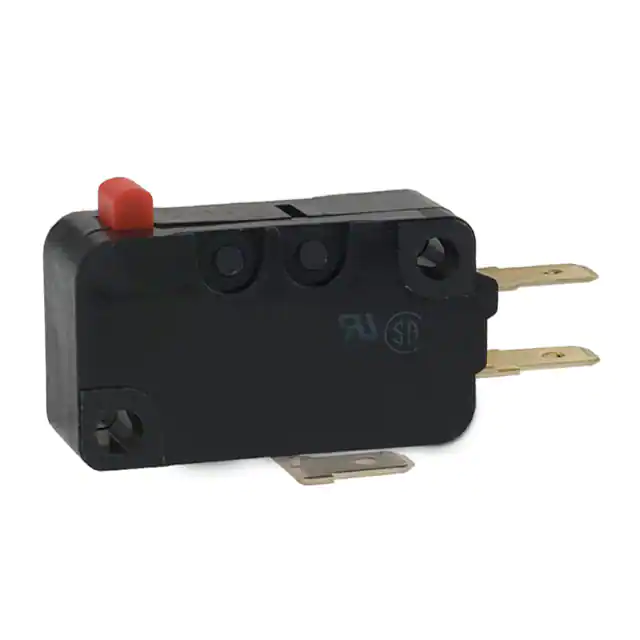
“Basic switch” is a mechanical sensor that detects (senses) the presence or absence of an
object as well as its position by activating a plunger when the object physically comes into
contact. With the emerging IoT, Omron’s basic switches have been widely adopted for
position detection installed in customers’ newly developed electric appliances, machines and
mechanical equipment. Furthermore, electrical signals outputted from the basic switch that
indicates normal and abnormal conditions when detecting positions can be transmitted to
remote monitoring systems over the Internet.
Definition
The following is the definition of a basic switch provided by the Nippon Electric Control
Equipment Industries Association (NECA).
“A miniature switch, also known as snap-action switch, achieves a very small contact
separation and the contacts are enclosed in a case in which these contacts open and close
according to the specified movement and force. An actuator is equipped outside the
case”(Figure 1)
With a snap-action mechanism, the contacts
will instantaneously switch at a specific
operating position regardless of its speed.
The mechanism allows the basic switch to
operate using a specified movement and
force.
Figure1 ● Basic Switches
ELECTRONIC AND MECHANICAL COMPONENTS COMPANY
�White Paper
Basics of Basic Switches
General Knowledge of Basic Switches
Features
In general, when the switch closes the electrical circuit, an electric spark, known also as an
electric arc, occurs between the contacts. The greater the amplitude of the current, the higher
the tendency of arc becomes and it takes longer time to arc when the switch is closed slowly,
which causes contact wear. With snap-action basic switch, contacts are instantaneously
switched which reduces the chance for arcing. Miniature basic switch is capable of controlling
a circuit with relatively high currents while it requires less mounting space.
A basic switch allows switching at approximately the same actuation point in repeated on and
off operation and hence has very small position detection error. They are suited for
applications where high level of repeat accuracy is required. This is a feature unique to snapaction basic switch.
Basic switch provides high durability as it reduces the arcing time and minimizes contact
damage from arcing.
Snap-action basic switch produces a unique clicking sound and snap-action feel that are
immediately recognizable.
Types of Basic Switch
Basic switch is available in four different types: miniature, subminiature, ultra-subminiature,
and non-of-the-above switches. Basic switches are used in many applications including home
appliances and industrial machinery(Figure 2).
Figure2 ● Types of Basic Switch
ELECTRONIC AND MECHANICAL COMPONENTS COMPANY
2
�White Paper
Basics of Basic Switches
General Knowledge of Basic Switches
Basic structure
Basic parts of a basic switch include (1) an actuator; (2) snap-action mechanism; (3) electrical
contacts; (4) terminals; and (5) a switch case. The descriptions of these parts are described
below(Figure 3).
Figure 3
(1)
Actuator
● Basic structure of Basic Switches
An actuator transmits external force and action received such as from an operating body,
to the internal spring mechanism of the switch. Various types of actuators are selected to
match the shape and movement of the operating body. Typical actuators include pinplunger, hinge lever and hinge roller lever types (Figure 4).
A pin-plunger type actuator is appropriate for linear short stroke action, to allow position
detection with high degree of accuracy. A hinge lever type has more design flexibility as
it has longer stroke length and is suitable for a variety of applications. A hinge roller lever
is suitable for high-speed operating condition such as high-speed cam operation.
Figure4 ●Actuator types
ELECTRONIC AND MECHANICAL COMPONENTS COMPANY
3
�White Paper
Basics of Basic Switches
General Knowledge of Basic Switches
(2) Snap-action mechanism
Parts of a snap-action mechanism include a movable spring, a moving armature, a
common terminal, and a spring pad. When force is applied to a plunger, it increases
the force of the moving spring on the moving armature at which it moves downward
immediately after the plunger approaches a specific operating point and the moving
contact switches from normally closed position to normally open position (terminal).
To give a better image of this movement, imagine bending a flexible plastic writing
board (that you place under a sheet of writing paper to provide smooth writing
surface), and as you press the top of the arch of the bent board downward, the arch
springs towards the other side when it reaches a certain point. This movement of a
flexible plastic writing board is very similar to that of a snap-action mechanism.
(3) Electrical contact
An electrical contact plays a main and critical role in the basic switch operation that
opens and closes (on and off) the electrical circuit. The choices of contact material and
shape to be used depend on the circuit voltage and the current flow. Most commonly
used materials are gold or gold-plated, silver or silver-plated, or gold-silver alloy.
Choices of contact forms include cross-bar type and rivet type (Figure 5).
Figure5 ●Contact shape
(4) Terminals
Terminals connect the switch and the external circuit. There are several types of
terminals for electrical connections including soldering terminals, tab terminals (quickconnect), screw terminals, and PCB terminals (Figure 6).
Figure6 ●Terminal shape
ELECTRONIC AND MECHANICAL COMPONENTS COMPANY
4
�White Paper
Basics of Basic Switches
General Knowledge of Basic Switches
(5)
Switch case
A switch case protects the enclosed snap-action contact mechanism. There are two
major materials for switch cases: recyclable thermoplastic resin and non-recyclable
thermosetting resin. Thermoplastic resin is the most common material used, but in
applications where high mechanical strength, heat resistance, and flame retardance are
required, thermosetting resin is used.
It is crucial for the position detecting function of basic switch used in different
applications to have durability (robustness) and failure-free (reliability). Omron has
succeeded in reducing variations in operational characteristics by strictly controlling
quality at every single stage in the production process.
Omron basic switches can be customized according to customer requirements and
maintain high quality by guaranteeing high accuracy and high reliability based on our
long-standing experience and achievements.
Applications
■Cover Detections of commercial equipment and industrial machinery
By using switches to detect that the door or cover is set correctly, the professional equipment
/ industrial machinery can be operated correctly and safely. By using a small size basic switch
equipped with a highly flexible actuator, and adjusting the operating force and stroke, the
movement of the door or cover in a limited space can be reliably detected.
■Position detection of built-in parts of equipment requiring remote communication
For devices that automatically operate by remote control such as IOT devices, switches can
detect that the built-in components are operating correctly, and prevent them from pinching
and interference, enabling safe operation.
ELECTRONIC AND MECHANICAL COMPONENTS COMPANY
5
�White Paper
Please check each region's Terms & Conditions by region website.
OMRON Corporation
Electronic and Mechanical Components Company
Regional Contact
Americas
Europe
https://www.components.omron.com/
http://components.omron.eu/
Asia-Pacific
China
https://ecb.omron.com.sg/
https://www.ecb.omron.com.cn/
Korea
Japan
https://www.omron-ecb.co.kr/
https://www.omron.co.jp/ecb/
© OMRON Corporation 2019 All Rights Reserved.
In the interest of product improvement, specifications are subject to change without notice.
Cat. No. B133-E1-01
0319(0319)
�
很抱歉,暂时无法提供与“D3V-16-1A5”相匹配的价格&库存,您可以联系我们找货
免费人工找货