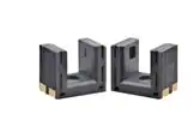
Photomicrosensor (Transmissive)
EE-SX1330
Ultra-Compact Slot / SMD Type
(Slot width: 3 mm)
• PCB surface mounting type.
• High resolution with a 0.3-mm-wide aperture.
Be sure to read Safety Precautions on page 3.
Ordering Information
Photomicrosensor
Sensing
method
Appearance
5
4
Connecting
method
Transmissive
(slot type)
SMT
Sensing distance
Aperture size (H × W)
(mm)
Output type
Emitter
1.4 × 1.4
3 mm
(slot width)
Phototransistor
Detector
1 × 0.3
6
Model
EE-SX1330
Ratings, Characteristics and Exterior Specifications
Absolute Maximum Ratings (Ta = 25°C)
Item
Symbol
Rated value
Electrical and Optical Characteristics (Ta = 25°C)
Unit
Item
Emitter
Value
Symbol
MIN.
TYP. MAX.
Unit
Condition
Emitter
Forward current
IF
25 *1
mA
Pulse forward current
IFP
100 *2
mA
Forward voltage
VF
---
1.1
1.3
V
IF = 5 mA
Reverse voltage
VR
5
V
Reverse current
IR
---
---
10
μA
VR = 5 V
Peak emission
wavelength
λP
---
940
---
nm
IF = 20 mA
Detector
Collector-Emitter
voltage
VCEO
12
V
Emitter-Collector
voltage
VECO
5
V
Light current
IL
100
---
1,000
μA
IF = 5 mA,
VCE = 5 V
Collector current
IC
20
mA
Dark current
ID
---
10
100
nA
VCE = 10 V,
0 lx
VCE
(sat)
---
0.1
0.4
V
IF = 20 mA,
IL = 100 μA
λP
---
900
---
nm
VCE = 5 V
Rising time
tr
---
19
---
μs
VCC = 5 V,
RL = 100 Ω,
IL = 500 μA
Falling time
tf
---
26
---
μs
VCC = 5 V,
RL = 100 Ω,
IL = 500 μA
PC
75 *1
mW
Operating temperature
Topr
-30 to +85 *1
°C
Storage temperature
Tstg
-40 to +90 *1
°C
Reflow soldering
temperature
Tsol
255 *3
°C
Collector dissipation
*1. Refer to the temperature rating chart if the ambient temperature
exceeds 25°C.
*2. Duty ratio: 1%, Pulse width: 0.1 ms
*3. Complete soldering within 10 seconds for reflow soldering.
Exterior Specifications
Connecting method
SMT
Weight (g)
0.2
Material
Case
PPS
Detector
Collector-Emitter
saturated voltage
Peak spectral
sensitivity
wavelength
Note: Refer to the following timing diagram for tr and tf.
IL
Input
Vcc
Input
0
t
Output
RL
90%
Output
0
10%
t
tr
tf
1
�EE-SX1330
Engineering Data (Reference value)
Fig 1. Forward Current vs. Collector
Dissipation Temperature Rating
Fig 2. Forward Current vs. Forward
Voltage Characteristics (Typical)
120
60
Fig 3. Light Current vs. Forward Current
Characteristics (Typical)
60
3,500
Ta = 25°C
VCE = 5 V
Ta = 25°C
IF
40
20
0
-40
-20
0
20
40
60
Ambient temperature Ta (ºC)
80
20
1,500
500
0
0
0.2
0.4
0.6 0.8
1
1.2
Forward voltage VF (V)
1.4
1.6
1.8
Fig 5. Relative Light Current vs. Ambient
Temperature Characteristics (Typical)
0
1,000
IF = 10 mA
40
50
0lx
110
Dark current ID (nA)
Relative light current IL (%)
1,500
20
30
Forward current IF (mA)
1,000
IF = 5 mA
VCE = 5 V
Ta = 25ºC
2,000
10
Fig 6. Dark Current vs. Ambient
Temperature Characteristics (Typical)
120
2,500
Light current IL (µA)
2,000
1,000
0
0
100
Fig 4. Light Current vs. CollectorEmitter Voltage Characteristics (Typical)
30
10
20
10
2,500
40
Light current IL (µA)
60
30
Forward current IF (mA)
80
PC
Collector dissipation PC (mW)
Forward current IF (mA)
40
3,000
50
100
50
100
90
100
VCE = 10 V
10
VCE = 2 V
80
1
500
2
4
6
8
10
12
Collector-Emitter voltage VCE (V)
70
60
−40
14
Fig 7. Response Time vs. Load
Resistance Characteristics (Typical)
0
20
40
60
Ambient temperature Ta (°C)
80
120
IF = 5 mA
VCE = 5 V
Ta = 25ºC
Relative light current IL (%)
100
1,000
tf
100
80
d
60
40
20
100
(Center of
optical axis)
d
80
60
40
20
0
1
10
Load resistance RL (kΩ)
IF = 5 mA
VCE = 5 V
Ta = 25ºC
100
(Center of
optical axis)
10
tr
0 10 20 30 40 50 60 70 80 90
Ambient temperature Ta (ºC)
Fig 9. Sensing Position Characteristics
(Typical)
120
VCC = 5 V
IL = 0.5 mA
Ta = 25°C
1
0.1
0.1
−30 −20 −10
100
Fig 8. Sensing Position Characteristics
(Typical)
10,000
Response time tr, tf (μs)
−20
Relative light current IL (%)
0
0
IF = 5 mA
-0.6
-0.4
-0.2
0
0.2
Distance d (mm)
0.4
0.6
0
-1.2 -0.9
-0.6
-0.3
0
0.3
0.6
Distance d (mm)
0.9
1.2
2
�EE-SX1330
Safety Precautions
To ensure safe operation, be sure to read and follow the Instruction Manual provided with the Sensor.
Precautions for Correct Use
Do not use the product in atmospheres or
environments that exceed product ratings.
This product is for surface mounting. Refer to
Soldering Information, Storage and Baking for
details.
Dispose of this product as industrial waste.
CAUTION
This product is not designed or rated for ensuring
safety of persons either directly or indirectly. Do not
use it for such purposes.
Precautions for Safe Use
Do not use the product with a voltage or current
that exceeds the rated range.
Applying a voltage or current that is higher than the rated range may
result in explosion or fire.
Do not miswire such as the polarity of the power
supply voltage.
Otherwise the product may be damaged or it may burn.
This product does not resist water. Do not use
the product in places where water or oil may be
sprayed onto the product.
Dimensions and Internal Circuit
(Unit: mm)
Photomicrosensor
EE-SX1330
(6
0.
2)
Ejector pin, gate mark, or flat surface
2.0 mm dia. or 0.5 mm recess (MAX)
(1)
Detector side
(4)
4
Emitter side
xC
(2)
(3)
6
Terminals are exposed
in the end face of the board
Terminals are exposed
in the end face of the board
(0.4)
(0.4)
A B
1.6
1.6
2.2
Cross section view A-A
(Detector side)
(1)
(4)
(2)
(3)
0.6
1.6
Internal circuit
1.6
1×0.3
1.6
2.2
Aperture size (H x W)
Detector
1
R0.3
1
1.6
Cross section view B-B
(Emitter side)
1.4×1.4
1
5
1.4
3.5
1
1
0.3 ±0.15
A B
Optical axis
R0.3
Emitter
Marking
(upper: model, lower: lot No.)
1.5
1
1.4
3 ±0.2
Terminal No.
2
4
2
Name
(1)
Anode
(2)
Cathode
(3)
Emitter
(4)
Collector
Unless otherwise specified, the tolerances are ±0.2 mm.
3
�EE-SX1330
Tape and Reel
Reel (Unit: mm) *
21±0.8 dia.
2±0.5
13±0.2 dia.
80±1dia.
330±2 dia.
Product name
PHOTO MICROSENSOR
Lot number
Quantity
Country of origin
W1 = 13.5±1
W2 = 17.5±1
W1
W2
Tape (Unit: mm)
1.5 dia.
E
K
C
A
Tape Pull-out direction
Note: Direction of product packing is upper figure.
Tape quantity
1,000 pcs./reel
100 pcs./pack *
* EE-SX1330-1 (100 pcs./pack) has no reel, only tape is attached.
4
�EE-SX1330
Soldering Information
Reflow soldering: Temperature profile
Manual soldering
1. The reflow soldering can be implemented in two times complying
with the following diagram.
All the temperatures in the product must be within the diagram.
2. The recommended thickness of the metal mask for screen printing
is between 0.2 and 0.25 mm.
The manual soldering should not be applied to the products,
otherwise the housing may be deformed and/or the Au plating may be
peeled off by heat.
260°C max.
255°C
Temperature (°C)
1 to 4°C/s
230°C
10 sec max.
150 to 180°C max.
1 to 4°C/sec
40 sec max.
1 to 4°C/s
120 sec max.
Other notes
The use of infrared lamp causes the temperature at the resin to rise
particularly too high.
All the temperatures in the product must be within the above diagram.
Do not immerse the resin part into the solder. Even if within the above
temperature diagram, there is a possibility that the gold wire in the
products is broken in case that the deformation of PC board gives
stress to the products.
Please confirm the conditions (including material and method of flux
and cleaning) of the reflow soldering fully by actual solder reflow
machine prior to the mass production use.
Time (s)
Storage
Storage conditions
Treatment after open
To protect the product from the effects of humidity until the package
is opened, dry-box storage is recommended. If this is not possible,
store the product under the following conditions:
Temperature: 10 to 30 °C
Humidity: 60% RH max.
1. Reflow soldering must be done within 48 hours stored at the
conditions of humidity 60% RH or less and temperature 10 to
30°C.
2. If the product must be stored after it is unpacked, store it in a dry
box or reseal it in a moisture-proof package with desiccant at a
temperature of 10 to 30°C and a humidity of 60% RH or less. Even
then, mount the product within one week.
Baking
In case that it could not carry out the above treatment, it is able to
mount by the following baking treatment. However baking treatment
shall be limited only 1 time.
Recommended conditions: 60°C for 24 to 48 hours (reeled one)
100°C for 8 to 24 hours (loose one)
5
�• Application examples provided in this document are for reference only. In actual applications, confirm equipment functions and safety before using the product.
• Consult your OMRON representative before using the product under conditions which are not described in the manual or applying the product to nuclear control systems, railroad
systems, aviation systems, vehicles, combustion systems, medical equipment, amusement machines, safety equipment, and other systems or equipment that may have a serious
influence on lives and property if used improperly. Make sure that the ratings and performance characteristics of the product provide a margin of safety for the system or
equipment, and be sure to provide the system or equipment with double safety mechanisms.
Note: Do not use this document to operate the Unit.
OMRON Corporation
Electronic and Mechanical Components Company
Contact: www.omron.com/ecb
Cat. No. E456-E1-05
0417(0816)(O)
�Mouser Electronics
Authorized Distributor
Click to View Pricing, Inventory, Delivery & Lifecycle Information:
Omron:
EE-SX1330
�