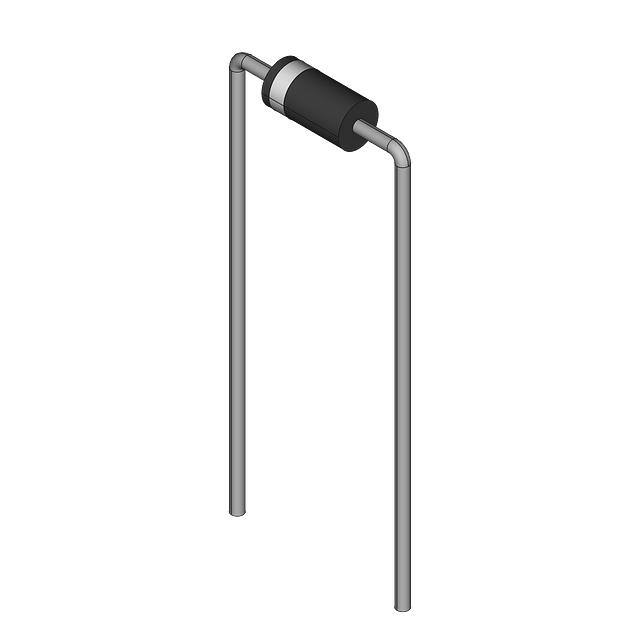
1N4728A Series
1 Watt DO-41 Hermetically
Sealed Glass Zener Voltage
Regulator Diodes
This is a complete series of 1 Watt Zener diode with limits and
excellent operating characteristics that reflect the superior capabilities
of silicon–oxide passivated junctions. All this in an axial–lead
hermetically sealed glass package that offers protection in all common
environmental conditions.
http://onsemi.com
Specification Features:
•
•
•
•
•
•
Zener Voltage Range – 3.3 V to 91 V
ESD Rating of Class 3 (>16 KV) per Human Body Model
DO–41 (DO–204AL) Package
Double Slug Type Construction
Metallurgical Bonded Construction
Oxide Passivated Die
AXIAL LEAD
CASE 59
GLASS
Mechanical Characteristics:
CASE: Double slug type, hermetically sealed glass
FINISH: All external surfaces are corrosion resistant and leads are
L
1N
47
xxA
YWW
readily solderable
MAXIMUM LEAD TEMPERATURE FOR SOLDERING PURPOSES:
L
= Assembly Location
1N47xxA = Device Code
Y
= Year
WW
= Work Week
230°C, 1/16″ from the case for 10 seconds
POLARITY: Cathode indicated by polarity band
MOUNTING POSITION: Any
MAXIMUM RATINGS
Rating
Max. Steady State Power Dissipation
@ TL ≤ 50°C, Lead Length = 3/8″
Derated above 50°C
Operating and Storage
Temperature Range
Symbol
Value
Unit
PD
1.0
Watt
6.67
mW/°C
TJ, Tstg
– 65 to
+200
°C
Cathode
Anode
ORDERING INFORMATION (1.)(NO TAG)
Device
Package
Shipping
1N47xxA
Axial Lead
2000 Units/Box
1N47xxARL
Axial Lead
6000/Tape & Reel
1N47xxARL2
Axial Lead
6000/Tape & Reel
1N47xxATA
Axial Lead
4000/Ammo Pack
1N47xxATA2
Axial Lead
4000/Ammo Pack
NOTES:
1. The “2” suffix refers to 26 mm tape spacing.
Devices listed in bold, italic are ON Semiconductor
Preferred devices. Preferred devices are recommended
choices for future use and best overall value.
Semiconductor Components Industries, LLC, 2000
November, 2000 – Rev. 1
215
Publication Order Number:
1N4728A/D
�1N4728A Series
ELECTRICAL CHARACTERISTICS (TA = 25°C unless
I
otherwise noted, VF = 1.2 V Max., IF = 200 mA for all types)
Symbol
VZ
Reverse Zener Voltage @ IZT
IZT
Reverse Current
ZZT
Maximum Zener Impedance @ IZT
IZK
Reverse Current
ZZK
Maximum Zener Impedance @ IZK
IR
Reverse Leakage Current @ VR
VR
Breakdown Voltage
IF
Forward Current
VF
Forward Voltage @ IF
Ir
IF
Parameter
VZ VR
V
IR VF
IZT
Zener Voltage Regulator
Surge Current @ TA = 25°C
ELECTRICAL CHARACTERISTICS (TA = 25°C unless otherwise noted, VF = 1.2 V Max, IF = 200 mA for all types)
Zener Voltage (3.)(4.)
VZ (Volts)
Zener Impedance (5.)
Leakage Current
ZZT @ IZT
Max
(mA)
(�)
(�)
(mA)
(µA Max)
(Volts)
(mA)
3.3
3.6
3.9
4.3
4.7
3.47
3.78
4.10
4.52
4.94
76
69
64
58
53
10
10
9
9
8
400
400
400
400
500
1
1
1
1
1
100
100
50
10
10
1
1
1
1
1
1380
1260
1190
1070
970
4.85
5.32
5.89
6.46
7.13
5.1
5.6
6.2
6.8
7.5
5.36
5.88
6.51
7.14
7.88
49
45
41
37
34
7
5
2
3.5
4
550
600
700
700
700
1
1
1
1
0.5
10
10
10
10
10
1
2
3
4
5
890
810
730
660
605
1N4738A
1N4739A
1N4740A
1N4741A
1N4742A
7.79
8.65
9.50
10.45
11.40
8.2
9.1
10
11
12
8.61
9.56
10.50
11.55
12.60
31
28
25
23
21
4.5
5
7
8
9
700
700
700
700
700
0.5
0.5
0.25
0.25
0.25
10
10
10
5
5
6
7
7.6
8.4
9.1
550
500
454
414
380
1N4743A
1N4744A
1N4745A
12.4
14.3
15.2
13
15
16
13.7
15.8
16.8
19
17
15.5
10
14
16
700
700
700
0.25
0.25
0.25
5
5
5
9.9
11.4
12.2
344
304
285
Min
Nom
1N4728A
1N4729A
1N4730A
1N4731A
1N4732A
3.14
3.42
3.71
4.09
4.47
1N4733A
1N4734A
1N4735A
1N4736A
1N4737A
ZZK @ IZK
Ir (6.)
@ IZT
JEDEC
Device (2.)
IR @ VR
TOLERANCE AND TYPE NUMBER DESIGNATION
2. The JEDEC type numbers listed have a standard tolerance on the nominal zener voltage of ±5%.
SPECIALS AVAILABLE INCLUDE:
3. Nominal zener voltages between the voltages shown and tighter voltage tolerances. For detailed information on price, availability, and
delivery, contact your nearest ON Semiconductor representative.
ZENER VOLTAGE (VZ) MEASUREMENT
4. ON Semiconductor guarantees the zener voltage when measured at 90 seconds while maintaining the lead temperature (TL) at 30°C
± 1°C, 3/8″ from the diode body.
ZENER IMPEDANCE (ZZ) DERIVATION
5. The zener impedance is derived from the 60 cycle ac voltage, which results when an ac current having an rms value equal to 10% of the
dc zener current (IZT or IZK) is superimposed on IZT or IZK.
SURGE CURRENT (IR) NON-REPETITIVE
6. The rating listed in the electrical characteristics table is maximum peak, non-repetitive, reverse surge current of 1/2 square wave or equivalent sine wave pulse of 1/120 second duration superimposed on the test current, IZT, per JEDEC registration; however, actual device
capability is as described in Figure 5 of the General Data – DO-41 Glass.
http://onsemi.com
216
�1N4728A Series
ELECTRICAL CHARACTERISTICS (TA = 25°C unless otherwise noted, VF = 1.2 V Max, IF = 200 mA for all types) (continued)
Zener Voltage (8.)(9.)
VZ (Volts)
Zener Impedance (10.)
Leakage Current
ZZT @ IZT
Max
(mA)
(�)
(�)
(mA)
(µA Max)
(Volts)
(mA)
18
20
18.9
21.0
14
12.5
20
22
750
750
0.25
0.25
5
5
13.7
15.2
250
225
20.9
22.8
25.7
28.5
31.4
22
24
27
30
33
23.1
25.2
28.4
31.5
34.7
11.5
10.5
9.5
8.5
7.5
23
25
35
40
45
750
750
750
1000
1000
0.25
0.25
0.25
0.25
0.25
5
5
5
5
5
16.7
18.2
20.6
22.8
25.1
205
190
170
150
135
1N4753A
1N4754A
1N4755A
1N4756A
1N4757A
34.2
37.1
40.9
44.7
48.5
36
39
43
47
51
37.8
41.0
45.2
49.4
53.6
7
6.5
6
5.5
5
50
60
70
80
95
1000
1000
1500
1500
1500
0.25
0.25
0.25
0.25
0.25
5
5
5
5
5
27.4
29.7
32.7
35.8
38.8
125
115
110
95
90
1N4758A
1N4759A
1N4760A
1N4761A
1N4762A
53.2
58.9
64.6
71.3
77.9
56
62
68
75
82
58.8
65.1
71.4
78.8
86.1
4.5
4
3.7
3.3
3
110
125
150
175
200
2000
2000
2000
2000
3000
0.25
0.25
0.25
0.25
0.25
5
5
5
5
5
42.6
47.1
51.7
56
62.2
80
70
65
60
55
1N4763A
86.5
91
95.6
2.8
250
3000
0.25
5
69.2
50
Min
Nom
1N4746A
1N4747A
17.1
19.0
1N4748A
1N4749A
1N4750A
1N4751A
1N4752A
ZZK @ IZK
Ir (11.)
@ IZT
JEDEC
Device (7.)
IR @ VR
PD , MAXIMUM STEADY STATE POWER DISSIPATION (WATTS)
TOLERANCE AND TYPE NUMBER DESIGNATION
7. The JEDEC type numbers listed have a standard tolerance on the nominal zener voltage of ±5%.
SPECIALS AVAILABLE INCLUDE:
8. Nominal zener voltages between the voltages shown and tighter voltage tolerances. For detailed information on price, availability, and
delivery, contact your nearest ON Semiconductor representative.
ZENER VOLTAGE (VZ) MEASUREMENT
9. ON Semiconductor guarantees the zener voltage when measured at 90 seconds while maintaining the lead temperature (TL) at 30°C ± 1°C,
3/8″ from the diode body.
ZENER IMPEDANCE (ZZ) DERIVATION
10. The zener impedance is derived from the 60 cycle ac voltage, which results when an ac current having an rms value equal to 10% of the
dc zener current (IZT or IZK) is superimposed on IZT or IZK.
SURGE CURRENT (IR) NON-REPETITIVE
11. The rating listed in the electrical characteristics table is maximum peak, non-repetitive, reverse surge current of 1/2 square wave or equivalent
sine wave pulse of 1/120 second duration superimposed on the test current, IZT, per JEDEC registration; however, actual device capability
is as described in Figure 5 of the General Data – DO-41 Glass.
1.25
L = 1″
L = 1/8″
1
L = LEAD LENGTH
TO HEAT SINK
L = 3/8″
0.75
0.5
0.25
0
20
40
60
80 100 120 140
TL, LEAD TEMPERATURE (°C)
160
180
Figure 1. Power Temperature Derating Curve
http://onsemi.com
217
200
�1N4728A Series
b. Range for Units to 12 to 100 Volts
+12
θVZ , TEMPERATURE COEFFICIENT (mV/°C)
θVZ , TEMPERATURE COEFFICIENT (mV/°C)
a. Range for Units to 12 Volts
+10
+8
+6
+4
+2
VZ�@�IZT
RANGE
0
-2
-4
2
3
4
5
6
7
8
9
VZ, ZENER VOLTAGE (VOLTS)
10
11
100
70
50
12
30
20
RANGE
10
7
5
VZ�@�IZT
3
2
1
10
20
30
50
VZ, ZENER VOLTAGE (VOLTS)
70
100
Ppk , PEAK SURGE POWER (WATTS)
175
θVZ , TEMPERATURE COEFFICIENT (mV/°C)
θ JL , JUNCTION�TO�LEAD THERMAL RESISTANCE (mV/°C/W)
Figure 2. Temperature Coefficients
(–55°C to +150°C temperature range; 90% of the units are in the ranges indicated.)
150
125
100
75
50
25
0
0
0.1
0.2
0.3
0.4
0.5
0.6
0.7
0.9
1
VZ�@�IZ
TA�=�25°C
+4
+2
20�mA
0
0.01�mA
1�mA
NOTE: BELOW 3 VOLTS AND ABOVE 8 VOLTS
NOTE: CHANGES IN ZENER CURRENT DO NOT
NOTE: EFFECT TEMPERATURE COEFFICIENTS
-2
-4
3
4
5
6
7
8
L, LEAD LENGTH TO HEAT SINK (INCHES)
VZ, ZENER VOLTAGE (VOLTS)
Figure 3. Typical Thermal Resistance
versus Lead Length
Figure 4. Effect of Zener Current
100
70
50
30
0.8
+6
RECTANGULAR
WAVEFORM
TJ�=�25°C PRIOR TO
INITIAL PULSE
11�V-100�V NONREPETITIVE
5% DUTY CYCLE
3.3�V-10�V NONREPETITIVE
20
10
7
5
3
2
1
0.01
10% DUTY CYCLE
20% DUTY CYCLE
0.02
0.05
0.1
0.2
0.5
This graph represents 90 percentile data points.
For worst case design characteristics, multiply surge power by 2/3.
1
2
5
PW, PULSE WIDTH (ms)
10
Figure 5. Maximum Surge Power
http://onsemi.com
218
20
50
100
200
500
1000
�1N4728A Series
VZ = 2.7 V
200
1000
700
500
TJ = 25°C
iZ(rms) = 0.1 IZ(dc)
f = 60 Hz
Z Z , DYNAMIC IMPEDANCE (OHMS)
Z Z , DYNAMIC IMPEDANCE (OHMS)
1000
500
47 V
100
27 V
50
20
10
6.2 V
5
2
1
0.1
0.2
0.5
1
2
5
10
IZ, ZENER CURRENT (mA)
20
50
IZ = 1 mA
200
100
70
50
5 mA
20
20 mA
10
7
5
2
1
100
1
2
Figure 6. Effect of Zener Current
on Zener Impedance
10000
7000
5000
5
7 10
20 30
VZ, ZENER VOLTAGE (V)
50
70 100
Figure 7. Effect of Zener Voltage
on Zener Impedance
200
C, CAPACITANCE (pF)
TYPICAL LEAKAGE CURRENT
AT 80% OF NOMINAL
BREAKDOWN VOLTAGE
1000
700
500
200
100
70
50
0 V BIAS
100
1 V BIAS
50
20
10
8
20
4
10
7
5
50% OF BREAKDOWN BIAS
1
2
5
10
20
VZ, NOMINAL VZ (VOLTS)
50
100
Figure 9. Typical Capacitance versus VZ
2
1
0.7
0.5
1000
500
+125°C
0.2
I F , FORWARD CURRENT (mA)
I R , LEAKAGE CURRENT (µ A)
3
400
300
2000
0.1
0.07
0.05
0.02
0.01
0.007
0.005
+25°C
MINIMUM
MAXIMUM
200
100
50
20
75°C
10
25°C
5 150°C
0°C
2
0.002
0.001
TJ = 25°C
iZ(rms) = 0.1 IZ(dc)
f = 60 Hz
3
4
5
6
7
8
9
10
11
12
13
14
15
1
0.4
0.5
0.6
0.7
0.8
0.9
1
VZ, NOMINAL ZENER VOLTAGE (VOLTS)
VF, FORWARD VOLTAGE (VOLTS)
Figure 8. Typical Leakage Current
Figure 10. Typical Forward Characteristics
http://onsemi.com
219
1.1
�1N4728A Series
APPLICATION NOTE
∆TJL is the increase in junction temperature above the lead
temperature and may be found as follows:
Since the actual voltage available from a given zener
diode is temperature dependent, it is necessary to determine
junction temperature under any set of operating conditions
in order to calculate its value. The following procedure is
recommended:
Lead Temperature, TL, should be determined from:
∆TJL = θJLPD.
θJL may be determined from Figure 3 for dc power
conditions. For worst-case design, using expected limits of
IZ, limits of PD and the extremes of TJ(∆TJ) may be
estimated. Changes in voltage, VZ, can then be found from:
TL = θLAPD + TA.
θLA is the lead-to-ambient thermal resistance (°C/W) and PD
is the power dissipation. The value for θLA will vary and
depends on the device mounting method. θLA is generally 30
to 40°C/W for the various clips and tie points in common use
and for printed circuit board wiring.
The temperature of the lead can also be measured using a
thermocouple placed on the lead as close as possible to the
tie point. The thermal mass connected to the tie point is
normally large enough so that it will not significantly
respond to heat surges generated in the diode as a result of
pulsed operation once steady-state conditions are achieved.
Using the measured value of TL, the junction temperature
may be determined by:
∆V = θVZ ∆TJ.
θVZ, the zener voltage temperature coefficient, is found
from Figure 2.
Under high power-pulse operation, the zener voltage will
vary with time and may also be affected significantly by the
zener resistance. For best regulation, keep current
excursions as low as possible.
Surge limitations are given in Figure 5. They are lower
than would be expected by considering only junction
temperature, as current crowding effects cause temperatures
to be extremely high in small spots, resulting in device
degradation should the limits of Figure 5 be exceeded.
TJ = TL + ∆TJL.
http://onsemi.com
220
�