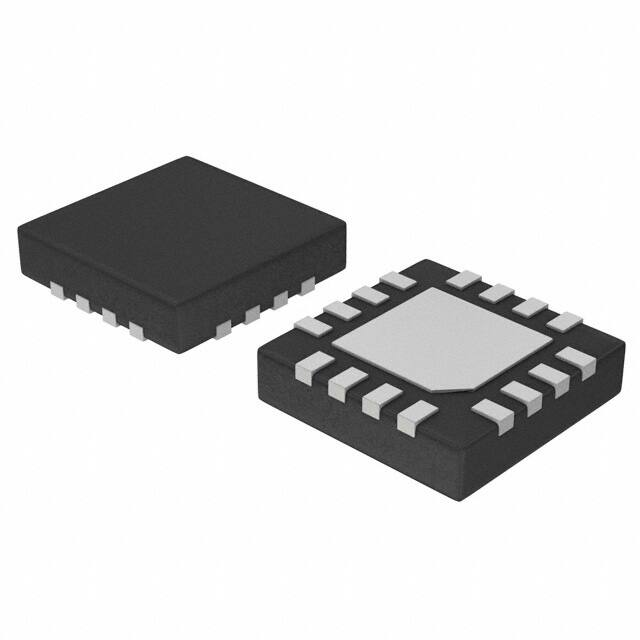
CAT3224
LED Driver, Charge Pump,
2-Channel
Description
http://onsemi.com
TQFN−16
HV3 SUFFIX
CASE 510AD
RF
VIN
CP
RT
LEDB
FLAG
LEDA
CAP
FLASH
CAP
TORCH
RC
CHRG
2 Channels at 2 A Each in Flash Mode
2 Channels at 200 mA Each in Torch Mode
Adjustable Charge Current Limit up to 1000 mA
Flash/Torch Current Separate Adjustment
Dual−mode 1x/2x Charge Pump
Dual Cell Supercapacitor Balancing
Flash Safety Timer and Ready Flag
Supercapacitor Continuous Charging
Shutdown CAP Leakage 3 mA
“Zero” Current Shutdown Mode
80 mA Standby Current (IVIN)
Over−voltage, Over−current Limiting
Thermal Shutdown Protection
Small 3 mm x 3 mm, 16−pad TQFN Package
This Device is Pb−Free, Halogen Free/BFR Free and RoHS
Compliant
1
BAL
Features
•
•
•
•
•
•
•
•
•
•
•
•
•
•
•
CN
PIN CONNECTIONS
GND
The CAT3224 is a very high−current integrated flash LED driver
which also supports the charging function for a dual−cell
supercapacitor applications. Ideal for Li−ion battery−powered
systems, it delivers up to 4 A LED flash pulses, far beyond the peak
current capability of the battery.
Dual−mode 1x/2x charge pump charges the stacked supercapacitor
to a nominal voltage of 5.4 V, while an active balance control circuit
ensures that both capacitor cell voltages remain matched. The nominal
charging current to be drawn from the battery is set by an external
resistor tied to the RC pin.
The driver also features two matched current sources. External
resistors provide the adjustment for the maximum flash mode current
(up to 4 A) and the torch mode current (up to 400 mA). A built−in
safety timer automatically terminates the flash pulse beyond a
maximum duration of 300 ms.
In addition to thermal shutdown and overvoltage protection, the
device is fully protected against external resistor programming faults
and fully supports reverse output voltage for all conditions.
The device is packaged in the tiny 16
−pad TQFN 3 mm x 3mm
package with a max height of 0.8 mm.
(Top View)
MARKING DIAGRAM
JAAT
JAAT = Specific Device Code
ORDERING INFORMATION
Device
Package
CAT3224HV3−GT2 TQFN−16
(Pb−Free)
Shipping
2,000/
Tape & Reel
Note: NiPdAu Plated Finish (RoHS−compliant)
Applications
• High Power LED Flash
• Systems with High Peak Loads
© Semiconductor Components Industries, LLC, 2009
December, 2009 − Rev. 0
1
Publication Order Number:
CAT3224/D
�CAT3224
1 mF
CP
VIN (2.5 V to 5.5 V)
1 mF
CAP
CAT3224
CAP
FLAG
+
0.55 F
BAL
CHRG
LEDA
FLASH
TORCH
RC RF
261 W
826 W
Dual−Cell
Supercapacitor
1 mF
CN
VIN
–
LEDB
RT
GND
2A
2A
562 W
GND
Figure 1. Typical Application Circuit
Table 1. ABSOLUTE MAXIMUM RATINGS
Parameter
Rating
Unit
VIN, RC, RF, RT voltage
GND−0.3 to 6
V
CAP, CP, CN voltage
GND−0.3 to 7
V
CHRG, FLASH, TORCH, FLAG voltage (Note 1)
GND−0.3 to 6
V
GND−0.3 to CAP+0.3
V
Storage Temperature Range
−65 to +160
_C
Junction Temperature Range
−40 to +150
_C
Lead Temperature
300
_C
ESD Rating HBM (Human Body Model)
2000
V
ESD Rating MM (Machine Model)
200
V
BAL, LEDA, LEDB
Stresses exceeding Maximum Ratings may damage the device. Maximum Ratings are stress ratings only. Functional operation above the
Recommended Operating Conditions is not implied. Extended exposure to stresses above the Recommended Operating Conditions may affect
device reliability.
Table 2. RECOMMENDED OPERATING CONDITIONS
Parameter
Rating
Unit
VIN
2.0 to 5.5
V
Ambient Temperature Range
−40 to +85
_C
LEDA, LEDB current (in flash mode)
up to 2
A
LEDA, LEDB current (in torch mode)
10 to 200
mA
Input Current Limit
up to 1
A
FLAG pull−up resistor current
0 to 10
mA
1.3 to 4.2
V
Range
Unit
42
_C/W
Range
Unit
7
_C/W
LED Forward Voltage Range (Vf)
Table 3. PACKAGE THERMAL IMPEDANCE
Parameter
TQFN 3 mm x 3 mm 16−Lead qJA (Note 2)
Table 4. PACKAGE TRANSIENT THERMAL IMPEDANCE
Parameter
TQFN 3 mm x 3 mm 16−Lead Transient qJA (Note 3) (100 ms pulse)
1. Pins can be driven above VIN with no leakage current or change in operation.
2. qJA (Junction to Ambient thermal resistance) is calculated with 2 square inches of copper connected to package exposed pad.
3. Transient qJA is calculated for a 100 ms pulse at 5 watts with 2 square inches of copper connected to package exposed pad.
http://onsemi.com
2
�CAT3224
Table 5. ELECTRICAL OPERATING CHARACTERISTICS (VIN = 3.6 V, EN = 1.3 V, TAMB = 25°C unless otherwise stated.)
Symbol
Name
Conditions
IQVIN
Quiescent Current on VIN pin (IIN – 2 x IOUT)
CAP Charged & idle
80
mA
CAP Charging 2x Mode
6
mA
CAP Charged & idle
10
mA
Shutdown mode
3
mA
Shutdown, VIN = 0 V
3
IQCAP
Quiescent Current on CAP pin
Min
Typ
IQSHDN
Shutdown Current
GFLASH
Flash Gain (IFLASH / IRF)
IFLASH = 2 A
900
GTORCH
Torch Gain (ITORCH / IRT)
ITORCH = 200 mA
120
Input Current Limit Gain (ICHRG / IRC)
ICHARGE = 400 mA
400
GCHARGE
VRX
CHRG = FLASH = TORCH = 0 V
RSET Regulated Voltage (VRF VRT VRC)
IRX_MAX
Rset Current limit (IRF IRT IRC)
IRX = 0.1 mA
0.59
0.6
Max
Units
mA
1
mA
0.61
V
VRX = 0 V
3.5
mA
IIN_MAX
Input current limit in charge mode
VRC = 0 V
1.4
A
VC_OFF
CAP Charge off voltage
RC = 2 kW
5.4
V
VC_HYST
CAP Charge Hysteresis
0.2
V
VF_ON
CAP voltage FLAG pulled low
5.2
V
VF_HYST
CAP voltage FLAG Hysteresis
0.2
V
RLEDAB
LEDA/B Combined Dropout Resistance
IFLASHAB = 4 A
110
mW
1x mode
2
W
2x mode, VIN = 3.5 V
4
W
Charge Pump Frequency
800
kHz
TFLASH
Flash Timeout Duration
300
ms
VFLAG
Flag low voltage threshold (Open Drain)
REN
VEHI
VELO
CHRG, FLASH, TORCH Pin
Internal Pull−down Resistor
Logic High Level
Logic Low Level
VBAL
Active Balance Control (VCAP / 2)
TSD
Thermal Shutdown
150
°C
THYS
Thermal Hysteresis
20
°C
VUVLO
Undervoltage lockout (UVLO) threshold
1.9
V
RCP
FOSC
Charge Mode Resistance
FLAG Driven low 100 mA pull−up
0.2
V
0.4
kW
V
V
+2
%
150
1.3
±5 mA Load on BAL
http://onsemi.com
3
−2
�CAT3224
Cap Voltage and Flag Output
The timing diagram in Figure 2 shows the CAP output voltage and the FLAG output in charge mode (with CHRG input high).
CAP VOLTAGE
VC OFF
VC HYST
VF ON
VF HYST
TIME
Charge Current
0A
FLAG
FLASH
LED Current
0A
Figure 2. Supercapacitor Charge Timing Diagram
http://onsemi.com
4
�CAT3224
TYPICAL CHARACTERISTICS
(VIN = 3.6 V, C = 0.55 F, TAMB = 25°C, typical application circuit unless otherwise specified.)
100
1.0
ICHARGE (A)
IQVIN (mA)
90
80
70
60
3.0
3.5
4.0
4.5
5.0
0.1
5.5
RC (kW)
Figure 3. Idle Quiescent Current vs. Input
Voltage
Figure 4. Charge Current vs. RC
10
ITORCH (mA)
1,000
1.0
0.1
1.0
100
10
10
0.1
1.0
RF (kW)
RT (kW)
Figure 5. Flash LED Current vs. RF
Figure 6. Torch LED Current vs. RT
20
15
RDSON (W)
IFLASH (A)
1.0
INPUT VOLTAGE (V)
10
0.1
0.1
10
5
0
3.0
3.5
4.0
4.5
5.0
INPUT VOLTAGE (V)
Figure 7. FLAG RDSON vs. Input Voltage
http://onsemi.com
5
5.5
10
�CAT3224
TYPICAL CHARACTERISTICS
630
630
620
620
610
610
VRC (mV)
VRF (mV)
(VIN = 3.6 V, C = 0.55 F, TAMB = 25°C, typical application circuit unless otherwise specified.)
600
600
590
590
580
580
570
0
0.5
1.0
1.5
570
2.0
0
0.2
0.4
0.6
0.8
IFLASH (A)
ICHARGE (A)
Figure 8. VRF vs. IFLASH
Figure 9. VRC vs. ICHARGE
630
1.0
6.0
620
5.5
VC_OFF (V)
600
590
5.0
4.5
580
570
0
50
100
150
4.0
200
0
0.5
1.0
1.5
2.0
ITORCH (mA)
RC (kW)
Figure 10. VRT vs. ITORCH
Figure 11. VCAP idle vs. RC
500
400
IOUT (mA)
VRT (mV)
610
300
200
Vled = 2.9 V
100
0
3.0
3.5
4.0
4.5
5.0
VCAP (V)
Figure 12. Torch Output Current vs. VCAP
http://onsemi.com
6
5.5
2.5
3.0
�CAT3224
TYPICAL CHARACTERISTICS
(VIN = 3.6 V, C = 0.55 F, TAMB = 25°C, typical application circuit unless otherwise specified.)
CHRG
5V/div
CHRG
5V/div
CAP
2V/div
CAP
2V/div
Input
Current
Input
Current
1A/div
500mA/div
1s/div
2s/div
Figure 13. Charge Cycle, 1 A Input Current
Figure 14. Charge Cycle, 500 mA Input Current
CHRG
5V/div
FLASH
5V/div
CAP
2V/div
LED
Current
1A/div
Input
Current
500mA/
div
4s/div
40 ms/div
Figure 15. Charge Cycle, 300 mA Input Current
Figure 16. FLASH Transient Response
CHRG
5V/div
Input Current
500mA/div
CAP
2V/div
FLAG
5V/div
2s/div
Figure 17. Charge Cycle with FLAG
http://onsemi.com
7
�CAT3224
Table 6. PIN DESCRIPTION
Pin #
Name
Function
1
RF
Flash Current Setting Resistor terminal
2
BAL
Active Supercapacitor Balance Control
3, 4
CAP
Supercapacitor Positive Connection
5
CHRG
Charge Supercapacitor Enable
6
FLASH
Flash Enable
7
TORCH
Torch Enable
8
FLAG
Flash Ready Flag output, Open drain (Active low)
9
LEDB
LED B channel anode (+) connection
10
LEDA
LED A channel anode (+) connection
11
RC
Charge Current Setting Resistor terminal
12
RT
Torch Current Setting Resistor terminal
13
VIN
Positive supply connection to battery
14
CP
Bucket capacitor Positive terminal
15
CN
Bucket capacitor Negative terminal
16
GND
Device ground connection
TAB
TAB
Connect to GND on the PCB
Pin Function
RF is connected to a resistor (RF) to set the current in the
LED channels in flash mode. The voltage on the pin is
regulated to 0.6 V in flash mode (FLASH high).
RT is connected to a resistor (RT) to set the current in the
LED channels in torch mode. The voltage on the pin is
regulated to 0.6 V in torch mode (TORCH high).
RC is connected to a resistor (RC) to set the current limit on
VIN when charging the supercapacitor. The voltage on the
pin is regulated to 0.6 V in charge mode (CHRG high).
CHRG is the charge mode enable pin. When high, the 1x/2x
charge pump is enabled and allows to charge the
supercapacitor and monitors its voltage.
FLASH is the flash mode enable pin. When high, the LED
current sources are enabled in flash mode. If FLASH is kept
high for longer then 300 ms typical, the LED channels are
automatically disabled.
TORCH is the torch mode enable pin. When high, the LED
current sources are enabled in torch mode.
FLAG is an active−low open−drain output that notify to the
microcontroller that the supercapacitor is fully charged by
pulling the output low. When using the flag, this pin should
be connected to a positive rail via an external pull−up
resistor.
VIN is the supply pin for the device and for the
supercapacitor charger circuit. A small 1 mF ceramic bypass
capacitor is required between the VIN pin and ground near
the device.
GND is the ground reference for the charge pump. This pin
must be connected to the ground plane on the PCB.
TAB is the exposed pad underneath the package. For best
thermal performance, the tab should be soldered to the PCB
and connected to the ground plane.
CAP is the positive connection to the supercapacitor.
Current sinks or sources from this pin to the capacitor
depending on the mode of operation.
CP, CN pins are connected to each side of the ceramic
bucket capacitor used in the 2x charge pump mode.
LEDA, LEDB are connected internally to the current
sources and must be connected to the LED anodes. Each
output is independently current regulated. These pins enter
a high−impedance ‘zero’ current state whenever the device
is placed in shutdown mode or FLASH and TORCH are low.
BAL is connected to the center−point between the two
supercapacitor cells. An active circuit forces the BAL pin to
remain at half of the voltage of the CAP output.
http://onsemi.com
8
�CAT3224
Block Diagram
Figure 18. Functional Block Diagram
http://onsemi.com
9
�CAT3224
Basic Operation
The CAT3224 integrates in a single device two main
functions: a dual cell supercapacitor charger and an LED
driver. Two LED channels provide accurately regulated and
matched current up to 2 A per channel. The charging mode
is activated when the CHRG control input is pulled high and
can remain active even during torch or flash mode. This
allows continuous torch mode operation. The two modes,
torch and flash, are activated using separate control inputs
repectively TORCH and FLASH.
current should be less than half the charging current. If the
requested torch current is greater than half the input current,
the LEDs will dim progressively according to the input
current.
Flash Mode
When the FLASH input is set high, the driver is in flash
mode and the LED channel current is set according to the
external resistor connected between the RF pin and ground.
The flash mode LED channel current can be calculated by
the following equation (approximation).
Charge Mode
When the CHRG input is set high, the driver is in charge
mode and the input supply current cannot exceed the current
limit set by an external resistor connected between the RC
pin and ground. The charging current limit is calculated by
the following equation (approximation).
I IN [ 400
I RC + 400
V RC
+ 400
RC
I FLASH [ 900
0.6 V
RC
LED Current per Channel [A]
RF [W]
1
549
1.5
360
2
261
The maximum flash duration where the LED current is
regulated depends on the initial CAP voltage, capacitor
value, LED forward voltage and the LED flash current
setting. The flash pulse duration can be calculated as
follows.
T FLASH + C
DV CAP
I FLASH
where C is the total supercapacitor value, ΔVCAP is the drop
in the CAP voltage during the flash. See the Capacitor
Selection section for more details.
The RF pin has a current limit of 3.5 mA typical. If the RF
pin is shorted to ground, the maximum flash LED current is
1000 x 3.5 mA or 3.5 A.
During flash mode, the LEDs stay in regulation as long as
their forward voltage does not exceed a maximum voltage
calculated as follows:
V Fmax + V CAP * IOUT
The torch mode allows the LEDs to run for extended time
duration but at a lower current than in the flash mode. When
the TORCH input is set high, the driver is in torch mode and
the LED channel current is set according to the external
resistor connected between the RT pin and ground. The torch
mode LED current per channel follows the equation:
V RT
+ 120
RT
0.6 V
RF
Table 7. RSET Resistor Settings
Torch Mode
I RT + 120
V RF
+ 900
RF
Table 7 shows some standard resistor values for RF and the
corresponding LED channel current.
If the CAP output voltage is lower than the charge
threshold, the charging cycle starts. The driver charge pump
initially starts in 1x mode and remains there as long as the
supply voltage VIN is high enough to drive the CAP output
voltage directly. In 1x mode, the output current charging the
supercapacitor is approximately equal to the input current.
The driver enters the 2x charge pump mode when the CAP
pin voltage approaches VIN (VCAP ≈ VIN – 0.3 V). In 2x
mode, the output current is approximately half of the input
current. The charge cycle stops when either the CHRG input
is pulled low or when the CAP output reaches the “CAP
charge off voltage” threshold. As soon as the CAP output
reaches the “CAP voltage FLAG pulled low” threshold, the
FLAG output is pulled low. There is an hysteresis on the
FLAG output which is illustrated in the timing diagram on
Figure 2.
The charge time is a function of the input voltage, input
current setting, supercapacitor value, final CAP voltage.
The RC pin has a current limit of 3.5 mA typical. If the RC
pin is shorted to ground, the maximum charge current is 400
x 3.5 mA or 1.4 A.
I TORCH [ 120
I RF + 900
ǒRCAP−ESR ) RLEDABǓ
where IOUT is the CAP total output current, RCAP−ESR is the
supercapacitor ESR (equivalent series resistance), and
RLEDAB is the LEDA/B combined dropout resistance of the
CAT3224.
The transient waveform in Figure 19 shows the CAP
output voltage during a 4 A flash pulse (2 A per LED
channel) with CHRG low (not in charge mode). The initial
drop on the CAP voltage (Vesr) is due to the supercapacitor
ESR. In this example, it is calculated as follows.
0.6 V
RT
How long the LED current is regulated depends on the
initial CAP voltage, capacitor value, the charge current,
LED forward voltage and the LED torch current setting. In
order to maintain regulation in 2x mode, the torch output
Vesr + 2
http://onsemi.com
10
I LED
R CAP−ESR + 2x 2A
0.1 W + 0.4 V
�CAT3224
To support 4 A flash pulses, we recommend using the
0.55 F supercapacitor HS206F from CAP−XX with a
voltage rating of 5.5 V and a low ESR of 85 mΩ.
In addition to the supercapacitor, a small 1 mF ceramic
capacitor is recommended on the CAP output in order to
filter out the charge pump switching noise due to the ESR of
the supercapacitor.
If a single cell supercapacitor is used, it is recommended
to connect a small 1 mF ceramic capacitor between the BAL
pin and GND. This will prevent any oscillation on the BAL
pin and keep the quiescent current low.
Thermal Dissipation
Thermal dissipation occurs in the CAT3224 device due to
the high current flowing in charge mode, as well as in torch
or flash mode. During charge mode, in case the input voltage
is high and the driver operates in 2x charge pump mode, the
power dissipation may increase significantly. In torch and
flash modes, the power dissipation is proportional to the
difference between the CAP and LEDA/B pin voltages. If
the junction temperature exceeds 150°C typical, the device
goes into thermal shutdown mode and resumes normal
operation as soon as the temperature drops by about 20°C.
To improve the thermal performance, the TQFN exposed
pad should be connected to the PCB ground plane
underneath.
Figure 19. CAP Output Transient during 4 A Flash
Flash Rate
Between two consecutive flash pulses, the supercapacitor
needs some time to recharge. The supercapacitor time
needed to fully recharge after a flash pulse is a function of
the flash current and duration, and the charging current.
Assuming the driver is in 2x mode, the charging time is
calculated as follows.
I OUT
IIN
T CHARGE + 2
T FLASH
where IOUT is the total LED current, TFLASH is the flash
duration and IIN is the input current.
For example, a 60 ms 4 A flash pulse with a charge current
of 300 mA corresponds to a recharge time:
4A
0.3 A
T CHARGE + 2
Recommended Layout
The ground side of the three current setting resistors, RC,
RT, RF, should be star connected back to the GND of the
PCB. In charge pump mode, the driver switches internally
at a high frequency. Therefore it is recommended to
minimize trace length to all four capacitors. A ground plane
should cover the area under the driver IC as well as the
bypass capacitors. Short connection to ground on capacitors
CIN and COUT can be implemented with the use of multiple
via. A copper area matching the TQFN exposed pad (TAB)
must be connected to the ground plane underneath with a
via.
In order to minimize the IR drop in flash mode, the traces
between the supercapacitor and the CAP pins, and between
LEDA/LEDB pins and the LED(s) should be kept as short
as possible and wide enough to handle the high current
peaks. The supercapacitor negative terminal and the LED
cathodes need to be connected to the ground plane directly.
0.06 s + 1.6 s
Capacitor Selection
The supercapacitor size depends on the flash requirement
including flash duration, LED current and LED forward
voltage. The minimum supercapacitor value is calculated as
follows.
C+
I OUT
T FLASH
V CAP * I OUTǒR CAP−ESR ) R LEDABǓ * V F
where VCAP is the initial CAP voltage (5.2 V typical), and
VF is the LED forward voltage. Any interconnection
parasitic resistance is assumed negligible in the calculation.
For example, for a 4 A flash with 0.1 s duration and 3.1 V
LED VF, the minimum capacitor value is:
C+
4A
0.1 s
5.2 V * 4 Aǒ0.1 W ) 0.1 WǓ * 3.1 V
^ 0.3 F
http://onsemi.com
11
�CAT3224
Example of Ordering Information (Note 4)
4.
5.
6.
7.
8.
Prefix
Device #
Suffix
CAT
3224
HV3
−G
T2
Company ID
(Optional)
Product Number
3224
Package
HV3: TQFN
Lead Finish
G: NiPdAu
Tape & Reel (Note 8)
T: Tape & Reel
2: 2,000 / Reel
The device used in the above example is a CAT3224HV3−GT2 (TQFN, NiPdAu, Tape & Reel, 2,000 / Reel).
All packages are RoHS−compliant (Lead−free, Halogen−free).
The standard lead finish is NiPdAu.
For additional package and temperature options, please contact your nearest ON Semiconductor sales office.
For information on tape and reel specifications, including part orientation and tape sizes, please refer to our Tape and Reel Packaging
Specifications Brochure, BRD8011/D.
http://onsemi.com
12
�MECHANICAL CASE OUTLINE
PACKAGE DIMENSIONS
TQFN16, 3x3
CASE 510AD−01
ISSUE A
DATE 19 MAR 2008
A
D
e
b
L
E2
E
PIN#1 ID
PIN#1 INDEX AREA
A1
TOP VIEW
SYMBOL
MIN
SIDE VIEW
NOM
A
0.70
0.75
0.80
0.00
0.02
0.05
0.20 REF
b
0.18
0.25
0.30
D
2.90
3.00
3.10
D2
1.40
−−−
1.80
E
2.90
3.00
3.10
E2
1.40
−−−
1.80
e
L
BOTTOM VIEW
MAX
A1
A3
D2
A
A3
A1
FRONT VIEW
0.50 BSC
0.30
0.40
0.50
Notes:
(1) All dimensions are in millimeters.
(2) Complies with JEDEC MO-220.
DOCUMENT NUMBER:
DESCRIPTION:
98AON34373E
TQFN16, 3X3
Electronic versions are uncontrolled except when accessed directly from the Document Repository.
Printed versions are uncontrolled except when stamped “CONTROLLED COPY” in red.
PAGE 1 OF 1
ON Semiconductor and
are trademarks of Semiconductor Components Industries, LLC dba ON Semiconductor or its subsidiaries in the United States and/or other countries.
ON Semiconductor reserves the right to make changes without further notice to any products herein. ON Semiconductor makes no warranty, representation or guarantee regarding
the suitability of its products for any particular purpose, nor does ON Semiconductor assume any liability arising out of the application or use of any product or circuit, and specifically
disclaims any and all liability, including without limitation special, consequential or incidental damages. ON Semiconductor does not convey any license under its patent rights nor the
rights of others.
© Semiconductor Components Industries, LLC, 2019
www.onsemi.com
�onsemi,
, and other names, marks, and brands are registered and/or common law trademarks of Semiconductor Components Industries, LLC dba “onsemi” or its affiliates
and/or subsidiaries in the United States and/or other countries. onsemi owns the rights to a number of patents, trademarks, copyrights, trade secrets, and other intellectual property.
A listing of onsemi’s product/patent coverage may be accessed at www.onsemi.com/site/pdf/Patent−Marking.pdf. onsemi reserves the right to make changes at any time to any
products or information herein, without notice. The information herein is provided “as−is” and onsemi makes no warranty, representation or guarantee regarding the accuracy of the
information, product features, availability, functionality, or suitability of its products for any particular purpose, nor does onsemi assume any liability arising out of the application or use
of any product or circuit, and specifically disclaims any and all liability, including without limitation special, consequential or incidental damages. Buyer is responsible for its products
and applications using onsemi products, including compliance with all laws, regulations and safety requirements or standards, regardless of any support or applications information
provided by onsemi. “Typical” parameters which may be provided in onsemi data sheets and/or specifications can and do vary in different applications and actual performance may
vary over time. All operating parameters, including “Typicals” must be validated for each customer application by customer’s technical experts. onsemi does not convey any license
under any of its intellectual property rights nor the rights of others. onsemi products are not designed, intended, or authorized for use as a critical component in life support systems
or any FDA Class 3 medical devices or medical devices with a same or similar classification in a foreign jurisdiction or any devices intended for implantation in the human body. Should
Buyer purchase or use onsemi products for any such unintended or unauthorized application, Buyer shall indemnify and hold onsemi and its officers, employees, subsidiaries, affiliates,
and distributors harmless against all claims, costs, damages, and expenses, and reasonable attorney fees arising out of, directly or indirectly, any claim of personal injury or death
associated with such unintended or unauthorized use, even if such claim alleges that onsemi was negligent regarding the design or manufacture of the part. onsemi is an Equal
Opportunity/Affirmative Action Employer. This literature is subject to all applicable copyright laws and is not for resale in any manner.
PUBLICATION ORDERING INFORMATION
LITERATURE FULFILLMENT:
Email Requests to: orderlit@onsemi.com
onsemi Website: www.onsemi.com
◊
TECHNICAL SUPPORT
North American Technical Support:
Voice Mail: 1 800−282−9855 Toll Free USA/Canada
Phone: 011 421 33 790 2910
Europe, Middle East and Africa Technical Support:
Phone: 00421 33 790 2910
For additional information, please contact your local Sales Representative
�