www.fairchildsemi.com
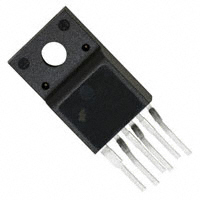
FSDM0465RB
Green Mode Fairchild Power Switch (FPSTM)
Features
• Internal Avalanche Rugged SenseFET
• Advanced Burst-Mode Operation Consumes Under One
W at 240VAC & 0.5W Load
• Precision Fixed Operating Frequency (66kHz)
• Internal Start-up Circuit
• Improved Pulse by Pulse Current Limiting
• Over Voltage Protection (OVP) : Auto-Restart
• Over Load Protection (OLP): Auto-Restart
• Internal Thermal Shutdown (TSD) : Auto-Restart
• Under Voltage Lock Out (UVLO) with Hysteresis
• Low Operating Current (2.5mA)
• Built-in Soft Start
Application
• SMPS for LCD monitor and STB
• Adapter
OUTPUT POWER TABLE (4)
230VAC ±15%(3)
85-265VAC
PRODUCT
Adapter(1)
Open
Frame(2)
Adapter(1)
Open
Frame(2)
FSDM0465RB
48W
56W
40W
48W
FSDM0565RB
60W
70W
50W
60W
FSDM07652RB
70W
80W
60W
70W
FSDM12652RB
90W
110W
80W
90W
Table 1. Maximum Output Power
Notes:
1. Typical continuous power in a non-ventilated enclosed
adapter measured at 50°C ambient.
2. Maximum practical continuous power in an open frame
design at 50°C ambient.
3. 230 VAC or 100/115 VAC with doubler.
4. The junction temperature can limit the maximum output
power.
Related Application Notes
• AN4137 - Design Guidelines for Off-line Flyback
Converters Using Fairchild Power Switch (FPS)
• AN4140 - Transformer Design Consideration for Off-line
Flyback Converters Using Fairchild Power Switch
• AN4141 - Troubleshooting and Design Tips for Fairchild
Power Switch Flyback Applications
• AN4148 - Audible Noise Reduction Techniques for FPS
Applications
Description
The FSDM0465RB is an integrated Pulse Width Modulator
(PWM) and SenseFET specifically designed for high
performance offline Switch Mode Power Supplies (SMPS)
with minimal external components. This device is an
integrated high voltage power switching regulator which
combines a rugged avalanche, SenseFET with a current mode
PWM control block. The PWM controller includes integrated
fixed frequency oscillator, under voltage lockout, leading edge
blanking (LEB), optimized gate driver, internal soft start,
temperature compensated precise current sources for a loop
compensation and self protection circuitry. Compared with a
discrete MOSFET and PWM controller solution, the PWM/
FSDMRB can reduce total cost, component count, size and
weigh, while simultaneously increasing efficiency, productivity,
and system reliability. This device provides a basic platform
well suited for cost-effective designs of flyback converters.
FPSTM is a trademark of Fairchild Semiconductor Corporation
©2005 Fairchild Semiconductor Corporation
Typical Circuit
AC
IN
DC
OUT
Vstr
Drain
PWM
Vfb
Vcc
Source
Figure 1. Typical Flyback Application
Rev.1.0.0
�FSDM0465RB
Internal Block Diagram
Vcc
Drain
1
Vstr
6
3
N.C 5
ICH
0.5/0.7V
+
Vref
8V/12V
Vcc
Vcc good
Internal
Bias
Vref
OSC
Idelay
IFB
2.5R
PWM
S
Q
R
Q
VFB 4
Soft start
R
Gate
driver
LEB
VSD
Vcc
2 GND
S
Q
R
Q
Vovp
TSD
Vcc Good
good
Vcc
Figure 2. Functional Block Diagram of FSDM0465RB
2
VCL
�FSDM0465RB
Pin Description
Pin Number
Pin Name
Pin Function Description
1
Drain
This pin is the high voltage power SenseFET drain. It is designed to drive the
transformer directly.
2
GND
This pin is the control ground and the SenseFET source.
Vcc
This pin is the positive supply voltage input. During start up, the power is supplied by an internal high voltage current source that is connected to the Vstr pin.
When Vcc reaches 12V, the internal high voltage current source is disabled and
the power is supplied from the auxiliary transformer winding.
4
Vfb
This pin is internally connected to the inverting input of the PWM comparator.
The collector of an opto-coupler is typically tied to this pin. For stable operation,
a capacitor should be placed between this pin and GND. If the voltage of this pin
reaches 6.0V, the over load protection is activated resulting in shutdown of the
FPSTM.
5
N.C
-
Vstr
This pin is connected directly to the high voltage DC link. At startup, the internal
high voltage current source supplies internal bias and charges the external capacitor that is connected to the Vcc pin. Once Vcc reaches 12V, the internal current source is disabled.
3
6
Pin Assignments
TO-220F-6L
6.Vstr
5.N.C.
4.Vfb
3.Vcc
2.GND
1.Drain
Figure 3. Pin Configuration (Top View)
3
�FSDM0465RB
Absolute Maximum Ratings
(Ta=25°C, unless otherwise specified)
Parameter
Drain-source Voltage
Vstr Max Voltage
Pulsed Drain Current (Tc=25°C)
(1)
Continuous Drain Current (Tc=25°C) (2)
Continuous Drain Current (Tc=100°C) (2)
*
Continuous Drain Current (TDL=25°C)
Single Pulsed Avalanche
(3)
Energy (4)
Symbol
Value
Unit
VDSS
650
V
VSTR
650
V
IDM
9.6
A
2.2
A (rms)
1.4
A (rms)
4
A (rms)
-
mJ
ID
ID
*
EAS
Supply Voltage
VCC
20
V
Input Voltage Range
VFB
-0.3 to VCC
V
PD
33
W
Tj
Internally limited
°C
Total Power Dissipation
(Tc=25°C) (2)
Operating Junction Temperature
TA
-25 to +85
°C
TSTG
-55 to +150
°C
ESD Capability, HBM Model (All pins
except Vstr and Vfb)
-
2.0
(GND-Vstr/Vfb=1.5kV)
kV
ESD Capability, Machine Model (All pins
except Vstr and Vfb)
-
300
(GND-Vstr/Vfb=225V)
V
Operating Ambient Temperature
Storage Temperature Range
Notes:
1. Repetitive Rating: Pulse width limited by maximum junction temperature
2. Tc: Case Back Surface Temperature (With infinite heat sink)
3. TDL: Drain Lead Temperature (With infinite heat sink)
4. L=14mH, starting Tj=25°C2. L=14mH, starting Tj=25°C
Thermal Impedance
Parameter
Junction-to-Ambient Thermal
Junction-to-Case Thermal
Notes:
1. Infinite cooling condition - refer to the SEMI G30-88.
4
Symbol
Value
Unit
θJA
θJC(1)
-
°C/W
3.78
°C/W
�FSDM0465RB
Electrical Characteristics
(Ta = 25°C unless otherwise specified)
Parameter
Symbol
Condition
Min.
Typ.
Max.
Unit
BVDSS
VGS = 0V, ID = 250µA
650
-
-
V
VDS = 650V, VGS = 0V
-
-
250
µA
IDSS
VDS= 520V
VGS = 0V, TC = 125°C
-
-
250
µA
RDS(ON)
VGS = 10V, ID = 2.5A
-
2.2
2.6
Ω
Output Capacitance
COSS
VGS = 0V, VDS = 25V,
f = 1MHz
-
60
-
pF
Turn On Delay Time
TD(ON)
VDD= 325V, ID= 3.2A
-
23
-
TR
-
20
-
TD(OFF)
-
65
-
TF
-
27
-
VFB = 3V
60
66
72
kHz
13V ≤ Vcc ≤ 18V
0
1
3
%
-25°C ≤ Ta ≤ 85°C
0
±5
±10
%
SenseFET SECTION
Drain Source Breakdown Voltage
Zero Gate Voltage Drain Current
Static Drain Source On Resistance (1)
Rise Time
Turn Off Delay Time
Fall Time
ns
CONTROL SECTION
Initial Frequency
FOSC
Voltage Stability
FSTABLE
Temperature Stability (2)
∆FOSC
Maximum Duty Cycle
DMAX
-
77
82
87
%
Minimum Duty Cycle
DMIN
-
-
-
0
%
Start Threshold Voltage
VSTART
VFB=GND
11
12
13
V
Stop Threshold Voltage
VSTOP
VFB=GND
7
8
9
V
Feedback Source Current
IFB
VFB=GND
0.7
0.9
1.1
mA
Soft-start Time
TS
Vfb=3
-
10
15
ms
-
250
-
ns
Leading Edge Blanking Time
-
TLEB
BURST MODE SECTION
Burst Mode Voltages
VBURH
Vcc=14V
-
0.7
-
V
VBURL
Vcc=14V
-
0.5
-
V
5
�FSDM0465RB
Electrical Characteristics (Continued)
(Ta = 25°C unless otherwise specified)
Parameter
Symbol
Condition
Min.
Typ.
Max.
Unit
1.6
1.8
2.0
A
PROTECTION SECTION
Peak Current Limit (3)
IOVER
Over Voltage Protection
VOVP
-
18
19
20
V
Thermal Shutdown Temperature (2)
TSD
-
130
145
160
°C
Shutdown Feedback Voltage
VSD
VFB ≥ 5.5V
5.5
6.0
6.5
V
VFB=5V
2.8
3.5
4.2
µA
-
1
1.3
mA
-
2.5
5
mA
Shutdown Delay Current
IDELAY
VFB=5V, VCC=14V
TOTAL DEVICE SECTION
Startup Current (4)
Operating Supply Current (4)
Istart
VFB=GND, VCC=11V
IOP
VFB=GND, VCC=14V
IOP(MIN)
VFB=GND, VCC=10V
IOP(MAX)
VFB=GND, VCC=18V
Notes:
1. Pulse test: Pulse width ≤ 300µS, duty ≤ 2%
2. These parameters, although guaranteed at the design, are not tested in mass production.
3. These parameters indicate the inductor current.
4. This parameter is the current flowing into the control IC.
6
�FSDM0465RB
Typical Performance Characteristics
1.2
1.2
1.0
1.0
Start Threshold Voltage
(Vstart)
Operating Current
(Iop)
(These Characteristic Graphs are Normalized at Ta= 25°C)
0.8
0.6
0.4
0.2
0.8
0.6
0.4
0.2
0.0
0.0
-25
0
25
50
75
100 125
-25
150
25
50
75
100 125 150
Start Threshold Voltage vs. Temp
1.2
1.2
1.0
1.0
Operating Frequency
(Fosc)
Stop Threshold Voltage
(Vstop)
Operating Current vs. Temp
0.8
0.6
0.4
0.2
0.8
0.6
0.4
0.2
0.0
0.0
-25
0
25
50
75
100 125
-25
150
0
25
50
75
100 125
150
Ju nc tion Te mpe ratu re (℃)
Ju nc tion Te mpe ratu re (℃)
Stop Threshold Voltage vs. Temp
Operating Frequency vs. Temp
1.2
1.2
1.0
1.0
FB Source Current
(Ifb)
Maximum Duty Cycle
(Dmax)
0
Junction Temperature(℃)
Ju nc tion Te mpe ratu re (℃)
0.8
0.6
0.4
0.2
0.8
0.6
0.4
0.2
0.0
-25
0
25
50
75
100 125
Ju nc tion Te mpe ratu re (℃)
Maximum Duty vs. Temp
150
0.0
-25
0
25
50
75
100 125
150
Ju nc tion Tempe rature (℃)
Feedback Source Current vs. Temp
7
�FSDM0465RB
Typical Performance Characteristics (Continued)
1.2
1.2
1.0
1.0
Shutdown Delay Current
(Idelay)
Shutdown FB Voltage
(Vsd)
(These Characteristic Graphs are Normalized at Ta= 25°C)
0.8
0.6
0.4
0.2
0.0
0.8
0.6
0.4
0.2
0.0
-25
0
25
50
75
100 125
150
-25
Ju nc tion Te mpe ratu re (℃)
75
100
125
150
1.2
FB Burst Mode Enable Voltage
(Vfbe)
Over Voltage Protection
(Vovp)
50
Shutdown Delay Current vs. Temp
1.2
1.0
0.8
0.6
0.4
0.2
0.0
-25
0
25
50
75
1.0
0.8
0.6
0.4
0.2
0.0
-25
100 125 150
0
25
50
75
100 125 150
Junction Temperature(℃)
Junction Temperature(℃)
Over Voltage Protection vs. Temp
Burst Mode Enable Voltage vs. Temp
1.2
1.2
1.0
0.8
0.6
0.4
0.2
0.0
-25
0
25
50
75
100 125 150
Junction Temperature(℃)
Burst Mode Disable Voltage vs. Temp
Peak Current Limit(Self protection)
(Iover)
FB Burst Mode Disable Voltage
(Vfbd)
25
Ju n c tion T e mpe ra tu re (℃ )
Shutdown Feedback Voltage vs. Temp
8
0
1.0
0.8
0.6
0.4
0.2
0.0
-50
-25
0
25
50
75
100
Ju nc tion Te mpe ratu re (℃)
Current Limit vs. Temp
125
�FSDM0465RB
Typical Performance Characteristics (Continued)
(These Characteristic Graphs are Normalized at Ta= 25°C)
1.2
Soft Start Time
(Normalized to 25℃)
1.0
0.8
0.6
0.4
0.2
0.0
-50
-25
0
25
50
75
100
125
Junction Temperature(℃)
Soft Start Time vs. Temp
9
�FSDM0465RB
Functional Description
1. Startup: In previous generations of Fairchild Power
Switches (FPSTM) the Vcc pin had an external start-up
resistor to the DC input voltage line. In this generation the
startup resistor is replaced by an internal high voltage current
source. At startup, an internal high voltage current source
supplies the internal bias and charges the external capacitor
(Ca) that is connected to the Vcc pin as illustrated in Figure
4. When Vcc reaches 12V, the FSDM0465RB begins
switching and the internal high voltage current source is
disabled. Then, the FSDM0465RB continues its normal
switching operation and the power is supplied from the
auxiliary transformer winding unless Vcc goes below the
stop voltage of 8V.
VDC
2.1 Pulse-by-Pulse Current Limit: Because current mode
control is employed, the peak current through the SenseFET
is limited by the inverting input of the PWM comparator
(Vfb*) as shown in Figure 5. Assuming that the 0.9mA
current source flows only through the internal resistor (2.5R
+R= 2.8 kΩ), the cathode voltage of diode D2 is about 2.5V.
Since D1 is blocked when the feedback voltage (Vfb)
exceeds 2.5V, the maximum voltage of the cathode of D2 is
clamped at this voltage, thus clamping Vfb*. Therefore, the
peak value of the current through the SenseFET is limited.
2.2 Leading Edge Blanking (LEB): At the instant the
internal SenseFET is turned on, there usually exists a high
current spike through the SenseFET, caused by primary-side
capacitance and secondary-side rectifier reverse recovery.
Excessive voltage across the Rsense resistor would lead to
incorrect feedback operation in the current mode PWM
control. To counter this effect, the FSDM0465RB employs
an LEB circuit. This circuit inhibits the PWM comparator for
a short time (TLEB) after the, SenseFET is turned on.
Ca
Vcc
Vref
Idelay
Vcc
3
6
Vstr
4
H11A817A
CB
D2
2.5R
+
Vfb*
Vref
SenseFET
OSC
D1
ICH
8V/12V
IFB
Vfb
Vo
KA431
R
Gate
Gate
driver
Driver
-
VccGood
good
Vcc
Internal
Bias
VSD
OLP
Rsense
Figure 5. Pulse Width Modulation (PWM) Circuit
Figure 4. Internal Startup Circuit
2. Feedback Control: FSDM0465RB employs current
mode control, as shown in Figure 5. An opto-coupler (such
as the H11A817A) and shunt regulator (such as the KA431)
are typically used to implement the feedback network.
Comparing the feedback voltage with the voltage across the
Rsense resistor plus an offset voltage makes it possible to
control the switching duty cycle. When the reference pin
voltage of the KA431 exceeds the internal reference voltage
of 2.5V, the H11A817A LED current increases, thus
decreasing the feedback voltage and reducing the duty cycle.
This event typically happens when the input voltage is
increased or the output load is decreased.
3. Protection Circuit: The FSDM0465RB has several self
protective functions such as over load protection (OLP), over
voltage protection (OVP), and thermal shutdown (TSD).
Because these protection circuits are fully integrated into the
IC without external components, the reliability can be
improved without increasing cost. Once the fault condition
occurs, switching is terminated and the SenseFET remains
off. This causes Vcc to fall. When Vcc reaches the UVLO
stop voltage, 8V, the protection is reset and the internal high
voltage current source charges the Vcc capacitor via the Vstr
pin. When Vcc reaches the UVLO start voltage,12V, the
FSDM0465RB resumes its normal operation. In this manner,
the auto-restart can alternately enable and disable the
switching of the power Sense FET until the fault condition is
eliminated (see Figure 6).
10
�FSDM0465RB
Vds
Power
On
on
Fault
Occurs
occurs
VFB
Fault
Removed
removed
Over Load
Protection
load protection
6.0V
2.5V
Vcc
T 12= Cfb*(6.0-2.5)/Idelay
12V
T1
8V
T2
t
Figure 7. Over Load Protection
t
Normal
Operation
operation
Fault
Situation
situation
Normal
Operation
operation
Figure 6. Auto Restart Operation
3.1 Over Load Protection (OLP): Overload is defined as
the load current exceeding a pre-set level due to an
unexpected event. In this situation, the protection circuit
should be activated to protect the SMPS.
However, even when the SMPS is operation normally, the
over load protection circuit can be activated during the load
transition. To avoid this undesired operation, the over load
protection circuit is designed to be activated after a specified
time to determine whether it is a transient situation or an
overload situation.
Because of the pulse-by-pulse current limit capability, the
maximum peak current through the SenseFET is limited, and
therefore the maximum input power is restricted with a given
input voltage. If the output consumes beyond this maximum
power, the output voltage (Vo) decreases below the set
voltage. This reduces the current through the opto-coupler
LED, which also reduces the opto-coupler transistor current,
thus increasing the feedback voltage (Vfb).
If Vfb exceeds 2.5V, D1 is blocked and the 3.5uA current
source starts to charge CB slowly up to Vcc.
In this condition, Vfb continues increasing until it reaches
6V, when the switching operation is terminated as shown in
Figure 7. The delay time for shutdown is the time required to
charge CB from 2.5V to 6.0V with 3.5uA.
In general, a 10 ~ 50 ms delay time is typical for most
applications.
11
3.2 Over Voltage Protection (OVP): If the secondary side
feedback circuit malfunction or a solder defect caused an
open in the feedback path, the current through the optocoupler transistor becomes almost zero. Then, Vfb climbs up
in a similar manner to the over load situation, forcing the
preset maximum current to be supplied to the SMPS until the
over load protection is activated. Because more energy than
required is provided to the output, the output voltage may
exceed the rated voltage before the over load protection is
activated, resulting in the breakdown of the devices in the
secondary side. To prevent this situation, an OVP circuit is
employed. In general, Vcc is proportional to the output
voltage and the FSDM0465RB uses Vcc instead of directly
monitoring the output voltage. If VCC exceeds 19V, an OVP
circuit is activated resulting in the termination of the
switching operation. To avoid undesired activation of OVP
during normal operation, Vcc should be designed to be
below 19V.
3.3 Thermal Shutdown (TSD): The SenseFET and the
control IC are built in one package. This makes it easy for
the control IC to detect the heat generation from the Sense
FET. When the temperature exceeds approximately 150°C,
the thermal shutdown is activated.
4. Soft Start: The FSDM0465RB’s internal soft-start circuit
slowly increases the PWM comparator’s inverting input
voltage along with the SenseFET current after it starts up.
The typical soft-start time is 10msec, The pulse width to the
power switching device is progressively increased to
establish the correct working conditions for transformers,
inductors, and capacitors. The voltage on the output
capacitors is progressively increased with the intention of
smoothly establishing the required output voltage. It also
helps to prevent transformer saturation and reduce the stress
on the secondary diode during startup.
�FSDM0465RB
5. Burst Operation: To minimize power dissipation in
standby mode, the FSDM0465RB enters burst mode
operation. As the load decreases, the feedback voltage
decreases. As shown in Figure 8, the device automatically
enters burst mode when the feedback voltage drops below
VBURL(500mV). At this point switching stops and the
output voltages start to drop at a rate dependent on the
standby current load. This causes the feedback voltage to
rise. Once it passes VBURH(700mV), switching resumes.
The feedback voltage then falls and the process repeats.
Burst mode operation alternately enables and disables
switching of the power SenseFET thereby reducing
switching loss in Standby mode.
Vo
Voset
VFB
0.7V
0.5V
Ids
Vds
time
Switching
Switching
Switching
Switching
disabled
disabled
T1 Disabled T2 T3 Disabled T4
Figure 8. Waveforms of Burst Operation
12
�FSDM0465RB
Typical application circuit
Application
Output Power
LCD Monitor
34W
Input Voltage
Output Voltage (Max Current)
Universal Input
5V (2.0A)
(85-265Vac)
12V (2.0A)
Features
•
•
•
•
•
•
High efficiency (>81% at 85Vac input)
Low zero load power consumption (