Is Now Part of
To learn more about ON Semiconductor, please visit our website at
www.onsemi.com
Please note: As part of the Fairchild Semiconductor integration, some of the Fairchild orderable part numbers
will need to change in order to meet ON Semiconductor’s system requirements. Since the ON Semiconductor
product management systems do not have the ability to manage part nomenclature that utilizes an underscore
(_), the underscore (_) in the Fairchild part numbers will be changed to a dash (-). This document may contain
device numbers with an underscore (_). Please check the ON Semiconductor website to verify the updated
device numbers. The most current and up-to-date ordering information can be found at www.onsemi.com. Please
email any questions regarding the system integration to Fairchild_questions@onsemi.com.
ON Semiconductor and the ON Semiconductor logo are trademarks of Semiconductor Components Industries, LLC dba ON Semiconductor or its subsidiaries in the United States and/or other countries. ON Semiconductor owns the rights to a number
of patents, trademarks, copyrights, trade secrets, and other intellectual property. A listing of ON Semiconductor’s product/patent coverage may be accessed at www.onsemi.com/site/pdf/Patent-Marking.pdf. ON Semiconductor reserves the right
to make changes without further notice to any products herein. ON Semiconductor makes no warranty, representation or guarantee regarding the suitability of its products for any particular purpose, nor does ON Semiconductor assume any liability
arising out of the application or use of any product or circuit, and specifically disclaims any and all liability, including without limitation special, consequential or incidental damages. Buyer is responsible for its products and applications using ON
Semiconductor products, including compliance with all laws, regulations and safety requirements or standards, regardless of any support or applications information provided by ON Semiconductor. “Typical” parameters which may be provided in ON
Semiconductor data sheets and/or specifications can and do vary in different applications and actual performance may vary over time. All operating parameters, including “Typicals” must be validated for each customer application by customer’s
technical experts. ON Semiconductor does not convey any license under its patent rights nor the rights of others. ON Semiconductor products are not designed, intended, or authorized for use as a critical component in life support systems or any FDA
Class 3 medical devices or medical devices with a same or similar classification in a foreign jurisdiction or any devices intended for implantation in the human body. Should Buyer purchase or use ON Semiconductor products for any such unintended
or unauthorized application, Buyer shall indemnify and hold ON Semiconductor and its officers, employees, subsidiaries, affiliates, and distributors harmless against all claims, costs, damages, and expenses, and reasonable attorney fees arising out
of, directly or indirectly, any claim of personal injury or death associated with such unintended or unauthorized use, even if such claim alleges that ON Semiconductor was negligent regarding the design or manufacture of the part. ON Semiconductor
is an Equal Opportunity/Affirmative Action Employer. This literature is subject to all applicable copyright laws and is not for resale in any manner.
�www.fairchildsemi.com
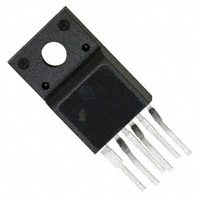
FSDM07652RB
Green Mode Fairchild Power Switch (FPSTM)
Features
• Internal Avalanche Rugged Sense FET
• Advanced Burst-Mode operation consumes under 1 W at
240VAC & 0.5W load
• Precision Fixed Operating Frequency (66kHz)
• Internal Start-up Circuit
• Improved Pulse by Pulse Current Limiting
• Over Voltage Protection (OVP)
• Over Load Protection (OLP)
• Internal Thermal Shutdown Function (TSD)
• Auto-Restart Mode
• Under Voltage Lock Out (UVLO) with hysteresis
• Low Operating Current (2.5mA)
• Built-in Soft Start
OUTPUT POWER TABLE
230VAC ±15%(3)
PRODUCT
Adapter(1)
Open
Frame(2)
85-265VAC
Adapter(1)
Open
Frame(2)
FSDM0565RB
60W
70W
50W
60W
FSDM07652RB
70W
80W
60W
70W
Table 1. Maximum Output Power
Notes:
1. Typical continuous power in a non-ventilated enclosed
adapter measured at 50°C ambient.
2. Maximum practical continuous power in an open frame
design at 50°C ambient.
3. 230 VAC or 100/115 VAC with doubler.
Application
• SMPS for LCD monitor and STB
• Adaptor
Typical Circuit
Description
The FSDM07652RB is an integrated Pulse Width Modulator
(PWM) and Sense FET specifically designed for high
performance offline Switch Mode Power Supplies (SMPS)
with minimal external components. This device is an
integrated high voltage power switching regulator which
combine an avalanche rugged Sense FET with a current mode
PWM control block. The PWM controller includes integrated
fixed frequency oscillator, under voltage lockout, leading edge
blanking (LEB), optimized gate driver, internal soft start,
temperature compensated precise current sources for a loop
compensation and self protection circuitry. Compared with
discrete MOSFET and PWM controller solution, it can reduce
total cost, component count, size and weight simultaneously
increasing efficiency, productivity, and system reliability. This
device is a basic platform well suited for cost effective
designs of flyback converters.
AC
IN
DC
OUT
Vstr
Drain
PWM
Vfb
Vcc
Source
Figure 1. Typical Flyback Application
Rev.1.0.6
©2005 Fairchild Semiconductor Corporation
�FSDM07652RB
Internal Block Diagram
Vcc
Drain
1
Vstr
6
3
N.C 5
Istart
0.5/0.7V
+
Vref
8V/12V
Vcc
Vcc good
Internal
Bias
Vref
OSC
Idelay
IFB
2.5R
PWM
S
Q
R
Q
FB 4
Soft start
R
Gate
driver
LEB
VSD
2 GND
Vcc
S
Q
R
Q
Vovp
TSD
Vcc good
Figure 2. Functional Block Diagram of FSDM07652RB
2
VCL
�FSDM07652RB
Pin Definitions
Pin Number
Pin Name
Pin Function Description
1
Drain
This pin is the high voltage power Sense FET drain. It is designed to drive the
transformer directly.
2
GND
This pin is the control ground and the Sense FET source.
Vcc
This pin is the positive supply voltage input. During start up, the power is supplied by an internal high voltage current source that is connected to the Vstr pin.
When Vcc reaches 12V, the internal high voltage current source is disabled and
the power is supplied from the auxiliary transformer winding.
4
Vfb
This pin is internally connected to the inverting input of the PWM comparator.
The collector of an opto-coupler is typically tied to this pin. For stable operation,
a capacitor should be placed between this pin and GND. If the voltage of this pin
reaches 6.0V, the over load protection is activated resulting in shutdown of the
FPSTM.
5
N.C
-
Vstr
This pin is connected directly to the high voltage DC link. At startup, the internal
high voltage current source supplies internal bias and charges the external capacitor that is connected to the Vcc pin. Once Vcc reaches 12V, the internal current source is disabled.
3
6
Pin Configuration
TO-220F-6L
6.Vstr
5.N.C.
4.Vfb
3.Vcc
2.GND
1.Drain
Figure 3. Pin Configuration (Top View)
3
�FSDM07652RB
Absolute Maximum Ratings
(Ta=25°C, unless otherwise specified)
Parameter
Drain-source voltage
Vstr Max Voltage
Pulsed Drain current (Tc=25°C)
(1)
Continuous Drain Current(Tc=25°C)
Continuous Drain Current(Tc=100°C)
Symbol
Value
Unit
VBSS
650
V
VSTR
650
V
IDM
15
ADC
3.8
A
2.4
A
ID
Single pulsed avalanche energy
(2)
EAS
370
mJ
Single pulsed avalanche current
(3)
IAS
-
A
VCC
20
V
Supply voltage
VFB
-0.3 to VCC
V
PD(Watt H/S)
45
W
Operating junction temperature
Tj
Internally limited
°C
Operating ambient temperature
TA
-25 to +85
°C
TSTG
-55 to +150
°C
ESD Capability, HBM Model (All pins
excepts for Vstr and Vfb)
-
2.0
(GND-Vstr/Vfb=1.5kV)
kV
ESD Capability, Machine Model (All pins
excepts for Vstr and Vfb)
-
300
(GND-Vstr/Vfb=225V)
V
Symbol
Value
Unit
θJA
θJC(2)
49.90
°C/W
2.78
°C/W
Input voltage range
Total power dissipation(Tc=25°C)
Storage temperature range
Notes:
1. Repetitive rating: Pulse width limited by maximum junction temperature
2. L=14mH, starting Tj=25°C
3. L=13uH, starting Tj=25°C
Thermal Impedance
Parameter
Junction-to-Ambient Thermal
Junction-to-Case Thermal
Notes:
1. Free standing with no heat-sink under natural convection.
2. Infinite cooling condition - Refer to the SEMI G30-88.
4
(1)
�FSDM07652RB
Electrical Characteristics
(Ta = 25°C unless otherwise specified)
Parameter
Symbol
Condition
Min.
Typ.
Max.
Unit
BVDSS
VGS = 0V, ID = 250µA
650
-
-
V
VDS = 650V, VGS = 0V
-
-
500
µA
IDSS
VDS= 520V
VGS = 0V, TC = 125°C
-
-
500
µA
RDS(ON)
VGS = 10V, ID = 2.5A
-
1.4
1.6
Ω
Output capacitance
COSS
VGS = 0V, VDS = 25V,
f = 1MHz
-
100
-
pF
Turn on delay time
TD(ON)
-
22
-
-
60
-
-
115
-
-
65
-
VFB = 3V
60
66
72
kHz
13V ≤ Vcc ≤ 18V
0
1
3
%
-25°C ≤ Ta ≤ 85°C
0
±5
±10
%
Sense FET SECTION
Drain source breakdown voltage
Zero gate voltage drain current
Static drain source on resistance (1)
Rise time
Turn off delay time
Fall time
TR
TD(OFF)
VDD= 325V, ID= 5A
(MOSFET switching
time is essentially
independent of
operating temperature)
TF
ns
CONTROL SECTION
Initial frequency
FOSC
Voltage stability
FSTABLE
Temperature stability (2)
∆FOSC
Maximum duty cycle
DMAX
-
75
80
85
%
Minimum duty cycle
DMIN
-
-
-
0
%
Start threshold voltage
VSTART
VFB=GND
11
12
13
V
Stop threshold voltage
VSTOP
VFB=GND
7
8
9
V
Feedback source current
IFB
VFB=GND
0.7
0.9
1.1
mA
Soft-start time
TS
Vfb=3
-
10
15
ms
-
250
-
ns
Leading Edge Blanking time
-
TLEB
BURST MODE SECTION
VBURH
Vcc=14V
-
0.7
-
V
VBURL
Vcc=14V
-
0.5
-
V
Peak current limit (4)
IOVER
VFB=5V, VCC=14V
2.2
2.5
2.8
A
Over voltage protection
VOVP
18
19
20
V
130
145
160
°C
VFB ≥ 5.5V
5.5
6.0
6.5
V
VFB=5V
2.8
3.5
4.2
µA
Burst Mode Voltages (2)
PROTECTION SECTION
Thermal shutdown temperature (2)
TSD
Shutdown feedback voltage
VSD
Shutdown delay current
IDELAY
-
5
�FSDM07652RB
TOTAL DEVICE SECTION
Operating supply current
(5)
IOP
VFB=GND, VCC=14V
IOP(MIN)
VFB=GND, VCC=10V
IOP(MAX)
VFB=GND, VCC=18V
Notes:
1. Pulse test : Pulse width ≤ 300µS, duty ≤ 2%
2. These parameters, although guaranteed at the design, are not tested in mass production.
3. These parameters, although guaranteed, are tested only in EDS(wafer test) process.
4. These parameters indicate the inductor current.
5. This parameter is the current flowing into the control IC.
6
-
2.5
5
mA
�FSDM07652RB
Comparison Between FS6M07652RTC and FSDM07652RB
Function
FS6M07652RTC
Soft-Start
Adjustable soft-start
time using an
external capacitor
Burst Mode Operation
FSDM07652RB
FSDM07652RB Advantages
Internal soft-start with • Gradually increasing current limit
typically 10ms (fixed)
during soft-start further reduces peak
current and voltage component
stresses
• Eliminates external components used
for soft-start in most applications
• Reduces or eliminates output
overshoot
• Built into controller • Built into controller • Improve light load efficiency
• Output voltage fixed • Reduces no-load consumption
• Output voltage
drops to around
half
7
�FSDM07652RB
Typical Performance Characteristics
1.2
1.2
1.0
1.0
Start Thershold Voltage
(Normalized to 25℃)
Operating Current
(Normalized to 25℃)
(These Characteristic Graphs are Normalized at Ta= 25°C)
0.8
0.6
0.4
0.2
0.8
0.6
0.4
0.2
0.0
0.0
-50
-25
0
25
50
75
100
-50
125
1.2
1.2
1.0
1.0
0.8
0.6
0.4
25
50
75
100
125
0.8
0.6
0.4
0.2
0.2
0.0
0.0
-50
-25
0
25
50
75
100
125
-50
Junction Temperature(℃)
-25
0
25
50
75
100
125
Junction Temperature(℃)
Stop Threshold Voltage vs. Temp
Operating Freqency vs. Temp
1.2
1.2
1.0
FB Source Current
(Normalized to 25℃)
1.0
Maximum Duty Cycle
(Normalized to 25℃)
0
Start Threshold Voltage vs. Temp
Initial Frequency
(Normalized to 25℃)
Stop Threshold Voltage
(Normalized to 25℃)
Operating Current vs. Temp
0.8
0.6
0.4
0.2
0.8
0.6
0.4
0.2
0.0
-50
-25
0
25
50
75
100
Junction Temperature(℃)
Maximum Duty vs. Temp
8
-25
Junction Temperature(℃)
Junction Temperature(℃)
125
0.0
-50
-25
0
25
50
75
100
Junction Temperature(℃)
Feedback Source Current vs. Temp
125
�FSDM07652RB
Typical Performance Characteristics (Continued)
1.2
1.2
1.0
1.0
Shutdown Delay Current
(Normalized to 25℃)
Shutdown FB Voltage
(Normalized to 25℃)
(These Characteristic Graphs are Normalized at Ta= 25°C)
0.8
0.6
0.4
0.2
0.0
-50
-25
0
25
50
75
100
0.8
0.6
0.4
0.2
0.0
125
-50
-25
Junction Temperature(℃)
ShutDown Feedback Voltage vs. Temp
25
50
75
100
125
ShutDown Delay Current vs. Temp
1.2
1.2
Burst Mode Enable Voltage
(Normalized to 25℃)
1.0
Over Voltage Protection
(Normalized to 25℃)
0
Junction Temperature(℃)
0.8
0.6
0.4
0.2
1.0
0.8
0.6
0.4
0.2
0.0
-50
-25
0
25
50
75
100
0.0
125
-50
Junction Temperature(℃)
-25
0
25
50
75
100
125
Junction Temperature(℃)
Burst Mode Enable Voltage vs. Temp
1.2
1.2
1.0
1.0
Over Current Limit
(Normalized to 25℃)
Burst Mode Disable Voltage
(Normalized to 25℃)
Over Voltage Protection vs. Temp
0.8
0.6
0.4
0.2
0.8
0.6
0.4
0.2
0.0
0.0
-50
-25
0
25
50
75
100
125
Junction Temperature(℃)
Burst Mode Disable Voltage vs. Temp
-50
-25
0
25
50
75
100
125
Junction Temperature(℃)
Current Limit vs. Temp
9
�FSDM07652RB
Typical Performance Characteristics (Continued)
(These Characteristic Graphs are Normalized at Ta= 25°C)
1.2
Soft Start Time
(Normalized to 25℃)
1.0
0.8
0.6
0.4
0.2
0.0
-50
-25
0
25
50
75
Junction Temperature(℃)
Soft Start Time vs. Temp
10
100
125
�FSDM07652RB
Functional Description
1. Startup : In previous generations of Fairchild Power
Switches (FPSTM) the Vcc pin had an external start-up
resistor to the DC input voltage line. In this generation the
startup resistor is replaced by an internal high voltage current
source. At startup, an internal high voltage current source
supplies the internal bias and charges the external capacitor
(Cvcc) that is connected to the Vcc pin as illustrated in
Figure 4. When Vcc reaches 12V, the FSDM07652RB
begins switching and the internal high voltage current source
is disabled. Then, the FSDM07652RB continues its normal
switching operation and the power is supplied from the
auxiliary transformer winding unless Vcc goes below the
stop voltage of 8V.
VDC
CVcc
Vcc
3
6
2.1 Pulse-by-pulse current limit: Because current mode
control is employed, the peak current through the Sense FET
is limited by the inverting input of PWM comparator (Vfb*)
as shown in Figure 5. Assuming that the 0.9mA current
source flows only through the internal resistor (2.5R +R= 2.8
kΩ), the cathode voltage of diode D2 is about 2.5V. Since D1
is blocked when the feedback voltage (Vfb) exceeds 2.5V,
the maximum voltage of the cathode of D2 is clamped at this
voltage, thus clamping Vfb*. Therefore, the peak value of
the current through the Sense FET is limited.
2.2 Leading edge blanking (LEB) : At the instant the
internal Sense FET is turned on, there usually exists a high
current spike through the Sense FET, caused by primary-side
capacitance and secondary-side rectifier reverse recovery.
Excessive voltage across the Rsense resistor would lead to
incorrect feedback operation in the current mode PWM
control. To counter this effect, the FSDM07652RB employs
a leading edge blanking (LEB) circuit. This circuit inhibits
the PWM comparator for a short time (TLEB) after the Sense
FET is turned on.
Vstr
Vcc
Istart
Vref
8V/12V
Vref
Idelay
Vcc good
Vfb
Vo
4
H11A817A
Figure 4. Internal startup circuit
SenseFET
OSC
D1
CB
Internal
Bias
IFB
D2
2.5R
+
Vfb*
KA431
Gate
driver
R
-
VSD
OLP
Rsense
Figure 5. Pulse width modulation (PWM) circuit
2. Feedback Control : FSDM07652RB employs current
mode control, as shown in Figure 5. An opto-coupler (such
as the H11A817A) and shunt regulator (such as the KA431)
are typically used to implement the feedback network.
Comparing the feedback voltage with the voltage across the
Rsense resistor plus an offset voltage makes it possible to
control the switching duty cycle. When the reference pin
voltage of the KA431 exceeds the internal reference voltage
of 2.5V, the H11A817A LED current increases, thus pulling
down the feedback voltage and reducing the duty cycle. This
event typically happens when the input voltage is increased
or the output load is decreased.
3. Protection Circuit : The FSDM07652RB has several self
protective functions such as over load protection (OLP), over
voltage protection (OVP) and thermal shutdown (TSD).
Because these protection circuits are fully integrated into the
IC without external components, the reliability can be
improved without increasing cost. Once the fault condition
occurs, switching is terminated and the Sense FET remains
off. This causes Vcc to fall. When Vcc reaches the UVLO
stop voltage, 8V, the protection is reset and the internal high
voltage current source charges the Vcc capacitor via the Vstr
pin. When Vcc reaches the UVLO start voltage,12V, the
FSDM07652RB resumes its normal operation. In this
manner, the auto-restart can alternately enable and disable
the switching of the power Sense FET until the fault
condition is eliminated (see Figure 6).
11
�FSDM07652RB
Vds
Power
on
Fault
occurs
VFB
Fault
removed
Over load protection
6.0V
2.5V
Vcc
T 12= Cfb*(6.0-2.5)/Idelay
T1
12V
T2
t
Figure 7. Over load protection
8V
t
Normal
operation
Fault
situation
Normal
operation
Figure 6. Auto restart operation
3.1 Over Load Protection (OLP) : Overload is defined as
the load current exceeding a pre-set level due to an
unexpected event. In this situation, the protection circuit
should be activated in order to protect the SMPS. However,
even when the SMPS is in the normal operation, the over
load protection circuit can be activated during the load
transition. In order to avoid this undesired operation, the over
load protection circuit is designed to be activated after a
specified time to determine whether it is a transient situation
or an overload situation. Because of the pulse-by-pulse
current limit capability, the maximum peak current through
the Sense FET is limited, and therefore the maximum input
power is restricted with a given input voltage. If the output
consumes beyond this maximum power, the output voltage
(Vo) decreases below the set voltage. This reduces the
current through the opto-coupler LED, which also reduces
the opto-coupler transistor current, thus increasing the
feedback voltage (Vfb). If Vfb exceeds 2.5V, D1 is blocked
and the 3.5uA current source starts to charge CB slowly up to
Vcc. In this condition, Vfb continues increasing until it
reaches 6V, when the switching operation is terminated as
shown in Figure 7. The delay time for shutdown is the time
required to charge CB from 2.5V to 6.0V with 3.5uA. In
general, a 10 ~ 50 ms delay time is typical for most
applications.
12
3.2 Over voltage Protection (OVP) : If the secondary side
feedback circuit were to malfunction or a solder defect
caused an open in the feedback path, the current through the
opto-coupler transistor becomes almost zero. Then, Vfb
climbs up in a similar manner to the over load situation,
forcing the preset maximum current to be supplied to the
SMPS until the over load protection is activated. Because
more energy than required is provided to the output, the
output voltage may exceed the rated voltage before the over
load protection is activated, resulting in the breakdown of the
devices in the secondary side. In order to prevent this
situation, an over voltage protection (OVP) circuit is
employed. In general, Vcc is proportional to the output
voltage and the FSDM07652RB uses Vcc instead of directly
monitoring the output voltage. If VCC exceeds 19V, an OVP
circuit is activated resulting in the termination of the
switching operation. In order to avoid undesired activation of
OVP during normal operation, Vcc should be designed to be
below 19V.
3.3 Thermal Shutdown (TSD) : The Sense FET and the
control IC are built in one package. This makes it easy for
the control IC to detect the heat generation from the Sense
FET. When the temperature exceeds approximately 150°C,
the thermal shutdown is activated.
4. Soft Start : The FSDM07652RB has an internal soft start
circuit that increases PWM comparator inverting input
voltage together with the Sense FET current slowly after it
starts up. The typical soft start time is 10msec, The pulse
width to the power switching device is progressively
increased to establish the correct working conditions for
transformers, inductors, and capacitors. The voltage on the
output capacitors is progressively increased with the
intention of smoothly establishing the required output
voltage. It also helps to prevent transformer saturation and
reduce the stress on the secondary diode during startup.
�FSDM07652RB
5. Burst operation : In order to minimize power dissipation
in standby mode, the FSDM07652RB enters burst mode
operation. As the load decreases, the feedback voltage
decreases. As shown in Figure 8, the device automatically
enters burst mode when the feedback voltage drops below
VBURL(500mV). At this point switching stops and the
output voltages start to drop at a rate dependent on standby
current load. This causes the feedback voltage to rise. Once
it passes VBURH(700mV) switching resumes. The feedback
voltage then falls and the process repeats. Burst mode
operation alternately enables and disables switching of the
power Sense FET thereby reducing switching loss in
Standby mode.
Vo
Voset
VFB
0.7V
0.5V
Ids
Vds
time
Switching
disabled
T1
T2 T3
Switching
disabled
T4
Figure 8. Waveforms of burst operation
13
�FSDM07652RB
Typical application circuit
Application
Output power
LCD Monitor
40W
Input voltage
Output voltage (Max current)
Universal input
5V (2.0A)
(85-265Vac)
12V (2.5A)
Features
•
•
•
•
•
•
High efficiency (>81% at 85Vac input)
Low zero load power consumption (