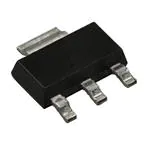
HUFA75309T3ST
Data Sheet
3A, 55V, 0.070 Ohm, N-Channel UltraFET
Power MOSFET
This N-Channel power MOSFET is
manufactured using the innovative
UltraFET® process. This advanced
process technology achieves the
lowest possible on-resistance per silicon area, resulting in
outstanding performance. This device is capable of
withstanding high energy in the avalanche mode and the
diode exhibits very low reverse recovery time and stored
charge. It was designed for use in applications where power
efficiency is important, such as switching regulators,
switching converters, motor drivers, relay drivers, lowvoltage bus switches, and power management in portable
and battery operated products.
December 2001
Features
• 3A, 55V
• Ultra Low On-Resistance, rDS(ON) = 0.070Ω
• Diode Exhibits Both High Speed and Soft Recovery
• Temperature Compensating PSPICE® Model
• Thermal Impedance SPICE Model
• Peak Current vs Pulse Width Curve
• UIS Rating Curve
• Related Literature
- TB334, “Guidelines for Soldering Surface Mount
Components to PC Boards”
Symbol
Formerly developmental type TA75309.
D
Ordering Information
PART NUMBER
HUFA75309T3ST
PACKAGE
SOT-223
G
BRAND
5309
S
NOTE: HUFA75309T3ST is available only in tape and reel.
Packaging
SOT-223
DRAIN
(FLANGE)
GATE
DRAIN
SOURCE
This product has been designed to meet the extreme test conditions and environment demanded by the automotive industry. For a copy
of the requirements, see AEC Q101 at: http://www.aecouncil.com/
Reliability data can be found at: http://www.fairchildsemi.com/products/discrete/reliability/index.html.
All Fairchild semiconductor products are manufactured, assembled and tested under ISO9000 and QS9000 quality systems certification.
©2001 Fairchild Semiconductor Corporation
HUFA75309T3ST Rev. B
�HUFA75309T3ST
Absolute Maximum Ratings
TA = 25oC, Unless Otherwise Specified
Drain to Source Voltage (Note 1) . . . . . . . . . . . . . . . . . . . . . . . . . . . . . . . . . . . . . . . . . . . . . . . VDSS
Drain to Gate Voltage (RGS = 20kΩ) (Note 1) . . . . . . . . . . . . . . . . . . . . . . . . . . . . . . . . . . . . . VDGR
Gate to Source Voltage . . . . . . . . . . . . . . . . . . . . . . . . . . . . . . . . . . . . . . . . . . . . . . . . . . . . . . . VGS
Drain Current
Continuous (Note 2) (Figure 2). . . . . . . . . . . . . . . . . . . . . . . . . . . . . . . . . . . . . . . . . . . . . . . . . . ID
Pulsed Drain Current . . . . . . . . . . . . . . . . . . . . . . . . . . . . . . . . . . . . . . . . . . . . . . . . . . . . . . . . IDM
Pulsed Avalanche Rating . . . . . . . . . . . . . . . . . . . . . . . . . . . . . . . . . . . . . . . . . . . . . . . . . . . . . . EAS
Power Dissipation (Note 2) . . . . . . . . . . . . . . . . . . . . . . . . . . . . . . . . . . . . . . . . . . . . . . . . . . . . . PD
Derate Above 25oC . . . . . . . . . . . . . . . . . . . . . . . . . . . . . . . . . . . . . . . . . . . . . . . . . . . . . . . . . . . .
Operating and Storage Temperature . . . . . . . . . . . . . . . . . . . . . . . . . . . . . . . . . . . . . . . . . TJ, TSTG
Maximum Temperature for Soldering
Leads at 0.063in (1.6mm) from Case for 10s . . . . . . . . . . . . . . . . . . . . . . . . . . . . . . . . . . . . . . . TL
Package Body for 10s, See Techbrief 334 . . . . . . . . . . . . . . . . . . . . . . . . . . . . . . . . . . . . . . . Tpkg
HUFA75309T3ST
55
55
±20V
UNITS
V
V
V
3
Figure 5
Figures 6, 14, 15
1.1
9.09
-55 to 150
A
W
mW/oC
oC
300
260
oC
oC
CAUTION: Stresses above those listed in “Absolute Maximum Ratings” may cause permanent damage to the device. This is a stress only rating and operation of the
device at these or any other conditions above those indicated in the operational sections of this specification is not implied.
NOTE:
1. TJ = 25oC to 125oC.
Electrical Specifications
TA = 25oC, Unless Otherwise Specified
PARAMETER
SYMBOL
TEST CONDITIONS
MIN
TYP
MAX
UNITS
V
Drain to Source Breakdown Voltage
BVDSS
ID = 250µA, VGS = 0V (Figure 11)
55
-
-
Gate to Source Threshold Voltage
VGS(TH)
VGS = VDS, ID = 250µA (Figure 10)
2
-
4
V
VDS = 50V, VGS = 0V
-
-
1
µA
Zero Gate Voltage Drain Current
IDSS
Gate to Source Leakage Current
Drain to Source On Resistance
IGSS
-
-
250
µA
VGS = ±20V
-
-
100
nA
rDS(ON)
ID = 3A, VGS = 10V (Figure 9)
-
0.057
0.070
Ω
tON
VDD = 30V, ID ≅ 3A, RL = 10Ω,
VGS = 10V, RGS = 28Ω
-
-
45
ns
-
8
-
ns
Turn-On Time
Turn-On Delay Time
td(ON)
tr
-
20
-
ns
td(OFF)
-
12
-
ns
tf
-
28
-
ns
-
-
65
ns
-
19
23
nC
-
10.7
13
nC
-
0.71
0.85
nC
Rise Time
Turn-Off Delay Time
VDS = 45V, VGS = 0V, TA = 150oC
Fall Time
Turn-Off Time
tOFF
Qg(TOT)
VGS = 0V to 20V
Gate Charge at 10V
Qg(10)
VGS = 0V to 10V
Threshold Gate Charge
Qg(TH)
VGS = 0V to 2V
Total Gate Charge
VDD = 30V, ID ≅ 3A,
RL = 10Ω
Ig(REF) = 1.0mA
(Figure 13)
Gate to Source Gate Charge
Qgs
-
1.40
-
nC
Gate to Drain “Miller” Charge
Qgd
-
4.80
-
nC
Input Capacitance
CISS
Output Capacitance
COSS
Reverse Transfer Capacitance
CRSS
Thermal Resistance Junction to Ambient
RθJA
VDS = 25V, VGS = 0V, f = 1MHz
(Figure 12)
-
352
-
pF
-
146
-
pF
-
30
-
pF
Pad Area = 0.164 in2 (See note 2)
-
-
110
oC/W
Pad Area = 0.068 in2 (See TB377)
-
-
126
oC/W
Pad Area = 0.026 in2 (See TB377)
-
-
143
oC/W
MIN
TYP
MAX
UNITS
Source to Drain Diode Specifications
PARAMETER
Source to Drain Diode Voltage
Reverse Recovery Time
Reverse Recovered Charge
SYMBOL
VSD
TEST CONDITIONS
ISD = 3A
-
-
1.25
V
trr
ISD = 3A, dISD/dt = 100A/µs
-
-
41
ns
QRR
ISD = 3A, dISD/dt = 100A/µs
-
-
59
nC
NOTE:
2. 110oC/W measured using FR-4 board with 0.164 in 2 footprint for 1000 seconds.
©2001 Fairchild Semiconductor Corporation
HUFA75309T3ST Rev. B
�HUFA75309T3ST
Typical Performance Curves
4
RθJA = 110oC/W
1.0
ID, DRAIN CURRENT (A)
POWER DISSIPATION MULTIPLIER
1.2
0.8
0.6
0.4
3
2
1
0.2
0
0
0
25
50
75
125
100
150
25
50
TA , AMBIENT TEMPERATURE (oC)
FIGURE 1. NORMALIZED POWER DISSIPATION vs AMBIENT
TEMPERATURE
ZθJA, NORMALIZED
THERMAL IMPEDANCE
1
0.1
75
100
125
150
TA, AMBIENT TEMPERATURE (oC)
FIGURE 2. MAXIMUM CONTINUOUS DRAIN CURRENT vs
AMBIENT TEMPERATURE
DUTY CYCLE - DESCENDING ORDER
0.5
0.2
0.1
0.05
0.02
0.01
PDM
0.01
t1
t2
NOTES:
DUTY FACTOR: D = t1/t2
PEAK TJ = PDM x ZθJA x RθJA + TA
SINGLE PULSE
0.001
10-5
10-4
10-3
10-2
10-1
100
101
102
103
t, RECTANGULAR PULSE DURATION (s)
FIGURE 3. NORMALIZED MAXIMUM TRANSIENT THERMAL IMPEDANCE
50
TJ = MAX RATED
TA = 25oC
RθJA = 110oC/W
10
100µs
1ms
1
10ms
OPERATION IN THIS
AREA MAY BE
LIMITED BY rDS(ON)
0.1
1
FOR TEMPERATURES
TA = 25oC
ABOVE 25oC DERATE PEAK
RθJA = 110oC/W CURRENT AS FOLLOWS:
I = I25
150 - TA
125
10
VDSS(MAX) = 55V
10
100
VDS, DRAIN TO SOURCE VOLTAGE (V)
FIGURE 4. FORWARD BIAS SAFE OPERATING AREA
©2001 Fairchild Semiconductor Corporation
IDM, PEAK CURRENT (A)
ID, DRAIN CURRENT (A)
100
200
1
10-3
10-2
10-1
100
101
t, PULSE WIDTH (s)
102
103
FIGURE 5. PEAK CURRENT CAPABILITY
HUFA75309T3ST Rev. B
�HUFA75309T3ST
Typical Performance Curves
25
If R = 0
tAV = (L)(IAS)/(1.3*RATED BVDSS - VDD)
If R ≠ 0
tAV = (L/R)ln[(IAS*R)/(1.3*RATED BV DSS - VDD) +1]
VGS = 20V
VGS = 10V
ID, DRAIN CURRENT (A)
IAS, AVALANCHE CURRENT (A)
20
(Continued)
10
STARTING TJ = 25oC
STARTING TJ = 150oC
20
VGS = 8V
15
VGS = 7V
VGS = 6V
10
VGS = 5V
5
PULSE DURATION = 80µs
DUTY CYCLE = 0.5% MAX
TA = 25oC
0
1
0.01
0.1
1
10
0
100
1
tAV, TIME IN AVALANCHE (ms)
2
3
4
5
VDS, DRAIN TO SOURCE VOLTAGE (V)
NOTE: Refer to Fairchild Application Notes AN9321 and AN9322.
FIGURE 7. SATURATION CHARACTERISTICS
FIGURE 6. UNCLAMPED INDUCTIVE SWITCHING CAPABILITY
2.0
PULSE DURATION = 80µs
DUTY CYCLE = 0.5% MAX
VDD = 15V
20
NORMALIZED DRAIN TO SOURCE
ON RESISTANCE
ID, DRAIN CURRENT (A)
25
15
10
25oC
150oC
5
-55oC
1.5
1.0
0.5
0
0
1.5
3.0
4.5
6.0
VGS, GATE TO SOURCE VOLTAGE (V)
-80
7.5
-40
0
40
80
120
160
TJ, JUNCTION TEMPERATURE (oC)
FIGURE 8. TRANSFER CHARACTERISTICS
FIGURE 9. NORMALIZED DRAIN TO SOURCE ON
RESISTANCE vs JUNCTION TEMPERATURE
1.2
1.0
0.8
0.6
NORMALIZED DRAIN TO SOURCE
BREAKDOWN VOLTAGE
1.2
VGS = VDS, ID = 250µA
NORMALIZED GATE
THRESHOLD VOLTAGE
PULSE DURATION = 80µs
DUTY CYCLE = 0.5% MAX
VGS = 10V, ID = 3A
ID = 250µA
1.1
1.0
0.9
0.8
0.4
-80
-40
0
40
80
120
160
TJ, JUNCTION TEMPERATURE (oC)
FIGURE 10. NORMALIZED GATE THRESHOLD VOLTAGE vs
JUNCTION TEMPERATURE
©2001 Fairchild Semiconductor Corporation
-80
-40
0
40
80
120
160
TJ , JUNCTION TEMPERATURE (oC)
FIGURE 11. NORMALIZED DRAIN TO SOURCE BREAKDOWN
VOLTAGE vs JUNCTION TEMPERATURE
HUFA75309T3ST Rev. B
�HUFA75309T3ST
Typical Performance Curves
(Continued)
VGS = 0V, f = 1MHz
CISS = CGS + CGD
CRSS = CGD
COSS = CDS + CGD
500
C, CAPACITANCE (pF)
VGS , GATE TO SOURCE VOLTAGE (V)
600
400
CISS
300
200
COSS
100
CRSS
10
WAVEFORMS IN
DESCENDING ORDER:
ID = 3A
ID = 1A
8
VDD = 30V
6
4
2
0
0
0
10
20
30
40
50
VDS , DRAIN TO SOURCE VOLTAGE (V)
0
60
FIGURE 12. CAPACITANCE vs DRAIN TO SOURCE VOLTAGE
2
4
6
8
Qg, GATE CHARGE (nC)
10
12
NOTE: Refer to Fairchild Application Notes AN7254 and AN7260.
FIGURE 13. GATE CHARGE WAVEFORMS FOR CONSTANT
GATE CURRENT
Test Circuits and Waveforms
BVDSS
VDS
tP
L
IAS
VARY tP TO OBTAIN
REQUIRED PEAK IAS
VDS
VDD
+
RG
VDD
-
VGS
DUT
0
tP
0V
IAS
tAV
0.01Ω
FIGURE 14. UNCLAMPED ENERGY TEST CIRCUIT
FIGURE 15. UNCLAMPED ENERGY WAVEFORMS
VDS
VDD
RL
Qg(TOT)
VDS
VGS = 20V
VGS
Qg(10)
+
VDD
DUT
Ig(REF)
VGS = 10V
VGS
-
VGS = 2V
0
Qg(TH)
Ig(REF)
0
FIGURE 16. GATE CHARGE TEST CIRCUIT
©2001 Fairchild Semiconductor Corporation
FIGURE 17. GATE CHARGE WAVEFORM
HUFA75309T3ST Rev. B
�HUFA75309T3ST
Test Circuits and Waveforms
(Continued)
VDS
tON
tOFF
td(ON)
td(OFF)
tr
RL
VDS
tf
90%
90%
+
VGS
-
VDD
10%
0
10%
DUT
90%
RGS
VGS
VGS
0
FIGURE 18. SWITCHING TIME TEST CIRCUIT
10%
50%
50%
PULSE WIDTH
FIGURE 19. RESISTIVE SWITCHING WAVEFORMS
Thermal Resistance vs. Mounting Pad Area
(T
–T )
A
J ( MAX )
P D ( MAX ) = -------------------------------------------R θJA
(EQ. 1)
In using surface mount devices such as the SOT-223
package, the environment in which it is applied will have a
significant influence on the part’s current and maximum
power dissipation ratings. Precise determination of the
PD(MAX) is complex and influenced by many factors:
1. Mounting pad area onto which the device is attached and
whether there is copper on one side or both sides of the
board.
2. The number of copper layers and the thickness of the
board.
3. The use of external heat sinks.
4. The use of thermal vias.
5. Air flow and board orientation.
6. For non steady state applications, the pulse width, the
duty cycle and the transient thermal response of the part,
the board and the environment they are in.
Fairchild provides thermal information to assist the
designer’s preliminary application evaluation. Figure 20
defines the RθJA for the device as a function of the top
copper (component side) area. This is for a horizontally
positioned FR-4 board with 1oz copper after 1000 seconds
of steady state power with no air flow.This graph provides
the necessary information for calculation of the steady state
junction temperature or power dissipation. Pulse applications
©2001 Fairchild Semiconductor Corporation
can be evaluated using the Fairchildl device Spice thermal
model or manually utilizing the normalized maximum
transient thermal impedance curve.
200
RθJA = 77.6 - 17.9 * ln(AREA)
143oC/W - 0.026in2
RθJA (oC/W)
The maximum rated junction temperature, TJ(MAX), and the
thermal resistance of the heat dissipating path determines
the maximum allowable device power dissipation, PD(MAX),
in an application. Therefore the application’s ambient
temperature, TA (oC), and thermal impedance RθJA (oC/W)
must be reviewed to ensure that TJ(MAX) is never exceeded.
Equation 1 mathematically represents the relationship and
serves as the basis for establishing the rating of the part.
150
126oC/W - 0.068in2
110oC/W - 0.164in2
100
50
0.01
0.1
1.0
AREA, TOP COPPER AREA (in2)
FIGURE 20. THERMAL RESISTANCE vs MOUNTING PAD
AREA
Displayed on the curve are the three RθJA values listed in
the Electrical Specifications table. The three points were
chosen to depict the compromise between the copper board
area, the thermal resistance and ultimately the power
dissipation, PD(MAX). Thermal resistances corresponding to
other component side copper areas can be obtained from
Figure 20 or by calculation using Equation 2. The area, in
square inches is the top copper area including the gate and
source pads.
R θJA = 77.6 – 17.9 × ln ( Area )
(EQ. 2)
HUFA75309T3ST Rev. B
�HUFA75309T3ST
PSPICE Electrical Model
.SUBCKT HUFA75309T3ST 2 1 3 ;
REV December 97
CA 12 8 5.0e-10
CB 15 14 5.0e-10
CIN 6 8 3.27e-10
LDRAIN
DPLCAP
DBODY 7 5 DBODYMOD
DBREAK 5 11 DBREAKMOD
DPLCAP 10 5 DPLCAPMOD
10
5
51
ESLC
11
-
RDRAIN
6
8
ESG
EVTHRES
+ 19 8
+
LGATE
GATE
1
+
50
EVTEMP
RGATE +
18 22
9
20
21
EBREAK
17
18
DBODY
-
16
MWEAK
6
MMED
MSTRO
RLGATE
LSOURCE
CIN
8
MMED 16 6 8 8 MMEDMOD
MSTRO 16 6 8 8 MSTROMOD
MWEAK 16 21 8 8 MWEAKMOD
SOURCE
3
7
RSOURCE
RLSOURCE
S1A
RBREAK 17 18 RBREAKMOD 1
RDRAIN 50 16 RDRAINMOD 5e-3
RGATE 9 20 2.2
RLDRAIN 2 5 10
RLGATE 1 9 27.1
RLSOURCE 3 7 5.6
RSLC1 5 51 RSLCMOD 1e-6
RSLC2 5 50 1e3
RSOURCE 8 7 RSOURCEMOD 4.8e-2
RVTHRES 22 8 RVTHRESMOD 1
RVTEMP 18 19 RVTEMPMOD 1
S1A
S1B
S2A
S2B
DBREAK
+
RSLC2
LDRAIN 2 5 1e-9
LGATE 1 9 2.71e-9
LSOURCE 3 7 5.6e-10
RLDRAIN
RSLC1
51
EBREAK 11 7 17 18 58.46
EDS 14 8 5 8 1
EGS 13 8 6 8 1
ESG 6 10 6 8 1
EVTHRES 6 21 19 8 1
EVTEMP 20 6 18 22 1
IT 8 17 1
DRAIN
2
5
12
S2A
14
13
13
8
S1B
17
18
RVTEMP
S2B
13
CA
RBREAK
15
CB
6
8
EGS
19
-
-
IT
14
+
+
VBAT
5
8
EDS
-
+
8
22
RVTHRES
6 12 13 8 S1AMOD
13 12 13 8 S1BMOD
6 15 14 13 S2AMOD
13 15 14 13 S2BMOD
VBAT 22 19 DC 1
ESLC 51 50 VALUE={(V(5,51)/ABS(V(5,51)))*(PWR(V(5,51)/(1e-6*50),3))}
.MODEL DBODYMOD D (IS = 3.4e-13 RS = 2.3e-2 TRS1 = 2.2e-3 TRS2 = 1.03e-6 CJO = 6.55e-10 TT = 3.6e-8 M = 0.57)
.MODEL DBREAKMOD D (RS = 2.8e- 1TRS1 = 1e- 4TRS2 = 2.25e-5)
.MODEL DPLCAPMOD D (CJO = 4e-1 0IS = 1e-3 0N = 10 M = 0.75)
.MODEL MMEDMOD NMOS (VTO = 3.35 KP = 3 IS = 1e-30 N = 10 TOX = 1 L = 1u W = 1u RG = 2.2)
.MODEL MSTROMOD NMOS (VTO = 3.65 KP = 16 IS = 1e-30 N = 10 TOX = 1 L = 1u W = 1u)
.MODEL MWEAKMOD NMOS (VTO = 2.97 KP = 0.125 LAMBDA = 1e-3 IS = 1e-30 N = 10 TOX = 1 L = 1u W = 1u RG = 22 RS = 0.1)
.MODEL RBREAKMOD RES (TC1 = 1.07e- 3TC2 = -5.2e-7)
.MODEL RDRAINMOD RES (TC1 = 5.25e-2 TC2 = 1.08e-4)
.MODEL RSLCMOD RES (TC1 = 3.3e-3 TC2 = 1.03e-7)
.MODEL RSOURCEMOD RES (TC1 = 0 TC2 = 0)
.MODEL RVTHRESMOD RES (TC1 = -3.15e-3 TC2 = -9.41e-6)
.MODEL RVTEMPMOD RES (TC1 = -1.61e- 3TC2 = 1.37e-6)
.MODEL S1AMOD VSWITCH (RON = 1e-5
.MODEL S1BMOD VSWITCH (RON = 1e-5
.MODEL S2AMOD VSWITCH (RON = 1e-5
.MODEL S2BMOD VSWITCH (RON = 1e-5
ROFF = 0.1
ROFF = 0.1
ROFF = 0.1
ROFF = 0.1
VON = -7.25 VOFF= -4.25)
VON = -4.25 VOFF= -7.25)
VON = 0 VOFF= 2.5)
VON = 2.5 VOFF= 0)
.ENDS
NOTE: For further discussion of the PSPICE model, consult A New PSPICE Sub-Circuit for the Power MOSFET Featuring Global
Temperature Options; IEEE Power Electronics Specialist Conference Records, 1991, written by William J. Hepp and C. Frank Wheatley.
©2001 Fairchild Semiconductor Corporation
HUFA75309T3ST Rev. B
�HUFA75309T3ST
SPICE Thermal Model
7
JUNCTION
REV December 97
HUFA75309T3ST
CTHERM1 7 6 7.5e-5
CTHERM2 6 5 4.0e-4
CTHERM3 5 4 1.7e-3
CTHERM4 4 3 1.5e-2
CTHERM5 3 2 7.1e-2
CTHERM6 2 1 5.9e-1
RTHERM1
RTHERM1 7 6 7.0e-2
RTHERM2 6 5 2.7e-1
RTHERM3 5 4 2.0
RTHERM4 4 3 3.5
RTHERM5 3 2 30
RTHERM6 2 1 80
RTHERM2
CTHERM1
6
CTHERM2
5
CTHERM3
RTHERM3
4
CTHERM4
RTHERM4
3
CTHERM5
RTHERM5
2
CTHERM6
RTHERM6
1
©2001 Fairchild Semiconductor Corporation
CASE
HUFA75309T3ST Rev. B
�