www.fairchildsemi.com
ILC6363
Step-Up DC-DC Converter for One-Cell Lithium-Ion
Batteries
Features
• ILC6363CIR-50: Fixed 5.0V output; custom voltages are
available upon request
• ILC6363CIR-ADJ: Adjustable output to 6V maximum
• Capable of 500mA output current
• Peak efficiency: > 90% at VOUT = 3.6V, IOUT = 300mA,
VIN = 3.6V
• No external diode is required (synchronous rectification)
• Battery input current of 300µA at no load
• True load disconnect from battery input in shutdown
(1µA)
• Oscillator frequency: 300kHz ±15%
• Low battery detector with 100ms transient rejection delay
• Power good output flag when VOUT is in regulation
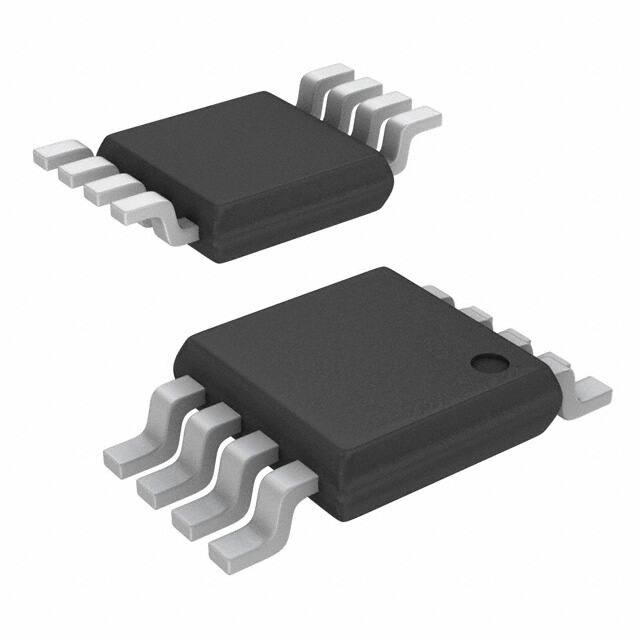
• MSOP-8 package
voltage exceeds the output voltage by more than 800mV, the
output will begin to track the input linearly.
The ILC6363 is a direct replacement for ILC6360, in applications where SYNC pin is not used. The PFM or PWM
operating mode is user selectable through SEL pin connected
to ground or left open, respectively. The choice should be
dependent upon the current to be delivered to the load: PFM
is recommended for better efficiency at light load,while
PWM is recommended for more than 50mA load current.
In shutdown mode, the device allows true load disconnect
from battery input.
Configured as a 300kHz, fixed frequency PWM/PFM boost
converter, the ILC6363 can perform a limited buck operation
in PFM mode, when the input voltage is up to 0.8V higher
than the output voltage.
Applications
• Cellular phones
• Palmtops, PDAs and portable electronics
• Equipment using single Lithium-Ion batteries
Description
The ILC6363 step-up/step-down DC-DC converter is a
switch mode converter, capable of supplying up to 500mA
output current, at a fixed or user selectable output voltage.
The range of input, and output voltage options makes the
ILC6363 ideal for Lithium-ion (Li-ion), or any other battery
application, where the input voltage range spans above and
below the regulated output voltage. When ILC6363’s input
The ILC6363 is unconditionally stable with no external
compensation; the sizes of the input and output capacitors
influence input and output ripple voltages, respectively.
Since the ILC6363 has an internal synchronous rectifier, the
standard fixed voltage version requires minimal external
components: an inductor, an input capacitor, and an output
capacitor. If a tantalum output capacitor is used, then an
additional 10µF ceramic output capacitor will help reduce
output ripple voltage.
Other features include a low battery input detector with a
built-in100ms transient rejection delay and a power good
indicator useful as a system power on reset.
Typical Circuit
ILC6363CIR-XX
1
VOUT
8
+
15µH
VOUT
+
2
VIN
GND
7
3
LBI/SD
LBO
6
Low Battery
Detector Output
4
SEL
POK
5
Power Good Output
(Fixed VOUT only)
R5
ON
OFF
LX
COUT
10µF 100µF
R6
90
4.2
80
3.6
70
3.0
Battery Voltage (V)
VIN
2.7V to 4.2V
Optimized to Maximize Battery Life
L
ILC6363 Efficiency (%)
CIN
100µF
+
MSOP-8
PWM
Time
PFM
Figure 1.
REV. 1.3.5 5/21/02
�ILC6363
PRODUCT SPECIFICATION
Pin Assignments
LX 1
8 VOUT
VIN 2
7 GND
LBO
LB/SD 3
6
5 POK
SEL 4
LX 1
8 VOUT
VIN
2
7 GND
LB/SD
3
6
LBO
SEL 4
5
VFB
MSOP
MSOP
(TOP VIEW)
(TOP VIEW)
ILC6363CIR-XX
ILC6363CIR-ADJ
Pin Definitions
Pin Number
Pin Name
Pin Function Description
1
LX
Inductor input. Inductor L connected between this pin and the battery
2
VIN
Input Voltage. Connect directly to battery
3
LBI/SD
Low battery detect input and shutdown. Low battery detect threshold
is set with this pin using a potential divider. If this pin is pulled to logic low
then the device will shutdown.
4
SEL
Select Input. A low logic level signal applied to this pin selects PFM
operation mode. If the pin is left open or high logic level is applied, PWM
mode is selected.
POK
(ILC6363CIR-XX
5
VFB
(ILC6363CIR-ADJ)
6
Power Good Output. This open drain output pin will go high when
output voltage is within regulation, 0.92•VOUT(NOM) < Vthreshold <
0.98•VOUT(NOM)
Feedback Input. This pin sets the adjustable output voltage via an
external resistor divider network. The formula for choosing the resistors
is shown in the “Applications Information” section.
LBO
Low Battery Output. This open drain output will go low if the battery
voltage is below the low battery threshold set at pin 3.
7
GND
Ground of the IC. Connect this pin to the battery and system ground
8
VOUT
Regulated output voltage.
Absolute Maximum Ratings
Parameter
Voltage on VOUT pin
Symbol
Ratings
Units
VOUT
-0.3 to 7
V
-0.3 to 7
V
ILX
1
A
ISINK(LBO)
5
mA
Voltage on LBI, Sync, LBO, POK, VFB, LX and VIN pins
Peak switch current on LX pin
Current on LBO pin
Continuous total power dissipation at 85°C
PD
315
mW
Short circuit current
ISC
Internally protected
(1 sec. duration)
A
Operating ambient temperature
TA
-40 to 85
°C
Maximum junction temperature
TJ(MAX)
150
°C
Tstg
-40 to 125
°C
300
°C
206
°C/W
Storage temperature
Lead temperature (soldering 10 sec.)
Package thermal resistance
2
θJA
REV. 1.3.5 5/21/02
�PRODUCT SPECIFICATION
ILC6363
Electrical Characteristics ILC6363CIR-50 in PFM Mode
(SEL in LOW State)
Unless otherwise specified, all limits are at VIN = VLBI = 3.6V, IOUT = 1mA and TA = 25°C, test circuit Figure 1.
BOLDFACE type indicate limits over the specified operating temperature range. (Note 2)
Parameter
Output Voltage
Symbol
VOUT(nom)
Maximum Output
Current
IOUT
Load Regulation
∆VOUT
Conditions
2.7V < VIN < 4.2V
Min.
Typ.
Max.
Units
4.875
4.825
5.0
5.125
5.175
V
VOUT ≥ 0.96VOUT(nom),
VIN = 2.7V
1mA < IOUT < 50mA
250
mA
1
%
VOUT
No Load Battery
Input Current
Efficiency
IIN (no load)
IOUT = 0mA
300
µA
η
IOUT = 20mA
85
%
Electrical Characteristics ILC6363CIR-50 in PWM Mode (SEL Open)
Unless otherwise specified, all limits are at VIN = VLBI = 3.6V, IOUT = 100mA and TA = 25°C, test circuit Figure 1.
BOLDFACE type indicate limits over the full operating temperature range. (Note 2)
Parameter
Output Voltage
Symbol
VOUT(nom)
Conditions
2.7V < VIN < 4.2V
Min.
Typ.
Max.
Units
4.850
4.800
5.0
5.150
5.200
V
Maximum Output
Current
IOUT
VOUT ≥ 0.92VOUT(nom)
500
mA
Load Regulation
∆VOUT
50mA < IOUT < 200mA
50mA < IOUT < 300mA
3
4
%
IOUT = 300mA
92
%
VOUT
Efficiency
REV. 1.3.5 5/21/02
η
3
�ILC6363
PRODUCT SPECIFICATION
General Electrical Characteristics
TA = 25°C, VIN = VLBI = 3.6V, IOUT = 50mA, unless otherwise specified.
BOLDFACE indicate limits over the specified operating temperature range. (Note 2).
Parameter
Symbol
Conditions
Min.
LBO output voltage low
VLBO(low)
ISINK = 2mA, open drain
output, VLBI = 1V
LBO output leakage current
ILBO(hi)
VLBO = 5V
Shutdown input voltage low
VSD(low)
Shutdown input voltage high
VSD(hi)
1
1.5
SEL input voltage high
VSEL(hi)
SEL input voltage low
VSEL(low)
POK output voltage low
VPOK(low)
POK output voltage high
VPOK(hi)
POK output leakage Current
IL(POK)
POK threshold
VTH(POK
Typ.
1
Max.
Units
0.4
V
2
µA
0.4
V
6
V
V
ISINK = 2mA, open drain
output
6V at pin 5
0.92xVOUT 0.95xVOUT
POK hysteresis
VHYST
Feedback voltage
(ILC6363CIR-ADJ only)
VFB
Output voltage adjustment
range (ILC6363CIR-ADJ only)
VOUT(ADJ) min
VOUT(ADJ) max
VIN = 0.9V, IOUT = 50mA
VIN = 3V, IOUT = 50mA
2.5
6
Minimum startup voltage
VIN(start)
IOUT = 10mA, PWM
mode
0.9
Input voltage range
VIN
VOUT = VOUT(nominal)
± 4%
IOUT = 10mA
Battery input current in load
disconnect mode
IIN(SD)
VLBI/SD < 0.4V,
VOUT = 0V
(short circuit)
Switch on resistance
Rds(on)
N-Channel MOSFET
P-Channel MOSFET
Oscillator frequency
fosc
LBI input threshold
VREF
Input leakage current
ILEAK
Pins LB/SD,SEL and
VFB, (Note 3)
LBI hold time
tHOLD(LBI)
(Note 4)
0.4
V
0.4
V
6
V
2
µA
0.98xVOUT
V
50
1.225
1.212
1.250
0.9
1
1
mV
1.275
1.288
V
V
1
V
VOUT(nominal) + 0.8V
V
10
µA
400
750
mΩ
255
300
345
kHz
1.175
1.150
1.250
1.325
1.350
V
200
nA
100
120
mS
Notes:
1. Absolute maximum ratings indicate limits which, when exceeded, may result in damage to the component. Electrical
specifications do not apply when operating the device outside its rated operating conditions.
2. Specified min/max limits are production tested or guaranteed through correlation based on statistical control methods.
Measurements are taken at constant junction temperature as close to ambient temperature as possible using low duty cycle
pulse testing.
3. Guaranteed by design
4. In order to get a valid low-battery-output (LBO) signal, the input voltage must be lower than the low-battery-input (LBI)
threshold for a duration greater than the low battery hold time (Hold(LBI)). This feature eliminates false triggering due to
voltage transients at the battery terminal.
4
REV. 1.3.5 5/21/02
�PRODUCT SPECIFICATION
ILC6363
Application Information
PWM Mode Operation
The ILC6363 performs boost DC-DC conversion by controlling the switch element as shown in the simplified circuit in
Figure 3 below.
The ILC6363 uses a PWM or Pulse Width Modulation
technique. The switches are constantly driven at typically
300kHz. The control circuitry varies the power being
delivered to the load by varying the on-time, or duty cycle,
of the switch SW1 (see Figure 5). Since more on-time
translates to higher current build-up in the inductor, the
maximum duty cycle of the switch determines the maximum
load current that the device can support. The minimum value
of the duty cycle determines the minimum load current that
can maintain the output voltage within specified values.
Figure 3. Basic Boost Circuit
When the switch is closed, current is built up through the
inductor. When the switch opens, this current is forced
through the diode to the output. As this on and off switching
continues, the output capacitor voltage builds up due to the
charge it is storing from the inductor current. In this way, the
output voltage is boosted relative to the input.
In general, the switching characteristic is determined by the
output voltage desired and the current required by the load.
The energy transfer is determined by the power stored in the
coil during each switching cycle.
PL = ƒ(tON, VIN)
Synchronous Rectification
The ILC6363 also uses a technique called “synchronous
rectification” which removes the need for the external diode
used in other circuits. The diode is replaced with a second
switch or in the case of the ILC6363, an FET as shown in
Figure 4 below.
ILC6363
SW2
VOUT
+
PWM/PFM
CONTROLLER
SW1
The other key advantage of the PWM type controllers over
pulse frequency modulated (PFM) types is that the radiated
noise due to the switching transients will always occur at
(fixed) switching frequency. Many applications do not care
much about switching noise, but certain types of applications, especially communication equipment, need to minimize the high frequency interference within their system as
much as possible. Use of the PWM converter in those cases
is desirable.
PFM Mode Operation
VIN
LX
There are two key advantages of the PWM type controllers.
First, because the controller automatically varies the duty
cycle of the switch's on-time in response to changing load
conditions, the PWM controller will always have an optimized waveform for a steady-state load. This translates to
very good efficiency at high currents and minimal ripple on
the output. Ripple is due to the output cap constantly accepting and storing the charge received from the inductor, and
delivering charge as required by the load. The “pumping”
action of the switch produces a sawtooth-shaped voltage as
seen by the output.
POK
For light loads the ILC6363 can be switched to PFM. This
technique conserves power by only switching the output if
the current drain requires it. As shown in the Figure 5, the
waveform actually skips pulses depending on the power
needed by the output. This technique is also called “pulse
skipping” because of this characteristic.
GND
SHUTDOWN
CONTROL
SEL
VREF
+
-
DELAY
LBO
LB/SD
Figure 4. Simplified ILC6383 block diagram
The two switches now open and close in opposition to each
other, directing the flow of current to either charge the inductor or to feed the load. The ILC6363 monitors the voltage on
the output capacitor to determine how much and how often
to drive the switches.
REV. 1.3.5 5/21/02
In the ILC6363, the switchover from PWM to PFM mode is
determined by the user to improve efficiency and conserve
power.
The Dual PWM/PFM mode architecture was designed specifically for applications such as wireless communications,
which need the spectral predictability of a PWM-type
DC-DC converter, yet also need the highest efficiencies
possible, especially in Standby mode.
5
�ILC6363
PRODUCT SPECIFICATION
Switch Waveform
2 VIN
ILC6363
Shutdown
R5
3
VSET
+
LBI/SD
R6
1.25V
Internal
Reference
VOUT
7 GND
Figure 5. PFM Waveform
Other Considerations
The other limitation of PWM techniques is that, while the
fundamental switching frequency is easier to filter out since
it's constant, the higher order harmonics of PWM will be
present and may have to be filtered out, as well. Any filtering
requirements, though, will vary by application and by actual
system design and layout, so generalizations in this area are
difficult, at best.
However, PWM control for boost DC-DC conversion is
widely used, especially in audio-noise sensitive applications
or applications requiring strict filtering of the high frequency
components.
Low Battery Detector
The ILC6363's low battery detector is a based on a CMOS
comparator. The negative input of the comparator is tied to
an internal 1.25V (nominal) reference, VREF. The positive
input is the LBI/SD pin. It uses a simple potential divider
arrangement with two resistors to set the LBI threshold as
shown in Figure 6. The input bias current of the LBI pin is
only 200nA. This means that the resistor values R1 and R2
can be set quite high. The formula for setting the LBI
threshold is:
6
LBO
DELAY
100ms
-
3.3V
RPU
Figure 6. Low Battery Detector
The output of the low battery detector is an open drain
capable of sinking 2mA. A 10kΩ pull-up resistor is
recommended on this output.
For VLBI < 1.25V
The low battery detector can also be configured for voltages