Smart LiB Gauge
Battery Fuel Gauge LSI
For 1‐Cell Lithium‐ion/
Polymer (Li+)
LC709203F
www.onsemi.com
Overview
LC709203F is a Fuel Gauge for a single lithium ion/polymer
battery. It is part of our Smart LiB Gauge family of Fuel Gauges
which measure the battery RSOC (Relative State Of Charge) using its
unique algorithm called HG−CVR. The HG−CVR algorithm
eliminates the use of a sense resistor and provides accurate RSOC
information even under unstable conditions (e.g. changes of battery;
temperature, loading, aging and self-discharge). An accurate RSOC
contributes to the operating time of portable devices.
LC709203F is available in two small packages realizing the
industries smallest PCB footprint for the complete solution. It has
minimal parameters to be set by the user enabling simple, quick setup
and operation.
1
WDFN8
CASE 509AF
MARKING DIAGRAMS
WDFN8
9203F
**
ASWLYW
G
Features
• HG−CVR Algorithm Technology
No External Sense Resistor
♦ 2.8% Accuracy of RSOC
♦ Accurate RSOC of Aging Battery
♦ Automatic Convergence of Error
♦ Adjustment for the Parasitic Impedance around the Battery
♦ Simple and Quick Setup
Low Power Consumption
♦ 3 �A Operational Mode
Precision Voltage Measurement
♦ ±7.5 mV
Precision Timer
♦ ±3.5%
Alerts for Low RSOC and/or Low Voltage
Temperature Compensation
♦ Sense Thermistor Input
♦ Via I2C
Detect Battery Insertion
I2C Interface (up to 400 kHz Supported)
These Devices are Pb−Free, Halogen Free/BFR Free and are RoHS
Compliant
♦
•
•
•
•
•
•
•
•
Applications
•
•
•
•
•
•
Wireless Handsets
Smartphones/PDA Devices
MP3 Players
Digital Cameras
Portable Game Players
USB-related Devices
© Semiconductor Components Industries, LLC, 2015
November, 2020 − Rev. 17
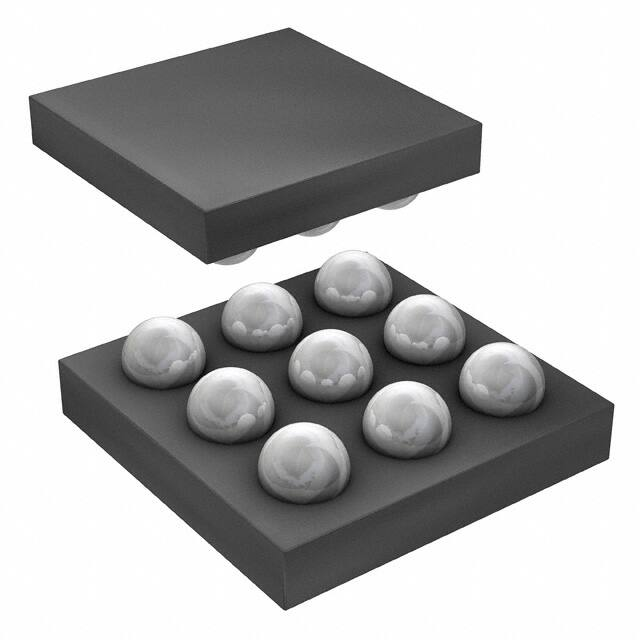
WLCSP9
CASE 567JH
9203F** = Specific Device Code
**
= 01 (LC709203FQH−01TWG)
02 (LC709203FQH−02TWG)
03 (LC709203FQH−03TWG)
04 (LC709203FQH−04TWG)
AS
= Assembly Location
WL
= Lot Number
YW
= Work Week
G
= Pb−Free Package
(Note: Microdot may be in either location)
WLCSP9
203**
YMXXX
203**
**
Y
M
XXX
= Specific Device Code
= 01 (LC709203FXE−01MH)
02 (LC709203FXE−02MH)
03 (LC709203FXE−03MH)
04 (LC709203FXE−04MH)
05 (LC709203FXE−05MH)
= Year
= Month Code
= Lot Number
ORDERING INFORMATION
See detailed ordering and shipping information on page 19 of
this data sheet.
1
Publication Order Number:
LC709203F/D
�LC709203F
Application Circuit Example
System VDD
10 k�
10 k�
I2C Bus VDD
Master
TSW
TSENSE
Battery
Pack
SDA
SCL
T
ASIC
ALARMB
VDD
VSS
10 k�
Interrupt Input
PACK+
PACK−
TEST
LC709203F
1 �F
VSS
System
System VSS
Figure 1. Example of an Application Schematic using LC709203F
(Temperature Input via I2C)
System VDD
10 k�
10 k�
I2C Bus VDD
Battery
Pack
Master
10 k� (same as Thermistor
Resistance Value)
TSW
SDA
SCL
10 k�
Thermistor
TSENSE
100 �
T
ASIC
PACK+
PACK−
ALARMB
VDD
VSS
TEST
LC709203F
10 k�
Interrupt Input
1 �F
VSS
System
System VSS
Figure 2. Example of an Application Schematic using LC709203F
(The Temperature is Measured Directly by a Thermistor)
www.onsemi.com
2
�LC709203F
SDA
ALARMB
I2C
Interface
SCL
TEST
VDD
Drv
TSW
Look Up
Table for
Internal
Battery
Impedance
& OCV
Processing
Unit
ADC
TSENSE
VDD
Voltage
Sense
VSS
Reference
Voltage
Timer
Power On
Reset
Figure 3. Simplified Block Diagram
ALARMB
(Bottom View)
VDD
(Bottom View)
VSS
WLCSP9 1.60x1.76
“Pb-Free, Halogen Free Type”
TEST
WDFN8 3x4, 065P
“Pb-Free, Halogen Free Type”
1
2
3
4
9
C1
C2
C3
SDA
SCL
TSENSE
B1
B2
B3
TEST
NC
TSW
A2
A3
8
7
6
5
SCL
SDA
TSENSE
TSW
A1
VSS
Figure 4. Pin Assignment
www.onsemi.com
3
ALARMB VDD
�LC709203F
Table 1. PIN FUNCTION
WDFN8
WLP9
Pin Name
I/O
1
B1
TEST
I
Connect this pin to VSS.
Description
2
A1
VSS
−
Connect this pin to the battery’s negative (−) pin.
3
A3
VDD
−
Connect this pin to the battery’s positive (+) pin.
4
A2
ALARMB
O
This pin indicates alarm by low output(open drain). Pull-up must be done externally.
Alarm conditions are specified by registers (0x13 or 0x14).
Connect this pin to VSS when not in use.
5
B3
TSW
O
Power supply output for thermistor. This pin goes HIGH during temperature read
operation. Resistance value of TSW (for thermistor pull-up) must be the same value
as the thermistor. (Note 1)
6
C3
TSENSE
I
Thermistor sense input. If you connect this pin to thermistor, insert 100 � resistance
between them for ESD. (Note 1)
7
C1
SDA
I/O
I2C Data pin (open drain). Pull-up must be done externally.
8
C2
SCL
I/O
I2C Clock pin (open drain). Pull-up must be done externally.
−
B2
NC
−
Don’t care.
9
−
Exposed
PAD
−
Don’t care.
1. TSW and TSENSE must be disconnected as Figure 1 when not in use.
Table 2. ABSOLUTE MAXIMUM RATINGS (TA = 25°C, VSS = 0 V)
Specification
Parameter
Symbol
Maximum Supply Voltage
Pin/Remarks
Conditions
VDD (V)
Min
Typ
Max
Unit
V
VDD max
VDD
−
−0.3
−
+6.5
Input Voltage
VI (1)
TSENSE
−
−0.3
−
VDD + 0.3
Output Voltage
Vo (1)
TSW
−
−0.3
−
VDD + 0.3
Vo (2)
ALARMB
−
−0.3
−
Input/Output Voltage
VIO (1)
SDA, SCL
−
−0.3
−
+5.5
Allowable Power Dissipation
Pd max
WDFN8
−
−
−
480
WLP9
TA = −40 to
+85_C
−
−
−
210
Operating Ambient Temperature
Topr
−
−40
−
+85
Storage Ambient Temperature
Tstg
−
−55
−
+125
mW
_C
Stresses exceeding those listed in the Maximum Ratings table may damage the device. If any of these limits are exceeded, device functionality
should not be assumed, damage may occur and reliability may be affected.
Table 3. ALLOWABLE OPERATING CONDITIONS (TA = −40 to +85°C, VSS = 0 V)
Specification
VDD (V)
Min
Typ
Max
Unit
VDD
−
2.5
−
4.5
V
VIH (1)
TSENSE
2.5 to 4.5
0.7 VDD
−
VDD
VIH (2)
ALARMB, SDA, SCL
2.5 to 4.5
1.4
−
−
VIL (1)
TSENSE
2.5 to 4.5
VSS
−
0.25 VDD
VIL (2)
ALARMB, SDA, SCL
2.5 to 4.5
−
−
0.5
Parameter
Symbol
Pin/Remarks
Operating Supply Voltage
VDD (1)
High Level Input Voltage
Low Level Input Voltage
Conditions
Functional operation above the stresses listed in the Recommended Operating Ranges is not implied. Extended exposure to stresses beyond
the Recommended Operating Ranges limits may affect device reliability.
www.onsemi.com
4
�LC709203F
Table 4. ELECTRICAL CHARACTERISTICS (TA = −40 to +85°C, VSS = 0 V)
Specification
Symbol
Pin/Remarks
Conditions
VDD (V)
Min
High Level Input Current
IIH (1)
SDA, SCL
VIN = VDD
(including output
transistor off leakage
current)
2.5 to 4.5
−
−
1
Low Level Input Current
IIL (1)
SDA, SCL
VIN = VSS
(including output
transistor off leakage
current)
2.5 to 4.5
−1
−
−
VOH (1)
TSW
IOH = −0.4 mA
3.0 to 4.5
VDD − 0.4
−
−
IOH = −0.2 mA
2.5 to 4.5
VDD − 0.4
−
−
IOL = 3.0 mA
3.0 to 4.5
−
−
0.4
IOL = 1.3 mA
2.5 to 4.5
−
−
0.4
2.5 to 4.5
−
0.1 VDD
−
2.5 to 4.5
−
10
−
pF
−
−
2.4
V
−
−
90
ms
Parameter
High Level Output Voltage
VOH (2)
Low Level Output Voltage
Hysteresis Voltage
VOL (2)
TSW,
ALARMB,
SDA, SCL
VOL (1)
VHYS(1)
SDA, SCL
Pin Capacitance
CP
All pins
Reset Release Voltage
(Note 2)
VRR
VDD
Initialization Time after
Reset Release (Note 2)
TINIT
Auto Sleep Set Time
TATS
Time Measurement
Accuracy
TME
Consumption Current
(Note 3)
IDD (1)
Voltage Measurement
Accuracy
VME (1)
2.4 to 4.5
VDD
IDD (2)
VME (2)
Pins other than
the pin under test
VIN = VSS
TA = 25_C
VDD
Typ
Max
Unit
�A
V
2.4 to 4.5
−
1
1.2
s
TA = −20_C to +70_C
2.5 to 4.5
−3.5
−
+3.5
%
Operational mode
2.5 to 4.5
−
3
4.5
�A
Sleep mode
2.5 to 4.5
−
1
2
TA = +25_C
3.6
−7.5
−
+7.5
TA = −20_C to +70_C
2.5 to 4.5
−20
−
+20
mV/cell
Product parametric performance is indicated in the Electrical Characteristics for the listed test conditions, unless otherwise noted. Product
performance may not be indicated by the Electrical Characteristics if operated under different conditions.
2. Once VDD voltage exceeds over the VRR, this LSI will release RESET status. And the LSI goes into Sleep mode TINIT after it.
3. Consumption current is a value in the range of −20_C to +70_C.
www.onsemi.com
5
�LC709203F
Table 5. I2C SLAVE CHARACTERISTICS (TA = −40 to +85°C, VSS = 0 V)
Specification
Min
Max
Unit
−
400
kHz
(See Figure 5)
1.3
−
�s
SCL, SDA
(See Figure 5)
1.1
−
�s
THD:RSTA
SCL, SDA
(See Figure 5)
0.6
−
�s
Repeated START Condition Setup Time
TSU:STA
SCL, SDA
(See Figure 5)
0.6
−
�s
STOP Condition Setup Time
TSU:STO
SCL, SDA
(See Figure 5)
0.6
−
�s
Data Hold Time
THD:DAT
SCL, SDA
(See Figure 5)
0
0.9
�s
Data Setup Time
TSU:DAT
SCL, SDA
(See Figure 5)
100
−
ns
Clock Low Period
TLOW
SCL
(See Figure 5)
1.3
−
�s
Clock High Period
(See Figure 5)
Parameter
Symbol
Pin/Remarks
Clock Frequency
TSCL
SCL
Bus Free Time between STOP Condition
and START Condition
TBUF
SCL, SDA
Hold Time START Condition.
First clock pulse is generated after this
interval
THD:STA
Hold Time Repeated START Condition
Conditions
VDD (V)
2.5 to 4.5
THIGH
SCL
0.6
−
�s
Clock/Data Fall Time
TF
SCL, SDA
20 + 0.1CB
300
ns
Clock/Data Rise Time
TR
SCL, SDA
20 + 0.1CB
300
ns
Time-out Interval (Notes 4, 5)
TTMO
SCL, SDA
(See Figure 6)
9
11
s
Wake Up Time from Sleep Mode
TWU
SDA
(See Figure 7)
−
400
�s
SDA Low Pulse Width to Wake Up
TSP
SDA
(See Figure 7)
0.6
−
�s
Wake Up Retention Time from the Falling
Edge of SDA
TWR1
SDA
(See Figure 7)
500
−
ms
Wake Up Retention Time from STOP
Condition
TWR2
SCL, SDA
(See Figure 7)
500
−
ms
4. This LSI resets I2C communication if the communication takes more than TTMO. It initializes an internal timer to measure the interval when
it detects ninth clock pulse. It can receive a new START condition after the reset.
5. This LSI may lose I2C communication at this reset operation. Then if a master can’t receive a response it must restart transaction from START
condition.
TBUF
SDA
THD:STA
TLOW
TR THD:DAT
THIGH
TF
TSU:DAT
TSU:STA
THD:RSTA
TSU:STO
SCL
P
S
Sr
Figure 5. I2C Timing Diagram
P
SDA
TTMO
SCL
1
S
2
8
1
9
ACK
Figure 6. I2C Time-out Interval
www.onsemi.com
6
2
8
9
ACK
�LC709203F
I2C Communication Protocol
Communication protocol type: I2C
Frequency: Supported up to 400 kHz
Slave Address: 0001011 (The first 8−bits after the Strat Condition is 0x16 (WRITE) or 0x17 (READ).)
This LSI will stretch the clock.
Bus Protocols
S
Sr
Rd
Wr
A
N
P
CRC−8
…
Read Word Protocol
S
:
:
:
:
:
:
:
:
:
:
:
Start Condition
Repeated Start Condition
Read (bit value of 1)
Write (bit value of 0)
ACK (bit value of 0)
NACK (bit value of 1)
Stop Condition
Slave Address to Last Data (CRC−8−ATM : ex.3778 mV : 0x16, 0x09, 0x17, 0xC2, 0x0E → 0x86)
Master-to-Slave
Slave-to-Master
Continuation of protocol
Slave Address
Wr
A
Command Code
A
Sr
Slave Address
Rd
A
Data Byte Low
A
A
CRC−8
N
P
…
Data Byte High
* When you do not read CRC−8, LSI data is not reliable. CRC−8−ATM ex: (5 bytes) 0x16, 0x09, 0x17, 0xC2,
0x0E → 0x86
Write Word Protocol
S
Data Byte Low
Slave Address
Wr
A
A
Command Code
Data Byte High
A
A
CRC−8
* When you do not add CRC−8, the Written data (Data byte Low/High) become invalid.
CRC−8−ATM ex: (4 bytes) 0x16, 0x09, 0x55, 0xAA → 0x3B
www.onsemi.com
7
…
A
P
…
�LC709203F
Wake Up from Sleep Mode
Sleep Mode
Enable I2C
Communication
Disable I2C Communication
Disable I2C
Communication
TSP
SDA
TWU
TWR1
(Not to Scale)
Sleep Mode
Enable I2C Communication
SCL
Disable I2C Communication
TWR2
SDA
(Not to Scale)
STOP Condition
Figure 7. I2C Wake up Timing Diagram
To wake up from Sleep mode, and to start I2C
communication, Host side must set SDA low prior to the I2C
communication. The Fuel Gauge LSI enables I2C
communication after the TWU time period which is
measured from the falling edge of SDA, as above timing
chart. This “Wake up condition” is invalid for the following
two cases:
1. After TWR1 timing following the falling edge of
SDA, the Fuel Gauge LSI “Wake up condition”
goes into autonomous disable. Once I2C
communication is started, the operation doesn’t go
into disable until the TWR2 timing has elapsed
after STOP condition (below case).
2. After TWR2 timing following I2C Bus STOP
condition, the Fuel gauge LSI “Wake up
condition” goes into autonomous disable.
If the “Wake up condition” goes into disable, set SDA low
to once again wake up from the Sleep mode prior to the I2C
communication. If Operational mode is set, it is possible to
start I2C communication without this “Wake up operation”.
Notice for I2C Communication Shared with Another
Device
When the I2C Bust (on which the Fuel Gauge LSI is
connected) is shared with another device the Fuel Gauge LSI
must be in its operation mode before the other Device starts
I2C communication.
www.onsemi.com
8
�LC709203F
Table 6. FUNCTION OF REGISTERS
Command
Code
Register Name
R/W
Range
0x04
Before RSOC
W
0xAA55: Initialize RSOC
0x06
Thermistor B
R/W
0x0000 to 0xFFFF
0x07
Initial RSOC
W
0xAA55: Initialize RSOC
0x08
Cell Temperature
R
0x0000 to 0xFFFF
Unit
W
0x09E4 to 0x0D04
(I2C mode)
Initial
Value
Description
Executes RSOC initialization with sampled
maximum voltage when 0xAA55 is set.
1K
Sets B−constant of the
thermistor to be measured.
Executes RSOC initialization when 0xAA55
is set.
0.1K
(0.0°C =
0x0AAC)
Displays Cell Temperature
Sets Cell Temperature in
mode
1 mV
I2C
Displays Cell Voltage
−
0x0D34
−
0x0BA6
(25°C)
0x09
Cell Voltage
R
0x0000 to 0xFFFF
−
0x0A
Current Direction
R/W
0x0000: Auto mode
0x0001: Charge mode
0xFFFF: Discharge mode
Selects Auto/Charge/Discharge mode
0x0000
0x0B
APA
(Adjustment Pack
Application)
R/W
0x0000 to 0x00FF
Sets Adjustment parameter
−
0x0C
APT
(Adjustment Pack
Thermistor)
R/W
0x0000 to 0xFFFF
Sets a value to adjust temperature
measurement delay timing
0x001E
0x0D
RSOC
R/W
0x0000 to 0x0064
1%
Displays RSOC value based
on a 0−100 scale
−
0x0F
ITE (Indicator to
Empty)
R
0x0000 to 0x03E8
0.1%
Displays RSOC value based
on a 0−1000 scale
−
0x11
IC Version
R
0x0000 to 0xFFFF
Displays an ID number of an IC
−
0x12
Change Of The
Parameter
R/W
0x0000 or 0x0001
Selects a battery profile
0x0000
0x13
Alarm Low RSOC
R/W
0x0000: Disable
0x0001to0x0064: Threshold
1%
Sets RSOC threshold to
generate Alarm signal
0x0008
0x14
Alarm Low Cell
Voltage
R/W
0x0000: Disable
0x0001to0xFFFF: Threshold
1 mV
Sets Voltage threshold to
generate Alarm signal
0x0000
0x15
IC Power Mode
R/W
0x0001: Operational mode
0x0002: Sleep mode
Selects Power mode
(Note 6)
0x16
Status Bit
R/W
0x0000: I2C mode
0x0001: Thermistor mode
Selects Temperature obtaining method
0x0000
0x1A
Number of The
Parameter
R
0x0301 or 0x0504
Displays Battery profile code
−
NOTE: 0xXXXX = Hexadecimal notation
6. See “Power-on Reset/Battery Insertion Detection” and Figure 17.
Before RSOC (0x04)
“Before RSOC” command can obtain historical voltage
data in-between Release reset and “Before RSOC”
command timing. And this command initializes RSOC with
the maximum battery voltage which was obtained. (See
Figure 9) Don’t use this command if battery is charged in the
term.
This LSI will get initial RSOC by Open Circuit Voltage
(OCV) of a battery. It is desirable for battery current to be
less than 0.025C to get expected OCV. (i.e. less than 75 mA
for 3000 mAh design capacity battery.) This LSI initializes
RSOC by measured battery voltage in initial sequence. (See
Figure 8) But if reported RSOC after reset release is not
expected value, “Before RSOC” command (0x04 = AA55)
or “Initial RSOC” command (0x07 = AA55) can initialize
RSOC again.
Thermistor B (0x06)
Sets B-constant of the thermistor to be measured. Refer to
the specification sheet of the thermistor for the set value to
use.
www.onsemi.com
9
�LC709203F
Initial RSOC (0x07)
Cell Voltage (0x09)
The LSI can be forced to initialize RSOC by sending the
Before RSOC Command (0×04 = AA55) or the Initial
RSOC Command (0×07 = AA55).
This register contains the voltage on VDD 1 mV units.
Current Direction (0x0A)
This register is used to control the reporting of RSOC. In
Auto mode the RSOC is reported as it increases or decreases.
In Charge mode the RSOC is not permitted to decrease. In
Discharge mode the RSOC is not permitted to increase.
With consideration of capacity influence by temperature,
we recommend operating in Auto because RSOC is affected
by the cell temperature. A warm cell has more capacity than
a cold cell. Be sure not to charge in the Discharge mode and
discharge in the Charge mode; it will create an error.
An example of RSOC reporting is shown in Figures 11
and 12.
Figure 8. RSOC Automatic Initialization
Figure 10. Initial RSOC Command
Figure 9. Before RSOC Command
The LSI initializes RSOC by the measured voltage at that
time when the Initial RSOC command is written. (See
Figure 10). The maximum time to initialize RSOC after the
command is written is 1.5 ms.
Cell Temperature (0x08)
This register contains the cell temperature from −20_C
(0×09E4) to +60_C (0×0D04) measured in 0.1_C units.
In the Thermistor mode (0×16 = 01) the LSI measures the
attached thermistor and loads the temperature into the Cell
Temperature register. In the Thermistor mode, the
thermistor shall be connected to the LSI as shown in
Figure 2. The temperature is measured by having TSW pin
to provide power into the thermistor and TSENSE pin to
sense the output voltage from the thermistor. Temperature
measurement timing is controlled by the LSI, and the power
to the thermistor is not supplied for other reasons except to
measure the temperature.
In the I2C mode (0×16 = 00) the temperature is provided
by the host processor. During discharge/charge the register
should be updates when the temperature changes more than
1_C
Figure 11. Discharge Mode
(An example with increasing in temperature. A warm
cell has more capacity than a cold cell. Therefore
RSOC increases without charging in Auto mode)
www.onsemi.com
10
�LC709203F
Table 7. TYPICAL APA
Figure 12. Charge Mode
(An example with decreasing in temperature. A cold
cell has less capacity than a warm cell. Therefore
RSOC decreases without discharging in Auto mode)
APA(0x0B)
Design
Capacity
of Battery
Type−01,
Type−03
Type−06
Type−07
100 mAh
0x08
0x0D
0x07
200 mAh
0x0B
0x15
0x0C
500 mAh
0x10
0x20
0x18
1000 mAh
0x19
−
0x28
2000 mAh
0x2D
−
0x40
3000 mAh
0x36
−
0x4D
Design
Capacity
of Battery
Type−04
Type−05
2600 mAh
0x1A
0x0D
APA(0x0B)
Adjustment Pack Application (0x0B)
This register contains the adjustment value for a battery
type to improve the RSOC precision. Figure 13 and Table 7
show typical values of APA according to the design
capacities per 1 cell and battery type. When some batteries
are connected in parallel, the design capacity per 1 cell is
applied to the table. The APA values of Type−04 and
Type−05 are used for battery type that is specified in Table 8.
Please contact ON Semiconductor if you don’t satisfy the
RSOC precision. The deeper adjustment of APA may
improve the accuracy.
Figure 14. An Example of a Capacitor Across
the Thermistor
RSOC (0x0D)
RSOC is reported in 1% units over the range 0% to 100%.
When this register is written in operational mode the data
may be updated to close it to actual RSOC of a battery. Set
Sleep mode to keep the data. Writing to this register is not
necessary in normal operation. ITE (0x0F) will be updated
with the writing too.
Figure 13. Typical APA
Indicator to Empty (0x0F)
This is the same as RSOC with a resolution of 0.1% over
the range 0.0% to 100.0%.
Adjustment Pack Thermistor (0x0C)
This is used to compensate for the delay of the thermistor
measurement caused by a capacitor across the thermistor.
The default value has been found to meet most of circuits
where a capacitor like showing in Figure 14 is not put.
Please contact ON Semiconductor if you have an unusual
circuit implementation.
IC Version (0x11)
This is an ID number of an LSI.
Change of the Parameter (0x12)
The LSI contains a data file comprised of two battery
profiles. This register is used to select the battery profile to
be used. See Table 8. Register Number of the Parameter
(0x1A) contains identity of the data file.
www.onsemi.com
11
�LC709203F
is counted continuously to measure the RSOC in
Operational mode. If battery is discharged or charged in the
Sleep mode, the count breaks off.
When it is switched from Sleep mode to Operational
mode, RSOC calculation is continued by using the data
which was measured in the previous Operational mode.
The Data file is loaded during final test depending on the
part number ordered.
Most of the time, battery nominal/rated voltage or
charging voltage values are used to determine which profile
data shall be used. Please contact ON Semiconductor if you
cannot identify which profile to select.
Alarm Low RSOC (0x13)
The ALARMB pin will be set low when the RSOC value
falls below this value, will be released from low when RSOC
value rises than this value. Set to Zero to disable. Figure 15.
Figure 16. Alarm Low Cell Voltage
Status Bit (0x16)
This selects the Thermistor mode. Thermistor mode
(0x16 = 01) the LSI measures the attached thermistor and
loads the temperature into the Cell Temperature register.
I2C mode (0x16 = 00) the temperature is provided by the
host processor.
Figure 15. Alarm Low RSOC
Alarm Low Cell Voltage (0x14)
The ALARMB pin will be set low if VDD falls below this
value, will be released from low if VDD rises than this value.
Set to Zero to disable. Figure 16.
Number of the Parameter (0x1A)
The LSI contains a data file comprised of two battery
profiles. This register contains identity of the data file.
Please see register Change of the Parameter (0x12) to select
the battery profile to be used. See Table 8.
The Data file is loaded during final test depending on the
part number ordered. This file can be loaded in the field if
required.
Please contact ON Semiconductor if you cannot identify
which profile to select.
IC Power Mode (0x15)
The LSI has two power modes. Sleep (0x15 = 02) or
Operational mode (0x15 = 01). In the Sleep mode only I2C
communication functions. In the Operational mode all
functions operate with full calculation and tracking of
RSOC during charge and discharge.
If the battery is significantly charged or discharged during
sleep mode, the RSOC will not be accurate. Moved charge
www.onsemi.com
12
�LC709203F
Table 8. BATTERY PROFILE VS. REGISTER
IC Type
LC709203Fxx−01xx
LC709203Fxx−03xx
LC709203Fxx−04xx
Battery
Type
Nominal/Rated
Voltage
Charging
Voltage
Design
Capacity
Number of
the Parameter
(0x1A)
Change of
the Parameter
(0x12)
03
3.8 V
4.35 V
≥ 500 mAh
0x0301
0x0000
01
3.7 V
4.2 V
−
06
3.8 V
4.35 V
< 500 mAh
01
3.7 V
4.2 V
−
05
0x0601
0x0001
0x0001
3.85 V
4.4 V
−
06
3.8 V
4.35 V
< 500 mAh
0x0706
Hybrid Gauging by Current-Voltage Tracking with
Internal Resistance
V(VARIED)
RM
FCC
100%
(eq. 3)
Then the decreased FCC must be preliminarily measured
with learning cycle. But HG−CVR can measure the RSOC
of deteriorated battery without learning cycle. The internal
battery impedance that HG−CVR uses to calculate the
current correlates highly with FCC. The correlation is based
on battery chemistry. The RSOC that this LSI reports using
the correlation is not affected by aging.
Figures 24−26 show RSOC measurement result of
a battery with decreased FCC due to its aging. The shown
RSOC is based on the decreased FCC even with a battery
with 80% FCC after executing 300 times of discharge/
charge.
HG−CVR is ON Semiconductor’s unique method which
is used to calculate accurate RSOC. HG−CVR first
measures battery voltage and temperature. Precise reference
voltage is essential for accurate voltage measurement.
LC709203F has accurate internal reference voltage circuit
with little temperature dependency.
It also uses the measured battery voltage and internal
impedance and Open Circuit Voltage (OCV) of a battery for
the current measurement. OCV is battery voltage without
load current. The measured battery voltage is separated into
OCV and varied voltage by load current. The varied voltage
is the product of load current and internal impedance. Then
the current is determined by the following formulas.
V(VARIED) + V(MEASURED) * OCV
0x0000
0x0001
RSOC +
R(INTERNAL)
0x0000
UR18650ZY (Panasonic)
07
HG−CVR
I+
0x0000
0x0504
ICR18650−26H (SAMSUNG)
04
LC709203Fxx−05xx
0x0001
Automatic Convergence of the Error
A problem of coulomb counting method is the fact that the
error is accumulated over time − This error must be
corrected. The general gauges using coulomb counting
method must find an opportunity to correct it.
This LSI with HG−CVR has the feature that the error of
RSOC converges autonomously, and doesn’t require
calibration opportunities. The error constantly converges in
the value estimated from the Open Circuit Voltage.
Figure 27 shows the convergent characteristic example
from the initialize error.
Also, coulomb counting method cannot detect accurate
residual change because the amount of the current from
self-discharge is too small but HG−CVR is capable to deal
with such detection by using the voltage information.
(eq. 1)
(eq. 2)
Where V(VARIED) is varied voltage by load current,
V(MEASURED) is measured voltage, R(INTERNAL) is
internal impedance of a battery. Detailed information about
the internal impedance and OCV is installed in the LSI. The
internal impedance is affected by remaining capacity,
load-current, temperature, and more. Then the LSI has the
information as look up table. HG−CVR accumulates battery
coulomb using the information of the current and a steady
period by a high accuracy internal timer. The remaining
capacity of a battery is calculated with the accumulated
coulomb.
Simple and Quick Setup
In general, it is necessary to obtain multiple parameters for
a fuel gauge and it takes a lot of resource and additional
development time of the users. One of the unique features of
LC709203F is very small number of parameters to be
prepared by the beginning of battery measurement – the
minimum amount of parameter which users may make is
one because Adjustment pack application register has to
How to Identify Aging
By repeating discharge/charge, internal impedance of
a battery will gradually increase, and the Full Charge
Capacity (FCC) will decrease. In coulomb counting method
RSOC is generally calculated using the FCC and the
Remaining Capacity (RM).
www.onsemi.com
13
�LC709203F
have one. Such simple and quick start-up is realized by
having multiple profile data in the LSI to support various
types of batteries. Please contact your local sales office to
learn more information on how to measure a battery that
cannot use already-prepared profile data.
into Sleep mode. LC709203FQH−0xTWG doesn’t set itself
into Sleep mode automatically. Figure 17.
This LSI will also execute system reset automatically if
a battery voltage exceeds under the VRR during operation.
Furthermore after Change of the Parameter (0x12)
command input it will execute LSI initialization like battery
insertion. Figure 18.
Low Power Consumption
Low power consumption of 3 �A is realized in the
Operation mode. This LSI monitors charge/discharge
condition of a battery and changes the sampling rate
according to its change of current. Power consumption
reduction without deteriorating its RSOC accuracy was
enabled by utilizing this method.
Parasitic Resistance
The LSI measures RSOC by using internal impedance of
a battery. Therefore, the parasitic resistance which exists in
VDD/VSS Lines between measured Battery or Battery Pack
to the LSI can become an error factor. But the resistance of
Lines which is not connected other than the LSI is not
included. Figure 19.
The lower resistance may improve the RSOC precision.
Please see LC709203F Application note for information
about layout method of VDD/VSS Lines to reduce it.
Power-on Reset/Battery Insertion Detection
When this LSI detects battery insertion, it starts Power-on
reset automatically. Once the battery voltage exceeds over
the VRR, it will release RESET status and will complete LSI
initialization within TINIT to enter into Operational mode.
All registers are initialized after Power-on reset. Then I2C
communication can be started.
LC709203FXE−0xMH sets itself into Sleep mode
automatically after TATS from the end of initialization.
Therefore set to operational mode manually after it enters
Measurement Starting Flow
After Reset release, users can start battery measurement
by writing appropriate value into the registers by following
the flow shown in Figures 20−21. Please refer to Register
function section for more information about each register.
LC709203FQH−0xTWG
Reset
Initialization
Operation Mode
VDD
VRR
TINT
LC709203FXE−0xMH
Reset
Initialization
Operation Mode
TINT
TATS
VDD
VRR
(Not to Scale)
Figure 17. Power On Timing Diagram
www.onsemi.com
14
Sleep Mode
�LC709203F
LC709203FQH−0xTWG
0x12
Command
Initialization
Operation Mode
SCL
TINIT
SDA
Stop Condition
LC709203FXE−0xMH
0x12
Command
Initialization
Operation Mode
Sleep Mode
SCL
TINIT
TATS
SDA
Stop Condition
(Not to Scale)
Figure 18. Timing Diagram after 0x12 Command
VDD
Application
LC709203F
VSS
Application
Processor
The components that the resistance must be measured.
Figure 19. An Example of Parasitic Resistance
www.onsemi.com
15
Battery
or
Battery Pack
�LC709203F
STARTING FLOW
Power On
Input SDA Pulse
(Note 7)
Wake Up from
Sleep Mode
Set 0x0001
to Register 0x15
(Note 7)
Set Operational
Mode
Set 0xZZZZ
to Register 0x0B
Set APA
Set 0x000Z
to Register 0x12
Initial RSOC
Set 0xAA55
to Register 0x04 or 0x07
(Note 8)
Set Thermistor
Mode
Set 0x0001
to Register 0x16
Set B-constant
of Thermistor
Set 0xZZZZ
to Register 0x06
Initialization End
7. It’s unnecessary if initial power mode is
Operational mode.
SDA pulse can be substituted in some kind of
commands.
Ex: Input “Set Operational mode” twice.
8. It’s unnecessary if OCV can be get at automatic
initialization.
Set Battery Profile
Figure 20. Starting Flow at Thermistor Mode
Power On
Input SDA Pulse
(Note 9)
Wake Up from
Sleep Mode
Set 0x0001
to Register 0x15
(Note 9)
Set 0xZZZZ
to Register 0x0B
Set 0x000Z
to Register 0x12
Initial RSOC
Set 0xAA55
to Register 0x04 or 0x07
(Note 10)
Set via I2C
Mode
Set 0x0000
to Register 0x16
Set Operational
Mode
Set Temperature
Set 0xZZZZ
to Register 0x08
Set APA
Initialization End
9. It’s unnecessary if initial power mode is
Operational mode.
SDA pulse can be substituted in some kind of
commands.
Ex: Input “Set Operational mode” twice.
10. It’s unnecessary if OCV can be get at automatic
initialization.
Set Battery Profile
Figure 21. Starting Flow at I2C Mode
www.onsemi.com
16
�LC709203F
TYPICAL CHARACTERISTICS
Figure 22. Discharge Characteristics by Temperature Change
Figure 23. Discharge Characteristics by Load Change
www.onsemi.com
17
�LC709203F
TYPICAL CHARACTERISTICS
Figure 24. Discharge/Charge Cycle
Figure 25. Battery Capacity Deterioration
Figure 26. Discharge Characteristics of Deterioration Battery
www.onsemi.com
18
�LC709203F
TYPICAL CHARACTERISTICS
Figure 27. Convergent Characteristic from the Initialize Error
This Graph is the Example for Starting Point 48% (Includes 52% Error Case) Instead of 100% (No Error)
Table 9. ORDERING INFORMATION
Package
Shipping†
LC709203FQH−01TWG
WDFN8 3x4, 0.65P
(Pb-Free / Halogen Free)
2,000 / Tape & Reel
LC709203FQH−02TWG
WDFN8 3x4, 0.65P
(Pb-Free / Halogen Free)
2,000 / Tape & Reel
LC709203FQH−03TWG
WDFN8 3x4, 0.65P
(Pb-Free / Halogen Free)
2,000 / Tape & Reel
LC709203FQH−04TWG
WDFN8 3x4, 0.65P
(Pb-Free / Halogen Free)
2,000 / Tape & Reel
LC709203FXE−01MH
WLCSP9, 1.60x1.76
(Pb-Free / Halogen Free)
5,000 / Tape & Reel
LC709203FXE−02MH
WLCSP9, 1.60x1.76
(Pb-Free / Halogen Free)
5,000 / Tape & Reel
LC709203FXE−03MH
WLCSP9, 1.60x1.76
(Pb-Free / Halogen Free)
5,000 / Tape & Reel
LC709203FXE−04MH
WLCSP9, 1.60x1.76
(Pb-Free / Halogen Free)
5,000 / Tape & Reel
LC709203FXE−05MH
WLCSP9, 1.60x1.76
(Pb-Free / Halogen Free)
5,000 / Tape & Reel
Device
†For information on tape and reel specifications, including part orientation and tape sizes, please refer to our Tape and Reel Packaging
Specifications Brochure, BRD8011/D.
NOTE: IC performance may vary depend on the types of battery to be in use. Contact your local sales office for
assistance in choosing the correct model.
ON Semiconductor is licensed by the Philips Corporation to carry the I2C bus protocol. All other brand names and product names
appearing in this document are registered trademarks or trademarks of their respective holders.
www.onsemi.com
19
�MECHANICAL CASE OUTLINE
PACKAGE DIMENSIONS
WDFN8 3x4, 0.65P
CASE 509AF
ISSUE C
1
SCALE 2:1
L
A
B
D
DATE 06 MAY 2014
L
NOTES:
1. DIMENSIONING AND TOLERANCING PER
ASME Y14.5M, 1994.
2. CONTROLLING DIMENSION: MILLIMETERS.
3. DIMENSION b APPLIES TO PLATED TERMINAL
AND IS MEASURED BETWEEN 0.15 AND
0.30mm FROM THE TERMINAL TIP.
4. PROFILE TOLERANCE APPLIES TO THE
EXPOSED PAD AS WELL AS THE LEADS.
L1
DETAIL A
PIN ONE
REFERENCE
2X
0.10 C
2X
ALTERNATE
CONSTRUCTIONS
ÉÉÉÉ
ÉÉÉÉ
ÉÉÉÉ
ÉÉÉÉ
0.10 C
E
ÉÉ
ÉÉ
ÇÇ
EXPOSED Cu
MOLD CMPD
DETAIL B
ALTERNATE
CONSTRUCTIONS
TOP VIEW
A
(A3)
DETAIL B
0.10 C
DIM
A
A1
A3
b
D
D2
E
E2
e
L
L1
GENERIC
MARKING DIAGRAM*
XXXXX
XXXXX
AYWWG
G
0.08 C
NOTE 4
SIDE VIEW
1
C
SEATING
PLANE
0.10 C A B
D2
DETAIL A
A1
4
0.10 C A B
8X
MILLIMETERS
MIN
MAX
−−−
0.80
0.00
0.05
0.20 REF
0.20
0.30
3.00 BSC
1.70
1.90
4.00 BSC
2.30
2.50
0.65 BSC
0.45
0.55
−−−
0.10
L
A
Y
WW
G
= Assembly Location
= Year
= Work Week
= Pb−Free Package
(Note: Microdot may be in either location)
*This information is generic. Please refer to
device data sheet for actual part marking.
Pb−Free indicator, “G” or microdot “ G”,
may or may not be present.
E2
8
5
e/2
8X
RECOMMENDED
SOLDERING FOOTPRINT*
b
1.96
ÇÇÇ
ÇÇÇ
ÇÇÇ
ÇÇÇ
0.10 C A B
e
BOTTOM VIEW
0.05 C
NOTE 3
8X
0.70
2.56 4.30
ÇÇÇ
ÇÇÇ
ÇÇÇ
ÇÇÇ
1
0.65
PITCH
8X
0.35
DIMENSIONS: MILLIMETERS
*For additional information on our Pb−Free strategy and soldering
details, please download the ON Semiconductor Soldering and
Mounting Techniques Reference Manual, SOLDERRM/D.
DOCUMENT NUMBER:
DESCRIPTION:
98AON80983E
WDFN8 3X4, 0.65P
Electronic versions are uncontrolled except when accessed directly from the Document Repository.
Printed versions are uncontrolled except when stamped “CONTROLLED COPY” in red.
PAGE 1 OF 1
ON Semiconductor and
are trademarks of Semiconductor Components Industries, LLC dba ON Semiconductor or its subsidiaries in the United States and/or other countries.
ON Semiconductor reserves the right to make changes without further notice to any products herein. ON Semiconductor makes no warranty, representation or guarantee regarding
the suitability of its products for any particular purpose, nor does ON Semiconductor assume any liability arising out of the application or use of any product or circuit, and specifically
disclaims any and all liability, including without limitation special, consequential or incidental damages. ON Semiconductor does not convey any license under its patent rights nor the
rights of others.
© Semiconductor Components Industries, LLC, 2019
www.onsemi.com
�MECHANICAL CASE OUTLINE
PACKAGE DIMENSIONS
WLCSP9, 1.60x1.76
CASE 567JH
ISSUE B
SCALE 4:1
ÈÈ
ÈÈ
PIN A1
REFERENCE
2X
E
A B
DATE 23 JAN 2014
NOTES:
1. DIMENSIONING AND TOLERANCING PER
ASME Y14.5M, 1994.
2. CONTROLLING DIMENSION: MILLIMETERS.
3. COPLANARITY APPLIES TO THE SPHERICAL
CROWNS OF THE SOLDER BALLS.
D
DIM
A
A1
b
D
E
e
0.05 C
2X
0.05 C
TOP VIEW
BACKCOAT
A
0.10 C
0.08 C
9X
C
SIDE VIEW
PACKAGE
OUTLINE
SEATING
PLANE
e
b
0.05 C A B
RECOMMENDED
SOLDERING FOOTPRINT*
A1
A1
NOTE 3
MILLIMETERS
MIN
MAX
0.51
−−−
0.09
0.19
0.20
0.30
1.60 BSC
1.76 BSC
0.50 BSC
e
C
0.03 C
B
0.50
PITCH
9X
0.25
0.50
PITCH
DIMENSIONS: MILLIMETERS
A
1
2
3
BOTTOM VIEW
DOCUMENT NUMBER:
DESCRIPTION:
98AON79525F
WLCSP9, 1.60X1.76
*For additional information on our Pb−Free strategy and soldering
details, please download the ON Semiconductor Soldering and
Mounting Techniques Reference Manual, SOLDERRM/D.
Electronic versions are uncontrolled except when accessed directly from the Document Repository.
Printed versions are uncontrolled except when stamped “CONTROLLED COPY” in red.
PAGE 1 OF 1
ON Semiconductor and
are trademarks of Semiconductor Components Industries, LLC dba ON Semiconductor or its subsidiaries in the United States and/or other countries.
ON Semiconductor reserves the right to make changes without further notice to any products herein. ON Semiconductor makes no warranty, representation or guarantee regarding
the suitability of its products for any particular purpose, nor does ON Semiconductor assume any liability arising out of the application or use of any product or circuit, and specifically
disclaims any and all liability, including without limitation special, consequential or incidental damages. ON Semiconductor does not convey any license under its patent rights nor the
rights of others.
© Semiconductor Components Industries, LLC, 2019
www.onsemi.com
�ON Semiconductor and
are trademarks of Semiconductor Components Industries, LLC dba ON Semiconductor or its subsidiaries in the United States and/or other countries.
ON Semiconductor owns the rights to a number of patents, trademarks, copyrights, trade secrets, and other intellectual property. A listing of ON Semiconductor’s product/patent
coverage may be accessed at www.onsemi.com/site/pdf/Patent−Marking.pdf. ON Semiconductor reserves the right to make changes without further notice to any products herein.
ON Semiconductor makes no warranty, representation or guarantee regarding the suitability of its products for any particular purpose, nor does ON Semiconductor assume any liability
arising out of the application or use of any product or circuit, and specifically disclaims any and all liability, including without limitation special, consequential or incidental damages.
Buyer is responsible for its products and applications using ON Semiconductor products, including compliance with all laws, regulations and safety requirements or standards,
regardless of any support or applications information provided by ON Semiconductor. “Typical” parameters which may be provided in ON Semiconductor data sheets and/or
specifications can and do vary in different applications and actual performance may vary over time. All operating parameters, including “Typicals” must be validated for each customer
application by customer’s technical experts. ON Semiconductor does not convey any license under its patent rights nor the rights of others. ON Semiconductor products are not
designed, intended, or authorized for use as a critical component in life support systems or any FDA Class 3 medical devices or medical devices with a same or similar classification
in a foreign jurisdiction or any devices intended for implantation in the human body. Should Buyer purchase or use ON Semiconductor products for any such unintended or unauthorized
application, Buyer shall indemnify and hold ON Semiconductor and its officers, employees, subsidiaries, affiliates, and distributors harmless against all claims, costs, damages, and
expenses, and reasonable attorney fees arising out of, directly or indirectly, any claim of personal injury or death associated with such unintended or unauthorized use, even if such
claim alleges that ON Semiconductor was negligent regarding the design or manufacture of the part. ON Semiconductor is an Equal Opportunity/Affirmative Action Employer. This
literature is subject to all applicable copyright laws and is not for resale in any manner.
PUBLICATION ORDERING INFORMATION
LITERATURE FULFILLMENT:
Email Requests to: orderlit@onsemi.com
ON Semiconductor Website: www.onsemi.com
◊
TECHNICAL SUPPORT
North American Technical Support:
Voice Mail: 1 800−282−9855 Toll Free USA/Canada
Phone: 011 421 33 790 2910
www.onsemi.com
1
Europe, Middle East and Africa Technical Support:
Phone: 00421 33 790 2910
For additional information, please contact your local Sales Representative
�









 工商网监
湘ICP备2023018690号
工商网监
湘ICP备2023018690号