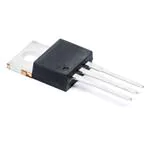
MTP50P03HDLG
Power MOSFET
50 Amps, 30 Volts, Logic Level P−Channel
TO−220
This Power MOSFET is designed to withstand high energy in the
avalanche and commutation modes. The energy efficient design also
offers a drain−to−source diode with a fast recovery time. Designed for
low voltage, high speed switching applications in power supplies,
converters and PWM motor controls, these devices are particularly
well suited for bridge circuits where diode speed and commutating
safe operating areas are critical and offer additional safety margin
against unexpected voltage transients.
www.onsemi.com
50 AMPERES, 30 VOLTS
RDS(on) = 25 mW
P−Channel
Features
D
• Avalanche Energy Specified
• Source−to−Drain Diode Recovery Time Comparable to a Discrete
Fast Recovery Diode
• Diode is Characterized for Use in Bridge Circuits
• IDSS and VDS(on) Specified at Elevated Temperature
• These are Pb−Free Devices*
G
S
MARKING DIAGRAM
& PIN ASSIGNMENT
MAXIMUM RATINGS (TC = 25°C unless otherwise noted)
Rating
Symbol
Value
Unit
Drain−Source Voltage
VDSS
30
Vdc
Drain−Gate Voltage (RGS = 1.0 MW)
VDGR
30
Vdc
Gate−Source Voltage
− Continuous
− Non−Repetitive (tp ≤ 10 ms)
VGS
VGSM
± 15
± 20
Vdc
Vpk
ID
ID
50
31
150
Adc
125
1.0
W
W/°C
−55 to
150
°C
1250
mJ
Drain Current − Continuous
Drain Current − Continuous @ 100°C
Drain Current − Single Pulse (tp ≤ 10 ms)
Total Power Dissipation
Derate above 25°C
Operating and Storage Temperature Range
Single Pulse Drain−to−Source Avalanche
Energy − Starting TJ = 25°C
(VDD = 25 Vdc, VGS = 5.0 Vdc, Peak
IL = 50 Apk, L = 1.0 mH, RG = 25 W)
IDM
PD
TJ, Tstg
EAS
RqJC
RqJA
1.0
62.5
Maximum Lead Temperature for Soldering
Purposes, 1/8″ from case for 10 seconds
TL
260
M50P03HDLG
AYWW
1
2
1
Gate
3
3
Source
2
Drain
M50P03HDL = Device Code
A
= Assembly Location
Y
= Year
WW
= Work Week
G
= Pb−Free Package
ORDERING INFORMATION
*For additional information on our Pb−Free strategy and soldering details, please
download the ON Semiconductor Soldering and Mounting Techniques
Reference Manual, SOLDERRM/D.
January, 2015 − Rev. 7
TO−220AB
CASE 221A
STYLE 5
°C
Stresses exceeding those listed in the Maximum Ratings table may damage the
device. If any of these limits are exceeded, device functionality should not be
assumed, damage may occur and reliability may be affected.
© Semiconductor Components Industries, LLC, 2015
4
Apk
°C/W
Thermal Resistance,
Junction−to−Case
Junction−to−Ambient, when mounted with
the minimum recommended pad size
4
Drain
1
Device
Package
Shipping
MTP50P03HDLG
TO−220AB
(Pb−Free)
50 Units/Rail
Publication Order Number:
MTP50P03HDL/D
�MTP50P03HDLG
ELECTRICAL CHARACTERISTICS (TJ = 25°C unless otherwise noted)
Symbol
Characteristic
Min
Typ
Max
30
−
−
26
−
−
−
−
−
−
1.0
10
−
−
100
1.0
−
1.5
4.0
2.0
−
−
0.020
0.025
−
−
0.83
−
1.5
1.3
15
20
−
Unit
OFF CHARACTERISTICS
(Cpk ≥ 2.0) (Note 3)
Drain−to−Source Breakdown Voltage
(VGS = 0 Vdc, ID = 250 mAdc)
Temperature Coefficient (Positive)
V(BR)DSS
Zero Gate Voltage Drain Current
(VDS = 30 Vdc, VGS = 0 Vdc)
(VDS = 30 Vdc, VGS = 0 Vdc, TJ = 125°C)
IDSS
Gate−Body Leakage Current (VGS = ± 15 Vdc, VDS = 0 Vdc)
IGSS
Vdc
mV/°C
mAdc
nAdc
ON CHARACTERISTICS (Note 1)
Gate Threshold Voltage
(VDS = VGS, ID = 250 mAdc)
Threshold Temperature Coefficient (Negative)
(Cpk ≥ 3.0) (Note 3)
Static Drain−to−Source On−Resistance
(VGS = 5.0 Vdc, ID = 25 Adc)
(Cpk ≥ 3.0) (Note 3)
Drain−to−Source On−Voltage (VGS = 10 Vdc)
(ID = 50 Adc)
(ID = 25 Adc, TJ = 125°C)
VGS(th)
Vdc
W
RDS(on)
VDS(on)
Forward Transconductance
(VDS = 5.0 Vdc, ID = 25 Adc)
mV/°C
Vdc
gFS
mhos
DYNAMIC CHARACTERISTICS
Input Capacitance
(VDS = 25 Vdc, VGS = 0 Vdc,
f = 1.0 MHz)
Output Capacitance
Transfer Capacitance
Ciss
−
3500
4900
Coss
−
1550
2170
Crss
−
550
770
td(on)
−
22
30
tr
−
340
466
td(off)
−
90
117
pF
SWITCHING CHARACTERISTICS (Note 2)
Turn−On Delay Time
Rise Time
(VDD = 15 Vdc, ID = 50 Adc,
VGS = 5.0 Vdc, RG = 2.3 W)
Turn−Off Delay Time
Fall Time
Gate Charge
(See Figure 8)
(VDS = 24 Vdc, ID = 50 Adc,
VGS = 5.0 Vdc)
tf
−
218
300
QT
−
74
100
Q1
−
13.6
−
Q2
−
44.8
−
Q3
−
35
−
−
−
2.39
1.84
3.0
−
trr
−
106
−
ta
−
58
−
tb
−
48
−
QRR
−
0.246
−
−
−
3.5
4.5
−
−
−
7.5
−
ns
nC
SOURCE−DRAIN DIODE CHARACTERISTICS
Forward On−Voltage
(IS =50 Adc, VGS = 0 Vdc)
(IS = 50 Adc, VGS = 0 Vdc, TJ = 125°C)
Reverse Recovery Time
(See Figure 15)
(IS = 50 Adc, VGS = 0 Vdc,
dIS/dt = 100 A/ms)
Reverse Recovery Stored Charge
VSD
Vdc
ns
mC
INTERNAL PACKAGE INDUCTANCE
Internal Drain Inductance
(Measured from contact screw on tab to center of die)
(Measured from the drain lead 0.25″ from package to center of die)
LD
Internal Source Inductance
(Measured from the source lead 0.25″ from package to source bond pad)
LS
1. Pulse Test: Pulse Width ≤ 300 ms, Duty Cycle ≤ 2%.
2. Switching characteristics are independent of operating junction temperature.
Max limit − Typ
3. Reflects typical values.
Cpk =
3 x SIGMA
www.onsemi.com
2
nH
nH
�MTP50P03HDLG
TYPICAL ELECTRICAL CHARACTERISTICS
100
VGS = 10 V
TJ = 25°C
8V
80
VDS ≥ 10 V
5V
4.5 V
I D , DRAIN CURRENT (AMPS)
I D , DRAIN CURRENT (AMPS)
100
6V
4V
60
3.5 V
40
3V
20
TJ = -�55°C
25°C
100°C
80
60
40
20
2.5 V
0.2
0.4
0.6
0.8
1.0
1.2
1.4
1.6
1.8
1.9
2.3
2.7
3.1
3.5
3.9
VDS, DRAIN-TO-SOURCE VOLTAGE (VOLTS)
VGS, GATE-TO-SOURCE VOLTAGE (VOLTS)
Figure 1. On−Region Characteristics
Figure 2. Transfer Characteristics
VGS = 5.0 V
0.027
0.025
TJ = 100°C
0.023
25°C
0.021
0.019
-�55°C
0.017
0.015
0
1.5
2.0
RDS(on) , DRAIN-TO-SOURCE RESISTANCE (OHMS)
0
0.029
0
20
40
60
80
100
4.3
0.022
TJ = 25°C
VGS = 5 V
0.021
0.020
0.019
0.018
0.017
10 V
0.016
0.015
0
20
40
60
80
100
ID, DRAIN CURRENT (AMPS)
ID, DRAIN CURRENT (AMPS)
Figure 3. On−Resistance versus Drain Current
and Temperature
Figure 4. On−Resistance versus Drain Current
and Gate Voltage
1.35
1000
VGS = 5 V
ID = 25 A
VGS = 0 V
1.25
I DSS, LEAKAGE (nA)
R DS(on) , DRAIN-TO-SOURCE RESISTANCE
(NORMALIZED)
RDS(on) , DRAIN-TO-SOURCE RESISTANCE (OHMS)
0
1.15
1.05
TJ = 125°C
100
0.95
100°C
0.85
-�50
10
-�25
0
25
50
75
100
125
150
0
5
10
15
20
25
TJ, JUNCTION TEMPERATURE (°C)
VDS, DRAIN-TO-SOURCE VOLTAGE (VOLTS)
Figure 5. On−Resistance Variation with
Temperature
Figure 6. Drain−To−Source Leakage
Current versus Voltage
www.onsemi.com
3
30
�MTP50P03HDLG
POWER MOSFET SWITCHING
Switching behavior is most easily modeled and predicted
by recognizing that the power MOSFET is charge
controlled. The lengths of various switching intervals (Dt)
are determined by how fast the FET input capacitance can
be charged by current from the generator.
The published capacitance data is difficult to use for
calculating rise and fall because drain−gate capacitance
varies greatly with applied voltage. Accordingly, gate
charge data is used. In most cases, a satisfactory estimate of
average input current (IG(AV)) can be made from a
rudimentary analysis of the drive circuit so that
t = Q/IG(AV)
The capacitance (Ciss) is read from the capacitance curve at
a voltage corresponding to the off−state condition when
calculating td(on) and is read at a voltage corresponding to the
on−state when calculating td(off).
At high switching speeds, parasitic circuit elements
complicate the analysis. The inductance of the MOSFET
source lead, inside the package and in the circuit wiring
which is common to both the drain and gate current paths,
produces a voltage at the source which reduces the gate drive
current. The voltage is determined by Ldi/dt, but since di/dt
is a function of drain current, the mathematical solution is
complex. The MOSFET output capacitance also
complicates the mathematics. And finally, MOSFETs have
finite internal gate resistance which effectively adds to the
resistance of the driving source, but the internal resistance
is difficult to measure and, consequently, is not specified.
The resistive switching time variation versus gate
resistance (Figure 9) shows how typical switching
performance is affected by the parasitic circuit elements. If
the parasitics were not present, the slope of the curves would
maintain a value of unity regardless of the switching speed.
The circuit used to obtain the data is constructed to minimize
common inductance in the drain and gate circuit loops and
is believed readily achievable with board mounted
components. Most power electronic loads are inductive; the
data in the figure is taken with a resistive load, which
approximates an optimally snubbed inductive load. Power
MOSFETs may be safely operated into an inductive load;
however, snubbing reduces switching losses.
During the rise and fall time interval when switching a
resistive load, VGS remains virtually constant at a level
known as the plateau voltage, VSGP. Therefore, rise and fall
times may be approximated by the following:
tr = Q2 x RG/(VGG − VGSP)
tf = Q2 x RG/VGSP
where
VGG = the gate drive voltage, which varies from zero to VGG
RG = the gate drive resistance
and Q2 and VGSP are read from the gate charge curve.
During the turn−on and turn−off delay times, gate current is
not constant. The simplest calculation uses appropriate
values from the capacitance curves in a standard equation for
voltage change in an RC network. The equations are:
td(on) = RG Ciss In [VGG/(VGG − VGSP)]
td(off) = RG Ciss In (VGG/VGSP)
14000
VGS = 0 V
VDS = 0 V
TJ = 25°C
C, CAPACITANCE (pF)
12000
Ciss
10000
8000
6000
Crss
Ciss
4000
Coss
2000
Crss
0
10
5
5
0
VGS
10
15
20
VDS
GATE-TO-SOURCE OR DRAIN-TO-SOURCE VOLTAGE (VOLTS)
Figure 7. Capacitance Variation
www.onsemi.com
4
25
�30
QT
5
Q1
25
VGS
Q2
4
20
3
15
2
10
ID = 50 A
TJ = 25°C
1
5
Q3
0
0
10
VDS
20
30
40
50
60
1000
ID = 50 A
TJ = 25°C
tr
td(off)
100
td(on)
0
80
70
VDD = 30 V
VGS = 10 V
tf
t, TIME (ns)
6
VDS , DRAIN-TO-SOURCE VOLTAGE (VOLTS)
VGS, GATE-TO-SOURCE VOLTAGE (VOLTS)
MTP50P03HDLG
10
1
10
QT, TOTAL GATE CHARGE (nC)
RG, GATE RESISTANCE (Ohms)
Figure 8. Gate−To−Source and Drain−To−Source
Voltage versus Total Charge
Figure 9. Resistive Switching Time
Variation versus Gate Resistance
DRAIN−TO−SOURCE DIODE CHARACTERISTICS
high di/dts. The diode’s negative di/dt during ta is directly
controlled by the device clearing the stored charge.
However, the positive di/dt during tb is an uncontrollable
diode characteristic and is usually the culprit that induces
current ringing. Therefore, when comparing diodes, the
ratio of tb/ta serves as a good indicator of recovery
abruptness and thus gives a comparative estimate of
probable noise generated. A ratio of 1 is considered ideal and
values less than 0.5 are considered snappy.
Compared to ON Semiconductor standard cell density
low voltage MOSFETs, high cell density MOSFET diodes
are faster (shorter trr), have less stored charge and a softer
reverse recovery characteristic. The softness advantage of
the high cell density diode means they can be forced through
reverse recovery at a higher di/dt than a standard cell
MOSFET diode without increasing the current ringing or the
noise generated. In addition, power dissipation incurred
from switching the diode will be less due to the shorter
recovery time and lower switching losses.
The switching characteristics of a MOSFET body diode
are very important in systems using it as a freewheeling or
commutating diode. Of particular interest are the reverse
recovery characteristics which play a major role in
determining switching losses, radiated noise, EMI and RFI.
System switching losses are largely due to the nature of
the body diode itself. The body diode is a minority carrier
device, therefore it has a finite reverse recovery time, trr, due
to the storage of minority carrier charge, QRR, as shown in
the typical reverse recovery wave form of Figure 12. It is this
stored charge that, when cleared from the diode, passes
through a potential and defines an energy loss. Obviously,
repeatedly forcing the diode through reverse recovery
further increases switching losses. Therefore, one would
like a diode with short trr and low QRR specifications to
minimize these losses.
The abruptness of diode reverse recovery effects the
amount of radiated noise, voltage spikes, and current
ringing. The mechanisms at work are finite irremovable
circuit parasitic inductances and capacitances acted upon by
I S , SOURCE CURRENT (AMPS)
50
VGS = 0 V
TJ = 25°C
40
30
20
10
0
0.4
0.6
0.8
1.0
1.2
1.4
1.6
1.8
2.0
2.2
2.4
VSD, SOURCE-TO-DRAIN VOLTAGE (VOLTS)
Figure 10. Diode Forward Voltage versus Current
www.onsemi.com
5
�MTP50P03HDLG
di/dt = 300 A/ms
Standard Cell Density
trr
I S , SOURCE CURRENT
High Cell Density
trr
tb
ta
t, TIME
Figure 11. Reverse Recovery Time (trr)
SAFE OPERATING AREA
reliable operation, the stored energy from circuit inductance
dissipated in the transistor while in avalanche must be less
than the rated limit and must be adjusted for operating
conditions differing from those specified. Although industry
practice is to rate in terms of energy, avalanche energy
capability is not a constant. The energy rating decreases
non−linearly with an increase of peak current in avalanche
and peak junction temperature.
Although many E−FETs can withstand the stress of
drain−to−source avalanche at currents up to rated pulsed
current (IDM), the energy rating is specified at rated
continuous current (ID), in accordance with industry
custom. The energy rating must be derated for temperature
as shown in the accompanying graph (Figure 13). Maximum
energy at currents below rated continuous ID can safely be
assumed to equal the values indicated.
The Forward Biased Safe Operating Area curves define
the maximum simultaneous drain−to−source voltage and
drain current that a transistor can handle safely when it is
forward biased. Curves are based upon maximum peak
junction temperature and a case temperature (TC) of 25°C.
Peak repetitive pulsed power limits are determined by using
the thermal response data in conjunction with the procedures
discussed in AN569, “Transient Thermal Resistance −
General Data and Its Use.”
Switching between the off−state and the on−state may
traverse any load line provided neither rated peak current
(IDM) nor rated voltage (VDSS) is exceeded, and that the
transition time (tr, tf) does not exceed 10 ms. In addition the
total power averaged over a complete switching cycle must
not exceed (TJ(MAX) − TC)/(RqJC).
A power MOSFET designated E−FET can be safely used
in switching circuits with unclamped inductive loads. For
EAS, SINGLE PULSE DRAIN-TO-SOURCE
AVALANCHE ENERGY (mJ)
I D , DRAIN CURRENT (AMPS)
1000
VGS = 20 V
SINGLE PULSE
TC = 25°C
100
100 ms
1 ms
10
10 ms
RDS(on) LIMIT
THERMAL LIMIT
PACKAGE LIMIT
1
0.1
dc
1400
ID = 50 A
1200
1000
800
600
400
200
0
1.0
10
100
25
50
75
100
125
150
VDS, DRAIN-TO-SOURCE VOLTAGE (VOLTS)
TJ, STARTING JUNCTION TEMPERATURE (°C)
Figure 12. Maximum Rated Forward Biased
Safe Operating Area
Figure 13. Maximum Avalanche Energy versus
Starting Junction Temperature
www.onsemi.com
6
�r(t), EFFECTIVE TRANSIENT THERMAL RESISTANCE
(NORMALIZED)
MTP50P03HDLG
1.0
D = 0.5
0.2
0.1
0.1
P(pk)
0.05
0.1
0.02
t1
0.01
t2
DUTY CYCLE, D = t1/t2
SINGLE PULSE
0.01
1.0E-05
1.0E-04
1.0E-03
1.0E-02
1.0E-01
t, TIME (s)
Figure 14. Thermal Response
di/dt
IS
trr
ta
tb
TIME
0.25 IS
tp
IS
Figure 15. Diode Reverse Recovery Waveform
www.onsemi.com
7
RqJC(t) = r(t) RqJC
D CURVES APPLY FOR POWER
PULSE TRAIN SHOWN
READ TIME AT t1
TJ(pk) - TC = P(pk) RqJC(t)
1.0E+00
1.0E+01
�MECHANICAL CASE OUTLINE
PACKAGE DIMENSIONS
TO−220
CASE 221A
ISSUE AK
DATE 13 JAN 2022
SCALE 1:1
STYLE 1:
PIN 1.
2.
3.
4.
BASE
COLLECTOR
EMITTER
COLLECTOR
STYLE 2:
PIN 1.
2.
3.
4.
BASE
EMITTER
COLLECTOR
EMITTER
STYLE 3:
PIN 1.
2.
3.
4.
CATHODE
ANODE
GATE
ANODE
STYLE 4:
PIN 1.
2.
3.
4.
MAIN TERMINAL 1
MAIN TERMINAL 2
GATE
MAIN TERMINAL 2
STYLE 5:
PIN 1.
2.
3.
4.
GATE
DRAIN
SOURCE
DRAIN
STYLE 6:
PIN 1.
2.
3.
4.
ANODE
CATHODE
ANODE
CATHODE
STYLE 7:
PIN 1.
2.
3.
4.
CATHODE
ANODE
CATHODE
ANODE
STYLE 8:
PIN 1.
2.
3.
4.
CATHODE
ANODE
EXTERNAL TRIP/DELAY
ANODE
STYLE 9:
PIN 1.
2.
3.
4.
GATE
COLLECTOR
EMITTER
COLLECTOR
STYLE 10:
PIN 1.
2.
3.
4.
GATE
SOURCE
DRAIN
SOURCE
STYLE 11:
PIN 1.
2.
3.
4.
DRAIN
SOURCE
GATE
SOURCE
STYLE 12:
PIN 1.
2.
3.
4.
MAIN TERMINAL 1
MAIN TERMINAL 2
GATE
NOT CONNECTED
DOCUMENT NUMBER:
DESCRIPTION:
98ASB42148B
TO−220
Electronic versions are uncontrolled except when accessed directly from the Document Repository.
Printed versions are uncontrolled except when stamped “CONTROLLED COPY” in red.
PAGE 1 OF 1
onsemi and
are trademarks of Semiconductor Components Industries, LLC dba onsemi or its subsidiaries in the United States and/or other countries. onsemi reserves
the right to make changes without further notice to any products herein. onsemi makes no warranty, representation or guarantee regarding the suitability of its products for any particular
purpose, nor does onsemi assume any liability arising out of the application or use of any product or circuit, and specifically disclaims any and all liability, including without limitation
special, consequential or incidental damages. onsemi does not convey any license under its patent rights nor the rights of others.
© Semiconductor Components Industries, LLC, 2019
www.onsemi.com
�onsemi,
, and other names, marks, and brands are registered and/or common law trademarks of Semiconductor Components Industries, LLC dba “onsemi” or its affiliates
and/or subsidiaries in the United States and/or other countries. onsemi owns the rights to a number of patents, trademarks, copyrights, trade secrets, and other intellectual property.
A listing of onsemi’s product/patent coverage may be accessed at www.onsemi.com/site/pdf/Patent−Marking.pdf. onsemi reserves the right to make changes at any time to any
products or information herein, without notice. The information herein is provided “as−is” and onsemi makes no warranty, representation or guarantee regarding the accuracy of the
information, product features, availability, functionality, or suitability of its products for any particular purpose, nor does onsemi assume any liability arising out of the application or use
of any product or circuit, and specifically disclaims any and all liability, including without limitation special, consequential or incidental damages. Buyer is responsible for its products
and applications using onsemi products, including compliance with all laws, regulations and safety requirements or standards, regardless of any support or applications information
provided by onsemi. “Typical” parameters which may be provided in onsemi data sheets and/or specifications can and do vary in different applications and actual performance may
vary over time. All operating parameters, including “Typicals” must be validated for each customer application by customer’s technical experts. onsemi does not convey any license
under any of its intellectual property rights nor the rights of others. onsemi products are not designed, intended, or authorized for use as a critical component in life support systems
or any FDA Class 3 medical devices or medical devices with a same or similar classification in a foreign jurisdiction or any devices intended for implantation in the human body. Should
Buyer purchase or use onsemi products for any such unintended or unauthorized application, Buyer shall indemnify and hold onsemi and its officers, employees, subsidiaries, affiliates,
and distributors harmless against all claims, costs, damages, and expenses, and reasonable attorney fees arising out of, directly or indirectly, any claim of personal injury or death
associated with such unintended or unauthorized use, even if such claim alleges that onsemi was negligent regarding the design or manufacture of the part. onsemi is an Equal
Opportunity/Affirmative Action Employer. This literature is subject to all applicable copyright laws and is not for resale in any manner.
PUBLICATION ORDERING INFORMATION
LITERATURE FULFILLMENT:
Email Requests to: orderlit@onsemi.com
onsemi Website: www.onsemi.com
◊
TECHNICAL SUPPORT
North American Technical Support:
Voice Mail: 1 800−282−9855 Toll Free USA/Canada
Phone: 011 421 33 790 2910
Europe, Middle East and Africa Technical Support:
Phone: 00421 33 790 2910
For additional information, please contact your local Sales Representative
�