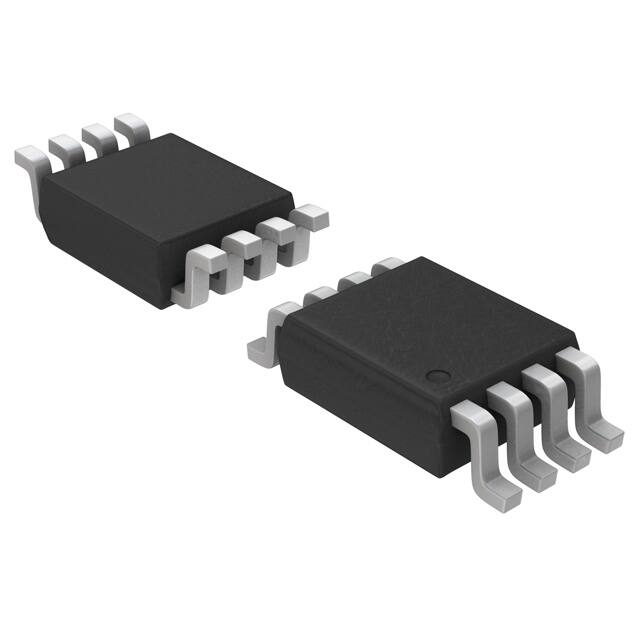
EEPROM Serial 64-Kb I2C
N24C64
Description
The N24C64 is a EEPROM Serial 64−Kb I2C device, organized
internally as 256 pages of 32 bytes each. This device supports the
Standard (100 kHz), Fast (400 kHz) and Fast−Plus (1 MHz) I2C
protocol.
Data is written by providing a starting address, then loading 1 to 32
contiguous bytes into a Page Write Buffer, and then writing all data to
non−volatile memory in one internal write cycle. Data is read by
providing a starting address and then shifting out data serially while
automatically incrementing the internal address count.
External address pins make it possible to address up to eight
N24C64 devices on the same bus.
www.onsemi.com
US8
U SUFFIX
CASE 493
Features
•
•
•
•
•
•
•
•
•
•
•
•
•
Automotive AEC−Q100 Grade 1 (−40°C to +125°C) Qualified
Supports Standard, Fast and Fast−Plus I2C Protocol
1.7 V / 1.6 V to 5.5 V Supply Voltage Range
32−Byte Page Write Buffer
Fast Write Time (4 ms max)
Hardware Write Protection for Entire Memory
Schmitt Triggers and Noise Suppression Filters on I2C Bus Inputs
(SCL and SDA)
Low Power CMOS Technology
1,000,000 Program/Erase Cycles
100 Year Data Retention
Industrial and Automotive Grade 1 Temperature Range
US 8−lead and 4−ball WLCSP Packages
These Devices are Pb−Free, Halogen Free/BFR Free, and RoHS
Compliant
WLCSP4
A4 SUFFIX
CASE 567NH
PIN CONFIGURATIONS
1
A0
A1
A2
VSS
1
VCC
VCC
WP
SCL
SCL
SDA
A1
A2
VSS
B1
B2
SDA
WLCSP4
(Top View)
US8 (U)
(Top View)
MARKING DIAGRAMS
8
8
AT
ALYW
A6 MG
G
1
N24C64UVTG
1
N24C64UDTG
T
YW
XX or T = Specific Device Code*
M
= Date Code
A
= Assembly Location
L
= Wafer Lot Traceability
YW
= Date Code
G
= Pb−Free Package
(Note: Microdot may be in either location)
ORDERING INFORMATION
See detailed ordering, marking and shipping information in the
package dimensions section on page 9 of this data sheet.
© Semiconductor Components Industries, LLC, 2016
April, 2020 − Rev. 4
1
Publication Order Number:
N24C64/D
�N24C64
VCC
VCC
SCL
A2, A1, A0
SDA
N24C64
SCL
SDA
N24C64
WP
VSS
VSS
US8
WLCSP4
PIN FUNCTION
Pin Name
Function
A0, A1, A2
Device Address
SDA
Serial Data
SCL
Serial Clock
WP
Write Protect
VCC
Power Supply
VSS
Ground
Figure 1. Functional Symbols
Table 1. ABSOLUTE MAXIMUM RATINGS
Parameters
Ratings
Units
Storage Temperature
–65 to +150
°C
Voltage on Any Pin with Respect to Ground (Note 1)
–0.5 to +6.5
V
Stresses exceeding those listed in the Maximum Ratings table may damage the device. If any of these limits are exceeded, device functionality
should not be assumed, damage may occur and reliability may be affected.
1. The DC input voltage on any pin should not be lower than −0.5 V or higher than VCC + 0.5 V. During transitions, the voltage on any pin may
undershoot to no less than −1.5 V or overshoot to no more than VCC + 1.5 V, for periods of less than 20 ns.
Table 2. RELIABILITY CHARACTERISTICS
Symbol
NEND (Note 2)
TDR (Note 2)
Parameter
Endurance
Data Retention
2. TA = 25°C
3. A Write Cycle refers to writing a Byte or a Page.
www.onsemi.com
2
Max
Units
1,000,000
Write Cycles (Note 3)
100
Years
�N24C64
Table 3. D.C. OPERATING CHARACTERISTICS
(VCC = 1.7 V / 1.6 V* to 5.5 V, TA = −40°C to +85°C and VCC = 1.8 V to 5.5 V, TA = −40°C to +125°C, unless otherwise specified.)
Symbol
Parameter
Test Conditions
Min
Max
Units
ICCR
Read Current
Read, fSCL = 1 MHz
1
mA
ICCW
Write Current
Write, fSCL = 1 MHz
1
mA
ISB
Standby Current
All I/O Pins at GND or VCC
2
mA
IL
I/O Pin Leakage
Pin at GND or VCC
2
mA
VIL
Input Low Voltage
SCL, SDA
−0.5
VCC x 0.3
V
VIH
Input High Voltage
SCL, SDA
VCC x 0.7
VCC + 0.5
V
VILA
Input Low Voltage
A2, A1, A0 and WP
−0.5
VCC x 0.3
V
VIHA
Input High Voltage
A2, A1, A0 and WP
VCC x 0.8
VCC + 0.5
V
VOL1
Output Low Voltage
VCC ≥ 2.5 V, IOL = 3.0 mA
0.4
V
VOL2
Output Low Voltage
VCC < 2.5 V, IOL = 1.0 mA
0.2
V
Product parametric performance is indicated in the Electrical Characteristics for the listed test conditions, unless otherwise noted. Product
performance may not be indicated by the Electrical Characteristics if operated under different conditions.
Table 4. PIN IMPEDANCE CHARACTERISTICS
(VCC = 1.7 V / 1.6 V* to 5.5 V, TA = −40°C to +85°C and VCC = 1.8 V to 5.5 V, TA = −40°C to +125°C, unless otherwise specified.)
Symbol
Parameter
Conditions
Min
Max
Units
CIN (Note 4)
SDA I/O Pin Capacitance
VIN = 0 V
8
pF
CIN (Note 4)
Input Capacitance (other pins)
VIN = 0 V
6
pF
RPD (Note 5)
WP, A0, A1 or A2 On−Chip Pull−Down Resistor
VIN < VIHA
IPD (Note 5)
WP, A0, A1 or A2 On−Chip Pull−Down Current
VIN > VIHA
50
kW
2
mA
4. These parameters are tested initially and after a design or process change that affects the parameter according to appropriate AEC−Q100
and JEDEC test methods.
5. For improved noise immunity (and to allow for floating input pins), the WP, A0, A1 & A2 inputs are pulled−down to GND by relatively strong
on−chip resistors. When attempting to drive these inputs High, the external drivers must be able to supply sufficient current, until the input level
at the pin exceeds VIHA. Once the input level at the pin exceeds VIHA, the resistive pull−down (RPD) converts to a constant current pull−down
(IPD).
www.onsemi.com
3
�N24C64
Table 5. A.C. CHARACTERISTICS
(VCC = 1.7 V / 1.6 V* to 5.5 V, TA = −40°C to +85°C and VCC = 1.8 V to 5.5 V, TA = −40°C to +125°C unless otherwise noted.) (Note 6)
Standard
Symbol
FSCL
tHD:STA
Parameter
Min
Fast
Max
Clock Frequency
Min
100
START Condition Hold Time
Fast−Plus
Max
Min
400
Max
Units
1,000
kHz
4
0.6
0.25
ms
tLOW
Low Period of SCL Clock
4.7
1.3
0.45
ms
tHIGH
High Period of SCL Clock
4
0.6
0.40
ms
4.7
0.6
0.25
ms
tSU:STA
START Condition Setup Time
tHD:DAT
Data In Hold Time
0
0
0
ms
tSU:DAT
Data In Setup Time
250
100
50
ns
tR (Note 7)
SDA and SCL Rise Time
1,000
300
100
ns
tF (Note 7)
SDA and SCL Fall Time
300
300
100
ns
tSU:STO
STOP Condition Setup Time
tBUF
Bus Free Time Between
STOP and START
tAA
SCL Low to Data Out Valid
tDH (Note 7)
Ti (Note 7)
Data Out Hold Time
4
0.6
0.25
ms
4.7
1.3
0.5
ms
3.5
100
0.9
100
Noise Pulse Filtered at SCL
and SDA Inputs
50
0.40
50
50
ms
ns
50
ns
tSU:WP
WP Setup Time
0
0
0
ms
tHD:WP
WP Hold Time
2.5
2.5
1
ms
tWR
tPU (Notes 7, 8)
Write Cycle Time
Power-up to Ready Mode
4
4
4
ms
0.35
0.35
0.35
ms
*VCC(min) = 1.6 V for Read operations, TA = −20°C to +85°C
6. Test conditions according to “A.C. Test Conditions” table.
7. Tested initially and after a design or process change that affects this parameter.
8. tPU is the delay between the time VCC is stable and the device is ready to accept commands.
Table 6. A.C. TEST CONDITIONS
Input Levels
0.2 x VCC to 0.8 x VCC for VCC ≥ 2.2 V; 0.15 x VCC to 0.85 x VCC for VCC < 2.2 V
Input Rise and Fall Times
≤ 50 ns
Input Reference Levels
0.3 x VCC, 0.7 x VCC
Output Reference Levels
0.3 x VCC, 0.7 x VCC
Output Load
Current Source: IOL = 6 mA (VCC ≥ 2.5 V); IOL = 2 mA (VCC < 2.5 V); CL = 100 pF
www.onsemi.com
4
�N24C64
I2C Bus Protocol
Power-On Reset (POR)
Each N24C64 incorporates Power-On Reset (POR)
circuitry which protects the internal logic against powering
up in the wrong state. The device will power up into Standby
mode after VCC exceeds the POR trigger level and will
power down into Reset mode when VCC drops below the
POR trigger level. This bi-directional POR behavior
protects the device against ‘brown-out’ failure following a
temporary loss of power.
The 2-wire I2C bus consists of two lines, SCL and SDA,
connected to the VCC supply via pull-up resistors. The
Master provides the clock to the SCL line, and either the
Master or the Slaves drive the SDA line. A ‘0’ is transmitted
by pulling a line LOW and a ‘1’ by letting it stay HIGH. Data
transfer may be initiated only when the bus is not busy (see
A.C. Characteristics). During data transfer, SDA must
remain stable while SCL is HIGH.
START/STOP Condition
Pin Description
SCL: The Serial Clock input pin accepts the clock signal
generated by the Master.
SDA: The Serial Data I/O pin accepts input data and delivers
output data. In transmit mode, this pin is open drain. Data is
acquired on the positive edge, and is delivered on the
negative edge of SCL.
A0, A1 and A2: The Address inputs set the device address
that must be matched by the corresponding Slave address
bits. The Address inputs are hard-wired HIGH or LOW
allowing for up to eight devices to be used (cascaded) on the
same bus. When left floating, these inputs are pulled LOW
internally.
WP: When pulled HIGH, the Write Protect input pin
inhibits all write operations. When left floating, this pin is
pulled LOW internally.
An SDA transition while SCL is HIGH creates a START
or STOP condition (Figure 2). The START consists of a
HIGH to LOW SDA transition, while SCL is HIGH. Absent
the START, a Slave will not respond to the Master. The
STOP completes all commands, and consists of a LOW to
HIGH SDA transition, while SCL is HIGH.
Device Addressing
The Master addresses a Slave by creating a START
condition and then broadcasting an 8-bit Slave address. For
the N24C64, the first four bits of the Slave address are set to
1010 (Ah); the next three bits, A2, A1 and A0, must match
the logic state of the similarly named input pins. The R/W
bit tells the Slave whether the Master intends to read (1) or
write (0) data (Figure 3). The device in WLCSP with 4
bumps responds only to address combination A2A1A0 =
000.
Functional Description
The N24C64 supports the Inter-Integrated Circuit (I2C)
Bus protocol. The protocol relies on the use of a Master
device, which provides the clock and directs bus traffic, and
Slave devices which execute requests. The N24C64
operates as a Slave device. Both Master and Slave can
transmit or receive, but only the Master can assign those
roles.
Acknowledge
During the 9th clock cycle following every byte sent to the
bus, the transmitter releases the SDA line, allowing the
receiver to respond. The receiver then either acknowledges
(ACK) by pulling SDA LOW, or does not acknowledge
(NoACK) by letting SDA stay HIGH (Figure 4). Bus timing
is illustrated in Figure 5.
SCL
SDA
START
CONDITION
STOP
CONDITION
Figure 2. Start/Stop Timing
1
0
1
0
A2
A1
A0
DEVICE ADDRESS
Figure 3. Slave Address Bits
www.onsemi.com
5
R/W
�N24C64
BUS RELEASE DELAY (TRANSMITTER)
SCL FROM
MASTER
1
BUS RELEASE DELAY (RECEIVER)
8
9
DATA OUTPUT
FROM TRANSMITTER
DATA OUTPUT
FROM RECEIVER
START
ACK SETUP (≥ tSU:DAT)
ACK DELAY (≤ tAA)
Figure 4. Acknowledge Timing
tF
tHIGH
tLOW
tR
tLOW
SCL
tSU:STA
tHD:DAT
tHD:STA
tSU:DAT
tSU:STO
SDA IN
tAA
tDH
tBUF
SDA OUT
Figure 5. Bus Timing
WRITE OPERATIONS
Byte Write
Acknowledge Polling
To write data to memory, the Master creates a START
condition on the bus and then broadcasts a Slave address
with the R/W bit set to ‘0’. The Master then sends two
address bytes and a data byte and concludes the session by
creating a STOP condition on the bus. The Slave responds
with ACK after every byte sent by the Master (Figure 6). The
STOP starts the internal Write cycle, and while this
operation is in progress (tWR), the SDA output is tri-stated
and the Slave does not acknowledge the Master (Figure 7).
As soon (and as long) as internal Write is in progress, the
Slave will not acknowledge the Master. This feature enables
the Master to immediately follow-up with a new Read or
Write request, rather than wait for the maximum specified
Write time (tWR) to elapse. Upon receiving a NoACK
response from the Slave, the Master simply repeats the
request until the Slave responds with ACK.
Hardware Write Protection
With the WP pin held HIGH, the entire memory is
protected against Write operations. If the WP pin is left
floating or is grounded, it has no impact on the Write
operation. The state of the WP pin is strobed on the last
falling edge of SCL immediately preceding the 1st data byte
(Figure 9). If the WP pin is HIGH during the strobe interval,
the Slave will not acknowledge the data byte and the Write
request will be rejected.
Page Write
The Byte Write operation can be expanded to Page Write,
by sending more than one data byte to the Slave before
issuing the STOP condition (Figure 8). Up to 32 distinct data
bytes can be loaded into the internal Page Write Buffer
starting at the address provided by the Master. The page
address is latched, and as long as the Master keeps sending
data, the internal byte address is incremented up to the end
of page, where it then wraps around (within the page). New
data can therefore replace data loaded earlier. Following the
STOP, data loaded during the Page Write session will be
written to memory in a single internal Write cycle (tWR).
Delivery State
The N24C64 is shipped erased, i.e., all bytes are FFh.
www.onsemi.com
6
�N24C64
BUS ACTIVITY: S
T
A
MASTER R
T
ADDRESS
BYTE
SLAVE
ADDRESS
ADDRESS
BYTE
DATA
BYTE
a7 − a0
d7 − d0
a15 − a8
S
S
T
O
P
P
* * * *
A
C
K
A
C
K
SLAVE
*a15 − a13 are don’t care bits.
A
C
K
A
C
K
Figure 6. Byte Write Sequence
SCL
SDA
8th Bit
Byte n
ACK
tWR
STOP
CONDITION
START
CONDITION
ADDRESS
Figure 7. Write Cycle Timing
BUS
ACTIVITY: S
T
A
MASTER R
T
ADDRESS
BYTE
SLAVE
ADDRESS
DATA
BYTE
n
ADDRESS
BYTE
DATA
BYTE
n+1
S
T
O
P
DATA
BYTE
n+P
P
S
n = 1; P ≤ 31
A
C
K
A
C
K
A
C
K
SLAVE
A
C
K
A
C
K
Figure 8. Page Write Sequence
ADDRESS
BYTE
DATA
BYTE
1
8
a7
a0
9
1
8
d7
d0
SCL
SDA
tSU:WP
WP
tHD:WP
Figure 9. WP Timing
www.onsemi.com
7
A
C
K
A
C
K
�N24C64
READ OPERATIONS
Immediate Read
Write sequence by sending data, the Master then creates a
START condition and broadcasts a Slave address with the
R/W bit set to ‘1’. The Slave responds with ACK after every
byte sent by the Master and then sends out data residing at
the selected address. After receiving the data, the Master
responds with NoACK and then terminates the session by
creating a STOP condition on the bus (Figure 11).
To read data from memory, the Master creates a START
condition on the bus and then broadcasts a Slave address
with the R/W bit set to ‘1’. The Slave responds with ACK
and starts shifting out data residing at the current address.
After receiving the data, the Master responds with NoACK
and terminates the session by creating a STOP condition on
the bus (Figure 10). The Slave then returns to Standby mode.
Sequential Read
Selective Read
If, after receiving data sent by the Slave, the Master
responds with ACK, then the Slave will continue
transmitting until the Master responds with NoACK
followed by STOP (Figure 12). During Sequential Read the
internal byte address is automatically incremented up to the
end of memory, where it then wraps around to the beginning
of memory.
To read data residing at a specific address, the selected
address must first be loaded into the internal address register.
This is done by starting a Byte Write sequence, whereby the
Master creates a START condition, then broadcasts a Slave
address with the R/W bit set to ‘0’ and then sends two
address bytes to the Slave. Rather than completing the Byte
N
O
BUS ACTIVITY: S
T
A
MASTER R
T
S
A T
CO
K P
SLAVE
ADDRESS
P
S
A
C
K
SLAVE
SCL
8
SDA
DATA
BYTE
9
8th Bit
DATA OUT
NO ACK
STOP
Figure 10. Immediate Read Sequence and Timing
BUS ACTIVITY: S
T
A
MASTER R
T
ADDRESS
BYTE
SLAVE
ADDRESS
S
T
A
R
T
ADDRESS
BYTE
S
N
O
A
C
K
SLAVE
ADDRESS
P
S
A
C
K
SLAVE
A
C
K
A
C
K
A
C
K
DATA
BYTE
Figure 11. Selective Read Sequence
N
O
A
C
K
BUS ACTIVITY:
MASTER
A
C
K
SLAVE
ADDRESS
A
C
K
A
C
K
S
T
O
P
P
SLAVE
A
C
K
DATA
BYTE
n
DATA
BYTE
n+1
DATA
BYTE
n+2
Figure 12. Sequential Read Sequence
www.onsemi.com
8
S
T
O
P
DATA
BYTE
n+x
�N24C64
ORDERING INFORMATION
Specific Device Marking
Package Type
Temperature Range
Shipping†
N24C64UDTG
AT
U = US−8
D = Industrial
(−40°C to +85°C)
T = Tape & Reel,
3,000 Units / Reel
N24C64UVTG
A6
U = US−8
V = Automotive Grade 1
(−40°C to +125°C)
T = Tape & Reel,
3,000 Units / Reel
T
A = WLCSP
D = Industrial
(−40°C to +85°C)
T = Tape & Reel,
5,000 Units / Reel
Device Order Number
N24C64A4DXTG
†For information on tape and reel specifications, including part orientation and tape sizes, please refer to our Tape and Reel Packaging
Specifications Brochure, BRD8011/D.
9. All packages are RoHS-compliant (Lead-free, Halogen-free).
10. For additional package and temperature options, please contact your nearest ON Semiconductor Sales office.
ON Semiconductor is licensed by the Philips Corporation to carry the I2C bus protocol.
www.onsemi.com
9
�MECHANICAL CASE OUTLINE
PACKAGE DIMENSIONS
US8
CASE 493
ISSUE F
DATE 01 SEP 2021
SCALE 4 :1
GENERIC
MARKING DIAGRAM*
8
XX MG
G
1
XX
M
G
= Specific Device Code
= Date Code
= Pb−Free Package
(Note: Microdot may be in either location)
*This information is generic. Please refer to
device data sheet for actual part marking.
Pb−Free indicator, “G” or microdot “G”, may
or may not be present. Some products may
not follow the Generic Marking.
DOCUMENT NUMBER:
DESCRIPTION:
98AON04475D
US8
Electronic versions are uncontrolled except when accessed directly from the Document Repository.
Printed versions are uncontrolled except when stamped “CONTROLLED COPY” in red.
PAGE 1 OF 1
onsemi and
are trademarks of Semiconductor Components Industries, LLC dba onsemi or its subsidiaries in the United States and/or other countries. onsemi reserves
the right to make changes without further notice to any products herein. onsemi makes no warranty, representation or guarantee regarding the suitability of its products for any particular
purpose, nor does onsemi assume any liability arising out of the application or use of any product or circuit, and specifically disclaims any and all liability, including without limitation
special, consequential or incidental damages. onsemi does not convey any license under its patent rights nor the rights of others.
© Semiconductor Components Industries, LLC, 2021
www.onsemi.com
�onsemi,
, and other names, marks, and brands are registered and/or common law trademarks of Semiconductor Components Industries, LLC dba “onsemi” or its affiliates
and/or subsidiaries in the United States and/or other countries. onsemi owns the rights to a number of patents, trademarks, copyrights, trade secrets, and other intellectual property.
A listing of onsemi’s product/patent coverage may be accessed at www.onsemi.com/site/pdf/Patent−Marking.pdf. onsemi reserves the right to make changes at any time to any
products or information herein, without notice. The information herein is provided “as−is” and onsemi makes no warranty, representation or guarantee regarding the accuracy of the
information, product features, availability, functionality, or suitability of its products for any particular purpose, nor does onsemi assume any liability arising out of the application or use
of any product or circuit, and specifically disclaims any and all liability, including without limitation special, consequential or incidental damages. Buyer is responsible for its products
and applications using onsemi products, including compliance with all laws, regulations and safety requirements or standards, regardless of any support or applications information
provided by onsemi. “Typical” parameters which may be provided in onsemi data sheets and/or specifications can and do vary in different applications and actual performance may
vary over time. All operating parameters, including “Typicals” must be validated for each customer application by customer’s technical experts. onsemi does not convey any license
under any of its intellectual property rights nor the rights of others. onsemi products are not designed, intended, or authorized for use as a critical component in life support systems
or any FDA Class 3 medical devices or medical devices with a same or similar classification in a foreign jurisdiction or any devices intended for implantation in the human body. Should
Buyer purchase or use onsemi products for any such unintended or unauthorized application, Buyer shall indemnify and hold onsemi and its officers, employees, subsidiaries, affiliates,
and distributors harmless against all claims, costs, damages, and expenses, and reasonable attorney fees arising out of, directly or indirectly, any claim of personal injury or death
associated with such unintended or unauthorized use, even if such claim alleges that onsemi was negligent regarding the design or manufacture of the part. onsemi is an Equal
Opportunity/Affirmative Action Employer. This literature is subject to all applicable copyright laws and is not for resale in any manner.
PUBLICATION ORDERING INFORMATION
LITERATURE FULFILLMENT:
Email Requests to: orderlit@onsemi.com
onsemi Website: www.onsemi.com
◊
TECHNICAL SUPPORT
North American Technical Support:
Voice Mail: 1 800−282−9855 Toll Free USA/Canada
Phone: 011 421 33 790 2910
Europe, Middle East and Africa Technical Support:
Phone: 00421 33 790 2910
For additional information, please contact your local Sales Representative
�