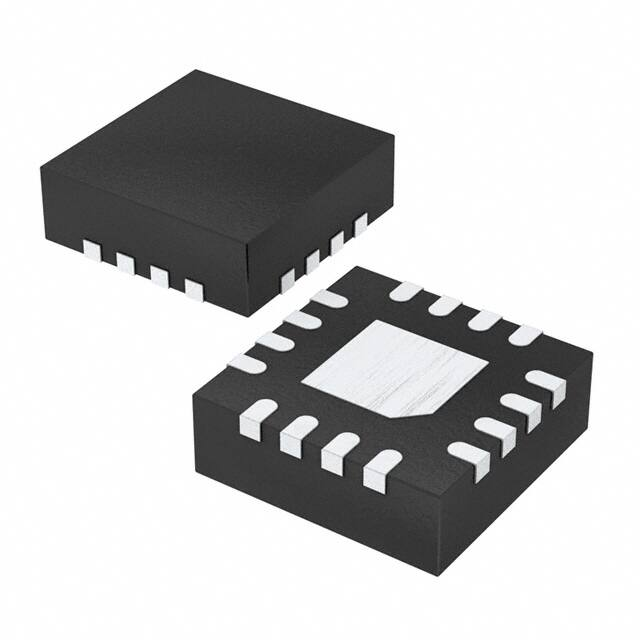
2.5 V/3.3 V Differential 2 x 2
Crosspoint Switch with
CML Outputs Clock/Data
Buffer/Translator
Multi−Level Inputs w/ Internal Termination
NB7L72M
www.onsemi.com
MARKING
DIAGRAM*
Description
The NB7L72M is a high bandwidth, low voltage, fully differential
2 x 2 crosspoint switch with CML outputs. The NB7L72M design is
optimized for low skew and minimal jitter as it produces two identical
copies of Clock or Data operating up to 7 GHz or 10 Gb/s,
respectively. As such, the NB7L72M is ideal for SONET, GigE, Fiber
Channel, Backplane and other clock/data distribution applications.
The differential IN/IN inputs incorporate internal 50 W termination
resistors and will accept LVPECL, CML, or LVDS logic levels (see
Figure 11). The 16 mA differential CML outputs provide matching
internal 50 W terminations and produce 400 mV output swings when
externally terminated with a 50 W resistor to VCC (see Figure 9).
The NB7L72M is the 2.5 V/3.3 V version of the and NB7V72M and
is offered in a low profile 3x3 mm 16−pin QFN package. Application
notes, models, and support documentation are available at
www.onsemi.com.
The NB7L72M is a member of the GigaComm™ family of high
performance clock products.
1
A
L
Y
W
G
Maximum Input Data Rate > 10 Gb/s
Data Dependent Jitter < 10 ps pk−pk
Maximum Input Clock Frequency > 7 GHz
Random Clock Jitter < 0.5 ps RMS, Max
150 ps Typical Propagation Delay
30 ps Typical Rise and Fall Times
Differential CML Outputs, 400 mV peak−to−peak, typical
Operating Range: VCC = 2.375 V to 3.6 V with GND = 0 V
Internal 50 W Input Termination Resistors
QFN16 Package, 3mm x 3mm
−40°C to +85°C Ambient Operating Temperature
These are Pb−Free Devices
NB7L
72M
ALYWG
G
= Assembly Location
= Wafer Lot
= Year
= Work Week
= Pb−Free Package
(Note: Microdot may be in either location)
*For additional marking information, refer to
Application Note AND8002/D.
+
SEL0
Features
•
•
•
•
•
•
•
•
•
•
•
•
QFN16
MN SUFFIX
CASE 485G
IN0
Q0
VT0
IN0
Q0
0
1
Q1
IN1
VT1
Q1
+
IN1
SEL1
0
Figure 1. Logic Diagram1
ORDERING INFORMATION
See detailed ordering and shipping information in the package
dimensions section on page 8 of this data sheet.
© Semiconductor Components Industries, LLC, 2017
May, 2021 − Rev. 5
1
Publication Order Number:
NB7L72M/D
�NB7L72M
VT0
16
IN0
1
IN0
2
SEL0 GND VCC
15
14
Exposed Pad (EP)
Table 1. INPUT/OUTPUT SELECT TRUTH TABLE
13
12
Q0
11
Q0
SEL0*
SEL1*
Q0
Q1
L
L
IN0
IN0
L
H
IN0
IN1
H
L
IN1
IN0
H
H
IN1
IN1
NB7L72M
IN1
3
10
Q1
IN1
4
9
Q1
*Defaults HIGH when left open
5
VT1
6
7
SEL1 GND
8
VCC
Figure 2. Pin Configuration (Top View)
Table 2. PIN DESCRIPTION
Pin
Name
I/O
1
IN0
LVPECL, CML,
LVDS Input
Noninverted Differential Input. (Note 1)
Description
2
IN0
LVPECL, CML,
LVDS Input
Inverted Differential Input. (Note 1)
3
IN1
LVPECL, CML,
LVDS Input
Inverted Differential Input. (Note 1)
4
IN1
LVPECL, CML,
LVDS Input
Noninverted Differential Input. (Note 1)
5
VT1
−
6
SEL1
LVCMOS Input
7
GND
8
VCC
−
9
Q1
CML Output
Noninverted Differential Output. (Note 1)
10
Q1
CML Output
Inverted Differential Output. (Note 1)
11
Q0
CML Output
Inverted Differential Output. (Note 1)
12
Q0
CML Output
Noninverted Differential Output. (Note 1)
13
VCC
−
Positive Supply Voltage
14
GND
−
Negative Supply Voltage
15
SEL0
LVCMOS Input
16
VT0
−
Internal 50 W Termination Pin for IN0 and IN0
−
EP
−
The Exposed Pad (EP) on the QFN16 package bottom is thermally connected to the die for
improved heat transfer out of package. The exposed pad must be attached to a heat−sinking
conduit. The pad is electrically connected to the die, and is recommended to be electrically and
thermally connected to GND on the PC board.
Internal 50 W Termination Pin for IN1 and IN1.
Input Select logic pin for IN0 or IN1 Inputs to Q1 output. See Table 1, Input/Output Select Truth
Table; pin defaults HIGH when left open.
Negative Supply Voltage
Positive Supply Voltage
Input Select logic pin for IN0 or IN1 Inputs to Q0 output. See Table 1, Input/Output Select Truth
Table; pin defaults HIGH when left open.
1. In the differential configuration when the input termination pins (VT0, VT1) are connected to a common termination voltage or left open, and
if no signal is applied on INx/INx input, then the device will be susceptible to self−oscillation.
2. All VCC and GND pins must be externally connected to a power supply for proper operation.
www.onsemi.com
2
�NB7L72M
Table 3. ATTRIBUTES
Characteristics
Value
ESD Protection
Human Body Model
Machine Model
> 4 kV
> 200 V
RPU − Input Pullup Resistor
75 kW
Moisture Sensitivity (Note 3)
QFN16
Level 1
Flammability Rating
Oxygen Index: 28 to 34
UL 94 V−0 @ 0.125 in
Transistor Count
212
Meets or exceeds JEDEC Spec EIA/JESD78 IC Latchup Test
3. For additional information, see Application Note AND8003/D.
Table 4. MAXIMUM RATINGS
Symbol
Parameter
Condition 1
Condition 2
Rating
Unit
VCC
Positive Power Supply
GND = 0 V
4.0
V
VIN
Positive Input Voltage
GND = 0 V
−0.5 to VCC +0.5
V
Differential Input Voltage |IN − IN|
1.89
V
Input Current Through RT (50 W Resistor)
±40
mA
VINPP
IIN
IOUT
±40
mA
TA
Operating Temperature Range
−40 to +85
°C
Tstg
Storage Temperature Range
−65 to +150
°C
qJA
Thermal Resistance (Junction−to−Ambient)
(Note 4)
QFN16
QFN16
42
35
°C/W
°C/W
qJC
Thermal Resistance (Junction−to−Case) (Note 4)
QFN16
4
°C/W
Tsol
Wave Solder
265
°C
Output Current Through RT (50 W Resistor)
0 lfpm
500 lfpm
Pb−Free
Stresses exceeding those listed in the Maximum Ratings table may damage the device. If any of these limits are exceeded, device functionality
should not be assumed, damage may occur and reliability may be affected.
4. JEDEC standard multilayer board − 2S2P (2 signal, 2 power) with 8 filled thermal vias under exposed pad.
www.onsemi.com
3
�NB7L72M
Table 5. DC CHARACTERISTICS, Multi−Level Inputs VCC = 2.375 V to 3.6 V, GND = 0 V, TA = −40°C to +85°C (Note 5)
Symbol
Characteristic
Min
Typ
Max
Unit
2.375
3.0
2.5
3.3
2.625
3.6
V
80
135
175
mA
VCC – 40
3260
2460
VCC – 20
3280
2480
VCC
3300
2500
mV
VCC – 650
2650
VCC – 600
1900
VCC – 500
2800
VCC – 500
2000
VCC – 400
2900
VCC – 350
2150
mV
1050
VCC − 100
mV
POWER SUPPLY CURRENT
VCC
Power Supply Voltage
VCC = 2.5 V
VCC = 3.3 V
ICC
Power Supply Current (Inputs and Outputs Open)
CML OUTPUTS
VOH
Output HIGH Voltage (Note 6)
VOL
Output LOW Voltage (Note 6)
VCC = 3.3 V
VCC = 2.5 V
VCC = 3.3 V
VCC = 2.5 V
DIFFERENTIAL CLOCK INPUTS DRIVEN SINGLE−ENDED (Note 7) (Figures 5 and 7)
Vth
Input Threshold Reference Voltage Range (Note 8)
VIH
Single−Ended Input HIGH Voltage
Vth + 100
VCC
mV
VIL
Single−Ended Input LOW Voltage
GND
Vth − 100
mV
Single−Ended Input Voltage (VIH − VIL)
200
2800
mV
VISE
DIFFERENTIAL DATA/CLOCK INPUTS DRIVEN DIFFERENTIALLY (Figures 6 and 8) (Note 9)
VIHD
Differential Input HIGH Voltage (INn, INn)
1100
VCC
mV
VILD
Differential Input LOW Voltage (INn, INn)
GND
VCC − 100
mV
VID
Differential Input Voltage (INn, INn) (VIHD − VILD)
100
1200
mV
Input Common Mode Range (Differential Configuration, Note 10)
(Figure 9)
950
VCC − 50
mV
IIH
Input HIGH Current INn, INn (VTIN/VTIN Open)
−150
150
mA
IIL
Input LOW Current INn, INn (VTIN/VTIN Open)
−150
150
mA
VCMR
CONTROL INPUTS (SEL0, SEL1)
VIH
Input HIGH Voltage for Control Pins
2.0
VCC
V
VIL
Input LOW Voltage for Control Pins
GND
0.8
V
IIH
Input HIGH Current
−150
150
mA
IIL
Input LOW Current
−150
150
mA
TERMINATION RESISTORS
RTIN
RTOUT
Internal Input Termination Resistor
40
50
60
W
Internal Output Termination Resistor
40
50
60
W
NOTE: Device will meet the specifications after thermal equilibrium has been established when mounted in a test socket or printed circuit
board with maintained transverse airflow greater than 500 lfpm.
5. Input and output parameters vary 1:1 with VCC.
6. CML outputs loaded with 50 W to VCC for proper operation.
7. Vth, VIH, VIL, and VISE parameters must be complied with simultaneously.
8. Vth is applied to the complementary input when operating in single−ended mode.
9. VIHD, VILD, VID, and VCMR parameters must be complied with simultaneously.
10. VCMR min varies 1:1 with GND, VCMR max varies 1:1 with VCC. The VCMR range is referenced to the most positive side of the differential
input signal.
www.onsemi.com
4
�NB7L72M
Table 6. AC CHARACTERISTICS VCC = 2.375 V to 3.6 V, GND = 0 V, TA = −40°C to 85°C (Note 11)
Symbol
Characteristic
fMAX
Min
Maximum Input Clock Frequency
fDATAMAX
7.0
8.5
fin ≤ 8.5 GHz
200
400
110
150
Maximum Operating Data Rate (PRBS23)
VOUTPP
Propagation Delay to Differential Outputs,
@ 1GHz, Measured at Differential Cross−point
tPLH TC
INn/INn to Qn/Qn
SELn to Qn/Qn
Propagation Delay Temperature Coefficient
tSKEW
Gbps
Output Clock Duty Cycle (Reference Duty Cycle = 50%)
fin ≤ 8.5GHz
tjitter
RJ – Output Random Jitter (Note 14)
DJ – Deterministic Jitter (Note 15)
fin ≤ 8.5 GHz
≤ 10 Gbps
45
Input Voltage Swing (Differential Configuration) (Note 16)
tr,, tf
mV
180
50
tDC
Output Rise/Fall Times @ 1 GHz (20% − 80%),
25
ps
Dfs/°C
10
20
ps
50
55
%
0.2
0.5
10
ps RMS
ps pk−pk
1200
mV
50
ps
100
Q, Q
Unit
GHz
Output−to−Output Skew (within device) (Note 13)
Device−to−Device Skew (tpdmax – tpdmin)
VINPP
Max
10
Output Voltage Amplitude (@ VINPPmin)
(See Figures 3 and 10, Note 12)
tPLH,
tPHL
Typ
VOUT ≥ 250 mV
VOUT ≥ 200 mV
30
NOTE: Device will meet the specifications after thermal equilibrium has been established when mounted in a test socket or printed circuit
board with maintained transverse airflow greater than 500 lfpm.
11. Measured using a 400 mV source, 50% duty cycle clock source. All output loading with external 50 W to VCC. Input edge rates w40 ps
(20% − 80%).
12. Output voltage swing is a single−ended measurement operating in differential mode.
13. Skew is measured between outputs under identical transitions and conditions. Duty cycle skew is defined only for differential operation when
the delays are measured from cross−point of the inputs to the cross−point of the outputs.
14. Additive RMS jitter with 50% duty cycle clock signal.
15. Additive Peak−to−Peak data dependent jitter with input NRZ data at PRBS23.
16. Input voltage swing is a single−ended measurement operating in differential mode.
OUTPUT VOLTAGE AMPLITUDE
(mV)
500
450
VCC
Q AMP (mV)
400
350
INn
300
50 W
VTn
250
200
50 W
INn
0
1.0
2.0
3.0
4.0
5.0
6.0
7.0
8.0
fin, Clock Input Frequency (GHz)
Figure 3. CLOCK Output Voltage Amplitude
(VOUTPP) vs. Input Frequency (fin) at Ambient
Temperature (Typ)
Figure 4. Input Structure
www.onsemi.com
5
�NB7L72M
IN
VIH
Vth
IN
VIL
IN
IN
Vth
Figure 5. Differential Input Driven
Single−Ended
VCC
Vthmax
Figure 6. Differential Inputs
Driven Differentially
VIHmax
VILmax
VIH
Vth
VIL
Vth
VILD
VILmin
GND
Figure 7. Vth Diagram
VCC
Figure 8. Differential Inputs Driven Differentially
VIHDmax
VCMmax
IN
VILDmax
IN
VCMR
IN
GND
VIHD
IN
VIHmin
Vthmin
VCMmin
VID = |VIHD(IN) − VILD(IN)|
IN
VINPP = VIH(IN) − VIL(IN)
IN
VIHDtyp
VID = VIHD − VILD
Q
VILDtyp
VOUTPP = VOH(Q) − VOL(Q)
Q
VIHDmin
tPHL
VILDmin
tPLH
Figure 9. VCMR Diagram
Figure 10. AC Reference Measurement
NB7L72M
Receiver
VCC
VCC (Receiver)
50 W
50 W
Q
50 W
50 W
Q
16 mA
GND
Figure 11. Typical CML Output Structure and Termination
www.onsemi.com
6
�NB7L72M
VCC
50 W
Z = 50 W
DUT
Driver
Device
50 W
Q
D
Receiver
Device
Z = 50 W
Q
D
Figure 12. Typical Termination for CML Output Driver and Device Evaluation
VCC
VCC
ZO = 50 W
LVPECL
Driver
NB7L72M
ZO = 50 W
IN
50 W
VT = VCC − 2 V
ZO = 50 W
VCC
VCC
LVDS
Driver
50 W
GND
GND
VCC
VCC
CML
Driver
50 W
VCC
NB7L72M
ZO = 50 W
IN
50 W
VT = VCC
ZO = 50 W
Differential
Driver
50 W
GND
Figure 14. LVDS Interface
VCC
IN
GND
50 W
IN
Figure 13. LVPECL Interface
ZO = 50 W
IN
VT = Open
ZO = 50 W
IN
GND
NB7L72M
NB7L72M
IN
50 W
VT = VREFAC*
ZO = 50 W
50 W
IN
GND
GND
GND
Figure 16. Capacitor−Coupled
Differential Interface
(VT Connected to External VREFAC)
Figure 15. Standard 50 W Load CML Interface
*VREFAC bypassed to ground with a 0.01 mF capacitor
www.onsemi.com
7
�NB7L72M
ORDERING INFORMATION
Device
Package
Shipping†
NB7L72MMNG
QFN16
(Pb−free)
123 Units / Tube
NB7L72MMNHTBG
QFN16
(Pb−free)
100 / Tape & Reel
†For information on tape and reel specifications, including part orientation and tape sizes, please refer to our Tape and Reel Packaging
Specifications Brochure, BRD8011/D.
GigaComm is a trademark of Semiconductor Components Industries, LLC (SCILLC) or its subsidiaries in the United States and/or other countries.
www.onsemi.com
8
�MECHANICAL CASE OUTLINE
PACKAGE DIMENSIONS
QFN16 3x3, 0.5P
CASE 485G
ISSUE G
1
SCALE 2:1
DATE 08 OCT 2021
GENERIC
MARKING DIAGRAM*
XXXXX
XXXXX
ALYWG
G
XXXXX
A
L
Y
W
G
= Specific Device Code
= Assembly Location
= Wafer Lot
= Year
= Work Week
= Pb−Free Package
(Note: Microdot may be in either location)
*This information is generic. Please refer to
device data sheet for actual part marking.
Pb−Free indicator, “G” or microdot “G”, may
or may not be present. Some products may
not follow the Generic Marking.
DOCUMENT NUMBER:
DESCRIPTION:
98AON04795D
QFN16 3X3, 0.5P
Electronic versions are uncontrolled except when accessed directly from the Document Repository.
Printed versions are uncontrolled except when stamped “CONTROLLED COPY” in red.
PAGE 1 OF 1
onsemi and
are trademarks of Semiconductor Components Industries, LLC dba onsemi or its subsidiaries in the United States and/or other countries. onsemi reserves
the right to make changes without further notice to any products herein. onsemi makes no warranty, representation or guarantee regarding the suitability of its products for any particular
purpose, nor does onsemi assume any liability arising out of the application or use of any product or circuit, and specifically disclaims any and all liability, including without limitation
special, consequential or incidental damages. onsemi does not convey any license under its patent rights nor the rights of others.
© Semiconductor Components Industries, LLC, 2019
www.onsemi.com
�onsemi,
, and other names, marks, and brands are registered and/or common law trademarks of Semiconductor Components Industries, LLC dba “onsemi” or its affiliates
and/or subsidiaries in the United States and/or other countries. onsemi owns the rights to a number of patents, trademarks, copyrights, trade secrets, and other intellectual property.
A listing of onsemi’s product/patent coverage may be accessed at www.onsemi.com/site/pdf/Patent−Marking.pdf. onsemi reserves the right to make changes at any time to any
products or information herein, without notice. The information herein is provided “as−is” and onsemi makes no warranty, representation or guarantee regarding the accuracy of the
information, product features, availability, functionality, or suitability of its products for any particular purpose, nor does onsemi assume any liability arising out of the application or use
of any product or circuit, and specifically disclaims any and all liability, including without limitation special, consequential or incidental damages. Buyer is responsible for its products
and applications using onsemi products, including compliance with all laws, regulations and safety requirements or standards, regardless of any support or applications information
provided by onsemi. “Typical” parameters which may be provided in onsemi data sheets and/or specifications can and do vary in different applications and actual performance may
vary over time. All operating parameters, including “Typicals” must be validated for each customer application by customer’s technical experts. onsemi does not convey any license
under any of its intellectual property rights nor the rights of others. onsemi products are not designed, intended, or authorized for use as a critical component in life support systems
or any FDA Class 3 medical devices or medical devices with a same or similar classification in a foreign jurisdiction or any devices intended for implantation in the human body. Should
Buyer purchase or use onsemi products for any such unintended or unauthorized application, Buyer shall indemnify and hold onsemi and its officers, employees, subsidiaries, affiliates,
and distributors harmless against all claims, costs, damages, and expenses, and reasonable attorney fees arising out of, directly or indirectly, any claim of personal injury or death
associated with such unintended or unauthorized use, even if such claim alleges that onsemi was negligent regarding the design or manufacture of the part. onsemi is an Equal
Opportunity/Affirmative Action Employer. This literature is subject to all applicable copyright laws and is not for resale in any manner.
PUBLICATION ORDERING INFORMATION
LITERATURE FULFILLMENT:
Email Requests to: orderlit@onsemi.com
onsemi Website: www.onsemi.com
◊
TECHNICAL SUPPORT
North American Technical Support:
Voice Mail: 1 800−282−9855 Toll Free USA/Canada
Phone: 011 421 33 790 2910
Europe, Middle East and Africa Technical Support:
Phone: 00421 33 790 2910
For additional information, please contact your local Sales Representative
�