NCP5667
3.0 A, Low Dropout Linear
Regulator with Enhanced ESD
Protection
The NCP5667 is a high performance, low dropout linear regulator
designed for high power applications that require up to 3.0 A current.
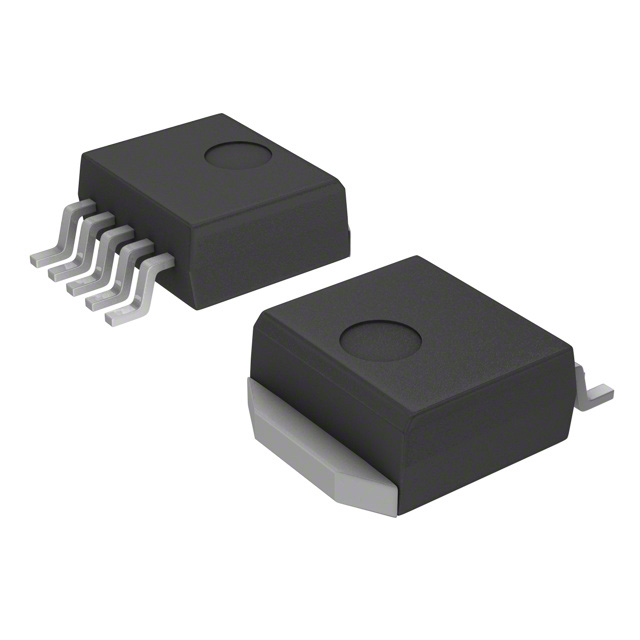
A thermally robust, 3 pin D2PAK, combined with an architecture that
offers low ground current (independent of load), provides for a
superior high−current LDO solution.
http://onsemi.com
MARKING
DIAGRAM
Features
•
•
•
•
•
•
•
•
•
•
±1% Output Voltage Accuracy
Ultra−Fast Transient Response (Settling Time: 1−3 ms)
Enhanced ESD Ratings: 4 kV (HBM), 400 V (MM)
Low Ground Current Independent of Load (3.0 mA Maximum)
Current Limit Protection
Thermal Protection
Power Supply Rejection Ratio > 65 dB
Stable with Aluminum, Tantalum and Ceramic Capacitors
Functional Substitute for LM323
This is a Pb−Free Device
Applications
•
•
•
•
•
•
•
Servers
DTV and Flat Panel Applications
Post Regulation for Power Supplies
Laptop Computing Applications
USB Powered Applications
Networking Equipment
Gaming and STB Modules
Vin
Vin
Cin*
Vout
NCP5667
1
3
D2PAK3
CASE 936
NC
5667DSxx
AWLYWWG
xx
= Voltage Option
= 50 = 5.0 V
A
= Assembly Location
WL = Wafer Lot
Y
= Year
WW = Work Week
G = Pb−Free
Tab = GND
Pin 1. Vin
2. GND
3. Vout
ORDERING INFORMATION
See detailed ordering and shipping information in the package
dimensions section on page 8 of this data sheet.
Vout
Cout**
GND
* Cin − 4.7 mF to 220 mF recommended
**Cout − 2.2 mF to 220 mF recommended
See more details in the Application Information section
Figure 1. Typical Application Circuit
© Semiconductor Components Industries, LLC, 2011
October, 2011 − Rev. 1
1
Publication Order Number:
NCP5667/D
�NCP5667
PIN FUNCTION DESCRIPTION
Pin No.
Pin Name
Description
1
Vin
2, Tab
GND
Power Supply Ground
3
Vout
Regulated Output Voltage
Positive Power Supply Input Voltage
Vin
Voltage
Reference
Block
Vref = 0.9 V
R3
Vout
Output
Stage
Cc
R1
R4
R2
GND
Figure 2. Block Diagram
http://onsemi.com
2
�NCP5667
ABSOLUTE MAXIMUM RATINGS
Symbol
Value
Unit
Input Voltage (Note 1)
Rating
Vin
18
Vdc
Output Pin Voltage
Vout
−0.3 to (Vin + 0.3)
V
TJ(max)
150
°C
Storage Temperature Range
Tstg
−55 to +150
°C
Moisture Sensitivity Level
MSL
1
−
ESD Capability, Human Body Model (Note 2)
ESDHBM
4000
V
ESD Capability, Machine Model (Note 2)
ESDMM
400
V
Maximum Junction Temperature
Stresses exceeding Maximum Ratings may damage the device. Maximum Ratings are stress ratings only. Functional operation above the
Recommended Operating Conditions is not implied. Extended exposure to stresses above the Recommended Operating Conditions may affect
device reliability.
THERMAL CHARACTERISTICS
Rating
Symbol
Thermal Characteristics (Note 1)
Thermal Resistance Junction−to−Ambient (Note 3)
Thermal Resistance Junction−to−Case
Value
Unit
°C/W
RθJA
RθJC
45
5.0
Symbol
Value
Unit
Operating Input Voltage (Note 1)
Vin
(Vout + VDO) to 9
V
Operating Ambient Temperature Range
TA
−40 to +85
°C
OPERATING RANGES
Rating
1. Refer to Electrical Characteristics and Application Information for Safe Operating Area.
2. This device series contains ESD protection and exceeds the following tests:
Human Body Model (HBM) JESD 22−A114−B
Machine Model (MM) JESD 22−A115−A.
3. As measured using a copper heat spreading area of 650 mm2, 1 oz copper thickness.
http://onsemi.com
3
�NCP5667
ELECTRICAL CHARACTERISTICS (Vin = Vout(nom) + 1.5 V, for typical values TA = 25°C, for min/max values TA = −40°C to 85°C, Cin
= 100 mF, Cout = 33 mF, unless otherwise noted. (Note 4))
Symbol
Characteristic
Output Voltage (Note 6)
5.0 V Regulator
TA = 25°C (Vin = 6.5 V to 7.0 V, Iout = 10 mA to 3.0 A)
TA = −20 to +125°C (Vin = 6.5 V to 7.0 V, Iout = 10 mA to 3.0 A)
TA = −40 to +150°C (Vin = 6.5 V to 7.0 V, Iout = 10 mA to 3.0 A)
Min
Typ
Max
Vout
Unit
V
4.950 (−1%)
4.925 (−1.5%)
4.900 (−2%)
5.000
5.000
5.000
5.050 (+1%)
5.075 (+1.5%)
5.100 (+2%)
Line Regulation (Iout = 10 mA, Vout+1.5 V < Vin < 7.0 V) (Note 5)
REGline
−
0.03
−
%
Load Regulation (10 mA < Iout < 3.0 A) (Note 5)
REGload
−
0.2
−
%
Dropout Voltage (Iout = 3.0 A)
VDO
−
1.0
1.3
V
Peak Output Current Limit
Iout
3.0
−
−
A
Internal Current Limitation (Note 5)
Ilim
−
4.5
−
A
Ripple Rejection (120 Hz) (Note 5)
Ripple Rejection (1 kHz) (Note 5)
RR
−
−
70
65
−
−
dB
Output Noise Voltage
(Iout = 10 mA, Cout = 1.0 mF, f = 10 Hz to 100 kHz) (Note 5)
Vn
−
105
−
mVrms
Thermal Shutdown (Note 5)
TSHD
−
160
−
°C
Ground Current (Iout = 3.0 A)
IGND
−
2.4
3.0
mA
4. Performance guaranteed over specified operating conditions by design, guard banded test limits, and/or characterization, production tested at
TJ = TA = 25°C. Low duty cycle pulse techniques are used during testing to maintain the junction temperature as close to ambient as possible.
5. Typical values are based on design and/or characterization.
6. Other fixed output voltages available at 0.9 V, 1.2 V, 1.5 V, 1.8 V, 2.5 V, 3.0 V, 3.3 V per request.
http://onsemi.com
4
�NCP5667
TYPICAL CHARACTERISTICS
1.2
Iout = 3.0 A
1.0
Iout = 1.5 A
0.8
0.6
Iout = 0.5 A
0.4
0.2
0.0
−50
Vout, OUTPUT VOLTAGE (V)
VDO, DROPOUT VOLTAGE (V)
1.4
−25
0
25
50
75
100
125
0.8
25°C
0.6
150°C
0.4
0.2
0
0.5
1.0
1.5
2.0
2.5
3.0
Iout, OUTPUT CURRENT (A)
Figure 1. Dropout Voltage vs. Ambient
Temperature
Figure 2. Dropout Voltage vs. Output Current
5.10
2.5
5.08
2.4
5.06
5.04
Iout = 3.0 A
5.02
5.00
Iout = 10 mA
4.98
4.96
4.94
Vout(nom) = 5.0 V
4.90
−50
0°C
1.0 −40°C
TA, AMBIENT TEMPERATURE (°C)
4.92
−25
0
25
50
75
100
125
Iout = 3.0 A
2.3
2.2
2.1
2.0
1.9
1.8
1.7
1.6
Vout(nom) = 5.0 V
1.5
−50
150
−25
0
25
50
75
100
125
TA, AMBIENT TEMPERATURE (°C)
TA, AMBIENT TEMPERATURE (°C)
Figure 3. Output Voltage vs. Ambient Temperature
Figure 4. Ground Current vs. Ambient
Temperature
5.00
4.75
4.50
4.25
4.00
3.75
3.50
3.25
3.00
−50
150
1.2
OUTPUT CURRENT (A)
ISC, SHORT CIRCUIT LIMIT (A)
1.2
0.0
150
IGND, GROUND CURRENT (mA)
VDO, DROPOUT VOLTAGE (V)
1.4
−25
0
25
50
75
100
125
0.8
0.6
0.4
0.2
0.0
150
TA = 25°C
L = 25 mm Copper
1.0
0
TA, AMBIENT TEMPERATURE (°C)
2
4
6
8
10
12
14
16
INPUT−OUTPUT VOLTAGE DIFFERENTIAL (V)
Figure 5. Short Circuit Current Limit vs. Ambient
Temperature
Figure 6. Output Current vs. Input−Output
Voltage Differential
http://onsemi.com
5
20
�NCP5667
TYPICAL CHARACTERISTICS
10
80
Unstable Region
Iout = 10 mA
70
1.0
50
40
30
Cin = 100 nF
Cout = 1.0 mF
Iout = 1.0 A
Cout = 220 mF
Cout = 22 mF
60
ESR (W)
RR, RIPPLE REJECTION (dB)
90
Cout = 2.2 mF
0.1
Stable Region
0.01
20
10
0
0
1.0
10
100
0.001
0.0
1000
F, FREQUENCY (kHz)
Figure 7. Ripple Rejection vs. Frequency
0.5
1.0
1.5
2.0
Iout, OUTPUT CURRENT (A)
2.5
Figure 8. Output Capacitor ESR Stability vs.
Output Current
http://onsemi.com
6
3.0
�NCP5667
Vout
50 mV/Div
Vout
50 mV/Div
TYPICAL CHARACTERISTICS
Iout
1.0 A/Div
Iout
1.0 A/Div
Cout = 150 mF
Cout = 150 mF
Iout = 3.0 A to 10 mA
Iout = 10 mA to 3.0 A
TIME (1.0 ms/Div)
TIME (1.0 ms/Div)
Figure 9. Load Transient Response
Figure 10. Load Transient Response
Vout
50 mV/Div
Iout
1.0 A/Div
Iout = 10 mA to 3.0 A
Cout = 150 mF
Iout = 3.0 A to 10 mA
TIME (100 ns/Div)
TIME (100 ns/Div)
Figure 11. Load Transient Response
Figure 12. Load Transient Response
Vout
20 mV/Div
Vout
20 mV/Div
Iout
1.0 A/Div
Vout
50 mV/Div
Cout = 150 mF
Cout = 10 mF
Cout = 10 mF
NOTE:
Iout
1.0 A/Div
Iout
1.0 A/Div
Iout = 10 mA to 3.0 A
Iout = 3.0 A to 10 mA
TIME (400 ns/Div)
TIME (10 ms/Div)
Figure 13. Load Transient Response
Figure 14. Load Transient Response
Typical characteristics were measured with the same conditions as electrical characteristics, unless otherwise noted.
http://onsemi.com
7
�NCP5667
APPLICATION INFORMATION
The NCP5667 is a high performance low dropout 3.0 A
linear regulator suitable for high power applications. It is
thermally robust and includes the safety features necessary
during a fault condition, which provide for an attractive high
current LDO solution for server, ASIC power supplies,
networking equipment applications, and many others.
Current Limit Operation
Input Capacitor
Input Voltage Operating Range
As the peak output current increases beyond its limitation,
the device is internally clampled to 4.5 A, thus causing the
output voltage to decrease and go out of regulation. This
allows the device never to exceed the maximum power
dissipation.
The NCP5667 is guaranteed to protect itself from self
destruction due to excessive power dissipation by activating
current limit and thermal shutdown protections. These
destructive situations can happen during very fast startup
with large output capacitors or when output is short
circuited. As long as the input voltage is lower than
maximum operating voltage (9 V), the maximum power
dissipation is never exceeded.
If input voltage is between maximum operating voltage
(9 V) and absolute maximum voltage (18 V) power
dissipation must never exceed limits specified in Thermal
Consideration section for safety operation.
To use the device over maximum operating voltage the
slow startup, not large output capacitors and no short circuit
is recommended to maintain.
An input bypass capacitor is recommended to improve
transient response or if the regulator is located more than a
few inches from the power source. This will reduce the
circuit’s sensitivity to the input line impedance at high
frequencies and significantly enhance the output transient
response. Different types and different sizes of input
capacitors can be chosen dependent on the quality of power
supply. The range of 4.7 mF to 220 mF should cover most of
the applications. The higher the capacitance, the lower
change of input voltage due to line and load transients. The
bypass capacitor should be mounted with shortest possible
lead or track length directly across the regulator’s input
terminals.
Output Capacitor
The output capacitor is required for stability. The
NCP5667 remains stable with ceramic, tantalum, and
aluminum electrolytic capacitors with a minimum value of
2.2 mF. See Figure 8 for stable region of ESR for various
output capacitors. The range of 2.2 mF to 220 mF should
cover most of the applications. The higher the capacitance,
the better load transient response. When a high value
capacitor is used, a low value capacitor is also recommended
to be put in parallel. The output capacitors should be placed
as close as possible to the output pin of the device. This
should help ensure ultrafast transient response times.
Thermal Consideration
The maximum device power dissipation can be calculated by:
T
P
D
+
J(max)
R
*T
A
qJA
The bipolar process employed for this IC is fully
characterized and rated for reliable 18 V operation. To avoid
damaging the part or degrading it’s reliability, power
dissipation transients should be limited to 30 W for D2PAK.
For open−circuit to short−circuit transient,
PDTransient = Vin(operating max) * ISC
ORDERING INFORMATION
Device
NCP5667DS50R4G (Note 7)
Nominal Output Voltage
Package
Shipping†
5.0 V
D2PAK
800 / Tape & Reel
(Pb−Free)
7. Other fixed output voltages available at 0.9 V, 1.2 V, 1.5 V, 1.8 V, 2.5 V, 3.0 V, 3.3 V per request.
†For information on tape and reel specifications, including part orientation and tape sizes, please refer to our Tape and Reel Packaging
Specifications Brochure, BRD8011/D.
http://onsemi.com
8
�MECHANICAL CASE OUTLINE
PACKAGE DIMENSIONS
D2PAK
CASE 936−03
ISSUE E
DATE 29 SEP 2015
SCALE 1:1
T
C
A
K
B
J
C
ES
OPTIONAL
CHAMFER
DETAIL C
DETAIL C
3
F
G
SIDE VIEW
2X
TOP VIEW
D
0.010 (0.254)
N
DUAL GAUGE
CONSTRUCTION
P
BOTTOM VIEW
SIDE VIEW
SINGLE GAUGE
CONSTRUCTION
T
M
M
R
T
V
H
2
U
ED
OPTIONAL
CHAMFER
S
1
TERMINAL 4
T
SEATING
PLANE
L
BOTTOM VIEW
DETAIL C
OPTIONAL CONSTRUCTIONS
NOTES:
1. DIMENSIONING AND TOLERANCING PER ANSI
Y14.5M, 1982.
2. CONTROLLING DIMENSION: INCHES.
3. TAB CONTOUR OPTIONAL WITHIN DIMENSIONS
A AND K.
4. DIMENSIONS U AND V ESTABLISH A MINIMUM
MOUNTING SURFACE FOR TERMINAL 4.
5. DIMENSIONS A AND B DO NOT INCLUDE MOLD
FLASH OR GATE PROTRUSIONS. MOLD FLASH
AND GATE PROTRUSIONS NOT TO EXCEED
0.025 (0.635) MAXIMUM.
6. SINGLE GAUGE DESIGN WILL BE SHIPPED AF
TER FPCN EXPIRATION IN OCTOBER 2011.
DIM
A
B
C
D
ED
ES
F
G
H
J
K
L
M
N
P
R
S
U
V
INCHES
MIN
MAX
0.386
0.403
0.356
0.368
0.170
0.180
0.026
0.036
0.045
0.055
0.018
0.026
0.051 REF
0.100 BSC
0.539
0.579
0.125 MAX
0.050 REF
0.000
0.010
0.088
0.102
0.018
0.026
0.058
0.078
0_
8_
0.116 REF
0.200 MIN
0.250 MIN
MILLIMETERS
MIN
MAX
9.804 10.236
9.042
9.347
4.318
4.572
0.660
0.914
1.143
1.397
0.457
0.660
1.295 REF
2.540 BSC
13.691 14.707
3.175 MAX
1.270 REF
0.000
0.254
2.235
2.591
0.457
0.660
1.473
1.981
0_
8_
2.946 REF
5.080 MIN
6.350 MIN
GENERIC
MARKING DIAGRAM*
SOLDERING FOOTPRINT*
10.490
XXXXXXG
ALYWW
8.380
16.155
XXXXXX = Specific Device Code
A
= Assembly Location
L
= Wafer Lot
Y
= Year
WW
= Work Week
G
= Pb−Free Package
2X
3.504
2X
1.016
5.080
PITCH
DIMENSIONS: MILLIMETERS
*For additional information on our Pb−Free strategy and soldering
details, please download the ON Semiconductor Soldering and
Mounting Techniques Reference Manual, SOLDERRM/D.
DOCUMENT NUMBER:
DESCRIPTION:
98ASH01005A
D2PAK
*This information is generic. Please refer to
device data sheet for actual part marking.
Pb−Free indicator, “G” or microdot “ G”,
may or may not be present.
Electronic versions are uncontrolled except when accessed directly from the Document Repository.
Printed versions are uncontrolled except when stamped “CONTROLLED COPY” in red.
PAGE 1 OF 1
ON Semiconductor and
are trademarks of Semiconductor Components Industries, LLC dba ON Semiconductor or its subsidiaries in the United States and/or other countries.
ON Semiconductor reserves the right to make changes without further notice to any products herein. ON Semiconductor makes no warranty, representation or guarantee regarding
the suitability of its products for any particular purpose, nor does ON Semiconductor assume any liability arising out of the application or use of any product or circuit, and specifically
disclaims any and all liability, including without limitation special, consequential or incidental damages. ON Semiconductor does not convey any license under its patent rights nor the
rights of others.
© Semiconductor Components Industries, LLC, 2019
www.onsemi.com
�onsemi,
, and other names, marks, and brands are registered and/or common law trademarks of Semiconductor Components Industries, LLC dba “onsemi” or its affiliates
and/or subsidiaries in the United States and/or other countries. onsemi owns the rights to a number of patents, trademarks, copyrights, trade secrets, and other intellectual property.
A listing of onsemi’s product/patent coverage may be accessed at www.onsemi.com/site/pdf/Patent−Marking.pdf. onsemi reserves the right to make changes at any time to any
products or information herein, without notice. The information herein is provided “as−is” and onsemi makes no warranty, representation or guarantee regarding the accuracy of the
information, product features, availability, functionality, or suitability of its products for any particular purpose, nor does onsemi assume any liability arising out of the application or use
of any product or circuit, and specifically disclaims any and all liability, including without limitation special, consequential or incidental damages. Buyer is responsible for its products
and applications using onsemi products, including compliance with all laws, regulations and safety requirements or standards, regardless of any support or applications information
provided by onsemi. “Typical” parameters which may be provided in onsemi data sheets and/or specifications can and do vary in different applications and actual performance may
vary over time. All operating parameters, including “Typicals” must be validated for each customer application by customer’s technical experts. onsemi does not convey any license
under any of its intellectual property rights nor the rights of others. onsemi products are not designed, intended, or authorized for use as a critical component in life support systems
or any FDA Class 3 medical devices or medical devices with a same or similar classification in a foreign jurisdiction or any devices intended for implantation in the human body. Should
Buyer purchase or use onsemi products for any such unintended or unauthorized application, Buyer shall indemnify and hold onsemi and its officers, employees, subsidiaries, affiliates,
and distributors harmless against all claims, costs, damages, and expenses, and reasonable attorney fees arising out of, directly or indirectly, any claim of personal injury or death
associated with such unintended or unauthorized use, even if such claim alleges that onsemi was negligent regarding the design or manufacture of the part. onsemi is an Equal
Opportunity/Affirmative Action Employer. This literature is subject to all applicable copyright laws and is not for resale in any manner.
PUBLICATION ORDERING INFORMATION
LITERATURE FULFILLMENT:
Email Requests to: orderlit@onsemi.com
onsemi Website: www.onsemi.com
◊
TECHNICAL SUPPORT
North American Technical Support:
Voice Mail: 1 800−282−9855 Toll Free USA/Canada
Phone: 011 421 33 790 2910
Europe, Middle East and Africa Technical Support:
Phone: 00421 33 790 2910
For additional information, please contact your local Sales Representative
�