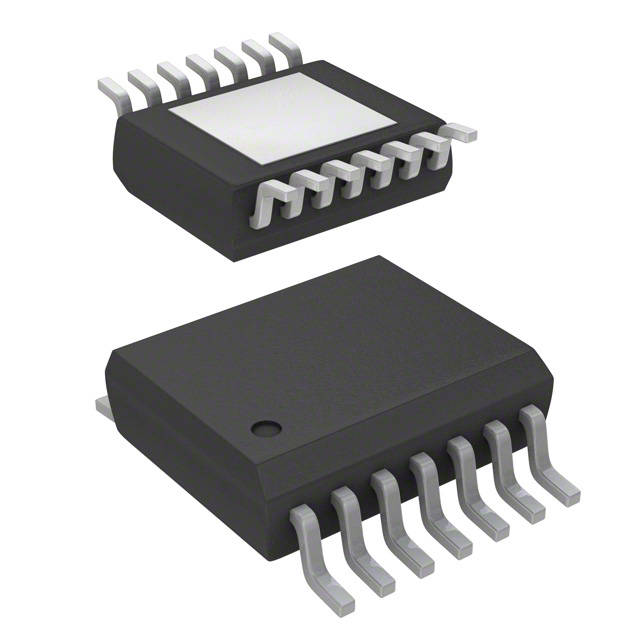
NCV47822
Dual High Side Switch with
Adjustable Current Limit and
Diagnostic Features
The NCV47822 dual channel High Side Switch (HSS) with 250 mA
per channel is designed for use in harsh automotive environments. The
device has a high peak input voltage tolerance and reverse input voltage,
reverse bias, overcurrent and overtemperature protections. The
integrated current sense feature (adjustable by resistor connected to
CSO pin for each channel) provides diagnosis and system protection
functionality. The CSO pin output current creates voltage drop across
CSO resistor which is proportional to output current of each channel.
Extended diagnostic features in OFF state are also available and
controlled by dedicated input and output pins.
Features
•
•
•
•
•
•
•
Output Current per Channel: up to 250 mA
Two Independent Enable Inputs (3.3 V Logic Compatible)
Adjustable Current Limits: up to 350 mA
Protection Features:
♦ Current Limitation
♦ Thermal Shutdown
♦ Reverse Input Voltage and Reverse Bias Voltage
Diagnostic Features:
♦ Short To Battery (STB) and Open Load (OL) in OFF State
♦ Internal Components for OFF State Diagnostics
♦ Open Collector Flag Output
♦ Two Output Voltage Monitoring Outputs (Analog)
AEC−Q100 Grade 1 Qualified and PPAP Capable
These Devices are Pb−Free, Halogen Free/BFR Free and are RoHS
Compliant
www.onsemi.com
MARKING
DIAGRAM
14
NCV4
7822
ALYWG
G
TSSOP−14
Exposed Pad
CASE 948AW
14
1
1
A
L
Y
W
G
= Assembly Location
= Wafer Lot
= Year
= Work Week
= Pb−Free Package
(Note: Microdot may be in either location)
ORDERING INFORMATION
See detailed ordering and shipping information in the package
dimensions section on page 13 of this data sheet.
Typical Applications
• Audio and Infotainment System
• Active Safety System
Cin
Vin
Vout1
EN1
Vout_FB1
CSO1
1 μF
Proportional Voltage to V out1*
C CSO1
Diagnostic Enable Input
DE
R CSO1
1 μF
NCV47822
(Dual HSS)
Error Flag Output (Open Collector)
EF
Diagnostic Channel Select Input
CS
Cout1
1 μF
Vout2
Proportional Voltage to V out2*
Vout_FB2
CSO2
EN2
GND
Cout2
1 μF
C CSO2
R CSO2
1 μF
* Vout_FB1 and Vout_FB2 are sensed Vout1 and Vout2 output voltages, respectively, via internal resistor dividers
Figure 1. Application Schematic
(See Application Section for More Details)
© Semiconductor Components Industries, LLC, 2016
May, 2016 − Rev. 0
1
Publication Order Number:
NCV47822/D
�NCV47822
IPU1
10 mA
IPU1_ON
Vin
Vout1
ICSO1 = Iout1 / RATIO*
VOLTAGE
REFERENCE
EN1
RPD_EN1
780 kΩ
ENABLE
VREF
VREF _OFF
EN1
PASS DEVICE 1
AND
CURRENT MIRROR
+
VREF
2.55 V
−
CSO1
SATURATION
PROTECTION
+
THERMAL
SHUTDOWN
OC1_ON
−
PD1_ON
0.95x
V REF
RPD11
500 kΩ
+
STB1_OL1_OFF
DE
CS
RPD_CS
780 kΩ
EN1
EN2
−
IPU1_ON
IPU2_ON
RPD_DE
DIAGNOSTIC
780 kΩ
CONTROL
LOGIC
Vout_FB1
RPD12
100 kΩ
VREF_OFF
PD1_ON
PD2_ON
EF
OC1_ON
OC2_ON
STB1_OL1_OFF
STB2_OL2_OFF
IPU2
10 mA
IPU2_ON
Vin
Vout2
ICSO2 = Iout2 / RATIO*
EN2
RPD_EN2
780 kΩ
PASS DEVICE 2
AND
CURRENT MIRROR
ENABLE
EN2
+
VREF
2.55 V
−
CSO2
SATURATION
PROTECTION
+
THERMAL
SHUTDOWN
OC2_ON
−
PD2_ON
0.95x
V REF
RPD21
500 kΩ
STB2_OL2_OFF
GND
+
−
*) for current value of RATIO see
into Electrical Characteristic Table
Figure 2. Simplified Block Diagram
www.onsemi.com
2
Vout_FB2
RPD22
100 kΩ
VREF_OFF
�NCV47822
1
14
V in
V out1
Vout_FB1
CSO1
CS
EN1
EPAD
GND
EF
DE
EN2
Vout_FB2
CSO2
V in
V out2
TSSOP−14 EPAD
(Top View)
Figure 3. Pin Connections
Table 1. PIN FUNCTION DESCRIPTION
Pin No.
TSSOP−14
EPAD
Pin Name
1
Vin
2
CSO1
3
EN1
Enable Input 1; low level disables the Channel 1. (Used also for OFF state diagnostics control for
Channel 1)
4
GND
Power Supply Ground.
5
EN2
Enable Input 2; low level disables the Channel 2. (Used also for OFF state diagnostics control for
Channel 2)
6
CSO2
Description
Power Supply Input for Channel 1 and supply of control circuits of whole chip. At least 4.4 V power
supply must be used for proper IC functionality.
Current Sense Output 1, Current Limit setting and Output Current value information. See Application
Section for more details.
Current Sense Output 2, Current Limit setting and Output Current value information. See Application
Section for more details.
7
Vin
8
Vout2
Power Supply Input for Channel 2. Connect to pin 1 or different power supply rail.
9
Vout_FB2
10
DE
Diagnostic Enable Input.
11
EF
Error Flag (Open Collector) Output. Active Low.
12
CS
Channel Select Input for OFF state diagnostics. Set CS = Low for OFF state diagnostics of Channel 1. Set CS = High for OFF state diagnostics of Channel 2. Corresponding EN pin has to be used
for diagnostics control (see Application Information section for more details).
13
Vout_FB1
14
Vout1
Output Voltage 1.
EPAD
EPAD
Exposed Pad is connected to Ground. Connect to GND plane on PCB.
Output Voltage 2.
Output Voltage 2 Analog Monitoring. See Application Section for more details.
Output Voltage 1 Analog Monitoring. See Application Section for more details.
www.onsemi.com
3
�NCV47822
Table 2. MAXIMUM RATINGS
Rating
Symbol
Min
Max
Unit
Input Voltage DC
Vin
−42
45
V
Input Voltage (Note 1)
Load Dump − Suppressed
Us*
−
60
VEN1,2
−42
45
V
Vout_FB1,2
−0.3
10
V
VCSO1,2
−0.3
7
V
VDE, VCS, VEF
−0.3
7
V
Vout1,2
−1
40
V
Junction Temperature
TJ
−40
150
°C
Storage Temperature
TSTG
−55
150
°C
Enable Input Voltage
Output Voltage Monitoring
CSO Voltage
DE, CS and EF Voltages
Output Voltage
V
Stresses exceeding those listed in the Maximum Ratings table may damage the device. If any of these limits are exceeded, device functionality
should not be assumed, damage may occur and reliability may be affected.
1. Load Dump Test B (with centralized load dump suppression) according to ISO16750−2 standard. Guaranteed by design. Not tested in
production. Passed Class A according to ISO16750−1.
Table 3. ESD CAPABILITY (Note 2)
Rating
ESD Capability, Human Body Model
Symbol
Min
Max
Unit
ESDHBM
−2
2
kV
2. This device series incorporates ESD protection and is tested by the following methods:
ESD Human Body Model tested per AEC−Q100−002 (JS−001−2010)
Field Induced Charge Device Model ESD characterization is not performed on plastic molded packages with body sizes < 50 mm2 due
to the inability of a small package body to acquire and retain enough charge to meet the minimum CDM discharge current waveform
characteristic defined in JEDEC JS−002−2014.
Table 4. MOISTURE SENSITIVITY LEVEL (Note 3)
Symbol
Rating
Moisture Sensitivity Level
Min
MSL
Max
1
Unit
−
3. For more information, please refer to our Soldering and Mounting Techniques Reference Manual, SOLDERRM/D
THERMAL CHARACTERISTICS (Note 4)
Symbol
Rating
Value
Unit
°C/W
Thermal Characteristics (single layer PCB)
Thermal Resistance, Junction−to−Air (Note 5)
Thermal Reference, Junction−to−Lead (Note 5)
RθJA
RψJL
52
9.0
Thermal Characteristics (4 layers PCB)
Thermal Resistance, Junction−to−Air (Note 5)
Thermal Reference, Junction−to−Lead (Note 5)
RθJA
RψJL
31
10
°C/W
4. Refer to ELECTRICAL CHARACTERISTICS and APPLICATION INFORMATION for Safe Operating Area.
5. Values based on copper area of 645 mm2 (or 1 in2) of 1 oz copper thickness and FR4 PCB substrate. Single layer − according to JEDEC51.3,
4 layers − according to JEDEC51.7
Table 5. RECOMMENDED OPERATING RANGES
Rating
Input Voltage (Note 6)
Output Current Limit (Note 7)
Junction Temperature
Current Sense Output (CSO) Capacitor
Symbol
Min
Max
Unit
Vin
4.4
40
V
ILIM1,2
10
350
mA
TJ
−40
150
°C
CCSO1,2
1
4.7
mF
Functional operation above the stresses listed in the Recommended Operating Ranges is not implied. Extended exposure to stresses beyond
the Recommended Operating Ranges limits may affect device reliability.
6. Minimum Vin = 4.4 V or (Vout1,2 + 0.5 V), whichever is higher.
7. Corresponding RCSO1,2 is in range from 76.5 kW down to 2185 W.
www.onsemi.com
4
�NCV47822
Table 6. ELECTRICAL CHARACTERISTICS Vin = 13.5 V, VEN1,2 = 3.3 V, VDE = 0 V, RCSO1,2 = 0 W, CCSO1,2 = 1 mF, Cin = 1 mF,
Cout1,2 = 1 mF, Min and Max values are valid for temperature range −40°C v TJ v +150°C unless noted otherwise and are guaranteed by
test, design or statistical correlation. Typical values are referenced to TJ = 25°C (Note 8)
Parameter
Test Conditions
Symbol
Min
Typ
Max
−
−
210
230
350
400
Unit
OUTPUTS
Input to Output Differential Voltage
Vin = 8 V to 18 V
Iout1,2 = 200 mA
Iout1,2 = 250 mA
Vin−out1,2
mV
Vout1,2 = Vin − 1 V
ILIM1,2
350
−
−
mA
IDIS
−
0.005
10
mA
CURRENT LIMIT PROTECTION
Current Limit
DISABLE AND QUIESCENT CURRENTS
Disable Current
VEN1,2 = 0 V
Quiescent Current, Iq = Iin − (Iout1 +Iout2)
Iout1 = Iout2 = 500 mA, Vin = 8 V to 18 V
Iq
−
0.85
1.5
mA
Quiescent Current, Iq = Iin – (Iout1 +Iout2)
Iout1 = Iout2 = 200 mA, Vin = 8 V to 18 V
Iq
−
15
25
mA
Quiescent Current, Iq = Iin – (Iout1 +Iout2)
Iout1 = Iout2 = 250 mA, Vin = 8 V to 18 V
Iq
−
20
40
mA
0.99
−
1.8
1.9
−
2.31
2
7
20
−
25
−
2.448
(−4%)
2.55
2.652
(+4%)
−
−
3.3
−
(−15%)
265
−
(+15%)
−
(−5%)
285
−
(+5%)
ICSO_off1,2
−
−
15
mA
% of
VCSO_
ENABLE
Enable Input Threshold Voltage
Logic Low (OFF)
Logic High (ON)
Vout1,2 v 0.1 V
Vout1,2 w Vin − 1 V
Enable Input Current
VEN1,2 = 3.3 V
Turn On Time
from Enable ON to Vout1,2 = Vin − 1 V
Iout1,2 = 100 mA
Vth(EN1,2)
IEN1,2
V
mA
ms
ton
OUTPUT CURRENT SENSE
CSO Voltage Level at Current Limit
Vout1,2 = Vin − 1 V
RCSO1,2 = 3.3 kW
CSO Transient Voltage Level
CCSO1,2 = 4.7 mF, RCSO1,2 = 3.3 kW, Iout1,2
pulse from 10 mA to 350 mA, tr = 1 ms
VCSO1,2
VCSO1,2 = 2 V, Iout1,2 = 10 mA to 50 mA
Vin = 8 V to 18 V, −40°C v TJ v +150°C)
Iout1,2/
ICSO1,2
Output Current to CSO Current Ratio
VCSO_Ilim1,2
VCSO1,2 = 2 V, Iout1,2 = 50 mA to 350 mA
Vin = 8 V to 18 V, −40°C v TJ v +150°C)
CSO Current at no Load Current
VCSO1,2 = 0 V, Iout1,2 = 0 mA
V
V
−
DIAGNOSTICS
Overcurrent Voltage Level Threshold
Vout1,2 = Vin − 1 V,
RCSO1,2 = 3.3 kW
VOC1,2
92
95
98
Short To Battery (STB) Voltage
Threshold in OFF state
Vin = 4.4 V to 18 V, Iout1 = Iout2 = 0 mA,
VDE = 3.3 V
VSTB1,2
2
3
4
V
Open Load (OL) Current Threshold
in OFF state
Vin = 4.4 V to 18 V, VDE = 3.3 V
IOL1,2
5.0
10
25
mA
Output Voltage to Output Feedback
Voltage Ratio
Vin = 4.4 V to 18 V
Vout1,2/
Vout_FB1,2
5.7
6.0
6.3
−
0.99
−
1.8
1.9
−
2.31
0.99
−
1.8
1.9
−
2.31
−
0.04
0.4
Ilim1,2
Diagnostics Enable Threshold Voltage
Logic Low
Logic High
Vth(DE)
Channel Select Threshold Voltage
Logic Low
Logic High
Vth(CS)
Error Flag Low Voltage
IEF = −1 mA
VEF_Low
V
V
V
Product parametric performance is indicated in the Electrical Characteristics for the listed test conditions, unless otherwise noted. Product
performance may not be indicated by the Electrical Characteristics if operated under different conditions.
8. Performance guaranteed over the indicated operating temperature range by design and/or characterization tested at TA [ TJ. Low duty
cycle pulse techniques are used during testing to maintain the junction temperature as close to ambient as possible.
9. Values based on design and/or characterization.
www.onsemi.com
5
�NCV47822
Table 6. ELECTRICAL CHARACTERISTICS Vin = 13.5 V, VEN1,2 = 3.3 V, VDE = 0 V, RCSO1,2 = 0 W, CCSO1,2 = 1 mF, Cin = 1 mF,
Cout1,2 = 1 mF, Min and Max values are valid for temperature range −40°C v TJ v +150°C unless noted otherwise and are guaranteed by
test, design or statistical correlation. Typical values are referenced to TJ = 25°C (Note 8)
Parameter
Test Conditions
Symbol
Min
Typ
Max
Unit
TSD1,2
150
175
195
°C
THERMAL SHUTDOWN
Thermal Shutdown Temperature (Note 9) Iout1 = Iout2 = 90 mA, each channel measured separately
Product parametric performance is indicated in the Electrical Characteristics for the listed test conditions, unless otherwise noted. Product
performance may not be indicated by the Electrical Characteristics if operated under different conditions.
8. Performance guaranteed over the indicated operating temperature range by design and/or characterization tested at TA [ TJ. Low duty
cycle pulse techniques are used during testing to maintain the junction temperature as close to ambient as possible.
9. Values based on design and/or characterization.
www.onsemi.com
6
�NCV47822
TYPICAL CHARACTERISTICS
400
350
Vin = 13.5 V
300
250
Iout1,2 = 200 mA
200
150
Iout1,2 = 15 mA
100
50
Vin = 13.5 V
350
TJ = 150°C
300
TJ = 25°C
250
200
150
TJ = −40°C
100
50
0
0
20
60
40
80
100 120 140 160
0
50
100
150
200
250
300
350
TJ, JUNCTION TEMPERATURE (°C)
Iout1,2, OUTPUT CURRENT (mA)
Figure 4. Input to Output Differential vs.
Temperature
Figure 5. Input to Output Diff. vs. Output
Current
900
400
0
850
TJ = 150°C
800
750
TJ = −40°C
700
650
600
550
500
0
5
10
15
TJ = 25°C
Rout1,2 = 3.3 kW
TJ = 25°C
Vout1,2 = (Vin − 1 V) V
Iin, INPUT CURRENT (mA)
ILIM1,2, OUTPUT CURRENT LIMIT (mA)
0
−40 −20
20
25
30
35
40
−1
−2
−3
−4
−5
−6
−45 −40
45
−35
−30
−25
−20
−10
−15
−5
VIN, INPUT VOLTAGE (V)
VIN, INPUT VOLTAGE (V)
Figure 6. Output Current Limit vs. Input
Voltage
Figure 7. Output Voltage vs. Input Voltage
(Reverse Input Voltage)
400
0
3.0
350
VCSO1,2, CSO VOLTAGE (V)
ILIM1,2, OUTPUT CURRENT LIMIT (mA)
Iout1,2 = 350 mA
Vin−out1,2, INPUT TO OUTPUT
DIFFERENTIAL VOLTAGE (mV)
Vin−out1,2, INPUT TO OUTPUT
DIFFERENTIAL VOLTAGE (mV)
400
300
250
200
150
100
50
TJ = −40°C to 150°C
ILIM1,2, = 10 mA to 350 mA
2.5
2.0
1.5
1.0
0.5
0
0
0
0 5 10 15 20 25 30 35 40 45 50 55 60 65 70 75 80
10
20
30
40
50
60
70
80
90 100 110
RCSO1,2 (kW)
Iout1,2, OUTPUT CURRENT (% of ILIM1,2)
Figure 8. Output Current Limit vs. RCSO
(Calculated Using E24 Series)
Figure 9. Output Current (% of ILIM) vs. CSO
Voltage
www.onsemi.com
7
�NCV47822
TYPICAL CHARACTERISTICS
40
1.5
Iq, QUIESCENT CURRENT (mA)
TJ = 25°C
Vin = 13.5 V
1.5
1.3
1.2
1.1
1.0
0.9
0.8
0.7
TJ = 25°C
Vin = 13.5 V
35
30
25
20
15
10
5
0
0
5
10
20
15
0
50
100
150
200
250
300
Iout1,2, OUTPUT CURRENT (mA)
Iout1,2, OUTPUT CURRENT (mA)
Figure 10. Quiescent Current vs. Output
Current (Low Load)
Figure 11. Quiescent Current vs. Output
Current (High Load)
Iout1,2/ICSO1,2, OUTPUT CURRENT
TO CSO CURRENT RATIO (−)
Iq, QUIESCENT CURRENT (mA)
1.6
310
305
300
295
TJ = 25°C
Vin = 13.5 V
290
285
280
275
270
265
260
255
250
10
100
Iout1,2, OUTPUT CURRENT (mA)
Figure 12. ICSO Current vs. Output Current
Ratio
www.onsemi.com
8
1000
350
�NCV47822
DEFINITIONS
General
Current Limit
All measurements are performed using short pulse low
duty cycle techniques to maintain junction temperature as
close as possible to ambient temperature.
Current Limit is value of output current by which output
voltage drops below 90% of its nominal value.
Thermal Protection
Internal thermal shutdown circuitry is provided to protect
the integrated circuit in the event that the maximum junction
temperature is exceeded. When activated at typically 175°C,
the regulator turns off. This feature is provided to prevent
failures from accidental overheating.
Input to Output Differential Voltage
The Input to Output Differential Voltage parameter is
defined for specific output current values and specified over
Temperature range.
Quiescent and Disable Currents
Quiescent Current (Iq) is the difference between the input
current (measured through the LDO input pin) and the
output load current. If Enable pin is set to LOW the regulator
reduces its internal bias and shuts off the output, this term is
called the disable current (IDIS).
Maximum Package Power Dissipation
The power dissipation level is maximum allowed power
dissipation for particular package or power dissipation at
which the junction temperature reaches its maximum
operating value, whichever is lower.
www.onsemi.com
9
�NCV47822
APPLICATIONS INFORMATION
Circuit Description
CSO pin provides information about output current actual
value. The CSO voltage is proportional to output current
according to Equation 1.
Once output current reaches its limit value (ILIM1,2) set by
external resistor RCSO than voltage at CSO pin is typically
2.55 V. Calculations of ILIM1,2 or RCSO1,2 values can be
done using equations Equation 2 and Equation 3,
respectively. Minimum and maximum value of Output
Current Limit can be calculated according Equation 4 and 5.
The NCV47822 is an integrated dual High Side Switch
(HSS) with output current capability up to 250 mA per each
output. It is enabled with an input to the enable pin. The
integrated current sense feature provides diagnosis and
system protection functionality. The current limit of the
device is adjustable by resistor connected to CSO pin.
Voltage on CSO pin is proportional to output current. The
HSS is protected by both current limit and thermal
shutdown. Thermal shutdown occurs above 150°C to
protect the IC during overloads and extreme ambient
temperatures.
I LIM1,2_min + RATIO min
Enable Inputs
I LIM1,2_max + RATIO max
An enable pin is used to turn a channel on or off. By
holding the pin down to a voltage less than 0.99 V, the output
of the channel will be turned off. When the voltage on the
enable pin is greater than 2.31 V, the output of the channel
will be enabled to power its output to the regulated output
voltage. The enable pins may be connected directly to the
input pin to give constant enable to the output channel.
The output current limit can be set up to 350 mA by
external resistor RCSO1,2 (see Figure 1). Capacitor CCSO of
1 mF in parallel with RCSO is required for stability of current
limit control circuitry (see Figure 1).
ǒ
I LIM1,2 + RATIO
1
R CSO1,2 + RATIO
1
1
RATIO
Ǔ
(eq. 1)
2.55
R CSO1,2
(eq. 2)
2.55
I LIM1,2
(eq. 3)
V CSO1,2_max
R CSO1,2_min
(eq. 4)
(eq. 5)
where
RATIOmin − minimum value of Output Current to
CSO Current Ratio from electrical
characteristics table and particular output
current range
RATIOmax − maximum value of Output Current to
CSO Current Ratio from electrical
characteristics table and particular output
current range
VCSO1,2_min minimum value of CSO Voltage Level at
Current Limit from electrical characteristics
table
VCSO1,2_max maximum value of CSO Voltage Level at
Current Limit from electrical characteristics
table
RCSO1,2_min − minimum value of RCSO1,2 with respect
its accuracy
RCSO1,2_max − maximum value of RCSO1,2 with respect
its accuracy
Designers should consider the tolerance of RCSO1,2
during the design phase.
Setting the Output Current Limit
V CSO1,2 + I out1,2 R CSO1,2
V CSO1,2_min
R CSO1,2_max
where
RCSO1,2 − current limit setting resistor
VCSO1,2 voltage at CSO pin proportional to Iout1,2
ILIM1,2 − current limit value
Iout1,2 − output current actual value
RATIO − typical value of Output Current to CSO
Current Ratio for particular output current
range
Diagnostic in OFF State
The NCV47822 contains also circuitry for OFF state
diagnostics for Short to Battery (STB) and Open Load (OL).
There are internal current sources and Pull Down resistors
which provide additional cost savings for overall application
www.onsemi.com
10
�NCV47822
by excluding external components and their assembly cost
and saving PCB space and safe control IOs of a
Microcontroller Unit (MCU).
Simplified functional schematic and truth table is shown
in Figure 13 and related flowchart in Figure 14.
I PU
Start
Diag. OFF. Set
EN = L & DE = L
Diag. ON. Set
EN = L & DE = H
Current source enabled via EN and DE pins
HZ
PASS DEVICE is OFF in Diagnostics
Mode in OFF state
Vin
Vout
EF = ?
L
RPD1
+
EN
Comparator active only in Diagnostic
state (DE = H).
− VREF_OFF
IPU ON. Set
EN = H & DE = H
RPD2
DE
EF
EN – Enable (Logic Input)
DE – Diagnostics Enable(Logic Input)
EF – Error Flag Output (Open Collector Output)
EN
L
L
DE IPU EF
Vout
L OFF HZ Unknown
H OFF L V out > Vout_OFF
Diagnostic Status/Action
None (Diagnostics OFF)
Short to Battery (STB)
Check for Open Load (OL)
L
H
OFF HZ V out < Vout_OFF
H
H
ON
H
H
ON
L
V out > Vout_OFF
HZ
Digital Diagnostics:
to MCU’s digital input
with pull−up resistor
to MCU’s DIO supply rail
No Failure
EF = ?
L
Open Load
Short to Battery
Figure 14. Flowchart for Diagnostics in OFF State
Open Load (OL)
HZ V out < Vout_OFF No Failure (V out close to 0 V)
The diagnostics in OFF state shall be performed for each
channel separately. For diagnostics of Channel 1 the input
CS pin has to be put logic low, for diagnostics of Channel 2
the input CS pin has to be put logic high. Corresponding EN
pin has to be used for control (EN1 for Channel 1 and EN2
for Channel 2).
Figure 13. Simplified Functional Diagram of OFF
State Diagnostics (STB and OL)
www.onsemi.com
11
�NCV47822
Diagnostic in ON State
Output Voltage Monitoring
Diagnostic in ON State provides information about
Overcurrent or Short to Ground failures, during which the
EF output is in logic low state. The diagnostics in ON state
shall be performed for each channel separately. For
diagnostics of Channel 1 the input CS pin has to be put logic
low, for diagnostics of Channel 2 the input CS pin has to be
put logic high. For detailed information see Diagnostic
Features Truth Table in Figure 15.
The Output Voltage net is connected to internal resistor
divider. Output of the resistor divider is connected to
Vout_FB1,2 pin and provides information about Output
Voltage Level according to Equation 4.
V out_FB1,2 +
V out1,2
6
(eq. 6)
Figure 15. Diagnostic Features Truth Table
10. State of EN pin of appropriate channel
11. CS = L means CH1 diagnostics and CS = H means CH2 diagnostics in OFF state (DE = H) via EF output, appropriate EN pin is used for
turning internal switch ON and OFF (e.g. when DE = H and CS = L and EN1 = L then IPU1 is OFF, when DE = H and CS = L and EN1 =
H then IPU1 is ON)
12. Internal current source turned OFF (between Vout and Vin of appropriate channel)
13. Internal current source turned ON (between Vout and Vin of appropriate channel)
14. CS = L means CH1 diagnostics and CS = H means CH2 diagnostics in ON state (e.g. when CS = L and EF = L then CH1 has Overcurrent
or Short to Ground failure, when CS = H and EF = L then CH1 has Overcurrent or Short to Ground failure)
www.onsemi.com
12
�NCV47822
130
RqJA, THERMAL RESISTANCE (°C/W)
Thermal Considerations
As power in the device increases, it might become
necessary to provide some thermal relief. The maximum
power dissipation supported by the device is dependent
upon board design and layout. Mounting pad configuration
on the PCB, the board material, and the ambient temperature
affect the rate of junction temperature rise for the part. When
the device has good thermal conductivity through the PCB,
the junction temperature will be relatively low with high
power applications. The maximum dissipation the device
can handle is given by:
P D(MAX) +
ƪTJ(MAX) * TAƫ
120
70
60
2 oz, Single Layer
50
40
1 oz, 4 Layer
30
20
2 oz, 4 Layer
100
200
300
400
500
COPPER HEAT SPREADER AREA
600
700
(mm2)
Figure 16. Thermal Resistance vs. PCB Copper Area
Hints
Vin and GND printed circuit board traces should be as
wide as possible. When the impedance of these traces is
high, there is a chance to pick up noise or cause the regulator
to malfunction. Place external components, especially the
output capacitor, as close as possible to the device and make
traces as short as possible.
The Output Voltage Monitoring Output is high impedance
output (see Figure 2) and during OFF state diagnostics it
may be prone to couple a noise via PCB track or wire.
Disturbing may appear as Error Flag Output oscillation
when Output Voltage Level is close to Short to Battery
threshold. To improve robustness connect capacitor
(typically 10 nF) between each Vout_FB1,2pin and GND as
close as possible to the Vout_FB1,2 pins.
(eq. 8)
or
I out1Ǔ ) ǒV out2
1 oz, Single Layer
80
0
P D [ V inǒI q@I out1,2Ǔ ) I out1ǒV in−V out1Ǔ ) I out2ǒV in−V out2Ǔ
V in(MAX) [
90
(eq. 7)
R qJA
Since TJ is not recommended to exceed 150°C, then the
device soldered on 645 mm2, 1 oz copper area, FR4 can
dissipate up to 2.38 W when the ambient temperature (TA)
is 25°C. See Figure 16 for RqJA versus PCB area. The power
dissipated by the device can be calculated from the
following equations:
P D(MAX) ) ǒV out1
110
100
(eq. 9)
I out2Ǔ
I out1 ) I out2 ) I q
ORDERING INFORMATION
Device
NCV47822PAAJR2G
Marking
Package
Shipping†
Line1: NCV4
Line2: 7822
TSSOP−14 Exposed Pad
(Pb−Free)
2500 / Tape & Reel
†For information on tape and reel specifications, including part orientation and tape sizes, please refer to our Tape and Reel Packaging
Specifications Brochure, BRD8011/D
www.onsemi.com
13
�MECHANICAL CASE OUTLINE
PACKAGE DIMENSIONS
TSSOP−14 EP
CASE 948AW
ISSUE C
14
1
SCALE 1:1
B
NOTE 6
14
DATE 09 OCT 2012
NOTES:
1. DIMENSIONING AND TOLERANCING PER ASME
Y14.5M, 1994.
2. CONTROLLING DIMENSION: MILLIMETERS.
3. DIMENSION b DOES NOT INCLUDE DAMBAR
PROTRUSION. ALLOWABLE PROTRUSION SHALL BE
0.07 mm MAX. AT MAXIMUM MATERIAL CONDITION.
DAMBAR CANNOT BE LOCATED ON THE LOWER RADIUS OF THE FOOT. MINIMUM SPACE BETWEEN PROTRUSION AND ADJACENT LEAD IS 0.07.
4. DIMENSION D DOES NOT INCLUDE MOLD FLASH,
PROTRUSIONS OR GATE BURRS. MOLD FLASH,
PROTRUSIONS OR GATE BURRS SHALL NOT EXCEED
0.15 mm PER SIDE. DIMENSION D IS DETERMINED AT
DATUM H.
5. DIMENSION E1 DOES NOT INCLUDE INTERLEAD
FLASH OR PROTRUSIONS. INTERLEAD FLASH OR
PROTRUSIONS SHALL NOT EXCEED 0.25 mm PER
SIDE. DIMENSION E1 IS DETERMINED AT DATUM H.
6. DATUMS A AND B ARE DETERMINED AT DATUM H.
7. A1 IS DEFINED AS THE VERTICAL DISTANCE FROM
THE SEATING PLANE TO THE LOWEST POINT ON THE
PACKAGE BODY.
8. SECTION B−B TO BE DETERMINED AT 0.10 TO 0.25 mm
FROM THE LEAD TIP.
b
8
ÉÉ
ÇÇÇ
ÇÇÇ
ÉÉ
b1
E1
c1
E
NOTE 5
SECTION B−B
c
PIN 1
REFERENCE
1
7
0.20 C B A
e
2X 14 TIPS
TOP VIEW
NOTE 6
A
D
A2
NOTE 4
0.05 C
0.10 C
A
0.10 C B
S
A
S
DETAIL A
B
14X b
14X
NOTE 8
C
M
SEATING
PLANE c
B
NOTE 3
END VIEW
SIDE VIEW
D2
H
E2
L2
A1
L
NOTE 7
C
DETAIL A
BOTTOM VIEW
RECOMMENDED
SOLDERING FOOTPRINT*
3.40
14X
1.15
GAUGE
PLANE
DIM
A
A1
A2
b
b1
c
c1
D
D2
E
E1
E2
e
L
L2
M
MILLIMETERS
MIN
MAX
−−−−
1.20
0.05
0.15
0.80
1.05
0.19
0.30
0.19
0.25
0.09
0.20
0.09
0.16
4.90
5.10
3.09
3.62
6.40 BSC
4.30
4.50
2.69
3.22
0.65 BSC
0.45
0.75
0.25 BSC
0_
8_
GENERIC
MARKING DIAGRAM*
14
XXXX
XXXX
ALYWG
G
1
3.06
6.70
1
0.65
PITCH
14X
0.42
DIMENSIONS: MILLIMETERS
*For additional information on our Pb−Free strategy and soldering
details, please download the ON Semiconductor Soldering and
Mounting Techniques Reference Manual, SOLDERRM/D.
DOCUMENT NUMBER:
DESCRIPTION:
98AON66474E
TSSOP−14 EP, 5.0X4.4
XXXX = Specific Device Code
A
= Assembly Location
L
= Wafer Lot
Y
= Year
W
= Work Week
G
= Pb−Free Package
(Note: Microdot may be in either location)
*This information is generic. Please refer to
device data sheet for actual part marking.
Pb−Free indicator, “G” or microdot “ G”,
may or may not be present.
Electronic versions are uncontrolled except when accessed directly from the Document Repository.
Printed versions are uncontrolled except when stamped “CONTROLLED COPY” in red.
PAGE 1 OF 1
ON Semiconductor and
are trademarks of Semiconductor Components Industries, LLC dba ON Semiconductor or its subsidiaries in the United States and/or other countries.
ON Semiconductor reserves the right to make changes without further notice to any products herein. ON Semiconductor makes no warranty, representation or guarantee regarding
the suitability of its products for any particular purpose, nor does ON Semiconductor assume any liability arising out of the application or use of any product or circuit, and specifically
disclaims any and all liability, including without limitation special, consequential or incidental damages. ON Semiconductor does not convey any license under its patent rights nor the
rights of others.
© Semiconductor Components Industries, LLC, 2019
www.onsemi.com
�onsemi,
, and other names, marks, and brands are registered and/or common law trademarks of Semiconductor Components Industries, LLC dba “onsemi” or its affiliates
and/or subsidiaries in the United States and/or other countries. onsemi owns the rights to a number of patents, trademarks, copyrights, trade secrets, and other intellectual property.
A listing of onsemi’s product/patent coverage may be accessed at www.onsemi.com/site/pdf/Patent−Marking.pdf. onsemi reserves the right to make changes at any time to any
products or information herein, without notice. The information herein is provided “as−is” and onsemi makes no warranty, representation or guarantee regarding the accuracy of the
information, product features, availability, functionality, or suitability of its products for any particular purpose, nor does onsemi assume any liability arising out of the application or use
of any product or circuit, and specifically disclaims any and all liability, including without limitation special, consequential or incidental damages. Buyer is responsible for its products
and applications using onsemi products, including compliance with all laws, regulations and safety requirements or standards, regardless of any support or applications information
provided by onsemi. “Typical” parameters which may be provided in onsemi data sheets and/or specifications can and do vary in different applications and actual performance may
vary over time. All operating parameters, including “Typicals” must be validated for each customer application by customer’s technical experts. onsemi does not convey any license
under any of its intellectual property rights nor the rights of others. onsemi products are not designed, intended, or authorized for use as a critical component in life support systems
or any FDA Class 3 medical devices or medical devices with a same or similar classification in a foreign jurisdiction or any devices intended for implantation in the human body. Should
Buyer purchase or use onsemi products for any such unintended or unauthorized application, Buyer shall indemnify and hold onsemi and its officers, employees, subsidiaries, affiliates,
and distributors harmless against all claims, costs, damages, and expenses, and reasonable attorney fees arising out of, directly or indirectly, any claim of personal injury or death
associated with such unintended or unauthorized use, even if such claim alleges that onsemi was negligent regarding the design or manufacture of the part. onsemi is an Equal
Opportunity/Affirmative Action Employer. This literature is subject to all applicable copyright laws and is not for resale in any manner.
PUBLICATION ORDERING INFORMATION
LITERATURE FULFILLMENT:
Email Requests to: orderlit@onsemi.com
onsemi Website: www.onsemi.com
◊
TECHNICAL SUPPORT
North American Technical Support:
Voice Mail: 1 800−282−9855 Toll Free USA/Canada
Phone: 011 421 33 790 2910
Europe, Middle East and Africa Technical Support:
Phone: 00421 33 790 2910
For additional information, please contact your local Sales Representative
�