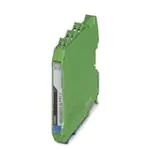
MACX MCR-EX-SL-RPSSI-2I(-SP)
Repeater power supplies and input signal
conditioners, Ex-i, with two electrically isolated
outputs
Data sheet
106034_en_00
1
© PHOENIX CONTACT 2014-08-19
Description
The MACX MCR-EX-SL-RPSSI-2I(-SP) repeater power
supplies and input signal conditioners are designed for the
operation of intrinsically safe 2-wire measuring transducers
and mA current sources installed in hazardous areas.
2-wire measuring transducers are supplied with energy.
4-wire measuring transducers as well as mA current
sources can be operated via the non-feed input.
Analog 0/4 ... 20 mA measured values from the hazardous
area are transferred via two electrically isolated active
outputs to the non-hazardous area.
The analog measuring value can be overlaid with digital
(HART) communication signals on the hazardous or nonhazardous side and transmitted bidirectionally from both
outputs.
Test sockets are integrated into the connectors for
connecting the HART communicators.
1.1
–
–
–
–
–
–
–
–
–
–
Certified for safety-related applications up to SIL 2
according to IEC/EN 61508.
–
Properties
0/4 mA ... 20 mA input, intrinsically safe, [Ex ia],
powered and not powered
Measuring transducer supply voltage >16 V
Two electrically isolated outputs, 0/4 mA ... 20 mA
(active)
Bidirectional HART transmission (both outputs)
Error indication according to NAMUR NE 43
SIL 2 according to IEC/EN 61508
Safe electrical isolation between input, outputs, and
supply
Energy supply possible via DIN rail connector
Installation in zone 2 permitted
Plug-in terminals with screw connection
(MACX MCR-EX-SL-RPSSI-2I)
or spring connection (push-in)
(MACX MCR-EX-SL-RPSSI-2I-SP)
Housing overall width 12.5 mm
WARNING: Explosion hazard
The module is an item of associated electrical equipment for intrinsically safe circuits. It is designed for
use in zone 2, if specific conditions are observed.
When installing and operating the device, the applicable safety directives (including national safety directives),
accident prevention regulations, as well as general technical regulations must be observed.
WARNING: Explosion hazard
Observe the safety regulations and installation notes on page 6.
Make sure you always use the latest documentation.
It can be downloaded at phoenixcontact.net/products.
This data sheet is valid for all products listed on page 3.
�MACX MCR-EX-SL-RPSSI-2I(-SP)
Table of contents
1
Description.................................................................................................................................. 1
1.1
Properties....................................................................................................................................................... 1
2
Ordering Data ............................................................................................................................. 3
3
Technical Data............................................................................................................................ 3
4
Safety regulations and installation notes..................................................................................... 6
4.1
4.2
4.3
4.4
4.5
5
Installation notes ............................................................................................................................................ 6
Intrinsic safety ................................................................................................................................................ 6
Installation in the hazardous area (zone 2) ..................................................................................................... 6
Areas with a danger of dust explosions .......................................................................................................... 6
Safety-related applications (SIL) .................................................................................................................... 6
Installation .................................................................................................................................. 7
5.1
5.2
5.3
5.4
5.5
5.6
5.7
5.8
5.9
5.10
5.11
5.12
5.13
Connection notes .......................................................................................................................................... 7
Electrostatic discharge ................................................................................................................................... 7
Structure......................................................................................................................................................... 7
Basic circuit diagram ...................................................................................................................................... 8
Input (intrinsically safe)................................................................................................................................... 8
Output ............................................................................................................................................................ 8
HART communicators .................................................................................................................................... 8
Supply voltage................................................................................................................................................ 8
Dimensions .................................................................................................................................................... 9
Assembly........................................................................................................................................................ 9
Connection of the cables ................................................................................................................................ 9
Startup............................................................................................................................................................ 9
Level shift ..................................................................................................................................................... 10
6
Comparison of safety data .........................................................................................................11
7
Safety-related applications (SIL 2).............................................................................................12
7.1
7.2
7.3
7.4
7.5
7.6
7.7
7.8
7.9
106034_en_00
Safety function and safety demand .............................................................................................................. 12
Safety integrity requirements........................................................................................................................ 12
Condition ...................................................................................................................................................... 13
Installation and Startup................................................................................................................................. 14
Notes on operation ....................................................................................................................................... 14
Recurring checks ......................................................................................................................................... 14
Repair........................................................................................................................................................... 15
Standards (SIL 2) ......................................................................................................................................... 15
Abbreviations ............................................................................................................................................... 16
PHOENIX CONTACT
2
�MACX MCR-EX-SL-RPSSI-2I(-SP)
2
Ordering Data
Repeater power supply and input signal conditioner Ex
Description
Type
Order No.
Pcs. / Pkt.
Repeater power supplies and input signal conditioners, Ex-i, with two
electrically isolated outputs with screw connection
MACX MCR-EX-SL-RPSSI-2I
2865366
1
Repeater power supplies and input signal conditioners, Ex-i,
with two electrically isolated outputs with spring connection
MACX MCR-EX-SL-RPSSI-2I-SP
2924236
1
Type
Order No.
Pcs. / Pkt.
ME 6,2 TBUS-2 1.5/5-ST-3,81 GN
2869728
10
MACX MCR-PTB
MACX MCR-PTB-SP
2865625
2924184
1
1
Accessories
Description
DIN rail connector (T-BUS), 5-pos., for bridging the supply voltage, can be
snapped onto NS 35 DIN rail in acc. with EN 60715
Power and error evaluation module, including the corresponding DIN rail
connector ME 17.5 TBUS 1.5/5-ST-3.81 GN
Screw connection
spring connection
For additional accessories, please refer to the catalog from Phoenix Contact.
3
Technical Data
Input
Operation as repeater power
supply
Operation as input signal
conditioner
Input
Current input, intrinsically safe
Current input, intrinsically safe
Input signal
CAT II (250 V against 6)
CAT II (250 V against 6)
(terminal assignment 4.1, 4.2)
(terminal assignment 5.1, 5.2)
4 mA ... 20 mA
0 mA ... 20 mA, 4 mA ... 20 mA
Supply voltage
> 16 V (at 20 mA)
> 15.1 V (at 23 mA)
–
Voltage drop
–
< 3.9 V (at 20 mA)
Output
Operation as repeater power
supply
Operation as input signal
conditioner
Output
Current output, short-circuit-proof
Current output, short-circuit-proof
CAT II (250 V against 6)
Output signal, active, current
CAT II (250 V against 6)
2x
2x
4 mA ... 20 mA
0 mA ... 20 mA
Transmission behavior
1:1
1:1
Load
0 ... 450 (20 mA)
0 ... 380 (23 mA)
0 ... 450 (20 mA)
0 ... 380 (23 mA)
Output ripple
< 20 mVeff
< 20 mVeff
Underload/Overload range (extended transmission channel for diagnostics)
0 mA ... 23 mA, acc. to NE 43
0 mA ... 23 mA, acc. to NE 43
In the event of a wire break in the input
0 mA (acc. to NE 43 I < 3.6 mA)
0 mA (acc. to NE 43 I < 3.6 mA)
In the event of a line short-circuit in the input
≥ 23 mA
0 mA
General data
Operation as repeater power
supply
Operation as input signal
conditioner
Supply voltage range
19.2 V DC ... 30 V DC
(24 V -20% ... +25%)
19.2 V DC ... 30 V DC
(24 V -20% ... +25%)
< 75 mA
< 46 mA
< 1.45 W
< 1.2 W
4 mA ... 20 mA
Output behavior in the event of an error
Current consumption
24 V/20 mA
Power dissipation
24 V/20 mA
106034_en_00
PHOENIX CONTACT
3
�MACX MCR-EX-SL-RPSSI-2I(-SP)
Operation as repeater power
supply
General data [...]
Operation as input signal
conditioner
Temperature coefficient
< 0.01%/K
< 0.01%/K
Step response (10% ... 90%), for jump 4 mA ... 20 mA
< 1.3 ms
< 1.3 ms
Maximum
< 0.1% (of end value)
< 0.1% (of final value)
Typical
< 0.05% (of final value)
< 0.05% (of final value)
Communication, output 1 and output 2
HART protocol
HART protocol
Test sockets, e.g., for HART communication
2-mm sockets in the connector
2-mm sockets in the connector
Status indicator
Green LED (PWR, supply voltage)
Transmission errors
Housing material
Polyamide PA 66-FR
Color
Green
Degree of protection
IP20
Width x height x depth
12.5 mm x 112.5 mm 114.5 x mm (MACX MCR-EX-SL-RPSSI-2I)
12.5 mm x 116 mm 114.5 x mm (MACX MCR-EX-SL-RPSSI-2I-SP)
Inflammability class according to UL 94
V0
Design
Terminal housing for mounting on DIN rails
Electrical isolation
Input/Outputs
375 Vpeak (peak value acc. to EN 60079-11)
Input / Power supply
375 Vpeak (peak value acc. to EN 60079-11)
Input / Output / Power supply
300 Veff rated insulation voltage
(Surge voltage category II, pollution degree 2,
safe electrical isolation as per EN 61010-1)
Test voltage 2.5 kV AC (50 Hz, 1 min)
Output 1 / Output 2
Test voltage 1.5 kV AC (50 Hz, 1 min)
Ambient conditions
Ambient temperature
Operation
-20 °C ... +60 °C (any mounting position)
Storage/transport
-40 °C ... +80 °C
Permissible humidity (operation)
10% ... 95% (non-condensing)
Maximum altitude
2000 m above sea level
Connection data
MACX MCR-EX-SL-RPSSI-2I
MACX MCR-EX-SL-RPSSI-2I-SP
Connection method
Screw connection
Push-in spring connection
solid
0.2 mm2 ... 2.5 mm2
0.2 mm2 ... 1.5 mm2
flexible
0.2 mm2 ... 2.5 mm2
0.2 mm2 ... 1.5 mm2
Conductor cross-section
24 ... 14
24 ... 16
Stripping length
7 mm
8 mm
Tightening torque
0.5 Nm ... 0.6 Nm
–
AWG/kcmil
Conformance
EMC Directive 2004/108/EC
EN 61000-6-2*, EN 61000-6-4, EN 61326-1
Ex Directive (ATEX)
EN 60079-0, EN 60079-11, EN 60079-15
*
When exposed to interference, there may be minimal deviations.
106034_en_00
PHOENIX CONTACT
4
�MACX MCR-EX-SL-RPSSI-2I(-SP)
Safety data according to ATEX for intrinsically safe circuits
Repeater power supply operation
Voltage, maximum Vo
25.2 V
Maximum current Io
93 mA
Maximum power Po
587 mW
Gas group
IIC
IIB
Maximum inductance Lo
2 mH
4 mH
Maximum capacity Co
107 nF
820 nF
Maximum voltage Vm (for output and power supply)
253 V AC (125 V DC)
Input signal conditioner operation
Maximum voltage Vi
30 V
Maximum current Ii
150 mA
Maximum inductance Li
negligible
Maximum capacity Ci
negligible
Maximum voltage Vm (for output and power supply)
253 V AC (125 V DC)
Approvals
ATEX
BVS 10 ATEX E 143 X II (1)G [Ex ia Ga] IIC/IIB
II (1)D [Ex ia Da] IIIC
II 3(1)G Ex nA [ia Ga] IIC/IIB T4 Gc
IECEx approval
IECEx BVS 10,0097X [Ex ia Ga] IIC/IIB
[Ex ia Da] IIIC
Ex nA [ia Ga] IIC/IIB T4 Gc
UL, USA/Canada
, C.D.-No 83104549; IS for Class I,II,III, Division 1 and Zone 0; Installation
in Class I, Division 2 and Zone 2
Functional safety (SIL)
SIL 2 according to IEC/EN 61508
106034_en_00
PHOENIX CONTACT
5
�MACX MCR-EX-SL-RPSSI-2I(-SP)
4
Safety regulations and installation notes
4.1
Installation notes
–
–
–
–
4.2
–
–
–
The device is an item of associated equipment
(category 1) with “intrinsic safety” protection type and
can be installed in zone 2 potentially explosive areas as
a category 3 device.
It meets the requirements of
EN 60079-0:2012, IEC 60079-0 Ed. 6.0,
EN 60079-11:2012, IEC 60079-11 Ed. 6.0
EN 60079-15:2010, IEC 60079-15 Ed. 4.0
Installation, operation, and maintenance may only be
carried out by qualified electricians.
Follow the installation instructions as described.
When installing and operating the device, the
applicable regulations and safety directives (including
national safety directives), as well as general technical
regulations, must be observed.
For the safety data, refer to this document and the
certificates (EC examination certificate and other
approvals if appropriate).
Do not open or modify the device. Do not repair the
device yourself; replace it with an equivalent device
instead. Repairs may only be carried out by the
manufacturer.
The IP20 degree of protection (EN/IEC 60529) of the
device is intended for use in a clean and dry
environment. Do not subject the device to mechanical
or thermal loads that exceed the specified limits.
The device complies with the EMC regulations for
industrial areas (EMC class A). When using the device
in residential areas, it may cause radio interference.
Intrinsic safety
The device is approved for intrinsically safe (protection
type Ex i) circuits up to zone 0 (gas) and zone 20 (dust)
in the hazardous area.
Observe the safety values for intrinsically safe
equipment and the connecting cables during
connection (IEC/EN 60079-14). They must conform to
the values specified in the installation manual, in this
data sheet, or the EC-type examination certificate.
When carrying out measurements on the intrinsically
safe side, observe the relevant regulations regarding
the connection of intrinsically safe equipment. In
intrinsically safe circuits, only use those measuring
devices that are approved for these circuits.
If the device has been used in non-intrinsically safe
circuits, it must not be used again in intrinsically safe
circuits. The device must be clearly marked as nonintrinsically safe.
106034_en_00
4.3
–
–
–
–
4.4
–
–
–
4.5
Installation in the hazardous area (zone 2)
Observe the specified conditions for use in potentially
explosive areas!
Install the device in a suitable approved housing (with at
least IP54 degree of protection) that meets the
requirements of EN 60079-15. Observe the
requirements of EN 60079-14.
Always disconnect the power before connecting or
disconnecting non-intrinsically safe cables.
In potentially explosive areas, always disconnect the
power before snapping the device on or off the DIN rail
connector.
The device must be stopped and immediately removed
from the hazardous area if it is damaged or was
subjected to an impermissible load or stored incorrectly
or if it malfunctions.
Areas with a danger of dust explosions
The device is not designed for installation in zone 22.
If, however, you wish to use the device in zone 22, it
must be installed in a housing that complies with
IEC/EN 60079-31. In doing so, observe the maximum
surface temperatures. Observe the requirements of
IEC/EN 60079-14.
Connection to the intrinsically safe circuit in areas with
a danger of dust explosions (Zone 20, 21 or 22) is only
permitted if the equipment connected to this circuit is
approved for this zone (e.g. Category 1D, 2D or 3D).
Safety-related applications (SIL)
When using in safety-related applications, observe the
instructions in Section 7, as the requirements differ for
safety-related functions.
PHOENIX CONTACT
6
�MACX MCR-EX-SL-RPSSI-2I(-SP)
5.1
Connection notes
5.2
Electrostatic discharge
NOTE: Electrostatic discharge!
WARNING: Electrical danger due to improper
installation
The device contains components that can be
damaged or destroyed by electrostatic discharge.
When handling the device, observe the
necessary safety precautions against
electrostatic discharge (ESD) according to
EN 61340-5-1 and IEC 61340-5-1.
Observe the connection notes for safe installation
in accordance with EN/UL 61010-1:
–
–
–
–
–
–
–
Near the device, provide a switch/circuit breaker that is
labeled as the disconnect device for this device (or
the entire control cabinet).
Provide overcurrent safety equipment (I 16 A) in
the installation.
To protect the device against mechanical or electrical
damage, install it in a suitable housing with an
appropriate degree of protection according to
IEC 60529.
If several devices are installed next to each other,
make sure that the device has a housing that features a
basic insulation for 300 Veff. Install additional insulation,
if necessary. If the neighboring device is equipped with
basic insulation, no additional insulation is required.
The voltages present at the input, output, and supply
are extra-low voltages (ELV). Depending on the
application, hazardous voltage (> 30 V AC) to ground
may occur. For this event, safe electrical isolation from
the other connections has been implemented.
Before performing any servicing or maintenance
work, ensure that the device is disconnected from all
effective power sources.
If the device is not used as described in the
documentation, the intended protection may be
impaired.
106034_en_00
5.3
Structure
1
1.1
1.2
1.1
1.2
2.1
1
2.2
2.1
2.2
3.1
3.2
3.1
3.2
4
1.2
1.1 2.2
2.1 3.2
3.1
R
PW
1.2
1.1 2.2
2.1 3.2
3.1
R
PW
MACX MCR-EX-SL-RPSSI-2I
Installation
MACX MCR-EX-SL-RPSSI-2I
5
2
3
4.2
4.1 5.2
5.1
Figure 1
4.2
4.1 5.2
5.1
Structure MACX MCR-EX-SL-RPSSI-2I(-SP)
1 Plug-in COMBICON screw or push-in connectors with
integrated test sockets
2 Green LED "PWR", supply voltage
3 Snap-on foot for fixing to the DIN rail
4 Connection option for DIN rail connector
PHOENIX CONTACT
7
�MACX MCR-EX-SL-RPSSI-2I(-SP)
5.4
Basic circuit diagram
5.8
OUT
IN
Sensor / Field
PLC / DCS
Supply voltage
The modules can be supplied with voltage via the
connection terminals as well as via the DIN rail connector.
AI
passive
4.2 - 4.2
4.1
+
3.2
3.2
3.1
3.1
OUT 1
4.1
+
Supply via connection terminals
The supply voltage is fed in through the connection
terminals 1.1 (+) and 1.2 (-).
Supply via DIN rail connector
or
2.2
passive
OUT 2
2.1
5.2 - 5.2
5.1
+
GND
5.1
+24V
1.2
2.2
2.1
+
The supply voltage can be fed in via an MACX MCR-EX-SL
module or via the power and fault signaling module
MACX MCR-PTB(-SP) to the DIN rail connector.
NOTE: Never connect the supply voltage directly
to the DIN rail connector.
Drawing power from the DIN rail connector is not
permitted.
1.1
Power
GND +24V
Zone 0,1,2
Zone 20,21,22
Zone 2
Div. 1,2
Div. 2
–
Figure 2
5.5
–
–
5.6
Basic circuit diagram with connection
terminals
Input (intrinsically safe)
Repeater power supply operation (feeding input for
2-wire transmitter or 2-wire measuring transducer)
Connection to terminal 4.1 (+) and 4.2 (-)
Input signal conditioner operation (non-feeding
input for 4-wire transmitter or current sources)
Connection to terminal 5.1 (+) and 5.2 (-)
Output
Connection of passive analog input cards or evaluation units
Output 1, active
Output 2, active
5.7
Terminals 3.1 (+) and 3.2 (-)
Terminals 2.1 (+) and 2.2 (-)
HART communicators
HART communicators can be connected as shown in the
basic circuit diagram. Test sockets (diameter 2.3 mm) are
integrated in the connection terminals for this purpose.
106034_en_00
–
Supply via an MACX MCR-EX-SL module
If the total current consumption of the modules in series
does not exceed 400 mA, power can be supplied
directly at the connection terminals of the module.
Up to 16 modules can be supplied depending on the
current consumption of the modules.
We recommend connecting a 630 mA fuse (normalblow or slow-blow) upstream.
Supply via the power and fault signaling module
MACX MCR-PTB(-SP)
The supply voltage is supplied via the
MACX MCR-PTB(-SP) module to the DIN rail
connector.
Simple or redundant diode-decoupled power supply is
possible.
The MACX MCR-PTB(-SP) module is protected by a
fuse. Depending on the current consumption of the
modules, up to 150 individual modules can be supplied.
The module has integrated error evaluation. An
auxiliary supply failure or fuse fault is indicated at a relay
output and displayed via a flashing LED.
PHOENIX CONTACT
8
�MACX MCR-EX-SL-RPSSI-2I(-SP)
5.9
Dimensions
5.11
116 (SP)
112,5
Connection of the cables
Screw connection
12,5
99
7
AWG 24-14
2
0,2-2,5 mm
MACX MCR-...
A
7 mm
114,5
B
Figure 5
Figure 3
5.10
Dimensions (in mm)
Assembly
A
B
C
0,5-0,6 Nm
5-7 lb In
Screw connection
Permissible conductor cross section: 0.2 mm2 ... 2.5 mm2
•
Strip the wire by approximately 7 mm and crimp ferrules
to the end of the wires.
•
Insert the conductor into the corresponding connection
terminal.
•
Use a screwdriver to tighten the screw in the opening
above the connection terminal.
Connection torque: 0.6 Nm
Spring connection (push-in connection)
AWG 24-16
2
0,2-1,5 mm
MACX MCR-...-SP
A
B
8 mm
A
Figure 4
•
•
•
Assembly and Removal
Mount the module on a 35 mm DIN rail according to
EN 60715.
When using the DIN rail connector, first place it into the
DIN rail (see A – C, Figure 4). It is used to bridge the
power supply.
Please also observe the direction of the module and
DIN rail connector when snapping into position:
Snap-on foot below and connector left.
Install the module in suitable housing to meet the
requirements for the protection class.
Figure 6
Permissible conductor cross section: 0.2 mm2 ... 1.5 mm2
•
Strip the wire by approximately 8 mm and crimp ferrules
to the end of the wires.
•
Insert the wire into the round opening of the terminal
without using a tool.
•
Push in the pushbutton with a screwdriver to release.
5.12
•
106034_en_00
Push-in connection
Startup
Before startup, check that the repeater power supply
and input signal conditioner Ex is wired correctly, in
particular with regard to the wiring and marking of the
intrinsically safe circuits.
PHOENIX CONTACT
9
�MACX MCR-EX-SL-RPSSI-2I(-SP)
5.13
Level shift
No signal-level shifting is planned between input and output.
4 ... 20 mA input signals therefore become 4 ... 20mA output
signals.
In the same way, active input signals from 0 ... 20 mA
become electrically isolated 0 ... 20 mA output signals.
106034_en_00
PHOENIX CONTACT
10
�MACX MCR-EX-SL-RPSSI-2I(-SP)
6
Comparison of safety data
WARNING: Explosion hazard
Compare the safety data before connecting a
device located in the Ex-i area to the
MACX MCR-EX-SL-RPSSI-2I(-SP).
Provide proof of intrinsic safety according to standard
IEC/EN 60079-14 and other national standards and
installation specifications, if applicable.
Safety data for the
Field devices:
Repeater power supplies, Ex i:
Vi, Ii, Pi, Li, Ci
Vo, Io, Po, Lo, Co
The values for Vo, Io, Po, Lo, and Co can be found under
“Safety data according to ATEX for intrinsically safe circuits”
on page 5.
Example for proof of intrinsic safety for intrinsically
safe circuit with one source
Vi ≥ Vo
Ii ≥ Io
Pi ≥ Po
Li + Lc ≤ Lo
Ci + Cc ≤ Co
Li + Lc ≤ 0.5 Lo
Ci + Cc ≤ 0.5 Co
}
}
Condition:
Li ≤ 1% of Lo or Ci ≤ 1% of Co
Condition:
Li > 1% of Lo and Ci > 1% of Co
Lc and Cc depend on the cables/lines used.
106034_en_00
PHOENIX CONTACT
11
�MACX MCR-EX-SL-RPSSI-2I(-SP)
7
Safety-related applications (SIL 2)
SIL regulations apply to the following modules:
Designation
Order No.
MACX MCR-EX-SL-RPSSI-2I
2865366
MACX MCR-EX-SL-RPSSI-2I-SP
2924236
MACX MCR-SL-RPSSI-2I
2924825
MACX MCR-SL-RPSSI-2I-SP
2924838
7.2
Safety integrity requirements
1-channel operating mode
In this case, only one of the two outputs of the repeater
power supply and input signal conditioner is used for safetyrelated applications.
The aforementioned safety-related repeater power supply
and input signal conditioner are certified in complying with
DIN EN 61508-1:2011 and DIN EN 61508-2:2011. Test
certificate: BVS Pb 10/13
Partial 2-channel operating mode
7.1
The subsequent safety-related controller then compares
both signals to check that they match.
Safety function and safety demand
The device performs the safety function of electrically
isolated forwarding of a 4...20mA standard signal with a
maximum deviation of 5% maximum.
Output values outside this range of 3.6 … 21 mA are
considered as the safe state, which is detected by the
subsequent controller.
Safe failures in the device are therefore those errors where
the repeater power supply and input signal conditioner
sends an output signal that deviates from the input signal by
no more than 5%.
Dangerous, non-detectable failures are errors where the
repeater power supply and input signal conditioner does not
follow a change in the input signal or deviates from the input
signal by more than 5% and is not outside the range.
Dangerous, detectable failures are those that send a
signal outside the range (< 3.6 mA and > 21 mA).
In this case, both outputs of the repeater power supply and
input signal conditioner are used for safety-related
applications.
The failure rates of the device result in a 1- and a 2-channel
part for this operating mode.
Operating mode
A
B
C
D
Repeater power supply (1-channel)
Input signal conditioner (1-channel)
Repeater power supply (partially 2-channel)
Input signal conditioner (partially 2-channel)
Failure rates
–
–
–
–
–
Type A device (according to IEC/EN 61508-2)
Safety Integrity Level (SIL) 2
HFT = 0
MTTR = 24 h
1-channel: 1oo1 structure
2-channel: 1oo1 and 1oo2 structure
Ambient temperature: 40 °C
–
Error rate depending on operating mode A – D
λSD
A
0 FIT
B
0 FIT
C
0 FIT
D
0 FIT
λSU
145.5
FIT
124.4
FIT
145.5
FIT
124.4
FIT
λDD
224.1
FIT
183.8
FIT
224.1
FIT
183.8
FIT
λDU
62.3
FIT
53.4
FIT
62.3
FIT
53.4
FIT
SFF
DCD
85.5%
78.3%
85.2%
77.5%
85.5%
78.3%
85.2%
77.5%
For all operating modes, the total failure rate is 579 FIT.
The MTBF is 197 years.
106034_en_00
PHOENIX CONTACT
12
�MACX MCR-EX-SL-RPSSI-2I(-SP)
The probability of a dangerous failure per hour for
“continuous demand” mode and the average probability of
failure of the specified function for “low demand” mode are
determined based on the error rates:
PFDavg values depending on operating mode A – D
A
T[PROOF] =
1 year
PFDavg =
2.73E-04
PFH = 6.23 * 10-8/h
3 years
8.19E-04
4 years
10.9E-04
B
T[PROOF] =
1 year
PFDavg =
2.34E-04
PFH = 5.34 * 10-8/h
4 years
9.37E-04
5 years
11.7E-04
T[PROOF] =
1 year
PFDavg =
1.86E-04
PFH = 4.31 * 10-8/h
5 years
9.29E-04
6 years
11.1E-04
T[PROOF] =
1 year
PFDavg =
1.47E-04
PFH = 3.43 * 10-8/h
6 Jahre
8.81E-04
7 years
10.3E-04
C
D
This fulfills the requirements for the PFH value for a SIL 2
system.
When calculating the PFDavg and PFH values for the partial
2-channel operating mode (C and D) failures of the same
cause where taken into account and a β or βD factor of 2%
was determined.
The boxes marked in gray mean that the calculated PFDavg
values are within the allowed range for SIL 2 according to
table 2 of IEC/EN 61508-1. They fulfill the requirement to not
cover more than 10% of the safety circuit, i.e., to be better
than or equal to 1.00E-03.
The box marked in white shows that the calculated PFDavg
values are within the permissible range for SIL2 in
accordance with Table 2 of IEC/EN 61508-1. However, they
do not fulfill the requirement to not cover more than 10% of
this safety circuit, i.e., to be better than or equal to 1.00 E03.
106034_en_00
Failure limit
In SIL2 applications, if the percentage of the device for the
entire safety circuit is assumed to be a maximum of 10%, a
maintenance/test interval of 4.26 years can be achieved in
this time depending on the operating mode:
A
B
C
D
3.66 years
4.26 years
5.26 years
6.80 years
Sensor
Device
Processing
Actuator
25%
< 10%
15%
50%
Figure 7
Safety circuit
The maintenance/test interval depends on the characteristic
data of all devices involved in the safety circuit. The intervals
may be shorter or longer depending on this characteristic
data.
7.3
Condition
The values are valid under the following conditions:
– The failure rates of the components used remain
constant throughout the period of use.
– The propagation of errors by the device in the system is
not taken into consideration.
– The failure rates of the external power supply are not
taken into consideration.
– The specified error rates are based on an average
ambient temperature of +40 °C. For an average
ambient temperature of +60 °C, the specified failure
rates must be multiplied by a factor of 2.5. This factor is
based on guide values.
PHOENIX CONTACT
13
�MACX MCR-EX-SL-RPSSI-2I(-SP)
7.4
Installation and Startup
NOTE: Installation, operation, and maintenance
may only be carried out by qualified electricians.
During installation, also follow the installation notes, which
pertain to delivery of the device. (PACKB.MACX MCR-EXSL-RPSSI-2I(-SP), MNR 9054623). They can also be
downloaded at phoenixcontact.net/products.
Lockable housing with IP54 protection is recommended for
the installation of the repeater power supply and input signal
conditioner.
• Connect the repeater power supply and input signal
conditioner according to the installation manual.
• Make sure that the connected sensor and measuring
transducer correspond to the intended configuration.
• Check that the repeater power supply and input signal
conditioner operates correctly with the measuring
transducer and sensor connected.
• A calibrated sensor simulator and a calibrated digital
multimeter may be required in order to check the
repeater power supply and input signal conditioner with
the measuring transducer connected.
• Start up the safety circuit and check that it operates
correctly.
7.5
Notes on operation
During normal operation, the green (PWR) LED is always
on.
If a failure occurs during operation, the output signal is
usually set to a value outside the normal signal range of 3.6
... 21 mA. The connected safety-related controller should
therefore check the validity of the read signal values and
initiate appropriate measures in the event of deviations from
the normal values.
You should make sure that the connected measuring
transducers respond to line faults at the sensors.
After being switched off and on again, the required voltages
are established in the device. Signal transmission is then
performed without further action.
7.6
•
Recurring checks
Check the function of the entire safety circuit according
to IEC/EN 61508 and EN 61511. The intervals for
checking are specified by the intervals of each
individual device within the safety circuit.
It is the operator's responsibility to select the type of
checks and the checking intervals in the specified time
period.
Checking must be carried out in such a way that the
correct function of the safety equipment in conjunction
with all components can be verified.
In SIL 2 applications, the repeater power supply and input
signal conditioners need to be checked at the latest after the
maximum maintenance/test interval, if they cover a share of
no more than 10% of the total safety circuit.
Maximum maintenance/test interval.
Operation as repeater
power supply
1-channel
Partial 2channel
3.66 years
4.26 years
106034_en_00
Operation as input signal
conditioner
1-channel
Partial 2channel
5.26 years
6.8 years
PHOENIX CONTACT
14
�MACX MCR-EX-SL-RPSSI-2I(-SP)
Possible procedure for recurring checks for
discovering dangerous and undetected device failures
The following are necessary for inspecting the repeater
power supply and input signal conditioner:
– 1 calibrated current simulator (0/4 … 20 mA)
or 1 sensor simulator
– 1 – 2 calibrated digital multimeter
1. Take appropriate steps to prevent incorrect use and
disconnect the safety circuit from further processing.
If you use a current simulator, connect it to the input of
the repeater power supply and input signal conditioner.
If you use a sensor simulator, connect it to the input of
the measuring transducer.
Connect the digital multimeters to the inputs and
outputs of the repeater power supply and input signal
conditioner.
2. If you use a current simulator, you should apply a signal
at the input of the device in the range of 4 ... 20 mA.
If you are using a sensor simulator, set a suitable signal
at the input of the connected measuring transducer.
Measure the current in the feed and input signal
conditioners. The outputs have to be set to the same
value.
3. Setting ≤ 3.6 mA or > 21 mA ensures that the
subsequent processing can detect signals that are out
of range and evaluate them accordingly.
If the output value deviates from the input value by more
than three times the specified class accuracy rating, the
device should be checked.
In the event of an error, the device should be replaced
with an equivalent device.
4. Restore the safety circuit to full functionality.
5. Resume normal operation.
106034_en_00
7.7
Repair
The devices have a long service life, are protected against
malfunctions, and are maintenance-free. However, if a
device should fail, send it back to Phoenix Contact. The type
of malfunction and possible cause has to be stated.
Please use the original packaging or other suitable safe
packaging when sending devices back for repairs.
Phoenix Contact GmbH & Co KG
Abteilung Service und Reparatur
Flachsmarktstr. 8
32825 Blomberg
GERMANY
7.8
Standards (SIL 2)
The devices are developed and tested according to the
following standards:
DIN EN 61508-1:2011 Functional safety of electrical/electronic/programmable electronic safety-related systems Part 1: General requirements
DIN EN 61508-2:2011 Functional safety of electrical/electronic/programmable electronic safety-related systems Part 2: Requirements for electrical/electronic/programmable electronic safety-related systems
EN 61326-1:2006
Electrical equipment for measurement, control and laboratory use EMC requirements - Part 1: General requirements
IEC 61326-3-2:2006 Electrical equipment for measurement, control, and laboratory use EMC requirements - Part 3-2: Immunity requirements for safety-related systems and for equipment
intended to perform safety-related
functions (functional safety) - General industrial applications in specified electromagnetic environment
PHOENIX CONTACT
15
�MACX MCR-EX-SL-RPSSI-2I(-SP)
7.9
Abbreviations
Abbreviation
DC
Diagnostic
Coverage
FIT
Failure in Time
HFT
Hardware Fault
Tolerance
MTBF
Mean Time
Between
Failures
MTTR
Mean Time To
Repair
PFDavg Average Probability of dangerous Failure on
Demand
PFH
Probability of a
Dangerous Failure per Hour
SFF
Safe Failure
Fraction
SIL
λ
DD
DU
SD
SU
Meaning
Diagnostic coverage of safe
failures (DCS) or dangerous
failures (DCD)
Number of failures that occur
in 109 hours
Hardware fault tolerance: ability of a function unit to continue
with the execution of a demanded function despite existing faults or deviations
Indicates the average time period between one failure and
the next. This includes the
length of time that the component functions for until the failure and the downtime.
Indicates the average time
needed in order to repair a
faulty component.
Average probability of failure
on demand of a safety function
Probability of failure per hour
for the safety function
Proportion of safe failures:
Proportion of failures without
the potential to set the safetyrelated system to a dangerous
or impermissible function state
Safety Integrity
IEC/EN 61508 defines four
Level
safety integrity levels (SIL 1 to
4). The higher the Safety Integrity Level of the safety-related
system, the lower the probability range for the failure of a
safety function.
The failure rate λ indicates the number of errors
per time unit.
Dangerous Detected
Dangerous Undetected
Safe Detected
Safe Undetected
106034_en_00
PHOENIX CONTACT GmbH & Co. KG • 32823 Blomberg • Germany
phoenixcontact.com
16
�