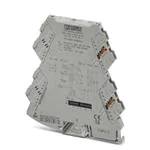
MINI MCR-2-RTD-UI(-PT)(-C)
Temperature transducers for resistance
thermometers and remote resistance-type sensors
Data sheet
106015_en_02
1
© PHOENIX CONTACT 2016-03-14
Description
Configurable 3-way isolated temperature transducer with
pluggable connection technology. The device is suitable for
the connection of resistance thermometers and resistance
potentiometers in 2, 3 and 4-wire connection technology.
Features
–
–
The measured values are converted into a linear and freely
configurable current or voltage signal.
–
–
–
–
–
–
Configurable, 3-way isolated temperature transducer
with plug-in connection technology.
Configurable via DIP switches for Pt 100 and Pt 1000
(IEC 751)
Virtually any RTD can be set by means of user
characteristic curves
Approval for Ex-zone 2 (nA)
Screw or push-in connection available
Can be supplied configured or unconfigured
Reinforced insulation according to IEC 61010-1
Supply voltage range 9.6 ... 30 V DC
WARNING: Correct usage in potentially explosive areas
The module is a category 3 item of electrical equipment. It is absolutely vital to follow the instructions provided
here during installation and observe the information in the "Safety regulations and installation notes".
This device offers the option of NFC communication.
You can use the MINI Analog Pro Smartphone app via the NFC interface of your Smartphone to configure the
device and to call-up DIP switch setting help and comprehensive module information.
The MINI Analog Pro Smartphone app is available to you free.
Make sure you always use the latest documentation.
It can be downloaded from the product at phoenixcontact.net/products.
This document is valid for the products listed in the “Ordering data”.
�MINI MCR-2-RTD-UI(-PT)(-C)
2
Table of contents
1
Description .............................................................................................................................. 1
2
Table of contents ..................................................................................................................... 2
3
Ordering data .......................................................................................................................... 3
4
Technical data ......................................................................................................................... 5
5
Safety regulations and installation notes.................................................................................. 7
5.1
Installation notes ................................................................................................................. 7
5.2
Installation in Zone 2............................................................................................................. 7
5.3
UL Notes ........................................................................................................................... 7
6
Installation ............................................................................................................................... 8
6.1
Connection notes ................................................................................................................ 8
6.2
Structure ........................................................................................................................... 8
6.3
Block diagram ..................................................................................................................... 8
6.4
Power supply ...................................................................................................................... 8
6.5
Assembly........................................................................................................................... 9
6.6
FASTCON Pro plugs ............................................................................................................ 9
6.7
Fault monitoring FM ........................................................................................................... 10
6.8
Current measurement ......................................................................................................... 10
6.9
Marking ........................................................................................................................... 10
7
Configuration ......................................................................................................................... 11
7.1
Configuration via DIP switches .............................................................................................. 11
7.2
Configuration via software .................................................................................................... 14
7.3
Configuration via MINI Analog Pro app .................................................................................... 14
8
Function description .............................................................................................................. 15
8.1
Analog switching output ...................................................................................................... 15
8.2
Monitoring........................................................................................................................ 15
8.3
Limiting behavior of the analog output ..................................................................................... 15
8.4
Diagnostic functions and error messages ................................................................................ 15
8.5
Simulation mode/force ....................................................................................................... 15
9
Diagnostics and status indicators .......................................................................................... 16
106015_en_02
PHOENIX CONTACT 2 / 16
�MINI MCR-2-RTD-UI(-PT)(-C)
3
Ordering data
Description
Type
Order No.
Pcs./Pkt.
Configurable temperature transducer with plug-in connection technology
for connecting 2, 3, and 4-conductor resistance thermometers and
resistance-type sensors. Configurable via DIP switch or software. Screw
connection technology, standard configuration
MINI MCR-2-RTD-UI
2902049
1
Configurable temperature transducer with plug-in connection technology
for connecting 2, 3, and 4-conductor resistance thermometers and
resistance-type sensors. Configurable via DIP switch or software. push-in
connection technology, standard configuration
MINI MCR-2-RTD-UI-PT
2902052
1
Configurable temperature transducer with plug-in connection technology
for connecting 2, 3, and 4-conductor resistance thermometers and
resistance-type sensors. Configurable via DIP switch or software. Screw
connection technology, order configuration
MINI MCR-2-RTD-UI-C
2902048
1
Configurable temperature transducer with plug-in connection technology
for connecting 2, 3, and 4-conductor resistance thermometers and
resistance-type sensors. Configurable via DIP switch or software. push-in
connection technology, order configuration
MINI MCR-2-RTD-UI-PT-C
2902051
1
Accessories
Type
Order No.
Pcs./Pkt.
Programming adapter with USB interface, for programming with software.
The USB driver is included in the software solutions for the products to be
programmed, such as measuring transducers or motor managers.
IFS-USB-PROG-ADAPTER
2811271
1
DIN rail connector for DIN rail mounting. Universal for TBUS housing. Gold- ME 6,2 TBUS-2 1,5/5-ST-3,81 GN
plated contacts, 5-pos. Plug component, Number of positions: 5, Pitch:
3.81 mm
2869728
10
Power terminal with plug-in connection technology for delivering the supply
voltage to the DIN rail connector. Monitoring of the supply voltages in
combination with the fault monitoring module. Screw connection
technology
MINI MCR-2-PTB
2902066
1
Power terminal with plug-in connection technology for delivering the supply
voltage to the DIN rail connector. Monitoring of the supply voltages in
combination with the fault monitoring module. Push-in connection
technology
MINI MCR-2-PTB-PT
2902067
1
Fault monitoring module with plug-in connection technology for evaluating
and reporting group errors from the FM system and for monitoring the
supply voltages. Error reporting via N/O contact. Screw connection
technology, standard configuration
MINI MCR-2-FM-RC
2904504
1
Fault monitoring module with plug-in connection technology for evaluating
and reporting group errors from the FM system and for monitoring the
supply voltages. Error reporting via N/O contact. Push-in connection
technology, standard configuration
MINI MCR-2-FM-RC-PT
2904508
1
Primary-switched MINI POWER supply for DIN rail mounting, input: 1phase, output: 24 V DC/1.5 A
MINI-SYS-PS-100-240AC/24DC/1.5
2866983
1
Marker for end clamp, Sheet, white, unlabeled, can be labeled with:
THERMOMARK CARD, BLUEMARK CLED, BLUEMARK LED,
TOPMARK LASER, Mounting type: snapped into marker carrier, Lettering
field: 30 x 5 mm
UCT-EM (30X5)
0801505
10
Marker for end clamp, can be ordered: by sheet, white, labeled according
to customer specifications, Mounting type: snapped into marker carrier,
Lettering field: 30 x 5 mm
UCT-EM (30X5) CUS
0801589
1
Marker for end clamp, Sheet, yellow, unlabeled, can be labeled with:
THERMOMARK CARD, BLUEMARK CLED, BLUEMARK LED,
TOPMARK LASER, Mounting type: snapped into marker carrier, Lettering
field: 30 x 5 mm
UCT-EM (30X5) YE
0830340
10
Marker for end clamp, can be ordered: by sheet, yellow, labeled according
to customer specifications, Mounting type: snapped into marker carrier,
Lettering field: 30 x 5 mm
UCT-EM (30X5) YE CUS
0830348
1
Plastic label, Sheet, white, unlabeled, can be labeled with: BLUEMARK
CLED, BLUEMARK LED, Plotter, Mounting type: Adhesive, Lettering
field: 15 x 5 mm
UC-EMLP (15X5)
0819301
10
106015_en_02
PHOENIX CONTACT 3 / 16
�MINI MCR-2-RTD-UI(-PT)(-C)
Accessories
Type
Order No.
Pcs./Pkt.
Plastic label, Sheet, white, unlabeled, can be labeled with: BLUEMARK
CLED, BLUEMARK LED, Plotter, Mounting type: Adhesive, Lettering
field: 15 x 5 mm
UC-EMLP (15X5)L
0820138
5
Plastic label, Sheet, yellow, unlabeled, can be labeled with: BLUEMARK
CLED, BLUEMARK LED, Plotter, Mounting type: Adhesive, Lettering
field: 15 x 5 mm
UC-EMLP (15X5) YE
0822615
10
Plastic label, can be ordered: by sheet, white, labeled according to
customer specifications, Mounting type: Adhesive, Lettering field: 15 x 5
mm
UC-EMLP (15X5) CUS
0824550
1
Plastic label, can be ordered: by sheet, yellow, labeled according to
customer specifications, Mounting type: Adhesive, Lettering field: 15 x 5
mm
UC-EMLP (15X5) YE CUS
0824551
1
Plastic label, can be ordered: by sheet, white, labeled according to
customer specifications, Mounting type: Adhesive, Lettering field: 15 x 5
mm
UC-EMLP (15X5)L CUS
0824552
1
Plastic label, Sheet, yellow, unlabeled, can be labeled with: BLUEMARK
CLED, BLUEMARK LED, Plotter, Mounting type: Adhesive, Lettering
field: 15 x 5 mm
UC-EMLP (15X5)L YE
0825325
5
Plastic label, can be ordered: by sheet, yellow, labeled according to
customer specifications, Mounting type: Adhesive, Lettering field: 15 x 5
mm
UC-EMLP (15X5)L YE CUS
0826680
1
Plastic label, Sheet, silver, unlabeled, can be labeled with: BLUEMARK
CLED, BLUEMARK LED, Plotter, Mounting type: Adhesive, Lettering
field: 15 x 5 mm
UC-EMLP (15X5) SR
0828095
10
Plastic label, can be ordered: by sheet, silver, labeled according to
customer specifications, Mounting type: Adhesive, Lettering field: 15 x 5
mm
UC-EMLP (15X5) SR CUS
0828099
1
Plastic label, Sheet, silver, unlabeled, can be labeled with: BLUEMARK
CLED, BLUEMARK LED, Plotter, Mounting type: Adhesive, Lettering
field: 15 x 5 mm
UC-EMLP (15X5)L SR
0828103
5
Marker strip, Roll, white, unlabeled, can be labeled with: THERMOMARK
ROLL, THERMOMARK X, THERMOMARK S1.1, THERMOMARK ROLL
X1, Mounting type: Adhesive, Lettering field: continuous x 5 mm
SK 5,0 WH:REEL
0805221
1
DIN rail connector (TBUS), 5-pos., for bridging the supply voltage, can be
snapped onto NS 35/... DIN rails according to EN 60715
ME 6,2 TBUS-2 1,5/5-ST-3,81 GY
2695439
10
Bluetooth programming adapter with µUSB and S-PORT interface for
wireless programming and monitoring. The driver is included in the
software solutions for the products to be programmed, such as measuring
transducers or motor managers.
IFS-BT-PROG-ADAPTER
2905872
1
106015_en_02
PHOENIX CONTACT 4 / 16
�MINI MCR-2-RTD-UI(-PT)(-C)
4
Technical data
Input
Configurable/programmable
Yes
Sensor type
Pt, Ni, Cu sensors
Connection method
2, 3, 4-wire
Sensor input current
approx. 200 µA
Max. permissible overall conductor resistance
≤ 25 Ω (Per line, RTD in 3- or 4-wire technology)
≤ 50 Ω (Per line, RTD in 2-wire technology)
Linear resistance measuring range
0 Ω ... 4000 Ω (Minimum measuring span: 10% of the selected measuring range)
Temperature measuring range
-200 °C ... 850 °C (Range depends on sensor type, range can be set freely via
software or in increments from -150°C to 850°C via DIP switches)
Measuring range span
≥ 20 K
Number of inputs
1
Output
Number of outputs
1
Voltage output signal
0 V ... 5 V (via DIP switch)
1 V ... 5 V (via DIP switch)
0 V ... 10 V (via DIP switch)
10 V ... 0 V (via DIP switch)
0 V ... 10.5 V (Can be set via software)
Max. voltage output signal
approx. 12.3 V
Short-circuit current
< 31.5 mA
Current output signal
0 mA ... 20 mA (via DIP switch)
4 mA ... 20 mA (via DIP switch)
20 mA ... 0 mA (via DIP switch)
20 mA ... 4 mA (via DIP switch)
0 mA ... 21 mA (Can be set via software)
Max. current output signal
24.6 mA
Non-load voltage
< 17.5 V
Configurable/programmable
Yes
Load/output load voltage output
≥ 10 kΩ
Ripple
< 10 mVrms
Load/output load current output
≤ 600 Ω (at 20 mA)
Resolution, outputs (voltage)
1 mV
Resolution, outputs (current)
2 µA
Behavior in the event of a sensor error
configurable
Supply
Supply voltage range
9.6 V DC ... 30 V DC (The DIN rail bus connector (ME 6,2 TBUS-2 1,5/5-ST-3,81
GN, Order No. 2869728) can be used to bridge the supply voltage. It can be
snapped onto a 35 mm DIN rail according to EN 60715))
Typical current consumption
32 mA (24 V DC)
63 mA (12 V DC)
Power consumption
≤ 850 mW (at IOUT = 20 mA, 9.6 V DC, 600 Ω load)
Diagnostic and status indicators
Indication
Red LED
Operating voltage display
Green LED
106015_en_02
PHOENIX CONTACT 5 / 16
�MINI MCR-2-RTD-UI(-PT)(-C)
General data
Transmission error resistance thermometer
0.1 % * 350 K / set measuring range; 0.1 % > 350 K (Pt/Ni)
0.3 % * 200 K / set measuring range; 0.3 % > 200 K (Cu)
Transmission error resistance-type sensor
2Ω
Maximum temperature coefficient
0.01 %/K
Step response (0–99%)
typ. 200 ms (2-wire)
typ. 500 ms (3-wire)
typ. 500 ms (4-wire)
Electrical isolation
Reinforced insulation in accordance with IEC 61010-1
Overvoltage category
II
Mounting position
any
Degree of protection
IP20
Degree of pollution
2
Rated insulation voltage
300 V (effective)
Test voltage, input/output/supply
3 kV (50 Hz, 1 min.)
Dimensions W/H/D
6.2 mm / 110.5 mm / 120.5 mm
Type of housing
PBT
Connection data
Screw connection
Solid conductor cross section with ferrule
0.2 mm² ... 1.5 mm²
0.14 mm² ... 2.5 mm²
Solid conductor cross section without ferrule
0.2 mm² ... 2.5 mm²
0.14 mm² ... 2.5 mm²
Conductor cross section, flexible
0.2 mm² ... 1.5 mm²
0.14 mm² ... 2.5 mm²
Conductor cross section AWG
24 ... 12
24 ... 12
Stripping length
10 mm
10 mm
Push-in connection
Ambient conditions
Ambient temperature (operation)
-40 °C ... 70 °C
Ambient temperature (storage/transport)
-40 °C ... 85 °C
Permissible humidity (operation)
5 % ... 95 % (non-condensing)
Conformance with EMC Directive 2004/108/EC (valid until 19.04.2016) / 2014/30/EU (valid from 20.04.2016)
Noise immunity according to EN 61000-6-2
When being exposed to interference, there may be minimal deviations.
Noise emission according to EN 61000-6-4
Conformance / approvals
Conformance
CE-compliant
ATEX
II 3 G Ex nA IIC T4 Gc X
UL, USA / Canada
UL 508 Listed
UL, USA / Canada
Class I, Div. 2, Groups A, B, C, D T6
UL, USA / Canada
Class I, Zone 2, Group IIC T6
Shipbuilding DNV GL 14445-15HH
C, EMC2
106015_en_02
PHOENIX CONTACT 6 / 16
�MINI MCR-2-RTD-UI(-PT)(-C)
5
Safety regulations and installation notes
5.1
Installation notes
•
•
•
•
•
•
•
•
•
•
•
The category 3 device is suitable for installation in
potentially explosive area zone 2. It fulfills the
requirements of EN 60079-0:2012 and EN 6007915:2010.
Installation, operation, and maintenance may only be
carried out by qualified electricians. Follow the
installation instructions as described. When installing
and operating the device, the applicable regulations
and safety directives (including national safety
directives), as well as generally approved technical
regulations, must be observed. The safety data is
provided in this package slip and on the certificates
(conformity assessment, additional approvals where
applicable).
While the devices are in operation, contact-dangerous
voltages may be present on the control elements. For
this reason parameterization, conductor connection,
and opening of the module lid are allowed only when
devices are in a de-energized state unless the
connected circuits are exclusively SELV or PELV
circuits.
The device must not be opened or modified. Do not
repair the device yourself, replace it with an equivalent
device. Repairs may only be carried out by the
manufacturer. The manufacturer is not liable for
damage resulting from violation.
The IP20 protection (IEC 60529/EN 60529) of the
device is intended for use in a clean and dry
environment. The device must not be subject to
mechanical strain and/or thermal loads, which exceed
the limits described.
The device is not designed for use in atmospheres with
a danger of dust explosions.
The device complies with the EMC regulations for
industrial areas (EMC class A). When using the device
in residential areas, it may cause radio interference.
If the device is not used as described in the
documentation, the intended protection can be
negatively affected.
To protect the device against mechanical or electrical
damage, install it in a suitable housing with appropriate
degree of protection as per IEC 60529.
Provide a switch/circuit breaker close to the device,
which is labeled as the disconnecting device for this
device.
Provide for a overcurrent protection device (I ≤ 4 A) in
the installation.
106015_en_02
•
•
•
•
5.2
•
•
•
•
5.3
There is a double isolation of 300 Veff between
neighboring modules of the same type oriented the
same way. The device has a base isolation of 150 Veff
to other neighboring modules on the side with the DIP
switch.
The voltages present at the input, output and supply are
extra-low voltages (ELV). Depending on the
application, dangerous voltage (> 30 V) against ground
could occur. For this event, safe electrical isolation from
the other connections has been implemented.
The device must be stopped if it is damaged, has been
subjected to an impermissible load, stored incorrectly,
or if it malfunctions.
Only use copper connecting cables providing the
permitted temperature range (60°C/75°C).
Installation in Zone 2
Observe the specified conditions for use in potentially
explosive areas! Install the device in a suitable
approved housing (with a minimum of IP54 protection)
that meets the requirements of EN 60079-15. Observe
the requirements of EN 60079-14.
Only devices which are designed for operation in Ex
zone 2 and are suitable for the conditions at the
installation location may be connected to the circuits in
the Ex zone.
In potentially explosive areas, terminals may only be
snapped onto or off the DIN rail connector and wires
may only be connected or disconnected when the
power is switched off.
The device must be stopped and immediately removed
from the Ex area if it is damaged, was subject to an
impermissible load, stored incorrectly or if it
malfunctions.
UL Notes
INDUSTRIAL CONTROL EQUIPMENT FOR
HAZARDOUS LOCATIONS 45FP
1 Suitable for use in class 1, division 2, groups A, B, C and
D hazardous locations, or nonhazardous locations only.
2 WARNING - EXPLOSION HAZARD: Do not disconnect
equipment unless power has been removed or the area
is known to be non-hazardous.
3 WARNING - EXPLOSION HAZARD: Substitution of any
components may impair suitability for Class I, Division
2.
4 This device is open-type and is required to be installed
in an enclosure suitable for the environment and can
only be accessed with the use of a tool or key.
PHOENIX CONTACT 7 / 16
�MINI MCR-2-RTD-UI(-PT)(-C)
6.3
6
Installation
6.1
Connection notes
Block diagram
OUT
IN
Sensor / Field
S-Port
The device contains components that can be
damaged or destroyed by electrostatic
discharge. When handling the device,
observe the necessary safety precautions
against electrostatic discharge (ESD)
according to EN 61340-5-1 and IEC 61340-51.
1
ϑ
ϑ
1
2
2
3
3
PLC / DCS
TI+
5 +
OUT U, I+
active
6 –
OUT U, I–
5
passive
6
ϑ
4
PWR+
4
7 +
PWR–
8 –
FM
Structure
1
2
PWR–
PWR+
6.2
3
Zone 2
13
4
12
Figure 2
6.4
Block diagram
Power supply
You must refer to the MACX and MINI Analog power manual
for the design of the power supply.
5
11
6
10
7
8
9
Figure 1
1
2
3
4
5
6
7
8
9
10
11
12
13
Structure
Error indicator "ERR" red LED
Green “PWR” LED, power supply
Cover with labeling option
Input: resistance thermometer and remote resistancetype sensor
DIP switch S2
DIP switch S1
NFC coil
Universal snap-on foot for EN DIN rails
Connection for DIN rail connector
Spindle screw
Supply voltage
Output: Standard signals
Current measuring socket
106015_en_02
NOTE
Never connect the supply voltage directly
to the DIN rail connector. Drawing power
from individual devices is not permitted!.
Supply via the module
Where the total current consumption of the aligned modules
does not exceed 400 mA, the power can be supplied directly
at the connection terminal blocks of the module.
We recommend connecting a 630 mA fuse (normal-blow or
slow-blow) upstream.
Supply via a power terminal block
The MINI MCR-2-PTB power terminal block (Order No.
2902066) or the MINI MCR-2-PTB-PT power terminal block
(Order No. 2902067) of the same shape is used to supply
the supply voltage to the DIN rail connector.
We recommend connecting a 4 A fuse upstream.
PHOENIX CONTACT 8 / 16
�MINI MCR-2-RTD-UI(-PT)(-C)
Supply via a system power supply unit
6.6
The system power supply unit with 1.5 A output current
connects the DIN rail connector to the supply voltage and
can thus be used to supply several modules from the mains.
– MINI-SYS-PS-100-240AC/24DC/1.5 (Order No.
2866983)
– Potentially explosive areas:
MINI-PS-100-240AC/24DC/1.5/EX (Order No.
2866653)
The device has pluggable connection terminals with an
integrated test disconnect terminal block, with either push-in
or screw-in connection technology.
6.5
4-way coding prevents incorrect insertion into the module.
Assembly
A
B
FASTCON Pro plugs
You can plug or screw the FASTCON Pro plugs onto the
device directly without tools. You can use the integrated
spindle screw to easily remove the plugs from the module or
set the isolating position, even when the plugs are
connected. For this purpose, use a screwdriver of sufficient
width, e.g. SZF 1-0.6x3.5 (order number: 1204517).
Screw connection:
AWG 26-16
2
0,2-1,5 mm
MINI MCR-2-…
C
B
E
D
A
Figure 4
Figure 3
–
–
Mounting and removing
Mount the module on a 35 mm DIN rail according to EN
60715.
When using the DIN rail connector, first place it into the
DIN rail (see A – C). It is used to bridge the power
supply. It is also absolutely vital that you snap the
module and the DIN rail connector into position in the
correct direction: the snap-on foot should be at the
bottom and the connector on the left.
•
•
10 mm
0,5-0,6 Nm
5-7 lb ln
Screw connection
Insert the wire into the corresponding connection
terminal block.
Use a screwdriver to tighten the screw in the opening
above the connection terminal block.
Push-in connection:
AWG 26-12
0,2-2,5 mm2
MINI MCR-2-…-PT
A
10 mm
A
Figure 5
•
106015_en_02
B
Push-in connection
Insert the wire into the corresponding connection
terminal block.
PHOENIX CONTACT 9 / 16
�MINI MCR-2-RTD-UI(-PT)(-C)
6.7
Fault monitoring FM
In addition to module and power supply failures, known
faults in the signal input of the module are reported via the
DIN rail connector to the form-matched MINI MCR-2-FM-RC
(order number 2904504) or MINI MCR-2-FM-RC-PT (order
number 2904508) fault monitoring module. The module
reports the error centrally via an N/C contact.
6.9
Marking
Standard UCT-EM... or UC-EMLP tags are available for
marking the devices and can be printed as per customer
requirements. In addition, the covers provide enough space
for the use of freely chosen sticky labels such as SK 5.0
WH:REEL without concealing the LED diagnostic
indicators.
A fault monitoring module is only required once in a group.
There is no need for individual evaluation of up to 115
connected Mini Analog Pro signal conditioners.
For the behavior of the fault monitoring contact for the different DIP
switch configurations, please refer to the corresponding table.
6.8
Current measurement
The device allows current measurement without disconnection of
the conductors by means of integrated test disconnect terminals.
Test sockets which support current measurement are
marked TI+ or TI-.
For the current measurement, use 2 mm probe tips of the
type Fluke TL75-1 or probe tips with a comparable tip shape.
Figure 6
Test disconnect terminal block
Furthermore, individual circuits can be specifically
disconnected, e.g. for commissioning.
You can set the isolating position by turning the integrated
spindle screw through 180°. The isolating position is
indicated by the marking on the plugs.
Figure 7
106015_en_02
Disconnect position
PHOENIX CONTACT 10 / 16
�MINI MCR-2-RTD-UI(-PT)(-C)
7
Configuration
The device is supplied with the following basic settings:
Sensor Pt 100 IEC 751; 3-wire; -50...150°C; output 4...20
mA; error evaluation according to NE43 (downscale); fault
monitoring contact reacts upon any error.
Configuration is possible for all configuration variants
without supply voltage.
7.1
Configuration via DIP switches
At delivery, all DIP switches are in the "OFF" position.
Configure the DIP switches according to the planned
application using the configuration tables.
Configuration tables
• = ON DIP S1
1 2 3 4 5 6 7 8
Connection technology
Analog output signal
Start temperature
106015_en_02
Configuration via software
2-wire
3-wire
4-wire
0...20 mA
20...0 mA
4...20 mA
20...4 mA
0...10 V
10...0 V
0...5 V
1...5 V
0°C
32°F
-10°C
14°F
-20°C
-4°F
-30°C
-22°F
-40°C
-40°F
-50°C
-58°F
-100°C
-148°F
-150°C
-238°F
•
•
• •
•
•
• •
•
•
• •
• • •
•
•
•
• •
•
•
• •
•
•
•
•
PHOENIX CONTACT 11 / 16
�MINI MCR-2-RTD-UI(-PT)(-C)
Measuring range final value
DIP S2
1 2 3 4 5 6
0°C
5°C
10°C
15°C
20°C
25°C
30°C
35°C
40°C
45°C
50°C
55°C
60°C
65°C
70°C
75°C
80°C
85°C
90°C
95°C
100°C
105°C
110°C
115°C
120°C
125°C
130°C
135°C
140°C
145°C
150°C
155°C
106015_en_02
32°F
41°F
50°F
59°F
68°F
77°F
86°F
95°F
104°F
113°F
122°F
131°F
140°F
149°F
158°F
167°F
176°F
185°F
194°F
203°F
212°F
221°F
230°F
239°F
248°F
257°F
266°F
275°F
284°F
293°F
302°F
311°F
•
•
•
•
•
•
•
•
•
•
•
•
•
•
•
•
•
•
•
•
•
•
•
•
•
•
•
•
•
•
•
•
•
•
•
•
•
•
•
•
•
•
•
•
•
•
•
•
•
•
•
•
•
•
•
•
•
•
•
•
•
•
•
•
•
•
•
•
•
•
•
•
•
•
•
•
•
•
•
•
1 2 3
160°C
165°C
170°C
175°C
180°C
185°C
190°C
195°C
200°C
210°C
220°C
230°C
240°C
250°C
260°C
270°C
280°C
290°C
300°C
325°C
350°C
375°C
400°C
425°C
450°C
475°C
500°C
550°C
600°C
650°C
700°C
850°C
320°F
329°F
338°F
347°F
356°F
365°F
374°F
383°F
392°F
410°F
428°F
446°F
464°F
482°F
500°F
518°F
536°F
554°F
572°F
617°F
662°F
707°F
752°F
797°F
842°F
887°F
932°F
1022°F
1112°F
1202°F
1292°F
1562°F
•
•
•
•
•
•
•
•
•
•
•
•
•
•
•
•
•
•
•
•
•
•
•
•
•
•
•
•
•
•
•
•
•
•
•
•
•
•
•
•
•
•
•
•
•
•
•
•
• = ON
DIP S2
4 5 6 7 8 9 0
•
•
•
•
•
•
•
•
•
•
•
•
•
•
•
•
•
•
•
•
•
•
•
•
• •
• •
• •
• •
• •
• •
• •
• •
• • •
• • •
• • •
• • •
• • •
• • •
• • •
• • •
PHOENIX CONTACT 12 / 16
�MINI MCR-2-RTD-UI(-PT)(-C)
Fault evaluation
0...20 mA 20...0
4...20
20...4
0...10 V 10...0 V 0...5 V
mA
mA
mA
A Cable break
21 mA
21 mA 21 mA 21 mA 10.5 V
10.5 V 5.25 V
Overrange
20.5 mA 20.5 mA 20.5 mA 20.5 mA 10.25 V 10.25 V 5.125 V
Underrange
0 mA
0 mA
4 mA
4 mA
0V
0V
0V
Short circuit
0 mA
0 mA
4 mA
4 mA
0V
0V
0V
B Cable break
21 mA
21 mA 21 mA 21 mA 10.5 V
10.5 V 5.25 V
Overrange
20.5 mA 20.5 mA 20.5 mA 20.5 mA 10.25 V 10.25 V 5.125 V
Underrange
0 mA
0 mA
3.5 mA 3.5 mA 0 V
0V
0V
Short circuit
0 mA
0 mA
3 mA
3 mA
0V
0V
0V
C Cable break
21 mA
21 mA 21 mA 21 mA 10.5 V
10.5 V 5.25 V
Overrange
20 mA
20 mA 20 mA 20 mA 10 V
10 V
5V
Underrange
0 mA
0 mA
4 mA
4 mA
0V
0V
0V
Short circuit
21 mA
21 mA 21 mA 21 mA 10.5 V
10.5 V 5.25 V
D Cable break
0 mA
0 mA
4 mA
4 mA
0V
0V
0V
Overrange
20 mA
20 mA 20 mA 20 mA 10 V
10 V
5V
Underrange
0 mA
0 mA
4 mA
4 mA
0V
0V
0V
Short circuit
0 mA
0 mA
4 mA
4 mA
0V
0V
0V
NE43
(Only OUT = 4...20 mA or 20...4 mA)
Upscale
Cable break, overrange, underrange, short circuit
Downscale
Cable break, overrange, underrange, short circuit
0 mA
Cable break, overrange, underrange, short circuit
Up/downscale
Cable break, short circuit
= 3.5 mA
Overrange, underrange
= 21.5 mA
Sensor type
Pt 100 (IEC 751)
Pt 1000 (IEC 751)
106015_en_02
• = ON
DIP S2
7 8 9 0
Analog OUT
1...5 V
5.25 V
5.125 V
1V
1V
5.25 V
5.125 V
0.875 V
0.75 V
5.25 V
5V
1V
5.25 V
1V
5V
1V
1V
•
•
• •
= 21.5 mA
•
= 3.5 mA •
•
= 0 mA
• •
• • •
•
PHOENIX CONTACT 13 / 16
�MINI MCR-2-RTD-UI(-PT)(-C)
7.2
Configuration via software
Use the IFS-USB-PROG-ADAPTER
programming adapter (Order No.: 2811271),
the NFC-USB-PROG-ADAPTER (Order No.:
2900013), or the IFS-BT-PROG-ADAPTER
(Order No.: 2905872) for connection of the
device and PC.
Figure 8
Programming connection
In addition to DIP switch settings, software configuration
offers enhanced setting options and a monitoring function
for maintenance purposes.
The following free software solutions are available for you to
download from the Internet.
– ANALOG-CONF standard software
– FDT/DTM solutions: FDT frame application and DTM
packages
7.3
Configuration via MINI Analog Pro app
In addition to DIP switch settings, app configuration offers
enhanced setting options.
Using the MINI Analog Pro Smartphone app via the NFC
interface of your Smartphone you can configure the module
without an additional programming adapter or cables.
Alternatively, you can use the Bluetooth programming
adapter (Order No. 2905872).
Figure 9
106015_en_02
Configuration
PHOENIX CONTACT 14 / 16
�MINI MCR-2-RTD-UI(-PT)(-C)
8
Function description
8.1
Analog switching output
If you configure the device using one of the software or app
solutions, this additional function is available. It allows you to
implement a threshold value switch without having to
integrate an extra switching output or use a separate
threshold value switch.
The analog output can be used as an analog switching
output. A low level or high level is signaled at the analog
output. The low level or high level can be freely adjusted
within the analog output range of 0 mA ... 20 mA or
0 V ... 10 V. The minimum distance between the two levels
must be 1 mA or 0.5 V. The high level must be greater than
the low level.
8.4
Diagnostic functions and error messages
Errors such as open circuit, short circuit, overrange,
underrange, and module errors are detected by the
modules. The errors are signaled via the analog output and/
or the fault monitoring and/or, if present, via a switching
output. At the same time, the error signaling is displayed by
means of a red LED.
The respective error displays are removed when the error is
eliminated.
The software and app solutions allow you to freely select
and adjust all signaling variants.
If you configure the device via the DIP switches, you can
choose between fixed signaling combinations (see
configuration tables).
8.5
Simulation mode/force
Switching points
The switching points are set finitely and in the selected unit
(°C/°F) and relate to the measuring input.
The two switching points can be configured within the input
signal range as follows.
Sensor
Pt
Ni
Cu 50, Cu 100
Cu 53
Resistor
Input range
-200 °C ... +850 °C
-60°C ... +250°C
-180°C ... +200°C
-50°C ... +180°C
0 Ω ... 4000 Ω
During startup it must be possible to specify analog values
without a pending sensor signal from the field.
The ANALOG-CONF and FDT/DTM software solutions
allow you to simulate analog signals at the output.
You can set this behavior via “Service > Force analog
output”. It can be specified as a percentage in relation to the
set input or as an absolute value of the output signal range.
Switching points must not exceed the maximum measuring range.
Switching behavior
Function of the switching output: signal high level after the
switching point is exceeded; before this signal low level.
8.2
Monitoring
A monitoring function can be used with the software or app
solutions. This means that you can display and note down
current measured values via the software interface.
8.3
Limiting behavior of the analog output
In some applications it is important that the standard signal
at the output remains within its limits. In the case of a
4 mA 20 mA signal, for example, this means that the
signal does not drop below 4 mA or exceed 20 mA.
You can set this behavior under “Error signaling > Analog
output > Limitation”. The best way to do this is via the
software or app solutions.
If you configure the device via the DIP switches, you must
select the combination with which the error signaling outputs
the measuring range starting value as the value for underrange
and the measuring range final value as the value for overrange.
106015_en_02
PHOENIX CONTACT 15 / 16
�MINI MCR-2-RTD-UI(-PT)(-C)
9
Diagnostics and status indicators
Green LED
Red LED
106015_en_02
PWR
Lit
ERR
Flashing fast (2.8 Hz)
Flashing slowly (1.4 Hz)
Lit
Supply voltage
Supply voltage present
Fault display or simulation mode
Sensor fault or invalid DIP switch configuration
Simulation mode
Internal device error
PHOENIX CONTACT GmbH & Co. KG • 32823 Blomberg • Germany
phoenixcontact.com
16 / 16
�