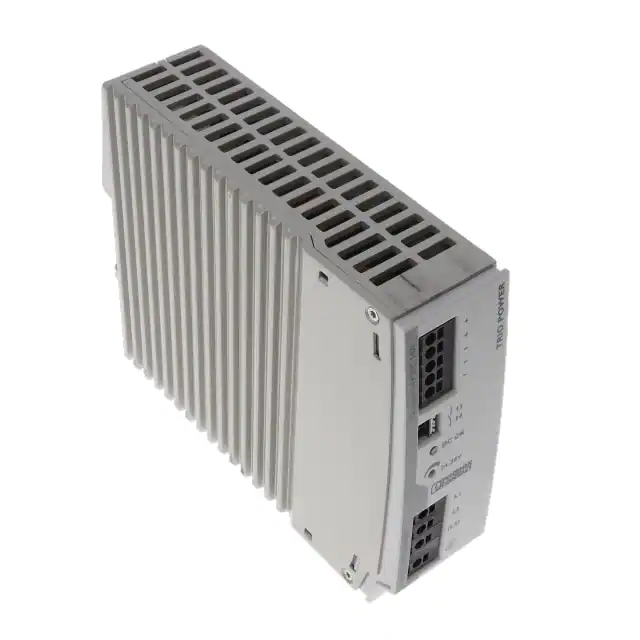
TRIO-PS-2G/3AC/24DC/10
Power supply unit
Data sheet
105905_en_00
1
© PHOENIX CONTACT 2015-08-31
Description
TRIO POWER - power supplies with standard functionality
The power supplies of the TRIO POWER family convince
due to their slim and robust design. The dynamic boost (1.5
x IN for 5 seconds) absorbs starting currents and short overload situations securely during operation and without a drop
in output voltage. The push-in connection technology on the
front enables fast and tool-free wiring of the devices.
Features
–
–
–
–
–
–
–
Especially slim design
Worldwide use, thanks to wide-range input
Safe operation, thanks to electrically and mechanically
robust design
Reliable starting of heavy loads, thanks to dynamic
boost (1.5 x IN for 5 seconds)
Simplified error diagnostics for remote signaling via DCOK signal contact
OVP (Over Voltage Protection) limits surge voltages to
≤ 30 V (EN61131-2)
Tool-free connection via push-in connection technology
Technical data (short form)
Nominal input voltage range
3x 400 V AC ... 500 V AC
2x 400 V AC ... 500 V AC
Frequency range
50 Hz ... 60 Hz
Nominal output voltage
> 24 V DC, constant capacity restricted
24 V DC ±1 %
24 V DC ... 28 V DC
Nominal output current IN / IDyn
10 A / 15 A (5 s)
Residual ripple
≤ 20 mVPP
Protection against surge voltage on
the output
≤ 30 V DC
MTBF (IEC 61709, SN 29500)
> 2100000 h (25 °C)
> 1200000 h (40°C)
> 590000 h (60°C)
Efficiency
at 400 V AC and nominal values
> 92 %
Maximum power dissipation NOLoad
< 1.1 W
Power loss nominal load max.
< 22 W
Ambient temperature (operation)
-25 °C ... 70 °C
> 60 °C Derating: 2,5 %/K
Ambient temperature (start-up type
tested)
-40 °C
Weight
0.9 kg
Dimensions W/H/D
42 mm / 130 mm / 160 mm
Make sure you always use the latest documentation.
It can be downloaded from the product at phoenixcontact.net/products.
�TRIO-PS-2G/3AC/24DC/10
2
Table of contents
1
Description .............................................................................................................................. 1
2
Table of contents ..................................................................................................................... 2
3
Ordering data .......................................................................................................................... 3
4
Technical data ......................................................................................................................... 3
5
Safety regulations and installation notes.................................................................................. 7
6
Basic circuit diagram ............................................................................................................... 7
7
Structure.................................................................................................................................. 8
8
Cooling .................................................................................................................................... 8
9
Mounting position and dimensions .......................................................................................... 9
9.1
Mounting position ................................................................................................................ 9
9.2
Device dimensions ............................................................................................................. 10
10
Mounting/removal.................................................................................................................. 11
10.1 Assembly......................................................................................................................... 11
10.2 Removal .......................................................................................................................... 11
11
Device connection terminal blocks ........................................................................................ 11
11.1 Push-in connection technology ............................................................................................. 11
12
Input ...................................................................................................................................... 12
12.1 Position of input terminals .................................................................................................... 12
12.2 Protection of the primary side ............................................................................................... 12
13
Output.................................................................................................................................... 13
13.1 Position of output terminals .................................................................................................. 13
13.2 Protection of the secondary side ............................................................................................ 13
13.3 Output characteristic curve................................................................................................... 13
14
Dynamic boost....................................................................................................................... 14
15
Signaling................................................................................................................................ 14
15.1 DC OK-LED ..................................................................................................................... 14
15.2 Floating signal contact ........................................................................................................ 14
16
Derating................................................................................................................................. 15
16.1 Temperature-dependent derating .......................................................................................... 15
16.2 Position-dependent derating ................................................................................................. 16
17
Operating modes ................................................................................................................... 19
17.1 Series operation ................................................................................................................ 19
17.2 Parallel operation ............................................................................................................... 19
17.3 Redundant operation .......................................................................................................... 19
17.4 Decoupling with diode module .............................................................................................. 19
17.5 Increasing power ............................................................................................................... 20
105905_en_00
PHOENIX CONTACT
2
�TRIO-PS-2G/3AC/24DC/10
3
Ordering data
Description
Type
Order No.
Pcs./Pkt.
Primary-switched TRIO POWER power supply with push-in connection for
DIN rail mounting, input: 3-phase, output: 24 V DC/10 A
TRIO-PS-2G/3AC/24DC/10
2903154
1
Accessories
Type
Order No.
Pcs./Pkt.
Multi-channel, electronic device circuit breaker with active current limitation for protecting four loads at 24 V DC in the event of overload and short
circuit. With nominal current assistant and electronic locking of the set
nominal currents. For installation on DIN rails.
CBM E4 24DC/0.5-10A NO-R
2905743
1
Multi-channel, electronic device circuit breaker with active current limitation for protecting eight loads at 24 V DC in the event of overload and short
circuit. With nominal current assistant and electronic locking of the set
nominal currents. For installation on DIN rails.
CBM E8 24DC/0.5-10A NO-R
2905744
1
VARIOFACE module, with two equipotential busbars (P1, P2) for potential
distribution, for mounting on NS 35 rails. Module width: 70.4 mm
VIP-2/SC/PDM-2/24
2315269
1
VARIOFACE module with push-in connection and two equipotential busbars (P1, P2) for potential distribution, for mounting on NS 35 rails. Module
width: 57.1 mm
VIP-3/PT/PDM-2/24
2903798
1
Our range of accessories is being continually extended, our current range can be found in the download area.
4
Technical data
Input data
Nominal input voltage range
3x 400 V AC ... 500 V AC -20 % ... +15 %
2x 400 V AC ... 500 V AC -10 % ... +15 %
Input voltage range
3x 320 V AC ... 575 V AC
2x 360 V AC ... 575 V AC
Current consumption (for nominal values)
3x 0.6 A (400 V AC)
3x 0.6 A (500 V AC)
2x 1.1 A (400 V AC)
2x 1.1 A (500 V AC)
Frequency
50 Hz ... 60 Hz
Inrush current limitation (at 25°C)
≤ 26 A (typical)
Inrush surge current I2t
0.3 A2s
Input fuse internal (device protection), slow-blow
3.15 A
Mains buffering
> 10 ms (400 V AC)
> 20 ms (500 V AC)
A choice of suitable fuses
6 A ... 16 A (Characteristics B, C, D, K)
Input connection data
Connection method
Push-in connection
Conductor cross section, solid
0.2 mm² ... 4 mm²
Conductor cross section, flexible
0.2 mm² ... 2.5 mm²
Cross section AWG
24 ... 12
Stripping length
10 mm
105905_en_00
PHOENIX CONTACT
3
�TRIO-PS-2G/3AC/24DC/10
Output data
Nominal output voltage
24 V DC ±1 %
Setting range of the output voltage
24 V DC ... 28 V DC (> 24 V DC, constant capacity restricted)
Output current
10 A
15 A (5 s)
Control deviation
< 1 % (change in load, static 10 % ... 90 %)
< 3 % (Dynamic load change 10 % ... 90 %, 10 Hz)
< 0.1 % (change in input voltage ±10 %)
Efficiency
> 92 % (at 400 V AC and nominal values)
Rise time
≤ 120 ms (UOUT (10 % ... 90 %))
Residual ripple
≤ 20 mVPP
Connection in parallel
Yes, for redundancy and increased capacity
Connection in series
Yes
Protection against surge voltage on the output
≤ 30 V DC
Output connection data
Connection method
Push-in connection
Conductor cross section, solid
0.2 mm² ... 4 mm²
Conductor cross section, flexible
0.2 mm² ... 2.5 mm²
Conductor cross section AWG
24 ... 12
Stripping length
10 mm
Signaling DC OK
Types of signaling
LED, floating signal contact
Signal threshold
UOUT < 0.9 x UN
Type of signaling
LED
Status indicator
green
Type of signaling
Switch contact
Maximum switching voltage
30 V AC/DC
Continuous load current
100 mA
Signal connection data
Connection method
Push-in connection
Conductor cross section, solid
0.2 mm² ... 1.5 mm²
Conductor cross section, flexible
0.2 mm² ... 1.5 mm²
Conductor cross section AWG
24 ... 16
Stripping length
8 mm
General data
Insulation voltage input/output
4 kV AC (type test)
1.5 kV AC (routine test)
Degree of protection
IP20
Protection class
I (in closed control cabinet)
Inflammability class in acc. with UL 94 (housing)
V0
MTBF (IEC 61709, SN 29500)
> 2100000 h (25 °C)
> 1200000 h (40°C)
> 590000 h (60°C)
Type of housing
Aluminum (AlMg3)
Hood version
Polycarbonate
Dimensions W / H / D (state of delivery)
42 mm / 130 mm / 160 mm
Weight
0.9 kg
105905_en_00
PHOENIX CONTACT
4
�TRIO-PS-2G/3AC/24DC/10
Power consumption
Maximum power dissipation NO-Load
< 1.1 W
Power loss nominal load max.
< 22 W
Ambient conditions
Ambient temperature (operation)
-25 °C ... 70 °C (> 60 °C Derating: 2,5 %/K)
Ambient temperature (start-up type tested)
-40 °C
Ambient temperature (storage/transport)
-40 °C ... 85 °C
Max. permissible relative humidity (operation)
≤ 95 % (at 25 °C, non-condensing)
Maximum altitude
≤ 5000 m (> 4000 m, observe derating)
Vibration (operation)
< 15 Hz, amplitude ±2.5 mm (according to IEC 60068-2-6)
15 Hz ... 150 Hz, 4g, 90 min.
Shock
30g in each direction, according to IEC 60068-2-27
Pollution degree
2
Climatic class
3K3 (in acc. with EN 60721)
Standards
Electrical Equipment for Machinery
EN 60204-1
Electrical safety (of information technology equipment)
IEC 60950-1/VDE 0805 (SELV)
Electronic equipment for use in electrical power installations
EN 50178/VDE 0160 (PELV)
SELV
IEC 60950-1 (SELV) and EN 60204-1 (PELV)
Safe isolation
DIN VDE 0100-410
Limitation of mains harmonic currents
EN 61000-3-2
Network version/undervoltage
Semi F47-0706
Rail applications
EN 50121-4
Approvals
UL
UL Listed UL 508
UL/C-UL Recognized UL 60950-1
Current approvals/permissions for the product can be found in the download area under phoenixcontact.net/products.
105905_en_00
PHOENIX CONTACT
5
�TRIO-PS-2G/3AC/24DC/10
Conformance with EMC Directive 2004/108/EC
Noise immunity according to EN 61000-6-2
EN 61000-6-2 requirement
Tested
Electrostatic discharge EN 61000-4-2
Housing contact discharge 4 kV (Test intensity 2)
6 kV (Test intensity 4)
Housing air discharge 8 kV (Test intensity 3)
8 kV (Test intensity 4)
Comments Criterion B
Criterion A
Electromagnetic HF field EN 61000-4-3
Frequency range 80 MHz ... 1 GHz
Test field strength 10 V/m (Test intensity 3)
Frequency range 1.4 GHz ... 2 GHz
Test field strength 3 V/m (Test intensity 2)
Frequency range 2 GHz ... 2.7 GHz
Test field strength 1 V/m (Test intensity 1)
Comments Criterion A
80 MHz ... 1 GHz
10 V/m (Test intensity 3)
1 GHz ... 2 GHz
10 V/m (Test intensity 3)
2 GHz ... 3 GHz
10 V/m (Test intensity 3)
Criterion A
Fast transients (burst) EN 61000-4-4
Input 2 kV (Test intensity 3 - asymmetrical)
4 kV (Test intensity 4 - asymmetrical)
Output 2 kV (Test intensity 3 - asymmetrical)
2 kV (Test intensity 3 - asymmetrical)
Signal 1 kV (Test intensity 2 - asymmetrical)
Comments Criterion B
1 kV (Test intensity 2 - asymmetrical)
Criterion A
Surge current loads (surge) EN 61000-4-5
Input 1 kV (Test intensity 1 - symmetrical)
2 kV (Test intensity 1 - asymmetrical)
3 kV (Test intensity 3 - symmetrical)
6 kV (Test intensity 4 - asymmetrical)
Output 0.5 kV (Test intensity 1 - symmetrical) 1 kV (Test intensity 2 - symmetrical)
0.5 kV (Test intensity 1 - asymmetrical) 2 kV (Test intensity 1 - asymmetrical)
Signal 1 kV (Test intensity 2 - asymmetrical)
Comments Criterion B
1 kV (Test intensity 1 - symmetrical)
Criterion B
Conducted interference EN 61000-4-6
Input/output asymmetrical
Frequency range 0.15 MHz ... 80 MHz
Voltage 10 V (Test intensity 3)
Comments Criterion A
asymmetrical
0.15 MHz ... 80 MHz
10 V (Test intensity 3)
Criterion A
Key
Criterion A
Normal operating behavior within the specified limits.
Criterion B
Temporary impairment to operational behavior that is corrected by the device itself.
Emitted interference in acc. with EN 61000-6-3
Radio interference voltage in acc. with EN 55011
EN 55011 (EN 55022) Class B, area of application: Industry and residential
Emitted radio interference in acc. with EN 55011
EN 55011 (EN 55022) Class B, area of application: Industry and residential
All technical specifications are nominal and refer to a room temperature of 25 °C and 70% relative humidity at
2000 m above sea level.
105905_en_00
PHOENIX CONTACT
6
�TRIO-PS-2G/3AC/24DC/10
5
Safety regulations and installation
notes
6
Basic circuit diagram
L1
Before startup please ensure:
– Installation and startup may only be carried out by qualified personnel.
– The relevant country-specific regulations
must be observed.
+
+
L2
L3
13
14
NOTE: Danger if used improperly
– The device is a built-in device.
– The IP20 degree of protection
(IEC 60529/EN 60529) of the device is intended for use in a clean and dry environment. Do not subject the device to any
load that exceeds the described limits.
– Do not subject the device to mechanical
and/or thermal loads that exceed the
specified limits.
– It is not permissible to open or modify the
device. Do not repair the device yourself
but replace it with an equivalent device.
Repairs may only be carried out by the
manufacturer. The manufacturer is not liable for damage resulting from violation.
Figure 1
Basic circuit diagram
Key:
Rectification
Switch
Electrically isolated signal transmission
Regulation
Transformer
CAUTION:
Before startup please ensure:
– Connection must be performed by specialist personnel and protection against
electric shock ensured.
– It must be possible to switch off the device outside the power supply according
to the regulations in EN 60950-1 (e.g., by
line protection on the primary side).
– All feed lines are sufficiently protected
and dimensioned!
– All output lines are dimensioned according to the maximum output current of the
device or separately protected!
– Sufficient convection is guaranteed!
Filter
Floating switching output
EXPLOSION HAZARD!
Only remove equipment when it is disconnected and not in the potentially explosive area.
DANGER
Never carry out work on live parts!
The housing can become very hot, depending
on the ambient temperature and load!
105905_en_00
PHOENIX CONTACT
7
�TRIO-PS-2G/3AC/24DC/10
Structure
8
5
Output DC 24V 10A
2
+
+
-
Cooling
Heat is dissipated from the power supply via the heatsinks
integrated into the housing surfaces. Convection to dissipate heat from the power supply only takes place in small dimensions above the housing openings.
TRIO POWER
7
13
14
4
DC OK
3
Input 2/3 AC 400-500V
24-28V
L1
L2
(L3)
6
1
Figure 2
No.
1.
2.
3.
4.
5.
6.
Function elements
Description of the function elements
Connection terminal block input voltage: Input L1/L2/L3/
PE
Connection terminal block output voltage: Output DC +/Potentiometer, output voltage: 24 V DC ... 28 V DC
Signaling DC OK LED
Floating signal contact: max. 30 V AC/DC, 100 mA
Integrated universal snap-on foot
Figure 3
Convection
The power supply can be aligned without minimum lateral clearance up to an ambient temperature of 40°C. In a temperature range up to
≤ 70°C, a lateral minimum clearance of 10 mm
between two active components (e.g., power
supply) is required.
The device can be snapped onto all DIN rails
in accordance with EN 60715 and should be
mounted in the normal mounting position.
To ensure sufficient wiring space to wire the
power supply, we recommend a vertical minimum clearance from other devices of 50 mm.
Depending on the cable duct used, a smaller
clearance may be possible.
105905_en_00
PHOENIX CONTACT
8
�TRIO-PS-2G/3AC/24DC/10
9
Mounting position and dimensions
9.1
Mounting position
115
Output DC 24V 10A
+
+
-
TRIO POWER
50
42
13
14
Input 2/3 AC 400-500V
24-28V
Figure 4
130
230
DC OK
L1
L2
(L3)
Locked areas
Possible mounting positions:
Normal mounting position, installation depth 160 mm (+ DIN
rail)
105905_en_00
PHOENIX CONTACT
9
�TRIO-PS-2G/3AC/24DC/10
9.2
Device dimensions
167
42
11
TRIO POWER
+
+
-
5
41
Output DC 24V 10A
9
160
8,5
DC OK
130
24-28V
45
78
L2
(L3)
68
Input 2/3 AC 400-500V
L1
24
10
7,5
30
80
3,5
13
14
11
Figure 5
105905_en_00
Device dimensions
PHOENIX CONTACT
10
�TRIO-PS-2G/3AC/24DC/10
10
Mounting/removal
11
Device connection terminal blocks
10.1
Assembly
11.1
Push-in connection technology
Position the module with the DIN rail guide on the upper
edge of the DIN rail, and snap it in with a downward motion.
A
All connection terminal blocks on the power supply have
push-in connection technology on the front. The power supply is wired by simply plugging in the connecting cables, no
tools are required. For the necessary connection parameters for the terminal blocks, please refer to the technical
data.
11.1.1 Plug in connecting cable
The wiring is carried out by simply plugging the connecting
cable into the contact opening provided. Insert the connecting cable as far as it will go.
A
B
Figure 6
10.2
Assembly on standard DIN rail
Figure 8
Removal
Pull the snap lever open with the aid of a screwdriver and
slide the module out at the lower edge of the DIN rail.
Insert connecting cable (push-in connection
technology)
11.1.2 Loosen the connecting cable
To disconnect the wiring, take a suitable screwdriver and insert it into the opening for release. Then carefully pull the
connecting cable out of the contact opening.
D
B
C
A
A
Figure 7
105905_en_00
B
Figure 9
Release connecting cable (push-in connection
technology)
Removing the DIN rail
PHOENIX CONTACT
11
�TRIO-PS-2G/3AC/24DC/10
12
12.1
Input
Position of input terminals
The power supply can be operated on three-phase AC
power grids (star grid) in accordance with the nominal input
voltage. Connection is via the INPUT L1/L2/L3/PE connection terminal blocks.
An all-pos. disconnecting device must be present for operation on three-phase systems.
TN-C
L1
L2
L3
N
PE
L1
L2
L3
+
-
L1
L2
L3
PEN
L1
L2
L3
TT
+
-
L2
(L3)
+
-
L1
L2
L3
L1
L2
L3
+
-
Figure 11
12.2
Figure 10
L1
iT
L1
L2
L3
N
L1
L2
L3
Input 2/3 AC 400-500V
TN-S
Network types
Position of input terminals
Protection of the primary side
Installation of the device must correspond to EN 60950 regulations. It must be possible to disconnect the device from
the voltage using a suitable separator outside the power
supply. For example, the primary-side line protection is suitable for this (see technical data).
Two internal, approved AC fuses are provided for device
protection. Additional device protection is not required.
If an internal fuse trips, this is due to a device
fault. In this case, the device must be inspected in the factory. Opening the device or repairing it yourself is prohibited.
Input 2/3 AC 400-500V
L1
L2
L3
PE
Figure 12
105905_en_00
L1
L2
(L3)
Schematic diagram, switching the input terminals
PHOENIX CONTACT
12
�TRIO-PS-2G/3AC/24DC/10
13
Output
Output DC 24V 10A
A DC voltage for supplying the load is provided at the output
of the power supply. The load is connected via the OUTPUT
+/- connection terminal blocks.
By default, the power supply is pre-set to a nominal output
voltage of 24 V DC.
The output voltage can also be set to the range from 24 V DC
to 28 V DC using the potentiometer in order to compensate
for a possible voltage drop due to the long cable lengths between the power supply and the load to be supplied.
13.1
Figure 14
+
R Load
+
-
Schematic diagram, switching the output terminals
Position of output terminals
13.3
Output characteristic curve
13
14
DC OK
UOUT [V]
O
The power supply works with a dynamic power reserve, the
dynamic boost, as shown in the U/I characteristic curve in
the figure. In the event of a secondary-side short circuit or
overload, the output current is limited to 1.5 x IN. The module does not switch off, but supplies a continuous output current instead. The secondary voltage is then reduced until the
short circuit is eliminated. The U/I characteristic curve with
the dynamic power reserve enables high switch-on currents
of capacitive loads or inductive loads to be supplied reliably.
dyn. Boost
t≥5s
UN
U < 0,9 x UN
24-28V
IN
1,5 x IN
IOUT [A]
Figure 15
Figure 13
13.2
U/I characteristic curve with dynamic load reserve
Position of output terminals
Protection of the secondary side
The power supply is electronically short-circuit-proof and
idling-proof. In the event of an error, the output voltage is limited. It must be ensured that all output cables are dimensioned accordingly for the maximum output current or have
separate protection.
–
–
–
–
–
UN = 24 V
IN = 10 A
Idyn. BOOST = 15 A
PN = 240 W
Pdyn. BOOST = 360 W
The connecting cables on the secondary side should have
large cross sections to keep the voltage drops in the cables
as low as possible.
105905_en_00
PHOENIX CONTACT
13
�TRIO-PS-2G/3AC/24DC/10
14
Dynamic boost
15
Signaling
The following example is used to explain how the power
supply dynamic boost functions.
15.1
DC OK-LED
Example:
The DC OK-LED is available for function monitoring. The
LED is continuously illuminated when the output voltage is
> 90 % of the nominal output voltage UOUT (24 V DC).
The power supply supplies a connected base load of 80%
until time point t1 (see illustration, schematic diagram of the
dynamic boost behavior). If an additional load is activated
while the power supply is in operation, the dynamic boost is
requested for the period of time t1 to t2. The power supply
provides the maximum dynamic power reserve of an additional 70% (ΔPdyn. Boost = 1.5 x IN x UN - PInitial load).
O
As such, the requested overall total power corresponds to
150% of the nominal power. This power can be accessed directly for at least 5 s in the event that the output voltage remains the same. On reaching time point t2, the dynamic
boost is once more returned to the output value of the base
load for thermal offloading of the power supply. In this case,
the base load amounts to the same value of 80%, as prior to
time point t1. If the request to supply the load still exists,
when the time intervals t2 to t3 have expired (at least 7 s), a
new cyclical switching of the dynamic power reserve occurs,
to a total of 70%.
13
14
DC OK
IOUT [A]
24-28V
Idyn. Boost
100%
80%
Figure 17
15.2
Figure 16
t2
7s
t3
5s
t4
7s
...
t5
t [s]
Schematic diagram of dynamic boost behavior
Depending on the connected base load, the
power supply firmware determines the time intervals for the dynamic boost procedure or the
time required for the release of thermal tension. The ratio of dynamic boost time and time
for thermal tension release always varies, depending on load.
Floating signal contact
A floating diagnostics contact can be used to forward data to
a higher-level control system. When opened, the diagnostics contact indicates an underrange of more than 90% for
the nominal output voltage UOUT.
TRIO P
t1
5s
Location of the elements
max. 30 V AC/DC
100 mA
+
13
14
PLC
Digital Input
DI x
DC OK
24-28V
Figure 18
105905_en_00
Wiring principle
PHOENIX CONTACT
14
�TRIO-PS-2G/3AC/24DC/10
16
Derating
16.1
Temperature-dependent derating
IOUT [A]
The device provides both the IN nominal output current and
the Idyn. BOOST dynamic output current at ambient temperatures up to +60 °C. For ambient temperatures above
+60°C, the ambient power must be decreased by 2.5% per
Kelvin increase in temperature. For ambient temperatures
above +70°C or in the event of a thermal overload, the device does not switch off. The output power will be decreased
by enough to allow device protection. Once the device has
cooled down, the output power will be increased again.
1,5 x IN
dyn. Boost
t≥5s
IN
0
-25
Figure 19
105905_en_00
20
40
60
[°C]
Temperature derating in normal mounting position
PHOENIX CONTACT
15
�TRIO-PS-2G/3AC/24DC/10
16.2
Position-dependent derating
The power supply can be installed onto all 35 mm DIN rails
according to EN 60175. The normal mounting position of the
power supply is horizontal.
When installing in a different mounting position, derating
should be adhered to.
The characteristic curve can be used to determine the maximal output power to be drawn for each ambient temperature
for different mounting positions.
Normal mounting position
Rotated mounting position 90° X-axis
105905_en_00
PHOENIX CONTACT
16
�TRIO-PS-2G/3AC/24DC/10
Rotated mounting position 180° X-axis
Rotated mounting position 270° X-axis
105905_en_00
PHOENIX CONTACT
17
�TRIO-PS-2G/3AC/24DC/10
Rotated mounting position 90° Z-axis
Rotated mounting position 270° Z-axis
105905_en_00
PHOENIX CONTACT
18
�TRIO-PS-2G/3AC/24DC/10
17
Operating modes
17.1
Series operation
Two power supplies can be switched in series, to double the
output voltage. For connection in series, only power supplies of the same performance class should be used. An output voltage of, for example, 48 V DC can be provided, if two
24 V power supplies are connected in series.
+
+
-
-
IN
IN
+
–
Various voltage levels are made possible by varying the
switching of the respective output voltage and the measurement reference point.
Σ = IN
+ –
+
+
-
-
+24 V
+
Figure 21
-
17.3
+48 V
+
+
-
-
Figure 20
17.2
-48 V
-24 V
+
-
Wiring principle, voltage levels with two power
supplies
Parallel operation
Devices of the same type can be connected in parallel to increase both redundancy and power. By default upon delivery, no further adjustments are required.
If the output voltage is adjusted, a uniform distribution of
power is guaranteed by setting all parallel operated power
supply units to exactly the same output voltage.
To ensure symmetrical current distribution we recommend
that all cable connections from the power supply unit to the
busbar are the same length and have the same cross section.
Depending on the system, for parallel connection of more
than two power supplies a protective circuit should be installed at each individual device output (e.g., decoupling diode, DC fuse or circuit breaker). This prevents high return
currents in the event of a secondary device fault.
105905_en_00
Schematic diagram in parallel operation
Redundant operation
Redundant circuits are suitable for supplying systems which
place particularly high demands on operational reliability. If
a fault occurs in the primary circuit of the first power supply
unit, the second device automatically takes over the complete power supply without interruption, and vice versa. For
this purpose, the power supply units to be connected in parallel must be large enough to ensure that the total current requirements of all loads can be fully met by one power supply
unit. External decoupling diodes or ORING modules are required for 100% redundancy.
17.4
Decoupling with diode module
+
+
-
-
IN
IN
+
–
+ –
Figure 22
Σ = IN
Schematic diagram, decoupling with diode
module
PHOENIX CONTACT
19
�TRIO-PS-2G/3AC/24DC/10
17.4.1 Decoupling with ORING module
+
+
-
-
IN
IN
+
–
Σ = IN
+ –
Figure 23
17.5
Schematic diagram, decoupling with ORING
module
Increasing power
The output current can be increased to n x IN in the case of
n parallel connected devices. Parallel connection for increasing power is used when extending existing systems. A
parallel connection is recommended if the power supply unit
does not cover the current consumption of the most powerful load. Otherwise, the load should be distributed between
individual devices that are independent from one another.
+
+
-
-
IN
IN
+
–
+ –
Figure 24
105905_en_00
Σ = 2 x IN
Schematic diagram of increased performance
PHOENIX CONTACT GmbH & Co. KG • 32823 Blomberg • Germany
phoenixcontact.com
20
�