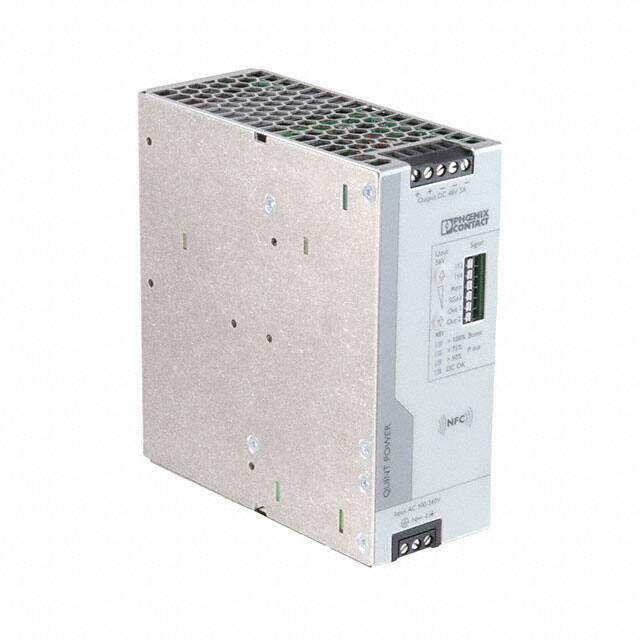
QUINT4-PS/1AC/48DC/5
Power supply unit
Data sheet
108476_en_01
1
© PHOENIX CONTACT 2018-09-05
Description
QUINT POWER power supplies with SFB Technology and
preventive function monitoring ensure superior system
availability.
Technical data (short form)
Input voltage range
100 V AC ... 240 V AC
-15 % ... +10 %
Powerful
Mains buffering
≥ 40 ms (120 V AC)
≥ 40 ms (230 V AC)
–
–
Nominal output voltage (UN)
48 V DC
Setting range of the output voltage
(USet)
48 V DC ... 56 V DC
Nominal output current (IN)
Static Boost (IStat.Boost)
Dynamic Boost (IDyn.Boost)
Selective Fuse Breaking (ISFB)
5A
6.25 A
10 A (5 s)
30 A (15 ms)
Output power (PN)
Output power (PStat. Boost)
Output power (PDyn. Boost)
240 W
300 W
480 W
Efficiency
typ. 92.3 % (120 V AC)
typ. 93.5 % (230 V AC)
Residual ripple
< 70 mVPP
SFB technology: 6 times the nominal current for 15 ms
Power reserves:
Static boost of up to 125% (PN) for a sustained period
Dynamic boost of up to 200% (PN) for 5 s
Robust
–
–
Mains buffering ≥ 20 ms
High degree of electrical immunity, thanks to integrated
gas-filled surge arrester (6 kV)
Preventive
–
Comprehensive signaling:
Analog signal, digital signal, relay contact, LED bar
graph
Can be ordered pre-configured
–
MTBF (IEC 61709, SN 29500)
> 784000 h (40 °C)
Ambient temperature (operation)
-25 °C ... 70 °C
-40°C (startup type tested)
> 60 °C Derating: 2.5 %/K
Dimensions W/H/D
50 mm / 130 mm / 125 mm
Weight
1 kg
Perform configuration online and order 1 or more units
All technical specifications are nominal values and refer to a room temperature of 25 °C and 70 % relative
humidity at 100 m above sea level.
�QUINT4-PS/1AC/48DC/5
2
Table of contents
1
Description .............................................................................................................................. 1
2
Table of contents ..................................................................................................................... 2
3
Ordering data .......................................................................................................................... 3
4
Technical data ......................................................................................................................... 4
5
Safety and installation notes .................................................................................................. 15
6
High-voltage test (HIPOT) ..................................................................................................... 16
7
Structure of the power supply ................................................................................................ 18
8
Mounting/removing the power supply .................................................................................... 21
9
Device connection terminal blocks ........................................................................................ 24
10
Output characteristic curves .................................................................................................. 26
11
Configuring the power supply ................................................................................................ 29
12
Boost currents ....................................................................................................................... 30
13
SFB technology ..................................................................................................................... 32
14
Signaling................................................................................................................................ 36
15
Operating modes ................................................................................................................... 44
16
Derating................................................................................................................................. 46
108476_en_01
PHOENIX CONTACT 2 / 49
�QUINT4-PS/1AC/48DC/5
3
Ordering data
Description
Type
Order No.
Pcs./Pkt.
Primary-switched QUINT POWER power supply for DIN
rail mounting with free choice of output characteristic
curve and SFB (Selective Fuse Breaking) technology,
input: 1-phase, output: 48 V DC / 5 A
QUINT4-PS/1AC/48DC/5
2904610
1
One or more of the primary-switched QUINT POWER power supply with SFB Technology (selective fuse
breaking) versions configured online can now be ordered using the following web code: phoenixcontact.net/
webcode/#0852
Accessories
Type
Order No.
Pcs./Pkt.
Universal wall adapter for securely mounting the power
UWA 182/52
supply in the event of strong vibrations. The power supply
is screwed directly onto the mounting surface. The
universal wall adapter is attached at the top/bottom.
2938235
1
2-piece universal wall adapter for securely mounting the UWA 130
power supply in the event of strong vibrations. The profiles
that are screwed onto the side of the power supply are
screwed directly onto the mounting surface. The universal
wall adapter is attached on the left/right.
2901664
1
Assembly adapter for QUINT-PS... power supply on S7300 rail
QUINT-PS-ADAPTERS7/1
2938196
1
Near Field Communication (NFC) programming adapter
with USB interface for the wireless configuration of NFCcapable products from PHOENIX CONTACT with
software. No separate USB driver is required.
TWN4 MIFARE NFC USB
ADAPTER
2909681
1
Type 2/3 surge protection, consisting of protective plug
PLT-SEC-T3-230-FM-UT
and base element, with integrated status indicator and
remote signaling for single-phase power supply networks.
Nominal voltage 230 V AC/DC.
2907919
5
Type 3 surge protection, consisting of protective plug and PLT-SEC-T3-60-FM-UT
base element, with integrated status indicator and remote
signaling for single-phase power supply networks.
Nominal voltage 60 V AC/DC.
2907917
5
Type 2/3 surge protection, consisting of protective plug
PLT-SEC-T3-230-FM-PT
and base element, with integrated status indicator and
remote signaling for single-phase power supply networks.
Nominal voltage 230 V AC/DC.
2907928
5
Type 3 surge protection, consisting of protective plug and PLT-SEC-T3-60-FM-PT
base element, with integrated status indicator and remote
signaling for single-phase power supply networks.
Nominal voltage 60 V AC/DC.
2907926
5
The range of accessories is being continuously extended. The current range of accessories can be found in
the download area for the product.
108476_en_01
PHOENIX CONTACT 3 / 49
�QUINT4-PS/1AC/48DC/5
4
Technical data
Input data
Unless otherwise stated, all data applies for 25°C ambient temperature, 230 V AC input voltage, and nominal
output current (IN).
Input voltage range
100 V AC ... 240 V AC -15 % ... +10 %
110 V DC ... 250 V DC -18 % ... +40 %
Electric strength, max.
300 V AC 60 s
Frequency range (fN)
50 Hz ... 60 Hz -10 % ... +10 %
Frequency (fR) for railway power supply systems
16.7 Hz (acc. to EN 50163)
Railway power supply systems can be operated at 16.7 Hz. Use conditions and technical data on request.
Current draw typ.
3.4 A (100 V AC)
2.8 A (120 V AC)
1.5 A (230 V AC)
1.5 A (240 V AC)
3 A (110 V DC)
1.3 A (250 V DC)
The specified values for current consumption apply for operation in the static boost (PN x 125%).
Discharge current to PE
typical
< 3.5 mA
0.6 mA (264 V AC, 60 Hz)
Mains buffering
≥ 40 ms (120 V AC)
≥ 40 ms (230 V AC)
Switch-on time
100%
LED lights up yellow, output power > 240 W
POut > 75%
LED lights up green, output power > 180 W
POut > 50%
LED lights up green, output power > 120 W
UOut > 0.9 x USet
LED lights up green
UOut < 0.9 x USet
LED flashes green
Signal contact (configurable)
Signal output (configurable) Out 1
Digital
0 / 24 V DC , 20 mA
Default
24 V DC , 20 mA ( 24 V DC for UOut > 0.9 x USet )
Signal output (configurable) Out 2
Digital
0 / 24 V DC , 20 mA
Analog
4 mA ... 20 mA 5 % (Load ≤400 )
Default
24 V DC , 20 mA ( 24 V DC for POut 0.9 USet)
Maximum contact load
24 V DC 1 A , 30 V AC/DC 0.5 A
Control input (configurable) Rem
Function
Output power ON/OFF (SLEEP MODE)
Default
Output power ON (>40 kΩ/24 V DC/open bridge between Rem
and SGnd)
Signal ground SGnd
Reference potential for Out1, Out2, and Rem
108476_en_01
PHOENIX CONTACT 7 / 49
�QUINT4-PS/1AC/48DC/5
Signal connection data
Connection method
Push-in connection
Conductor cross section, solid
0.2 mm² ... 1 mm²
Conductor cross section, flexible
0.2 mm² ... 1.5 mm²
Conductor cross section flexible, with ferrule with plastic
sleeve
0.2 mm² ... 0.75 mm²
Conductor cross section flexible, with ferrule without
plastic sleeve
0.2 mm² ... 1.5 mm²
Conductor cross section AWG
24 ... 16
Stripping length
8 mm
Reliability
230 V AC
MTBF (IEC 61709, SN 29500)
> 1242000 h (25 °C)
> 784000 h (40 °C)
> 374000 h (60 °C)
Life expectancy (electrolytic capacitors)
Output current (IOut)
120 V AC
230 V AC
2.5 A
> 326000 h ( 40 °C )
> 321000 h ( 40 °C )
5A
> 159000 h ( 40 °C )
> 218000 h ( 40 °C )
5A
> 452000 h ( 25 °C )
> 618000 h ( 25 °C )
The expected service life is based on the capacitors used. If the capacitor specification is observed, the
specified data will be ensured until the end of the stated service life. For runtimes beyond this time, error-free
operation may be reduced. The specified service life of more than 15 years is simply a comparative value.
Switching frequency
Min.
Max.
PFC stage
50 kHz
70 kHz
Auxiliary converter stage
90 kHz
110 kHz
Main converter stage
80 kHz
280 kHz
General data
Degree of protection
IP20
Protection class
I
Inflammability class in acc. with UL 94 (housing / terminal V0
blocks)
Side element version
Aluminum
Hood version
Stainless steel X6Cr17
Dimensions W / H / D (state of delivery)
50 mm / 130 mm / 125 mm
Dimensions W / H / D (90° turned)
122 mm / 130 mm / 53 mm
Weight
1 kg
Power dissipation
Maximum power dissipation in no-load condition
120 V AC
230 V AC
1 % P Ou
5
> 7 0%
> 5 OK
DC
C
NF
Signal
13
14
Rem
SGnd
Out 1
Out 2
2
> 100% Boost
QUINT POWER
> 75% P
out
> 50%
DC OK DC OK
HV
3
�/=
NFC
Input AC 100-240 V
N/- L/+
4
Figure 1
Potential-related wiring for the high-voltage
test
Key
No.
Designation
Color coding
1
2
3
DC output circuit
Signal contacts
High-voltage
tester
AC input circuit
Blue
Blue
--
Potential
levels
Potential 1
Potential 1
--
Red
Potential 2
4
108476_en_01
Figure 2
Disconnect gas-filled surge arrester
To disconnect the gas-filled surge arrester, proceed as
follows:
1. Remove power from the unit.
2. Unscrew the Phillips head screw completely and keep
the gas-filled surge arrester screw in a safe place. The
gas-filled surge arrester is now disconnected and is no
longer functional.
3. Perform the surge voltage test on the power supply.
4. Following successful high-voltage testing, screw the
gas-filled surge arrester screw fully back into the power
supply.
DANGER: Risk of electric shock or
damage to the power supply due to using
the wrong gas-filled surge arrester screw
To connect the gas-filled surge arrester, only
use the gas-filled surge arrester screw that
was originally installed in the power supply.
PHOENIX CONTACT 17 / 49
�QUINT4-PS/1AC/48DC/5
7.2
Structure of the power supply
Device dimensions
The fanless convection-cooled power supply can be
snapped onto all DIN rails according to EN 60715.
7.1
50
Function elements
+ +
Output DC 48V 5A
UOut
65
1
2
2
+ +
Output DC 48V 5A
3
Signal
56V
48V
13
14
Rem
SGnd
Out 1
Out 2
8
7
QUINT POWER
> 100% Boost
> 75% P
out
> 50%
DC OK DC OK
4
NFC
Input AC 100-240 V
N/- L/+
Figure 4
NFC
13
14
Rem
SGnd
Out 1
Out 2
> 100% Boost
> 75% P
out
> 50%
DC OK DC OK
QUINT POWER
UOut
48V
Signal Ground
9
Signal
56V
130
7
Device dimensions (dimensions in mm)
5
131
Input AC 100-240 V
N/- L/+
125
122
2
Figure 3
6
2
Operating and indication elements
8
9
108476_en_01
80
Designation
DC output voltage connection terminal blocks
Accommodation for cable binders
Signaling connection terminal blocks
Status and diagnostics indicators
NFC interface (Near Field Communication)
AC input voltage connection terminal blocks
Gas-filled surge arrester for surge protection (left
side of housing)
Universal DIN rail adapter (rear of housing)
Output voltage button (-) / (+)
45
No.
1
2
3
4
5
6
7
130
Key
Figure 5
Device dimensions (dimensions in mm)
PHOENIX CONTACT 18 / 49
�QUINT4-PS/1AC/48DC/5
7.3
Keep-out areas
Nominal output
capacity
Spacing [mm]
b
40
50
a
0
5
< 50 %
≥ 50 %
c
20
50
If adjacent components are active and the
nominal output power ≥ 50%, there must be
lateral spacing of 15 mm.
50
a
b
a
+ +
Output DC 48V 5A
UOut
130
48V
13
14
Rem
SGnd
Out 1
Out 2
Signal Ground
Signal
56V
QUINT POWER
> 100% Boost
> 75% P
out
> 50%
DC OK DC OK
NFC
c
Input AC 100-240 V
N/- L/+
Figure 6
108476_en_01
Device dimensions and minimum keep-out
areas (in mm)
PHOENIX CONTACT 19 / 49
�QUINT4-PS/1AC/48DC/5
7.4
Block diagram
(+)
L
�
+
+
-
active
PFC
N
(-)
13
14
OVP
Rem
SGnd
Out 1
Out 2
�C
NFC
POut
Figure 7
Block diagram
Key
Symbol
Designation
Surge protection (varistor, gas-filled surge
arrester) with filter
Symbol
Bridge rectifier
OVP
13
14
Inrush current limitation
Additional regulatory protection against
surge voltage
Relay contact and signal contacts
Rem
SGnd
Out 1
Out 2
�
active
PFC
Designation
Optocoupler (electrically isolating)
Power factor correction (PFC)
Switching transistor and main transmitter
(electrically isolating)
�C
Microcontroller
NFC interface (Near Field Communication)
NFC
Secondary rectification and smoothing
Output voltage button (-) / (+)
Filter
Signal/display LEDs (POut, DC OK)
POUT
Auxiliary converter (electrically isolating)
108476_en_01
PHOENIX CONTACT 20 / 49
�QUINT4-PS/1AC/48DC/5
8
Mounting/removing the power
supply
8.1
Mounting the power supply unit
D
Proceed as follows to mount the power supply:
1. In the normal mounting position the power supply is
mounted on the DIN rail from above. Make sure that the
universal DIN rail adapter is in the correct position
behind the DIN rail (A).
2. Then press the power supply down until the universal
DIN rail adapter audibly latches into place (B).
3. Check that the power supply is securely attached to the
DIN rail.
C
A
Figure 9
A
8.3
B
Removing the power supply from the DIN rail
Retrofitting the universal DIN rail adapter
For installation in horizontal terminal boxes it is possible to
mount the power supply at a 90° angle to the DIN rail.
No additional mounting material is required.
Click
Use the Torx screws provided to attach the
universal DIN rail adapter to the side of the
power supply.
B
8.3.1
Figure 8
8.2
Snapping the power supply onto the DIN rail
Removing the power supply unit
Proceed as follows to remove the power supply:
1. Take a suitable screwdriver and insert this into the lock
hole on the universal DIN rail adapter (A).
2. Release the lock by lifting the screwdriver (B).
3. Carefully swivel the power supply forward (C) so that
the lock slides back into the starting position.
4. Then separate the power supply from the DIN rail (D).
Disassembling the universal DIN rail adapter
Proceed as follows to disassemble the universal DIN rail
adapter that comes pre-mounted:
1. Remove the screws for the universal DIN rail adapter
using a suitable screwdriver (Torx 10).
2. Separate the universal DIN rail adapter from the rear of
the power supply.
8
M3x
Figure 10
108476_en_01
M3x
8
Disassembling the universal DIN rail adapter
PHOENIX CONTACT 21 / 49
�QUINT4-PS/1AC/48DC/5
8.3.2
Mounting the universal DIN rail adapter
To mount the universal DIN rail adapter on the left side of the
device, proceed as follows:
1. Position the universal DIN rail adapter on the left side of
the housing so that the mounting holes are congruent
with the hole pattern for the mounting holes.
2. Insert the Torx screws that were removed earlier into the
appropriate hole pattern on the universal DIN rail
adapter so that the necessary drill holes on the power
supply can be accessed.
3. Screw the universal DIN rail adapter onto the power
supply.
The maximum tightening torque of the Torx
screw (Torx® T10) is 0.7 Nm.
x8
M3
8.4.1
Mounting the UWA 182/52 universal wall
adapter
Proceed as follows to disassemble the universal DIN rail
adapter that comes pre-mounted:
1. Remove the screws for the universal DIN rail adapter
using a suitable screwdriver (Torx 10).
2. Separate the universal DIN rail adapter from the rear of
the power supply.
3. Position the universal wall adapter in such a way that
the keyholes or oval tapers face up. The mounting
surface for the power supply is the raised section of the
universal wall adapter.
4. Place the power supply on the universal wall adapter in
the normal mounting position (input voltage connection
terminal blocks below).
5. Insert the Torx screws into the appropriate hole pattern
on the universal wall adapter so that the necessary
mounting holes on the power supply can be accessed.
6. Screw the universal wall adapter onto the power supply.
x8
M3
8
M3x
Figure 11
8.4
8
M3x
Mounting the universal DIN rail adapter
Retrofitting the universal wall adapter
The UWA 182/52 universal wall adapter (Order No.
2938235) or UWA 130 universal wall adapter (Order No.
2901664) is used to attach the power supply directly to the
mounting surface.
The use of universal wall adapters is recommended under
extreme ambient conditions, e.g., strong vibrations. Thanks
to the tight screw connection between the power supply and
the universal wall adapter or the actual mounting surface, an
extremely high level of mechanical stability is ensured.
Figure 12
Mounting the UWA 182/52 universal wall
adapter
The maximum tightening torque of the Torx
screw (Torx® T10) is 0.7 Nm.
Make sure you use suitable mounting material
when attaching to the mounting surface.
The power supply is attached to the UWA 182
or UWA 130 universal wall adapter by means
of the Torx screws of the universal DIN rail
adapter.
108476_en_01
PHOENIX CONTACT 22 / 49
�QUINT4-PS/1AC/48DC/5
8.4.2
Mounting the UWA 130 2-piece universal wall
adapter
Proceed as follows to disassemble the universal DIN rail
adapter that comes pre-mounted:
1. Remove the screws for the universal DIN rail adapter
using a suitable screwdriver (Torx 10).
2. Separate the universal DIN rail adapter from the rear of
the power supply.
3. Position the universal wall adapter. The mounting
surface for the power supply is the raised section of the
universal wall adapter.
4. Place the power supply on the universal wall adapter in
the normal mounting position (input voltage connection
terminal blocks below).
5. Insert the Torx screws into the appropriate hole pattern
on the universal wall adapter so that the necessary
mounting holes in the side flanges of the power supply
can be accessed.
6. Screw the two-piece universal wall adapter onto the
power supply.
8.5
Fix connection wiring to the power supply
Two receptacles for the bundled attachment of the
connection wiring are integrated in the left and right housing
panel. Use cable binders to secure the connection wiring
(optional PKB 140X3,6 - Order No. 1005460).
Proceed as follows to secure the connection wiring:
– Wire the power supply with sufficient connection
reserve (input terminal blocks, output terminal blocks,
signal terminal blocks)
– Bundle and set up the connection wiring so that the
cooling grilles on the top and bottom of the housing are
covered as little as possible.
– Thread the cable binders into the necessary
receptacles for the cable binders.
U
Out
8
M3x
13
14
Re
m
SG
nd
Ou
t1
Ou
t2
Sig
na
l
>1
> 700%
> 55% Boo
DC0% P st
OK out
8
M3x
Figure 14
–
Figure 13
Lay and align connection wiring
Secure the connection wiring with the cable binders.
Make sure that the connection wiring is attached safely
and securely without damaging the connection wiring.
Mounting the UWA 130 universal wall adapter
U
Out
13
14
Re
m
SG
nd
Ou
t1
Ou
t2
Sig
na
l
>1
> 700%
> 55% Boo
DC0% P st
OK out
Figure 15
108476_en_01
Secure connection wiring with cable binder
PHOENIX CONTACT 23 / 49
�QUINT4-PS/1AC/48DC/5
–
–
Shorten the excess length of the cable binder ends.
Then check again that the connection wiring is properly
secured.
9
Device connection terminal blocks
The AC input and DC output terminal blocks on the front of
the power supply feature screw connection technology. The
signal level is wired without tools by means of Push-in
connection technology.
For the necessary connection parameters for
the connection terminal blocks, refer to the
technical data section.
9.1
Input
U
Out
13
14
Re
m
SG
nd
Ou
t1
Ou
t2
Sig
The power supply is operated on single-phase AC systems
or two outer conductors of three-phase systems. The power
supply is connected on the primary side via the INPUT L/N/
connection terminal blocks.
na
l
>1
> 700%
> 55% Boo
DC0% P st
OK out
Figure 16
Shorten protruding ends of the cable binder
The power supply is approved for connection
to TN, TT, and IT power grids with a maximum
phase-to-phase voltage of 240 V AC.
NOTE: Mechanical damage to the connection
wiring caused by friction
In extreme ambient conditions, e.g., strong
vibrations, protect the connection wiring
against mechanical damage using additional
insulation material. The additional insulation
material for protecting the connection wiring is
limited to the area where the cable binders are
attached.
TN-S
TN-C
L
N
PE
N L
L
PEN
N L
+ −
+ −
L1
L2
L3
N
PE
N L
L1
L2
L3
PEN
N L
+ −
TT
+ −
iT
L
PEN
N L
L
N
N L
+ −
+ −
L1
L2
L3
L1
L2
L3
N
N L
Figure 17
108476_en_01
+ −
N L
+ −
Network types
PHOENIX CONTACT 24 / 49
�QUINT4-PS/1AC/48DC/5
9.2
Protection of the primary side
9.3
Installation of the device must correspond to EN 60950-1
regulations. It must be possible to switch off the device using
a suitable disconnecting device outside the power supply.
The line protection on the primary side is suitable for this
(see technical data section).
DANGER: Hazardous voltage
An all-pos. fuse must be present for operation
on two outer conductors of a three-phase
system.
Output
By default, the power supply is pre-set to a nominal output
voltage of 48 V DC.
The output voltage is adjusted via the two arrow keys (-)
and (+) on the front of the power supply.
When you press the arrow key once briefly, the output
voltage is reduced (-) or increased (+) by 3 mV. When you
press the arrow key for longer, the voltage is adjusted in
100 mV increments.
9.4
Protection of the secondary side
The power supply is electronically short-circuit-proof and
no-load-proof. In the event of an error, the output voltage is
limited
Protection for AC supply
Input AC 100...240 V
L
If sufficiently long connecting cables are used,
fuse protection does not have to be provided
for each individual load.
L
N
PE
If each load is protected separately with its
own protective device, the selective shutdown
in the event of a fault enables the system to
remain operational.
N
PE
Figure 18
N/-
L/+
Pin assignment for AC supply voltage
Protection for DC supply
Input DC 110...250 V
+
+
-
-
PE
Figure 19
N/-
L/+
Pin assignment for DC supply voltage
DC applications require upstream installation of a fuse that
is permitted for the operating voltage.
108476_en_01
PHOENIX CONTACT 25 / 49
�QUINT4-PS/1AC/48DC/5
10
Output characteristic curves
This section describes the various output characteristic curves together with their areas of application for customization to
your specific application. The U/I Advanced characteristic curve is set by default.
M
Application
Normal load
Your benefits
Reliable power supply
System extension
+
-
Loads with high inrush
Energy storage charging
current
A stable 24 V, even in the No over-dimensioned
power supply unit
event of a sustained
required
overload
Fast charging
Selective tripping of
fuses
Keeps temperatures
low in the event of
faults
Short circuit, non-fused
Parallel loads continue
working
Low thermal stress in
the even of faults
Enables configuration
without fuse
Characteristics
-
U/I Advanced
-
Smart HICCUP
-
FUSE MODE
Symbol
-
-
-
Designation
Suitable for the application
-
108476_en_01
Not suitable for the application
PHOENIX CONTACT 26 / 49
�QUINT4-PS/1AC/48DC/5
U/I Advanced output characteristic curve
10.2
UOut [V]
The preset U/I Advanced output characteristic curve is
optimized for the following applications:
– For selective tripping of standard circuit breakers (SFB
technology). The power supply supplies up to 6 times
the nominal current for 15 ms. Loads connected in
parallel continue working.
– When supplying loads with high switch-on currents,
such as motors. The dynamic boost of the power supply
supplies up to 200% of the nominal power for 5 s. This
ensures that sufficient reserve energy is available;
overdimensioning of the power supply is not necessary.
– For system extension. With the static boost, up to
125% of the nominal output power is available for a
sustained period (up to 40°C).
– For fast energy storage charging (e.g., of batteries) to
supply a wide range of loads. The power supply
operates in the nominal operating range. Energy supply
to the load is ensured.
UN
Smart HICCUP output characteristic curve
The SMART HICCUP output characteristic curve keeps the
thermal load of the connecting cables at a low level in the
event of a sustained overload. If loads are not protected or
are protected in a way that is not permitted, the loads are
supplied for 2 s. The DC output of the power supply is then
switched off for 8 s. This procedure is repeated until the
cause of the overload has been remedied.
The preset Smart HICCUP output characteristic curve is
optimized for the following applications:
– If only a low short-circuit current is permitted.
– If following an overload or short circuit the output
voltage should be made available again automatically.
UOut [V]
10.1
UN
5s
UN
2
5s
0
IN
100%
IStat. Boost
125%
200%
0
IStat. Boost
125%
200%
IDyn. Boost 2s
IOut [A]
IN
100%
IOut [A]
UN
3
IDyn. Boost
0
5s
Figure 21
0
Figure 20
108476_en_01
t [s]
Smart HICCUP output characteristic curve
t [s]
U/I Advanced output characteristic curve
PHOENIX CONTACT 27 / 49
�QUINT4-PS/1AC/48DC/5
10.3
FUSE MODE output characteristic curve
In the event of an overload (e.g., short circuit), the power
supply switches off the DC output permanently. The value of
the switch-off threshold and the time period for which it may
be exceeded can be freely selected. The power supply is
restarted via the remote contact. As an option, the power
supply can be switched on by switching the supply voltage
on the primary side off and on.
IOut [A]
Selecting the FUSE MODE output characteristic curve sets
the following default values.
– tFuse = 100 ms
– IFuse = IN
IFuse
0
tFuse
t [s]
Figure 22
108476_en_01
FUSE MODE output characteristic curve
PHOENIX CONTACT 28 / 49
�QUINT4-PS/1AC/48DC/5
11
Configuring the power supply
With the fourth generation of the QUINT POWER power
supply, it is now possible for the first time to adapt the
behavior of the power supply. In addition to setting the
output voltage and selecting the output characteristic
curves, you can configure signal outputs Out 1, Out 2, and
floating signal contact 13/14, for example. Configuration of
the remote input for controlling the power supply or
specification of signal options and signal thresholds also
extend the range of possible applications.
11.2
To configure the power supply, proceed as follows:
– Before you can configure the power supply, it should
either be disconnected from the supply voltage or
switched to SLEEP MODE.
– To switch the power supply to SLEEP MODE, use one
of the external circuits. The following connection
versions are possible between the Rem (remote input)
and SGnd (signal ground) connection terminal blocks.
Signal
The power supply is configured via the device's internal NFC
(near field communication) interface.
a)
13
14
Rem
SGnd
Out 1
Out 2
The power supply behaves like a passive
NFC tag. An auxiliary power source is
required in order to supply the power supply
with configuration data.
11.1
Configuring the power supply
< 15 k�
b)
Configuration with PC software
Figure 23
In order to configure the power supply via the NFC interface,
the following hardware and software requirements must be
met:
– PC or notebook (as of Windows 7, Microsoft.Net
Framework 4.5, USB 2.0 interface, 50 MB hard disk
capacity, QUINT POWER software).
– Programming adapter:
TWN4 MIFARE NFC USB ADAPTER (Order No.
2909681) is plugged into the USB interface.
– Programming software: the QUINT POWER software
has been successfully installed.
–
SLEEP MODE connection versions
Hold the USB-PROG-ADAPTER in front of the mounted
power supply so that the NFC antenna symbols are
congruent with one another.
l
na
Sig
UOu
t
13
14
Rem
nd
SG 1
Out 2
Out
Figure 24
–
NFC
C
NF
CONN
x8
DAT
M3
QUINT POWER
t
os
Bo
% ut
00
o
> 15% P
> 70%
> 5 OK
C
D
Configuration of the power supply
In the programming interface of the QUINT POWER
software, press the [Read] button. The current device
and configuration data for the power supply is read and
displayed.
If a connection cannot be established
between the USB-PROG-ADAPTER and the
power supply, more detailed information can
be found in the user manual for the QUINT
POWER software.
108476_en_01
PHOENIX CONTACT 29 / 49
�QUINT4-PS/1AC/48DC/5
For information regarding the configuration of
the power supply, such as selecting the
characteristic curve and output parameters,
refer to the user manual for the QUINT
POWER software.
12
Boost currents
The power supply provides the static boost (IStat. Boost) for a
sustained load supply or the time-limited dynamic boost
(IDyn. Boost).
12.1
Configuration with NFC-capable mobile
terminal device
The QUINT POWER app enables you to conveniently
configure the power supply using a mobile terminal device,
such as a smartphone.
In order to configure the power supply via the NFC interface,
the following hardware and software requirements must be
met:
– NFC-capable mobile terminal device with Android
operating system as of Version 4.1.x (Jelly Bean)
– QUINT POWER app (Google Play Store)
For information regarding the configuration of
the power supply, such as selecting the
characteristic curve and output parameters,
please refer to the QUINT POWER app.
PDyn. Boost
200%
PStat. Boost
PN
125%
100%
75%
-25
40
60
70
TA [°C]
Figure 25
12.2
Performance characteristic in static boost
Dynamic Boost
Ordering a configured power supply
Customer-specified QUINT POWER power supplies are
ordered as a KMAT item (configurable material) and are
configured during the production process in the factory. The
power supply is therefore supplied ready to connect for your
specific application.
You can type in the the web code
phoenixcontact.net/webcode/#0852
to configure and order your power supply.
Dynamic boost (IDyn. Boost) delivers up to 200 % of the power
supply nominal current to supply high loads. This temporary
power supply to the load lasts a maximum of 5 s at an
ambient temperature of up to 60 °C. The energy supplied
adaptively for the load supply and the recovery time (tPause)
are calculated based on the specific load situation using
algorithms (see recovery time tables).
IOut [A]
11.4
Static Boost
For system expansion purposes, the sustained static boost
(IStat. Boost) supports the load supply with up to 125 % of the
nominal current of the power supply. The static boost is
available at an ambient temperature of up to 40 °C.
POut [W]
11.3
IDyn.Boost
IBase Load
tDyn.Boost
tDyn.Boost
tPause
t [s]
Figure 26
108476_en_01
Basic curve of the dynamic boost process
PHOENIX CONTACT 30 / 49
�QUINT4-PS/1AC/48DC/5
If a current that is lower than the maximum
available dynamic boost current (IDyn. Boost) is
required for the same period, the recovery
time may (tPause) decrease.
12.2.1 Recovery times at an ambient temperature of
40 °C
IDyn. Boost
[A]
0
10
1
tDyn. Boost [s]
2
3
4
5
1,1
2
2,5
3,5
4
10
1,7
2,5
3,3
4
4,8
2
10
2
2,8
3,8
4,7
6
3
10
2,1
3,3
4,5
6
7
4
10
2,6
4,2
6
8
9
5
10
4,5
7,2
10
13
16
6,25
10
14
26
40
53
66
Figure 27
1
At an output current (IBase Load) of 2 A, the dynamic output
current (IDyn. Boost) of 10 A increases for 2 s (tDyn. Boost).
After a recovery time (tPause) of 2.8 s, the dynamic boost is
available once again.
tDyn. Boost [s]
IBase Load
[A]
IDyn. Boost
[A]
1
2
3
4
5
0
10
1,1
2
2,5
3,5
4
1
10
1,7
2,5
3,3
4
4,8
2
10
2
2,8
3,8
4,7
6
3
10
2,1
3,3
4,5
6
7
4
10
2,6
4,2
6
8
9
5
10
4,5
7,2
10
13
16
6,25
10
14
26
40
53
66
Figure 29
Example recovery time for ≤ 40°C
tPause [s]
IBase Load
[A]
12.2.3 Example: Determining the recovery time
(tPause)
tPause [s]
Use the following tables to determine the required recovery
time (tPause) at the maximum dynamic boost current (IDyn.
Boost) based on the following values:
– IBase Load
– Duration of the boost current (tDyn. Boost)
– Ambient temperature (40 °C or 60 °C)
Required recovery times at ≤ 40°C
12.2.2 Recovery times at an ambient temperature of
60 °C
IDyn. Boost
[A]
1
2
3
4
5
0
10
1,5
3
4,5
6
8
1
10
2,3
3,6
6
8
10
2
10
2,5
5
7
10
12
3
10
3,1
7
10
13
15
4
10
5
8
14
20
25
5
10
15
30
46
61
73
Figure 28
108476_en_01
tPause [s]
tDyn. Boost [s]
IBase Load
[A]
Required recovery times at ≤ 60°C
PHOENIX CONTACT 31 / 49
�QUINT4-PS/1AC/48DC/5
13
13.3
SFB technology
SFB Technology (selective fuse breaking) can be used to
quickly and reliably trip miniature circuit breakers and fuses
connected on the secondary side. In the event of a short
circuit on the secondary side, the power supply supplies up
to 6 times the nominal current for 15 ms. The faulty current
path is switched off selectively.
Loads that are connected in parallel are still supplied with
energy. Operation of these system parts is ensured. In order
to always enable the reliable tripping of circuit breakers and
fuses, certain framework conditions must be observed (see
SFB configuration section).
The U/I Advanced output characteristic curve
supports SFB technology.
13.1
SFB configuration
Observe the following framework conditions for determining
the maximum distance between the power supply and load:
– The performance class of the power supply
– The cross section of the connecting cable
– The tripping characteristic of the fuse component
Power supply unit
+
+
-
-
Load
l
Figure 31
Schematic diagram of the maximum cable
length
Tripping circuit breakers
I [A]
The circuit breaker is tripped by the high SFB current of the
power supply, typically within 3 to 5 ms. As a result, voltage
dips at loads that are connected in parallel are avoided.
6x IN
typ. 3 - 5 ms
IN
0
Figure 30
13.2
t [s]
SFB pulse trips circuit breakers
Tripping a fuse
Fuses are tripped by melting the predetermined breaking
point inside the fuse capsule. The tripping characteristic of
the fuse is described by the melting integral (I²t). A high
current is crucial in order to achieve a very short tripping
time.
108476_en_01
PHOENIX CONTACT 32 / 49
�QUINT4-PS/1AC/48DC/5
13.4
Maximum distance between the power supply and load
The distances given in the table are worst-case values and therefore cover the entire tolerance range for the magnetic tripping
of circuit breakers. The possible distances are often greater in practice.
13.4.1 Thermomagnetic device circuit breaker, type: Phoenix Contact CB TM1 SFB
Maximum distance l [m] with device circuit
breaker
Phoenix Contact
CB TM1 1A SFB P
CB TM1 2A SFB P
CB TM1 3A SFB P
CB TM1 4A SFB P
CB TM1 5A SFB P
Conductor cross section
A [mm²]
AWG
0.75
19
77
27
12
7
4
1.0
18
103
36
16
9
6
1.5
16
155
54
25
14
9
2.5
14
259
91
42
23
15
The cable lengths determined are based on the following parameters:
Tripping:
DC correction factor (0 Hz):
Characteristics:
Ambient temperature:
Internal resistance Ri of the device circuit
breaker:
Comments:
108476_en_01
magnetic
Phoenix Contact = 1,0
C
Characteristic C (10 times the rated current) x correction factor
+20 °C
taken into consideration
In addition to the short-circuit current, the power supply unit also supplies
half the nominal current for load paths connected in parallel.
PHOENIX CONTACT 33 / 49
�QUINT4-PS/1AC/48DC/5
13.4.2 Thermomagnetic circuit breaker, type: Siemens 5SY, ABB S200
Maximum distance l [m] with circuit breaker
Siemens 5SY
A1
A1.6
A2
A3
A4
A6
B2
C1
C1.6
C2
ABB S200
C1
C1.6
Z1
Z1.6
C2
C3
C4
C6
Conductor cross section
A [mm²]
0.75
AWG
19
198
133
109
75
43
20
57
40
17
12
27
10
176
116
98
65
37
16
1.0
18
265
177
145
100
58
27
76
53
23
17
36
14
235
155
131
87
50
22
1.5
16
397
266
218
150
87
40
115
80
34
25
54
21
352
233
197
131
75
33
2.5
14
663
444
364
250
146
68
191
133
58
42
91
35
587
389
329
219
126
55
The cable lengths determined are based on the following parameters:
Tripping:
DC correction factor (0 Hz):
Characteristics:
Ambient temperature:
Internal resistance Ri of the device circuit
breaker:
Comments:
108476_en_01
magnetic
Siemens = 1.4; ABB = 1.5
A, B, C, Z
Characteristic A (3 times the rated current) x correction factor
Characteristic B (5 times the rated current) x correction factor
Characteristic C (10 times the rated current) x correction factor
Characteristic Z (3 times the rated current) x correction factor
+20 °C
taken into consideration
In addition to the short-circuit current, the power supply unit also supplies
half the nominal current for load paths connected in parallel.
PHOENIX CONTACT 34 / 49
�QUINT4-PS/1AC/48DC/5
13.4.3 Fuse, type: Cooper Bussmann GMA xA, GMC xA
Maximum distance l [m] with
fuse
Cooper Bussmann GMA 1A
GMA 1.25A
GMA 1.5A
GMA 1.6A
GMA 2A
GMC 1A
GMC 1,25A
Melting integral I²t Conductor cross section
[A²s]
A [mm²]
0.75
AWG
19
0.48
100
0.84
74
1.6
40
2
32
3.1
21
1.8
34
3.4
18
1.0
18
134
99
53
43
28
46
24
1.5
16
201
149
80
65
42
69
37
2.5
14
335
248
134
108
70
115
62
The cable lengths determined are based on the following parameters:
Tripping:
Characteristics:
Ambient temperature:
Internal resistance Ri of the fuse:
Comments:
108476_en_01
thermal
Cooper Bussmann GMA (fast-blow - fast acting)
Cooper Bussmann GMC (medium-blow - medium time delay)
+20 °C
taken into consideration
In addition to the short-circuit current, the power supply unit also supplies
half the nominal current for load paths connected in parallel.
PHOENIX CONTACT 35 / 49
�QUINT4-PS/1AC/48DC/5
14
Signaling
14.1
Location and function of the signaling elements
A floating signal contact and two digital outputs are available
for preventive function monitoring of the power supply.
Depending on the configuration of the power supply, either
the two digital outputs or one digital and one analog output
can be selected. The signal outputs are electrically isolated
from the input and output of the power supply.
UOut
56V
The current device status of the power supply is signaled
using four LED status indicators. The function of each LED
status indicator is assigned to a fixed event.
9
In addition, the power supply can be switched off and on via
an external circuit.
8
The signal outputs are configured on the software side using
the QUINT POWER software or the QUINT POWER app.
Upon delivery, the power supply is pre-allocated a default
configuration for the signal outputs.
48V
Signal
13
14
Rem
SGnd
Out 1
Out 2
2
3
> 100% Boost
> 75%
POut
> 50%
DC OK
7
6
Figure 32
1
4
5
Position of signaling elements
Key
No.
1
2
3
4
5
6
7
8
9
108476_en_01
Signaling elements
13/14 floating switch contact (N/O contact)
Rem, remote input (switch power supply off and on)
SGnd, signal ground (reference potential for signals
Out 1, Out 2)
Out 1 (digital output, function depends on the signal
option set)
Out 2 (digital or analog output, function depends on
the signal option set)
LED status indicator DC-OK
LED on: UOut > 90% x USet
LED flashing: UOut 50% (output power >120 W)
LED status indicator
POut >75% (output power >180 W)
LED status indicator POut >100%, boost mode
(output power >240 W)
PHOENIX CONTACT 36 / 49
�QUINT4-PS/1AC/48DC/5
14.1.1 Floating signal contact
14.1.3 Active analog signal output
In the default configuration, the floating switch contact
opens to indicate that the set output voltage has been
undershot by more than 10 % (UOut 75% LED lights up green in addition
to the > 50% LED. If the required output power is then
greater than the nominal device power, the power supply
operates in boost mode. In boost mode, the > 100% LED
additionally lights up yellow.
b)
External wiring versions, disable
SLEEP MODE
PHOENIX CONTACT 40 / 49
�QUINT4-PS/1AC/48DC/5
14.6
U/I Advanced characteristic curve signaling
The following table shows the standard assignment for signaling for the U/I Advanced characteristic curves which is set by
default.
LED: POut >100 %
yellow
Signal Out 2: POut < PN
Default
Normal operation
BOOST
Overload operation
POut < PN
POut > PN
UOut < 0.9 x USet
Active High
Active Low
Active Low
closed
closed
open
Active High
Active High
Active Low
LED: POut > 75 %
LED: POut > 50 %
green
LED: DC OK
Relay: 13/14, DC OK
Default
Signal Out 1: DC OK
LED off
Figure 39
14.7
LED on
LED flashing
Signal image for U/I Advanced
SMART HICCUP characteristic curve signaling
The following table shows the standard assignment for signaling for the SMART HICCUP characteristic curve.
LED: POut >100 %
Signal Out 2: POut < PN
Normal operation
BOOST
Overload operation
POut < PN
POut > PN
UOut < 0.9 x USet
Active High
Active Low
Active Low
Yellow
Default
LED: POut > 75 %
LED: POut > 50 %
Green
LED: DC OK
Closed
Relay: 13/14, DC OK
Closed
Open
Default
Signal Out 1: DC OK
Active High
LED off
Figure 40
108476_en_01
LED on
Active High
Active Low
LED flashing
Signal image for SMART HICCUP
PHOENIX CONTACT 41 / 49
�QUINT4-PS/1AC/48DC/5
14.8
FUSE MODE characteristic curve signaling
The following table shows the standard assignment for signaling for the FUSE MODE characteristic curve.
LED: POut >100 %
Yellow
Signal Out 2: POut < PN
Default
Normal operation
BOOST
POut < PN
POut > PN
Active High
Active Low
Active Low
Closed
Closed
Open
Active High
Active High
Active Low
FUSE MODE
I > IFuse
for t > tFuse
LED: POut > 75 %
LED: POut > 50 %
Green
LED: DC OK
Relay: 13/14, DC OK
Default
Signal Out 1: DC OK
LED off
Figure 41
14.9
LED on
LED flashing
Signal image for FUSE MODE
SLEEP MODE signaling
In SLEEP MODE, all LEDs are off, all signals are low, and the relay switching contact is open.
108476_en_01
PHOENIX CONTACT 42 / 49
�QUINT4-PS/1AC/48DC/5
14.10 Special immunity for the signal level
14.10.1 Surge protection for the high-voltage area at the power plant
Surge protection (Phoenix Contact Order No.: 2905223 or comparable protection) must be implemented for power plant
applications when using signal connection types t (telecommunications area), h (high voltage area) or f (field) in accordance
with IEC/EN 61850-3 or signal connection types 3 (process area) and 4 (high voltage area) in accordance with EN 61000-6-5.
When using the digital signals, a relay (Phoenix Contact Order No.: 2900299 or a comparable relay) can be implemented.
14.10.2 Surge protection for signals in railway applications
Surge protection (Phoenix Contact Order No.: 2905223 or comparable protection) must be implemented for railway
applications when using signals in accordance with EN 62236-4 and EN 50121-4.
When using the digital signals, a relay (Phoenix Contact Order No.: 2900299 or a comparable relay) can be implemented.
14.10.3 Surge protection for devices in use in safety-related systems
Surge protection (Phoenix Contact Order No.: 2905223 or comparable protection) must be implemented for railway
applications when using signals in accordance with EN 61000-6-7 for devices provided to perform functions in safety-related
systems (functional safety) in industrial settings.
When using the digital signals, a relay (Phoenix Contact Order No.: 2900299 or a comparable relay) can be implemented.
Uout
Signal
13
14
Rem
Sgnd
Out 1
Out 2
PLC
Digital Input
5
> 100% Boost
> 75%
> 50% POut
DC OK
Figure 42
Uout
6
1
2
3
4
DI x 0/24 V DC
GND
Schematic diagram, signal wiring with TRABTECH surge protection
Signal
13
14
Rem
Sgnd
Out 1
Out 2
> 100% Boost
> 75%
> 50% POut
DC OK
Figure 43
108476_en_01
A2-
A1+
11/13(+)
A2
11
A1
14
14
PLC
Digital Input
DI x 0/24 V DC
GND
12
Schematic diagram, signal wiring with relay module
PHOENIX CONTACT 43 / 49
�QUINT4-PS/1AC/48DC/5
15
Operating modes
15.2
15.1
Series operation
You can connect several power supplies in parallel in order
to increase the power or to supply the loads redundantly.
To double the output voltage, connect two power supplies in
series. Only use power supplies with the same performance
class and configuration for series operation. If two 48 V DC
power supplies are connected in series, an output voltage of
96 V DC is available to supply the loads.
+
+
-
-
IN
+ −
-96 V
Figure 45
+
-
-
Figure 44
-48 V
+ −
-
+96 V
+
IN
+ −
+
−
+
+48 V
Parallel operation
Σ = IN
Schematic diagram in parallel operation
+
-
Schematic diagrams in series operation
Observe the following points when carrying out parallel
connection:
1. Use power supplies of the same type and performance
class
2. Setting the same output voltages
3. Using the same cable cross sections for wiring
4. Using the same cable lengths for the DC convergence
point
5. Operating power supplies in the same temperature
environment
6. When three or more power supplies are connected in
parallel, each output must be protected (e.g., with
circuit breakers, fuses or decoupling modules)
We recommend the configuration "parallel
operation" for a parallel connection.
For more detailed information on the
operating mode for parallel operation, refer to
the user manual for the QUINT POWER
software or the QUINT POWER app.
108476_en_01
PHOENIX CONTACT 44 / 49
�QUINT4-PS/1AC/48DC/5
15.2.1 Redundancy operation
When three or more power supplies are
connected in parallel, each output must be
protected separately, e.g., by a circuit
breaker, fuse or decoupling module such as
QUINT DIODE.
Redundant circuits are suitable for supplying systems and
system parts which place particularly high demands on
operational reliability.
If energy is to be supplied to the load with 1+1 redundancy,
two power supplies of the same type and performance class
must be used. In the event of an error, it must be ensured
that one of the power supplies is able to provide the total
required power for the load. This means that in redundancy
mode, two 20 A power supplies supply a load with a nominal
current of 20 A, for example. During normal operation of the
power supplies, each power supply therefore supplies 10 A.
Always use cables with the same cross sections and lengths
when wiring the power supplies on the DC output side.
Redundancy modules can be used to fully decouple two
power supplies from one another and to ensure the supply.
Optimum decoupling can be achieved with the
QUINT DIODE redundancy module.
IN
IN
IN
+ –
+ –
+
–
+ –
Figure 47
IΣ= 2 x IN
Schematic diagram of increased performance
IN
+ −
+ −
+
−
+ −
Figure 46
Σ = IN
Schematic diagram, redundant operation with
QUINT DIODE
Certain specifications apply in redundancy operation with
regard to the configuration of the keepout areas. In
redundancy operation, the power supplies are operated with
maximum half the nominal power. The keepout areas are
therefore reduced.
Using the signaling settings, you can monitor whether both
power supplies are being operated with ≤ half the nominal
load. In the case of system extension, an overload is
prevented if one of the power supplies fails.
15.2.2 Increased power
When n power supplies are connected in parallel, the output
current is increased to n x IN. Parallel connection for
increased power is used when extending existing systems.
If the individual power supply does not cover the current
consumption of the most powerful load, parallel connection
of power supplies is recommended.
108476_en_01
PHOENIX CONTACT 45 / 49
�QUINT4-PS/1AC/48DC/5
16.3
Derating
The QUINT POWER power supply runs in nominal
operation without any limitations. For operation outside the
nominal range, the following points should be observed
depending on the type of use.
16.1
Ambient temperature
POut [W]
When operating the power supply at an ambient
temperature of > 60 °C, a power derating of 2.5 %/K should
be observed. Up to an ambient temperature of 40 °C, the
power supply can take power from the static boost for a
sustained period. In the 40 °C to 60 °C temperature range,
the power supply can output more than the nominal power
for a sustained period.
PDyn. Boost
200%
PStat. Boost
PN
125%
100%
75%
-25
40
60
Installation height
The power supply can be operated at an installation height
of up to 2000 m without any limitations. Different data
applies for installation locations above 2000 m due to the
differing air pressure and the reduced convection cooling
associated with this (see technical data section). The data
provided is based on the results of pressure chamber testing
performed by an accredited test laboratory.
POut [%]
16
225
200
175
150
125
100
75
50
25
0
�
�
0
� = PN 100 % 60 °C
� = PStat. 125 % 40 °C
� = PDyn. 200 % 60 °C
1000
2000
�
3000
4000
5000
H [m]
Figure 49
Output power depending on the installation
height
70
TA [°C]
Figure 48
16.2
Output power depending on the ambient
temperature
Input voltage
UIn
< 100 V AC
< 110 V DC
< 115 V AC
< 110 V DC
108476_en_01
Derating 1 %/V
TA
IOut
≤ 60 °C
IN
≤ 40 °C
IStat. Boost
UOut
24 V DC
PHOENIX CONTACT 46 / 49
�QUINT4-PS/1AC/48DC/5
16.4
Position-dependent derating
The fanless convection-cooled power supply can be snapped onto all DIN rails according to EN 60715.
The power supply should be mounted horizontally for heat dissipation reasons (AC connection terminal blocks
facing downward). Please observe the derating for any mounting other than the normal mounting position.
Reduce the output power based on the prevailing ambient temperature.
The recommended output power for different mounting positions and ambient temperatures can be found in the
characteristic curves below.
Exceeding these values will reduce the service life of the power supply.
POut [%]
16.4.1 Normal mounting position
U
Ou
t
QUINT POWER
13
14
Re
m
SG
nd
Ou
t1
Ou
t2
Y
Sig
na
l
>1
> 700%
> 55% Boo
DC0% P st
OK out
225
200
175
150
125
100
75
50
25
0
-25
�
�
� = PN 100 %
� = PStat. 125 %
� = PDyn. 200 %
0
10
20
�
30
40
50
60
NF
C
70
T [°C]
Z
X
NFC
> 100% Boost
> 75%
> 50% Pout
DC OK
UOut
13
14
Rem
SGnd
Out 1
Out 2
Signal
POut [%]
16.4.2 Rotated mounting position 90° Z-axis
QU
IN
TP
OW
ER
Y
225
200
175
150
125
100
75
50
25
0
-25
�
� = PN 100 %
� = PStat. 125 %
� = PDyn. 200 %
0
10
20
�
�
30
40
50
60
70
T [°C]
Z
X
108476_en_01
PHOENIX CONTACT 47 / 49
�QUINT4-PS/1AC/48DC/5
POut [%]
16.4.3 Rotated mounting position 180° Z-axis
NF
C
QUINT POWER
>1
> 700%
> 55% Boo
DC0% P st
OK out
13
14
Re
m
SG
n
Ou d
t
Ou 1
t2
l
na
Sig
Y
225
200
175
150
125
100
75
50
25
0
-25
�
�
� = PN 100 %
� = PStat. 125 %
� = PDyn. 200 %
0
10
20
�
30
40
50
60
70
Out
U
T [°C]
Z
X
POut [%]
16.4.4 Rotated mounting position 270° Z-axis
QU
IN
TP
OW
ER
NFC
UOut
13
14
Rem
SGnd
Out 1
Out 2
> 100% Boost
> 75%
> 50% Pout
DC OK
Signal
Y
225
200
175
150
125
100
75
50
25
0
-25
�
� = PN 100 %
� = PStat. 125 %
� = PDyn. 200 %
0
10
20
�
�
30
40
50
60
70
T [°C]
Z
X
108476_en_01
PHOENIX CONTACT 48 / 49
�QUINT4-PS/1AC/48DC/5
POut [%]
16.4.5 Rotated mounting position 90° X-axis
225
200
175
150
125
100
75
50
25
0
-25
�
� = PN 100 %
� = PStat. 125 %
� = PDyn. 200 %
0
10
20
�
�
30
40
50
60
Y
70
T [°C]
Z
X
16.4.6 Rotated mounting position 270° X-axis
st
oo
B ut
o
0% P
10 %
> 75 %
0
> 5 OK
> C
D
13
O
ut
R 14
S em
O Gnd
Ou ut 1
t2
l
na
ig
S
R
E
O
W
P
POut [%]
NF
C
U
Q
T
IN
225
200
175
150
125
100
75
50
25
0
-25
�
� = PN 100 %
� = PStat. 125 %
� = PDyn. 200 %
0
10
20
�
�
30
U
Y
40
50
60
70
T [°C]
Z
X
108476_en_01
PHOENIX CONTACT GmbH & Co. KG • 32823 Blomberg • Germany
phoenixcontact.com
49 / 49
�