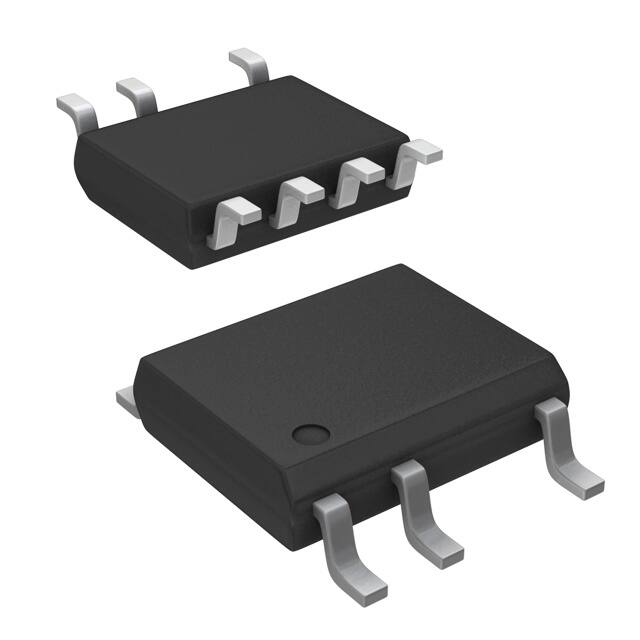
LNK454/456-458/460
LinkSwitch-PL Family
™
LED Driver IC with TRIAC Dimming, Single-Stage PFC and
Constant Current Control for Non-Isolated Applications
Product Highlights
Dramatically Simplifies Off-line LED Drivers
• Flicker-free phase-controlled TRIAC dimming
• Single-stage power factor correction and accurate constant
current (CC) output
• Very low component count with small non-electrolytic bulk
capacitor for compact replacement lamp designs
• Compact SO8, eSOP, and eDIP packages
• Completely eliminates control loop compensation
AC
IN
D
BP
Advanced Performance Features
• Optimized for non-isolated flyback designs
• Frequency jitter greatly reduces EMI filter size and costs
• Low dissipation direct sensing of LED current
Advanced Protection and Safety Features
• Cycle skipping regulation for abnormally low output power to
clamp peak output current delivered
• 725 V integrated power MOSFET allows small bulk capacitance
and maximizes power capability
• Short-circuit, overload, open feedback and output overvoltage
protection
• Hysteretic thermal shutdown
• Meets high-voltage creepage between DRAIN and all other pins
both on PCB and at package
EcoSmart™ - Energy Efficient
• High power factor optimizes system lumen per input VA
• Control algorithm balances switching and conduction losses
over line and load to maintain optimum efficiency
Description
The LinkSwitch-PL family enables a very small and low cost
single-stage power factor corrected constant current driver for
solid state lighting. Optimized for direct LED current sensing, the
LinkSwitch-PL operates over a wide input voltage range delivering
an output power of up to 16 W. The LinkSwitch-PL control
algorithm provides flicker-free TRIAC dimming with minimal
external components.
Each device incorporates a 725 V rated power MOSFET, a novel
discontinuous mode variable frequency variable on-time controller,
frequency jitter, cycle-by-cycle current limit and hysteretic thermal
shutdown in a monolithic 4-pin IC, available in SO-8C, eSOP-12,
and eDIP-12 packages.
FB
S
PI-5835-060710
Figure 1.
Basic Application Schematic.
Output Power Table
Product 2
LNK454D
LNK456D
LNK457D/K/V
LNK458K/V
LNK460K/V
85-265 VAC
Minimum Output
Maximum Output
Power
Power1
1.5 W
3W
3W
6W
4W
8W
6W
11.5 W
8W
16 W
Table 1. Output Power Table.
Notes:
1. Maximum practical continuous power in an open frame design with adequate
heat sinking, measured at +50 °C ambient (see Key Applications Considerations
for more information).
2. Packages: D: SO-8C, K: eSOP-12, V: eDIP-12.
Output Current
Number of
Serial LEDs
1
2
3
4
5
6
7
8
9
10
11
12
Figure 2.
www.powerint.com
LinkSwitch-PL
CONTROL
350 mA
500 mA
700 mA
1000 mA
LNK454
LNK454
LNK456
LNK456
LNK457
LNK457
LNK458
LNK458
LNK458
LNK460
LNK460
LNK460
LNK454
LNK456
LNK456
LNK457
LNK458
LNK458
LNK460
LNK460
LNK460
LNK454
LNK456
LNK457
LNK458
LNK460
LNK460
LNK456
LNK457
LNK458
LNK460
Device Selection Based on Length of Output LED Series String and
Current. A Typical Voltage Drop of 3.5 V per LED is Assumed.
October 2011
�LNK454/456-458/460
DRAIN (D)
REGULATOR
5.85 V
BYPASS (BP)
UV
4.9 V
ILIM
ILIM
+
V_ILIM
SOA
VFB(SK)
VFB(LO)
+
Q
SET
S
Q
CLR
R
CURRENT LIMIT
SOA
STATE MACHINE
UV
+
IFB
VREF DAC
PHASE
MEASUREMENT
FILTER
DIGITAL
INTEGRATOR
Zero Crossing
+
V_ZLIM
1 µA
FEEDBACK (FB)
+
Update
CLK
AUTO-RESTART
INC/DEC
FREQUENCY/
DUTY CYCLE
CONTROLLER
S
SET
Q
R
CLR
Q
ON-TIME
EXTENSION
SOURCE (S)
PI-5893-091010
Figure 2. Functional Block Diagram.
Pin Functional Description
DRAIN (D) Pin:
High-voltage power MOSFET drain connection. The internal
start-up bias current is drawn from this pin through a switched
high-voltage current source. Drain current sensing and
associated controller functions are also performed using this pin.
SOURCE (S) Pin:
Power MOSFET source connection. Ground reference for
BYPASS and FEEDBACK pins.
BYPASS (BP) Pin:
Connection point for the external bypass capacitor for the
internally generated 5.85 V supply.
FEEDBACK (FB) Pin:
LED current sensing pin. During normal operation the 290 mV
threshold determines the average value of the current flowing
through the load sense resistor.
A second threshold clamps excessive output current ripple.
A third higher threshold is used to protect against output
short-circuit and overvoltage conditions (see Figure 5).
D Package (SO-8C)
FB
BP
1
8
2
7
6
D
4
5
S
S
Exposed Pad (On Bottom)
Internally Connected to
SOURCE Pin
K Package
(eSOP-12)
S
S
NC 1
12 S
FB 2
11 S
BP 3
10 S
NC 4
9S
8S
Exposed Pad Internally
Connected to SOURCE Pin
D6
7S
V Package (eDIP-12)
S 12
1 NC
S 11
2 FB
S 10
3 BP
S 9
4 NC
S 8
S 7
6 D
PI-5836a-061311
Figure 3. Pin Configuration (Top View).
2
Rev. C 10/11
www.powerint.com
�LNK454/456-458/460
AC
IN
D
DES
DZOV
RES
ROV
LinkSwitch-PL
CONTROL
BP
S
FB
CF
RSENSE
RF
PI-5837-060710
Figure 4. Typical Application Schematic.
Functional Description
The LinkSwitch-PL combines a high-voltage power MOSFET
switch with a power supply controller in one device. The IC
provides a single-stage power factor correction plus LED
current control. The LinkSwitch-PL controller consists of an
oscillator, feedback (sense and logic) circuit, 5.85 V regulator,
hysteretic over-temperature protection, frequency jittering,
cycle-by-cycle current limit, loop compensation circuitry, autorestart, switching on-time extension, power factor and constant
current control.
Auto-restart protection is triggered by a FEEDBACK pin voltage
in excess of 2 V. This feature can be used to provide output
overvoltage protection (via DZOV and ROV, in Figure 4), which
triggers the IC to enter auto-restart.
Auto-Restart
In a direct LED current sensing configuration, the average
FEEDBACK pin voltage is a replica of the LED current, scaled
by the sense resistor (RSENSE in Figure 4). A small low-pass filter
(RF and CF in Figure 4) reduces high frequency noise at the
FEEDBACK pin.
Figure 5 illustrates the operating regions of the FEEDBACK pin
voltage. The LinkSwitch-PL sets its operating point such that
the average FEEDBACK pin voltage in steady-state operation is
290 mV. This threshold is set low to minimize the sensing
resistor dissipation. The internal MOSFET switching frequency
and on-time are updated once every input AC half-cycle to
regulate the output current and maintain high power factor.
If the FEEDBACK pin peak voltage exceeds 550 mV, cycle
skipping mode is triggered and the power processed by the
integrated power MOSFET is clamped on a cycle-by-cycle
basis. Switching frequency may vary during an input voltage
half-cycle to reduce thermal stress on the output LEDs.
2V
Cycle Skipping
Mode
550 mV
Normal Operation
290 mV
PI-5838-060111
Figure 5. FEEDBACK Pin Operational Voltage Thresholds.
3
www.powerint.com
Rev. C 10/11
�LNK454/456-458/460
VFB
ϕOS
ϕOL
ϕOL
VFB(ϕ)
ϕOS
VFB(ϕ)
Phase
Angle
0°
Phase
Angle
0°
180°
180°
VLINE
VTRIAC
ϕ
0°
ϕ
Phase
Angle
Phase
Angle
Conduction
Angle
Leading Edge
TRIAC Dimmers
0°
Conduction
Angle
Trailing Edge
Dimmers
Phase
Angle
Phase
Angle
PI-5894a-091010
Figure 6. Feedback Voltage vs. Phase Angle Dimming Characteristics.
TRIAC (Phase-Controlled) Dimming
The LinkSwitch-PL integrates several features to improve
dimming range and reduce external circuit complexity when
using a phase-controlled TRIAC dimmer. The output LED
current is controlled by the FEEDBACK pin voltage which
changes proportionally to the TRIAC dimmer conduction angle.
When the conduction angle decreases, the voltage at the
FEEDBACK pin decreases causing the average LED current to
decrease.
The FEEDBACK pin reference voltage adjustment is initiated at
approximately 25% of the AC line half-cycle duration. When this
(jOS) threshold is exceeded, VFB and the output LED current
are reduced until a second phase angle threshold is reached.
At this point, with the TRIAC conduction angle being very
limited, the IC runs open loop at constant frequency and duty
cycle (jOL region) and the integrated power MOSFET processes
as much power as the heavily chopped input voltage will allow
creating a light output that is deeply dimmed.
The 520 mV clamping feedback threshold is also linearly reduced
during dimming to control LED current ripple.
4
Rev. C 10/11
www.powerint.com
�LNK454/456-458/460
IC Supply and BYPASS Pin
The internal 5.85 V regulator charges the bypass capacitor
connected to the BYPASS pin to 5.85 V by drawing current
from the voltage on the DRAIN pin whenever the power MOSFET
is off. The BYPASS pin is the internal supply voltage node.
When the power MOSFET is on, the device operates from the
energy stored in the bypass capacitor. Extremely low power
consumption of the internal circuitry allows LinkSwitch-PL to
operate continuously from current it takes from the DRAIN pin.
A bypass capacitor value of 1 µF is sufficient for both high
frequency decoupling and energy storage. Dimming
applications may require a higher bypass capacitor value.
Overload Protection
In case of overload, the system will increase the operating
frequency and on-time each AC half-cycle until the maximum
frequency and maximum on-time are reached. When this state
is reached, the controller enters auto-restart protection, thus
inhibiting the gate of the power MOSFET for approximately
1.28 s if the main line frequency is 50 Hz, 1.02 s if it is 60 Hz.
After this auto-restart off-time expires, the power MOSFET is
re-enabled and a normal start-up is initiated, i.e. at fMIN and
tON(MIN), stepping up until regulation is achieved again. In case of
a persistent overload condition, the auto-restart duty cycle DCAR
is ~33%.
During phase angle dimming when the conduction angle is
small the AC input voltage is present for only short periods of
time. In that case the IC should not rely on the integrated
high-voltage current source, but instead external bias circuitry
should be used to supply the IC from the output (DES and RES in
Figure 4). If the output voltage is less than 7 V, external bias
circuitry should be implemented. This is accomplished by
adding an auxiliary winding on the transformer, which is then
rectified and filtered via a diode (ultrafast) and capacitor. The
winding voltage (turns) should be selected such that the maximum
IC consumption can be supported at the lowest operating
output current.
Overload protection is inhibited during phase dimming when the
TRIAC conduction duty cycle is less than 60%.
Start-up, Switching Frequency and On-time Range
At start-up the controller uses an initial switching frequency fMIN
and minimum on-time tON(MIN). The charging of the output
capacitor together with the energy delivery to the output LEDs
determines a step-by-step increase of the power MOSFET
switching frequency and on-time updated every half-cycle of the
AC input voltage.
The steady-state switching frequency and on-time are
determined by the line voltage, voltage drop across the LEDs
and converter efficiency.
At light load when the device reaches the minimum frequency
fMIN and on-time tON(MIN), the controller regulates by skipping
cycles. In this mode of operation the input current is not power
factor corrected and the average output current is not guaranteed
to fall within the normal range. A properly designed supply will
not operate in this mode under normal load conditions.
A power supply designed correctly will operate within the
switching frequency range [fMIN … fMAX ], with an on-time falling
between tON(MIN) and tON(MAX) when connected to a normal load.
Output Overvoltage Protection
If a no-load condition is present on the output of the supply, the
output overvoltage Zener (DZOV in Figure 4) will conduct once its
threshold is reached. A voltage VOV in excess of VFB(AR) = 2 V will
appear across the FEEDBACK pin and the IC will enter autorestart.
Output Short-Circuit
If the output of the supply (i.e. the LED load) is short-circuited,
then a large amount of energy will be delivered to the sense
resistor, generating a high-voltage at the FEEDBACK pin. If this
condition develops more than 2 V on the FEEDBACK pin, then
the IC will interpret this event as an output short-circuit and will
enter auto-restart.
Safe Operating Area (SOA) Protection
If 3 consecutive cycles of the power MOSFET are prematurely
terminated due to the power MOSFET current exceeding the
current limit after the leading edge blanking time, SOA protection
mode is triggered and the IC will enter auto-restart.
Hysteretic Thermal Shutdown
The thermal shutdown circuitry senses the die junction
temperature. The thermal shutdown threshold is set to 142 °C
typical with a 75 °C hysteresis. When the die temperature rises
above this threshold (142 °C) the power MOSFET is disabled
and remains disabled until the die temperature falls by 75 °C, at
which point the power MOSFET is re-enabled.
5
www.powerint.com
Rev. C 10/11
�LNK454/456-458/460
LinkSwitch-PL Application Example
The circuit shown in Figure 7 provides a single constant current
output of 350 mA with an LED string voltage of 15 V. The
output current can be reduced using a standard AC mains
TRIAC dimmer down to 1% (3 mA) without instability and
flickering of the LED load. The board is compatible with both
low cost leading edge and more sophisticated trailing edge
dimmers.
The board was optimized to operate over the universal AC input
voltage range (85 VAC to 265 VAC, 47 Hz to 63 Hz) but suffers
no damage over an input range of 0 VAC to 300 VAC. This
increases field reliability and lifetime during line sags and swells.
LinkSwitch-PL based designs provide high power factor (>0.9
at 115 VAC / 230 VAC) and low THD ( VFB(SK), TJ = 25 °C
DRAIN Supply Voltage
Auto-Restart OFF-Time
tAR(OFF)
Auto-Restart Duty Cycle
DCAR
50
W
mA
725
V
50
V
fMAIN = 50 Hz
1.28
fMAIN = 60 Hz
1.02
33
s
%
13
www.powerint.com
Rev. C 10/11
�LNK454/456-458/460
Typical Performance Characteristics
100
10
PI-6006-060210
1.2
1
DRAIN Current (A)
Scaling Factors:
LNK454
0.3
LNK456
0.6
LNK457
1.0
LNK458
1.55
LNK460
3.1
PI-6005-060210
DRAIN Capacitance (pF)
1000
0.8
Scaling Factors:
LNK454
0.3
LNK456
0.6
LNK457
1.0
LNK458
1.55
LNK460
3.1
0.6
0.4
0.2
0
0
100
200
300
400
500
LNK457 TCASE = 25 °C
LNK457 TCASE = 100 °C
0
600
0
25
50
75 100 125 150
Junction Temperature (°C)
Figure 9. Breakdown vs. Temperature.
8 10 12 14 16 18 20
PI-6209-102910
1.2
Current Limit
(Normalized to 25 °C)
PI-2213-012301
Breakdown Voltage
(Normalized to 25 °C)
0.9
0
6
Figure 8. Drain Current vs. Drain Voltage.
1.0
-50 -25
4
DRAIN Voltage (V)
DRAIN Voltage (V)
Figure 7. Drain Capacitance vs. Drain Voltage.
1.1
2
1
0.8
0.6
0.4
0.2
0
-50
0
50
100
150
Temperature (°C)
Figure 10. Standard Current Limit vs. Temperature.
14
Rev. C 10/11
www.powerint.com
�LNK454/456-458/460
SO-8C (D Package)
4
B
0.10 (0.004) C A-B 2X
2
DETAIL A
4.90 (0.193) BSC
A
4
8
D
5
2 3.90 (0.154) BSC
GAUGE
PLANE
SEATING
PLANE
6.00 (0.236) BSC
0-8
C
1.04 (0.041) REF
2X
0.10 (0.004) C D
Pin 1 ID
1
4
1.35 (0.053)
1.75 (0.069)
0.25 (0.010)
BSC
0.40 (0.016)
1.27 (0.050)
0.20 (0.008) C
2X
7X 0.31 - 0.51 (0.012 - 0.020)
0.25 (0.010) M C A-B D
1.27 (0.050) BSC
o
1.25 - 1.65
(0.049 - 0.065)
DETAIL A
0.10 (0.004)
0.25 (0.010)
7X
0.10 (0.004) C
H
SEATING PLANE
C
Reference
Solder Pad
Dimensions
+
Notes:
1. JEDEC reference: MS-012.
2.00 (0.079)
+
D07C
0.17 (0.007)
0.25 (0.010)
1.27 (0.050)
4.90 (0.193)
+
+
0.60 (0.024)
2. Package outline exclusive of mold flash and metal burr.
3. Package outline inclusive of plating thickness.
4. Datums A and B to be determined at datum plane H.
5. Controlling dimensions are in millimeters. Inch dimensions
are shown in parenthesis. Angles in degrees.
PI-4526-040110
15
www.powerint.com
Rev. C 10/11
�LNK454/456-458/460
eSOP-12B (K Package)
0.004 [0.10] C A 2X
2
0.400 [10.16]
Pin #1 I.D.
(Laser Marked)
2X
7
0.004 [0.10] C B
0.059 [1.50]
Ref, Typ
0.460 [11.68]
0.059 [1.50]
Ref, Typ
0.008 [0.20] C 1
2X, 5/6 Lead Tips
2
3
4
6
0.325 [8.26]
Max. 7
0.010 [0.25]
H
12
Gauge Plane
2
4
Seating Plane
0°- 8°
0.225 [5.72]
Max. 7
0.034 [0.85]
0.026 [0.65]
6
1
0.120 [3.05] Ref
BOTTOM VIEW
0.020 [0.51]
Ref.
0.092 [2.34]
0.086 [2.18]
0.032 [0.80]
0.029 [0.72]
0.006 [0.15]
0.000 [0.00]
Seating plane to
package bottom
standoff
0.004 [0.10] C
C
Seating
Plane
Detail A
0.217 [5.51]
3
0.019 [0.48]
Ref.
0.022 [0.56]
Ref.
0.016 [0.41]
0.011 [0.28]
11×
0.306 [7.77]
Ref.
END VIEW
SIDE VIEW
0.067 [1.70]
0.049 [1.23]
0.046 [1.16]
0.028 [0.71]
Ref.
0.070 [1.78]
TOP VIEW
0.098 [2.49]
0.086 [2.18]
C
DETAIL A (Scale = 9X)
B
3
0.055 [1.40] Ref.
0.350 [8.89]
0.023 [0.58]
11×
0.018 [0.46]
0.010 (0.25) M C A B
0.010 [0.25]
Ref.
0.356 [9.04]
Ref.
Land Pattern
Dimensions
1
12
2
11
3
10
4
9
0.028 [0.71]
0.321 [8.15]
Notes:
1. Dimensioning and tolerancing per ASME Y14.5M-1994.
2. Dimensions noted are determined at the outermost
extremes of the plastic body exclusive of mold flash,
tie bar burrs, gate burrs, and interlead flash, but
including any mismatch between the top and bottom of
the plastic body. Maximum mold protrusion is 0.007
[0.18] per side.
3. Dimensions noted are inclusive of plating thickness.
4. Does not include interlead flash or protrusions.
5. Controlling dimensions in inches [mm].
6
0.429 [10.90]
8
6. Datums A and B to be determined at Datum H.
7
7. Exposed pad is nominally located at the centerline of
Datums A and B. “Max” dimensions noted include both
size and positional tolerances.
PI-5748a-100311
16
Rev. C 10/11
www.powerint.com
�LNK454/456-458/460
eDIP-12B (V Package)
0.004 [0.10] C A
Seating Plane
0.325 [8.26]
Max.
Pin #1 I.D.
(Laser Marked)
10
2X
0.004 [0.10] C B
1
2 3 4
0.010 [0.25] Ref.
0.120 [3.05]
Ref.
6
0.412 [10.46]
Ref.
0.306 [7.77]
Ref.
10
2
0.225 [5.72]
Max.
0.350 [8.89]
B
2
C
12 11 10 9 8
6
TOP VIEW
0.104 [2.65] Ref.
5 °± 4°
0.059 [1.50]
Ref, typ.
12
3 4
0.023 [0.58]
11×
0.018 [0.46]
BOTTOM VIEW
0.092 [2.34]
0.086 [2.18]
0.049 [1.23]
0.046 [1.16]
0.022 [0.56]
Ref.
0.020 [0.51]
Ref.
0.070 [1.78]
SIDE VIEW
0.07 [1.78]
8
0.192 [4.87]
Ref.
H
0.031 [0.80]
0.028 [0.72]
0.059 [1.50]
Ref, typ.
0.010 [0.25] M C A B
END VIEW
0.019 [0.48]
Ref.
1
0.436 [11.08]
0.406 [10.32]
7
Detail A
A
7
0.400 [10.16]
7
0.356 [9.04]
Ref.
0.400 [10.16]
0.016 [0.41]
11×
0.011 [0.28]
0.03 [0.76]
0.028 [0.71]
Ref.
DETAIL A (Scale = 9X)
Mounting
Hole Pattern
Dimensions
0.400 [10.16]
Drill Hole
0.03 [0.76]
Round Pad 0.05 [1.27]
Solder Mask 0.056 [1.42]
Notes:
1. Dimensioning and tolerancing per
ASME Y14.5M-1994.
2. Dimensions noted are determined at the outermost extremes of the plastic body exclusive of
mold flash, tie bar burrs, gate burrs, and interlead
flash, but including any mismatch between the
top and bottom of the plastic body. Maximum
mold protrusion is 0.007 [0.18] per side.
3. Dimensions noted are inclusive of plating
thickness.
4. Does not include inter-lead flash or protrusions.
5. Controlling dimensions in inches [mm].
6. Datums A and B to be determined at Datum H.
7. Measured with the leads constrained to be
perpendicular to Datum C.
8. Measured with the leads unconstrained.
9. Lead numbering per JEDEC SPP-012.
10. Exposed pad is nominally located at the centerline of Datums A and B. “Max” dimensions
noted include both size and positional tolerances.
PI-5556a-100311
17
www.powerint.com
Rev. C 10/11
�LNK454/456-458/460
Part Ordering Information
• LinkSwitch Product Family
• PL Series Number
• Package Identifier
D
SO-8C
K
eSOP-12
V
eDIP-12
• Package Material
G
GREEN: Halogen Free and RoHS Compliant
• Tape & Reel and Other Options
Blank
LNK 454
D G - TL
TL
Standard Configurations
Tape & Reel, 2.5 k pcs minimum for D package, 1 k pcs minimum for K package.
18
Rev. C 10/11
www.powerint.com
�LNK454/456-458/460
19
www.powerint.com
Rev. C 10/11
�Revision
Notes
Date
A
Initial Release.
B
Revised K and V Package Drawings.
11/01/10
06/11
C
Added eDIP-12B and eSOP-12B packages. Removed eDIP-12 and eSOP-12 packages.
10/11
For the latest updates, visit our website: www.powerint.com
Power Integrations reserves the right to make changes to its products at any time to improve reliability or manufacturability. Power
Integrations does not assume any liability arising from the use of any device or circuit described herein. POWER INTEGRATIONS MAKES
NO WARRANTY HEREIN AND SPECIFICALLY DISCLAIMS ALL WARRANTIES INCLUDING, WITHOUT LIMITATION, THE IMPLIED
WARRANTIES OF MERCHANTABILITY, FITNESS FOR A PARTICULAR PURPOSE, AND NON-INFRINGEMENT OF THIRD PARTY RIGHTS.
Patent Information
The products and applications illustrated herein (including transformer construction and circuits external to the products) may be covered
by one or more U.S. and foreign patents, or potentially by pending U.S. and foreign patent applications assigned to Power Integrations. A
complete list of Power Integrations patents may be found at www.powerint.com. Power Integrations grants its customers a license under
certain patent rights as set forth at http://www.powerint.com/ip.htm.
Life Support Policy
POWER INTEGRATIONS PRODUCTS ARE NOT AUTHORIZED FOR USE AS CRITICAL COMPONENTS IN LIFE SUPPORT DEVICES OR
SYSTEMS WITHOUT THE EXPRESS WRITTEN APPROVAL OF THE PRESIDENT OF POWER INTEGRATIONS. As used herein:
1. A Life support device or system is one which, (i) is intended for surgical implant into the body, or (ii) supports or sustains life, and (iii)
whose failure to perform, when properly used in accordance with instructions for use, can be reasonably expected to result in significant
injury or death to the user.
2. A critical component is any component of a life support device or system whose failure to perform can be reasonably expected to cause
the failure of the life support device or system, or to affect its safety or effectiveness.
The PI logo, TOPSwitch, TinySwitch, LinkSwitch, DPA-Switch, PeakSwitch, CAPZero, SENZero, LinkZero, HiperPFS, HiperTFS, HiperLCS,
Qspeed, EcoSmart, Clampless, E-Shield, Filterfuse, StakFET, PI Expert and PI FACTS are trademarks of Power Integrations, Inc. Other
trademarks are property of their respective companies. ©2011, Power Integrations, Inc.
Power Integrations Worldwide Sales Support Locations
World Headquarters
5245 Hellyer Avenue
San Jose, CA 95138, USA.
Main: +1-408-414-9200
Customer Service:
Phone: +1-408-414-9665
Fax: +1-408-414-9765
e-mail: usasales@powerint.com
China (Shanghai)
Rm 1601/1610, Tower 1,
Kerry Everbright City
No. 218 Tianmu Road West,
Shanghai, P.R.C. 200070
Phone: +86-21-6354-6323
Fax: +86-21-6354-6325
e-mail: chinasales@powerint.com
China (ShenZhen)
3rd Floor, Block A,
Zhongtou International Business
Center, No. 1061, Xiang Mei Rd,
FuTian District, ShenZhen,
China, 518040
Phone: +86-755-8379-3243
Fax: +86-755-8379-5828
e-mail: chinasales@powerint.com
Germany
Rueckertstrasse 3
D-80336, Munich
Germany
Phone: +49-89-5527-3910
Fax: +49-89-5527-3920
e-mail: eurosales@powerint.com
India
#1, 14th Main Road
Vasanthanagar
Bangalore-560052 India
Phone: +91-80-4113-8020
Fax: +91-80-4113-8023
e-mail: indiasales@powerint.com
Italy
Via De Amicis 2
20091 Bresso MI
Italy
Phone: +39-028-928-6000
Fax: +39-028-928-6009
e-mail: eurosales@powerint.com
Japan
Kosei Dai-3 Bldg.
2-12-11, Shin-Yokomana,
Kohoku-ku
Yokohama-shi Kanagwan
222-0033 Japan
Phone: +81-45-471-1021
Fax: +81-45-471-3717
e-mail: japansales@powerint.com
Korea
RM 602, 6FL
Korea City Air Terminal B/D, 159-6
Samsung-Dong, Kangnam-Gu,
Seoul, 135-728, Korea
Phone: +82-2-2016-6610
Fax: +82-2-2016-6630
e-mail: koreasales@powerint.com
Taiwan
5F, No. 318, Nei Hu Rd., Sec. 1
Nei Hu Dist.
Taipei, Taiwan 114, R.O.C.
Phone: +886-2-2659-4570
Fax: +886-2-2659-4550
e-mail: taiwansales@powerint.com
Europe HQ
1st Floor, St. James’s House
East Street, Farnham
Surrey GU9 7TJ
United Kingdom
Phone: +44 (0) 1252-730-141
Fax: +44 (0) 1252-727-689
e-mail: eurosales@powerint.com
Applications Hotline
World Wide +1-408-414-9660
Singapore
51 Newton Road
Applications Fax
#15-08/10 Goldhill Plaza
World Wide +1-408-414-9760
Singapore, 308900
Phone: +65-6358-2160
Fax: +65-6358-2015
e-mail: singaporesales@powerint.com
�