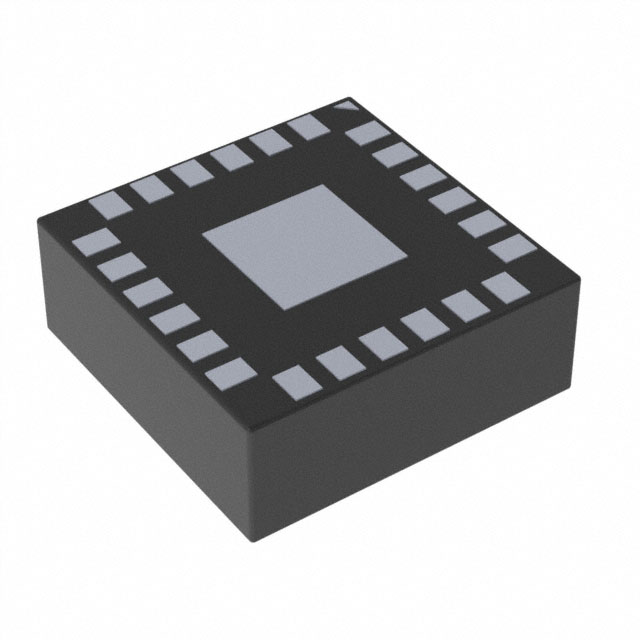
Programmable Clock Generator
5P49V5933
DATASHEET
Description
Features
The 5P49V5933 is a programmable clock generator intended
for high-performance consumer, networking, industrial,
computing, and data-communications applications.
Configurations may be stored in on-chip One-Time
Programmable (OTP) memory or changed using I2C
interface. This is IDT’s fifth generation of programmable clock
technology (VersaClock® 5).
• Generates up to two independent output frequencies
• High-performance, low-phase noise PLL, < 0.7ps RMS
5P49V5933 by default uses an integrated 25MHz crystal as
input reference. It also has a redundant external clock input.
A glitchless manual switchover functions allows selection of
either one as mentioned above as input reference during
normal operation
• Two fractional output dividers (FODs)
• Independent spread spectrum capability on each output
Two select pins allow up to 4 different configurations to be
programmed and accessible using processor GPIOs or
bootstrapping. The different selections may be used for
different operating modes (full function, partial function, partial
power-down), regional standards (US, Japan, Europe) or
system production margin testing.
• I2C serial programming interface
• One reference LVCMOS output clock
• Two universal output pairs:
typical phase jitter on outputs:
– PCIe Gen1–3 compliant clock capability
– USB 3.0 compliant clock capability
– 1GbE and 10GbE
pair
• Two banks of internal non-volatile in-system programmable
or factory programmable OTP memory
The device may be configured to use one of two I2C
addresses to allow multiple devices to be used in a system.
•
– Single-ended I/Os: 1.8V to 3.3V LVCMOS
– Differential I/Os: LVPECL, LVDS and HCSL
•
OUT1B
VDDO1
OUT1
VDDD
• Input frequency ranges:
VDDO0
OUT0_SEL_I2CB
Pin Assignment
1
24 23 22 21 20 19
18
2
17
NC
16
NC
NC
4
15
VDDA
VDDA
5
14
NC
CLKSEL
6
13
10 11 12
NC
OUT2
9
SEL1/SDA
SEL0/SCL
SD/OE
8
VDDO2
EPAD
• Individually selectable output voltage (1.8V, 2.5V, 3.3V) for
VDDA
each output pair
•
•
•
•
•
•
•
•
•
OUT2B
3
4 × 4 mm 24-LGA
5P49V5933 NOVEMBER 1, 2017
– LVDS, LVPECL, HCSL differential clock input (CLKIN,
CLKINB) – 1MHz to 350MHz
Output frequency ranges:
– LVCMOS clock outputs: 1MHz to 200MHz
– LVDS, LVPECL, HCSL differential clock outputs: 1MHz
to 350MHz
CLKIN
CLKINB
NC
7
– Each configurable as one differential output pair or two
LVCMOS outputs
I/O Standards:
1
Redundant clock inputs with manual switchover
Programmable loop bandwidth
Programmable output to output skew
Programmable slew rate control
Individual output enable/disable
Power-down mode
1.8V, 2.5V or 3.3V core VDDD, VDDA
4 x 4 mm 24-LGA package
-40° to +85°C industrial temperature operation
©2017 Integrated Device Technology, Inc.
�5P49V5933 DATASHEET
Functional Block Diagram
VDDO0
OSC
OUT0_SEL_I2CB
25MHz
VDDO1
OUT1
CLKIN
FOD1
OUT1B
CLKINB
PLL
VDDO2
CLKSEL
OUT2
FOD2
OUT2B
SD/OE
SEL1/SDA
SEL0/SCL
OTP
and
Control Logic
VDDA
VDDD
Typical Applications
•
•
•
•
•
•
•
•
•
•
Ethernet switch/router
PCI Express 1.0/2.0/3.0
Broadcast video/audio timing
Multi-function printer
Processor and FPGA clocking
Any-frequency clock conversion
MSAN/DSLAM/PON
Fiber Channel, SAN
Telecom line cards
1GbE and 10GbE
PROGRAMMABLE CLOCK GENERATOR
2
NOVEMBER 1, 2017
�5P49V5933 DATASHEET
Table 1: Pin Descriptions
Number
1
2
3
4
Name
CLKIN
CLKINB
NC
NC
Input
Input
---
5
VDDA
Power
6
CLKSEL
Input
Pull-down
7
SD/OE
Input
Pull-down
8
SEL1/SDA
Input
Pull-down
9
SEL0/SCL
Input
Pull-down
10
VDDO2
Power
11
OUT2
Output
12
OUT2B
Output
13
14
NC
NC
---
15
VDDA
Power
16
17
NC
NC
---
18
VDDA
Power
19
OUT1B
Output
20
OUT1
Output
21
VDDO1
Power
22
VDDD
Power
23
VDDO0
Power
24
Type
Pull-down
Pull-down
OUT0_SELB_I2C Input/Output
EPAD
NOVEMBER 1, 2017
VEE
Power
Pull-down
Description
Differential clock input. Weak 100kohms internal pull-down.
Complementary differential clock input. Weak 100kohms internal pull-down.
No connect.
No connect.
Analog functions power supply pin. Connect to 1.8V to 3.3V. VDDA and VDDD
should have the same voltage applied.
Input clock select. Selects the active input reference source, when in Manual
switchover mode.
0 = Integrated Crystal (default)
1 = CLKIN, CLKINB
CLKSEL Polarity can be changed by I2C programming as shown in Table 4.
Enables/disables the outputs (OE) or powers down the chip (SD). The SH bit
controls the configuration of the SD/OE pin. The SH bit needs to be high for
SD/OE pin to be configured as SD. The SP bit (0x02) controls the polarity of the
signal to be either active HIGH or LOW only when pin is configured as OE
(Default is active LOW.) Weak internal pull down resistor. When configured as
SD, device is shut down, differential outputs are driven high/low, and the singleended LVCMOS outputs are driven low. When configured as OE, and outputs are
disabled, the outputs can be selected to be tri-stated or driven high/low,
depending on the programming bits as shown in the SD/OE Pin Function Truth
table.
Configuration select pin, or I2C SDA input as selected by OUT0_SEL_I2CB.
Weak internal pull down resistor.
Configuration select pin, or I2C SCL input as selected by OUT0_SEL_I2CB.
Weak internal pull down resistor.
Output power supply. Connect to 1.8 to 3.3V. Sets output voltage levels for
OUT2/OUT2B.
Output Clock 2. Please refer to the Output Drivers section for more details.
Complementary Output Clock 2. Please refer to the Output Drivers section for
more details.
No connect.
No connect.
Analog functions power supply pin. Connect to 1.8V to 3.3V. VDDA and VDDD
should have the same voltage applied.
No connect.
No connect.
Analog functions power supply pin. Connect to 1.8V to 3.3V. VDDA and VDDD
should have the same voltage applied.
Complementary Output Clock 1. Please refer to the Output Drivers section for
more details.
Output Clock 1. Please refer to the Output Drivers section for more details.
Output power supply. Connect to 1.8 to 3.3V. Sets output voltage levels for
OUT1/OUT1B.
Digital functions power supply pin. Connect to 1.8 to 3.3V. VDDA and VDDB
should have the same voltage applied.
Power supply pin for OUT0_SEL_I2CB. Connect to 1.8 to 3.3V. Sets output
voltage levels for OUT0.
Latched input/LVCMOS Output. At power up, the voltage at the pin
OUT0_SEL_I2CB is latched by the part and used to select the state of pins 8
and 9. If a weak pull up (10Kohms) is placed on OUT0_SEL_I2CB, pins 8 and 9
will be configured as hardware select pins, SEL1 and SEL0. If a weak pull down
(10Kohms) is placed on OUT0_SEL_I2CB or it is left floating, pins 8 and 9 will
act as the SDA and SCL pins of an I2C interface. After power up, the pin acts as
a LVCMOS reference output which is the same frequency as the input reference.
At default, 25MHz integrated crystal is used so OUT0 will also be 25MHz.
Connect to ground pad.
3
PROGRAMMABLE CLOCK GENERATOR
�5P49V5933 DATASHEET
If OUT0_SEL_I2CB was 0 at POR, alternate configurations
can only be loaded via the I2C interface.
PLL Features and Descriptions
Spread Spectrum
Table 4: Input Clock Select
To help reduce electromagnetic interference (EMI), the
5P49V5933 supports spread spectrum modulation. The
output clock frequencies can be modulated to spread energy
across a broader range of frequencies, lowering system EMI.
The 5P49V5933 implements spread spectrum using the
Fractional-N output divide, to achieve controllable modulation
rate and spreading magnitude. The spread spectrum can be
applied to any output clock, any clock frequency, and any
spread amount from ±0.25% to ±2.5% center spread and
-0.5% to -5% down spread.
Input clock select. Selects the active input reference source in
manual switchover mode.
0 = Integrated XTAL (default)
1 = CLKIN, CLKINB
CLKSEL Polarity can be changed by I2C programming as
shown in the table below.
Table 2: Loop Filter
PLL loop bandwidth range depends on the input reference
frequency (Fref) and can be set between the loop bandwidth
range as shown in the table below.
40
126
350
300
1000
Source
0
0
Integrated XTAL
0
1
CLKIN, CLKINB
1
0
CLKIN, CLKINB
1
1
Integrated XTAL
Reference Clock Input Pins and
Selection
The 5P49V5933 by default uses an integrated 25MHz crystal
as input reference. It also has a redundant external clock
input. A glitchless manual switchover functions allows
selection of either one as mentioned above as input reference
during normal operation.
Table 3: Configuration Table
This table shows the SEL1, SEL0 settings to select the
configuration stored in OTP. Four configurations can be stored
in OTP. These can be factory programmed or user
programmed.
REG0:7 Config
OUT0_SEL_I2CB SEL1 SEL0
I 2C
Access
at POR
1
0
0
No
0
0
1
0
1
No
0
1
1
1
0
No
0
2
1
1
1
No
0
3
0
X
X
Yes
1
I2C
defaults
0
X
X
Yes
0
0
Either clock input can be set as the primary clock. The primary
clock designation is to establish which is the main reference
clock to the PLL. The non-primary clock is designated as the
secondary clock in case the primary clock goes absent and a
backup is needed. The PRIMSRC bit determines which clock
input will be selected as primary clock. When PRIMSRC bit is
“0”, integrated crystal is selected as the primary clock, and
when “1”, (CLKIN, CLKINB) as the primary clock.
The two reference inputs can be manually selected using the
CLKSEL pin. The SM bits must be set to “0x” for manual
switchover which is detailed in Manual Switchover Mode
section.
Manual Switchover Mode
At power-up time, the SEL0 and SEL1 pins must be tied to
either the VDDD/VDDA power supply so that they ramp with
that supply or are tied low (this is the same as floating the
pins). This will cause the register configuration to be loaded
that is selected according to Table 3 above. Providing that
OUT0_SEL_I2CB was 1 at POR and OTP register 0:7 = 0,
after the first 10ms of operation the levels of the SELx pins can
be changed, either to low or to the same level as
VDDD/VDDA. The SELx pins must be driven with a digital
signal of < 300ns Rise/Fall time and only a single pin can be
changed at a time. After a pin level change, the device must
not be interrupted for at least 1ms so that the new values have
time to load and take effect.
PROGRAMMABLE CLOCK GENERATOR
CLKSEL
PRIMSRC is bit 1 of Register 0x13.
Input Reference
Loop
Loop
Frequency–Fref Bandwidth Min Bandwidth Max
(MHz)
(kHz)
(kHz)
1
PRIMSRC
When SM[1:0] is “0x”, the redundant inputs are in manual
switchover mode. In this mode, CLKSEL pin is used to switch
between the primary and secondary clock sources. The
primary and secondary clock source setting is determined by
the PRIMSRC bit. During the switchover, no glitches will occur
at the output of the device, although there may be frequency
and phase drift, depending on the exact phase and frequency
relationship between the primary and secondary clocks.
4
NOVEMBER 1, 2017
�5P49V5933 DATASHEET
Table 5: SD/OE Pin Function Truth Table
OTP Interface
The 5P49V5933 can also store its configuration in an internal
OTP. The contents of the device's internal programming
registers can be saved to the OTP by setting burn_start
(W114[3]) to high and can be loaded back to the internal
programming registers by setting usr_rd_start(W114[0]) to
high.
SH bit SP bit OSn bit OEn bit SD/OE
To initiate a save or restore using I2C, only two bytes are
transferred. The Device Address is issued with the read/write
bit set to “0”, followed by the appropriate command code. The
save or restore instruction executes after the STOP condition
is issued by the Master, during which time the 5P49V5933 will
not generate Acknowledge bits. The 5P49V5933 will
acknowledge the instructions after it has completed execution
of them. During that time, the I2C bus should be interpreted as
busy by all other users of the bus.
On power-up of the 5P49V5933, an automatic restore is
performed to load the OTP contents into the internal
programming registers. The 5P49V5933 will be ready to
accept a programming instruction once it acknowledges its
7-bit I2C address.
x
x
0
1
Tri-state2
Output active
Output active
Output driven High Low
0
0
0
0
1
1
1
1
0
1
1
1
x
0
1
1
x
x
0
1
Tri-state2
Output active
Output driven High Low
Output active
1
1
1
0
0
0
0
1
1
x
0
1
0
0
0
Tri-state2
Output active
Output active
1
1
1
1
1
1
1
x
0
1
1
x
x
0
1
x
0
0
0
1
Tri-state2
Output active
Output driven High Low
Output driven High Low 1
Besides the POR at power-up, the same synchronization
reset is also triggered when switching between configurations
with the SEL0/1 pins. This ensures that the outputs remain
aligned in every configuration. This reset causes the outputs
to suspend for a few hundred microseconds so the switchover
is not glitch-less. The reset can be disabled for applications
where glitch-less switch over is required and alignment is not
critical.
When using I2C to reprogram an output divider during
operation, alignment can be lost. Alignment can be restored
by manually triggering the reset through I2C.
When alignment is required for outputs with different
frequencies, the outputs are actually aligned on the falling
edges of each output by default. Rising edge alignment can
also be achieved by utilizing the programmable skew feature
to delay the faster clock by 180 degrees. The programmable
skew feature also allows for fine tuning of the alignment.
OUTn
SD/OE Input
OSn
Global Shutdown
For details of register programming, please see VersaClock 5
Family Register Descriptions and Programming Guide for
details.
When configured as SD, device is shut down, differential
outputs are driven High/low, and the single-ended LVCMOS
outputs are driven low. When configured as OE, and outputs
are disabled, the outputs are driven high/low.
NOVEMBER 1, 2017
x
0
1
1
Each output divider block has a synchronizing POR pulse to
provide startup alignment between outputs. This allows
alignment of outputs for low skew performance. The phase
alignment works both for integer output divider values and for
fractional output divider values.
The polarity of the SD/OE signal pin can be programmed to be
either active HIGH or LOW with the SP bit (W16[1]). When SP
is “0” (default), the pin becomes active LOW and when SP is
“1”, the pin becomes active HIGH. The SD/OE pin can be
configured as either to shutdown the PLL or to enable/disable
the outputs. The SH bit controls the configuration of the
SD/OE pin The SH bit needs to be high for SD/OE pin to be
configured as SD.
SH
0
1
1
1
Output Alignment
SD/OE Pin Function
OEn
0
0
0
0
Note 1 : Global Shutdown
Note 2 : Tri-state regardless of OEn bits
Availability of Primary and Secondary I2C addresses to allow
programming for multiple devices in a system. The I2C slave
address can be changed from the default 0xD4 to 0xD0 by
programming the I2C_ADDR bit D0. VersaClock 5
Programming Guide provides detailed I2C programming
guidelines and register map.
SP
OUTn
0
0
0
0
5
PROGRAMMABLE CLOCK GENERATOR
�5P49V5933 DATASHEET
Output Divides
Device Hardware Configuration
Each of the four output divides are comprised of a 12-bit
integer counter, and a 24-bit fractional counter. The output
divide can operate in integer divide only mode for improved
performance, or utilize the fractional counters to generate any
frequency with a synthesis accuracy better than 50ppb.
The 5P49V5933 supports an internal One-Time
Programmable (OTP) memory that can be pre-programmed
at the factory with up to 4 complete device configuration.
These configurations can be over-written using the serial
interface once reset is complete. Any configuration written via
the programming interface needs to be re-written after any
power cycle or reset. Contact IDT if a specific
factory-programmed configuration is desired.
The output divide also has the capability to apply a spread
modulation to the output frequency. Independent of output
frequency, a triangle wave modulation between 30 and 63kHz
may be generated.
Device Start-up & Reset Behavior
Output Skew
The 5P49V5933 has an internal power-up reset (POR) circuit.
The POR circuit will remain active for a maximum of 10ms
after device power-up.
For outputs that share a common output divide value, there
will be the ability to skew outputs by quadrature values to
minimize interaction on the PCB. The skew on each output
can be adjusted from 0 to 360 degrees. Skew is adjusted in
units equal to 1/32 of the VCO period. So, for 100MHz output
and a 2800MHz VCO, you can select how many 11.161ps
units you want added to your skew (resulting in units of 0.402
degrees). For example, 0, 0.402, 0.804, 1.206, 1.408, and so
on. The granularity of the skew adjustment is always
dependent on the VCO period and the output period.
Upon internal POR circuit expiring, the device will exit reset
and begin self-configuration.
The device will load internal registers according to Table 3.
Once the full configuration has been loaded, the device will
respond to accesses on the serial port and will attempt to lock
the PLL to the selected source and begin operation.
Power-Up Ramp Sequence
Output Drivers
VDDA and VDDD must ramp up together. VDDO0–2 must
ramp up before, or concurrently with, VDDA and VDDD. All
power supply pins must be connected to a power rail even if
the output is unused. All power supplies must ramp in a linear
fashion and ramp monotonically.
The OUT1 to OUT4 clock outputs are provided with
register-controlled output drivers. By selecting the output drive
type in the appropriate register, any of these outputs can
support LVCMOS, LVPECL, HCSL or LVDS logic levels
The operating voltage ranges of each output is determined by
its independent output power pin (VDDO) and thus each can
have different output voltage levels. Output voltage levels of
2.5V or 3.3V are supported for differential HCSL, LVPECL
operation, and 1. 8V, 2.5V, or 3.3V are supported for LVCMOS
and differential LVDS operation.
VDDO0~2
Each output may be enabled or disabled by register bits.
When disabled an output will be in a logic 0 state as
determined by the programming bit table shown on page 6.
VDDA
VDDD
LVCMOS Operation
When a given output is configured to provide LVCMOS levels,
then both the OUTx and OUTxB outputs will toggle at the
selected output frequency. All the previously described
configuration and control apply equally to both outputs.
Frequency, phase alignment, voltage levels and enable /
disable status apply to both the OUTx and OUTxB pins. The
OUTx and OUTxB outputs can be selected to be
phase-aligned with each other or inverted relative to one
another by register programming bits. Selection of
phase-alignment may have negative effects on the phase
noise performance of any part of the device due to increased
simultaneous switching noise within the device.
PROGRAMMABLE CLOCK GENERATOR
6
NOVEMBER 1, 2017
�5P49V5933 DATASHEET
I2C Mode Operation
The device acts as a slave device on the I2C bus using one of
the two I2C addresses (0xD0 or 0xD4) to allow multiple
devices to be used in the system. The interface accepts
byte-oriented block write and block read operations. Two
address bytes specify the register address of the byte position
of the first register to write or read. Data bytes (registers) are
accessed in sequential order from the lowest to the highest
byte (most significant bit first). Read and write block transfers
can be stopped after any complete byte transfer. During a
write operation, data will not be moved into the registers until
the STOP bit is received, at which point, all data received in
the block write will be written simultaneously.
For full electrical I2C compliance, it is recommended to use
external pull-up resistors for SDATA and SCLK. The internal
pull-down resistors have a size of 100k typical.
Current Read
S
Dev Addr + R
A
Data 0
A
Data 1
A
A
Data n
Abar
P
A
Data 1
Sequential Read
S
Dev Addr + W
A
Reg start Addr
A
A
Reg start Addr
A
Sr
Dev Addr + R
A
Data 0
Data 1
A
A
A
Data n
Abar
P
Sequential Write
S
Dev Addr + W
from master to slave
from slave to master
Data 0
A
A
Data n
A
P
S = start
Sr = repeated start
A = acknowledge
Abar= none acknowledge
P = stop
I2C Slave Read and Write Cycle Sequencing
NOVEMBER 1, 2017
7
PROGRAMMABLE CLOCK GENERATOR
�5P49V5933 DATASHEET
Table 6: I2C Bus DC Characteristics
Symbol
Parameter
VIH
Input HIGH Level
VIL
Input LOW Level
VHYS
IIN
VOL
Hysteresis of Inputs
Input Leakage Current
Output LOW Voltage
Conditions
For SEL1/SDA pin
and SEL0/SCL pin
For SEL1/SDA pin
and SEL0/SCL pin
Min
Typ
Max
Unit
0.7xVDDD
5.5 2
V
GND-0.3
0.3xVDDD
V
30
0.4
V
µA
V
0.05xVDDD
-1
IOL = 3mA
Table 7: I2C Bus AC Characteristics
Symbol
FSCLK
tBUF
tSU:START
tHD:START
tSU:DATA
tHD:DATA
tOVD
CB
tR
tF
tHIGH
tLOW
tSU:STOP
Parameter
Serial Clock Frequency (SCL)
Bus free time between STOP and START
Setup Time, START
Hold Time, START
Setup Time, data input (SDA)
Hold Time, data input (SDA) 1
Output data valid from clock
Capacitive Load for Each Bus Line
Rise Time, data and clock (SDA, SCL)
Fall Time, data and clock (SDA, SCL)
HIGH Time, clock (SCL)
LOW Time, clock (SCL)
Setup Time, STOP
Min
10
1.3
0.6
0.6
0.1
0
20 + 0.1xCB
20 + 0.1xCB
0.6
1.3
0.6
Typ
Max
400
0.9
400
300
300
Unit
kHz
µs
µs
µs
µs
µs
µs
pF
ns
ns
µs
µs
µs
Note 1: A device must internally provide a hold time of at least 300ns for the SDA signal (referred to the VIH(MIN) of the SCL signal) to bridge
the undefined region of the falling edge of SCL.
Note 2: I2C inputs are 5V tolerant.
PROGRAMMABLE CLOCK GENERATOR
8
NOVEMBER 1, 2017
�5P49V5933 DATASHEET
Table 8: Absolute Maximum Ratings
Stresses above the ratings listed below can cause permanent damage to the 5P49V5933. These ratings, which are standard values for IDT
commercially rated parts, are stress ratings only. Functional operation of the device at these or any other conditions above those indicated in
the operational sections of the specifications is not implied. Exposure to absolute maximum rating conditions for extended periods can affect
product reliability. Electrical parameters are guaranteed only over the recommended operating temperature range.
Item
Rating
Supply Voltage, VDDA, VDDD, VDDO
3.465V
Inputs
CLKIN, CLKINB
Other inputs
0V to 1.2V voltage swing single-ended
-0.5V to VDDD
Outputs, VDDO (LVCMOS)
-0.5V to VDDO+ 0.5V
Outputs, IO (SDA)
10mA
Package Thermal Impedance, JA
62C/W (0 mps)
Package Thermal Impedance, JC
55C/W (0 mps)
Storage Temperature, TSTG
-65C to 150C
ESD Human Body Model
2000V
Junction Temperature
125°C
Table 9: Recommended Operation Conditions
Symbol
Parameter
Min
Typ
Max
Unit
VDDOX
Power supply voltage for supporting 1.8V outputs.
1.71
1.8
1.89
V
VDDOX
Power supply voltage for supporting 2.5V outputs.
2.375
2.5
2.625
V
VDDOX
Power supply voltage for supporting 3.3V outputs.
3.135
3.3
3.465
V
VDDD
Power supply voltage for core logic functions.
1.71
3.465
V
VDDA
Analog power supply voltage. Use filtered analog power
supply.
1.71
3.465
V
Operating temperature, ambient.
-40
+85
°C
15
pF
TA
CLOAD_OUT Maximum load capacitance (3.3V LVCMOS only).
FIN
25
Integrated reference crystal.
External reference clock CLKIN, CLKINB.
tPU
Power-up time for all VDDs to reach minimum specified
voltage (power ramps must be monotonic).
MHz
1
350
0.05
5
ms
Note: VDDO1 and VDDO2 must be powered on either before or simultaneously with VDDD, VDDA and VDDO0.
NOVEMBER 1, 2017
9
PROGRAMMABLE CLOCK GENERATOR
�5P49V5933 DATASHEET
Table 10:Input Capacitance, LVCMOS Output Impedance, and Internal Pull-down
Resistance (TA = +25 °C)
Symbol
Parameter
Input Capacitance (CLKIN, CLKINB, CLKSEL, SD/OE,
SEL1/SDA, SEL0/SCL)
CIN
CLKSEL, SD/OE, SEL1/SDA, SEL0/SCL, CLKIN, CLKINB,
Pull-down Resistor OUT0_SEL_I2CB
LVCMOS Output Driver Impedance (VDDO = 1.8V, 2.5V, 3.3V)
ROUT
Min
Typ
Max
Unit
3
7
pF
300
kΩ
100
17
Ω
Table 11:DC Electrical Characteristics
Symbol
Parameter
Iddcore3
Core Supply Current
Iddox
Output Buffer Supply Current
Test Conditions
100 MHz on all outputs, 25 MHz
REFCLK
Min
Unit
30
34
mA
42
47
mA
LVPECL, 350MHz, 2.5V VDDOx
37
42
mA
LVDS, 350MHz, 3.3V VDDOx
18
21
mA
LVDS, 350MHz, 2.5V VDDOx
17
20
mA
LVDS, 350MHz, 1.8V VDDOx
16
19
mA
HCSL, 250MHz, 3.3V VDDOx, 2 pF load
29
33
mA
HCSL, 250MHz, 2.5V VDDOx, 2 pF load
LVCMOS, 50MHz, 3.3V, VDDOx 1,2
28
33
mA
16
18
mA
LVCMOS, 50MHz, 2.5V, VDDOx
1,2
14
16
mA
LVCMOS, 50MHz, 1.8V, VDDOx
1,2
12
14
mA
36
42
mA
27
32
mA
LVCMOS, 200MHz, 2.5V VDDOx
Power Down Current
Max
LVPECL, 350MHz, 3.3V VDDOx
LVCMOS, 200MHz, 3.3V VDDOx 1
Iddpd
Typ
1,2
LVCMOS, 200MHz, 1.8V VDDOx 1,2
16
19
mA
SD asserted, I2C programming
10
14
mA
1. Single CMOS driver active.
2. Measured into a 5” 50 Ohm trace with 2 pF load.
3. Iddcore = IddA+ IddD, no loads.
PROGRAMMABLE CLOCK GENERATOR
10
NOVEMBER 1, 2017
�5P49V5933 DATASHEET
Table 12:Electrical Characteristics – Differential Clock Input Parameters 1,2 (Supply
Voltage VDDA, VDDD, VDDO0 = 3.3V ±5%, 2.5V ±5%, 1.8V ±5%, TA = -40°C to +85°C)
Symbol
Parameter
VIH
Input High Voltage - CLKIN, CLKINBSingle-ended input
Test Conditions
0.55
Min
Typ
Max
Unit
1.7
V
VIL
VSWING
Input Low Voltage - CLKIN, CLKINB Single-ended input
GND - 0.3
0.4
V
Input Amplitude - CLKIN, CLKINB
Peak to Peak value, single-ended
200
1200
mV
dv/dt
Input Slew Rate - CLKIN, CLKINB
Measured differentially
0.4
8
V/ns
IIL
Input Leakage Low Current
VIN = GND
-5
5
µA
IIH
dTIN
Input Leakage High Current
Input Duty Cycle
VIN = 1.7V
Measurement from differential waveform
45
20
55
µA
%
1. Guaranteed by design and characterization, not 100% tested in production.
2. Slew rate measured through ±75mV window centered around differential zero.
Table 13:DC Electrical Characteristics for 3.3V LVCMOS (VDDO = 3.3V ±5%, TA = -40°C to +85°C)1
Symbol
VOH
Output HIGH Voltage
Test Conditions
IOH = -15mA
VOL
Output LOW Voltage
IOL = 15mA
IOZDD
IOZDD
Parameter
Min
Typ
2.4
Output Leakage Current (OUT1~4) Tri-state outputs, VDDO = 3.465V
Tri-state outputs, VDDO = 3.465V
Output Leakage Current (OUT0)
Max
Unit
VDDO
V
0.4
V
5
µA
30
µA
VIH
Input HIGH Voltage
Single-ended inputs - CLKSEL, SD/OE
0.7xVDDD
VDDD + 0.3
V
VIL
Input LOW Voltage
Single-ended inputs - CLKSEL, SD/OE
GND - 0.3
0.3xVDDD
V
VIH
Input HIGH Voltage
Single-ended input OUT0_SEL_I2CB
2
VDDO0 + 0.3
V
VIL
Input LOW Voltage
GND - 0.3
0.4
V
TR/TF
Input Rise/Fall Time
Single-ended input OUT0_SEL_I2CB
CLKSEL, SD/OE, SEL1/SDA,
SEL0/SCL
300
ns
1. See “Recommended Operating Conditions” table.
Table 14:DC Electrical Characteristics for 2.5V LVCMOS (VDDO = 2.5V ±5%, TA = -40°C to +85°C)
Symbol
Parameter
VOH
Output HIGH Voltage
Test Conditions
IOH = -12mA
VOL
Output LOW Voltage
IOL = 12mA
IOZDD
IOZDD
Output Leakage Current (OUT1~4) Tri-state outputs, VDDO = 2.625V
Tri-state outputs, VDDO = 2.625V
Output Leakage Current (OUT0)
VIH
Input HIGH Voltage
Single-ended inputs - CLKSEL, SD/OE
0.7xVDDD
VIL
Input LOW Voltage
Single-ended inputs - CLKSEL, SD/OE
GND - 0.3
0.3xVDDD
V
VIH
Input HIGH Voltage
Single-ended input OUT0_SEL_I2CB
1.7
VDDO0 + 0.3
V
VIL
Input LOW Voltage
GND - 0.3
0.4
V
TR/TF
Input Rise/Fall Time
Single-ended input OUT0_SEL_I2CB
CLKSEL, SD/OE, SEL1/SDA,
SEL0/SCL
300
ns
NOVEMBER 1, 2017
Min
Typ
Max
0.7xVDDO
11
Unit
V
0.4
V
5
µA
30
µA
VDDD + 0.3
V
PROGRAMMABLE CLOCK GENERATOR
�5P49V5933 DATASHEET
Table 15:DC Electrical Characteristics for 1.8V LVCMOS (VDDO = 1.8V ±5%, TA = -40°C to +85°C)
Symbol
Parameter
VOH
Output HIGH Voltage
Test Conditions
IOH = -8mA
Min
Typ
VOL
Output LOW Voltage
IOL = 8mA
IOZDD
IOZDD
Output Leakage Current (OUT1~4) Tri-state outputs, VDDO = 3.465V
Tri-state outputs, VDDO = 3.465V
Output Leakage Current (OUT0)
VIH
Input HIGH Voltage
Single-ended inputs - CLKSEL, SD/OE
VIL
Input LOW Voltage
Single-ended inputs - CLKSEL, SD/OE
VIH
Input HIGH Voltage
Single-ended input OUT0_SEL_I2CB
VIL
Input LOW Voltage
GND - 0.3
TR/TF
Input Rise/Fall Time
Single-ended input OUT0_SEL_I2CB
CLKSEL, SD/OE, SEL1/SDA,
SEL0/SCL
0.7 xVDDO
Max
Unit
VDDO
V
0.25 x VDDO
V
5
µA
30
µA
VDDD + 0.3
V
GND - 0.3
0.3 * VDDD
V
0.65 * VDDO0
VDDO0 + 0.3
V
0.4
V
300
ns
0.7 * VDDD
Table 16:DC Electrical Characteristics for LVDS(VDDO = 3.3V +5% or 2.5V +5%, TA = -40°C to +85°C)
Symbol
Parameter
Min
Typ
Max
Unit
VOT (+)
Differential Output Voltage for the TRUE binary state
247
454
mV
VOT (-)
Differential Output Voltage for the FALSE binary state
-247
-454
mV
50
mV
1.375
V
50
mV
VOT
VOS
VOS
IOS
IOSD
Change in VOT between Complimentary Output States
1.125
Output Common Mode Voltage (Offset Voltage)
1.25
Change in VOS between Complimentary Output States
Outputs Short Circuit Current, VOUT+ or VOUT - = 0V or VDDO
9
24
mA
Differential Outputs Short Circuit Current, VOUT+ = VOUT -
6
12
mA
Table 17:DC Electrical Characteristics for LVDS (VDDO = 1.8V +5%, TA = -40°C to +85°C)
Symbol
Parameter
Min
Typ
Max
Unit
VOT (+)
Differential Output Voltage for the TRUE binary state
247
454
mV
VOT (-)
Differential Output Voltage for the FALSE binary state
-247
-454
mV
50
mV
0.95
V
50
mV
VOT
VOS
VOS
IOS
IOSD
Change in VOT between Complimentary Output States
0.8
Output Common Mode Voltage (Offset Voltage)
0.875
Change in VOS between Complimentary Output States
Outputs Short Circuit Current, VOUT+ or VOUT - = 0V or VDDO
9
24
mA
Differential Outputs Short Circuit Current, VOUT+ = VOUT -
6
12
mA
Table 18:DC Electrical Characteristics for LVPECL (VDDO = 3.3V +5% or 2.5V +5%, TA = -40°C to
+85°C)
Symbol
Parameter
Min
Typ
Max
Unit
VOH
Output Voltage HIGH, terminated through 50 tied to VDD - 2 V
VDDO - 1.19
VDDO - 0.69
V
VOL
Output Voltage LOW, terminated through 50 tied to VDD - 2 V
VDDO - 1.94
VDDO - 1.4
V
0.55
0.993
V
VSWING
Peak-to-Peak Output Voltage Swing
PROGRAMMABLE CLOCK GENERATOR
12
NOVEMBER 1, 2017
�5P49V5933 DATASHEET
Table 19:Electrical Characteristics – DIF 0.7V Low Power HCSL Differential Outputs
(VDDO = 3.3V ±5%, 2.5V ±5%, TA = -40°C to +85°C)
Symbol
Parameter
Conditions
dV/dt
ΔdV/dt
Slew Rate
Scope averaging on
Slew Rate
VHIGH
Voltage High
VLOW
Voltage Low
Scope averaging on
Statistical measurement on single-ended
signal using oscilloscope math function
(Scope averaging ON)
VMAX
Maximum Voltage
VMIN
Minimum Voltage
Min
Max
Units
Notes
4
V/ns
1,2,3
20
%
1,2,3
660
850
mV
1,6,7
-150
150
mV
1,6
1
Measurement on single-ended signal using
absolute value (Scope averaging off)
Scope averaging off
VSWING Voltage Swing
Scope averaging off
VCROSS Crossing Voltage Value
ΔVCROSS Crossing Voltage variation Scope averaging off
Typ
1150
-300
300
250
mV
1
mV
1
mV
1,2,6
550
mV
1,4,6
140
mV
1,5
1. Guaranteed by design and characterization. Not 100% tested in production.
2. Measured from differential waveform.
3. Slew rate is measured through the VSWING voltage range centered around differential 0V. This results in a ±150mV window around
differential 0V.
4. VCROSS is defined as voltage where Clock = Clock# measured on a component test board and only applies to the differential rising edge
(i.e. Clock rising and Clock# falling).
5. The total variation of all VCROSS measurements in any particular system. Note that this is a subset of VCROSS min/max (VCROSS absolute)
allowed. The intent is to limit VCROSS induced modulation by setting VCROSS to be smaller than VCROSS absolute.
6. Measured from single-ended waveform.
7. Measured with scope averaging off, using statistics function. Variation is difference between minimum and maximum.
NOVEMBER 1, 2017
13
PROGRAMMABLE CLOCK GENERATOR
�5P49V5933 DATASHEET
Table 20:AC Timing Electrical Characteristics
(VDDO = 3.3V +5% or 2.5V +5% or 1.8V ±5%, TA = -40°C to +85°C)
(Spread spectrum generation = OFF)
Symbol
fIN
1
Parameter
Input Frequency
Min.
Test Conditions
Typ.
Max.
Units
MHz
Input frequency limit (CLKIN, CLKINB)
1
350
1
200
1
350
fOUT
Output Frequency
Single ended clock output limit (LVCMOS)
Differential cock output limit (LVPECL/ LVDS/HCSL)
fVCO
VCO Frequency
VCO operating frequency range
2600
2900
fPFD
PFD Frequency
MHz
Loop Bandwidth
11
0.06
150
fBW
PFD operating frequency range
Input frequency = 25MHz
0.9
MHz
t2
Input Duty Cycle
Duty Cycle
45
50
55
%
Measured at VDD/2, all outputs except
Reference output OUT0, VDDOX = 2.5V or 3.3V
45
50
55
%
Measured at VDD/2, all outputs except
Reference output OUT0, VDDOX = 1.8V
40
50
60
%
Measured at VDD/2, Reference output
OUT0 (5MHz - 120MHz) with 50% duty cycle input
40
50
60
%
Measured at VDD/2, Reference output
OUT0 (150.1MHz - 200MHz) with 50% duty cycle input
30
50
70
%
1.0
2.2
1.2
2.3
1.3
2.4
1.7
2.7
0.6
1.3
0.7
1.4
0.6
1.4
1.0
1.7
0.3
0.7
0.4
0.8
0.4
0.9
t3 5
Output Duty Cycle
Slew Rate, SLEW[1:0] = 00
Slew Rate, SLEW[1:0] = 01
Slew Rate, SLEW[1:0] = 10
Slew Rate, SLEW[1:0] = 11
Slew Rate, SLEW[1:0] = 00
t4 2
Slew Rate, SLEW[1:0] = 01
Slew Rate, SLEW[1:0] = 10
Slew Rate, SLEW[1:0] = 11
Slew Rate, SLEW[1:0] = 00
Slew Rate, SLEW[1:0] = 01
Slew Rate, SLEW[1:0] = 10
Slew Rate, SLEW[1:0] = 11
t5
Single-ended 3.3V LVCMOS output clock rise and fall time, 20% to
80% of VDDO
(Output Load = 5 pF) VDDOX = 3.3V
Single-ended 2.5V LVCMOS output clock rise and fall time, 20% to
80% of VDDO
(Output Load = 5 pF) VDDOX = 2.5V
Single-ended 1.8V LVCMOS output clock rise and fall time, 20% to
80% of VDDO
(Output Load = 5 pF) VDDOX=1.8V
0.7
LVDS, 20% to 80%
300
Fall Times
LVDS, 80% to 20%
300
Rise Times
LVPECL, 20% to 80%
400
Fall Times
LVPECL, 80% to 20%
400
14
MHz
V/ns
1.2
Rise Times
PROGRAMMABLE CLOCK GENERATOR
MHz
ps
NOVEMBER 1, 2017
�5P49V5933 DATASHEET
t6
t7
t8 3
t9 4
Clock Jitter
Cycle-to-Cycle jitter (Peak-to-Peak), multiple output frequencies
switching, differential outputs (1.8V to 3.3V nominal output voltage)
OUT0 = 25MHz
OUT1 = 100MHz
OUT2 = 125MHz
Cycle-to-Cycle jitter (Peak-to-Peak), multiple output frequencies
switching, LVCMOS outputs (1.8 to 3.3V nominal output voltage)
OUT0 = 25MHz
OUT1 = 100MHz
OUT2 = 125MHz
RMS Phase Jitter (12kHz to 5MHz
integration range) reference clock (OUT0),
25MHz LVCMOS outputs (1.8 to 3.3V nominal output voltage).
OUT0 = 25MHz
OUT1 = 100MHz
OUT2 = 125MHz (
g
g )
Startup Time
output, VDDO = 3.465V, 25MHz crystal, 156.25MHz output
frequency
OUT0 = 25MHz
OUT1 = 100MHz
OUT2 = 125MHz
Skew between the same frequencies, with outputs using the same
driver format and phase delay set to 0 ns.
PLL lock time from power-up, measured after all VDD's have raised
above 90% of their target value.
Startup Time
PLL lock time from shutdown mode.
Output Skew
Frequency Stability
ps
74
ps
0.5
ps
0.75
1.5
75
3
ps
ps
10
ms
4
ms
±20
ppm
±2
Initial frequency accuracy.
t10
46
Frequency stability over temperature.
±2
Aging per year.
1. Practical lower frequency is determined by loop filter settings.
2. A slew rate of 2.75V/ns or greater should be selected for output frequencies of 100MHz or higher.
3. Includes loading the configuration bits from EPROM to PLL registers. It does not include EPROM programming/write time.
4. Actual PLL lock time depends on the loop configuration.
5. Duty Cycle is only guaranteed at max slew rate settings.
NOVEMBER 1, 2017
15
PROGRAMMABLE CLOCK GENERATOR
�5P49V5933 DATASHEET
Table 21:PCI Express Jitter Specifications (VDDO = 3.3V +5% or 2.5V +5%, TA = -40°C to +85°C)
Symbol
Parameter
tJ
(PCIe Gen1)
Conditions
Max
PCIe Industry
Specification
Units Notes
30
86
ps
1,4
ƒ = 100MHz, 25MHz crystal input
high band: 1.5MHz - Nyquist (clock
frequency/2)
2.56
3.10
ps
2,4
Phase Jitter RMS
ƒ = 100MHz, 25MHz crystal input
low band: 10kHz - 1.5MHz
0.27
3.0
ps
2,4
ƒ = 100MHz, 25MHz crystal input
evaluation band: 0Hz - Nyquist
(clock frequency/2)
0.8
1.0
ps
3,4
Phase Jitter RMS
tREFCLK_HF_RMS
(PCIe Gen2)
Phase Jitter RMS
tREFCLK_RMS
(PCIe Gen3)
Typ
ƒ = 100MHz, 25MHz crystal input
evaluation band: 0Hz - Nyquist
(clock frequency/2)
Phase Jitter
Peak-to-Peak
tREFCLK_LF_RMS
(PCIe Gen2)
Min
Note: Electrical parameters are guaranteed over the specified ambient operating temperature range, which is established when the device is mounted in a test
socket with maintained transverse airflow greater than 500 lfpm. The device will meet specifications after thermal equilibrium has been reached under these
conditions.
1. Peak-to-Peak jitter after applying system transfer function for the Common Clock architecture. Maximum limit for PCI Express Gen1.
2. RMS jitter after applying the two evaluation bands to the two transfer functions defined in the Common Clock Architecture and reporting the worst case results
for each evaluation band. Maximum limit for PCI Express Gen2 is 3.1ps RMS for tREFCLK_HF_RMS (High Band) and 3.0ps RMS for tREFCLK_LF_RMS (Low Band).
3. RMS jitter after applying system transfer function for the common clock architecture. This specification is based on the PCI_Express_Base_r3.0 10 Nov, 2010
specification, and is subject to change pending the final release version of the specification.
4. This parameter is guaranteed by characterization. Not tested in production.
Table 22:Jitter Specifications 1,2,3
(VDDx = 3.3V+5% or 2.5V+5%, TA = -40°C to +85°C)
Parameter
Symbol
Min
Typ
Max
Unit
GbE Random Jitter (12kHz–20MHz)
JGbE
Crystal in = 25MHz, All CLKn at 125MHz
5
-
0.79
0.95
ps
GbE Random Jitter (1.875–20MHz)
RJGbE
Crystal in = 25MHz, All CLKn at 125MHz 5
-
0.32
0.5
ps
-
0.69
0.95
ps
-
9.1
12
ps
4
OC-12 Random Jitter (12kHz–5MHz)
PCI Express 1.1 Common Clocked
JOC12
Test Condition
CLKIN = 19.44MHz, All CLKn at 155.52MHz
Total Jitter6
6
PCI Express 2.1 Common Clocked
PCI Express 3.0 Common Clocked
5
RMS Jitter , 10 kHz to 1.5MHz
-
0.1
0.3
ps
RMS Jitter6, 1.5MHz to 50MHz
-
0.9
1.1
ps
RMS Jitter6
-
0.2
0.4
ps
Notes:
1
All measurements w ith spread spectrum Off.
2
For best jitter performance, keep the single ended clock input slew rates at more than 1.0V/ns and the differential clock input slew rates more than 0.3V/ns.
All jitter data in this table is based upon all output formats being differential. When single-ended outputs are used, there is the potential that the output jitter may increase
due to the nature of single-ended outputs. If your configuration implements any single-ended output and any output is required to have jitter less than 3 ps rms, contact
IDT for support to validate your configuration and ensure the best jitter performance. In many configurations, CMOS outputs have little to no effect upon jitter.
3
4
DJ for PCI and GbE is < 5ps p-p.
5
Output FOD in Integer mode.
All output clocks 100MHz HCSL format. Jitter is from the PCIE jitter filter combination that produces the highest jitter. Jitter is measured w ith the Intel Clock Jitter Tool, Ver.
1.6.6.
6
PROGRAMMABLE CLOCK GENERATOR
16
NOVEMBER 1, 2017
�5P49V5933 DATASHEET
Table 23:Spread Spectrum Generation Specifications
Symbol
Parameter
Description
fOUT
Output Frequency
Output frequency range
fMOD
Mod Frequency
Modulation frequency
Spread Value
fSPREAD
Min
Typ
5
Max
Unit
300
MHz
30 to 63
kHz
Amount of spread value (programmable) – center spread
±0.25% to ±2.5%
%fOUT
Amount of spread value (programmable) – down spread
-0.5% to -5%
Test Circuits and Loads
VDDOx
VDDD
VDDA
0.1µF
OUTx
0.1µF
0.1µF
CLKOUT
CL
GND
HCSL Differential Output Test Load
Zo=100ohm differential
33
33
HCSL Output
2pF
50
2pF
50
Test Circuits and Loads for Outputs
NOVEMBER 1, 2017
17
PROGRAMMABLE CLOCK GENERATOR
�5P49V5933 DATASHEET
Typical Phase Noise at 100MHz (3.3V, 25°C)
NOTE: All outputs operational at 100MHz, phase noise plot with spurs on.
PROGRAMMABLE CLOCK GENERATOR
18
NOVEMBER 1, 2017
�5P49V5933 DATASHEET
5P49V5933 Application Schematic
The following figure shows an example of 5P49V5933 application schematic. Input and output terminations shown are intended as examples
only and may not represent the exact user configuration. In this example, the device is operated at VDDD, VDDA = 3.3V. The decoupling
capacitors should be located as close as possible to the power pin. For different board layout, the C1 and C2 may be slightly adjusted for
optimizing frequency accuracy.
As with any high speed analog circuitry, the power supply pins are vulnerable to random noise. To achieve optimum jitter performance, power
supply isolation is required. 5P49V5933 provides separate power supplies to isolate any high switching noise from coupling into the internal
PLL.
In order to achieve the best possible filtering, it is recommended that the placement of the filter components be on the device side of the PCB
as close to the power pins as possible. If space is limited, the 0.1uf capacitor in each power pin filter should be placed on the device side. The
other components can be on the opposite side of the PCB.
Power supply filter recommendations are a general guideline to be used for reducing external noise from coupling into the devices. The filter
performance is designed for a wide range of noise frequencies. This low-pass filter starts to attenuate noise at approximately 10 kHz. If a
specific frequency noise component is known, such as switching power supply frequencies, it is recommended that component values be
adjusted and if required, additional filtering be added. Additionally, good general design practices for power plane voltage stability suggests
adding bulk capacitance in the local area of all devices.
The schematic example focuses on functional connections and is not configuration specific. Refer to the pin description and functional tables
in the datasheet to ensure the logic control inputs are properly set.
NOVEMBER 1, 2017
19
PROGRAMMABLE CLOCK GENERATOR
�6
5
4
3
U5
5P49V5933A
NC
NC
VDDA
VDDA
VDDA
VDDD
6
8
9
SDA
SCL
7
CLKSEL
VDDO1
OUT1
OUT1B
SEL1/SDA
SEL0/SCL
NC
NC
NC
NC
SD/OE
VDDO2
OUT2
OUT2B
EPAD
EPAD
EPAD
EPAD
EPAD
EPAD
EPAD
EPAD
EPAD
SD/OE
VDDO0
OUT0_SEL_I2CB
V3P3
V1P8VC
OUTR0
21
20
19
V1P8VC
OUTR1
OUTRB1
U3
1
1
R3
U2
17
16
14
13
10
11
12
1
2
1
R10
1
R11
1
R12
V1P8VC
OUTR2
OUTRB2
RECEIVER
2
CLKIN
.1uF
1
2 CLKINB
C12
.1uF
U4
1
R13
1
R14
R9
10K
OUT_0_SEL-I2C
The following pins
have weak internal
pull-down resistors:
6,7,8,9 and 24
FOR LVDS, LVPECL AC COUPLE
USE TERMINATION ON RIGHT
SEE DATASHEET FOR BIAS NETWORK
2
33
2
33
1
2
R5
49.9
1%
1
1
1
PLACE NEAR
I2C CONTROLLER
IF USED
2
50
2
50
2
50
C
PULL-UP FOR
HARDWARE
CONFIGURATION
CONTROL
REMOVE FOR I2C
1
C13
RECEIVER
3.3V LVPECL TERMINATION
2
2
20
SDA
SCL
100
LVDS TERMINATION
V1P8VC
R7
10K
R8
10K
D
2
2
25
26
27
28
29
30
31
32
33
C
V1P8VC
23
24
2
CLKSEL
CLKIN
CLKINB
22
RECEIVER
R4
49.9
1%
1
1
2
1
OUT_0_SEL-I2C
2 33
2
CLKIN
CLKINB
R6 1
V1P8VCA
1
D
5
18
15
2
3
4
2
2.5V and 3.3V HCSL TERMINATION
VCC1P8
A
C2
1uF
OUTR2
1
2.2
C8
.1uF
33
V1P8VCA
C3 is
for pin 5
2
1
C4
.1uF
2
1
C5
.1uF
2
1
C11
.1uF
2
1
2
C1
10uF
2
1
1
V1P8VC
2
SIGNAL_BEAD
V1P8VCA
R2
2
2
FB1
1
1
B
.1uF
C3
R15 1
2
B
OUT_2
LVCMOS TERMINATION
Layout notes:
1 Route power from bead through bulk capacitor pad
then through 0.1uF capacitor pad then to clock chip
Vdd pad.
NOTE:FERRITE BEAD FB1 =
2 Do not share ground vias. One ground pin one ground
Manufacture Part Number
Z@100MHz PkgSz DC res. Current(Ma) via.
Fair-Rite
2504021217Y0
120
0402
0.5
200
TDK
MMZ1005S241A
240
0402
0.18
200
muRata
BLM15AG221SN1 220
0402
0.35
300
muRata
BLM15BB121SN1 120
0402
0.35
300
TECSTAR
TB4532153121
120
0402
0.3
300
Integrated Device Technology
NOVEMBER 1, 2017
Revision history
0.1 03/26/2015 first publication
0.2 04/25/16 pin out correction
8
7
6
5
4
Size
A
San Jose, CA
Document Number
5P49V5933A_SCH
Date:
Monday, April 25, 2016
3
Re v
0.1
Sheet
2
1
1
of
1
A
5P49V5933 DATASHEET
7
5P49V5933 Reference Schematic
PROGRAMMABLE CLOCK GENERATOR
8
�5P49V5933 DATASHEET
CLKIN Equivalent Schematic
Figure CLKIN Equivalent Schematic below shows the basis of
the requirements on VIH max, VIL min and the 1200mV p-p
single-ended Vswing maximum.
• The 1.2V p-p maximum Vswing input requirement is
determined by the internally regulated 1.2V supply for the
actual clock receiver. This is the basis of the Vswing
specification in Table 13.
• The CLKIN and CLKINB Vih max spec comes from the
cathode voltage on the input ESD diodes D2 and D4, which
are referenced to the internal 1.2V supply. CLKIN or
CLKINB voltages greater than 1.2V + 0.5V = 1.7V will be
clamped by these diodes. CLKIN and CLKINB input
voltages less than -0.3V will be clamped by diodes D1 and
D3.
CLKIN Equivalent Schematic
NOVEMBER 1, 2017
21
PROGRAMMABLE CLOCK GENERATOR
�5P49V5933 DATASHEET
Wiring the Differential Input to Accept Single-Ended Levels
the Vrx voltage is generated at the CLKIN inputs which
maintains the LVCMOS driver voltage level across the
transmission line for best S/N and the R1–R2 voltage divider
values ensure that Vrx p-p at CLKIN is less than the maximum
value of 1.2V.
Figure Recommended Schematic for Wiring a Differential
Input to Accept Single-ended Levels shows how a differential
input can be wired to accept single-ended levels. This
configuration has three properties; the total output impedance
of Ro and Rs matches the 50 transmission line impedance,
VDD
Rs
Ro
Zo = 50 Ohm
R1
Vrx
CLKI N
Ro + Rs = 5 0
LVCMOS
CLKI NB
R2
Vers aCloc k 5 Rec eiver
Recommended Schematic for Wiring a Differential Input to Accept Single-ended Levels
Table 24 Nominal Voltage Divider Values vs Driver VDD
shows resistor values that ensure the maximum drive level for
the CLKIN port is not exceeded for all combinations of 5%
tolerance on the driver VDD, the VersaClock Vddo_0 and 5%
resistor tolerances. The values of the resistors can be
adjusted to reduce the loading for slower and weaker
LVCMOS driver by increasing the impedance of the R1–R2
divider. To assist this assessment, the total load on the driver
is included in the table.
Table 24: Nominal Voltage Divider Values vs Driver VDD
LVCMOS Driver VDD
Ro+Rs
R1
R2
Vrx (peak)
Ro+Rs+R1+R2
3.3
50.0
130
75
0.97
255
2.5
50.0
100
100
1.00
250
1.8
50.0
62
130
0.97
242
HCSL Differential Clock Input Interface
CLKIN/CLKINB will accept DC coupled HCSL signals.
Q
nQ
Zo=50ohm
CLKIN
Zo=50ohm
CLKINB
VersaClock 5 Receiver
CLKIN, CLKINB Input Driven by an HCSL Driver
PROGRAMMABLE CLOCK GENERATOR
22
NOVEMBER 1, 2017
�5P49V5933 DATASHEET
3.3V Differential LVPECL Clock Input Interface
The logic levels of 3.3V LVPECL and LVDS can exceed VIH
max for the CLKIN/B pins. Therefore the LVPECL levels must
be AC coupled to the VersaClock differential input and the DC
bias restored with external voltage dividers. A single table of
bias resistor values is provided below for both for 3.3V
LVPECL and LVDS. Vbias can be VDDD, VDDOX or any other
available voltage at the VersaClock receiver that is most
conveniently accessible in layout.
Vbias
Rpu1
Zo=50ohm
Rpu2
C5
0.01µF
CLKIN
C6
0.01µF
Zo=50ohm
CLKINB
+3.3V LVPECL
Driver
R9
50ohm
R10
50ohm
VersaClock 5 Receiver
R13
4.7kohm
R15
4.7kohm
RTT
50ohm
CLKIN, CLKINB Input Driven by a 3.3V LVPECL Driver
Vbias
Rpu1
Zo=50ohm
Rpu2
C1
0.1µF
CLKIN
Zo=50ohm
Rterm
100ohm
C2
0.1µF
CLKINB
VersaClock 5 Receiver
LVDS Driver
R1
4.7kohm
R2
4.7kohm
CLKIN, CLKINB Input Driven by an LVDS Driver
NOVEMBER 1, 2017
23
PROGRAMMABLE CLOCK GENERATOR
�5P49V5933 DATASHEET
Table 25: Bias Resistors for 3.3V LVPECL and LVDS Drive to CLKIN/B
Vbias
(V)
Rpu1/2
(kohm)
CLKIN/B Bias Voltage
(V)
3.3
22
0.58
2.5
15
0.60
1.8
10
0.58
2.5V Differential LVPECL Clock Input Interface
The maximum DC 2.5V LVPECL voltage meets the VIH max
CLKIN requirement. Therefore 2.5V LVPECL can be
connected directly to the CLKIN terminals without AC coupling
Zo=50ohm
CLKIN
Zo=50ohm
CLKINB
+2.5V LVPECL
Driver
R1
50ohm
R2
50ohm
Versaclock 5 Receiver
RTT
18ohm
CLKIN, CLKINB Input Driven by a 2.5V LVPECL Driver
PROGRAMMABLE CLOCK GENERATOR
24
NOVEMBER 1, 2017
�5P49V5933 DATASHEET
LVDS Driver Termination
For a general LVDS interface, the recommended value for the
termination impedance (ZT) is between 90. and 132. The
actual value should be selected to match the differential
impedance (Zo) of your transmission line. A typical
point-to-point LVDS design uses a 100 parallel resistor at the
receiver and a 100 differential transmission-line
environment. In order to avoid any transmission-line reflection
issues, the components should be surface mounted and must
be placed as close to the receiver as possible. The standard
termination schematic as shown in figure Standard
Termination or the termination of figure Optional Termination
can be used, which uses a center tap capacitance to help filter
LVDS
Driver
common mode noise. The capacitor value should be
approximately 50pF. In addition, since these outputs are LVDS
compatible, the input receiver's amplitude and common-mode
input range should be verified for compatibility with the IDT
LVDS output. If using a non-standard termination, it is
recommended to contact IDT and confirm that the termination
will function as intended. For example, the LVDS outputs
cannot be AC coupled by placing capacitors between the
LVDS outputs and the 100 shunt load. If AC coupling is
required, the coupling caps must be placed between the 100
shunt termination and the receiver. In this manner the
termination of the LVDS output remains DC coupled.
ZO ZT
ZT
LVDS
Receiver
Standard Termination
LVDS
Driver
ZO ZT
C
ZT
2 LVDS
ZT Receiver
2
Optional Termination
NOVEMBER 1, 2017
25
PROGRAMMABLE CLOCK GENERATOR
�5P49V5933 DATASHEET
Termination for 3.3V LVPECL Outputs
The clock layout topology shown below is a typical termination
for LVPECL outputs. The two different layouts mentioned are
recommended only as guidelines.
The differential outputs generate ECL/LVPECL compatible
outputs. Therefore, terminating resistors (DC current path to
ground) or current sources must be used for functionality.
These outputs are designed to drive 50 transmission lines.
Matched impedance techniques should be used to maximize
operating frequency and minimize signal distortion. The
figures below show two different layouts which are
recommended only as guidelines. Other suitable clock layouts
may exist and it would be recommended that the board
designers simulate to guarantee compatibility across all
printed circuit and clock component process variations.
3.3V
3.3V
Zo=50ohm
+
Zo=50ohm
LVPECL
R1
50ohm
R2
50ohm
Input
RTT
50ohm
3.3V LVPECL Output Termination (1)
3.3V
3.3V
R3
125ohm
3.3V
R4
125ohm
Zo=50ohm
+
Zo=50ohm
LVPECL
Input
R1
84ohm
R2
84ohm
3.3V LVPECL Output Termination (2)
PROGRAMMABLE CLOCK GENERATOR
26
NOVEMBER 1, 2017
�5P49V5933 DATASHEET
Termination for 2.5V LVPECL Outputs
Figures 2.5V LVPECL Driver Termination Example (1) and (2)
show examples of termination for 2.5V LVPECL driver. These
terminations are equivalent to terminating 50 to VDDO – 2V.
For VDDO = 2.5V, the VDDO – 2V is very close to ground level.
The R3 in Figure 2.5V LVPECL Driver Termination Example
(3) can be eliminated and the termination is shown in example
(2).
VDDO = 2.5V
2.5V
2.5V
VDDO = 2.5V
R1
250ohm
Zo=50ohm
2.5V
R3
250ohm
+
Zo=50ohm
Zo=50ohm
+
2.5V LVPECL
Driver
Zo=50ohm
2.5V LVPECL
Driver
R2
62.5ohm
R4
62.5ohm
R2
50ohm
R3
18ohm
2.5V LVPECL Driver Termination Example (3)
2.5V LVPECL Driver Termination Example (1)
VDDO = 2.5V
R1
50ohm
2.5V
Zo=50ohm
+
Zo=50ohm
2.5V LVPECL
Driver
R1
50ohm
R2
50ohm
2.5V LVPECL Driver Termination Example (2)
NOVEMBER 1, 2017
27
PROGRAMMABLE CLOCK GENERATOR
�5P49V5933 DATASHEET
PCI Express Application Note
PCI Express jitter analysis methodology models the system
response to reference clock jitter. The block diagram below
shows the most frequently used Common Clock Architecture
in which a copy of the reference clock is provided to both ends
of the PCI Express Link.
In the jitter analysis, the transmit (Tx) and receive (Rx) serdes
PLLs are modeled as well as the phase interpolator in the
receiver. These transfer functions are called H1, H2, and H3
respectively. The overall system transfer function at the
receiver is:
For PCI Express Gen2, two transfer functions are defined with 2
evaluation ranges and the final jitter number is reported in RMS. The
two evaluation ranges for PCI Express Gen2 are 10kHz – 1.5MHz
(Low Band) and 1.5MHz – Nyquist (High Band). The plots show the
individual transfer functions as well as the overall transfer function Ht.
Ht s = H3 s H1 s – H2 s
The jitter spectrum seen by the receiver is the result of
applying this system transfer function to the clock spectrum
X(s) and is:
Y s = X s H3 s H1 s – H2 s
In order to generate time domain jitter numbers, an inverse
Fourier Transform is performed on X(s) × H3(s) × [H1(s) H2(s)].
PCIe Gen2A Magnitude of Transfer Function
PCI Express Common Clock Architecture
For PCI Express Gen 1, one transfer function is defined and the
evaluation is performed over the entire spectrum: DC to Nyquist (e.g
for a 100MHz reference clock: 0Hz – 50MHz) and the jitter result is
reported in peak-peak.
PCIe Gen2B Magnitude of Transfer Function
For PCI Express Gen 3, one transfer function is defined and the
evaluation is performed over the entire spectrum. The transfer
function parameters are different from Gen 1 and the jitter result is
reported in RMS.
PCIe Gen1 Magnitude of Transfer Function
PROGRAMMABLE CLOCK GENERATOR
28
NOVEMBER 1, 2017
�5P49V5933 DATASHEET
PCIe Gen3 Magnitude of Transfer Function
For a more thorough overview of PCI Express jitter analysis
methodology, please refer to IDT application note PCI Express
Reference Clock Requirements.
Marking Diagram
5933B
ddd
YWW**$
1. Line 1 is the truncated part number.
2. “ddd” denotes dash code.
3. “YWW” is the last digit of the year and week that the part was assembled.
4. “**” denotes sequential lot number.
5. “$” denotes mark code.
Package Drawings (4 x 4 mm 24-LGA, LTG24T2)
The package outline drawings are located at the end of this document. The package information is the most current data available and is
subject to change without notice or revision of this document.
NOVEMBER 1, 2017
29
PROGRAMMABLE CLOCK GENERATOR
�Ordering Information
Part / Order Number
Marking
Shipping Packaging
Package
Temperature
5P49V5933BdddLTGI
5P49V5933BdddLTGI8
see page 29
Trays
Tape and Reel
4 x 4 mm 24-LGA
4 x 4 mm 24-LGA
-40° to +85C
-40° to +85C
“G” after the two-letter package code denotes Pb-Free configuration, RoHS compliant.
Revision History
Date
November 1, 2017
Description of Change
1. Changed package designator from VFQFPN to LGA.
2. Updated package outline drawings.
August 16, 2017
Corrected typo for package code.
March 10, 2017
1. Updated unit typos and legal disclaimer.
February 24, 2017
1. Added “Output Alignment” section.
2. Update “Output Divides” section.
5P49V5933 NOVEMBER 1, 2017
30
©2017 Integrated Device Technology, Inc.
�24-LGA Package Outline Drawing
4.0 x 4.0 x 1.40 mm Body, 0.5mm Pitch
LTG24T2, PSC-4481-02, Rev 00, Page 1
�24-LGA Package Outline Drawing
4.0 x 4.0 x 1.40 mm Body, 0.5mm Pitch
LTG24T2, PSC-4481-02, Rev 00, Page 2
Package Revision History
Date Created
Rev No.
Sept 15, 2017
Rev 00
Description
Initial Release
�IMPORTANT NOTICE AND DISCLAIMER
RENESAS ELECTRONICS CORPORATION AND ITS SUBSIDIARIES (“RENESAS”) PROVIDES TECHNICAL
SPECIFICATIONS AND RELIABILITY DATA (INCLUDING DATASHEETS), DESIGN RESOURCES (INCLUDING
REFERENCE DESIGNS), APPLICATION OR OTHER DESIGN ADVICE, WEB TOOLS, SAFETY INFORMATION, AND
OTHER RESOURCES “AS IS” AND WITH ALL FAULTS, AND DISCLAIMS ALL WARRANTIES, EXPRESS OR IMPLIED,
INCLUDING, WITHOUT LIMITATION, ANY IMPLIED WARRANTIES OF MERCHANTABILITY, FITNESS FOR A
PARTICULAR PURPOSE, OR NON-INFRINGEMENT OF THIRD PARTY INTELLECTUAL PROPERTY RIGHTS.
These resources are intended for developers skilled in the art designing with Renesas products. You are solely responsible
for (1) selecting the appropriate products for your application, (2) designing, validating, and testing your application, and (3)
ensuring your application meets applicable standards, and any other safety, security, or other requirements. These
resources are subject to change without notice. Renesas grants you permission to use these resources only for
development of an application that uses Renesas products. Other reproduction or use of these resources is strictly
prohibited. No license is granted to any other Renesas intellectual property or to any third party intellectual property.
Renesas disclaims responsibility for, and you will fully indemnify Renesas and its representatives against, any claims,
damages, costs, losses, or liabilities arising out of your use of these resources. Renesas' products are provided only subject
to Renesas' Terms and Conditions of Sale or other applicable terms agreed to in writing. No use of any Renesas resources
expands or otherwise alters any applicable warranties or warranty disclaimers for these products.
(Rev.1.0 Mar 2020)
Corporate Headquarters
Contact Information
TOYOSU FORESIA, 3-2-24 Toyosu,
Koto-ku, Tokyo 135-0061, Japan
www.renesas.com
For further information on a product, technology, the most
up-to-date version of a document, or your nearest sales
office, please visit:
www.renesas.com/contact/
Trademarks
Renesas and the Renesas logo are trademarks of Renesas
Electronics Corporation. All trademarks and registered
trademarks are the property of their respective owners.
© 2020 Renesas Electronics Corporation. All rights reserved.
�