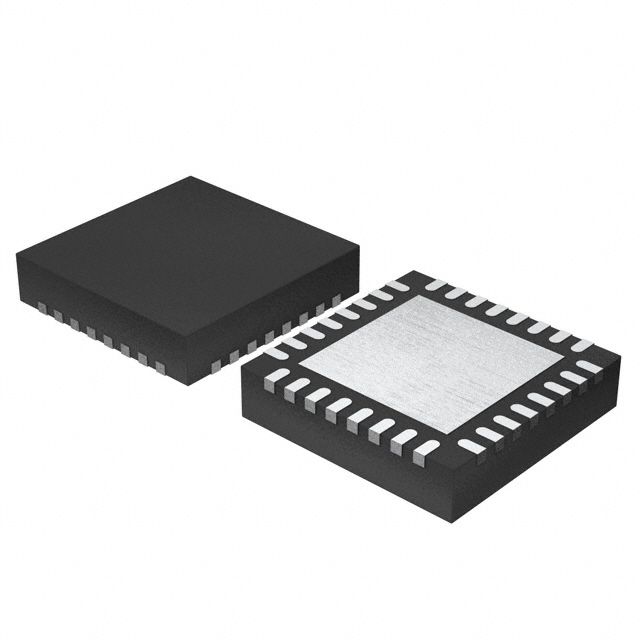
Crystal-to-LVPECL Clock Synthesizer
ICS843156
DATA SHEET
PRODUCT DISCONTINUATION NOTICE - LAST TIME BUY EXPIRES MAY 6, 2017
General Description
Features
The ICS843156 is a high frequency clock generator. The ICS843156
uses an external 25MHz crystal to synthesize 156.25MHz clock. The
ICS843156 has excellent cycle-to-cycle and RMS period jitter performance.
•
•
Ten differential LVPECL outputs of 156.25MHz
•
•
Cycle-to-cycle jitter: 40ps (maximum)
•
•
•
•
•
Output Duty Cycle: 45% – 55%
The ICS843156 operates at full 3.3V and 2.5V, or mixed 3.3V/2.5V
operating supplies and is available in a fully RoHS compliant 32-lead
VFQFN package.
Crystal oscillator interface designed for 18pF, 25MHz parallel
resonant crystal
RMS phase jitter at 156.25MHz (1.875MHz - 20MHz):
0.39ps (typical)
Full 3.3V and 2.5V, or mixed 3.3V/2.5V supply modes
0°C to 70°C ambient operating temperature
Available in lead-free (RoHS 6) package
For drop-in replacement part use 843156
Output Frequency Table
Crystal Frequency (MHz)
Feedback Divider
VCO Frequency (MHz)
Output Divider
Output Frequency (MHz)
25
25
625
÷4
156.25
nQA0
VCCO
QA0
VCCA
BYPASS
VEE
VCC
TEST_CLK
Pin Assignment
32 31 30 29 28 27 26 25
XTAL_IN
1
24 QA1
XTAL_OUT
2
23 nQA1
VCC 3
22 QA2
ICS843156
nQC1 4
21 nQA2
QC1
5
20 QA3
nQC0
6
19 nQA3
QC0 7
18 QA4
VCCO 8
BYPASS
Pulldown
TEST_CLK
Pulldown
1
25MHz
6
XTAL_IN
OSC
XTAL_OUT
÷4
625MHz
QA5
VCCO
VEE
nQA5
QB0
nQB0
QB1
32-Lead VFQFN
5mm x 5mm x 0.925mm package body
3.15mm x 3.15mm EPad
K Package
QA[0:5]
Top View
nQA[0:5]
VCO
Phase
Detector
10 11 12 13 14 15 16
nQB1
Block Diagram
17 nQA4
9
0
2
÷4
QB[0:1]
nQB[0:1]
÷25
÷4
2
QC[0:1]
nQC[0:1]
ICS843156AK REVISION B May 26, 2016
1
©2016 Integrated Device Technology, Inc.
�ICS843156 Data Sheet
CRYSTAL-TO-LVPECL CLOCK SYNTHESIZER
Table 1. Pin Descriptions
Number
Name
1,
2
XTAL_IN
XTAL_OUT
Type
Description
Input
3, 32
VCC
Power
Core supply pins.
4, 5
nQC1, QC1
Output
Differential output pair. LVPECL interface levels.
Crystal oscillator interface. XTAL_IN is the input, XTAL_OUT is the output.
6, 7
nQC0, QC0
Output
Differential output pair. LVPECL interface levels.
8, 16, 25
VCCO
Power
Output supply pins.
9, 10
nQB1, QB1
Output
Differential output pair. LVPECL interface levels.
11, 12
nQB0, QB0
Output
Differential output pair. LVPECL interface levels.
13, 30
VEE
Power
Negative supply pins.
14, 15
nQA5, QA5
Output
Differential output pair. LVPECL interface levels.
17, 18
nQA4, QA4
Output
Differential output pair. LVPECL interface levels.
19, 20
nQA3, QA3
Output
Differential output pair. LVPECL interface levels.
21, 22
nQA2, QA2
Output
Differential output pair. LVPECL interface levels.
23, 24
nQA1, QA1
Output
Differential output pair. LVPECL interface levels.
26, 27
nQA0, QA0
Output
Differential output pair. LVPECL interface levels.
28
VCCA
Power
Analog supply pin.
29
BYPASS
Input
Pulldown
A HIGH on BYPASS signal allows TEST_CLK to propagate to output
dividers and bypass the PLL. a LOW on BYPASS signal allows VCO
frequency to propagate to the output dividers. See Table 3.
LVCMOS/LVTTL interface levels.
31
TEST_CLK
Input
Pulldown
Single-ended input test clock. LVCMOS interface levels.
NOTE: Pulldown refers to an internal input resistor. See Table 2, Pin Characteristics, for typical values.
Table 2. Pin Characteristics
Symbol
Parameter
Test Conditions
Minimum
Typical
Maximum
Units
CIN
Input Capacitance
4
pF
RPULLDOWN
Input Pulldown Resistor
51
k
Function Table
Table 3. Bypass Function Table
Input
BYPASS
Device Configuration
0
PLL Mode
1
Bypass the PLL
ICS843156AK REVISION B May 26, 2016
2
©2016 Integrated Device Technology, Inc.
�ICS843156 Data Sheet
CRYSTAL-TO-LVPECL CLOCK SYNTHESIZER
Absolute Maximum Ratings
NOTE: Stresses beyond those listed under Absolute Maximum Ratings may cause permanent damage to the device.
These ratings are stress specifications only. Functional operation of product at these conditions or any conditions beyond
those listed in the DC Characteristics or AC Characteristics is not implied. Exposure to absolute maximum rating conditions for
extended periods may affect product reliability.
Item
Rating
Supply Voltage, VCC
4.6V
Inputs, VI
XTAL_IN
Other Inputs
0V to VCC
-0.5V to VCC + 0.5V
Outputs, IO
Continuous Current
Surge Current
50mA
100mA
Package Thermal Impedance, JA
37C/W (0 mps)
Storage Temperature, TSTG
-65C to 150C
DC Electrical Characteristics
Table 4A. Power Supply DC Characteristics, VCC = VCCO = 3.3V ± 5%, VEE = 0V, TA = 0°C to 70°C
Symbol
Parameter
VCC
Core Supply Voltage
VCCA
Test Conditions
Minimum
Typical
Maximum
Units
3.135
3.3
3.465
V
Analog Supply Voltage
VCC – 0.33
3.3
VCC
V
VCCO
Output Supply Voltage
3.135
3.3
3.465
V
IEE
Power Supply Current
179
mA
ICCA
Analog Supply Current
33
mA
Table 4B. Power Supply DC Characteristics, VCC = VCCO = 2.5V ± 5%, VEE = 0V, TA = 0°C to 70°C
Symbol
Parameter
VCC
Core Supply Voltage
VCCA
Test Conditions
Minimum
Typical
Maximum
Units
2.375
2.5
2.625
V
Analog Supply Voltage
VCC – 0.23
2.5
VCC
V
VCCO
Output Supply Voltage
2.375
2.5
2.625
V
IEE
Power Supply Current
168
mA
ICCA
Analog Supply Current
23
mA
Table 4C. Power Supply DC Characteristics, VCC = 3.3V ± 5%, VCCO = 2.5V ± 5%, VEE = 0V, TA = 0°C to 70°C
Symbol
Parameter
VCC
Core Supply Voltage
VCCA
Minimum
Typical
Maximum
Units
3.135
3.3
3.465
V
Analog Supply Voltage
VCC – 0.33
3.3
VCC
V
VCCO
Output Supply Voltage
2.375
2.5
2.625
V
IEE
Power Supply Current
164
mA
ICCA
Analog Supply Current
33
mA
ICS843156AK REVISION B May 26, 2016
Test Conditions
3
©2016 Integrated Device Technology, Inc.
�ICS843156 Data Sheet
CRYSTAL-TO-LVPECL CLOCK SYNTHESIZER
Table 4D. LVCMOS/LVTTL DC Characteristics, TA = 0°C to 70°C
Symbol
Parameter
Test Conditions
Minimum
VIH
Input High Voltage
VCC = 3.3V
VIL
Input Low Voltage
IIH
Input High Current
BYPASS,
TEST_CLK
VCC = VIN = 3.465V or 2.625V
IIL
Input Low Current
BYPASS,
TEST_CLK
VCC = 3.465V or 2.625V, VIN = 0V
Typical
Maximum
Units
2
VCC + 0.3
V
VCC = 2.5V
1.7
VCC + 0.3
V
VCC = 3.3V
-0.3
0.8
V
VCC = 2.5V
-0.3
0.7
V
150
µA
-5
µA
Table 4E. LVPECL DC Characteristics, VCC = VCCO = 3.3V ± 5%, VEE = 0V, TA = 0°C to 70°C
Symbol
Parameter
VOH
Output High Voltage
VOL
VSWING
Test Conditions
Minimum
Typical
Maximum
Units
VCCO - 1.4
VCCO - 0.9
V
Output Low Voltage
VCCO - 2.0
VCCO - 1.7
V
Peak-to-Peak Output
Voltage Swing
0.6
1.0
V
Table 4F. LVPECL DC Characteristics, VCC = 3.3V ± 5% or 2.5V ± 5%, VCCO = 2.5V ± 5%,VEE = 0V, TA = 0°C to 70°C
Symbol
Parameter
VOH
Output High Voltage
VOL
VSWING
Test Conditions
Minimum
Typical
Maximum
Units
VCC – 1.4
VCC – 0.9
V
Output Low Voltage
VCC – 2.0
VCC – 1.5
V
Peak-to-Peak Output
Voltage Swing
0.4
1.0
V
Maximum
Units
Table 5. Crystal Characteristics
Parameter
Test Conditions
Mode of Oscillation
Minimum
Typical
Fundamental
Frequency
25
MHz
Equivalent Series Resistance (ESR)
50
Shunt Capacitance
7
pF
ICS843156AK REVISION B May 26, 2016
4
©2016 Integrated Device Technology, Inc.
�ICS843156 Data Sheet
CRYSTAL-TO-LVPECL CLOCK SYNTHESIZER
AC Electrical Characteristics
Table 6A. AC Characteristics, VCC = VCCO = 3.3V ± 5%, VEE = 0V, TA = 0°C to 70°C
Symbol
Parameter
fOUT
Output Frequency
tjit(cc)
Cycle-to-Cycle Jitter; NOTE 1
tjit(Ø)
RMS Phase Jitter, (Random);
NOTE 2
tR / tF
Output Rise/Fall Time
odc
Output Duty Cycle
tLOCK
PLL Lock Time
Test Conditions
Minimum
Typical
Maximum
156.25
MHz
40
156.25MHz, Integration Range:
1.875MHz - 20MHz
20% to 80%
Units
0.39
ps
ps
200
700
ps
45
55
%
100
ms
NOTE: Electrical parameters are guaranteed over the specified ambient operating temperature range, which is established when the device is
mounted in a test socket with maintained transverse airflow greater than 500 lfpm. The device will meet specifications after thermal equilibrium
has been reached under these conditions.
NOTE 1: This parameter is defined in accordance with JEDEC standard 65.
NOTE 2: Refer to phase noise plot.
Table 6B. AC Characteristics, VCC = VCCO = 2.5V ± 5%, VEE = 0V, TA = 0°C to 70°C
Symbol
Parameter
fOUT
Output Frequency
tjit(cc)
Cycle-to-Cycle Jitter; NOTE 1
tjit(Ø)
RMS Phase Jitter, (Random)
tR / tF
Output Rise/Fall Time
odc
Output Duty Cycle
tLOCK
PLL Lock Time
Test Conditions
Minimum
Typical
Maximum
156.25
MHz
35
156.25MHz, Integration Range:
1.875MHz - 20MHz
20% to 80%
Units
0.49
ps
ps
200
700
ps
45
55
%
100
ms
NOTE: Electrical parameters are guaranteed over the specified ambient operating temperature range, which is established when the device is
mounted in a test socket with maintained transverse airflow greater than 500 lfpm. The device will meet specifications after thermal equilibrium
has been reached under these conditions.
NOTE 1: This parameter is defined in accordance with JEDEC standard 65.
Table 6C. AC Characteristics, VCC = 3.3V ± 5%, VCCO = 2.5V ± 5%, VEE = 0V, TA = 0°C to 70°C
Symbol
Parameter
fOUT
Output Frequency
tjit(cc)
Cycle-to-Cycle Jitter; NOTE 1
tjit(Ø)
RMS Phase Jitter, (Random)
tR / tF
Output Rise/Fall Time
odc
Output Duty Cycle
tLOCK
PLL Lock Time
Test Conditions
Minimum
Typical
Maximum
156.25
MHz
40
156.25MHz, Integration Range:
1.875MHz - 20MHz
20% to 80%
Units
0.40
ps
ps
200
700
ps
45
55
%
100
ms
NOTE: Electrical parameters are guaranteed over the specified ambient operating temperature range, which is established when the device is
mounted in a test socket with maintained transverse airflow greater than 500 lfpm. The device will meet specifications after thermal equilibrium
has been reached under these conditions.
NOTE 1: This parameter is defined in accordance with JEDEC standard 65.
ICS843156AK REVISION B May 26, 2016
5
©2016 Integrated Device Technology, Inc.
�ICS843156 Data Sheet
CRYSTAL-TO-LVPECL CLOCK SYNTHESIZER
Typical Phase Noise at 156.25MHz @ 3.3V
Noise Power dBc
Hz
156.25MHz
RMS Phase Jitter (Random)
1.875MHz to 20MHz = 0.39ps (typical)
Offset Frequency (Hz)
ICS843156AK REVISION B May 26, 2016
6
©2016 Integrated Device Technology, Inc.
�ICS843156 Data Sheet
CRYSTAL-TO-LVPECL CLOCK SYNTHESIZER
Parameter Measurement Information
2.8V±0.04V
2V
2V
2V
VCC,
VCCO
2.8V±0.04V
VCC
VCCO
VCCA
VCCA
Qx
SCOPE
nQx
VEE
-1.3V±0.165V
-0.5V±0.125V
3.3V Core/ 2.5V LVPECL Output Load Test Circuit
3.3V Core/ 3.3V LVPECL Output Load Test Circuit
2V
2V
VCC,
VCCO
VCCA
-0.5V±0.125V
RMS Phase Jitter
2.5V Core/ 2.5V LVPECL Output Load Test Circuit
nQAx, nQBx, nQCx
nQAx,
nQBx,
nQCx
QAx,
QBx,
QCx
QAx, QBx, QCx
tcycle n
tcycle n+1
tjit(cc) = |tcycle n – tcycle n+1|
1000 Cycles
Output Duty Cycle/Pulse Width/Period
Cycle-to-Cycle Jitter
ICS843156AK REVISION B May 26, 2016
7
©2016 Integrated Device Technology, Inc.
�ICS843156 Data Sheet
CRYSTAL-TO-LVPECL CLOCK SYNTHESIZER
Parameter Measurement Information, continued
nQAx,
nQBx,
nQCx
QAx,
QBx,
QCx
LVPECL Output Rise/Fall Time
ICS843156AK REVISION B May 26, 2016
Lock Time
8
©2016 Integrated Device Technology, Inc.
�ICS843156 Data Sheet
CRYSTAL-TO-LVPECL CLOCK SYNTHESIZER
Applications Information
Recommendations for Unused Input and Output Pins
Inputs:
Outputs:
TEST_CLK Input
LVPECL Outputs
For applications not requiring the use of the test clock, it can be left
floating. Though not required, but for additional protection, a 1k
resistor can be tied from the TEST_CLK to ground.
All unused LVPECL outputs can be left floating. We recommend that
there is no trace attached. Both sides of the differential output pair
should either be left floating or terminated.
Crystal Inputs
For applications not requiring the use of the crystal oscillator input,
both XTAL_IN and XTAL_OUT can be left floating. Though not
required, but for additional protection, a 1k resistor can be tied from
XTAL_IN to ground.
LVCMOS Control Pins
All control pins have internal pulldowns; additional resistance is not
required but can be added for additional protection. A 1k resistor
can be used.
Power Supply Filtering Technique
As in any high speed analog circuitry, the power supply pins are
vulnerable to random noise. To achieve optimum jitter perform ance,
power supply isolation is required. The ICS843156 provides separate
power supplies to isolate any high switching noise from the outputs
to the internal PLL. VCC, VCCA and VCCO should be individually
connected to the power supply plane through vias, and 0.01µF
bypass capacitors should be used for each pin. Figure 1 illustrates
this for a generic VCC pin and also shows that VCCA requires that an
additional 10 resistor along with a 10F bypass capacitor be
connected to the VCCA pin.
3.3V
VCC
0.01µF
VCCA
0.01µF
10µF
Figure 1. Power Supply Filtering
Crystal Input Interface
The ICS843156 has been characterized with 18pF parallel resonant
crystals. The capacitor values, C1 and C2, shown in Figure 2 below
were determined using a 25MHz, 18pF parallel resonant crystal and
were chosen to minimize the ppm error. The optimum C1 and C2
values can be slightly adjusted for different board layouts.
XTAL_IN
C1
27pF
X1
18pF Parallel Crystal
XTAL_OUT
C2
27pF
Figure 2. Crystal Input Interface
ICS843156AK REVISION B May 26, 2016
9
©2016 Integrated Device Technology, Inc.
�ICS843156 Data Sheet
CRYSTAL-TO-LVPECL CLOCK SYNTHESIZER
Overdriving the XTAL Interface
The XTAL_IN input can be overdriven by an LVCMOS driver or by one
side of a differential driver through an AC coupling capacitor. The
XTAL_OUT pin can be left floating. The amplitude of the input signal
should be between 500mV and 1.8V and the slew rate should not be
less than 0.2V/nS. For 3.3V LVCMOS inputs, the amplitude must be
reduced from full swing to at least half the swing in order to prevent
signal interference with the power rail and to reduce internal noise.
Figure 3A shows an example of the interface diagram for a high
speed 3.3V LVCMOS driver. This configuration requires that the sum
of the output impedance of the driver (Ro) and the series resistance
(Rs) equals the transmission line impedance. In addition, matched
termination at the crystal input will attenuate the signal in half. This
VCC
can be done in one of two ways. First, R1 and R2 in parallel should
equal the transmission line impedance. For most 50 applications,
R1 and R2 can be 100. This can also be accomplished by removing
R1 and changing R2 to 50. The values of the resistors can be
increased to reduce the loading for a slower and weaker LVCMOS
driver. Figure 3B shows an example of the interface diagram for an
LVPECL driver. This is a standard LVPECL termination with one side
of the driver feeding the XTAL_IN input. It is recommended that all
components in the schematics be placed in the layout. Though some
components might not be used, they can be utilized for debugging
purposes. The datasheet specifications are characterized and
guaranteed by using a quartz crystal as the input.
XTAL_OUT
R1
100
Ro
Rs
C1
Zo = 50 ohms
XTAL_IN
R2
100
Zo = Ro + Rs
.1uf
LVCMOS Driver
Figure 3A. General Diagram for LVCMOS Driver to XTAL Input Interface
XTAL_OUT
C2
Zo = 50 ohms
XTAL_IN
.1uf
Zo = 50 ohms
LVPECL Driver
R1
50
R2
50
R3
50
Figure 3B. General Diagram for LVPECL Driver to XTAL Input Interface
ICS843156AK REVISION B May 26, 2016
10
©2016 Integrated Device Technology, Inc.
�ICS843156 Data Sheet
CRYSTAL-TO-LVPECL CLOCK SYNTHESIZER
Termination for 3.3V LVPECL Outputs
The clock layout topology shown below is a typical termination for
LVPECL outputs. The two different layouts mentioned are
recommended only as guidelines.
transmission lines. Matched impedance techniques should be used
to maximize operating frequency and minimize signal distortion.
Figures 4A and 4B show two different layouts which are
recommended only as guidelines. Other suitable clock layouts may
exist and it would be recommended that the board designers
simulate to guarantee compatibility across all printed circuit and clock
component process variations.
The differential outputs are low impedance follower outputs that
generate ECL/LVPECL compatible outputs. Therefore, terminating
resistors (DC current path to ground) or current sources must be
used for functionality. These outputs are designed to drive 50
R3
125
3.3V
R4
125
3.3V
3.3V
Zo = 50
+
_
Input
Zo = 50
R1
84
Figure 4A. 3.3V LVPECL Output Termination
ICS843156AK REVISION B May 26, 2016
R2
84
Figure 4B. 3.3V LVPECL Output Termination
11
©2016 Integrated Device Technology, Inc.
�ICS843156 Data Sheet
CRYSTAL-TO-LVPECL CLOCK SYNTHESIZER
Termination for 2.5V LVPECL Outputs
level. The R3 in Figure 5B can be eliminated and the termination is
shown in Figure 5C.
Figure 5A and Figure 5B show examples of termination for 2.5V
LVPECL driver. These terminations are equivalent to terminating 50
to VCCO – 2V. For VCCO = 2.5V, the VCCO – 2V is very close to ground
2.5V
VCCO = 2.5V
2.5V
2.5V
VCCO = 2.5V
R1
250
50
R3
250
+
50
+
50
–
50
2.5V LVPECL Driver
–
R1
50
2.5V LVPECL Driver
R2
62.5
R2
50
R4
62.5
R3
18
Figure 5A. 2.5V LVPECL Driver Termination Example
Figure 5B. 2.5V LVPECL Driver Termination Example
2.5V
VCCO = 2.5V
50
+
50
–
2.5V LVPECL Driver
R1
50
R2
50
Figure 5C. 2.5V LVPECL Driver Termination Example
ICS843156AK REVISION B May 26, 2016
12
©2016 Integrated Device Technology, Inc.
�ICS843156 Data Sheet
CRYSTAL-TO-LVPECL CLOCK SYNTHESIZER
VFQFN EPAD Thermal Release Path
In order to maximize both the removal of heat from the package and
the electrical performance, a land pattern must be incorporated on
the Printed Circuit Board (PCB) within the footprint of the package
corresponding to the exposed metal pad or exposed heat slug on the
package, as shown in Figure 6. The solderable area on the PCB, as
defined by the solder mask, should be at least the same size/shape
as the exposed pad/slug area on the package to maximize the
thermal/electrical performance. Sufficient clearance should be
designed on the PCB between the outer edges of the land pattern
and the inner edges of pad pattern for the leads to avoid any shorts.
and dependent upon the package power dissipation as well as
electrical conductivity requirements. Thus, thermal and electrical
analysis and/or testing are recommended to determine the minimum
number needed. Maximum thermal and electrical performance is
achieved when an array of vias is incorporated in the land pattern. It
is recommended to use as many vias connected to ground as
possible. It is also recommended that the via diameter should be 12
to 13mils (0.30 to 0.33mm) with 1oz copper via barrel plating. This is
desirable to avoid any solder wicking inside the via during the
soldering process which may result in voids in solder between the
exposed pad/slug and the thermal land. Precautions should be taken
to eliminate any solder voids between the exposed heat slug and the
land pattern. Note: These recommendations are to be used as a
guideline only. For further information, please refer to the Application
Note on the Surface Mount Assembly of Amkor’s Thermally/
Electrically Enhance Lead frame Base Package, Amkor Technology.
While the land pattern on the PCB provides a means of heat transfer
and electrical grounding from the package to the board through a
solder joint, thermal vias are necessary to effectively conduct from
the surface of the PCB to the ground plane(s). The land pattern must
be connected to ground through these vias. The vias act as “heat
pipes”. The number of vias (i.e. “heat pipes”) are application specific
PIN
PIN PAD
SOLDER
EXPOSED HEAT SLUG
GROUND PLANE
THERMAL VIA
SOLDER
LAND PATTERN
(GROUND PAD)
PIN
PIN PAD
Figure 6. P.C. Assembly for Exposed Pad Thermal Release Path – Side View (drawing not to scale)
ICS843156AK REVISION B May 26, 2016
13
©2016 Integrated Device Technology, Inc.
�ICS843156 Data Sheet
CRYSTAL-TO-LVPECL CLOCK SYNTHESIZER
Power Considerations
This section provides information on power dissipation and junction temperature for the ICS843156.
Equations and example calculations are also provided.
1.
Power Dissipation.
The total power dissipation for the ICS843156 is the sum of the core power plus the power dissipation in the load(s).
The following is the power dissipation for VCCO = 3.3V + 5% = 3.465V, which gives worst case results.
NOTE: Please refer to Section 3 for details on calculating power dissipation in the load.
•
Power (core)MAX = VCCO_MAX * IEE_MAX = 3.465V * 179mA = 620.235mW
•
Power (outputs)MAX = 30mW/Loaded Output pair
If all outputs are loaded, the total power is 10 * 30mW = 300mW
Total Power_MAX (3.3V, with all outputs switching) = 620.235mW + 300mW = 920.235mW
2. Junction Temperature.
unction temperature, Tj, is the temperature at the junction of the bond wire and bond pad directly affects the reliability of the device. The
maximum recommended junction temperature is 125°C. Limiting the internal transistor junction temperature, Tj, to 125°C ensures that the bond
wire and bond pad temperature remains below 125°C.
The equation for Tj is as follows: Tj = JA * Pd_total + TA
Tj = Junction Temperature
JA = Junction-to-Ambient Thermal Resistance
Pd_total = Total Device Power Dissipation (example calculation is in section 1 above)
TA = Ambient Temperature
In order to calculate junction temperature, the appropriate junction-to-ambient thermal resistance JA must be used. Assuming no air flow and
a multi-layer board, the appropriate value is 37°C/W per Table 7 below.
Therefore, Tj for an ambient temperature of 70°C with all outputs switching is:
70°C + 0.920W * 37°C/W = 1046°C. This is below the limit of 125°C.
This calculation is only an example. Tj will obviously vary depending on the number of loaded outputs, supply voltage, air flow and the type of
board (multi-layer).
Table 7. Thermal Resistance JA for 32 Lead VFQFN, Forced Convection
JA by Velocity
Meters per Second
Multi-Layer PCB, JEDEC Standard Test Boards
ICS843156AK REVISION B May 26, 2016
0
1
2.5
37.0°C/W
32.4°C/W
29.0°C/W
14
©2016 Integrated Device Technology, Inc.
�ICS843156 Data Sheet
CRYSTAL-TO-LVPECL CLOCK SYNTHESIZER
3. Calculations and Equations.
The purpose of this section is to calculate the power dissipation for the LVPECL output pairs.
The LVPECL output driver circuit and termination are shown in Figure 7.
VCC
Q1
VOUT
RL
50Ω
VCC - 2V
Figure 7. LVPECL Driver Circuit and Termination
To calculate power dissipation per output pair due to loading, use the following equations which assume a 50 load, and a termination voltage
of VCCO – 2V.
•
For logic high, VOUT = VOH_MAX = VCCO_MAX – 0.9V
(VCCO_MAX – VOH_MAX) = 0.9V
•
For logic low, VOUT = VOL_MAX = VCCO_MAX – 1.7V
(VCCO_MAX – VOL_MAX) = 1.7V
Pd_H is power dissipation when the output drives high.
Pd_L is the power dissipation when the output drives low.
Pd_H = [(VOH_MAX – (VCCO_MAX – 2V))/RL] * (VCCO_MAX – VOH_MAX) = [(2V – (VCCO_MAX – VOH_MAX))/RL] * (VCCO_MAX – VOH_MAX) =
[(2V – 0.9V)/50] * 0.9V = 19.8mW
Pd_L = [(VOL_MAX – (VCCO_MAX – 2V))/RL] * (VCCO_MAX – VOL_MAX) = [(2V – (VCCO_MAX – VOL_MAX))/RL] * (VCCO_MAX – VOL_MAX) =
[(2V – 1.7V)/50] * 1.7V = 10.2mW
Total Power Dissipation per output pair = Pd_H + Pd_L = 30mW
ICS843156AK REVISION B May 26, 2016
15
©2016 Integrated Device Technology, Inc.
�ICS843156 Data Sheet
CRYSTAL-TO-LVPECL CLOCK SYNTHESIZER
Reliability Information
Table 8. JA vs. Air Flow Table for a 32 Lead VFQFN
JA vs. Air Flow
Meters per Second
Multi-Layer PCB, JEDEC Standard Test Boards
0
1
2.5
37.0°C/W
32.4°C/W
29.0°C/W
Transistor Count
The transistor count for ICS843156 is: 3059
ICS843156AK REVISION B May 26, 2016
16
©2016 Integrated Device Technology, Inc.
�ICS843156 Data Sheet
CRYSTAL-TO-LVPECL CLOCK SYNTHESIZER
Package Outline and Package Dimensions
Package Outline - K Suffix for 32 Lead VFQFN
(Ref.)
S eating Plan e
N &N
Even
(N -1)x e
(R ef.)
A1
Ind ex Area
L
A3
N
N
Anvil
Anvil
Singulation
Singula tion
e (Ty p.)
2 If N & N
1
are Even
2
OR
E2
(N -1)x e
(Re f.)
E2
2
To p View
b
A
(Ref.)
D
Chamfer 4x
0.6 x 0.6 max
OPTIONAL
0. 08
C
Th er mal
Ba se
D2
C
Bottom View w/Type C ID
2
1
2
1
4
D2
2
N &N
Odd
Bottom View w/Type A ID
CHAMFER
e
N N-1
RADIUS
4
N N-1
There are 2 methods of indicating pin 1 corner at the back of the VFQFN package:
1. Type A: Chamfer on the paddle (near pin 1)
2. Type C: Mouse bite on the paddle (near pin 1)
Table 9. Package Dimensions
NOTE: The following package mechanical drawing is a generic
drawing that applies to any pin count VFQFN package. This drawing
is not intended to convey the actual pin count or pin layout of this
device. The pin count and pinout are shown on the front page. The
package dimensions are in Table 9 below.
JEDEC Variation: VHHD-2/-4
All Dimensions in Millimeters
Symbol
Minimum
Nominal
Maximum
N
32
A
0.80
1.00
A1
0
0.05
A3
0.25 Ref.
b
0.18
0.25
0.30
8
ND & NE
D&E
5.00 Basic
D2 & E2
3.0
3.3
e
0.50 Basic
L
0.30
0.40
0.50
Reference Document: JEDEC Publication 95, MO-220
ICS843156AK REVISION B May 26, 2016
17
©2016 Integrated Device Technology, Inc.
�ICS843156 Data Sheet
CRYSTAL-TO-LVPECL CLOCK SYNTHESIZER
Ordering Information
Table 10. Ordering Information
Part/Order Number
843156AKLF
843156AKLFT
Marking
ICS843156AL
ICS843156AL
ICS843156AK REVISION B May 26, 2016
Package
“Lead-Free” 32 Lead VFQFN
“Lead-Free” 32 Lead VFQFN
18
Shipping Packaging
Tray
Tape & Reel
Temperature
0°C to 70°C
0°C to 70°C
©2016 Integrated Device Technology, Inc.
�ICS843156 Data Sheet
CRYSTAL-TO-LVPECL CLOCK SYNTHESIZER
Revision History Sheet
Rev
A
B
B
Table
Page
Description of Change
Date
10
VFQFN EPAD Thermal Release Path
10/25/12
1
8
10
17
Per Errata #108
Pin Assignment - corrected pins 9 - 12. Added E-Pad dimensions.
Parameter Measurement Information - added Lock Time Diagram.
Updated Application Note, Overdriving the XTAL Interface.
Updated Package Outline.
11/28/12
Product Discontinuation Notice - Last time buy expires May 6, 2017.
PDN CQ-16-01
5/26/16
ICS843156AK REVISION B May 26, 2016
19
©2016 Integrated Device Technology, Inc.
�ICS843156 Data Sheet
CRYSTAL-TO-LVPECL CLOCK SYNTHESIZER
We’ve Got Your Timing Solution
6024 Silver Creek Valley Road
San Jose, California 95138
Sales
800-345-7015 (inside USA)
+408-284-8200 (outside USA)
Fax: 408-284-2775
www.IDT.com/go/contactIDT
Technical Support
netcom@idt.com
+480-763-2056
DISCLAIMER Integrated Device Technology, Inc. (IDT) and its subsidiaries reserve the right to modify the products and/or specifications described herein at any time and at IDT’s sole discretion. All information in this document,
including descriptions of product features and performance, is subject to change without notice. Performance specifications and the operating parameters of the described products are determined in the independent state and are not
guaranteed to perform the same way when installed in customer products. The information contained herein is provided without representation or warranty of any kind, whether express or implied, including, but not limited to, the
suitability of IDT’s products for any particular purpose, an implied warranty of merchantability, or non-infringement of the intellectual property rights of others. This document is presented only as a guide and does not convey any
license under intellectual property rights of IDT or any third parties.
IDT’s products are not intended for use in applications involving extreme environmental conditions or in life support systems or similar devices where the failure or malfunction of an IDT product can be reasonably expected to significantly affect the health or safety of users. Anyone using an IDT product in such a manner does so at their own risk, absent an express, written agreement by IDT.
Integrated Device Technology, IDT and the IDT logo are registered trademarks of IDT. Other trademarks and service marks used herein, including protected names, logos and designs, are the property of IDT or their respective third
party owners.
Copyright 2016. All rights reserved.
�IMPORTANT NOTICE AND DISCLAIMER
RENESAS ELECTRONICS CORPORATION AND ITS SUBSIDIARIES (“RENESAS”) PROVIDES TECHNICAL
SPECIFICATIONS AND RELIABILITY DATA (INCLUDING DATASHEETS), DESIGN RESOURCES (INCLUDING
REFERENCE DESIGNS), APPLICATION OR OTHER DESIGN ADVICE, WEB TOOLS, SAFETY INFORMATION, AND
OTHER RESOURCES “AS IS” AND WITH ALL FAULTS, AND DISCLAIMS ALL WARRANTIES, EXPRESS OR IMPLIED,
INCLUDING, WITHOUT LIMITATION, ANY IMPLIED WARRANTIES OF MERCHANTABILITY, FITNESS FOR A
PARTICULAR PURPOSE, OR NON-INFRINGEMENT OF THIRD PARTY INTELLECTUAL PROPERTY RIGHTS.
These resources are intended for developers skilled in the art designing with Renesas products. You are solely responsible
for (1) selecting the appropriate products for your application, (2) designing, validating, and testing your application, and (3)
ensuring your application meets applicable standards, and any other safety, security, or other requirements. These
resources are subject to change without notice. Renesas grants you permission to use these resources only for
development of an application that uses Renesas products. Other reproduction or use of these resources is strictly
prohibited. No license is granted to any other Renesas intellectual property or to any third party intellectual property.
Renesas disclaims responsibility for, and you will fully indemnify Renesas and its representatives against, any claims,
damages, costs, losses, or liabilities arising out of your use of these resources. Renesas' products are provided only subject
to Renesas' Terms and Conditions of Sale or other applicable terms agreed to in writing. No use of any Renesas resources
expands or otherwise alters any applicable warranties or warranty disclaimers for these products.
(Rev.1.0 Mar 2020)
Corporate Headquarters
Contact Information
TOYOSU FORESIA, 3-2-24 Toyosu,
Koto-ku, Tokyo 135-0061, Japan
www.renesas.com
For further information on a product, technology, the most
up-to-date version of a document, or your nearest sales
office, please visit:
www.renesas.com/contact/
Trademarks
Renesas and the Renesas logo are trademarks of Renesas
Electronics Corporation. All trademarks and registered
trademarks are the property of their respective owners.
© 2020 Renesas Electronics Corporation. All rights reserved.
�