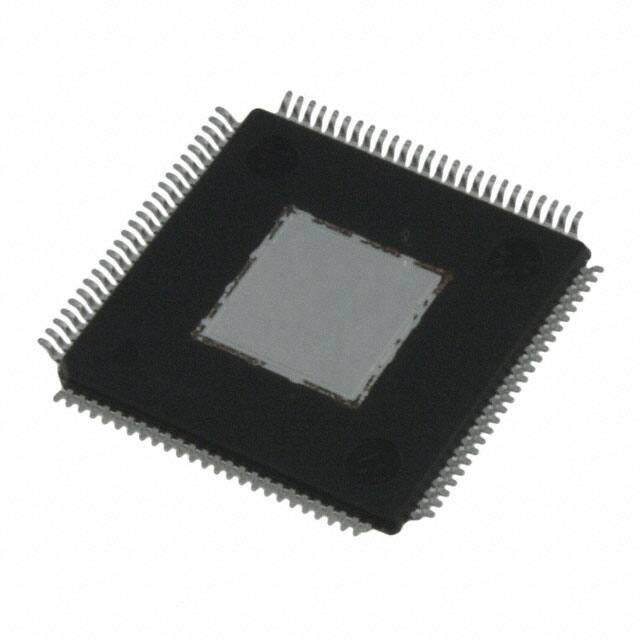
DAC1205D650
Dual 12-bit DAC, up to 650 Msps; 2 4 and 8 interpolating
Rev. 04 — 2 July 2012
Product data sheet
1. General description
The DAC1205D650 is a high-speed 12-bit dual-channel Digital-to-Analog Converter
(DAC) with selectable 2, 4 or 8 interpolating filters optimized for multi-carrier wireless
transmitters.
Thanks to its digital on-chip modulation, the DAC1205D650 allows the complex I and Q
inputs to be converted up from BaseBand (BB) to IF. The mixing frequency is adjusted
using a Serial Peripheral Interface (SPI) with a 32-bit Numerically Controlled Oscillator
(NCO). The phase is controlled by a 16-bit register.
Two modes of operation are available: separate data ports or a single interleaved
high-speed data port. In the Interleaved mode, the input data stream is demultiplexed into
its original I and Q data and then latched.
The DAC1205D650 also includes a 2, 4 and 8 clock multiplier which provides the
appropriate internal clocks and an internal regulator to adjust the output full-scale current.
2. Features and benefits
Dual 12-bit resolution
650 Msps maximum update rate
IMD3: 79 dBc; fs = 640 Msps; fo = 96 MHz
ACPR: 68 dB; 2 carriers WCDMA;
fs = 614.4 Msps; fo = 115.2 MHz; PLL on
Selectable 2, 4 or 8 interpolation
Typical 0.95 W power dissipation at 4
filters
interpolation
Input data rate up to 160 Msps
Power-down and Sleep modes
Very low noise cap-free integrated PLL Differential scalable output current from
1.6 mA to 22 mA
32-bit programmable NCO frequency On-chip 1.29 V reference
Dual-port or Interleaved data modes
External analog offset control
(10-bit auxiliary DACs)
1.8 V and 3.3 V power supplies
Internal digital offset control
LVDS compatible clock
Inverse (sin x) / x function
Fully compatible SPI port
Two’s complement or binary offset
data format
3.3 V CMOS input buffers
Industrial temperature range from
40 C to +85 C
®
�DAC1205D650
Integrated Device Technology
Dual 12-bit DAC, up to 650 Msps; 2 4 and 8 interpolating
3. Applications
Wireless infrastructure: LTE, WiMAX, GSM, CDMA, WCDMA, TD-SCDMA
Communication: LMDS/MMDS, point-to-point
Direct Digital Synthesis (DDS)
Broadband wireless systems
Digital radio links
Instrumentation
Automated Test Equipment (ATE)
4. Ordering information
Table 1.
Ordering information
Type number
DAC1205D650HW-C1
Package
Name
Description
Version
HTQFP100
plastic thermal enhanced thin quad flat package; 100 leads;
body 14 14 1 mm; exposed die pad
SOT638-1
DAC1205D650 4
Product data sheet
© IDT 2012. All rights reserved.
Rev. 04 — 2 July 2012
2 of 41
�xxxxxxxxxxxxxxxxxxxxx xxxxxxxxxxxxxxxxxxxxxxxxxx xxxxxxx x x x xxxxxxxxxxxxxxxxxxxxxxxxxxxxxx xxxxxxxxxxxxxxxxxxx xx xx xxxxx
xxxxxxxxxxxxxxxxxxxxxxxxxxx xxxxxxxxxxxxxxxxxxx xxxxxx xxxxxxxxxxxxxxxxxxxxxxxxxxxxxxxxxxx xxxxxxxxxxxx x x
xxxxxxxxxxxxxxxxxxxxx xxxxxxxxxxxxxxxxxxxxxxxxxxxxxx xxxxx xxxxxxxxxxxxxxxxxxxxxxxxxxxxxxxxxxxxxxxxxxxxxxxxxx xxxxxxxx
xxxxxxxxxxxxxxxxxxxxxxxxx xxxxxxxxxxxxxxxxxxxx xxx
SDO
Integrated Device Technology
DAC1205D650 4
Product data sheet
5. Block diagram
SCS_N
SDIO
62
63
SCLK
65
64
10-BIT
OFFSET
CONTROL
NCO
SPI
cos
sin
AUXILIARY
DAC
2
3
AUXAP
AUXAN
mixer
10-BIT
GAIN
CONTROL
DAC1205D650
+
18 to 25,
28 to 31
I0 to I11
12
LATCH
I
FIR1
FIR2
FIR3
2×
2×
2×
90
A
x
sin x
−
DAC
91
IOUTAP
IOUTAN
+
68
OFFSET
CONTROL
dual port/
interleaved
data modes
41, 42,
45 to 48,
51 to 56
Q0 to Q11
LATCH
Q
FIR1
FIR2
FIR3
2×
2×
2×
REFERENCE
BANDGAP
69
CLKN
+
+
B
12
8
9
GAPOUT
mixer
x
sin x
86
DAC
85
+
CLKP
VIRES
IOUTBP
IOUTBN
10-BIT
GAIN
CONTROL
CLOCK GENERATOR/PLL
mixer
COMPLEX MODULATOR
RESET_N
Fig 1.
Block diagram
74
AUXILIARY
DAC
73
AUXBP
AUXBN
001aak157
3 of 41
© IDT 2012. All rights reserved.
DAC1205D650
66
10-BIT
OFFSET
CONTROL
Dual 12-bit DAC, up to 650 Msps; 2 4 and 8 interpolating
Rev. 04 — 2 July 2012
mixer
�DAC1205D650
Integrated Device Technology
Dual 12-bit DAC, up to 650 Msps; 2 4 and 8 interpolating
6. Pinning information
77 VDDA(1V8)
76 AGND
78 AGND
79 VDDA(1V8)
80 AGND
81 VDDA(1V8)
82 AGND
83 VDDA(1V8)
84 AGND
85 IOUTBN
86 IOUTBP
87 AGND
88 n.c.
89 AGND
90 IOUTAP
91 IOUTAN
92 AGND
93 VDDA(1V8)
94 AGND
95 VDDA(1V8)
96 AGND
97 VDDA(1V8)
98 AGND
99 VDDA(1V8)
100 AGND
6.1 Pinning
VDDA(3V3)
1
75 VDDA(3V3)
AUXAP
2
74 AUXBP
AUXAN
3
73 AUXBN
AGND
4
72 AGND
VDDA(1V8)
5
71 VDDA(1V8)
VDDA(1V8)
6
70 VDDA(1V8)
AGND
7
69 GAPOUT
CLKP
8
68 VIRES
CLKN
9
67 d.n.c.
AGND 10
66 RESET_N
VDDA(1V8) 11
65 SCS_N
d.n.c. 12
64 SCLK
DAC1205D650HW
d.n.c. 13
63 SDIO
TM1 14
62 SDO
TM0 15
61 TM3
VDD(IO)(3V3) 16
60 VDD(IO)(3V3)
GNDIO 17
59 GNDIO
I11 18
58 n.c.
AGND
I10 19
56 Q0
I8 21
55 Q1
I7 22
54 Q2
VDDD(1V8) 50
DGND 49
Q6 48
Q7 47
Q8 46
Q9 45
VDDD(1V8) 44
DGND 43
Q10 42
Q11/SELIQ 41
VDDD(1V8) 40
DGND 39
TM2 38
DGND 37
VDDD(1V8) 36
n.c. 35
n.c. 34
DGND 33
VDDD(1V8) 32
I0 31
51 Q5
I1 30
I4 25
I2 29
52 Q4
I3 28
53 Q3
I5 24
DGND 27
I6 23
VDDD(1V8) 26
Fig 2.
57 n.c.
I9 20
001aak156
Pin configuration
DAC1205D650 4
Product data sheet
© IDT 2012. All rights reserved.
Rev. 04 — 2 July 2012
4 of 41
�DAC1205D650
Integrated Device Technology
Dual 12-bit DAC, up to 650 Msps; 2 4 and 8 interpolating
6.2 Pin description
Table 2.
Pin description
Symbol
Pin
Type[1]
Description
VDDA(3V3)
1
P
analog supply voltage 3.3 V
AUXAP
2
O
auxiliary DAC B output current
AUXAN
3
O
complementary auxiliary DAC B output current
AGND
4
G
analog ground
VDDA(1V8)
5
P
analog supply voltage 1.8 V
VDDA(1V8)
6
P
analog supply voltage 1.8 V
AGND
7
G
analog ground
CLKP
8
I
clock input
CLKN
9
I
complementary clock input
AGND
10
G
analog ground
VDDA(1V8)
11
P
analog supply voltage 1.8 V
d.n.c.
12
-
do not connect
d.n.c.
13
-
do not connect
TM1
14
I/O
test mode 1 (to connect to DGND)
TM0
15
I/O
test mode 0 (to connect to DGND)
VDD(IO)(3V3)
16
P
input/output buffers supply voltage 3.3 V
GNDIO
17
G
input/output buffers ground
I11
18
I
I data input bit 11 (MSB)
I10
19
I
I data input bit 10
I9
20
I
I data input bit 9
I8
21
I
I data input bit 8
I7
22
I
I data input bit 7
I6
23
I
I data input bit 6
I5
24
I
I data input bit 5
I4
25
I
I data input bit 4
VDDD(1V8)
26
P
digital supply voltage 1.8 V
DGND
27
G
digital ground
I3
28
I
I data input bit 3
I2
29
I
I data input bit 2
I1
30
I
I data input bit 1
I0
31
I
I data input bit 0 (LSB)
VDDD(1V8)
32
P
digital supply voltage 1.8 V
DGND
33
G
digital ground
n.c.
34
I
not connected
n.c.
35
I
not connected
VDDD(1V8)
36
P
digital supply voltage 1.8 V
DGND
37
G
digital ground
TM2
38
-
test mode 2 (to connect to DGND)
DGND
39
G
digital ground
DAC1205D650 4
Product data sheet
© IDT 2012. All rights reserved.
Rev. 04 — 2 July 2012
5 of 41
�DAC1205D650
Integrated Device Technology
Dual 12-bit DAC, up to 650 Msps; 2 4 and 8 interpolating
Table 2.
Pin description …continued
Symbol
Pin
Type[1]
Description
VDDD(1V8)
40
P
digital supply voltage 1.8 V
Q11/SELIQ
41
I
Q data input bit 11 (MSB)
select IQ in Interleaved mode
Q10
42
I
Q data input bit 10
DGND
43
G
digital ground
VDDD(1V8)
44
P
digital supply voltage 1.8 V
Q9
45
I
Q data input bit 9
Q8
46
I
Q data input bit 8
Q7
47
I
Q data input bit 7
Q6
48
I
Q data input bit 6
DGND
49
G
digital ground
VDDD(1V8)
50
P
digital supply voltage 1.8 V
Q5
51
I
Q data input bit 5
Q4
52
I
Q data input bit 4
Q3
53
I
Q data input bit 3
Q2
54
I
Q data input bit 2
Q1
55
I
Q data input bit 1
Q0
56
I
Q data input bit 0 (LSB)
n.c.
57
I
not connected
n.c.
58
I
not connected
GNDIO
59
G
input/output buffers ground
VDD(IO)(3V3)
60
P
input/output buffers supply voltage 3.3 V
TM3
61
I/O
test mode 3 (to connect to DGND)
SDO
62
O
SPI data output
SDIO
63
I/O
SPI data input/output
SCLK
64
I
SPI clock
SCS_N
65
I
SPI chip select (active LOW)
RESET_N
66
I
general reset (active LOW)
d.n.c.
67
-
do not connect
VIRES
68
I/O
DAC biasing resistor
GAPOUT
69
I/O
bandgap input/output voltage
VDDA(1V8)
70
P
analog supply voltage 1.8 V
VDDA(1V8)
71
P
analog supply voltage 1.8 V
AGND
72
G
analog ground
AUXBN
73
O
complementary auxiliary DAC B output current
AUXBP
74
O
auxiliary DAC B output current
VDDA(3V3)
75
P
analog supply voltage 3.3 V
AGND
76
G
analog ground
VDDA(1V8)
77
P
analog supply voltage 1.8 V
AGND
78
G
analog ground
VDDA(1V8)
79
P
analog supply voltage 1.8 V
DAC1205D650 4
Product data sheet
© IDT 2012. All rights reserved.
Rev. 04 — 2 July 2012
6 of 41
�DAC1205D650
Integrated Device Technology
Dual 12-bit DAC, up to 650 Msps; 2 4 and 8 interpolating
Table 2.
Pin description …continued
Symbol
Pin
Type[1]
Description
AGND
80
G
analog ground
VDDA(1V8)
81
P
analog supply voltage 1.8 V
AGND
82
G
analog ground
VDDA(1V8)
83
P
analog supply voltage 1.8 V
AGND
84
G
analog ground
IOUTBN
85
O
complementary DAC B output current
IOUTBP
86
O
DAC B output current
AGND
87
G
analog ground
n.c.
88
-
not connected
AGND
89
G
analog ground
IOUTAP
90
O
DAC A output current
IOUTAN
91
O
complementary DAC A output current
AGND
92
G
analog ground
VDDA(1V8)
93
P
analog supply voltage 1.8 V
AGND
94
G
analog ground
VDDA(1V8)
95
P
analog supply voltage 1.8 V
AGND
96
G
analog ground
VDDA(1V8)
97
P
analog supply voltage 1.8 V
AGND
98
G
analog ground
VDDA(1V8)
99
P
analog supply voltage 1.8 V
AGND
100
G
analog ground
AGND
H[2]
G
analog ground
[1]
P = power supply
G = ground
I = input
O = output.
[2]
H = heatsink (exposed die pad to be soldered).
DAC1205D650 4
Product data sheet
© IDT 2012. All rights reserved.
Rev. 04 — 2 July 2012
7 of 41
�DAC1205D650
Integrated Device Technology
Dual 12-bit DAC, up to 650 Msps; 2 4 and 8 interpolating
7. Limiting values
Table 3.
Limiting values
In accordance with the Absolute Maximum Rating System (IEC 60134).
Symbol
Parameter
Conditions
Min
Max
Unit
0.5
+4.6
V
VDDA(3V3)
analog supply voltage (3.3 V)
0.5
+4.6
V
VDDA(1V8)
analog supply voltage (1.8 V)
0.5
+3.0
V
VDDD(1V8)
digital supply voltage (1.8 V)
0.5
+3.0
V
VI
input voltage
pins CLKP, CLKN, VIRES and GAPOUT
referenced to AGND
0.5
+3.0
V
pins I11 to I0, Q11 to Q0, SDO, SDIO, SCLK,
SCS_N and RESET_N referenced to GNDIO
0.5
+4.6
V
pins IOUTAP, IOUTAN, IOUTBP, IOUTBN,
AUXAP, AUXAN, AUXBP and AUXBN
referenced to AGND
0.5
+4.6
V
55
+150
C
VDD(IO)(3V3) input/output supply voltage (3.3 V)
VO
output voltage
Tstg
storage temperature
Tamb
ambient temperature
45
+85
C
Tj
junction temperature
-
125
C
8. Thermal characteristics
Table 4.
Thermal characteristics
Symbol
Parameter
Rth(j-a)
thermal resistance from junction to ambient
thermal resistance from junction to case
Rth(j-c)
[1]
Conditions
Typ
Unit
[1]
19.8
K/W
[1]
7.7
K/W
In compliance with JEDEC test board, in free air.
DAC1205D650 4
Product data sheet
© IDT 2012. All rights reserved.
Rev. 04 — 2 July 2012
8 of 41
�DAC1205D650
Integrated Device Technology
Dual 12-bit DAC, up to 650 Msps; 2 4 and 8 interpolating
9. Characteristics
Table 5.
Characteristics
VDDA(1V8) = VDDD(1V8) = 1.8 V; VDDA(3V3) = VDD(IO)(3V3) = 3.3 V; AGND, DGND and GNDIO shorted together; Tamb = 40 C to
+85 C; typical values measured at Tamb = 25 C; RL = 50 ; IO(fs) = 20 mA; maximum sample rate; PLL on unless otherwise
specified.
Symbol
Parameter
Conditions
Test
Min
Typ
Max
Unit
[1]
VDD(IO)(3V3)
input/output supply
voltage (3.3 V)
I
3.0
3.3
3.6
V
VDDA(3V3)
analog supply voltage
(3.3 V)
I
3.0
3.3
3.6
V
VDDA(1V8)
analog supply voltage
(1.8 V)
I
1.7
1.8
1.9
V
VDDD(1V8)
digital supply voltage
(1.8 V)
I
1.7
1.8
1.9
V
IDD(IO)(3V3)
input/output supply
current (3.3 V)
fo = 19 MHz; fs = 640 Msps;
8 interpolation; NCO on
I
-
5
13
mA
IDDA(3V3)
analog supply current fo = 19 MHz; fs = 640 Msps;
(3.3 V)
8 interpolation; NCO on
I
-
48
26
mA
IDDD(1V8)
digital supply current
(1.8 V)
fo = 19 MHz; fs = 640 Msps;
8 interpolation; NCO on
I
-
270
309
mA
IDDA(1V8)
analog supply current fo = 19 MHz; fs = 640 Msps;
(1.8 V)
8 interpolation; NCO on
I
-
330
358
mA
IDDD
digital supply current
for x / (sin x) function only
I
-
67
-
mA
Ptot
total power
dissipation
fo = 19 MHz; fs = 320 Msps;
4 interpolation; NCO off; DAC B
off
C
-
0.53
-
W
fo = 19 MHz; fs = 320 Msps;
4 interpolation; NCO off
C
-
0.82
-
W
fo = 19 MHz; fs = 320 Msps;
4 interpolation; NCO on
C
-
0.94
-
W
fo = 19 MHz; fs = 640 Msps;
8 interpolation; NCO off
C
-
0.95
-
W
fo = 19 MHz; fs = 640 Msps;
8 interpolation; NCO on; All VDD
I
-
1.18
1.4
W
fo = 19 MHz; fs = 640 Msps;
8 interpolation; NCO low-power
on
C
-
1.07
-
W
full power-down; all VDD
I
-
0.08
0.13
W
DAC A and DAC B Sleep mode;
8 interpolation; NCO on
I
-
0.88
-
W
Power-down mode
DAC1205D650 4
Product data sheet
© IDT 2012. All rights reserved.
Rev. 04 — 2 July 2012
9 of 41
�DAC1205D650
Integrated Device Technology
Dual 12-bit DAC, up to 650 Msps; 2 4 and 8 interpolating
Table 5.
Characteristics …continued
VDDA(1V8) = VDDD(1V8) = 1.8 V; VDDA(3V3) = VDD(IO)(3V3) = 3.3 V; AGND, DGND and GNDIO shorted together; Tamb = 40 C to
+85 C; typical values measured at Tamb = 25 C; RL = 50 ; IO(fs) = 20 mA; maximum sample rate; PLL on unless otherwise
specified.
Symbol
Parameter
Conditions
Test
Min
Typ
Max
Unit
[1]
Clock inputs (CLKP and CLKN)[2]
input voltage
CLKP; or CLKN Vgpd < 50 mV
Vidth
input differential
threshold voltage
Vgpd < 50 mV
Ri
input resistance
Ci
input capacitance
Vi
C
[3]
825
-
1575
mV
C
[3]
100
-
+100
mV
D
-
10
-
M
D
-
0.5
-
pF
V
Digital inputs (I0 to I11, Q0 to Q11)
VIL
LOW-level input
voltage
C
GNDIO -
1.0
VIH
HIGH-level input
voltage
C
2.3
-
VDD(IO)(3V3) V
IIL
LOW-level input
current
VIL = 1.0 V
I
-
40
-
A
IIH
HIGH-level input
current
VIH = 2.3 V
I
-
80
-
A
V
Digital inputs (SDO, SDIO, SCLK, SCS_N and RESET_N)
VIL
LOW-level input
voltage
C
GNDIO -
1.0
VIH
HIGH-level input
voltage
C
2.3
-
VDD(IO)(3V3) V
IIL
LOW-level input
current
VIL = 1.0 V
I
-
20
-
nA
IIH
HIGH-level input
current
VIH = 2.3 V
I
-
20
-
nA
C
-
1.6
-
mA
Analog outputs (IOUTAP, IOUTAN, IOUTBP and IOUTBN)
IO(fs)
full-scale output
current
register value = 00h
default register
C
-
20
-
mA
VO
output voltage
compliance range
C
1.8
-
VDDA(3V3)
V
Ro
output resistance
D
-
250
-
k
Co
output capacitance
D
-
3
-
pF
NDAC(mono)
DAC monotonicity
D
-
8
-
bit
EO
offset error variation
C
-
6
-
ppm/C
EG
gain error variation
C
-
18
-
ppm/C
I
1.24
1.29
1.34
V
C
-
117
-
ppm/C
D
-
40
-
A
guaranteed
Reference voltage output (GAPOUT)
VO(ref)
reference output
voltage
VO(ref)
reference output
voltage variation
IO(ref)
reference output
current
Tamb = 25 C
external voltage 1.25 V
DAC1205D650 4
Product data sheet
© IDT 2012. All rights reserved.
Rev. 04 — 2 July 2012
10 of 41
�DAC1205D650
Integrated Device Technology
Dual 12-bit DAC, up to 650 Msps; 2 4 and 8 interpolating
Table 5.
Characteristics …continued
VDDA(1V8) = VDDD(1V8) = 1.8 V; VDDA(3V3) = VDD(IO)(3V3) = 3.3 V; AGND, DGND and GNDIO shorted together; Tamb = 40 C to
+85 C; typical values measured at Tamb = 25 C; RL = 50 ; IO(fs) = 20 mA; maximum sample rate; PLL on unless otherwise
specified.
Symbol
Parameter
Conditions
Test
Min
Typ
Max
Unit
[1]
Analog auxiliary outputs (AUXAP, AUXAN, AUXBP and AUXBN)
IO(aux)
auxiliary output
current
differential outputs
I
-
2.2
-
mA
VO(aux)
auxiliary output
voltage
compliance range
C
0
-
2
V
guaranteed
D
-
10
-
bit
Dual-port mode input
C
-
-
160
MHz
C
1.5
-
Tdata 1.5
ns
NDAC(aux)mono auxiliary DAC
monotonicity
Input timing (see Figure 10)
fdata
data rate
tw(CLK)
CLK pulse width
th(i)
input hold time
C
1.1
-
-
ns
tsu(i)
input set-up time
C
1.1
-
-
ns
fs
sampling frequency
C
-
-
650
Msps
ts
settling time
D
-
20
-
ns
register value = 00000000h
D
-
0
-
MHz
register value = FFFFFFFFh
D
-
640
-
MHz
D
-
0.149 -
Hz
register value = 00000000h
D
-
0
-
MHz
register value = F8000000h
D
-
620
-
MHz
D
-
20
-
MHz
C
fdata = 80 MHz; fs = 320 Msps;
B = fdata / 2; fo = 35 MHz at 0 dBFS
-
84
-
dBc
Output timing
to 0.5 LSB
NCO frequency range; fs = 640 Msps
fNCO
fstep
NCO frequency
step frequency
Low-power NCO frequency range; fDAC = 640 MHz
fNCO
fstep
NCO frequency
step frequency
Dynamic performance; PLL on
SFDR
spurious-free
dynamic range
fdata = 80 MHz; fs = 640 Msps;
B = fdata / 2
fo = 4 MHz at 0 dBFS
I
-
76
-
dBc
fo = 19 MHz at 0 dBFS
I
-
76
-
dBc
-
83
-
dBc
C
fdata = 160 MHz; fs = 640 Msps;
B = fdata / 2; fo = 70 MHz at 0 dBFS
SFDRRBW
restricted bandwidth
spurious-free
dynamic range
fs = 640 Msps; fo = 96 MHz at
0 dBFS; B = 30 kHz
2.51 MHz foffset 2.71 MHz
I
-
91
84
dBc
2.71 MHz foffset 3.51 MHz
I
-
92
-
dBc
3.51 MHz foffset 4 MHz
I
-
93
85
dBc
I
-
84
65
dBc
fs = 640 Msps; fo = 96 MHz at
0 dBFS; B = 1 MHz
4 MHz foffset 40 MHz
DAC1205D650 4
Product data sheet
© IDT 2012. All rights reserved.
Rev. 04 — 2 July 2012
11 of 41
�DAC1205D650
Integrated Device Technology
Dual 12-bit DAC, up to 650 Msps; 2 4 and 8 interpolating
Table 5.
Characteristics …continued
VDDA(1V8) = VDDD(1V8) = 1.8 V; VDDA(3V3) = VDD(IO)(3V3) = 3.3 V; AGND, DGND and GNDIO shorted together; Tamb = 40 C to
+85 C; typical values measured at Tamb = 25 C; RL = 50 ; IO(fs) = 20 mA; maximum sample rate; PLL on unless otherwise
specified.
Symbol
Parameter
Conditions
Test
Min
Typ
Max
Unit
[1]
IMD3
ACPR
third-order
intermodulation
distortion
adjacent channel
power ratio
fo1 = 49 MHz; fo2 = 51 MHz;
fs = 320 Msps; 4 interpolation
C
[4]
-
82
-
dBc
fo1 = 95 MHz; fo2 = 97 MHz;
fs = 320 Msps; 4 interpolation
C
[4]
-
80
-
dBc
fo1 = 95 MHz; fo2 = 97 MHz;
fs = 640 Msps; 8 interpolation
I
[4]
66
79
-
dBc
fo1 = 152 MHz; fo2 = 154 MHz;
fs = 640 Msps; 8 interpolation
C
[4]
-
77
-
dBc
fdata = 76.8 MHz; fs = 614.4 Msps;
fo = 96 MHz
1 carrier; B = 5 MHz
I
-
70
-
dB
2 carriers; B = 10 MHz
C
-
68
-
dB
4 carriers; B = 20 MHz
C
-
67
-
dB
1 carrier; B = 5 MHz
C
-
70
-
dB
2 carriers; B = 10 MHz
C
-
68
-
dB
4 carriers; B = 20 MHz
C
-
66
-
dB
1 carrier; B = 5 MHz
C
-
68
-
dB
2 carriers; B = 10 MHz
C
-
66
-
dB
4 carriers; B = 20 MHz
C
-
65
-
dB
noise shaper disabled
C
-
149
-
dBm/Hz
noise shaper enabled
C
-
150
-
dBm/Hz
fdata = 153.6 MHz; fs = 614.4 Msps;
fo = 115.2 MHz
fdata = 153.6 MHz; fs = 614.4 Msps;
fo = 153.6 MHz
NSD
noise spectral density fs = 640 Msps; 8 interpolation;
fo = 19 MHz at 0 dBFS
[1]
D = guaranteed by design; C = guaranteed by characterization; I = 100 % industrially tested.
[2]
CLKP and CLKN inputs are at differential LVDS levels. An external differential resistor with a value of between 80 and 120 should
be connected across the pins (see Figure 8).
[3]
Vgpd represents the ground potential difference voltage. This is the voltage that results from current flowing through the finite resistance
and the inductance between the receiver and the driver circuit ground.
[4]
IMD3 rejection with 6 dBFS/tone.
DAC1205D650 4
Product data sheet
© IDT 2012. All rights reserved.
Rev. 04 — 2 July 2012
12 of 41
�DAC1205D650
Integrated Device Technology
Dual 12-bit DAC, up to 650 Msps; 2 4 and 8 interpolating
10. Application information
10.1 General description
The DAC1205D650 is a dual 12-bit DAC operating at up to 650 Msps. Each DAC consists
of a segmented architecture, comprising a 6-bit thermometer sub-DAC and an 6-bit binary
weighted sub-DAC.
With an input data rate of up to 160 MHz, and a maximum output sampling rate of
650 Msps, the DAC1205D650 allows more flexibility for wide bandwidth and multi-carrier
systems. Combined with its quadrature modulator and its 32-bit NCO, the DAC1205D650
simplifies the frequency selection of the system. This is also possible because of the 2,
4 and 8 interpolation filters that remove undesired images.
Two modes are available for the digital input. In the Dual-port mode, each DAC uses its
own data input line. In Interleaved mode, both DACs use the same data input line.
Each DAC generates two complementary current outputs on pins IOUTAP/IOUTAN and
IOUTBP/IOUTBN. This provides a full-scale output current (IO(fs)) up to 20 mA. An internal
reference is available for the reference current which is externally adjustable using pin
VIRES.
There are embedded features which provide analog offset correction (internal auxiliary
DACs), digital offset control and gain adjustment. All the functions can be set using a SPI.
The DAC1205D650 operates at both 3.3 V and 1.8 V using separate digital and analog
power supplies. The digital input is 3.3 V compliant and the clock input is LVDS compliant.
10.2 Serial interface (SPI)
10.2.1 Protocol description
The DAC1205D650 serial interface is a synchronous serial communication port allowing
easy interfacing with many industry microprocessors. It provides access to the registers
that define the operating modes of the chip in both write and read modes.
This interface can be configured as a 3-wire type (SDIO as bidirectional pin) or a 4-wire
type (SDIO and SDO as unidirectional pin, input and output port respectively). In both
configurations, SCLK acts as the serial clock, and SCS_N acts as the serial chip select
bar. If several DAC1205D650 devices are connected to an application on the same
SPI-bus, only a 3-wire type can be used.
Each read/write operation is sequenced by the SCS_N signal and enabled by a LOW
assertion to drive the chip with between 2 to 5 bytes, depending on the content of the
instruction byte (see Table 7).
DAC1205D650 4
Product data sheet
© IDT 2012. All rights reserved.
Rev. 04 — 2 July 2012
13 of 41
�DAC1205D650
Integrated Device Technology
Dual 12-bit DAC, up to 650 Msps; 2 4 and 8 interpolating
RESET_N
SCS_N
SCLK
SDIO
R/W
N1
N0
A4
A3
A2
A1
A0
SDO
(optional)
D7
D6
D5
D4
D3
D2
D1
D0
D7
D6
D5
D4
D3
D2
D1
D0
001aaj812
R/W indicates the mode access (see Table 6).
Fig 3.
SPI protocol
Table 6.
Read or Write mode access description
R/W
Description
0
Write mode operation
1
Read mode operation
In Table 7 N1 and N0 indicate the number of bytes transferred after the instruction byte.
Table 7.
Number of bytes to be transferred
N1
N0
Number of bytes
0
0
1 byte transferred
0
1
2 bytes transferred
1
0
3 bytes transferred
1
1
4 bytes transferred
A0 to A4: indicates which register is being addressed. In the case of a multiple transfer,
this address concerns the first register after which the next registers follow directly in
decreasing order according to Table 9 “Register allocation map”.
10.2.2 SPI timing description
The SPI interface can operate at a frequency of up to 15 MHz. The SPI timing is shown in
Figure 4.
tw(RESET_N)
RESET_N
50 %
th(SCS_N)
tsu(SCS_N)
SCS_N
50 %
tw(SCLK)
SCLK
SDIO
50 %
50 %
th(SDIO)
tsu(SDIO)
Fig 4.
SPI timing diagram
DAC1205D650 4
Product data sheet
001aaj813
© IDT 2012. All rights reserved.
Rev. 04 — 2 July 2012
14 of 41
�DAC1205D650
Integrated Device Technology
Dual 12-bit DAC, up to 650 Msps; 2 4 and 8 interpolating
The SPI timing characteristics are given in Table 8.
Table 8.
SPI timing characteristics
Symbol
Parameter
Min
Typ
Max
Unit
fSCLK
SCLK frequency
-
-
15
MHz
tw(SCLK)
SCLK pulse width
30
-
-
ns
tsu(SCS_N)
SCS_N set-up time
20
-
-
ns
th(SCS_N)
SCS_N hold time
20
-
-
ns
tsu(SDIO)
SDIO set-up time
10
-
-
ns
th(SDIO)
SDIO hold time
5
-
-
ns
tw(RESET_N)
RESET_N pulse width
30
-
-
ns
10.2.3 Detailed descriptions of registers
An overview of the details for all registers is provided in Table 9.
DAC1205D650 4
Product data sheet
© IDT 2012. All rights reserved.
Rev. 04 — 2 July 2012
15 of 41
�xxxxxxxxxxxxxxxxxxxxx xxxxxxxxxxxxxxxxxxxxxxxxxx xxxxxxx x x x xxxxxxxxxxxxxxxxxxxxxxxxxxxxxx xxxxxxxxxxxxxxxxxxx xx xx xxxxx
xxxxxxxxxxxxxxxxxxxxxxxxxxx xxxxxxxxxxxxxxxxxxx xxxxxx xxxxxxxxxxxxxxxxxxxxxxxxxxxxxxxxxxx xxxxxxxxxxxx x x
xxxxxxxxxxxxxxxxxxxxx xxxxxxxxxxxxxxxxxxxxxxxxxxxxxx xxxxx xxxxxxxxxxxxxxxxxxxxxxxxxxxxxxxxxxxxxxxxxxxxxxxxxx xxxxxxxx
xxxxxxxxxxxxxxxxxxxxxxxxx xxxxxxxxxxxxxxxxxxxx xxx
Register allocation map
R/W Bit definition
Default
b7
b6
b5
b4
b3
b2
b1
b0
0
00h
COMMon
R/W
3W_SPI
SPI_RST
CLK_SEL
-
MODE_
SEL
CODING
IC_PD
GAP_PD
10000000 80
128
1
01h
TXCFG
R/W
NCO_ON
NCO_LP_
SEL
INV_SIN_
SEL
INTERPOLATION[1:0]
10000111 87
135
2
02h
PLLCFG
R/W
PLL_PD
-
PLL_DIV_
PD
3
03h
FREQNCO_LSB
R/W
4
04h
FREQNCO_LISB
R/W
FREQ_NCO[15:8]
01100110 66
102
5
05h
FREQNCO_UISB
R/W
FREQ_NCO[23:16]
01100110 66
102
6
06h
FREQNCO_MSB
R/W
FREQ_NCO[31:24]
00100110 26
38
7
07h
PHINCO_LSB
R/W
PH_NCO[7:0]
00000000 00
0
8
08h
PHINCO_MSB
R/W
00000000 00
0
9
09h
DAC_A_Cfg_1
R/W DAC_A_PD
00000000 00
0
MODULATION[2:0]
PLL_DIV[1:0]
PLL_PHASE[1:0]
Hex Dec
PLL_POL 00010000 10
FREQ_NCO[7:0]
01100110 66
PH_NCO[15:8]
DAC_A_
SLEEP
Bin
DAC_A_OFFSET[4:0]
-
16
102
R/W
DAC_A_GAIN_
COARSE[1:0]
DAC_A_GAIN_FINE[5:0]
01000000 40
64
11 0Bh DAC_A_Cfg_3
R/W
DAC_A_GAIN_
COARSE[3:2]
DAC_A_OFFSET[10:5]
11000000 C0
192
12 0Ch DAC_B_Cfg_1
R/W DAC_B_PD
00000000 00
0
13 0Dh DAC_B_Cfg_2
R/W
DAC_B_GAIN_
COARSE[1:0]
DAC_B_GAIN_FINE[5:0]
01000000 40
64
14 0Eh DAC_B_Cfg_3
R/W
DAC_B_GAIN_
COARSE[3:2]
DAC_B_OFFSET[10:5]
11000000 C0
192
15 0Fh DAC_Cfg
R/W
11000000 C0
0
...
...
...
...
DAC_B_
SLEEP
DAC_B_OFFSET[4:0]
...
...
...
...
...
16 of 41
© IDT 2012. All rights reserved.
26 1Ah DAC_A_Aux_MSB
R/W
AUX_A[9:2]
27 1Bh DAC_A_Aux_LSB
R/W AUX_A_PD
-
28 1Ch DAC_B_Aux_MSB
R/W
AUX_B[9:2]
29 1Dh DAC_B_Aux_LSB
R/W AUX_B_PD
-
...
-
MINUS_
3DB
NOISE_
SHPER
...
...
AUX_A[1:0]
AUX_B[1:0]
...
...
...
10000000 80
128
00000000 00
0
10000000 80
128
00000000 00
0
DAC1205D650
10 0Ah DAC_A_Cfg_2
Dual 12-bit DAC, up to 650 Msps; 2 4 and 8 interpolating
Rev. 04 — 2 July 2012
Address Register name
Integrated Device Technology
DAC1205D650 4
Product data sheet
Table 9.
�DAC1205D650
Integrated Device Technology
Dual 12-bit DAC, up to 650 Msps; 2 4 and 8 interpolating
10.2.4 Registers detailed description
Please refer to Table 9 for a register overview and their default values. In the following
tables, all the values highlighted are the default values.
Table 10. COMMon register (address 00h) bit description
Default settings are shown highlighted.
Bit
Symbol
Access Value Description
7
3W_SPI
R/W
6
SPI_RST
serial interface bus type
0
4 wire SPI
1
3 wire SPI
R/W
serial interface reset
0
no reset
1
5
3
2
1
0
CLK_SEL
MODE_SEL
CODING
IC_PD
GAP_PD
performs a reset on all registers except 00h
R/W
data input latch
0
at CLK rising edge
1
at CLK falling edge
R/W
input data mode
0
dual-port
1
interleaved
R/W
coding
0
binary
1
two’s compliment
R/W
power-down
0
disabled
1
all circuits (digital and analog, except SPI)
are switched off
R/W
internal bandgap power-down
0
power-down disabled
1
internal bandgap references are switched off
Table 11. TXCFG register (address 01h) bit description
Default settings are shown highlighted.
Bit
Symbol
Access Value Description
7
NCO_ON
R/W
6
5
NCO_LP_SEL
INV_SIN_SEL
NCO
0
disabled (the NCO phase is reset to 0)
1
enabled
R/W
low-power NCO
0
disabled
1
NCO frequency and phase given by the five
MSBs of the registers 06h and 08h respectively
R/W
x / (sin x) function
0
disabled
1
enabled
DAC1205D650 4
Product data sheet
© IDT 2012. All rights reserved.
Rev. 04 — 2 July 2012
17 of 41
�DAC1205D650
Integrated Device Technology
Dual 12-bit DAC, up to 650 Msps; 2 4 and 8 interpolating
Table 11. TXCFG register (address 01h) bit description …continued
Default settings are shown highlighted.
Bit
Symbol
Access Value Description
4 to 2 MODULATION[2:0] R/W
1 to 0 INTERPOLATION
[1:0]
modulation
000
dual DAC: no modulation
001
positive upper single sideband
up-conversion
010
positive lower single sideband up-conversion
011
negative upper single sideband up-conversion
100
negative lower single sideband up-conversion
R/W
interpolation
01
2
10
4
11
8
Table 12. PLLCFG register (address 02h) bit description
Default settings are shown highlighted.
Bit
Symbol
Access
7
PLL_PD
R/W
5
PLL_DIV_PD
Value Description
PLL
0
switched on
1
switched off
R/W
PLL divider
0
1
4 to 3
PLL_DIV[1:0]
R/W
PLL_PHASE[1:0]
00
fs = 2 fclk
01
fs = 4 fclk
R/W
PLL_POL
Table 13.
00
0
01
120
240
DAC clock edge (fs)
R/W
0
normal
1
inverted
FREQNCO_LSB register (address 03h) bit description
Bit
Symbol
Access Value Description
7 to 0
FREQ_NCO[7:0]
R/W
Table 14.
-
lower 8 bits for the NCO frequency setting
FREQNCO_LISB register (address 04h) bit description
Bit
Symbol
Access Value Description
7 to 0
FREQ_NCO[15:8]
R/W
-
DAC1205D650 4
Product data sheet
fs = 8 fclk
PLL phase shift of fs
10
0
switched off
PLL divider factor
10
2 to 1
switched on
lower intermediate 8 bits for the NCO
frequency setting
© IDT 2012. All rights reserved.
Rev. 04 — 2 July 2012
18 of 41
�DAC1205D650
Integrated Device Technology
Dual 12-bit DAC, up to 650 Msps; 2 4 and 8 interpolating
Table 15.
FREQNCO_UISB register (address 05h) bit description
Bit
Symbol
Access Value Description
7 to 0
FREQ_NCO[23:16]
R/W
Table 16.
-
upper intermediate 8 bits for the NCO
frequency setting
FREQNCO_MSB register (address 06h) bit description
Bit
Symbol
Access Value Description
7 to 0
FREQ_NCO[31:24]
R/W
Table 17.
-
most significant 8 bits for the NCO frequency
setting
PHINCO_LSB register (address 07h) bit description
Bit
Symbol
Access Value Description
7 to 0
PH_NCO[7:0]
R/W
Table 18.
-
lower 8 bits for the NCO phase setting
PHINCO_MSB register (address 08h) bit description
Bit
Symbol
Access Value Description
7 to 0
PH_NCO[15:8]
R/W
-
most significant 8 bits for the NCO phase setting
Table 19. DAC_A_Cfg_1 register (address 09h) bit description
Default settings are shown highlighted.
Bit
Symbol
Access Value Description
7
DAC_A_PD
R/W
6
DAC_A_SLEEP
DAC A power
0
on
1
off
R/W
DAC A Sleep mode
0
disabled
1
5 to 1
DAC_A_OFFSET[4:0]
Table 20.
R/W
-
DAC_A_Cfg_2 register (address 0Ah) bit description
Bit
Symbol
Access Value Description
7 to 6
DAC_A_GAIN_COARSE[1:0]
R/W
-
least significant 2 bits for the DAC A
gain setting for coarse adjustment
5 to 0
DAC_A_GAIN_FINE[5:0]
R/W
-
the 6 bits for the DAC A gain fine
adjustment setting
Table 21.
DAC_A_Cfg_3 register (address 0Bh) bit description
Bit
Symbol
Access
Value
Description
7 to 6
DAC_A_GAIN_COARSE[3:2]
R/W
-
most significant 2 bits for the DAC A
gain setting for coarse adjustment
5 to 0
DAC_A_OFFSET[10:5]
R/W
-
most significant 6 bits for the DAC A
offset
DAC1205D650 4
Product data sheet
enabled
lower 5 bits for the DAC A offset
© IDT 2012. All rights reserved.
Rev. 04 — 2 July 2012
19 of 41
�DAC1205D650
Integrated Device Technology
Dual 12-bit DAC, up to 650 Msps; 2 4 and 8 interpolating
Table 22. DAC_B_Cfg_1 register (address 0Ch) bit description
Default settings are shown highlighted.
Bit
Symbol
Access Value Description
7
DAC_B_PD
R/W
6
5 to 1
DAC_B_SLEEP
0
on
1
off
R/W
DAC_B_OFFSET[4:0]
Table 23.
DAC B power
DAC B Sleep mode
0
disabled
1
enabled
R/W
lower 5 bits for the DAC B offset
DAC_B_Cfg_2 register (address 0Dh) bit description
Bit
Symbol
Access Value Description
7 to 6
DAC_B_GAIN_COARSE[1:0]
R/W
-
less significant 2 bits for the DAC B
gain setting for coarse adjustment
5 to 0
DAC_B_GAIN_FINE[5:0]
R/W
-
the 6 bits for the DAC B gain setting
for fine adjustment
Table 24.
DAC_B_Cfg_3 register (address 0Eh) bit description
Bit
Symbol
Access
Value Description
7 to 6
DAC_B_GAIN_COARSE[3:2]
R/W
-
most significant 2 bits for the DAC B
gain setting for coarse adjustment
5 to 0
DAC_B_OFFSET[10:5]
R/W
-
most significant 6 bits for the DAC B
offset
Table 25. DAC_Cfg register (address 0Fh) bit description
Default settings are shown highlighted.
Bit
Symbol
Access Value
Description
1
MINUS_3DB
R/W
NCO gain
0
NOISE_SHPER
Table 26.
0
unity
1
3 dB
R/W
noise shaper
0
disabled
1
enabled
DAC_A_Aux_MSB register (address 1Ah) bit description
Bit
Symbol
Access Value
Description
7 to 0
AUX_A[9:2]
R/W
most significant 8 bits for the auxiliary DAC A
-
Table 27. DAC_A_Aux_LSB register (address 1Bh) bit description
Default settings are shown highlighted.
Bit
Symbol
Access Value
Description
7
AUX_A_PD
R/W
auxiliary DAC A power
1 to 0
AUX_A[1:0]
0
on
1
off
R/W
DAC1205D650 4
Product data sheet
lower 2 bits for the auxiliary DAC A
© IDT 2012. All rights reserved.
Rev. 04 — 2 July 2012
20 of 41
�DAC1205D650
Integrated Device Technology
Dual 12-bit DAC, up to 650 Msps; 2 4 and 8 interpolating
Table 28.
DAC_B_Aux_MSB register (address 1Ch) bit description
Bit
Symbol
Access
Value
Description
7 to 0
AUX_B[9:2]
R/W
-
most significant 8 bits for the auxiliary DAC B
Table 29. DAC_B_Aux_LSB register (address 1Dh) bit description
Default settings are shown highlighted.
Bit
Symbol
Access Value
Description
7
AUX_B_PD
R/W
auxiliary DAC B power
1 to 0
AUX_B[1:0]
0
on
1
off
R/W
lower 2 bits for the auxiliary DAC B
10.3 Input data
The setting applied to MODE_SEL (register 00h[3]; see Table 10 on page 17) defines
whether the DAC1205D650 operates in the Dual-port mode or in the Interleaved mode
(see Table 30).
Table 30.
Mode selection
Bit 3 setting
Function
I11 to I0
Q11 to Q0
0
Dual-port mode, pin Q11
active
active
1
Interleaved mode, pin SELIQ
active
off
10.3.1 Dual-port mode
The data input for Dual-port mode operation is shown in Figure 5 “Dual-port mode”. Each
DAC has its own independent data input. The data enters the input latch on the rising
edge of the internal clock signal and is transferred to the DAC latch.
FIR 1
In
LATCH
I
Qn
LATCH
Q
2×
FIR 1
2×
FIR 2
2×
FIR 2
2×
FIR 3
2×
FIR 3
2×
001aaj585
n in Qn = 0 to 11 and for In = 0 to 11.
Fig 5.
Dual-port mode
DAC1205D650 4
Product data sheet
© IDT 2012. All rights reserved.
Rev. 04 — 2 July 2012
21 of 41
�DAC1205D650
Integrated Device Technology
Dual 12-bit DAC, up to 650 Msps; 2 4 and 8 interpolating
10.3.2 Interleaved mode
The data input for Interleaved mode operation is shown in Figure 6 “Interleaved mode
operation”.
FIR 1
LATCH
I
FIR 2
2×
FIR 3
2×
2×
In
FIR 1
LATCH
Q
Qn/SELIQ
FIR 2
2×
FIR 3
2×
2×
001aaj586
n in Qn = 11 and for In is 0 to 11.
Fig 6.
Interleaved mode operation
In the Interleaved mode, both DACs use the same data input at twice the Dual-port mode
frequency. Data enters the latch on the rising edge of the internal clock signal. The data is
sent to either latch I or latch Q, depending on the SELIQ signal; see Figure 7.
The SELIQ input (pin 41) allows the synchronization of the internally de-multiplexed I and
Q channels; see Figure 7 “Interleaved mode timing (8´ interpolation, latch on rising edge)”.
In
N
N+1
N+2
N+3
N+4
N+5
SELIQ
(synchronous alternative)
SELIQ
(asynchronous alternative 1)
SELIQ
(asynchronous alternative 2)
CLKdig
Latch I output
XX
N
N+2
Latch Q output
XX
N+1
N+3
001aaj814
Fig 7.
Interleaved mode timing (8 interpolation, latch on rising edge)
SELIQ can be either a synchronous or asynchronous (single rising edge, single pulse)
signal. The first data bits following the SELIQ rising edge are sent in channel I and
following data bits are sent in channel Q. After this, the data is distributed alternately
between both channels.
DAC1205D650 4
Product data sheet
© IDT 2012. All rights reserved.
Rev. 04 — 2 July 2012
22 of 41
�DAC1205D650
Integrated Device Technology
Dual 12-bit DAC, up to 650 Msps; 2 4 and 8 interpolating
10.4 Input clock
The DAC1205D650 can operate with a clock frequency of 160 MHz in the Dual-port mode
and up to 320 MHz in the Interleaved mode. The input clock is LVDS (see Figure 8) but it
can also be interfaced with CML (see Figure 9).
CLKINP
LVDS
LVDS
Zdiff = 100 Ω
100 Ω
CLKINN
001aah021
Fig 8.
LVDS clock configuration
VDDA(1V8)
1.1 kΩ
100 nF
CLKINP
55 Ω
CML
Zdiff = 100 Ω
LVDS
1 kΩ
55 Ω
100 nF
CLKINN
2.2 kΩ
AGND
Fig 9.
001aah020
Interfacing CML to LVDS
DAC1205D650 4
Product data sheet
100 nF
© IDT 2012. All rights reserved.
Rev. 04 — 2 July 2012
23 of 41
�DAC1205D650
Integrated Device Technology
Dual 12-bit DAC, up to 650 Msps; 2 4 and 8 interpolating
10.5 Timing
The DAC1205D650 can operate at an update rate (fs) of up to 650 Msps and with an input
data rate (fdata) of up to 160 MHz. The input timing is shown in Figure 10 “Input timing
diagram”.
th(i)
tsu(i)
In/Qn
90 %
90 %
N
CLK
(CLKP-CLKN)
N+1
N+2
50 %
tw(CLK)
001aaj815
n in Qn = 0 to 11 and for In = 0 to 11.
Fig 10. Input timing diagram
The typical performances are measured at 50 % duty cycle but any timing within the limits
of the characteristics will not alter the performance.
In Table 31 “Frequencies”, the links between internal and external clocking are defined.
The setting applied to PLL_DIV[1:0] (register 02h[4:3]; see Table 12 “PLLCFG register
(address 02h) bit description”) allows the frequency between the digital part and the DAC
core to be adjusted.
Table 31.
Frequencies
Mode
CLK input Input data rate
(MHz)
(MHz)
Interpolation
Update rate
(Msps)
PLL_DIV[1:0]
Dual-port
160
160
2
320
01 (/4)
Dual-port
160
160
4
640
01 (/4)
Dual-port
80
80
8
640
10 (/8)
Interleaved
320
320
2
320
00 (/2)
Interleaved
320
320
4
640
00 (/2)
Interleaved
160
160
8
640
01 (/4)
The settings applied to PLL_PHASE[1:0] (register 02h[2:1]) and PLL_POL
(register 02h[0]), allows adjustment of the phase and polarity of the sampling clock. This
occurs at the input of the DAC core and depends mainly on the sampling frequency. Some
examples are given in Table 32 “Sample clock phase and polarity examples”.
Table 32.
Sample clock phase and polarity examples
Mode
Input data rate
(MHz)
Interpolation
Update rate
(Msps)
PLL_PHASE
[1:0]
PLL_POL
Dual-port
80
2
160
01
1
Dual-port
80
4
320
01
0
Dual-port
80
8
640
01
1
Interleaved
160
2
160
01
1
Interleaved
160
4
320
01
0
Interleaved
160
8
640
01
1
DAC1205D650 4
Product data sheet
© IDT 2012. All rights reserved.
Rev. 04 — 2 July 2012
24 of 41
�DAC1205D650
Integrated Device Technology
Dual 12-bit DAC, up to 650 Msps; 2 4 and 8 interpolating
10.6 FIR filters
The DAC1205D650 integrates three selectable Finite Impulse Response (FIR) filters
which enable the device to use interpolation rates of 2, 4 or 8.
All three interpolation filters have a stop-band attenuation of at least 80 dBc and a
pass-band ripple of less than 0.0005 dB.
The coefficients of the interpolation filters are given in Table 33 “Interpolation filter
coefficients”.
Table 33.
Interpolation filter coefficients
First interpolation filter[1]
Second interpolation filter[1]
Third interpolation filter[1]
Lower
Upper
Value
Lower
Upper
Value
Lower
Upper
Value
H(1)
H(55)
4
H(1)
H(23)
2
H(1)
H(15)
39
H(2)
H(54)
0
H(2)
H(22)
0
H(2)
H(14)
0
H(3)
H(53)
13
H(3)
H(21)
17
H(3)
H(13)
273
H(4)
H(52)
0
H(4)
H(20)
0
H(4)
H(12)
0
H(5)
H(51)
34
H(5)
H(19)
75
H(5)
H(11)
1102
H(6)
H(50)
0
H(6)
H(18)
0
H(6)
H(10)
0
H(7)
H(49)
72
H(7)
H(17)
238
H(7)
H(9)
4964
H(8)
H(48)
0
H(8)
H(16)
0
H(8)
-
8192
H(9)
H(47)
138
H(9)
H(15)
660
-
-
-
H(10)
H(46)
0
H(10)
H(14)
0
-
-
-
H(11)
H(45)
245
H(11)
H(13)
2530
-
-
-
H(12)
H(44)
0
H(12)
-
4096
-
-
-
H(13)
H(43)
408
-
-
-
-
-
-
H(14)
H(42)
0
-
-
-
-
-
-
H(15)
H(41)
650
-
-
-
-
-
-
H(16)
H(40)
0
-
-
-
-
-
-
H(17)
H(39)
1003
-
-
-
-
-
-
H(18)
H(38)
0
-
-
-
-
-
-
H(19)
H(37)
1521
-
-
-
-
-
-
H(20)
H(36)
0
-
-
-
-
-
-
H(21)
H(35)
2315
-
-
-
-
-
-
H(22)
H(34)
0
-
-
-
-
-
-
H(23)
H(33)
3671
-
-
-
-
-
-
H(24)
H(32)
0
-
-
-
-
-
-
H(25)
H(31)
6642
-
-
-
-
-
-
H(26)
H(30)
0
-
-
-
-
-
-
H(27)
H(29)
20756
-
-
-
-
-
-
32768
-
-
-
-
-
-
H(28)
[1]
H(n) is the digital filter coefficient.
DAC1205D650 4
Product data sheet
© IDT 2012. All rights reserved.
Rev. 04 — 2 July 2012
25 of 41
�DAC1205D650
Integrated Device Technology
Dual 12-bit DAC, up to 650 Msps; 2 4 and 8 interpolating
10.7 Quadrature modulator and NCO
The quadrature modulator allows the 12-bit I and Q data to be mixed with the carrier
signal generated by the Numerically Controlled Oscillator (NCO).
The frequency of the NCO is programmed over 32-bit and allows the sign of the sine
component to be inverted in order to operate positive or negative, lower or upper single
sideband up-conversion.
10.7.1 NCO in 32-bit
When using the NCO, the frequency can be set by the four registers FREQNCO_LSB,
FREQNCO_LISB, FREQNCO_UISB and FREQNCO_MSB over 32 bits.
The frequency for the NCO in 32-bit is calculated as follows:
M fs
f NCO = -------------32
2
(1)
where M is the decimal representation of FREQ_NCO[31:0].
The phase of the NCO can be set from 0 to 360 by both registers PHINCO_LSB and
PHINCO_MSB over 16 bits.
The default setting is fNCO = 96 MHz when fs = 640 Msps and the default phase is 0.
10.7.2 Low-power NCO
When using the low-power NCO, the frequency can be set by the 5 MSB of register
FREQNCO_MSB.
The frequency for the low-power NCO is calculated as follows:
M fs
f NCO = -------------5
2
(2)
where M is the decimal representation of FREQ_NCO[31:27].
The phase of the low-power NCO can be set by the 5 MSB of the register PHINCO_MSB.
10.7.3 Minus 3dB
During normal use, a full-scale pattern will also be full scale at the output of the DAC.
Nevertheless, when the I and Q data are simultaneously close to full scale, some clipping
can occur and the Minus_3dB function can be used to reduce gain by 3 dB in the
modulator. This is to keep a full-scale range at the output of the DAC without added
interferers.
10.8 x / (sin x)
Due to the roll-off effect of the DAC, a selectable FIR filter is inserted to compensate for
the (sin x) / x effect. This filter introduces a DC loss of 3.4 dB. The coefficients are
represented in Table 34 “Inversion filter coefficients”.
DAC1205D650 4
Product data sheet
© IDT 2012. All rights reserved.
Rev. 04 — 2 July 2012
26 of 41
�DAC1205D650
Integrated Device Technology
Dual 12-bit DAC, up to 650 Msps; 2 4 and 8 interpolating
Table 34.
Inversion filter coefficients
First interpolation filter[1]
Lower
Upper
Value
H(1)
H(9)
2
H(2)
H(8)
4
H(3)
H(7)
10
H(4)
H(6)
35
H(5)
-
401
[1]
H(n) is the digital filter coefficient.
10.9 DAC transfer function
The full-scale output current for each DAC is the sum of the two complementary current
outputs:
(3)
I O fs = I IOUTP + I IOUTN
The output current depends on the digital input data:
DATA
I IOUTP = I O fs ----------------
4095
(4)
4095 – DATA
I IOUTN = I O fs ----------------------------------
4095
(5)
The setting applied to CODING (register 00h[2]; see Table 9 “Register allocation map”)
defines whether the DAC1205D650 operates with a binary input or a two’s complement
input.
Table 35 “DAC transfer function” shows the output current as a function of the input data,
when IO(fs) = 20 mA.
Table 35.
DAC transfer function
Data
(Decimal)
I11/Q11 to I0/Q0
Binary
Two’s complement
0
0000 0000 0000
1000 0000 0000
IOUTP
IOUTN
0 mA
20 mA
...
...
...
...
...
2048
1000 0000 0000
0000 0000 0000
10 mA
10 mA
...
...
...
...
...
4095
1111 1111 1111
0111 1111 1111
20 mA
0 mA
10.10 Full-scale current
10.10.1 Regulation
The DAC1205D650 reference circuitry integrates an internal bandgap reference voltage
which delivers a 1.29 V reference to the GAPOUT pin. It is recommended to decouple pin
GAPOUT using a 100 nF capacitor.
DAC1205D650 4
Product data sheet
© IDT 2012. All rights reserved.
Rev. 04 — 2 July 2012
27 of 41
�DAC1205D650
Integrated Device Technology
Dual 12-bit DAC, up to 650 Msps; 2 4 and 8 interpolating
The reference current is generated using an external resistor of 953 (1 %) connected to
pin VIRES. A control amplifier sets the appropriate full-scale current (IO(fs)) for both DACs
(see Figure 11 “Internal reference configuration”).
VDDA(1V8)
REF.
BANDGAP
100
kΩ
100 nF
AGND
AGND
953 Ω
(1 %)
GAPOUT
VIRES
DAC
CURRENT
SOURCES
ARRAY
aaa-002266
Fig 11. Internal reference configuration
This configuration is optimum for temperature drift compensation because the bandgap
reference voltage can be matched to the voltage across the feedback resistor.
The DAC current can also be set by applying an external reference voltage to the
non-inverting input pin GAPOUT and disabling the internal bandgap reference voltage
with GAP_PD (register 00h[0]; see Table 10 “COMMon register (address 00h) bit
description”).
10.10.2 Full-scale current adjustment
The default full-scale current (IO(fs)) is 20 mA. It can be further adjusted for each DAC
using SPI. The adjustment range is between 1.6 mA and 22 mA, 10 %.
The settings applied to DAC_A_GAIN_COARSE[3:0] (register 0Ah; see Table 20
“DAC_A_Cfg_2 register (address 0Ah) bit description” and register 0Bh; see Table 21
“DAC_A_Cfg_3 register (address 0Bh) bit description”) and to DAC_B_GAIN
COARSE[3:0] (register 0Dh; see Table 23 “DAC_B_Cfg_2 register (address 0Dh) bit
description” and register 0Eh; see Table 24 “DAC_B_Cfg_3 register (address 0Eh) bit
description”) define the coarse variation of the full-scale current (see Table 36 “IO(fs)
coarse adjustment”).
Table 36. IO(fs) coarse adjustment
Default settings are shown highlighted.
DAC_GAIN_COARSE[3:0]
IO(fs) (mA)
Decimal
Binary
0
0000
1.6
1
0001
3.0
2
0010
4.4
3
0011
5.8
4
0100
7.2
5
0101
8.6
6
0110
10.0
7
0111
11.4
DAC1205D650 4
Product data sheet
© IDT 2012. All rights reserved.
Rev. 04 — 2 July 2012
28 of 41
�DAC1205D650
Integrated Device Technology
Dual 12-bit DAC, up to 650 Msps; 2 4 and 8 interpolating
Table 36. IO(fs) coarse adjustment …continued
Default settings are shown highlighted.
DAC_GAIN_COARSE[3:0]
IO(fs) (mA)
Decimal
Binary
8
1000
12.8
9
1001
14.2
10
1010
15.6
11
1011
17.0
12
1100
18.5
13
1101
20.0
14
1110
21.0
15
1111
22.0
The settings applied to DAC_A_GAIN_FINE[5:0] (register 0Ah; see Table 20
“DAC_A_Cfg_2 register (address 0Ah) bit description”) and to DAC_B_GAIN_FINE[5:0]
(register 0Dh; see Table 23 “DAC_B_Cfg_2 register (address 0Dh) bit description”) define
the fine variation of the full-scale current (see Table 37 “IO(fs) fine adjustment”).
Table 37. IO(fs) fine adjustment
Default settings are shown highlighted.
DAC_GAIN_FINE[5:0]
Delta IO(fs)
Decimal
Two’s complement
32
10 0000
10 %
...
...
...
0
00 0000
0
...
...
...
+31
01 1111
+10 %
The coding of the fine gain adjustment is two’s complement.
10.11 Digital offset adjustment
When the DAC1205D650 analog output is DC connected to the next stage, the digital
offset correction can be used to adjust the common mode level at the output of the DAC. It
adds an offset at the end of the digital part, just before the DAC.
The settings applied to DAC_A_OFFSET[10:0] (register 09h; see Table 19
“DAC_A_Cfg_1 register (address 09h) bit description” and register 0Bh; see Table 21
“DAC_A_Cfg_3 register (address 0Bh) bit description”) and to “DAC_B_OFFSET[10:0]”
(register 0Ch; see Table 22 “DAC_B_Cfg_1 register (address 0Ch) bit description” and
register 0Eh; see Table 24 “DAC_B_Cfg_3 register (address 0Eh) bit description”) define
the range of variation of the digital offset (see Table 38 “Digital offset adjustment”).
DAC1205D650 4
Product data sheet
© IDT 2012. All rights reserved.
Rev. 04 — 2 July 2012
29 of 41
�DAC1205D650
Integrated Device Technology
Dual 12-bit DAC, up to 650 Msps; 2 4 and 8 interpolating
Table 38. Digital offset adjustment
Default settings are shown highlighted.
DAC_OFFSET[10:0]
Offset applied
Decimal
Two’s complement
1024
100 0000 0000
1024
1023
100 0000 0001
1023
...
...
...
1
111 1111 1111
1
0
000 0000 0000
0
+1
000 0000 0001
+1
...
...
...
+1022
011 1111 1110
+1022
+1023
011 1111 1111
+1023
10.12 Analog output
The DAC1205D650 has two output channels each of which produces two complementary
current outputs. These allow the even-order harmonics and noise to be reduced. The pins
are IOUTAP/IOUTAN and IOUTBP/IOUTBN respectively and need to be connected using
a load resistor RL to the 3.3 V analog power supply (VDDA(3V3)).
Refer to Figure 12 “Equivalent analog output circuit (one DAC)” for the equivalent analog
output circuit of one DAC. This circuit consists of a parallel combination of NMOS current
sources, and their associated switches, for each segment.
VDDA(3V3)
RL
RL
IOUTAP/IOUTBP
IOUTAN/IOUTBN
AGND
AGND
001aah019
Fig 12. Equivalent analog output circuit (one DAC)
The cascode source configuration increases the output impedance of the source, thus
improving the dynamic performance of the DAC by introducing less distortion.
The device can provide an output level of up to 2 Vo(p-p) depending on the application, the
following stages and the targeted performances.
DAC1205D650 4
Product data sheet
© IDT 2012. All rights reserved.
Rev. 04 — 2 July 2012
30 of 41
�DAC1205D650
Integrated Device Technology
Dual 12-bit DAC, up to 650 Msps; 2 4 and 8 interpolating
10.13 Auxiliary DACs
The DAC1205D650 integrates two auxiliary DACs that can be used to compensate for
any offset between the DAC and the next stage in the transmission path.
Both auxiliary DACs have a resolution of 10-bit and are current sources (referenced to
ground). The settings applied to AUX_A[9:0] and AUX_B[9:0] define the offset data:
(6)
I O AUX = I AUXP + I AUXN
The output current depends on the auxiliary DAC data:
AUX 9:0
AUXP = I O AUX -------------------------
1023
(7)
1023 – A UX 9:0
AUXN = I O AUX -------------------------------------------
1023
(8)
Table 39 “Auxiliary DAC transfer function” shows the output current as a function of the
auxiliary DAC data.
Table 39. Auxiliary DAC transfer function
Default settings are shown highlighted.
Data
AUX_A[9:0] and AUX_B[9:0] (binary) IAUXP
IAUXN
0
00 0000 0000
2.2 mA
...
...
...
...
512
10 0000 0000
1.1 mA
1.1 mA
...
...
...
...
1023
11 1111 1111
2.2 mA
0 mA
DAC1205D650 4
Product data sheet
0 mA
© IDT 2012. All rights reserved.
Rev. 04 — 2 July 2012
31 of 41
�DAC1205D650
Integrated Device Technology
Dual 12-bit DAC, up to 650 Msps; 2 4 and 8 interpolating
10.14 Output configuration
10.14.1 Basic output configuration
The use of a differentially-coupled transformer output provides optimum distortion
performance (see Figure 13 “Differential output with transformer; Vo(dif)(p-p) = 1 V”). In
addition, it helps to match the impedance and provides electrical isolation.
VDDA(3V3)
50 Ω
0 mA to 20 mA
2:1
IOUTnP
50 Ω
0 mA to 20 mA
IOUTnN
50 Ω
VDDA(3V3)
IOUTnP/IOUTnN; Vo(cm) = 2.8 V; Vo(dif)(p-p) = 1 V
001aaj817
Fig 13. Differential output with transformer; Vo(dif)(p-p) = 1 V
The DAC1205D650 can operate up to 2 Vo(p-p) differential outputs. In this configuration, it
is recommended to connect the center tap of the transformer to a 62 resistor connected
to the 3.3 V analog power supply, in order to adjust the DC common mode to
approximately 2.7 V (see Figure 14 “Differential output with transformer; Vo(dif)(p-p) = 2 V”).
VDDA(3V3)
100 Ω
VDDA(3V3)
62 Ω
0 mA to 20 mA
4:1
IOUTnP
50 Ω
0 mA to 20 mA
IOUTnN
100 Ω
VDDA(3V3)
IOUTnP/IOUTnN; Vo(cm) = 2.7 V; Vo(dif)(p-p) = 2 V
001aaj818
Fig 14. Differential output with transformer; Vo(dif)(p-p) = 2 V
10.14.2 DC interface to an AQM
When the system operation requires to keep the DC component of the spectrum, the
DAC1205D650 can use a DC interface to connect to an Analog Quadrature
Modulator (AQM). In this case, the offset compensation for LO cancellation can be made
with the use of the digital offset control in the DAC.
DAC1205D650 4
Product data sheet
© IDT 2012. All rights reserved.
Rev. 04 — 2 July 2012
32 of 41
�DAC1205D650
Integrated Device Technology
Dual 12-bit DAC, up to 650 Msps; 2 4 and 8 interpolating
Figure 15 provides an example of a connection to an AQM with a 1.7 V common mode
input level.
AQM (Vi(cm) = 1.7 V)
VDDA(3V3)
51.1 Ω
(1)
51.1 Ω
(2)
442 Ω
IOUTnP
BBP
442 Ω
BBN
IOUTnN
0 mA to 20 mA
768 Ω
768 Ω
(1) IOUTnP/IOUTnN; V
o(cm) = 2.67 V; Vo(dif)(p-p) = 1.98 V
(2) BBP/BBN; V
i(cm) = 1.7 V; Vi(dif)(p-p) = 1.26 V
001aaj541
Fig 15. An example of a DC interface to a 1.7 Vi(cm) AQM
Figure 16 provides an example of a connection to an AQM with a 3.3 V common mode
input level.
VDDA(3V3)
(1)
54.9 Ω
AQM (Vi(cm) = 3.3 V)
5V
54.9 Ω
750 Ω
(2)
750 Ω
237 Ω
IOUTnP
BBP
237 Ω
IOUTnN
BBN
1.27 kΩ
1.27 kΩ
(1) IOUTnP/IOUTnN; V
o(cm) = 2.75 V; Vo(dif)(p-p) = 1.97 V
(2) BBP/BBN; V
i(cm) = 3.3 V; Vi(dif)(p-p) = 1.5 V
001aaj542
Fig 16. An example of a DC interface to a 3.3 Vi(cm) AQM
The auxiliary DACs can be used to control the offset in a precise range or with precise
steps.
DAC1205D650 4
Product data sheet
© IDT 2012. All rights reserved.
Rev. 04 — 2 July 2012
33 of 41
�DAC1205D650
Integrated Device Technology
Dual 12-bit DAC, up to 650 Msps; 2 4 and 8 interpolating
Figure 17 provides an example of a DC interface with the auxiliary DACs to an AQM with
a 1.7 V common mode input level.
VDDA(3V3)
51.1 Ω
(1)
AQM (Vi(cm) = 1.7 V)
51.1 Ω
(2)
442 Ω
IOUTnP
BBP
442 Ω
IOUTnN
BBN
0 mA to 20 mA
698 Ω
698 Ω
51.1 Ω
51.1 Ω
AUXnP
AUXnN
1.1 mA (typ.)
(1) IOUTnP/IOUTnN; V
o(cm) = 2.67 V; Vo(dif)(p-p) = 1.94 V
(2) BBP/BBN; V
i(cm) = 1.7 V; Vi(dif)(p-p) = 1.23 V; offset correction up to 36 mV
001aaj543
Fig 17. An example of a DC interface to a 1.7 Vi(cm) AQM using auxiliary DACs
Figure 18 provides an example of a DC interface with the auxiliary DACs to an AQM with
a 3.3 V common mode input level.
3.3 V
54.9 Ω
(1)
AQM (Vi(cm) = 3.3 V)
5V
54.9 Ω
750 Ω
750 Ω
(2)
237 Ω
IOUTnP
BBP
237 Ω
IOUTnN
BBN
634 Ω
634 Ω
442 Ω
442 Ω
AUXnP
AUXnN
(1) IOUTnP/IOUTnN; V
o(cm) = 2.75 V; Vo(dif)(p-p) = 1.96 V
(2) BBP/BBN; V
i(cm) = 3.3 V; Vi(dif)(p-p) = 1.5 V; offset correction up to 36 mV
001aaj544
Fig 18. An example of a DC interface to a 3.3 Vi(cm) AQM using auxiliary DACs
The constraints to adjust the interface are the output compliance range of the DAC and
the auxiliary DACs, the input common mode level of the AQM, and the offset correction
range.
DAC1205D650 4
Product data sheet
© IDT 2012. All rights reserved.
Rev. 04 — 2 July 2012
34 of 41
�DAC1205D650
Integrated Device Technology
Dual 12-bit DAC, up to 650 Msps; 2 4 and 8 interpolating
10.14.3 AC interface to an AQM
When the Analog Quadrature Modulator (AQM) common mode voltage is close to ground,
the DAC1205D650 must be AC-coupled and the auxiliary DACs are needed for offset
correction.
Figure 18 provides an example of a connection to an AQM with a 0.5 V common mode
input level using auxiliary DACs.
VDDA(3V3)
66.5 Ω
(1)
AQM (Vi(cm) = 0.5 V)
5V
66.5 Ω
2 kΩ
(2)
2 kΩ
10 nF
IOUTnP
BBP
10 nF
IOUTnN
BBN
0 mA to 20 mA
174 Ω
174 Ω
34 Ω
34 Ω
AUXnP
AUXnN
1.1 mA (typ.)
(1) IOUTnP/IOUTnN; V
o(cm) = 2.65 V; Vo(dif)(p-p) = 1.96 V
(2) BBP/BBN; V
i(cm) = 0.5 V; Vi(dif)(p-p) = 1.96 V; offset correction up to 70 mV
001aaj589
Fig 19. An example of an AC interface to a 0.5 Vi(cm) AQM using auxiliary DACs
10.15 Power and grounding
In order to obtain optimum performance, it is recommended that the 1.8 V analog power
supplies on pins 5, 11, 71, 77 and 99 should not be connected with those on pins 70, 79,
81, 83, 93, 95 and 97 on the top layer.
To optimize the decoupling, the power supplies should be decoupled with the following
pins:
• VDDD(1V8): pin 26 with 27; pin 32 with 33; pin 36 with 37; pin 40 with 39; pin 44 with 43
and pin 50 with 49.
• VDD(IO)(3V3): pin 16 with 17 and pin 60 with 59.
• VDDA(1V8): pin 5 with 4; pin 6 with 7; pin 11 with 10; pin 71 with 72; pin 77 with 78; pins
79, 81, 83 with 80, 82, 84; pins 93, 95, 97 with 92, 94, 96 and pin 99 with 98.
• VDDA(3V3): pin 1 with 100 and pin 75 with 76.
DAC1205D650 4
Product data sheet
© IDT 2012. All rights reserved.
Rev. 04 — 2 July 2012
35 of 41
�DAC1205D650
Integrated Device Technology
Dual 12-bit DAC, up to 650 Msps; 2 4 and 8 interpolating
10.16 Alternative parts
The following alternative parts are available.
Table 40.
Alternative parts
Type number
Description
Sampling frequency
DAC1005D650
dual 10-bit DAC
up to 650 Msps
DAC1405D650
dual 14-bit DAC
up to 650 Msps
DAC1205D650 4
Product data sheet
© IDT 2012. All rights reserved.
Rev. 04 — 2 July 2012
36 of 41
�DAC1205D650
Integrated Device Technology
Dual 12-bit DAC, up to 650 Msps; 2 4 and 8 interpolating
11. Package outline
HTQFP100: plastic thermal enhanced thin quad flat package; 100 leads;
body 14 x 14 x 1 mm; exposed die pad
SOT638-1
c
y
exposed die pad side
X
Dh
A
75
51
76
50
ZE
e
E HE
Eh
A
A2
(A3)
A1
w M
θ
bp
Lp
pin 1 index
L
detail X
26
100
1
25
bp
e
w M
ZD
v M A
D
B
HD
v M B
0
10 mm
scale
DIMENSIONS (mm are the original dimensions)
A
UNIT max.
1.2
mm
A1
A2
A3
bp
c
D(1)
Dh
E(1)
Eh
e
0.15
0.05
1.05
0.95
0.25
0.27
0.17
0.20
0.09
14.1
13.9
7.1
6.1
14.1
13.9
7.1
6.1
0.5
HD
HE
16.15 16.15
15.85 15.85
L
Lp
v
w
y
1
0.75
0.45
0.2
0.08
0.08
ZD(1) ZE(1)
θ
1.15
0.85
7°
0°
1.15
0.85
Note
1. Plastic or metal protrusions of 0.25 mm maximum per side are not included.
OUTLINE
VERSION
SOT638-1
REFERENCES
IEC
JEDEC
JEITA
EUROPEAN
PROJECTION
ISSUE DATE
03-04-07
05-02-02
MS-026
Fig 20. Package outline SOT638-1 (HTQFP100)
DAC1205D650 4
Product data sheet
© IDT 2012. All rights reserved.
Rev. 04 — 2 July 2012
37 of 41
�DAC1205D650
Integrated Device Technology
Dual 12-bit DAC, up to 650 Msps; 2 4 and 8 interpolating
12. Abbreviations
Table 41.
Abbreviations
Acronym
Description
CDMA
Code Division Multiple Access
CML
Current Mode Logic
CMOS
Complementary Metal-Oxide Semiconductor
DAC
Digital-to-Analog Converter
FIR
Finite Impulse Response
GSM
Global System for Mobile communications
IF
Intermediate Frequency
IMD3
Third-order Inter Modulation Distortion
LISB
Lower Intermediate Significant Byte
LMDS
Local Multipoint Distribution Service
LSB
Least Significant Bit
LTE
Long Term Evolution
LVDS
Low-Voltage Differential Signaling
MMDS
Multichannel Multipoint Distribution Service
MSB
Most Significant Bit
NCO
Numerically Controlled Oscillator
NMOS
Negative Metal-Oxide Semiconductor
PLL
Phase-Locked Loop
SFDR
Spurious-Free Dynamic Range
SPI
Serial Peripheral Interface
TD-SCDMA
Time Division-Synchronous Code Division Multiple Access
UISB
Upper Intermediate Significant Byte
WCDMA
Wideband Code Division Multiple Access
WiMAX
Worldwide Interoperability for Microwave Access
DAC1205D650 4
Product data sheet
© IDT 2012. All rights reserved.
Rev. 04 — 2 July 2012
38 of 41
�DAC1205D650
Integrated Device Technology
Dual 12-bit DAC, up to 650 Msps; 2 4 and 8 interpolating
13. Glossary
Spurious-Free Dynamic Range (SFDR): — The ratio between the RMS value of the
reconstructed output sine wave and the RMS value of the largest spurious observed
(harmonic and non-harmonic, excluding DC component) in the frequency domain.
Intermodulation Distortion (IMD): — From a dual-tone digital input sine wave (these
two frequencies being close together), the intermodulation distortion products IMD2 and
IMD3 (respectively, 2nd and 3rd order components) are defined below.
IMD2 — The ratio of the RMS value of either tone to the RMS value of the worst 2nd order
intermodulation product.
IMD3 — The ratio of the RMS value of either tone to the RMS value of the worst 3rd order
intermodulation product.
Restricted Bandwidth Spurious-Free Dynamic Range — The ratio of the RMS value of
the reconstructed output sine wave to the RMS value of the noise, including the
harmonics, in a given bandwidth centered around foffset.
DAC1205D650 4
Product data sheet
© IDT 2012. All rights reserved.
Rev. 04 — 2 July 2012
39 of 41
�DAC1205D650
Integrated Device Technology
Dual 12-bit DAC, up to 650 Msps; 2 4 and 8 interpolating
14. Revision history
Table 42.
Revision history
Document ID
Release date
Data sheet status
Change notice
Supersedes
DAC11205D650 v.4
20120702
Product data sheet
-
DAC1205D650 v.3
DAC11205D650 v.3
20120410
Product data sheet
-
DAC1205D650 v.2
Modifications:
•
•
•
•
Section 2 “Features and benefits” has been updated.
The values for VO(ref) in Table 5 “Characteristics” have been updated.
Section 10.2.1 “Protocol description” has been updated.
Section 10.10.1 “Regulation” has been updated.
DAC1205D650 v.2
20100913
Product data sheet
-
DAC1205D650 v.1
DAC1205D650 v.1
20090728
Product data sheet
-
-
15. Contact information
For more information or sales office addresses, please visit: http://www.idt.com
DAC1205D650 4
Product data sheet
© IDT 2012. All rights reserved.
Rev. 04 — 2 July 2012
40 of 41
�DAC1205D650
Integrated Device Technology
Dual 12-bit DAC, up to 650 Msps; 2 4 and 8 interpolating
16. Contents
1
2
3
4
5
6
6.1
6.2
7
8
9
10
10.1
10.2
10.2.1
10.2.2
10.2.3
10.2.4
10.3
10.3.1
10.3.2
10.4
10.5
10.6
General description . . . . . . . . . . . . . . . . . . . . . . 1
Features and benefits . . . . . . . . . . . . . . . . . . . . 1
Applications . . . . . . . . . . . . . . . . . . . . . . . . . . . . 2
Ordering information . . . . . . . . . . . . . . . . . . . . . 2
Block diagram . . . . . . . . . . . . . . . . . . . . . . . . . . 3
Pinning information . . . . . . . . . . . . . . . . . . . . . . 4
Pinning . . . . . . . . . . . . . . . . . . . . . . . . . . . . . . . 4
Pin description . . . . . . . . . . . . . . . . . . . . . . . . . 5
Limiting values. . . . . . . . . . . . . . . . . . . . . . . . . . 8
Thermal characteristics . . . . . . . . . . . . . . . . . . 8
Characteristics . . . . . . . . . . . . . . . . . . . . . . . . . . 9
Application information. . . . . . . . . . . . . . . . . . 13
General description . . . . . . . . . . . . . . . . . . . . 13
Serial interface (SPI) . . . . . . . . . . . . . . . . . . . 13
Protocol description . . . . . . . . . . . . . . . . . . . . 13
SPI timing description . . . . . . . . . . . . . . . . . . . 14
Detailed descriptions of registers . . . . . . . . . . 15
Registers detailed description. . . . . . . . . . . . . 17
Input data . . . . . . . . . . . . . . . . . . . . . . . . . . . . 21
Dual-port mode . . . . . . . . . . . . . . . . . . . . . . . . 21
Interleaved mode . . . . . . . . . . . . . . . . . . . . . . 22
Input clock . . . . . . . . . . . . . . . . . . . . . . . . . . . 23
Timing . . . . . . . . . . . . . . . . . . . . . . . . . . . . . . . 24
FIR filters . . . . . . . . . . . . . . . . . . . . . . . . . . . . 25
10.7
10.7.1
10.7.2
10.7.3
10.8
10.9
10.10
10.10.1
10.10.2
10.11
10.12
10.13
10.14
10.14.1
10.14.2
10.14.3
10.15
10.16
11
12
13
14
15
16
DAC1205D650 4
Product data sheet
Quadrature modulator and NCO . . . . . . . . . .
NCO in 32-bit . . . . . . . . . . . . . . . . . . . . . . . . .
Low-power NCO . . . . . . . . . . . . . . . . . . . . . .
Minus 3dB . . . . . . . . . . . . . . . . . . . . . . . . . . .
x / (sin x) . . . . . . . . . . . . . . . . . . . . . . . . . . . .
DAC transfer function. . . . . . . . . . . . . . . . . . .
Full-scale current . . . . . . . . . . . . . . . . . . . . . .
Regulation . . . . . . . . . . . . . . . . . . . . . . . . . . .
Full-scale current adjustment. . . . . . . . . . . . .
Digital offset adjustment. . . . . . . . . . . . . . . . .
Analog output. . . . . . . . . . . . . . . . . . . . . . . . .
Auxiliary DACs . . . . . . . . . . . . . . . . . . . . . . . .
Output configuration. . . . . . . . . . . . . . . . . . . .
Basic output configuration . . . . . . . . . . . . . . .
DC interface to an AQM. . . . . . . . . . . . . . . . .
AC interface to an AQM . . . . . . . . . . . . . . . . .
Power and grounding. . . . . . . . . . . . . . . . . . .
Alternative parts . . . . . . . . . . . . . . . . . . . . . . .
Package outline. . . . . . . . . . . . . . . . . . . . . . . .
Abbreviations . . . . . . . . . . . . . . . . . . . . . . . . .
Glossary. . . . . . . . . . . . . . . . . . . . . . . . . . . . . .
Revision history . . . . . . . . . . . . . . . . . . . . . . .
Contact information . . . . . . . . . . . . . . . . . . . .
Contents. . . . . . . . . . . . . . . . . . . . . . . . . . . . . .
26
26
26
26
26
27
27
27
28
29
30
31
32
32
32
35
35
36
37
38
39
40
40
41
© IDT 2012. All rights reserved.
Rev. 04 — 2 July 2012
41 of 41
�