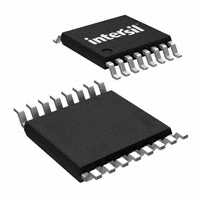
DATASHEET
ISL6144
FN9131
Rev 7.00
October 6, 2011
High Voltage ORing MOSFET Controller
The ISL6144 ORing MOSFET Controller and a suitably sized
N-Channel power MOSFET(s) increases power distribution
efficiency and availability when replacing a power ORing diode
in high current applications.
Features
In a multiple supply, fault tolerant, redundant power distribution
system, paralleled similar power supplies contribute equally to
the load current through various power sharing schemes.
Regardless of the scheme, a common design practice is to
include discrete ORing power diodes to protect against reverse
current flow should one of the power supplies develop a
catastrophic output short to ground. In addition, reverse current
can occur if the current sharing scheme fails and an individual
power supply voltage falls significantly below the others.
• Reverse Current Fault Isolation
Although the discrete ORing diode solution has been used for
some time and is inexpensive to implement, it has some
drawbacks. The primary downside is the increased power
dissipation loss in the ORing diodes as power requirements for
systems increase. Another disadvantage when using an ORing
diode would be failure to detect a shorted or open ORing diode,
jeopardizing power system reliability. An open diode reduces
the system to single point of failure while a diode short might
pose a hazard to technical personnel servicing the system
while unaware of this failure.
• Open Drain, Active Low Fault Output with 120µs Delay
The ISL6144 can be used in 9V to 75V systems having similar
power sources and has an internal charge pump to provide a
floating gate drive for the N-Channel ORing MOSFET. The High
Speed (HS) Comparator protects the common bus from
individual power supply shorts by turning off the shorted feed’s
ORing MOSFET in less than 300ns and ensuring low reverse
current.
Applications
• Wide Supply Voltage Range +9V to +75V
• Transient Rating to +100V
• Internal Charge Pump Allows the use of N-Channel
MOSFET
• HS Comparator Provides Very Fast VIN + 7.5V
8.9
-
-
V
12V Bias Current
I12V
VIN = 12V, VGATE = VIN + VGQP
-
3.5
-
mA
48V Bias Current
I48V
VIN = 48V, VGATE = VIN + VGQP
-
4.5
-
mA
75V Bias Current
I75V
VIN = 75V, VGATE = VIN + VGQP
-
5
-
mA
GATE
Charge Pump Voltage
VGQP
VIN = 12V to 75V
VIN + 9
VIN + 10.5
VIN + 12
V
Gate Low Voltage Level
VGL
VIN - VOUT < 0V
-0.3
VIN
VIN + 0.5
V
Low Pull Down Current
IPDL
Cgs = 39nF, IPDL = Cgs*dVgs/Ttofs
-
5
-
mA
High Pull Down Current
IPDH
Cgs = 39nF, IPDH = Cgs*dVgs/Ttoff
-
2
-
A
Slow Turn-off Time
ttoffs
Cgs = 39nF
-
-
100
µs
Fast Turn-off Time
ttoff
Turn-off from VGATE = VIN + VGQP to VIN + 1V with
Cgs = 39nF (includes HS Comparator delay time)
-
250
300
ns
Start-up “Turn-On” Time
tON
Turn-on from VGATE = VIN to VIN + 7.5V into 39nF
-
1
-
ms
GATE Turn-On Current
ION
VIN = 9V to 75V
-
1
-
mA
ISL6144 controls voltage across FET Vds to
VFWD_HR during static forward operation at loads
resulting in I * rDS(ON) < VFWD_HR
10
20
30
mV
Externally programmable threshold for noise
sensitivity (system dependent), typical 0.05V to 0.3V
0
0.05
5.3
V
CONTROL AND REGULATION I/O
HR Amplifier Forward Voltage
Regulation
VFWD_HR
HS COMP Externally
Programmable Threshold
VTH(HS)
HS Comparator Offset Voltage
VOS(HS)
-40
0
25
mV
ICOMP
-
1.1
-
µA
-
5.5
-
V
Comp Input Current
(Bias Current)
HVREF Voltage (VIN - HVREF)
FN9131 Rev 7.00
October 6, 2011
HVREF(VZ)
VIN = 9V to 75V
Page 5 of 30
�ISL6144
Electrical Specifications
PARAMETER
VSET Voltage (VOUT - VSET)
Fault Low Output Voltage
VIN = 48V, TA = -40°C to +105°C, Unless Otherwise Specified. Boldface limits apply over the operating
temperature range, -40°C to +105°C.
MIN
(Note 12)
TYP
-
5.3
-
V
VIN - VOUT < 0V, VGATE = VGL
-
-
0.5
V
SYMBOL
TEST CONDITIONS
VREF(VSET) VIN = 9V to 75V
VFLT_L
MAX
(Note 12) UNITS
Fault Sink Current
IFLT_SINK
FAULT = VFLT_L, VIN < VOUT, VGATE = VGL
4
-
-
mA
Fault Leakage Current
IFLT_LEAK
FAULT = ”VFLT_H”, VIN > VOUT, VGATE = VIN +
VGQP
-
-
10
µA
GATE = VGL to FAULT = VFLT_L
-
120
-
µs
Fault Delay - Low to High
tFLT
NOTES:
12. Compliance to datasheet limits is assured by one or more methods: production test, characterization and/or design.
Functional Pin Descriptions
GATE
This is the Gate Drive output of the external N-Channel
MOSFET generated by the IC internal charge pump. Gate
turn-on time is typically 1ms.
VIN
Input bias pin connected to the sourcing supply side (ORing
MOSFET Source). Also serves as the sense pin to
determine the sourcing supply voltage. The ORing MOSFET
will be turned off when VIN becomes lower than VOUT by a
value more than the externally set threshold.
VOUT
Connected to the Load side (ORing MOSFET Drain). This is
the VOUT sense pin connected to the load. This is the
common connection point for multiple paralleled supplies.
VOUT is compared to VIN to determine when the ORing
FET has to be turned off.
HVREF
Low side of the internal IC High Voltage Reference used by
internal circuitry, also available as an external pin for
additional external capacitor connection.
COMP
This is the high side connection for the HS Comparator trip
level setting (VTH(HS)). Resistor R1, connected between
COMP and VOUT along with resistor R2, provides adjustable
VOUT - VIN trip level (0V to 5V). This provides flexibility to
externally set the desired level depending on particular
system requirement.
VSET
Low side connection for the HS Comparator trip level setting
A second resistor R2 connected between VSET and COMP
provides adjustable “VIN - VOUT” level along with R1.
FN9131 Rev 7.00
October 6, 2011
FAULT
Open-Drain pull-down FAULT Output with internal on-chip
filtering (tFLT). The ISL6144 fault detection circuitry will
pull-down this pin to GND as soon as it detects a fault.
Different types of faults and their detection mechanisms are
discussed in more detail in the “Functional Block Description”
on page 6.
GND
IC ground reference.
Detailed Description
The ISL6144 and a suitably sized N-Channel power
MOSFET(s) increases power distribution efficiency and
availability when replacing a power ORing diode in high current
applications. Refer to “Application Considerations” on page 8
for power saving when using ISL6144 with an N-channel ORing
MOSFET compared to a typical ORing diode.
Functional Block Description
Regulating Amplifier-Slow (Quiet) Turn-off
A Hysteretic Regulating (HR) Amplifier is used for a
Quiet/Slow turn-off mechanism. This slow turn-off is initiated
when the sourcing power supply is turned off slowly for
system diagnostics. Under normal operating conditions as
VOUT pulls up to 20mV below VIN (VIN - 20mV > VOUT), the
HR Amplifier regulates the gate voltage to keep the 20mV
(VFWD_HR) forward voltage drop across the ORing MOSFET
(Vs - Vd). This will continue until the load current exceeds
the MOSFET ability to deliver the current with Vsd of 20mV.
In this case, Gate will be charged to the full charge pump
voltage (VGQP) to fully enhance the MOSFET. At this point,
the MOSFET will be fully enhanced and behave as a
constant resistor valued at the rDS(ON). Once VIN starts to
drop below VOUT, regulation cannot be maintained and the
output of the HR Amp is pulled high and the gate is pulled
down to VIN slowly in less than a 100µs. As a result, the
ORing FET is turned off, avoiding reverse current as well as
voltage and current stresses on supply components.
Page 6 of 30
�ISL6144
The slow turn-off is achieved in two stages. The first stage
starts with a slow turn-off action and lasts for up to 20µs. The
gate pull down current for the first stage is 2mA. The second
slow turn-off stage completes the gate turn-off with a 10mA
pull down current. The 20µs delay filters out any false trip off
due to noise or glitches that might be present on the supply
line.
The gate turn-on and gate turn-off drivers have a 50kHz filter
to reduce the variation in FET forward voltage drop (and FET
gate voltage) due to normal SMPS system switching noises
(typically higher than 50kHz). These filters do not affect the
total turn-on or slow turn-off times.
Special system design precautions must be taken to insure
that no AC mains related low frequency noise will be present
at the input or output of ISL6144. Filters and multiple power
conversion stages, which are part of any distributed DC
power system, normally filter out all such noise.
HS Comparator-Fast Turn-off
There is a High Speed (HS) Comparator used for fast turnoff of the ORing MOSFET to protect the common bus
against hard short faults at a sourcing power supply output
(refer to Figure 1).
During normal operation the gate of the ORing MOSFET is
charge pumped to a voltage that depends on whether it is in
the 20mV regulation mode or fully enhanced. In this case:
(EQ. 1)
V OUT = V IN – I OUT r DS(ON
If a dead short fault occurs in the sourcing supply, it causes
VIN to drop very quickly while VOUT is not affected as more
than one supply are paralleled. In the absence of the
ISL6144 functionality, a very high reverse current will flow
from Output to the Input supply pulling down the common
DC Bus, resulting in an overall “catastrophic” system failure.
FROM
SOURCING
SUPPLY
VIN
TO SHARED
LOAD
GATE
VOUT
VIN
2A*
+
HS
DRIVER COMP
VTH(HS)
HV PASS
AND
CLAMP
COMP
5.3V VSET
R1
C2
R2
BIAS
R1 + R2 = 50k
FIGURE 1. HS COMPARATOR
FN9131 Rev 7.00
October 6, 2011
The fault can be detected and isolated by using the ISL6144
and an N-Channel ORing MOSFET. VIN is compared to
VCOMP, and whenever:
V IN < V COMP; where
V COMP = V OUT – V TH HS
(EQ. 2)
VTH(HS) is defined below
The fast turn-off mechanism will be activated and the
MOSFET(s) will be turned off very quickly. The speed of this
turn-off depends on the amount of equivalent gate loading
capacitance. For an equivalent Cgs = 39nF. The gate turn-off
time is 12V.
2. Power Losses: In this application the ORing MOSFET is
used as a series pass element, which is normally fully
enhanced at high load currents; switching losses are
negligible. The major losses are conduction losses, which
depend on the value of the on-state resistance of the
MOSFET rDS(ON), and the per feed load current. For an
N + 1 redundant system with perfect current sharing, the
per feed MOSFET losses are as shown in Equation 7:
On the other hand, the most common failures caused by
diode ORing include open circuit and short circuit failures. If
one of these diodes (Feed A) has failed open, then the other
Feed B will provide all of the power demand. The system will
continue to operate without any notification of this failure,
reducing the system to a single point of failure. A much more
dangerous failure is where the diode has failed short. The
system will continue to operate without notification that the
short has occurred. With this failure, transients and failures
on Feed B propagate to Feed A. Also, this silent short failure
could pose a significant safety hazard for technical
personnel servicing these feeds.
“ISL6144 + ORing FET” vs “Discrete ORing FET”
Solution
If we compare the ISL6144 integrated solution to discrete
ORing MOSFET solutions, the ISL6144 wins in all aspects.
The main ones are: PCB real estate saving, cost savings,
and reduction in the MTBF of this section of the circuit as the
overall number of components is reduced.
In brief, the solution offered by this IC enhances power
system performance and protection while not adding any
considerable cost. This solution provides both a PCB board
real estate savings and a simple to implement integrated
solution.
Setting the External HS Comparator Threshold
Voltage
Another important consideration when choosing the ORing
MOSFET is the forward voltage drop across it. If this drop
approaches the 0.41V limit, which is used in the VOUT fault
monitoring mechanism, then this will result in a permanent
fault indication. Normally the voltage drop would be chosen
not to exceed a value around 100mV.
In general, paralleled modules in a redundant power system
have some form of active current sharing, to realize the full
benefit of this scheme, including lower operating
temperatures, lower system failure rate, and better transient
response when load step is shared. Current sharing is
realized using different techniques; all of these techniques
will lead to similar modules operating under similar
conditions in terms of switching frequency, duty cycle, output
voltage and current. When paralleled modules are current
sharing, their individual output ripple will be similar in
amplitude and frequency and the common bus will have the
same ripple as these individual modules and will not cause
any of the turn-off mechanisms to be activated, as the same
ripple will be present on both sensing nodes (VIN and
VOUT). This would allow setting the high speed comparator
threshold (VTH(HS)) to a very low value. As a starting point, a
VTH(HS) of 50mV could be used, the final value of this TH
will be system dependent and has to be finalized in the
system prototype stage. If the gate experiences false turn-off
due to system noise, the VTH(HS) has to be increased.
“ISL6144 + ORing FET” vs “ORing Diode” Solution
The reverse current peak can be estimated as:
“ISL6144 + ORing FET” solution is more efficient, which will
result in simplified PCB and thermal design. It will also
eliminate the need for a heat sink for the ORing diode. This
will result in cost savings. In addition, the ISL6144 solution
provides a more flexible, reliable and controllable ORing
functionality and protects against system fault scenarios
(refer to “Fault Detection Block” on page 8).
V TH HS + V SD + V OS HS
I reverseP = ------------------------------------------------------------------------r DS ON
I LOAD 2
P loss FET = ----------------- r DS ON
N+1
(EQ. 7)
The rDS(ON) value also depends on junction temperature;
a curve showing this relationship is usually part of any
MOSFET’s data sheet. The increase in the value of the
rDS(ON) over temperature has to be taken into account.
3. Current handling capability, steady state and peak, are
also two important parameters that must be considered.
The limitation on the maximum allowable drain current
comes from limitation on the maximum allowable device
junction temperature. The thermal board design has to be
able to dissipate the resulting heat without exceeding the
MOSFET’s allowable junction temperature.
FN9131 Rev 7.00
October 6, 2011
(EQ. 8)
where:
VSD is the MOSFET forward voltage drop.
VOS(HS) is the voltage offset of HS Comparator.
Page 9 of 30
�ISL6144
The duration of the reverse current pulse is a few hundred
nanoseconds and is normally kept well below current rating
of the ORing MOSFET.
Reducing the value of VTH(HS) results in lower reverse
current amplitude and reduces transients on the common
bus output voltage.
HVREF and COMP Capacitor Values
HVREF CAPACITOR (C1)
this capacitor is necessary to stabilize the HVREF(VZ) supply
and a value of 150nF is sufficient. Increasing this value will
result in gate turn-on time increase.
COMP CAPACITOR (C2)
In hot swap applications lacking adequate VIN and VOUT
bulk capacitance and where the ISL6144 is directly
connected to a prebiased bus exposing either the VIN or
VOUT pins directly to high dv/dt transients, these pins must
be filtered to prevent catastrophic damage caused by the
high dv/dt transients. A simple RC filter using a pin 2 series
resistor, of 10 -100and the 100nF or greater best design
practices decoupling capacitor to ground. This will provide a
>1µs rise time on the VIN pin to protect it. A resistor of ~3.3
times the value should be added in series with the VOUT pin
to reduce the introduced HS Vth error.
Alternately, the programmed HS Vth can be adjusted upward
by the voltage across RVIN as described on page 9.
Hot Swapped
Input
Q1
Rin
10-100
Rout
~3.3X Rin
2
3
C1 >
100nF
FN9131 Rev 7.00
October 6, 2011
8
VIN
HVREF
GND
GATE
1
Placed between VOUT and COMP pins to provide filtering
and decoupling. A 10nF capacitor is adequate for most
cases.
Protecting VIN and VOUT from High dv/dt Events
VOUT
COMP
ISL6144
VSET
16
15
14
Page 10 of 30
�ISL6144
Typical Performance Curves and Waveforms
REG AMP FORWARD REGULATION (mV)
CHARGE PUMP VOLTAGE (V)
12
75V
11
48V
12V
10
9
10V
8
7
-40
-20
0
20
40
60
80
100
120
32
75V
28
48V
24
10V AND 12V
20
16
12
-40
-20
0
20
40
60
80
100
120
TEMPERATURE (°C)
TEMPERATURE (°C)
FIGURE 4. CHARGE PUMP VOLTAGE (VGQP) vs
TEMPERATURE
FIGURE 5. REG. AMP FORWARD REGULATION
5.4
6.0
75V
5.0
VSET VOLTAGE (V)
BIAS CURRENT (mA)
5.5
48V
4.5
4.0
12V
12V
3.5
10V
3.0
75V
5.3
48V
10V AND 12V
5.2
5.1
2.5
2.0
-40
-20
0
20
40
60
80
100
120
5.0
-40
-20
0
20
40
60
80
120
FIGURE 7. VSET VOLTAGE
FIGURE 6. I BIAS CURRENT vs TEMPERATURE
HVREF(VZ)
6.000
1V/DIV
75V
5.875
HVREF VOLTAGE (V)
100
TEMPERATURE (°C)
TEMPERATURE (°C)
VG
48V
10V/DIV
VIN
10V/DIV
5.750
10V AND 12V
5.625
IIN
10A/DIV
5.500
5.375
5.250
-40
-20
0
20
40
60
80
100
120
TEMPERATURE (°C)
FIGURE 8. HVREF VOLTAGE
FN9131 Rev 7.00
October 6, 2011
FIGURE 9. FIRST SUPPLY START-UP
Page 11 of 30
�ISL6144
Typical Performance Curves and Waveforms
rDS(ON) = 19m, QTOT = 70nC,
EXTERNAL CGS = 33nF, VTH(HS) = 55mV
rDS(ON) = 19m, QTOT = 70nC,
EXTERNAL CGS = 33nF, VTH(HS) = 55mV
IIN2
(Continued)
IIN2
5A/DIV
VOUT
VIN2
VGS2
5A/DIV
VOUT
10V/DIV
10V/DIV
VIN2
10V/DIV
10V/DIV
VGS2
5V/DIV
5V/DIV
FIGURE 10. HIGH SPEED TURN-OFF, VIN = 48V, COMMON
LOAD IS SMPS (CLOAD = 100µF) WITH
EQUIVALENT 4A LOAD
IIN2
FIGURE 11. HIGH SPEED TURN-OFF, VIN = 48V, COMMON
LOAD IS SMPS (CLOAD = 100µF) WITH
EQUIVALENT 1.3A LOAD
2A/DIV
VOUT
VOUT
2V/DIV
10V/DIV
VIN2
VIN2
10V/DIV
VGS2
5V/DIV
VGS2
5V/DIV
IIN2
FIGURE 12. SLOW SPEED TURN-OFF, VIN = 48V, COMMON
LOAD IS SMPS (CLOAD = 100µF) WITH
EQUIVALENT 4A LOAD
FN9131 Rev 7.00
October 6, 2011
2A/DIV
FIGURE 13. SLOW SPEED TURN-OFF, VIN = 12V, COMMON
LOAD IS SMPS (CLOAD = 100µF) WITH
EQUIVALENT 4A LOAD
Page 12 of 30
�ISL6144
Application Circuit
INPUT BUS 1
36V TO 75VDC
(NOTE 13)
DC/DC
#1
+OUT1 = 48V
+IN +OUT
CIN1
100µF
Cd1
220nF
Ccs1
1nF
PC
SC
PR
-IN
INPUT BUS 2
36V TO 75VDC
CIN2
100µF
+S
+OUT2 = 48V
+S
SC
Ccs2
1nF
PR
-IN
VIN
GATE
VOUT
Rpb2 Sa
Sb
10
FROM
CB
C2
10nF
R5
499
R6
47.5k
C4
10nF
COMMON BUS “CB”
10A
Q2
FDB3632
Cpb2
22µF
C3
150nF
VIN
GATE
VOUT
U1 COMP
HVREF
5V
ISL6144
R4
VSET
FAULT
GND
4.99k
-OUT
R1
499
R2
47.5k
D2 (NOTE 10)
F2 (NOTE 12)
15A
-S
PRIMARY
Q1
FDB3632
HVREF U1 COMP
5V
R3
ISL6144
VSET
FAULT
GND
4.99k
-OUT
+IN +OUT
Cd2
220nF
FROM
CB
Cpb1
22µF C
1
150nF
-S
(NOTE 13)
DC/DC
#2
PC
Rpb1 Sa
Sb
10
D1 (NOTE 10)
F1 (NOTE 12)
15A
SECONDARY
NOTES:
10. D1, D2 are parasitic MOSFET diodes.
11. Remote Sense pin (+S) on both DC/DC converters has to be connected either directly at the module output (Sa closed) or to the CB point (Sb
closed). Connecting to CB is not recommended as it might cause Fault propagation in case of short circuit on a PS output.
12. F1, F2 are optional and can be eliminated depending on power system configuration and requirements.
13. DC/DC #1, 2 configuration is based on Vicor V48B48C250AN3.
FIGURE 14. APPLICATION CIRCUIT FOR A 1 + 1 REDUNDANT 48V SYSTEM
FN9131 Rev 7.00
October 6, 2011
Page 13 of 30
�ISL6144
In a multiple supply, fault tolerant, redundant power
distribution system, paralleled power supplies contribute
equally to the load current through various power sharing
schemes. Regardless of the scheme, a common design
practice is to include discrete ORing power diodes to protect
against reverse current flow should one of the power
supplies develop a catastrophic output short to ground. In
addition, reverse current can occur if the current sharing
scheme fails and an individual power supply voltage falls
significantly below the others.
Although the discrete ORing diode solution has been used
for some time and is inexpensive to implement, it has some
drawbacks. The primary downside is the increased power
dissipation loss in the ORing diodes as power requirements
for systems increase. In some systems this lack of efficiency
results in a cost that surpasses the cost of the ISL6144 and
power FET implementation. The power loss across a typical
ORing diode with 20A is about 10W. Many diodes will be
paralleled to help distribute the heat. In comparison, a FET
with 5mon-resistance dissipates 2W, which constitutes an
80% reduction. When multiplied by the number of paralleled
supplies, the power savings are significant. Another
disadvantage when using an ORing diode would be failure to
detect a shorted or open ORing diode, jeopardizing power
system reliability. An open diode reduces the system to a
single point of failure while a diode short might pose a
hazard to technical personnel servicing the system while
unaware of this failure.
The ISL6144 ORing MOSFET Controller and a suitably
sized N-Channel power MOSFET(s) increase power
distribution efficiency and availability when replacing a
power ORing diode in high current applications. It can be
used in +9V to +75V systems and has an internal charge
pump to provide a floating gate drive for the N-Channel
ORing MOSFET.
The input/output differential trip point “VOUT - VIN” can be
programmed by two external resistors (R1, R2 or R6, R7).
This trip point can be adjusted to avoid false gate trip off due
to power supply noise.
The high speed comparator action protects the common bus
from being affected due to individual power supply shorts by
turning off the ORing MOSFET of the shorted feed in less
than 300ns (when using an ORing MOSFET with equivalent
gate to source capacitance equal to 39nF).
A circuit fault condition is indicated on an open drain FAULT
pin. The fault detection circuitry covers different types of
failures; including dead short in the sourcing supply, a
dead-short of any two ORing MOSFET terminals, or a blown
fuse in the power distribution path.
Typical Application
VIN1
9V TO 75V
PS_1
Q1
C6*
DC/DC
C5*
1
GATE
VPU
VIN
C1
R3
R1 C2
R2
LED1
CS
FAULT GND
RED
PS_2
VOUT
U1
ISL6144
COMP
HVREF
VIN2
9V TO 75V
VSET
Q1
DC/DC C7*
2
C8*
GATE
VPU
R4
VOUT
COMMON BUS
Using the ISL6144EVAL1Z High Voltage
ORing MOSFET Controller Evaluation
Board
VOUT
U2
ISL6144
HVREF
COMP
VIN
C3
LED2
RED
FAULT GND
VSET
R6
C4
R7
R1 = R6 = 499 (5%)
R2 = R7 = 47.5k (5%)
R3 = R4 = 1.21k (5%)
C1 = C2 = 150nF (10V)
C3 = C4 = 10nF (10V)
C5* TO C8* = 100nF *(100V) Optional Decoupling Caps
- LED1, LED2 are red LEDs to indicate a fault, different interfaces
are possible to the FAULT pin.
- VPU is an external pull up voltage source. Also, VOUT can be
used as the pull up source. In this case if it is higher than 16V,
use a zener diode from the FAULT pin to GND with a clamping
voltage less than the rating of the FAULT pin which is 16V.
Related Literature
• TB389 (PCB Land Pattern Design and Surface Mount
Guidelines for QFN (MLFP) Packages)
• Manufacturer’s MOSFET data sheets
The Hysteretic Regulating (HR) Amplifier provides a slow
turn-off of the ORing MOSFET. This turn-off is achieved in
less than 100µs when one of the sourcing power supplies is
shutdown slowly for system diagnostics, ensuring zero
reverse current. This slow turn-off mechanism also reacts to
output voltage droop, degradation, or power-down.
FN9131 Rev 7.00
October 6, 2011
Page 14 of 30
�ISL6144
DC/DC CONVERTERS (NOT PART OF THE EVAL BOARD)
ISL6144EVAL1Z CONTROL BOARD
FIGURE 15. TEST SETUP USING DC/DC MODULES
ISL6144 Evaluation Board Overview
This section of the data sheet serves as an instruction
manual for the ISL6144EVAL1Z board. It also provides
design guidelines and recommendations for using the
ISL6144 for ORing MOSFET control. The ISL6144EVAL1Z
Control Board has two parallel feeds connected to each
other through N-channel ORing MOSFETs. Each ORing
MOSFET has an ISL6144 connected to it. This board
demonstrates the operation of Intersil’s ISL6144 HV ORing
MOSFET Controller IC in a typical 1 + 1 redundant power
system.
To demonstrate the functionality of the ISL6144, two power
supplies with identical output voltages are required as the
input to the ISL6144EVAL1Z board. This will show the ability
of the ISL6144 to provide the gate drive voltage for the
ORing N-Channel MOSFET. The ISL6144 also monitors the
drain (VOUT), source (VIN) and gate voltages in order to
provide reverse current protection and protection against
power feeds’ related faults.
Figure 15 shows a test setup used in the characterization of
ISL6144 in a 1 + 1 redundant power system.
ISL6144EVAL1Z Control Board (Rev C)
the current if their respective voltages are close to each
other). ORing MOSFET’s gate drive voltage, control and
monitoring for each of these feeds are implemented using
the ISL6144.
The board has the following features:
• Evaluation of the ISL6144 in a 1 + 1 redundant power
system using a single board
• Has footprint for a total of three parallel MOSFETs per
feed. Number of MOSFETs used will depend on the load
current (on the standard ISL6144EVAL1Z board only one
MOSFET is populated per feed)
• Allows the user to test turn-on, slow turn-off, fast turn-off
and different fault scenarios
• Visual fault indication with Red LEDs
• Banana Connectors and test points for all inputs, outputs
and IC pins
• Can be easily connected to the power system prototype
for initial evaluation
Note that the board was designed to handle high load
currents (up to 20A per feed) with the appropriate MOSFET
selection.
This board is configured with two input power feeds
connected in parallel for redundancy using ORing
MOSFETs. The ISL6144 allows the two rails to operate in
active ORing mode (This means that both feeds can share
FN9131 Rev 7.00
October 6, 2011
Page 15 of 30
�ISL6144
Input Voltage Range (+9V to +75V)
The ISL6144 can operate in equipment with voltages in the
+9V to +75V range. The ISL6144 can also be used in
systems with negative voltages -9V to -75V, but it has to be
placed on the return (high) side. For example, in ATCA
systems, an ORing of both the low (-48V) and high (-48V
Return) sides is required. In this case the ISL6144 can be
used on the high side.
The ISL6144 draws bias from both the input and output
sides. External bias voltage rail is not needed and cannot be
used. As soon as the Input voltage reaches the minimum
operational voltage, the internal charge pump turns on and
provides gate voltage to turn-on the ORing FET.
Multiple Feed ORing (ISL6144EVAL1Z)
In today’s high availability systems, two or more power
supplies can be paralleled to provide redundancy and fault
tolerance. These paralleled power supplies operate in an
active ORing mode where all of these supplies share the
load current, depending on the redundancy scheme
implemented in the particular system. The power system
must be able to continue its normal operation, even in the
event of one or more failures of these power supplies. Faults
occurring on the power supply side need to be isolated from
the common bus point connected to the system critical
loads. This fault isolation device is known as the ORing
device. The function of the ORing device is to pass the
forward supply current flowing from the power supply side
and block the reverse fault current. A fault current might flow
if a short occurs on the input side (typically this could be a
power supply output capacitor short). In this case, the input
voltage drops and current may flow in the reverse direction
from the load to the input, causing the common bus to drop
and the system to fail. Although ORing diodes are simple to
implement in such systems, they suffer from many
drawbacks, as outlined earlier.
The ISL6144 (with an external N-Channel MOSFET)
provides an integrated solution to perform the ORing
function in high availability systems, while increasing power
system efficiency at the same time.
Operating Instructions and Functional
Tests
Test setup for ISL6144EVAL1Z is shown in Figures 16 and
17 with two options for the input power sources.
Option 1: Using two identical bench power supplies (BPS)
connected directly to the ISL6144EVAL1Z Control Board
(refer to Figure 16). Just make sure to program the voltages
on PS1_V1 and PS2_V2 to identical values so that they
share the load current. A MOSFET (Qshort) is connected at
the Input of one or both feeds as close as possible to the
input connectors of the ISL6144EVAL1Z board. Slow turn-off
of the input BPS can be performed by the on/off button
FN9131 Rev 7.00
October 6, 2011
(depending on the output capacitance value of the power
supply/module, a local loading resistor might be needed to
help discharge the BPS output capacitor). An output
capacitor COUT (equivalent to the capacitor that will be used
in the final power system solution) is connected to the
Common Bus point (VOUT). Different types of loads can be
used (power resistors, electronic load or simply another
DC/DC converter).
Option 2: Using a custom designed DC/DC converter Power
Board which consists of two DC/DC modules connected in
current sharing configuration, each DC/DC module output
can be turned off slowly using the ON/OFF pin or can be
shorted using on-board Power MOSFET (Refer to
Figure 17). In this case also, similar considerations for COUT
and type of load apply as in option 1.
AUX PS* +
5V
+
PS1
+48V
USED ONLY FOR POWERING THE LEDS
PS1_V1 = VIN1
J4
QSHORT
PS1_V1RTN
J6
GND
+
PS2
+48V
J1
5V_AUX
VIN1
J7
PS2_V2 = VIN2
VIN2
J2
VOUT
J3
L
COUT O
A
D
GND
J8
PS2_V2RTN
GND
ISL6144EVAL1Z
BENCH POWER
SUPPLIES
CONTROL
BOARD
*Auxiliary power supply is used to power the LED circuit. If VOUT is
less than 16V, J1 can be connected directly to VOUT (J5). If VOUT is
higher than 16V, we still can use VOUT to replace AUX PS, but a
zener diode has to be connected from FAULT to GND to clamp the
voltage across the pin to 16V or lower.
FIGURE 16. TEST SETUP USING BENCH PS
.
USED ONLY FOR POWERING THE LEDs
AUX PS +
+
PS1
+48V
PS1_V1
J4
J1
PS1_V1RTN
PS2
+48V
PS2_V2
PS2_V2RTN
-
BENCH POWER
SUPPLIES
DC/DC 1
J6
J2
PRI_GND GND
CS
J7
J3
VOUT2
+
VOUT1
DC/DC 2
J8
J9
PRI_GND GND
POWER MODULES
BOARD*
J4
J1
VIN1 5V_AUX
J6
GND
J7
J2
VOUT
J3
VIN2
L
COUT O
A
D
GND
J8
GND
ISL6144EVAL1Z
CONTROL
BOARD
*Power Modules Board can be replaced by bench power supplies or
any discrete DC/DC modules. Just make sure to adjust both VOUT1
and VOUT2 close to each other to allow current sharing between the
two modules (Refer to option 1 and Figure17).
FIGURE 17. TEST SETUP USING DC/DC MODULES
Page 16 of 30
�ISL6144
DC/DC Converter Power Board (not part of the
ISL6144EVAL1Z board)
The DC/DC converter board consists of two DC/DC
converters with independent input voltage rails. In reality, two
identical power supplies can be used in the test setup to
replace this board (contact Intersil Applications Engineering
if you need assistance in your test setup). This DC/DC
converter board is configured for operation at different output
voltage levels depending on the choice of DC/DC modules.
Most evaluation results are provided for a mix of +48V and
+12V input voltages. Any other voltage within the +9V to
+75V range can also be used.
Each DC/DC converter has a low rDS(ON) MOSFET
connected in parallel to the output terminals. This MOSFET
is normally off. When turned on it simulates a short across
the output. Another MOSFET is connected at the ON/OFF
pin of the modules to simulate a slow turn-off of the module.
Single-Feed Evaluation
The ISL6144EVAL1Z is hooked up to two input power
supplies using test setup shown in Figure 16 or Figure 17.
Note that the ISL6144EVAL1Z is populated with one
FDB3632 MOSFET per feed (Nominal value of the
MOSFET’s rDS(ON) is approximately 8mat VGS = 10V).
1. Connect the input power supplies, auxiliary 5V power
supply, load and output capacitor to the ISL6144EVAL1Z.
2. Connect test equipment (Oscilloscope, DMM) to the
signals of interest using on-board test points and scope
probe jacks.
3. Turn-on PS1 with VIN1 = +48V (VIN1 can be any voltage
within +9V to +75V). Turn-on the auxiliary power supply
(AUX PS powering the LED circuit) with +5V. Adjust load
current to 2A. Verify the main operational parameters
such as the 20mV forward regulation at light loads, and
gate voltage as a function of load current.
4. The forward voltage drop across the MOSFET terminals
VSD1 (TP1-TP2) is equal to the maximum of the 20mV
forward regulated voltage drop across the source-drain
“VFWD_HR“ or the product of the load current and the
MOSFET on-state resistance “ILoad * rDS(ON)”.
5. For ILoad = 2A, VSD1 is equal to VFWD_HR = 20mV. The
gate-source voltage is modulated as a function of load
current and MOSFET transconductance. Gate-source
voltage VGS1 (TP13 -TP17) is approximately 4V. In this
case, LED1 is off. LED2 will be RED as VIN2 is still off.
6. Increase the load current ILoad to 4A. Note that VDS1 is
increased to above VFWD_HR and operation in the 20mV
forward regulation cannot be maintained. The MOSFET
cannot deliver the required load current with a 20mV
constant VSD1. In this case, gate voltage is fully chargepumped to VGQP (10.6V nominal).
7. Turn-off VIN1 and turn-on VIN2 and repeat the same tests
listed above. Make sure the ISL6144 is providing gate
voltage, which is modulated based on the load current.
VSD2 is measured between (TP4-TP5), VGS2 is
measured between (TP14-TP21).
FN9131 Rev 7.00
October 6, 2011
Two-Feed Parallel Evaluation
Two Feed parallel operation verification can be performed
after completion of the single feed evaluations. Make sure
that the two Input power supplies connected to the
ISL6144EVAL1Z board are identical in voltage value.
Identical input voltages are needed to enable the two feeds
to share the load current (In real world power systems,
current sharing is most likely insured by the power
supplies/modules that have an active current sharing
feature).
1. Turn-on PS1 and PS2 in sequence (hot plugging is not
recommended). Adjust VIN1 and VIN2 close to each
other. Verify the input current of both feeds to be within
acceptable current sharing accuracy (~10%). Current
sharing accuracy will be very poor at light loads and
becomes better with higher load currents.
2. Adjust the load current to different values and verify that
both VSD1 (TP1 to TP2) and VSD2 (TP4 to TP5) are close
to each other. These two voltages might be different
depending on the amount of load current passing through
each of the two feeds.
3. At light loads, ILoad * rDS(ON) is less than 20mV, the
ISL6144 operates in the forward regulation mode and
gate voltage is modulated as a function of load current.
When ILoad*rDS(ON) becomes higher than the regulated
20mV, the charge pump increases and clamps the gate
voltage to the maximum possible charge pump voltage,
VGQP.
4. Verify the Gate voltage of both MOSFETs VGS1 (TP13 to
TP17) and VGS2 (TP14 to TP21) with different load
currents.
5. Both LED1 and LED2 are off when both feeds are on.
6. For ILoad = 4A, turn-off VIN2 and note that VGS2 has
turned off. LED2 is RED and VGS1 has increased from
around 4V to VGQP.
7. Turn VIN2 back on and turn VIN1 off. VGS1 is now off.
LED1 is RED. VGS2 has increased to VGQP.
Performance Tests
Performance tests can be carried out after the two feeds
have been verified and found to be operational in active,
1 + 1 redundancy (when two feeds share the load current,
current sharing is ensured by the incoming power supplies.)
These include gate turn-on at power supply start-up, fast
speed turn-off (in case of fast dropping input rail), slow
speed turn-off (in response to slow dropping input rail) and
fault detection in response to different faults.
Gate Start-Up Test
FIRST-FEED START-UP
When the first feed is turned on, as VIN1 rises, conduction
occurs through the body diode of the MOSFET. This only
occurs for a short time until the MOSFET gate voltage can
be charge-pumped on. This conduction is necessary for
proper operation of the ISL6144. It provides bias for the gate
Page 17 of 30
�ISL6144
hold off and other internal bias and reference circuitry. The
charge pump circuitry starts functioning as the input voltage
at the VIN pin reaches a value around 8V. The gate voltage
depends on the load current (as explained in previous
sections), The maximum gate voltage will be clamped to a
maximum of VGQP when load current becomes too high to
be handled with 20mV across the source-drain terminals.
Overall, it takes less than 1ms to reach the load-dependent
final gate voltage value. Note that the Input voltage cannot
be hot swapped and has to rise slowly. A rise time of at least
1ms is recommended for the voltage at VIN pin.
VIN = 12V; RESISTIVE LOAD = 5A, CGSEXT = 33nF
IIN1
5A/DIV
VG1
5V/DIV
VIN1
5V/DIV
VIN = 48V; RESISTIVE LOAD = 4A, CGSEXT = 33nF
VIN1,VG1,IIN1 and HVREF(VZ) WAVEFORMS
HVREF(Vz)
5V/DIV
VOUT
5V/DIV
4A
IIN1
2A/DIV
VG1
10V/DIV
0A
FIGURE 19. FIRST FEED VIN1 START-UP (12V CASE)
The start-up tests were done with the addition of an external
gate to source capacitor to demonstrate start-up time with a
total equivalent gate-source capacitance around 39nF.
VIN1
10V/DIV
SECOND (CONSECUTIVE) FEED START-UP
WHEN VIN REACHES ~ 8V AND HVREF REACHES
3V to 4V, GATE CHARGE PUMP ACTION STARTS
VIN1, VG1, IIN1 and VOUT WAVEFORMS
0A
4A
IIN1
5A/DIV
In this case, the ISL6144 for the second (consecutive) feed
(U4) already has output bias voltage as the first parallel feed
has been turned on and VOUT is present on the common bus.
As VIN2 rises, VG2 rises with it (VG2 is GATE2 voltage with
respect to GND). When VIN2 approaches VIN1 value, Gate 2 is
turned. Second feed gate turn-on is faster than the first feed as
the HVREF capacitor (C3) is already charged.The second or
consecutive power supply to be started can be turned on faster
than the first power supply, a rise time of at least 200µs of the
second rail is recommended.
VIN = 48V; RESISTIVE LOAD = 4A, CGS(EXT) = 33nF
VOUT
20V/DIV
IIN2
2A/DIV
VG1
20V/DIV
VIN1
20V/DIV
WHEN VIN REACHES ~ 8V
AND HVREF REACHES 3V TO 4V
GATE CHARGE PUMP ACTION STARTS
FIGURE 18. FIRST FEED VIN1 START-UP (48V CASE)
VOUT
20V/DIV
IN THIS CASE GATE VOLTAGE IS MEASURED
BETWEEN GATE2 AND GND
VG2
SECOND GATE TURNS ON ONLY
WHEN VIN2 REACHES VIN1
20V/DIV
POWER SUPPLY
RELATED DELAY
VIN2
20V/DIV
FIGURE 20. SECOND (CONSECUTIVE) FEED VIN2 START-UP
FN9131 Rev 7.00
October 6, 2011
Page 18 of 30
�ISL6144
Gate Fast Turn-off Test
During normal operation, the ISL6144 provides gate drive
voltage for the ORing MOSFET when the Input voltage
exceeds the output voltage. The current flows in the forward
direction from the input to the output. Now, what happens if
the input voltage drops quickly below the output voltage as a
result of a failure on the input sourcing power supply while
the MOSFET remained on? The answer is: If the MOSFET is
kept on, current starts to flow in the reverse direction from
the output to the input. Of course this is not desired nor
acceptable. It will lead to effectively shorting the output and
causing an overall system failure. In order to block this
reverse current, the ISL6144 senses the voltage at both VIN
and COMP pins (this is VOUT voltage reduced by a resistor
programmable threshold (VTH(HS), it is programmed to
55mV on the EVAL board and could be adjusted by
changing R1, R4 values for both feeds. If VIN drops below
COMP (VOUT - VTH(HS), the High Speed Comparator turns
off the gate of the ORing MOSFET very quickly, the gate pull
down current IPDH is 2A. As a result the reverse current flow
is prevented. The maximum turn-off time is less than 300ns
when using an ORing MOSFET(s) with an equivalent gatesource capacitance of 39nF (equivalent to QTOT = 390nC at
VGS = 10V).
On the ISL6144EVAL1Z board, FDB3632 has an equivalent
gate-source capacitance of 8.4nF, some of the tests are
performed while an external gate to source capacitance is
added to demonstrate gate current sink capability.
VIN1 = VIN2 = 48V; RESISTIVE LOAD = 4A, CGS(EXT) = 0nF
VG2
10V/DIV
VGS1
2V/DIV
IIN1
2A/DIV
VIN1 = VIN2 = 48V;
RESISTIVE LOAD = 6A, Cgs(ext) = 33nF
REVERSE CURRENT
VOUT
10V/DIV
VIN1
10V/DIV
VGS1
5V/DIV
0.1µs/DIV
FIGURE 22. FAST SPEED TURN-OFF (MOSFET WITH
QTOT = 8.4nc) AND 33nF EXTERNAL CGS
VOUT
10V/DIV
IIN1
2A/DIV
tDELAY(HS) is the High Speed Comparator internal worstcase time delay. The setup in Figure 17 can be used to
perform the Input dead-short test; a pulse generator is
connected between Gate-Source of QSHORT1 (use pulse
mode single shot, set the frequency to Backup_PS
Also, the voltage difference between the two rails has to be
higher than the High Speed Comparator threshold voltage.
Prime_PS - Backup_PS >> VTH(HS)
FN9131 Rev 7.00
October 6, 2011
RED
VSET
C4
R7
GND
FIGURE 32. USING ISL6144 FOR BACKUP REDUNDANCY
Remote Sense in Redundant Power
Systems
Remote output voltage sensing is a feature implemented in
most of today’s power supplies. This feature is used to
compensate for any resistive voltage drops between the power
supply output and the load-connection point. The remote
sensing pin (RS/+S) must be connected as close as possible
to the load in order to compensate for any resistive voltage
drops across the power path from the power supply output to
the load. The output of many such power supplies can be
connected in parallel to provide redundancy and fault
tolerance. An ORing device (MOSFET/Diode) is typically used
to provide the required isolation of any fault on the power
supply side from propagating to the load side. In this case it is
not recommended to connect the remote sense pins of the
parallel units to the Common Bus point (at load terminals), as
this can provide an alternative path for fault currents. The
remote sense pins can be connected on the input side of the
ORing device to compensate for any drop prior to it. Using an
ORing MOSFET (compared to an ORing diode) reduces the
forward voltage drop. By using a low rDS(ON) N-Channel
ORing MOSFET in redundant power systems, the forward
voltage drop can be reduced to less than 100mV. This is
another advantage over the ORing diode solution (that has
400mV to 600mV drop) when tight regulation is imposed on the
Common Bus voltage. If remote sense is absolutely required,
one has to make sure that it will not lead to fault propagation
when one power supply output is shorted. The remote sense
configuration has to be looked at and design precautions has
to be made to make sure the redundancy and fault tolerance
are not compromised by the remote sense connection to the
Common Bus.
Page 25 of 30
�ISL6144
PCB Layout Considerations
DRAIN1 - TP2, TP18
The ISL6144EVAL1Z uses a 4 layer PCB with 1oz external
layers and 2oz internal layers, dedicated ground and power
planes are used to insure good efficiency and EMC
performance. Other layer stack-up and thickness is possible
depending on the particular power system.
GATE1 - TP13
The power traces are designed to handle at least 20A of load
per feed. Power and ground planes are made of 2oz copper
and external signal/power layers are 1oz copper.
The loop area for all power traces is minimized to reduce
parasitic inductance.
A ground island can be created under the IC and connected to
the power ground at a single point for reduction of noise that
may be injected from the power ground into the IC ground.
HVREF1 - TP9
COMP1 - TP11
VSET1 - TP10
FAULT1 - TP3
VIN2 - J7
SOURCE2 - TP4, TP21
DRAIN2 - TP5, TP22
GATE2 - TP14
HVREF2 - TP8
Component Selection Summary
COMP2 -TP12
Component selection is listed for one feed and is applicable for
all other parallel feeds.
VSET2 - TP7
R1, R2 - are resistors that define the HS comparator threshold
voltage used in the high speed turn-off. The sum of R1+ R2
50kR1 and R2 are found using Equation 17.
R3 - is a pull-up resistor on the FAULT pin that can be used if
LED1 is not used. FAULT is an open drain that can be used to
interface with an optocoupler, LED or directly to a logic circuit.
This resistor is not populated on the EVAL board.
FAULT2 - TP6
VOUT - J2 and J5 (connect to J1 when VOUT replace LED AUX
PS)
GND - J3, J6, J8, TP24-TP27
V+5V - (AUX PS for LEDs) - J1
R4 - is the FAULT pin LED current limit resistor, R4 is chosen to
have an LED current of about 4mA.
C1 - is the HVREF Capacitor, placed between VIN and HVREF
pins, this capacitor is necessary to stabilize the HVREF(VZ)
supply and a value of 150nF is sufficient. Increasing this value
will result in gate turn-on time increase.
C2 - is the COMP Capacitor, Placed between VOUT and
COMP pins to provide filtering and decoupling. A 10nF
capacitor is adequate for most cases.
C5, C6 - are VIN and VOUT local decoupling capacitors, help
immunize the pins against transients that might result in case
of fast speed gate turn-off.
Q1-Q3 - are ORing MOSFET(s), number of paralleled
MOSFETs depends on device rDS(ON), maximum allowable
losses and junction temperature of the ORing MOSFETs.
U3 - is Intersil’s ISL6144 High Voltage ORing MOSFET
Controller IC.
LED1 - is a red LED used to indicate first feed faults. When
VIN1 is off while VOUT and auxiliary 5V supply are present
LED1 will be red.
List of Test Points and Connectors
VIN1 - J4
SOURCE1 - TP1, TP17
FN9131 Rev 7.00
October 6, 2011
Page 26 of 30
�ISL6144
ISL6144EVAL1Z Schematics
Q3
J1 EXTERNAL 5V VAUX1
V + 5V
Q2
TP17
J4
VIN1
FROM PS1
1
TP28
VIN1
4
TP9
3
J6
3
4
TP2
1
VIN
HVREF
VOUT
COMP
ISL6144
NC2
6 NC3
TP24 7 NC4
8
GND
15
14
VSET
NC8 13
NC7 12
11
NC6
NC1
5
C5
100nF
100V
TP18
TP13
GATE
C1
150nF
10V
U3
DRAIN1
GATE1
TP1
2
2
FDB3632
Q1
C2
10nF
10V
R1
499
R2 TP11
47.5k
VAUX1
R3
4.99k
DNP
R3
1.21k
LED1
1
SOURCE1
DNP
C7
100nF
100V
TP3
TP10
NC5 10
9
2
VIN1
DNP
FAULT
VOUT
FAULT INDICATION
LED AND PULL UP
1
Q6
DNP
2
3
TP25 TP28
Q5
DNP
SOURCE2
J5
VOUT
TP8
VIN
3 HVREF
4
NC1
5 NC2
6 NC3
TP27 7 NC4
8
GND
FN9131 Rev 7.00
October 6, 2011
TP14
VOUT 16
COMP
ISL6144
15
R6
499
C4
10nF
10V
R7
47.5k
TP12
C8
VSET 14
13
100nF
TP7
100V
NC7 12
11
NC6
TP6
NC5 10
FAULT
VAUX1
R9
1.21k
R8
4.99k
DNP
1
U4
C3
150nF
10V
C6
100nF
100V
TP5
GATE2
2
J8
TP22
TP4
TP29
VIN2
4
3
2
GND
LED2
2
1
TP21
DRAIN2
1
VIN2
FROM PS2
FDB3832
Q4
GATE
VIN2
J7
TP15
4 VOUT
9
Page 27 of 30
�ISL6144
Bill of Materials
TABLE 3. BILL OF MATERIALS
COMPONENT
NAME
SIZE, VALUE, RATING
DESCRIPTION/COMMENTS
CONTROL BOARD BOM
R1, R6
VTH(HS) Programming Resistor
499, RNC55, 1/8W
TH on EVAL board, could be replaced by SMT
R2, R7
VTH(HS) Programming Resistor
47.5k, 0603, 1/8W
SMT, 0603
R3, R8
FAULT Pull-up Resistor
4.99k, 0603, 1/8W
SMT, 0603 (DNP)
R4, R9
FAULT LED Current Limit Resistor
1.21k, 0603, 1/8W
SMT, 0603 (used with LED connected to +5V)
LED1
Feed 1 Fault Indication RED LED
Red LED, 0805 ceramic
SMT
LED2
Feed 2 Fault Indication RED LED
Red LED, 0805 ceramic
SMT
C1, C3
HVREF Capacitor
150nF, SM1206, 10V
SMT
C2, C4
COMP Decoupling Capacitor
10nF, SM0805, 10V
SMT
C5, C6
VIN Pin Decoupling Capacitor
100nF, SM1206, 100V
SMT
C7, C8
VOUT Pin Decoupling Capacitor
100nF, SM1206, 100V
SMT
Q1-Q3
Feed 1 ORing MOSFET(s)
FDB3632, 100V, 9m, D2PAK
Q2, Q3 - DNP (populate for higher current
applications if needed)
Q4-Q6
Feed 2 ORing MOSFET(s)
FDB3632, 100V, 9m, D2PAK
Q5, Q6 - DNP (populate for higher current
applications if needed)
U3, U4
ORing MOSFET Controller
ISL6144IV, 10V to 75V
TSSOP16
U5, U6
ORing MOSFET Controller
ISL6144IR, 10V to 75V
20 Ld QFN 5x5 - DNP (alternative footprint)
NOTE: DNP = Do Not Populate
© Copyright Intersil Americas LLC 2004-2011. All Rights Reserved.
All trademarks and registered trademarks are the property of their respective owners.
For additional products, see www.intersil.com/en/products.html
Intersil products are manufactured, assembled and tested utilizing ISO9001 quality systems as noted
in the quality certifications found at www.intersil.com/en/support/qualandreliability.html
Intersil products are sold by description only. Intersil may modify the circuit design and/or specifications of products at any time without notice, provided that such
modification does not, in Intersil's sole judgment, affect the form, fit or function of the product. Accordingly, the reader is cautioned to verify that datasheets are
current before placing orders. Information furnished by Intersil is believed to be accurate and reliable. However, no responsibility is assumed by Intersil or its
subsidiaries for its use; nor for any infringements of patents or other rights of third parties which may result from its use. No license is granted by implication or
otherwise under any patent or patent rights of Intersil or its subsidiaries.
For information regarding Intersil Corporation and its products, see www.intersil.com
FN9131 Rev 7.00
October 6, 2011
Page 28 of 30
�ISL6144
Package Outline Drawing
M16.173
16 LEAD THIN SHRINK SMALL OUTLINE PACKAGE (TSSOP)
Rev 2, 5/10
A
1
3
5.00 ±0.10
SEE DETAIL "X"
9
16
6.40
PIN #1
I.D. MARK
4.40 ±0.10
2
3
0.20 C B A
1
8
B
0.65
0.09-0.20
END VIEW
TOP VIEW
H
1.00 REF
- 0.05
C
1.20 MAX
SEATING
PLANE
0.90 +0.15/-0.10
GAUGE
PLANE
0.25 +0.05/-0.06 5
0.10 M C B A
0.10 C
0°-8°
0.05 MIN
0.15 MAX
SIDE VIEW
0.25
0.60 ±0.15
DETAIL "X"
(1.45)
NOTES:
1. Dimension does not include mold flash, protrusions or gate burrs.
(5.65)
Mold flash, protrusions or gate burrs shall not exceed 0.15 per side.
2. Dimension does not include interlead flash or protrusion. Interlead
flash or protrusion shall not exceed 0.25 per side.
3. Dimensions are measured at datum plane H.
4. Dimensioning and tolerancing per ASME Y14.5M-1994.
5. Dimension does not include dambar protrusion. Allowable protrusion
shall be 0.08mm total in excess of dimension at maximum material
condition. Minimum space between protrusion and adjacent lead
(0.65 TYP)
(0.35 TYP)
TYPICAL RECOMMENDED LAND PATTERN
is 0.07mm.
6. Dimension in ( ) are for reference only.
7. Conforms to JEDEC MO-153.
FN9131 Rev 7.00
October 6, 2011
Page 29 of 30
�ISL6144
Quad Flat No-Lead Plastic Package (QFN)
Micro Lead Frame Plastic Package (MLFP)
L20.5x5
20 LEAD QUAD FLAT NO-LEAD PLASTIC PACKAGE
MILLIMETERS
SYMBOL
MIN
NOMINAL
MAX
NOTES
A
0.80
0.90
1.00
-
A1
-
0.02
0.05
-
A2
-
0.65
1.00
9
0.38
5, 8
A3
b
0.20 REF
0.23
0.30
9
D
5.00 BSC
-
D1
4.75 BSC
9
D2
2.95
E
E1
E2
3.10
3.25
7, 8
5.00 BSC
-
4.75 BSC
2.95
e
3.10
9
3.25
7, 8
0.65 BSC
-
k
0.20
-
-
-
L
0.35
0.60
0.75
8
N
20
2
Nd
5
3
Ne
5
3
P
-
-
0.60
9
-
-
12
9
Rev. 4 11/04
NOTES:
1. Dimensioning and tolerancing conform to ASME Y14.5-1994.
2. N is the number of terminals.
3. Nd and Ne refer to the number of terminals on each D and E.
4. All dimensions are in millimeters. Angles are in degrees.
5. Dimension b applies to the metallized terminal and is measured
between 0.15mm and 0.30mm from the terminal tip.
6. The configuration of the pin #1 identifier is optional, but must be
located within the zone indicated. The pin #1 identifier may be
either a mold or mark feature.
7. Dimensions D2 and E2 are for the exposed pads which provide
improved electrical and thermal performance.
8. Nominal dimensions are provided to assist with PCB Land Pattern
Design efforts, see Intersil Technical Brief TB389.
9. Features and dimensions A2, A3, D1, E1, P & are present when
Anvil singulation method is used and not present for saw
singulation.
10. Compliant to JEDEC MO-220VHHC Issue I except for the "b"
dimension.
FN9131 Rev 7.00
October 6, 2011
Page 30 of 30
�