DATASHEET
ISL85005, ISL85005A
FN8871
Rev.2.00
May 17, 2018
4.5V to 18V Input, 5A High Efficiency Synchronous Buck Regulator
The ISL85005 and ISL85005A are monolithic, synchronous
buck regulators with integrated 5A, 18V high-side and low-side
FETs. These devices provide an integrated bootstrap diode for
the high-side gate driver to reduce the external parts count.
These devices also have a wide input voltage range to support
applications with input voltage from multi-cell batteries or
regulated 5V and 12V power rails.
Features
The ISL85005 and ISL85005A regulate the output voltage
with current mode control and have an internal oscillator. The
switching frequency of the ISL85005 is internally set as
500kHz, and can be synchronized to an external clock signal
with frequency ranges from 300kHz to 2MHz. The ISL85005A
has a fixed 500kHz switching frequency.
• Current mode control with internal slope compensation
• 4.5V to 18V input voltage range
• Internal 5A, 18V high-side and low-side MOSFET switches
• ±1%, 0.8V feedback voltage reference
• Integrated bootstrap diode with undervoltage detection
• Internal or external compensation options
• Default internally set 500kHz switching frequency
• Synchronization capability to external clock (ISL85005)
• Diode Emulation Mode (DEM) and Forced CCM (FCCM)
options (ISL85005)
• Adjustable soft-start time (ISL85005A)
• Output Power-Good (PG) indicator
• Input Undervoltage Lockout (UVLO), input and output
overvoltage protection
• High-side cycle-by-cycle current limit, low-side forward and
reverse overcurrent protection, and thermal shutdown
The ISL85005 has a fixed 2.3ms soft-start, while the
ISL85005A features programmable soft-start to limit inrush
current during startup. With the SS pin floating, the soft-start
time of ISL85005A is also 2.3ms.
The ISL85005 can be configured in either forced Continuous
Conduction Mode (CCM) or Diode Emulation Mode (DEM). DEM
enables high efficiency at light-load conditions. The
ISL85005A always operates in forced CCM.
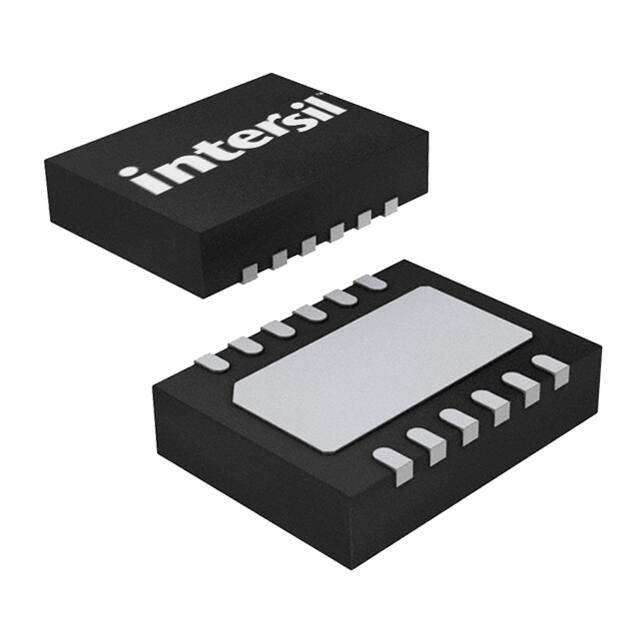
• Small 12-pin 3mmx4mm Dual Flat No-Lead (DFN) package
with EPAD for enhanced thermal performance
The ISL85005 and ISL85005A have built-in protections
including input UVLO protection, input and output overvoltage
protection, high-side cycle-by-cycle current limit, low-side
forward current limit and reverse current limit, and thermal
shutdown.
Applications
• Network and communications equipment
• Battery powered systems
Related Literature
• Multifunction printers
• Point-of-load regulators
For a full list of related documents, visit our website
• Standard 12V rail supplies
• ISL85005, ISL85005A product pages
• Embedded computing systems
Typical Application
95
1
SYNC/
MODE
PG
2 PG
VDD 11
EN
3 EN
VIN 10
PGND
VIN
9
5 COMP
PHASE
8
6 AGND
PHASE
7
4 FB
R1
R2
C1
85
C4
BOOT 12
C3
VIN
4.5V TO 18V
C5
L1
C8
C6
VOUT
5A MAX
C9
EFFICIENCY (%)
MODE
90
ISL85005
GND = DEM; VCC = FCCM
80
75
70
12V TO 5V
65
12V TO 3.3V
60
12V TO 1.8V
55
50
0
1
2
3
4
OUTPUT CURRENT (A)
FIGURE 1. ISL85005 WITH INTERNAL COMPENSATION
FN8871 Rev.2.00
May 17, 2018
FIGURE 2. EFFICIENCY vs OUTPUT CURRENT
Page 1 of 23
5
�ISL85005, ISL85005A
Table of Contents
Typical Application . . . . . . . . . . . . . . . . . . . . . . . . . . . . . . . . . . . . . . . . . . . . . . . . . . . . . . . . . . . . . . . . . . . . . . . . . . . . . . . . . . . . . . . . . . 1
Functional Block Diagram . . . . . . . . . . . . . . . . . . . . . . . . . . . . . . . . . . . . . . . . . . . . . . . . . . . . . . . . . . . . . . . . . . . . . . . . . . . . . . . . . . . . 3
Pin Configurations. . . . . . . . . . . . . . . . . . . . . . . . . . . . . . . . . . . . . . . . . . . . . . . . . . . . . . . . . . . . . . . . . . . . . . . . . . . . . . . . . . . . . . . . . . . 4
Pin Descriptions. . . . . . . . . . . . . . . . . . . . . . . . . . . . . . . . . . . . . . . . . . . . . . . . . . . . . . . . . . . . . . . . . . . . . . . . . . . . . . . . . . . . . . . . . . . . . 4
Ordering Information . . . . . . . . . . . . . . . . . . . . . . . . . . . . . . . . . . . . . . . . . . . . . . . . . . . . . . . . . . . . . . . . . . . . . . . . . . . . . . . . . . . . . . . . 5
Typical Application Schematics. . . . . . . . . . . . . . . . . . . . . . . . . . . . . . . . . . . . . . . . . . . . . . . . . . . . . . . . . . . . . . . . . . . . . . . . . . . . . . . . 6
Absolute Maximum Ratings . . . . . . . . . . . . . . . . . . . . . . . . . . . . . . . . . . . . . . . . . . . . . . . . . . . . . . . . . . . . . . . . . . . . . . . . . . . . . . . . . . . 7
Thermal Information . . . . . . . . . . . . . . . . . . . . . . . . . . . . . . . . . . . . . . . . . . . . . . . . . . . . . . . . . . . . . . . . . . . . . . . . . . . . . . . . . . . . . . . . . 7
Recommended Operating Conditions . . . . . . . . . . . . . . . . . . . . . . . . . . . . . . . . . . . . . . . . . . . . . . . . . . . . . . . . . . . . . . . . . . . . . . . . . . 7
Electrical Specifications . . . . . . . . . . . . . . . . . . . . . . . . . . . . . . . . . . . . . . . . . . . . . . . . . . . . . . . . . . . . . . . . . . . . . . . . . . . . . . . . . . . . . 7
Typical Characteristics . . . . . . . . . . . . . . . . . . . . . . . . . . . . . . . . . . . . . . . . . . . . . . . . . . . . . . . . . . . . . . . . . . . . . . . . . . . . . . . . . . . . . . . 9
Typical Performance Curves . . . . . . . . . . . . . . . . . . . . . . . . . . . . . . . . . . . . . . . . . . . . . . . . . . . . . . . . . . . . . . . . . . . . . . . . . . . . . . . . . 11
Detailed Description . . . . . . . . . . . . . . . . . . . . . . . . . . . . . . . . . . . . . . . . . . . . . . . . . . . . . . . . . . . . . . . . . . . . . . . . . . . . . . . . . . . . . . . . 15
Operation Initialization. . . . . . . . . . . . . . . . . . . . . . . . . . . . . . . . . . . . . . . . . . . . . . . . . . . . . . . . . . . . . . . . . . . . . . . . . . . . . . . . . . . . . .
FCCM Control Scheme . . . . . . . . . . . . . . . . . . . . . . . . . . . . . . . . . . . . . . . . . . . . . . . . . . . . . . . . . . . . . . . . . . . . . . . . . . . . . . . . . . . . . . . . . . .
Light-Load Operation. . . . . . . . . . . . . . . . . . . . . . . . . . . . . . . . . . . . . . . . . . . . . . . . . . . . . . . . . . . . . . . . . . . . . . . . . . . . . . . . . . . . . . . . . . . . .
Synchronization Control . . . . . . . . . . . . . . . . . . . . . . . . . . . . . . . . . . . . . . . . . . . . . . . . . . . . . . . . . . . . . . . . . . . . . . . . . . . . . . . . . . . . . . . . . .
Enable, Soft-Start, and Disable . . . . . . . . . . . . . . . . . . . . . . . . . . . . . . . . . . . . . . . . . . . . . . . . . . . . . . . . . . . . . . . . . . . . . . . . . . . . . . . . . . . .
Output Voltage Selection . . . . . . . . . . . . . . . . . . . . . . . . . . . . . . . . . . . . . . . . . . . . . . . . . . . . . . . . . . . . . . . . . . . . . . . . . . . . . . . . . . . . . . . . .
15
15
15
15
16
16
Protection Features. . . . . . . . . . . . . . . . . . . . . . . . . . . . . . . . . . . . . . . . . . . . . . . . . . . . . . . . . . . . . . . . . . . . . . . . . . . . . . . . . . . . . . . . .
Forward Overcurrent Protection. . . . . . . . . . . . . . . . . . . . . . . . . . . . . . . . . . . . . . . . . . . . . . . . . . . . . . . . . . . . . . . . . . . . . . . . . . . . . . . . . . . .
Reverse Overcurrent Protection. . . . . . . . . . . . . . . . . . . . . . . . . . . . . . . . . . . . . . . . . . . . . . . . . . . . . . . . . . . . . . . . . . . . . . . . . . . . . . . . . . . .
Output Overvoltage Protection. . . . . . . . . . . . . . . . . . . . . . . . . . . . . . . . . . . . . . . . . . . . . . . . . . . . . . . . . . . . . . . . . . . . . . . . . . . . . . . . . . . . .
Input Overvoltage Protection . . . . . . . . . . . . . . . . . . . . . . . . . . . . . . . . . . . . . . . . . . . . . . . . . . . . . . . . . . . . . . . . . . . . . . . . . . . . . . . . . . . . . .
Thermal Overload Protection . . . . . . . . . . . . . . . . . . . . . . . . . . . . . . . . . . . . . . . . . . . . . . . . . . . . . . . . . . . . . . . . . . . . . . . . . . . . . . . . . . . . . .
Power Derating Characteristics . . . . . . . . . . . . . . . . . . . . . . . . . . . . . . . . . . . . . . . . . . . . . . . . . . . . . . . . . . . . . . . . . . . . . . . . . . . . . . . . . . . .
16
16
16
16
16
16
16
Application Guidelines . . . . . . . . . . . . . . . . . . . . . . . . . . . . . . . . . . . . . . . . . . . . . . . . . . . . . . . . . . . . . . . . . . . . . . . . . . . . . . . . . . . . . .
Boot Undervoltage Detection . . . . . . . . . . . . . . . . . . . . . . . . . . . . . . . . . . . . . . . . . . . . . . . . . . . . . . . . . . . . . . . . . . . . . . . . . . . . . . . . . . . . . .
Switching Regulator Output Capacitor Selection. . . . . . . . . . . . . . . . . . . . . . . . . . . . . . . . . . . . . . . . . . . . . . . . . . . . . . . . . . . . . . . . . . . . . .
Output Inductor Selection. . . . . . . . . . . . . . . . . . . . . . . . . . . . . . . . . . . . . . . . . . . . . . . . . . . . . . . . . . . . . . . . . . . . . . . . . . . . . . . . . . . . . . . . .
Input Capacitor Selection . . . . . . . . . . . . . . . . . . . . . . . . . . . . . . . . . . . . . . . . . . . . . . . . . . . . . . . . . . . . . . . . . . . . . . . . . . . . . . . . . . . . . . . . .
Loop Compensation Design . . . . . . . . . . . . . . . . . . . . . . . . . . . . . . . . . . . . . . . . . . . . . . . . . . . . . . . . . . . . . . . . . . . . . . . . . . . . . . . . . . . . . . .
17
17
17
18
18
19
Compensator Design Goal . . . . . . . . . . . . . . . . . . . . . . . . . . . . . . . . . . . . . . . . . . . . . . . . . . . . . . . . . . . . . . . . . . . . . . . . . . . . . . . . . . . 19
High DC Gain . . . . . . . . . . . . . . . . . . . . . . . . . . . . . . . . . . . . . . . . . . . . . . . . . . . . . . . . . . . . . . . . . . . . . . . . . . . . . . . . . . . . . . . . . . . . . . . . . . . 19
Layout Considerations. . . . . . . . . . . . . . . . . . . . . . . . . . . . . . . . . . . . . . . . . . . . . . . . . . . . . . . . . . . . . . . . . . . . . . . . . . . . . . . . . . . . . . . . . . . . 19
Revision History. . . . . . . . . . . . . . . . . . . . . . . . . . . . . . . . . . . . . . . . . . . . . . . . . . . . . . . . . . . . . . . . . . . . . . . . . . . . . . . . . . . . . . . . . . . . 21
Package Outline Drawing . . . . . . . . . . . . . . . . . . . . . . . . . . . . . . . . . . . . . . . . . . . . . . . . . . . . . . . . . . . . . . . . . . . . . . . . . . . . . . . . . . . . 22
FN8871 Rev.2.00
May 17, 2018
Page 2 of 23
�ISL85005, ISL85005A
Functional Block Diagram
1
SS (ISL85005A)
SOFT-START
BOOT
CONTROL
12
BOOT
UVP
SYNC/MODE (ISL85005)
1
VDD
UNDERVOLTAGE
VIN
LDO
EN
LOCKOUT
11
9
OSCILLATOR
10
CSA
2
PG
FAULT
0.8V
MONITOR
REFERENCE
+
SLOPE
COMP
CIRCUITS
+
-
3
EN
+
+
THERMAL
SHUTDOWN
4
FB
600k
COMP
AGND
8
13
ZERO CROSS
DETECTOR
AND
NEGATIVE
CURRENT
LIMIT
GND DETECTION
6
7
VDD
PGND
EA
-
30pF
5
PHASE
GATE DRIVE
CONTROL
CIRCUIT
POSITIVE
LS OCP
CIRCUIT
FIGURE 3. BLOCK DIAGRAM
FN8871 Rev.2.00
May 17, 2018
Page 3 of 23
�ISL85005, ISL85005A
Pin Configurations
ISL85005A
(12 LD 3x4 DFN)
TOP VIEW
ISL85005
(12 LD 3x4 DFN)
TOP VIEW
SYNC/MODE
1
12
BOOT
SS
1
12
BOOT
PG
2
11
VDD
PG
2
11
VDD
EN
3
10
VIN
EN
3
10
VIN
FB
4
9
VIN
FB
4
9
VIN
COMP
5
8
PHASE
COMP
5
8
PHASE
AGND
6
7
PHASE
AGND
6
7
PHASE
PGND
(EPAD)
PGND
(EPAD)
Pin Descriptions
PIN
NUMBER
PIN
NAME
1
(ISL85005)
SYNC/
MODE
Synchronization and mode selection input. Connect to VDD for Forced Continuous Conduction Mode (FCCM). Connect to AGND
for Diode Emulation Mode (DEM). Connect to an external function generator for synchronization with the positive edge trigger.
The internal 1MΩ pull-up resistor to VDD prevents an undefined logic state when SYNC is floating.
1
(ISL85005A)
SS
Soft-start input. This pin provides a programmable soft-start. When the chip is enabled, the regulated 3.5µA pull-up current
source charges a capacitor connected from SS to ground. The output voltage of the converter follows the ramping voltage on
this pin. Without the external capacitor, the default soft-start is 2.3ms.
2
PG
Power-good, open-drain output. Connect a 10kΩ to 100kΩ pull-up resistor between PG and VDD or between PG and a voltage
not exceeding 5.5V. PG transitions high about 1.5ms after the switching regulator’s output voltage reaches the regulation
threshold, which is typically 85% of the regulated output voltage.
3
EN
Enable input. The regulator is held off when the pin is pulled to ground. The device is enabled when the voltage on this pin rises
above 0.6V.
4
FB
Feedback input. The synchronous buck regulator employs a current mode control loop. FB is the negative input to the voltage
loop error amplifier. The output voltage is set by an external resistor divider connected to FB. The output voltage can be set to
any voltage between the power rail (reduced by converter losses) and the 0.8V reference.
5
COMP
Compensation node. This pin is connected to the output of the error amplifier and compensates the loop. Internal
compensation meets most applications. Connect COMP to AGND to select internal compensation. Connect a compensation
network between COMP and FB to use external compensation.
6
AGND
The AGND terminal. Provides the return path for the core analog control circuitry within the device. Connect AGND to the board
ground plane. AGND and PGND are connected internally within the device. Do not operate the device with AGND and PGND
connected to dissimilar voltages.
Phase switch output node. Connect to the external output inductor.
DESCRIPTION
7, 8
PHASE
9, 10
VIN
Voltage supply input. The main power input for the IC. Connect to a suitable voltage supply. Place a ceramic capacitor from VIN
to PGND, close to the IC for decoupling.
11
VDD
Low dropout linear regulator decoupling pin. VDD is the internally generated 5V supply voltage and is derived from VIN. The
VDD powers all the internal core analog control blocks and drivers. Connect a 1µF capacitor from VDD to the board ground
plane. If VIN is between 3V to 5.5V, then connect VDD directly to VIN to improve efficiency.
12
BOOT
Bootstrap input. A floating bootstrap supply pin for the upper power MOSFET gate driver. Connect a 0.1µF capacitor between
BOOT and PHASE.
(EPAD)
PGND
Power ground terminal. Provides thermal relief for the package and is connected to the source of the low-side output MOSFET.
Connect PGND to the board ground plane using as many vias as possible. AGND and PGND are connected internally within the
device. Do not operate the device with AGND and PGND connected to dissimilar voltages.
FN8871 Rev.2.00
May 17, 2018
Page 4 of 23
�ISL85005, ISL85005A
Ordering Information
PART NUMBER
(Notes 2, 3, 4)
PART
MARKING
TEMP. RANGE
(°C)
OPTION
FREQUENCY
(kHz)
TAPE AND REEL
PACKAGE
(UNITS) (Note 1) (RoHS COMPLIANT)
PKG.
DWG. #
ISL85005FRZ
005F
-40 to +125
SYNC
500
-
12 Ld DFN
L12.3x4
ISL85005FRZ-T
005F
-40 to +125
SYNC
500
6k
12 Ld DFN
L12.3x4
ISL85005FRZ-TK
005F
-40 to +125
SYNC
500
1k
12 Ld DFN
L12.3x4
ISL85005FRZ-T7A
005F
-40 to +125
SYNC
500
250
12 Ld DFN
L12.3x4
ISL85005AFRZ
005A
-40 to +125
SOFT-START
500
-
12 Ld DFN
L12.3x4
ISL85005AFRZ-T
005A
-40 to +125
SOFT-START
500
6k
12 Ld DFN
L12.3x4
ISL85005AFRZ-TK
005A
-40 to +125
SOFT-START
500
1k
12 Ld DFN
L12.3x4
ISL85005AFRZ-T7A
005A
-40 to +125
SOFT-START
500
250
12 Ld DFN
L12.3x4
ISL85005AEVAL1Z
Evaluation Board
ISL85005ADEMO1Z
Demonstration Board
ISL85005EVAL1Z
Evaluation Board
ISL85005DEMO1Z
Demonstration Board
NOTES:
1. Refer to TB347 for details about reel specifications.
2. These Pb-free plastic packaged products employ special Pb-free material sets, molding compounds/die attach materials, and 100% matte tin plate
plus anneal (e3 termination finish, which is RoHS compliant and compatible with both SnPb and Pb-free soldering operations). Pb-free products are
MSL classified at Pb-free peak reflow temperatures that meet or exceed the Pb-free requirements of IPC/JEDEC J STD-020.
3. For Moisture Sensitivity Level (MSL), see the ISL85005, ISL85005A product information pages. For more information about MSL, refer to TB363.
4. The ISL85005 is provided with a frequency synchronization input. The ISL85005A is a version of the part with programmable soft-start.
TABLE 1. KEY DIFFERENCES BETWEEN FAMILY OF PARTS
INTERNAL/EXTERNAL
COMPENSATION
EXTERNAL FREQUENCY
SYNC
PROGRAMMABLE
SOFT-START
SWITCHING
FREQUENCY (kHz)
CURRENT
RATING
ISL85005A
Yes
No
Yes
500
5A
ISL85005
Yes
Yes
No
500
5A
ISL85003
Yes
Yes
No
500
3A
ISL85003A
Yes
No
Yes
500
3A
PART NUMBER
FN8871 Rev.2.00
May 17, 2018
Page 5 of 23
�ISL85005, ISL85005A
Typical Application Schematics
ISL85005
GND = DEM; VCC = FCCM
MODE
1 SYNC/
BOOT 12
MODE
PG
EN
2 PG
VDD 11
3 EN
VIN 10
PGND
4 FB
R1
R2
C1
VIN 9
5 COMP
PHASE 8
6 AGND
PHASE 7
C4
VIN
4.5V TO 18V
C3
C6
C5
VOUT
5A MAX
L1
C8
C9
FIGURE 4. ISL85005 VIN RANGE FROM 4.5V TO 18V WITH INTERNAL COMPENSATION
ISL85005A
CSS
1 SS
BOOT 12
PG
2 PG
VDD 11
EN
3 EN
4 FB
R1
R2
C1
C4
VIN
4.5V TO 18V
VIN 10
PGND
VIN 9
5 COMP
PHASE 8
6 AGND
PHASE 7
C3
C6
C5
VOUT
5A MAX
L1
C8
C9
FIGURE 5. ISL85005A VIN RANGE FROM 4.5V TO 18V, WITH INTERNAL COMPENSATION WITH PROGRAMMABLE SOFT-START
TABLE 2. COMPONENTS SELECTION (REFER TO Figures 1 AND 2)
VOUT
1.2V
1.8V
2.5V
3.3V
5V
C5, C6
1OµF
1OµF
1OµF
1OµF
1OµF
C8, C9
47µF
47µF
47µF
47µF
47µF
C1
12pF
12pF
12pF
12pF
12pF
L1
3.3µH
3.3µH
3.3µH
3.3µH
3.3µH
R1
499kΩ
499kΩ
499kΩ
499kΩ
499kΩ
R2
998kΩ
392kΩ
232kΩ
157kΩ
95.3kΩ
NOTE: VIN = 12V, IOUT = 5A; The components selection table is a suggestion for typical application using internal compensation mode. For application
that requires high output capacitance greater than 200µF, R1 should be adjusted to maintain loop response bandwidth about 40kHz. See “Loop
Compensation Design” on page 19 for more detail.
FN8871 Rev.2.00
May 17, 2018
Page 6 of 23
�ISL85005, ISL85005A
Absolute Maximum Ratings
Thermal Information
VIN, EN to AGND and PGND. . . . . . . . . . . . . . . . . . . . . . . . . . . -0.3V to + 24V
PHASE to AGND and PGND . . . . . . . . . . . . . . . . . . . . . . . -0.7V to +24V (DC)
PHASE to AGND and PGND . . . . . . . . . . . . . . . . . . . . . . . -2V to +24V (40ns)
FB to AGND and PGND. . . . . . . . . . . . . . . . . . . . . . . . . . . . . . . . -0.3V to + 7V
BOOT to PHASE . . . . . . . . . . . . . . . . . . . . . . . . . . . . . . . . . . . . . . -0.3V to + 7V
VDD, COMP, SYNC, PG to AGND and PGND . . . . . . . . . . . . . . . -0.3V to + 7V
Junction Temperature Range at 0A . . . . . . . . . . . . . . . . . .-55°C to +150°C
ESD Rating
Human Body Model (Tested per JESD22-A114F) . . . . . . . . . . . . . . .2.5kV
Machine Model (Tested per JESD22-A115-C) . . . . . . . . . . . . . . . . . 150V
Charged Device Model (Tested per JESD22-C101-E) . . . . . . . . . . . . . 1kV
Latch-Up (Tested per JESD-78D; Class 2, Level A) . . . . . . . . . . . . . . 100mA
Thermal Resistance
JA (°C/W) JC (°C/W)
DFN Package (Notes 5, 6) . . . . . . . . . . . . . .
41
3
Maximum Storage Temperature Range . . . . . . . . . . . . . .-65°C to +150°C
Junction Temperature Range . . . . . . . . . . . . . . . . . . . . . . .-40°C to +125°C
Pb-Free Reflow Profile . . . . . . . . . . . . . . . . . . . . . . . . . . . . . . . . . . see TB493
Recommended Operating Conditions
VIN Supply Voltage Range . . . . . . . . . . . . . . . . . . . . . . . . . . . . . . 4.5V to 18V
Load Current Range . . . . . . . . . . . . . . . . . . . . . . . . . . . . . . . . . . . . . . 0A to 5A
CAUTION: Do not operate at or near the maximum ratings listed for extended periods of time. Exposure to such conditions may adversely impact product
reliability and result in failures not covered by warranty.
NOTES:
5. JA is measured in free air with the component mounted on a high-effective thermal conductivity test board with “direct attach” features. See TB379.
6. For JC, the “case temp” location is the center of the exposed metal pad on the package underside.
Electrical Specifications All parameter limits are established over the recommended operating conditions with TJ = -40°C to +125°C,
and with VIN = 12V unless otherwise noted. Typical values are at TA = +25°C. Boldface limits apply across the operating junction temperature range,
-40°C to +125°C.
PARAMETER
SYMBOL
TEST CONDITIONS
MIN
(Note 7)
MAX
(Note 7)
UNIT
18
V
3.2
4.5
mA
TYP
SUPPLY VOLTAGE
VIN Voltage Range
VIN
VIN Quiescent Supply Current
IQ
SYNC = Low, EN > 1V, FB = 0.85V, not switching
VIN Shutdown Supply Current
ISD
EN = AGND
6
11
µA
Rising edge
4.20
4.35
V
4.5
UNDERVOLTAGE LOCKOUT
VIN UVLO Threshold
Falling edge
3.5
3.8
VIN = 6V to 18V, IVDD = 0mA to 30mA
4.30
5.00
V
INTERNAL VDD LDO
VDD Output Voltage
VDD Output Current Limit
5.50
50
V
mA
OSCILLATOR
Nominal Switching Frequency
fSW
Minimum On-Time
tON
Minimum Off-Time
Synchronization Range
400
500
600
kHz
IOUT = 0mA (Note 8)
120
140
ns
tOFF
(Note 8)
140
180
ns
SYNC
ISL85005
300
2000
kHz
SYNC High-Time
tHI
ISL85005
100
ns
SYNC Low-Time
tLO
ISL85005
100
ns
SYNC Logic Input Low
ISL85005
0.50
SYNC Logic Input High
ISL85005
1.20
VIN = 4.5V to 18V
0.792
V
V
ERROR AMPLIFIER
FB Regulation Voltage
VFB
FB Leakage Current
Open-Loop Bandwidth
Gain
FN8871 Rev.2.00
May 17, 2018
VFB = 0.8V (Note 8)
BW
0.800
0.808
V
0.3
10.0
nA
5.5
MHz
70
dB
Page 7 of 23
�ISL85005, ISL85005A
Electrical Specifications All parameter limits are established over the recommended operating conditions with TJ = -40°C to +125°C,
and with VIN = 12V unless otherwise noted. Typical values are at TA = +25°C. Boldface limits apply across the operating junction temperature range,
-40°C to +125°C. (Continued)
PARAMETER
SYMBOL
Output Drive
TEST CONDITIONS
MIN
(Note 7)
VCOMP = 1.5V
Current Sense Gain
RT
Slope Compensation
Se
fSW = 500kHz
TYP
MAX
(Note 7)
UNIT
±110
µA
0.15
Ω
550
mV/µs
ENABLE INPUT
EN Input Threshold
Rising edge
0.5
0.6
0.7
V
Hysteresis
60
100
140
mV
Default Soft-Start Time
ISL85005, ISL85005A with SS pin floating
1.0
2.3
3.6
ms
SS Internal Soft-Start Charging Current
ISL85005A
2.5
3.5
4.5
µA
SOFT-START FUNCTION
POWER-GOOD OPEN-DRAIN OUTPUT
Output Low Voltage
IPG = 5mA sinking
0.25
V
PG Pin Leakage Current
VPG = VDD
0.01
µA
PG Lower Threshold
Percentage of output regulation
80
85
90
PG Upper Threshold
Percentage of output regulation
110
115
120
PG Thresholds Hysteresis
Delay Time
%
%
3
%
Rising edge
1.5
ms
Falling edge
18
µs
FAULT PROTECTION
High-Side MOSFET Forward Current Limit
Threshold
IPOCP
Low-Side MOSFET Reverse Current Limit
Threshold
INOCP
6
7.8
A
9.5
Current forced into PHASE node, high-side MOSFET is off,
SYNC = High
-3.3
A
Low-Side MOSFET Forward Current Limit
Threshold
Current in low-side MOSFET at end of low-side cycle.
8.6
A
VIN Overvoltage Threshold
VIN rising
20
V
1
V
19
Hysteresis
Thermal Shutdown Threshold
TSD
Temperature rising
165
°C
THYS
Hysteresis
10
°C
High-Side MOSFET On-Resistance
RHDS
IPHASE = 100mA
57
95
mΩ
Low-Side MOSFET On-Resistance
RLDS
IPHASE = 100mA
40
75
mΩ
EN = AGND
10
kΩ
ISL85005
150
mA
POWER MOSFET
PHASE Pull-Down Resistor
DIODE EMULATION
Zero-Cross Detection Threshold
NOTE:
7. Compliance to datasheet limits is assured by one or more methods: production test, characterization, and/or design.
8. Compliance to limits is assured by characterization and design.
FN8871 Rev.2.00
May 17, 2018
Page 8 of 23
�ISL85005, ISL85005A
10
10
9
9
QUIESCENT CURRENT (mA)
SHUTDOWN CURRENT (µA)
Typical Characteristics VIN = 12V, TA = +25°C, unless otherwise noted.
8
7
6
5
4
3
2
1
8
7
6
5
4
3
2
1
0
0
-40
-25
-10
5
20
35
50
65
80
95
-40
110 125
-25
-10
0.83
0.9
0.82
0.8
EN THRESHOLD (V)
FB REFERENCE VOLTAGE (V)
20
35
50
65
80
95
110 125
FIGURE 7. VIN QUIESCENT CURRENT vs JUNCTION TEMPERATURE
FIGURE 6. VIN SHUTDOWN CURRENT vs JUNCTION TEMPERATURE
0.81
0.80
0.79
0.78
EN RISING
EN FALLING
0.7
0.6
0.5
0.4
0.3
0.2
0.77
-40
-25
-10
5
20
35
50
65
80
95
-40
110 125
-25
-10
JUNCTION TEMPERATURE (oC)
5
20
35
50
65
80
95
110 125
JUNCTION TEMPERATURE (oC)
FIGURE 8. FEEDBACK VOLTAGE vs JUNCTION TEMPERATURE
FIGURE 9. ENABLE THRESHOLDS vs JUNCTION TEMPERATURE
4.5
560
UVLO START SWITCHING
SWITCHING FREQUENCY (kHz)
VIN UVLO THRESHOLD (V)
5
JUNCTION TEMPERATURE (oC)
JUNCTION TEMPERATURE (oC)
UVLO STOP SWITCHING
4.3
4.1
3.9
3.7
3.5
3.3
540
520
500
480
460
440
420
400
-40
-25
-10
5
20
35
50
65
80
95
110 125
JUNCTION TEMPERATURE (oC)
FIGURE 10. VIN UVLO THRESHOLD vs JUNCTION TEMPERATURE
FN8871 Rev.2.00
May 17, 2018
-40
-25
-10
5
20
35
50
65
80
95
110 125
JUNCTION TEMPERATURE (oC)
FIGURE 11. SWITCHING FREQUENCY vs JUNCTION TEMPERATURE
Page 9 of 23
�ISL85005, ISL85005A
Typical Characteristics VIN = 12V, TA = +25°C, unless otherwise noted. (Continued)
2.4
26
PG RISING EDGE DELAY (ms)
PG FALLING EDGE DELAY (µs)
28
24
22
20
18
16
14
12
2.0
1.6
1.2
0.8
10
-40
-25
-10
5
20
35
50
65
80
95
0.4
110 125
-40
-25
-10
JUNCTION TEMPERATURE (oC)
12
35
50
65
80
95
110 125
0
REVERSE OCP THRESHOLD (A)
FORWARD OCP THRESHOLD (A)
20
FIGURE 13. PG DELAY (RISING) vs JUNCTION TEMPERATURE
FIGURE 12. PG DELAY (FALLING) vs JUNCTION TEMPERATURE
11
10
9
8
7
6
HIGH SIDE MOSFET
5
LOW SIDE MOSFET
-1
-2
-3
-4
-5
-6
4
-40
-25
-10
5
20
35
50
65
80
95
110 125
-40
-25
-10
JUNCTION TEMPERATURE (oC)
5
20
35
50
65
80
95
110 125
JUNCTION TEMPERATURE (oC)
FIGURE 14. FORWARD OCP THRESHOLD vs JUNCTION TEMPERATURE
FIGURE 15. LOW-SIDE REVERSE OCP THRESHOLD vs JUNCTION
TEMPERATURE
80
80
LOW-SIDE ON-RESISTANCE (mΩ)
HIGH-SIDE ON-RESISTANCE (mΩ)
5
JUNCTION TEMPERATURE (oC)
70
60
50
40
30
20
10
0
70
60
50
40
30
20
10
0
-40
-25
-10
5
20
35
50
65
80
95
110 125
JUNCTION TEMPERATURE (oC)
FIGURE 16. HIGH-SIDE rDS(ON) vs JUNCTION TEMPERATURE
FN8871 Rev.2.00
May 17, 2018
-40
-25
-10
5
20
35
50
65
80
95
110 125
JUNCTION TEMPERATURE (oC)
FIGURE 17. LOW-SIDE rDS(ON) vs JUNCTION TEMPERATURE
Page 10 of 23
�ISL85005, ISL85005A
Typical Performance Curves Circuit of Figure 1. VIN = 12V, VOUT = 5V, L = 3.3µH, fSW = 500kHz, TA = +25°C, unless
100
100
95
95
90
90
85
85
EFFICIENCY (%)
EFFICIENCY (%)
otherwise noted.
80
75
70
65
80
75
70
65
60
VIN = 12V, DEM
60
55
VIN = 12V, FORCED CCM
55
VIN = 12V, DEM
VIN = 5V, DEM
50
50
0
1
2
3
4
0
5
1
100
95
95
90
90
85
EFFICIENCY (%)
EFFICIENCY (%)
100
80
75
70
VIN = 12V, FORCED CCM
4
80
75
70
65
60
VIN = 12V, DEM
55
VIN = 5V, DEM
50
50
VIN = 5V, FORCED CCM
0
1
2
5
85
55
60
3
4
0
5
1
2
3
4
5
OUTPUT CURRENT (A)
OUTPUT CURRENT (A)
FIGURE 20. EFFICIENCY vs LOAD, VOUT = 3.3V, FORCED CCM
FIGURE 21. EFFICIENCY vs LOAD, VOUT = 2.5V, DEM
100
100
95
95
90
90
85
85
EFFICIENCY (%)
EFFICIENCY (%)
3
FIGURE 19. EFFICIENCY vs LOAD, VOUT = 3.3V, DEM
FIGURE 18. EFFICIENCY vs LOAD, VOUT = 5V
65
2
OUTPUT CURRENT (A)
OUTPUT CURRENT (A)
80
75
70
65
80
75
70
65
60
V IN = 12V, FORCED CCM
60
VIN = 12V, DEM
55
V IN = 5V, FORCED CCM
55
VIN = 5V, DEM
50
50
0
1
2
3
4
5
OUTPUT CURRENT (A)
FIGURE 22. EFFICIENCY vs LOAD, VOUT = 2.5V, FORCED CCM
FN8871 Rev.2.00
May 17, 2018
0
1
2
3
4
5
OUTPUT CURRENT (A)
FIGURE 23. EFFICIENCY vs LOAD, VOUT = 1.8V, DEM
Page 11 of 23
�ISL85005, ISL85005A
Typical Performance Curves Circuit of Figure 1. VIN = 12V, VOUT = 5V, L = 3.3µH, fSW = 500kHz, TA = +25°C, unless
100
100
95
95
90
90
85
85
EFFICIENCY (%)
EFFICIENCY (%)
otherwise noted. (Continued)
80
75
70
65
80
75
70
65
60
VIN = 12V, FORCED CCM
60
VIN = 12V, DEM
55
VIN = 5V, FORCED CCM
55
VIN = 5V, DEM
50
50
0
1
2
3
4
5
0
1
2
3
4
5
OUTPUT CURRENT (A)
OUTPUT CURRENT (A)
FIGURE 24. EFFICIENCY vs LOAD, VOUT = 1.8V, FORCED CCM
FIGURE 25. EFFICIENCY vs LOAD, VOUT = 1.2V, DEM
100
95
VOUT (2V/DIV)
EFFICIENCY (%)
90
85
80
75
70
65
60
VIN = 12V, FORCED CCM
55
VIN = 5V, FORCED CCM
IL (2A/DIV)
EN (10V/DIV)
50
0
1
2
3
4
5
1ms/DIV
OU TPUT CURRENT (A)
FIGURE 26. EFFICIENCY vs LOAD, VOUT = 1.2V, FORCED CCM
FIGURE 27. START-UP WITH EN, NO LOAD
VOUT (2V/DIV)
VOUT (2V/DIV)
IL (2A/DIV)
IL (2A/DIV)
VIN (5V/DIV)
EN (10V/DIV)
1ms/DIV
2ms/DIV
FIGURE 28. START-UP WITH EN, IOUT = 5A
FIGURE 29. START-UP WITH VIN, NO LOAD
FN8871 Rev.2.00
May 17, 2018
Page 12 of 23
�ISL85005, ISL85005A
Typical Performance Curves Circuit of Figure 1. VIN = 12V, VOUT = 5V, L = 3.3µH, fSW = 500kHz, TA = +25°C, unless
otherwise noted. (Continued)
VOUT (2V/DIV)
VOUT (2V/DIV)
IL (2A/DIV)
IL (2A/DIV)
VIN (5V/DIV)
EN (10V/DIV)
2ms/DIV
50ms/DIV
FIGURE 30. START-UP WITH VIN, IOUT = 5A
FIGURE 31. SHUTDOWN WITH EN, IOUT = 10mA
VOUT (2V/DIV)
VOUT (2V/DIV)
IL (2A/DIV)
IL (2A/DIV)
VIN (10V/DIV)
EN (10V/DIV)
200µs/DIV
50ms/DIV
FIGURE 32. SHUTDOWN WITH EN, IOUT = 5A
FIGURE 33. SHUTDOWN WITH VIN, IOUT = 10mA
VOUT (2V/DIV)
IL (500mA/DIV)
IL (2A/DIV)
VIN (10V/DIV)
PHASE (5V/DIV)
200µs/DIV
1µs/DIV
FIGURE 34. SHUTDOWN WITH VIN, IOUT = 5A
FIGURE 35. STEADY STATE OPERATION IN DCM, IOUT = 0.2A
FN8871 Rev.2.00
May 17, 2018
Page 13 of 23
�ISL85005, ISL85005A
Typical Performance Curves Circuit of Figure 1. VIN = 12V, VOUT = 5V, L = 3.3µH, fSW = 500kHz, TA = +25°C, unless
otherwise noted. (Continued)
IL (500mA/DIV)
VOUT (100mV/DIV),
AC COUPLING
IOUT (1A/DIV)
PHASE (5V/DIV)
1µs/DIV
50µs/DIV
FIGURE 36. STEADY STATE IN FORCED CCM, IOUT = 0.2A
FIGURE 37. LOAD TRANSIENT, 0A → 2.5A → 0A, 2.5A/µs
VOUT (200mV/DIV),
AC COUPLING
VOUT (2V/DIV)
IL (2A/DIV)
IOUT (2A/DIV)
50µs/DIV
2ms/DIV
FIGURE 38. LOAD TRANSIENT, 0A → 5A → 0A, 2.5A/µs
FIGURE 39. HIGH-SIDE FORWARD OVER CURRENT PROTECTION
IL (2A/DIV)
IL (2A/DIV)
PHASE (5V/DIV)
PHASE (10V/DIV)
20µs/DIV
FIGURE 40. OUTPUT SHORT-CIRCUIT BEHAVIOR
FN8871 Rev.2.00
May 17, 2018
1µs/DIV
FIGURE 41. LOW-SIDE MOSFET REVERSE OVER CURRENT
PROTECTION
Page 14 of 23
�ISL85005, ISL85005A
Detailed Description
The ISL85005 and ISL85005A combine a synchronous buck
controller with a pair of integrated switching MOSFETs. The buck
controller drives the internal high-side and low-side N-channel
MOSFETs to deliver load currents up to 5A. The buck regulator
can operate from an unregulated DC source, such as a battery,
with a voltage ranging from +4.5V to +18V. An internal 5V LDO
voltage regulator is used to bias the controller. The converter
output voltage is programmed using an external resistor divider
and generates regulated voltages down to 0.8V. These features
make the regulator suited for a wide range of applications.
The controller uses a current mode loop, which simplifies the
loop compensation and permits fixed frequency operation over a
wide range of input and output voltages. The internal feedback
loop compensation option allows for a lower number of external
components. The regulator switches at a default of 500kHz, or it
can be synchronized from 300kHz to 2MHz on the ISL85005.
The buck regulator is equipped with a lossless current limit
scheme. The current in the output stage is derived from
temperature compensated measurements of the drain-to-source
voltage of the internal power MOSFETs. The current limit
threshold is internally set at 7.8A.
Operation Initialization
To start operation, pull EN above 0.6V (typical). The power-on
reset circuitry prevents operation if the input voltage is below
4.2V. When the power-on reset requirement is met, the controller
soft-starts with a 2.3ms ramp on the ISL85005 or at a rate
determined by the value of a capacitor connected between SS
and AGND on the ISL85005A.
FCCM Control Scheme
The regulator employs a current mode Pulse-Width
Modulation (PWM) control scheme for fast transient response
and pulse-by-pulse current limiting. The current loop consists of
the oscillator, the PWM comparator, current-sensing circuit, and
a slope compensation circuit. The gain of the current-sensing
circuit is typically 150mV/A and the slope compensation is
1.1V/T. The reference for the current loop is in turn provided by
the output of an Error Amplifier (EA), which compares the
feedback signal at the FB pin to the integrated 0.8V reference.
Therefore, the output voltage is regulated by using the error
amplifier to control the reference for the current loop.
The error amplifier is an operational amplifier that converts the
voltage error signal to a voltage output. The voltage loop is
internally compensated with the 30pF and 600kΩ RC network
that can support most applications.
PWM operation is initialized by the clock from the oscillator. The
upper MOSFET is turned on at the beginning of a cycle and the
current in the MOSFET starts to ramp up. When the sum of the
current amplifier CSA signal and the slope compensation
reaches the control reference of the current loop, the PWM
comparator sends a signal to the logic to turn off the upper
MOSFET and turn on the lower MOSFET. The lower MOSFET stays
on until the end of the cycle. Figure 42 shows the typical
operating waveforms during Continuous Conduction Mode (CCM)
operation. The dotted lines illustrate the sum of the
compensation ramp and the current-sense amplifier’s output.
VEAMP
VCSA
DUTY
CYCLE
IL
VOUT
FIGURE 42. CCM OPERATION WAVEFORMS
Light-Load Operation
The ISL85005 monitors both the current in the low-side MOSFET
and the voltage of the FB node for regulation. Pulling the
SYNC/MODE pin low allows the ISL85005 to enter discontinuous
operation when lightly loaded by operating the low-side MOSFET
in Diode Emulation Mode (DEM). In this mode, reverse current is
not allowed in the inductor, and the output falls naturally to the
regulation voltage before the high-side MOSFET is switched for
the next cycle. The boundary is set by Equation 1:
V OUT 1 – D
I OUT = ----------------------------------2Lf SW
(EQ. 1)
where D = duty cycle, fSW = switching frequency, L = inductor
value, IOUT = output loading current, VOUT = output voltage.
Synchronization Control
The ISL85005 can be synchronized from 300kHz to 2MHz by an
external signal applied to the SYNC pin. The rising edge on the
SYNC triggers the rising edge of the PHASE pulse. Make sure that
the on-time of the SYNC pulse is greater than 100ns. Although
the maximum synchronized frequency can be as high as 2MHz,
the ISL85005 is a current mode regulator that requires a
minimum of 140ns on-time to regulate properly. As an example,
the maximum recommended synchronized frequency will be
about 600kHz with 12VIN and 1VOUT.
FN8871 Rev.2.00
May 17, 2018
Page 15 of 23
�ISL85005, ISL85005A
Enable, Soft-Start, and Disable
Forward Overcurrent Protection
Chip operation begins after VIN exceeds its rising POR trip point
(nominal 4.2V). If EN is held low externally, nothing happens until
this pin is released. When the voltage on the EN pin is above
0.6V, the LDO powers up and soft-start control begins. The
default soft-start time is 2.3ms.
The current flowing through the internal high-side MOSFET is
monitored during the on-time and compared to a typical 7.8A
overcurrent limit threshold. If the current exceeds the overcurrent
limit threshold, the high-side MOSFET is immediately turned off
and does not turn on again until the next switching cycle. The
current through the low-side switching MOSFET is sampled
during off time. If the low-side MOSFET current exceeds 8.6A at
the end of the low-side cycle, then the high-side MOSFET skips
the next cycle, allowing the inductor current to decay to a safe
level before resuming switching.
On the ISL85005A, let SS float to select the internal soft-start
time with a default of 2.3ms. The soft-start time is extended by
connecting an external capacitor between SS and AGND. A 3.5µA
current source charges up the capacitor. The soft-start capacitor
is charged until the voltage on the SS pin reaches a 2.0V clamp
level. However, the output voltage reaches its regulation value
when the voltage on the SS pin reaches approximately 0.9V. The
capacitor, along with an internal 3.5µA current source, sets the
soft-start interval of the converter, tSS, according to Equation 2:
C SS nF = 3.5 t SS mS – 1.6nF
(EQ. 2)
Output Voltage Selection
The regulator output voltage is programmed using an external
resistor divider that scales the feedback relative to the internal
reference voltage. The scaled voltage is fed back to the inverting
input of the error amplifier (see Figure 43).
The output voltage programming resistor, R2, depends on the
value chosen for the feedback resistor, R1, and the desired
regulator output voltage, VOUT (see Equation 2). The R1 value
determines the gain of the feedback loop. See “Loop
Compensation Design” on page 19 for more details. The value for
the feedback resistor is typically between 10kΩ and 600kΩ.
R 1 0.8V
R 2 = ---------------------------------V OUT – 0.8V
(EQ. 3)
If the output voltage desired is 0.8V, then R2 is left unpopulated.
R1 is still required to set the low frequency pole of the modulator
compensation.
VOUT
R1
+
-
EA
R2
0.8V
REFERENCE
FIGURE 43. EXTERNAL RESISTOR DIVIDER
Reverse Overcurrent Protection
Similar to the overcurrent, the negative current protection is
enabled by monitoring the current across the low-side MOSFET,
as shown in Figure 41 on page 14. When the inductor current
reaches -3.3A, the synchronous rectifier is turned off. This limits
the ability of the regulator to actively pull down the output
voltage and prevents large reverse currents that may fall outside
the range of the high-side current-sense amplifier.
Output Overvoltage Protection
The output overvoltage protection is triggered when the output
voltage exceeds 115% of the nominal voltage setting point. In
this condition, high-side and low-side MOSFETs are turned off
until the output drops to within the regulation band. When the
output is in regulation, the controller restarts under internal SS
control.
Input Overvoltage Protection
The input overvoltage protection system prevents operation of
the switching regulator when the input voltage is higher than
20V. The high-side and low-side MOSFETs are turned off and the
converter restarts under internal SS control when the input
voltage returns to normal.
Thermal Overload Protection
Thermal overload protection limits the maximum die
temperature, and thus the total power dissipation in the
regulator. A sensor on the chip monitors the junction
temperature. A signal is sent to the fault monitor circuits
whenever the junction temperature (TJ) exceeds +165°C, and
this causes the switching regulator and LDO to shut down.
The switching regulator turns on again and soft-starts after the
IC’s junction temperature cools by 10°C. For continuous
operation, do not exceed the +125°C junction temperature
rating.
Protection Features
Power Derating Characteristics
The regulator limits current in all on-chip power devices.
Overcurrent limits are applied to the two output switching
MOSFETs as well as to the LDO linear regulator that feeds VDD.
Input and output overvoltage protection circuitry on the switching
regulator provides a second layer of protection.
To prevent the regulator from exceeding the maximum junction
temperature, some thermal analysis is required. The
temperature rise is given by Equation 4:
T RISE = PD JA
(EQ. 4)
where PD is the power dissipated by the regulator and JA is the
thermal resistance from the junction of the die to the ambient
FN8871 Rev.2.00
May 17, 2018
Page 16 of 23
�ISL85005, ISL85005A
temperature. The junction temperature, TJ, is given by
Equation 5:
the manufacturer of the load on specific decoupling
requirements.
(EQ. 5)
T J = T A + T RISE
where TA is the ambient temperature. The DFN package’s JA is
49 (°C/W).
The actual junction temperature should not exceed the absolute
maximum junction temperature of +125°C when considering
the thermal design.
T
Application Guidelines
Boot Undervoltage Detection
The internal driver of the high-side FET is equipped with a boot
Undervoltage (UV) detection circuit. If the voltage difference
between BOOT and PHASE falls below 2.5V, the UV detection
circuit allows the low-side MOSFET on for 300ns to recharge the
bootstrap capacitor.
Although the ISL85005 and ISL85005A include an internal
bootstrap diode, efficiency can be improved by using an external
supply voltage and bootstrap Schottky diode. The external diode
is then sourced from a fixed external 5V supply or from the
output of the switching regulator if this is at 5V. The bootstrap
diode can be a low cost type, such as the BAT54.
The shape of the output voltage waveform during a load transient
that represents the worst case loading conditions ultimately
determines the number of output capacitors and their type.
When this load transient is applied to the converter, most of the
energy required by the load is initially delivered from the output
capacitors. This is due to the finite amount of time required for
the inductor current to slew up to the level of the output current
required by the load. This phenomenon results in a temporary dip
in the output voltage. At the very edge of the transient, the
Equivalent Series Inductance (ESL) of each capacitor induces a
spike that adds on top of the existing voltage drop due to the
ESR.
After the initial spike, attributable to the ESR and ESL of the
capacitors, the output voltage experiences sag. This sag is a
direct consequence of the amount of capacitance on the output.
During the removal of the same output load, the energy stored in
the inductor is dumped into the output capacitors. This energy
dumping creates a temporary hump in the output voltage. This
hump, as with the sag, can be attributed to the total amount of
capacitance on the output. Figure 45 shows a typical response to
a load transient.
PHASE
ISL85005
ISL85005A
BOOT
VHUMP
C4
0.1µF
VOUT
VESR
VSAG
BAT54
VESL
5VOUT or 5V SOURCE
FIGURE 44. EXTERNAL BOOTSTRAP DIODE
IOUT
Switching Regulator Output Capacitor
Selection
An output capacitor is required to filter the inductor current and
supply the load transient current. The filtering requirements are a
function of the switching frequency, the ripple current, and the
required output ripple. The load transient requirements are a
function of the slew rate (di/dt) and the magnitude of the
transient load current. These requirements are generally met
with a mix of capacitor types and careful layout.
High-frequency ceramic capacitors initially supply the transient
and slow the current load rate seen by the bulk capacitors. The
bulk filter capacitor values are generally determined by the
Equivalent Series Resistance (ESR) and voltage rating
requirements rather than actual capacitance requirements.
Place he high-frequency decoupling capacitors as close to the
power pins of the load as physically possible. Be careful not to
add inductance in the circuit board wiring that could cancel the
usefulness of these low inductance components. Consult with
FN8871 Rev.2.00
May 17, 2018
Itran
FIGURE 45. TYPICAL TRANSIENT RESPONSE
The amplitudes of the different types of voltage excursions can
be approximated using Equations 6, 7, 8, and 9.
V ESR = ESR I tran
(EQ. 6)
dI tran
V ESL = ESL --------------dt
(EQ. 7)
2
L OUT I tran
V SAG = ----------------------------------------------------------C OUT V IN – V OUT
(EQ. 8)
Page 17 of 23
�ISL85005, ISL85005A
2
L OUT I tran
V HUMP = -------------------------------------C OUT V OUT
(EQ. 9)
where Itran = Output load current transient and COUT = Total
output capacitance.
In a typical converter design, the ESR of the output capacitor
bank dominates the transient response. The ESR and the ESL are
typically the major contributing factors in determining the output
capacitance. The number of output capacitors can be
determined by using Equation 10, which relates the ESR and ESL
of the capacitors to the transient load step and the voltage limit
(VO):
L x Itran
tRISE =
VIN - VOUT
L x Itran
(EQ. 10)
If VSAG or VHUMP are too large for the output voltage limits,
then the amount of capacitance may need to be increased. In
this situation, a trade-off between output inductance and output
capacitance may be necessary.
The ESL of the capacitors, which is an important parameter in
the above equations, is not usually listed in the specification.
Practically, it can be approximated using Equation 11 if an
Impedance vs Frequency curve is given for a specific capacitor:
(EQ. 11)
where fres is the resonant frequency in which the lowest
impedance is achieved.
The ESL of the capacitors becomes a concern when designing
circuits that supply power to loads with high rates of change in
the current.
Output Inductor Selection
Select the output inductor to meet the output voltage ripple
requirements and minimize the converter’s response time to the
load transient. The inductor value determines the converter’s
ripple current and the output ripple voltage is a function of the
ripple current. The ripple voltage and current are approximated
by Equations 12 and 13:
(EQ. 12)
VOUT = I x ESR
(EQ. 13)
Increasing the inductance value reduces the ripple current and
voltage. However, the large inductance values reduce the
converter’s response time to a load transient. Furthermore, the
ripple current is an important signed-in current mode control.
Therefore, set the ripple inductor current to approximately 30%
of the maximum output current for optimized performance.
One of the parameters limiting the converter’s response to a load
transient is the time required to change the inductor current.
Given a sufficiently fast control loop design, the regulator will
provide either 0% or 100% duty cycle in response to a load
transient. The response time is the time required to slew the
VOUT
(EQ. 14)
(EQ. 15)
where Itran is the transient load current step, tRISE is the
response time to the application of load, and tFALL is the
response time to the removal of load. The worst case response
time can be either at the application or removal of load. Check
both of these equations at the minimum and maximum output
levels for the worst case response time.
Input Capacitor Selection
Use a mix of input bypass capacitors to control the input voltage
ripple. Use ceramic capacitors for high frequency decoupling and
bulk capacitors to supply the current needed each time the
switching MOSFET turns on. Place the ceramic capacitors
physically close to the MOSFET VIN pins (switching MOSFET
drain) and PGND.
The important parameters for the bulk input capacitance are the
voltage rating and the RMS current rating. For reliable operation,
select bulk capacitors with voltage and current ratings above the
maximum input voltage and largest RMS current required by the
circuit. Their voltage rating should be at least 1.25 times greater
than the maximum input voltage, while a voltage rating of
1.5 times is a conservative guideline. For most cases, the RMS
current rating requirement for the input capacitor of a buck
regulator is approximately half the DC load current.
The maximum RMS current required by the regulator may be
more closely approximated through Equation 16:
I RMS
V IN – V OUT V OUT
I = ------------------------------------ ---------------V IN
Fs L
FN8871 Rev.2.00
May 17, 2018
The response time to a transient is different for the application of
load and the removal of load. Equations 14 and 15 give the
approximate response time interval for application and removal
of a transient load:
tFALL =
ESL I tran
------------------------------ + ESR I tran
dt
Number of Caps = -------------------------------------------------------------------V O
1
ESL = ---------------------------------------2
C 2 f res
inductor current from an initial current value to the transient
current level. During this interval, the difference between the
inductor current and the transient current level must be supplied
by the output capacitor. Minimizing the response time can
minimize the output capacitance required.
MAX
=
V OUT
V IN – V OUT V OUT 2
2
1
-------------- I OUT
+ ------ ----------------------------- --------------
V IN
V IN
L fs
12
MAX
(EQ. 16)
For a through-hole design, several electrolytic capacitors may be
needed, especially at temperatures less than -25°C. The
electrolytic's ESR can increase ten times higher than at room
temperature and cause input line oscillation. In this case, use a
more thermally stable capacitor such as X7R ceramic. For
surface mount designs, solid tantalum capacitors can be used,
but caution must be exercised with regard to the capacitor surge
current rating. Some capacitor series available from reputable
manufacturers are surge current tested.
Page 18 of 23
�ISL85005, ISL85005A
Compensator Design Goal
Loop Compensation Design
When COMP is not connected to GND, the COMP pin is active for
external loop compensation. In an application with extreme
temperatures, such as less than -10°C or greater than +85°C,
use external compensation. The regulator uses constant
frequency peak current mode control architecture to achieve a
fast loop transient response. An accurate current sensing pilot
device in parallel with the upper MOSFET is used for peak current
control signal and overcurrent protection. The inductor is not
considered a state variable because its peak current is constant,
and the system becomes a single order system. It is much easier
to design a Type II compensator to stabilize the loop than to
implement voltage mode control. Peak current mode control has
an inherent input voltage feed-forward function to achieve good
line regulation. Figure 46 shows the small signal model of the
synchronous buck regulator.
+
^
iin
^
iL
LP
RLP
V ^
^
ILd 1:D IN d
^
VIN
+
GAIN (VLOOP (S(fi))
RT
Rc
Ro
• Gain margin: >10dB
• Phase margin: >40°
The compensator design procedure is as follows:
The loop gain at crossover frequency of fc has a unity gain.
Therefore, the compensator resistance, R6, is determined by
Equation 18.
(EQ. 18)
R 6 = 2f c C o R t R 1 f c C o R 1
Vo Co
Ro Co
C 6 = --------------- = ------------------10R 6 10I o R 6
Ti (S)
d^
Choose Loop bandwidth fc of approximately 50kHz or 1/10 of
the switching frequency.
Note that Co is the actual capacitance seen by the regulator,
which may include ceramic high frequency decoupling and bulk
output capacitors. Ceramic may have to be derated by
approximately 40% depending on dielectric, voltage stress, and
temperature. Compensator capacitor C6 is then given by
Equations 19 and 20.
^
v
o
Co
High DC Gain
K
(EQ. 19)
Fm
+
Rc Co 1
-,----------------]
C 7 = max [-------------10R 6 f s R 6
Tv(S)
He(S)
^
Vcomp -Av(S)
FIGURE 46. SMALL SIGNAL MODEL OF SYNCHRONOUS BUCK
REGULATOR
R6
R1
C3
Put compensator zero, CZ2 from 1/2fc to fc.
-
VCOMP
+
VREF
FIGURE 47. TYPE II COMPENSATOR
Figure 47 shows the Type II compensator. Its transfer function is
expressed, as shown in Equation 17:
S
S
1 + ------------ 1 + -------------
vˆ comp
1
cz1
cz2
- = -------------------------------------- -------------------------------------------------------------A v S = --------------- C6 + C7 R1
S
S
vˆ o
S 1 + ------------- 1 + ------------
cp1
(EQ. 21)
For internal compensation mode, R6 is equal 600kΩ and C6 is
30pF. Equation 18 can be rearranged to solve for R1.
C6
VFB
R2
An optional zero can boost the phase margin. CZ2 is a zero due
to R1 and C3.
1
C 3 = -------------------2f c R 1
C7
VO
(EQ. 20)
(EQ. 17)
cp2
where:
C6 + C7
1
1
cz1 = --------------- , cz2 = --------------- cp1 = ----------------------- cp2 350kHz
R6 C6 C7
R6 C6
R1 C3
Layout Considerations
The layout is very important in a high frequency switching
converter design. With power devices switching efficiently at
500kHz, the resulting current transitions from one device to
another cause voltage spikes across the interconnecting
impedances and parasitic circuit elements. These voltage spikes
can degrade efficiency, radiate noise into the circuit, and lead to
device overvoltage stress. Careful component layout and Printed
Circuit Board (PCB) design minimizes these voltage spikes.
A snubber can be added to reduce voltage spikes. The snubber
consists of a resistor and a capacitor that are connected in series
from the PHASE pin to PGND pin. The snubber damps the voltage
ringing caused by parasitic inductance and capacitance. Another
option to reduce voltage spikes is to add a boot resistor in series
with the boot capacitor, which slows down the turn-on of the
high-side FET and allows more time for the parasitic network to
discharge.
As an example, consider the turn-off transition of the upper
MOSFET. Before turn-off, the MOSFET is carrying the full load
FN8871 Rev.2.00
May 17, 2018
Page 19 of 23
�ISL85005, ISL85005A
current. During turn-off, current stops flowing in the MOSFET and
is picked up by the internal body diode. Any parasitic inductance
in the switched current path generates a large voltage spike
during the switching interval. Careful component selection, tight
layout of the critical components, and short, wide traces
minimize the magnitude of voltage spikes.
VIN
CIN
ISL85005
ISL85005A
Place the switching components close to the regulator first.
Minimize the length of the connections between the input
capacitors, CIN, and the power switches by placing them nearby.
Position both the ceramic and bulk input capacitors as close to
the upper MOSFET drain as possible.
VOUT1
COMP
C6
C7
R6
R1
FB
PGND PAD
LOAD
COUT1
PGND
R2
C3
KEY
ISLAND ON CIRCUIT AND/OR POWER PLANE LAYER
VIA CONNECTION TO GROUND PLANE
FIGURE 48. PRINTED CIRCUIT BOARD POWER PLANES AND ISLANDS
The critical small signal components include any bypass
capacitors, feedback components, and compensation
components. Place the compensation components close to the
FB and COMP pins. Place the feedback resistors as close as
possible to the FB pin with vias tied straight to the ground plane.
Figure 49 shows a recommended layout example.
VIN
PHASE
L1
CIN
GND
COUT
VOUT
To dissipate heat generated by the internal LDO and MOSFETs,
the ground pad should be connected to the internal ground plane
through at least five vias. This allows the heat to move away from
the IC and ties the pad to the ground plane through a low
impedance path.
L
PHASE
There are two sets of critical components in the regulator
switching converter. The switching components are the most
critical because they switch large amounts of energy and
therefore tend to generate large amounts of noise. Next are the
small signal components, which connect to sensitive nodes or
supply critical bypass current and signal coupling.
A multi-layer PCB is recommended. Figure 48 shows the
connections of the critical components in the converter. Note
that capacitors CIN and COUT could each represent numerous
physical capacitors. Dedicate one solid layer, usually a middle
layer of the PCB, for a ground plane and make all critical
component ground connections with vias to this layer. Dedicate
another solid layer as a power plane and break this plane into
smaller islands of common voltage levels. Keep the metal runs
from the PHASE terminals to the output inductor short. The
power plane should support the input power and output power
nodes. Use copper-filled polygons on the top and bottom circuit
layers for the phase nodes. Use the remaining printed circuit
layers for small signal wiring.
VIN
FIGURE 49. RECOMMEND LAYOUT (TOP LAYER)
FN8871 Rev.2.00
May 17, 2018
Page 20 of 23
�ISL85005, ISL85005A
Revision History
The revision history provided is for informational purposes only and is believed to be accurate, however, not
warranted. Please visit our website to make sure you have the latest revision.
DATE
REVISION
May 17, 2018
FN8871.2
Updated Pin Configuration labels from “4X3” to “3X4”.
Updated Ordering information by adding tape and reel parts to table, adding tape and reel quantity column,
updating Note 1, adding demonstration board parts.
Removed About Intersil section and updated disclaimer.
Aug 17, 2017
FN8871.1
In the Component Selection Table, for C1, changed “15pF” to “12pF” for all voltages.
Updated Figures 27-34.
Updated Figure 39.
In Output Voltage Selection on page 16, changed the maximum value of the feedback resistor from “400kΩ” to
“600kΩ”.
In Layout Considerations on page 19, added the second paragraph, which is a description of a snubber.
Updated Figure 49.
Nov 28, 2016
FN8871.0
Initial release
FN8871 Rev.2.00
May 17, 2018
CHANGE
Page 21 of 23
�ISL85005, ISL85005A
Package Outline Drawing
For the most recent package outline drawing, see L12.3x4.
L12.3x4
12 LEAD DUAL FLAT NO-LEAD PLASTIC PACKAGE
Rev 1, 3/15
3.00
B
6
PIN 1
INDEX AREA
1
12
4.00
(4X)
6
PIN #1
INDEX AREA
SEE DETAIL "X"
A
3.30 ±0.10
0.10
2X 2.50
6
7
12X 0.25 ±0.05
0.10 M C A B
TOP VIEW
0.90 MAX
4
C
SIDE VIEW
1.70
±0.10
10X 0.50
12X 0.40 ± 0.05
BOTTOM VIEW
(12X 0.60)
( 12 X 0.25)
( 3.30 )
( 2.50)
0.10 C
(10x 0.50)
C
0 . 203 REF
SEATING PLANE
(1.70)
0.08 C
0 . 00 MIN.
0 . 05 MAX.
( 2.80 )
TYPICAL RECOMMENDED LAND PATTERN
DETAIL "X"
NOTES:
FN8871 Rev.2.00
May 17, 2018
1.
Dimensions are in millimeters.
Dimensions in ( ) for Reference Only.
2.
Dimensioning and tolerancing conform to ASME Y14.5m-1994.
3.
Unless otherwise specified, tolerance : Decimal ± 0.05
4.
Dimension applies to the metallized terminal and is measured
between 0.15mm and 0.30mm from the terminal tip.
5.
Tiebar shown (if present) is a non-functional feature and may be
located on any of the 4 sides (or ends).
6.
The configuration of the pin #1 identifier is optional, but must be
located within the zone indicated. The pin #1 identifier may be
either a mold or mark feature.
7.
Reference document JEDEC MO-229.
Page 22 of 23
�Notice
1.
Descriptions of circuits, software and other related information in this document are provided only to illustrate the operation of semiconductor products and application examples. You are fully responsible for
the incorporation or any other use of the circuits, software, and information in the design of your product or system. Renesas Electronics disclaims any and all liability for any losses and damages incurred by
you or third parties arising from the use of these circuits, software, or information.
2.
Renesas Electronics hereby expressly disclaims any warranties against and liability for infringement or any other claims involving patents, copyrights, or other intellectual property rights of third parties, by or
arising from the use of Renesas Electronics products or technical information described in this document, including but not limited to, the product data, drawings, charts, programs, algorithms, and application
examples.
3.
No license, express, implied or otherwise, is granted hereby under any patents, copyrights or other intellectual property rights of Renesas Electronics or others.
4.
You shall not alter, modify, copy, or reverse engineer any Renesas Electronics product, whether in whole or in part. Renesas Electronics disclaims any and all liability for any losses or damages incurred by
5.
Renesas Electronics products are classified according to the following two quality grades: “Standard” and “High Quality”. The intended applications for each Renesas Electronics product depends on the
you or third parties arising from such alteration, modification, copying or reverse engineering.
product’s quality grade, as indicated below.
"Standard":
Computers; office equipment; communications equipment; test and measurement equipment; audio and visual equipment; home electronic appliances; machine tools; personal electronic
equipment; industrial robots; etc.
"High Quality": Transportation equipment (automobiles, trains, ships, etc.); traffic control (traffic lights); large-scale communication equipment; key financial terminal systems; safety control equipment; etc.
Unless expressly designated as a high reliability product or a product for harsh environments in a Renesas Electronics data sheet or other Renesas Electronics document, Renesas Electronics products are
not intended or authorized for use in products or systems that may pose a direct threat to human life or bodily injury (artificial life support devices or systems; surgical implantations; etc.), or may cause
serious property damage (space system; undersea repeaters; nuclear power control systems; aircraft control systems; key plant systems; military equipment; etc.). Renesas Electronics disclaims any and all
liability for any damages or losses incurred by you or any third parties arising from the use of any Renesas Electronics product that is inconsistent with any Renesas Electronics data sheet, user’s manual or
other Renesas Electronics document.
6.
When using Renesas Electronics products, refer to the latest product information (data sheets, user’s manuals, application notes, “General Notes for Handling and Using Semiconductor Devices” in the
reliability handbook, etc.), and ensure that usage conditions are within the ranges specified by Renesas Electronics with respect to maximum ratings, operating power supply voltage range, heat dissipation
characteristics, installation, etc. Renesas Electronics disclaims any and all liability for any malfunctions, failure or accident arising out of the use of Renesas Electronics products outside of such specified
ranges.
7.
Although Renesas Electronics endeavors to improve the quality and reliability of Renesas Electronics products, semiconductor products have specific characteristics, such as the occurrence of failure at a
certain rate and malfunctions under certain use conditions. Unless designated as a high reliability product or a product for harsh environments in a Renesas Electronics data sheet or other Renesas
Electronics document, Renesas Electronics products are not subject to radiation resistance design. You are responsible for implementing safety measures to guard against the possibility of bodily injury, injury
or damage caused by fire, and/or danger to the public in the event of a failure or malfunction of Renesas Electronics products, such as safety design for hardware and software, including but not limited to
redundancy, fire control and malfunction prevention, appropriate treatment for aging degradation or any other appropriate measures. Because the evaluation of microcomputer software alone is very difficult
and impractical, you are responsible for evaluating the safety of the final products or systems manufactured by you.
8.
Please contact a Renesas Electronics sales office for details as to environmental matters such as the environmental compatibility of each Renesas Electronics product. You are responsible for carefully and
sufficiently investigating applicable laws and regulations that regulate the inclusion or use of controlled substances, including without limitation, the EU RoHS Directive, and using Renesas Electronics
products in compliance with all these applicable laws and regulations. Renesas Electronics disclaims any and all liability for damages or losses occurring as a result of your noncompliance with applicable
laws and regulations.
9.
Renesas Electronics products and technologies shall not be used for or incorporated into any products or systems whose manufacture, use, or sale is prohibited under any applicable domestic or foreign laws
or regulations. You shall comply with any applicable export control laws and regulations promulgated and administered by the governments of any countries asserting jurisdiction over the parties or
transactions.
10. It is the responsibility of the buyer or distributor of Renesas Electronics products, or any other party who distributes, disposes of, or otherwise sells or transfers the product to a third party, to notify such third
party in advance of the contents and conditions set forth in this document.
11. This document shall not be reprinted, reproduced or duplicated in any form, in whole or in part, without prior written consent of Renesas Electronics.
12. Please contact a Renesas Electronics sales office if you have any questions regarding the information contained in this document or Renesas Electronics products.
(Note 1)
“Renesas Electronics” as used in this document means Renesas Electronics Corporation and also includes its directly or indirectly controlled subsidiaries.
(Note 2)
“Renesas Electronics product(s)” means any product developed or manufactured by or for Renesas Electronics.
(Rev.4.0-1 November 2017)
http://www.renesas.com
SALES OFFICES
Refer to "http://www.renesas.com/" for the latest and detailed information.
Renesas Electronics America Inc.
1001 Murphy Ranch Road, Milpitas, CA 95035, U.S.A.
Tel: +1-408-432-8888, Fax: +1-408-434-5351
Renesas Electronics Canada Limited
9251 Yonge Street, Suite 8309 Richmond Hill, Ontario Canada L4C 9T3
Tel: +1-905-237-2004
Renesas Electronics Europe Limited
Dukes Meadow, Millboard Road, Bourne End, Buckinghamshire, SL8 5FH, U.K
Tel: +44-1628-651-700, Fax: +44-1628-651-804
Renesas Electronics Europe GmbH
Arcadiastrasse 10, 40472 Düsseldorf, Germany
Tel: +49-211-6503-0, Fax: +49-211-6503-1327
Renesas Electronics (China) Co., Ltd.
Room 1709 Quantum Plaza, No.27 ZhichunLu, Haidian District, Beijing, 100191 P. R. China
Tel: +86-10-8235-1155, Fax: +86-10-8235-7679
Renesas Electronics (Shanghai) Co., Ltd.
Unit 301, Tower A, Central Towers, 555 Langao Road, Putuo District, Shanghai, 200333 P. R. China
Tel: +86-21-2226-0888, Fax: +86-21-2226-0999
Renesas Electronics Hong Kong Limited
Unit 1601-1611, 16/F., Tower 2, Grand Century Place, 193 Prince Edward Road West, Mongkok, Kowloon, Hong Kong
Tel: +852-2265-6688, Fax: +852 2886-9022
Renesas Electronics Taiwan Co., Ltd.
13F, No. 363, Fu Shing North Road, Taipei 10543, Taiwan
Tel: +886-2-8175-9600, Fax: +886 2-8175-9670
Renesas Electronics Singapore Pte. Ltd.
80 Bendemeer Road, Unit #06-02 Hyflux Innovation Centre, Singapore 339949
Tel: +65-6213-0200, Fax: +65-6213-0300
Renesas Electronics Malaysia Sdn.Bhd.
Unit 1207, Block B, Menara Amcorp, Amcorp Trade Centre, No. 18, Jln Persiaran Barat, 46050 Petaling Jaya, Selangor Darul Ehsan, Malaysia
Tel: +60-3-7955-9390, Fax: +60-3-7955-9510
Renesas Electronics India Pvt. Ltd.
No.777C, 100 Feet Road, HAL 2nd Stage, Indiranagar, Bangalore 560 038, India
Tel: +91-80-67208700, Fax: +91-80-67208777
Renesas Electronics Korea Co., Ltd.
17F, KAMCO Yangjae Tower, 262, Gangnam-daero, Gangnam-gu, Seoul, 06265 Korea
Tel: +82-2-558-3737, Fax: +82-2-558-5338
© 2018 Renesas Electronics Corporation. All rights reserved.
Colophon 7.0
�