DATASHEET
ISL9107, ISL9108
FN6612
Rev 0.00
December 21, 2007
1.5A 1.6MHz Low Quiescent Current High Efficiency Synchronous Buck Regulator
ISL9107 and ISL9108 are 1.6MHz synchronous step-down
regulators with integrated power switches capable of
delivering 1.5A output current, which is ideal for powering
low-voltage microprocessors in compact devices such as
PDAs and cellular phones. These devices are optimized for
generating low output voltages down to 0.8V. The supply
voltage range is from 2.7V to 5.5V allowing for the use of a
single Li+ cell, three NiMH cells or a regulated 5V input.
1.6MHz pulse-width modulation (PWM) switching frequency
allows using small external components. They have flexible
operation mode selection of forced PWM mode and Skip
(Low IQ) mode with typical 17A quiescent current for
highest light load efficiency to maximize battery life.
Features
The ISL9107 and ISL9108 integrate a pair of low
ON-resistance P-Channel and N-Channel MOSFETs to
maximize efficiency and minimize external component
count.
• Discharge Output Capacitor when Shutdown
The ISL9107 offers a typical 215ms Power-Good (PG) timer
when powered up. The timer output can be reset by RSI.
When shutdown, ISL9107 and ISL9108 discharge the output
capacitor. Other features include internal digital soft-start,
enable for power sequence, overcurrent protection, and
thermal shutdown.
• Over-Temperature Protection
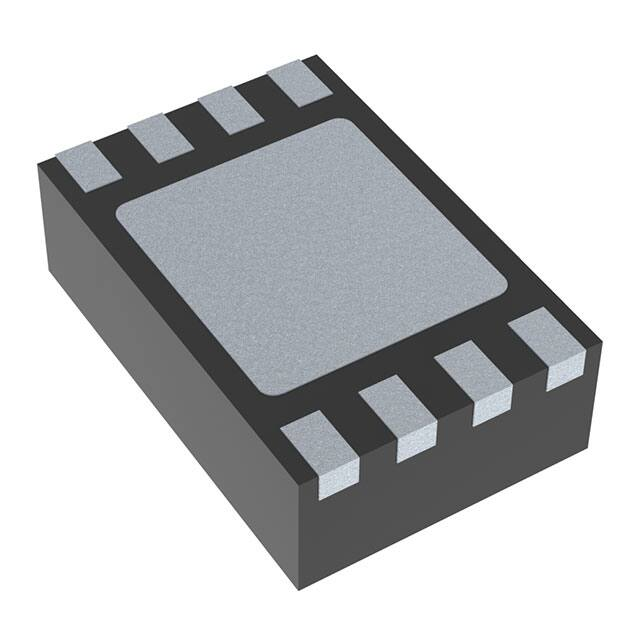
The ISL9107 and ISL9108 are offered in 8 Ld 2mmx3mm
DFN package with 0.9mm typical height. The complete
converter can occupy less than 1cm2 area.
Ordering Information
PART
NUMBER
(Note)
PART
MARKING
TEMP.
RANGE
(°C)
• Integrated Synchronous Buck Regulator with up to 95%
Efficiency
• 2.7V to 5.5V Supply Voltage
• 1.5A Guaranteed Output Current
• 17A Quiescent Supply Current in Skip (Low IQ) Mode
• Selectable Forced PWM Mode and Skip Mode
• Less Than 1µA Logic Controlled Shutdown Current
• 100% Maximum Duty Cycle for Lowest Dropout
• Internal Digital Soft-Start
• Enable, Peak Current Limiting, Short Circuit Protection
• Power-Good Function (for ISL9107 only)
• 8 Ld 2mmx3mm DFN
• Pb-Free (RoHS Compliant)
Applications
• Single Li-Ion Battery-Powered Equipment
• DSP Core Power
• PDAs and Palmtops
PACKAGE
(Pb-Free)
PKG.
DWG. #
ISL9107IRZ-T 107
-40 to +85 8 Ld 2x3 DFN
L8.2x3
ISL9108IRZ-T 108
-40 to +85 8 Ld 2x3 DFN
L8.2x3
Pinouts
ISL9107
(8 LD 2X3 DFN)
TOP VIEW
*Please refer to TB347 for details on reel specifications.
VIN
1
8
SW
NOTE: These Intersil Pb-free plastic packaged products employ
special Pb-free material sets; molding compounds/die attach
materials and 100% matte tin plate PLUS ANNEAL - e3 termination
finish, which is RoHS compliant and compatible with both SnPb and
Pb-free soldering operations. Intersil Pb-free products are MSL
classified at Pb-free peak reflow temperatures that meet or exceed
the Pb-free requirements of IPC/JEDEC J STD-020.
EN
2
7
GND
PG
3
6
FB
MODE
4
5
RSI
ISL9108
(8 LD 2X3 DFN)
TOP VIEW
FN6612 Rev 0.00
December 21, 2007
VIN
1
8 SW
EN
2
7 GND
NC
3
6 FB
MODE
4
5 NC
Page 1 of 13
�ISL9107, ISL9108
Absolute Maximum Ratings (Reference to GND)
Thermal Information
VIN . . . . . . . . . . . . . . . . . . . . . . . . . . . . . . . . . . . . . . . . -0.3V to 6.5V
EN, MODE . . . . . . . . . . . . . . . . . . . . . . . . . . . . . -0.3V to VIN + 0.3V
PG, RSI (Note 1) . . . . . . . . . . . . . . . . . . . . . . . . -0.3V to VIN + 0.3V
SW . . . . . . . . . . . . . . . . . . . . . . . . . . . . . . . . . . . . . . . . -1.5V to 6.5V
FB . . . . . . . . . . . . . . . . . . . . . . . . . . . . . . . . . . . . . . . . -0.3V to 2.7V
Thermal Resistance (Notes 2, 3)
JA (°C/W)
JC (°C/W)
2x3 DFN Package . . . . . . . . . . . . . .
78
11
Junction Temperature Range. . . . . . . . . . . . . . . . . .-40°C to +125°C
Storage Temperature Range . . . . . . . . . . . . . . . . . .-65°C to +150°C
Pb-free reflow profile . . . . . . . . . . . . . . . . . . . . . . . . . .see link below
http://www.intersil.com/pbfree/Pb-FreeReflow.asp
Recommended Operating Conditions
VIN Supply Voltage Range . . . . . . . . . . . . . . . . . . . . . . 2.7V to 5.5V
Load Current . . . . . . . . . . . . . . . . . . . . . . . . . . . . . . . . . . 0A to 1.5A
Ambient Temperature Range . . . . . . . . . . . . . . . . . . .-40°C to +85°C
CAUTION: Do not operate at or near the maximum ratings listed for extended periods of time. Exposure to such conditions may adversely impact product reliability and
result in failures not covered by warranty.
NOTES:
1. For ISL9107 only.
2. JA is measured in free air with the component mounted on a high effective thermal conductivity test board with “direct attach” features. See
Tech Brief TB379.
3. JC, “case temperature” location is at the center of the exposed metal pad on the package underside. See Tech Brief TB379.
Electrical Specifications
Unless otherwise noted, all parameter limits are guaranteed over the recommended operating conditions and
the typical specifications are measured at the following conditions: TA = +25°C, VIN = VEN = 3.6V, L = 2.2µH,
C1 = 10µF, C2 = 10µF, IOUT = 0A (see the Typical Application Circuit on page 7).
PARAMETER
SYMBOL
TEST CONDITIONS
MIN
TYP
MAX
UNITS
Rising
-
2.5
2.7
V
Falling
2.2
2.4
-
V
MODE = VIN, no load at the output
-
17
30
µA
MODE = GND, no load at the output
-
5
8
mA
ISD
VIN = 5.5V, EN = LOW
-
0.05
2
A
VFB
TA = 0°C to +85°C
0.784
0.8
0.816
V
TA = -40°C to +85°C
0.78
0.8
0.82
V
VFB = 0.75V
-
0.1
-
µA
VIN = VO + 0.5V to 5.5V (minimal 2.7V)
-
0.2
-
%/V
Design info only
-
20
-
µA/V
VIN = 3.6V, IO = 200mA
-
0.12
0.22
VIN = 2.7V, IO = 200mA
-
0.16
0.27
VIN = 3.6V, IO = 200mA
-
0.11
0.22
VIN = 2.7V, IO = 200mA
-
0.15
0.27
-
90
-
1.8
2.1
2.6
A
-
100
-
%
1.35
1.6
1.75
MHz
-
-
100
ns
-
1.1
-
ms
SUPPLY
Undervoltage Lockout Threshold
Quiescent Supply Current
Shut Down Supply Current
VUVLO
IVIN
OUTPUT REGULATION
FB Regulation Voltage
FB Bias Current
IFB
Line Regulation
COMPENSATION
Error Amplifier Trans-conductance
SW
P-Channel MOSFET ON-Resistance
N-Channel MOSFET ON-Resistance
N-Channel Bleeding MOSFET ON-Resistance
P-Channel MOSFET Peak Current Limit
IPK
VIN = 5.5V
Maximum Duty Cycle
PWM Switching Frequency
SW Minimum On-Time
Soft Start-Up Time
FN6612 Rev 0.00
December 21, 2007
fS
TA = -40°C to +85°C
MODE = LOW (forced PWM mode)
Page 2 of 13
�ISL9107, ISL9108
Electrical Specifications
Unless otherwise noted, all parameter limits are guaranteed over the recommended operating conditions and
the typical specifications are measured at the following conditions: TA = +25°C, VIN = VEN = 3.6V, L = 2.2µH,
C1 = 10µF, C2 = 10µF, IOUT = 0A (see the Typical Application Circuit on page 7). (Continued)
PARAMETER
SYMBOL
TEST CONDITIONS
MIN
TYP
MAX
UNITS
PG (NOTE 1)
Output Low Voltage
Sinking 1mA, VFB = 0.7V
Delay Time
PG = VIN = 3.6V
PG Pin Leakage Current
Minimum Supply Voltage for Valid PG Signal
-
-
0.3
V
150
215
275
ms
-
0.01
0.1
µA
1.2
-
-
V
Internal PGOOD Low Rising Threshold
Percentage of Nominal Regulation Voltage
89.5
92
94.5
%
Internal PGOOD Low Falling Threshold
Percentage of Nominal Regulation Voltage
85
88
91
%
Internal PGOOD High Rising Threshold
Percentage of Nominal Regulation Voltage
108.2
110.7
113.2
%
Internal PGOOD High Falling Threshold
Percentage of Nominal Regulation Voltage
104
107
110
%
-
50
-
µs
Logic Input Low
-
-
0.4
V
Logic Input High
1.4
-
-
V
-
0.1
1
µA
Thermal Shutdown
-
150
-
°C
Thermal Shutdown Hysteresis
-
25
-
°C
Internal PGOOD Delay Time
RSI (NOTE 1), EN, MODE
Logic Input Leakage Current
Pulled up to 5.5V
Pin Descriptions
PIN #
ISL9107
ISL9108
PIN NAME PIN NAME
1
VIN
Input supply voltage pin. Connect a 10µF ceramic capacitor to power ground.
2
EN
Enable pin. Enable the output when driven to high. Shut down the chip and discharge output capacitor when
driven to low. Do not leave this pin floating.
4
MODE
Mode selection pin. Connect to logic high or VIN to enable skip mode; connect to logic low or ground for force
PWM mode.
6
FB
7
GND
8
SW
E-PAD
-
DESCRIPTION
Buck regulator output feedback pin. Connect to the output voltage through voltage divider resistors for
adjustable output voltage.
System ground.
Switching node pin. Connect to one terminal of the inductor.
Exposed pad. It should be connected to ground for proper electrical performance. The exposed pad must also
be connected to as much as possible for optimal thermal performance.
3
PG
NC
For ISL9107, it is 215ms timer output. It outputs 215ms delayed power-good signal when output voltage is
within power-good window. It can be reset by a high RSI signal, then 215ms starts when RSI goes from high
to low.
For ISL9108, do not connect. Leave this pin floating.
5
RSI
NC
For ISL9107, this input resets the 215ms timer. Please refer to “Theory of Operation” on page 9 for more
details.
For ISL9108, do not connect. Leave this pin floating.
FN6612 Rev 0.00
December 21, 2007
Page 3 of 13
�ISL9107, ISL9108
100
100
95
95
90
90
VIN = 3.6V
85
VIN = 4.2V
EFFICIENCY (%)
EFFICIENCY (%)
Typical Operating Performance
80
75
70
65
85
75
70
65
60
55
55
0
500
1000
50
1500
VIN = 3.6V
80
60
50
VIN = 4.2V
0
500
LOAD CURRENT (mA)
FIGURE 1. EFFICIENY vs LOAD CURRENT (VOUT = 3.3V)
100
30
QUIESCENT CURRENT (µA)
EFFICIENCY (%)
90
85
80
75
EFFICIENCY @ 3.6V
70
EFFICIENCY @ 2.7V
65
60
55
50
0
500
1500
FIGURE 2. EFFICIENCY vs LOAD CURRENT (VOUT = 2.5V)
EFFICIENCY @ 4.2V
95
1000
LOAD CURRENT (mA)
1000
25
20
15
10
5
0
2.7
1500
3.4
LOAD CURRENT (mA)
4.1
4.8
5.5
INPUT VOLTAGE (V)
FIGURE 3. EFFICIENCY vs LOAD CURRENT (VOUT = 1.6V)
FIGURE 4. IQ vs VIN (MODE = VIN, VOUT = 1.6V, IOUT = 0)
QUIESCENT CURRENT (mA)
8
7
6
5
4
3
2
1
0
2.7
3.4
4.1
4.8
5.5
INPUT VOLTAGE (V)
FIGURE 5. IQ vs VIN (MODE = GND, VOUT = 1.6V, IOUT = 0)
FN6612 Rev 0.00
December 21, 2007
Page 4 of 13
�ISL9107, ISL9108
Typical Operating Performance (Continued)
5V/DIV
1V/DIV
1A/DIV
5V/DIV
5V/DIV
VSW
1V/DIV
VOUT
VSW
VOUT
500mA/DIV
IL
IL
EN
EN
5V/DIV
200µs/DIV
FIGURE 6. SOFT-START (VIN = 4.2V, VOUT = 1.6V,
IOUT = 1.5A)
200µs/DIV
FIGURE 7. SOFT-START (VIN = 4.2V, VOUT = 1.6V,
IOUT = 1mA)
VSW
5V/DIV
5V/DIV
VSW
VOUT (AC COUPLED)
VOUT (AC COUPLED)
20mV/DIV
50mV/DIV
IL
IL
1A/DIV
200mA/DIV
1µs/DIV
2µs/DIV
FIGURE 8. STEADY-STATE IN SKIP MODE (VIN = 5.0V,
VOUT = 1.6V, IOUT = 35mA)
FIGURE 9. STEADY-STATE IN PWM MODE (VIN = 5.0V,
VOUT = 1.6V, IOUT = 1.5A)
VVSW
SW
VSW
5V/DIV
5V/DIV
VOUT (AC COUPLED)
100mV/DIV
VOUT (AC COUPLED)
100mV/DIV
IL
1A/DIV
100µs/DIV
FIGURE 10. LOAD TRANSIENT TEST (MODE = VIN = 5.0V;
VO = 1.6V; IO = 0.01A~1A)
FN6612 Rev 0.00
December 21, 2007
IL
1A/DIV
100µs/DIV
FIGURE 11. LOAD TRANSIENT TEST (MODE = GND,
VIN = 5.0V; VO = 1.6V; IO = 0.01A~1A)
Page 5 of 13
�ISL9107, ISL9108
Typical Operating Performance (Continued)
VSW
5V/DIV
VSW
5V/DIV
VOUT (AC COUPLED)
100mV/DIV
VOUT (AC COUPLED)
100mV/DIV
IL
IL
1A/DIV
1A/DIV
100µs/DIV
FIGURE 12. LOAD TRANSIENT TEST (MODE = VIN = 4.2V;
VO = 1.6V; IO = 0.01A~1A)
100µs/DIV
FIGURE 13. LOAD TRANSIENT TEST (MODE = GND,
VIN = 4.2V; VO = 1.6V; IO = 0.01A~1A)
VSW
VSW
5V/DIV
5V/DIV
VOUT (AC COUPLED)
VOUT (AC COUPLED)
100mV/DIV
100mV/DIV
IL
100µs/DIV
FIGURE 14. LOAD TRANSIENT TEST (MODE = VIN = 3.6V;
VO = 1.6V; IO = 0.01A~1A)
FN6612 Rev 0.00
December 21, 2007
IL
1A/DIV
1A/DIV
100µs/DIV
FIGURE 15. LOAD TRANSIENT TEST (MODE = GND,
VIN = 3.6V; VO = 1.6V; IO = 0.01A~1A)
Page 6 of 13
�ISL9107, ISL9108
Typical Applications
L
2.2µH
INPUT
2.7V TO 5.5V
OUTPUT
1.6V/0A~1.5A
SW
VIN
C2
10µF
C1
10µF
R2
100k
EN
R1
ISL9107
100k
GND
C3
220pF
R3
100k
PG
FB
RSI
MODE
E-PAD
L
2.2µH
INPUT
2.7V TO 5.5V
OUTPUT
1.6V/0A~1.5A
SW
VIN
C2
10µF
C1
10µF
R2
100k
EN
ISL9108
GND
C3
220pF
R3
100k
MODE
FB
NC
NC
E-PAD
PARTS
DESCRIPTION
MANUFACTURERS
PART NUMBER
SPECIFICATIONS
SIZE
L
Inductor
Sumida
CDRH4D15/SNP-2R2NC
2.2µH/2.0A/48m
4.4mmx4.4mmx1.7mm
C1
Input capacitor
Murata
GRM21BR60J106KE19L
10µF/6.3V
2.0mmx1.25mmx1.25mm
C2
Output capacitor
Murata
GRM21BR60J106KE19L
10µF/6.3V
2.0mmx1.25mmx1.25mm
C3
Capacitor
Murata
GRM188R71H221KA01C
220pF/50V
1.6mmx0.8mmx0.8mm
R1(ISL9107)
Resistor
Various
100k SMD,
1.6mmx0.8mmx0.45mm
R2, R3
Resistor
Various
100k SMD,
1.6mmx0.8mmx0.45mm
FIGURE 16. TYPICAL APPLICATION DIAGRAM FOR ISL9107 AND ISL9108
FN6612 Rev 0.00
December 21, 2007
Page 7 of 13
�ISL9107, ISL9108
Block Diagram
MODE
SOFT-
EN
0.8V
BANDGAP
SHUTDOWN
+
SHUTDOWN
START
EAMP
+
COMP
OSCILLATOR
VIN
PWM/PFM
LOGIC
CONTROLLER
SW
PROTECTION
SLOPE
COMP
DRIVER
+
GND
RSI*
VREF5
+
SCP
FB
+
*Note
VREF3
CSA
+
+
OCP
VREF1
+
+
VREF4
SKIP
PG*
PGOOD
DELAY
*Note: Only applies to ISL9107.
FN6612 Rev 0.00
December 21, 2007
VREF2
ZERO-CROSS
SENSING
FIGURE 17. FUNCTIONAL BLOCK DIAGRAM
Page 8 of 13
�ISL9107, ISL9108
Theory of Operation
The ISL9107 and ISL9108 are step-down switching regulators
optimized for battery-powered handheld applications. The
regulators operate at typical 1.6MHz fixed switching frequency
under heavy load condition to allow small external inductor and
capacitors to be used for minimal printed-circuit board (PCB)
area. At light load, the regulators can be selected to enter skip
mode to reduce the switching frequency, unless forced to the
fixed frequency, to minimize the switching loss and to
maximize the battery life. The quiescent current under skip
mode with no loading is typically only 17µA. The supply current
is typically only 0.1µA when the regulator is disabled.
PWM Control Scheme
These devices use the peak-current-mode pulse-width
modulation (PWM) control scheme for fast transient response
and pulse-by-pulse current limiting. Figure 17 shows the circuit
functional block diagram. The current loop consists of the
oscillator, the PWM comparator COMP, current sensing circuit
and the slope compensation for the current loop stability. The
current sensing circuit consists of the resistance of the PChannel MOSFET when it is turned on and the Current Sense
Amplifier (CSA). The control reference for the current loops
comes from the Error Amplifier (EAMP) of the voltage loop.
vEAMP
vCSA
d
iL
vOUT
separately in “Soft Start-Up” on page 10. The EAMP is a
transconductance amplifier, which converts the voltage error
signal to a current output. The voltage loop is internally
compensated by a RC network. The maximum EAMP voltage
output is precisely clamped to the bandgap voltage.
Skip Mode
With the MODE pin connected to logic high, the device enters
a pulse-skipping mode at light load to minimize the switching
loss by reducing the switching frequency. Figure 19 illustrates
the skip mode operation. A zero-cross sensing circuit (as
shown in Figure 17) monitors the N-Channel MOSFET current
for zero crossing. When it is detected to cross zero for 8
consecutive cycles, the regulator enters the skip mode. During
the 8 consecutive cycles, the inductor current could be
negative. The counter is reset to zero when the sensed NChannel MOSFET current does not cross zero during any
cycle within the 8 consecutive cycles. Once the device enters
the skip mode, the pulse modulation starts being controlled by
the SKIP comparator shown in Figure 17. Each pulse cycle is
still synchronized by the PWM clock. The P-Channel MOSFET
is turned on at the rising edge of clock and turned off when its
current reaches 20% of the peak current limit. As the average
inductor current in each cycle is higher than the average
current of the load, the output voltage rises cycle over cycle.
When the output voltage reaches 1.5% above it’s nominal
voltage, the P-Channel MOSFET is turned off immediately and
the inductor current is fully discharged to zero and stays at
zero. The output voltage reduces gradually due to the load
current discharging the output capacitor. When the output
voltage drops to the nominal voltage, the P-Channel MOSFET
will be turned on again, repeating the previous operations.
The regulator resumes normal PWM mode operation when the
output voltage is sensed to drop below 1.5% of its nominal
voltage value.
Enable
FIGURE 18. PWM OPERATION WAVEFORMS
The PWM operation is initialized by the clock from the
oscillator. The P-Channel MOSFET is turned on at the
beginning of a PWM cycle and the current in the P-Channel
MOSFET starts ramping up. When the sum of the CSA output
and the compensation slope reaches the control reference of
the current loop, the PWM comparator COMP sends a signal
to the PWM logic to turn off the P-Channel MOSFET and to
turn on the N-Channel MOSFET. The N-MOSFET remains on till
the end of the PWM cycle. Figure 18 shows the typical operating
waveforms during the normal PWM operation. The dotted lines
illustrate the sum of the slope compensation ramp and the CSA
output.
The enable (EN) pin allows the user to enable or disable the
converter for purposes such as power-up sequencing. With the
EN pin pulled to high, the converter is enabled, the internal
reference circuit wakes up first and then the soft start-up
begins. When the EN pin is pulled to logic low, the converter is
disabled, the P-Channel MOSFET is turned off immediately
and the output capacitor is discharged through internal
discharge path.
Undervoltage Lockout (UVLO)
When the input voltage is below the Undervoltage Lockout
(UVLO) threshold, the device is disabled.
The output voltage is regulated by controlling the reference
voltage to the current loop. The bandgap circuit outputs a 0.8V
reference voltage to the voltage control loop. The feedback
signal comes from the FB pin. The soft-start block only affects
the operation during the start-up and will be discussed
FN6612 Rev 0.00
December 21, 2007
Page 9 of 13
�ISL9107, ISL9108
Mode Selection
The MODE pin is provided on ISL9107 and ISL9108 to select
the operation mode. When it is driven to logic low or ground,
the regulator operates in forced PWM mode. Under forced
PWM mode, the device remains at the fixed PWM operation
(typical at 1.6MHz), regardless of if the load current is high or
low.
When the MODE pin is driven to logic high or connected to
input voltage VIN, the regulator operates in either SKIP mode
or fixed PWM mode depending on the different load conditions.
Overcurrent Protection
The overcurrent protection is provided when an overload
condition happens. It is realized by monitoring the CSA output
with the OCP comparator, as shown in Figure 17. When the
current at P-Channel MOSFET is sensed to reach the current
limit, the OCP comparator is triggered to turn off the P-Channel
MOSFET immediately.
Short-Circuit Protection
As shown in Figure 17, the device has a Short-Circuit Protection
(SCP) comparator, which monitors the FB pin voltage for
output short-circuit protection. When the FB voltage is lower
than 0.2V, the SCP comparator forces the PWM oscillator
frequency to drop to 1/3 of its normal operation frequency.
Soft Start-Up
The soft start-up eliminates the inrush current during the circuit
start-up. The soft-start block outputs a ramp reference to both
the voltage loop and the current loop. The two ramps limit the
inductor current rising speed as well as the output voltage
speed so that the output voltage rises in a controlled fashion.
At the very beginning of the start-up, the output voltage is less
than 0.2V; hence the PWM operating frequency is 1/3 of the
normal frequency.
Power MOSFETs
The power MOSFETs are optimized to achieve better
efficiency. The ON-resistance for the P-Channel MOSFET is
typically 0.16 and the typical ON-resistance for the
N-Channel MOSFET is 0.15.
Low Dropout Operation
The ISL9107 and ISL9108 feature low dropout operation to
maximize the battery life. When the input voltage drops to a
level that the device can no longer operate under switching
regulation to maintain the output voltage, the P-Channel
MOSFET is completely turned on (100% duty cycle). The
dropout voltage under such condition is the product of the load
current and the ON-resistance of the P-Channel MOSFET.
Minimum required input voltage VIN under this condition is the
sum of the output voltage plus the voltage drop cross the
inductor and the P-Channel MOSFET switch.
Thermal Shut Down
The ISL9107 and ISL9108 provide a built-in thermal protection
function. The thermal shutdown threshold temperature is
typical +160°C with typical +25°C hysteresis. When the internal
temperature is sensed to reach +150°C, the regulator is
completely shut down and as the temperature is sensed to
drop to +125°C (typical), the device resumes operation starting
from the soft start-up.
RSI Signal
The RSI signal is an input signal, which can reset the PG
signal. As shown in Figure 17, the power-good signal is gated
by the RSI signal. When the RSI is high, the PG signal remains
low, regardless of the output voltage condition. This function is
provided on ISL9107 only.
Power-Good
The ISL9107 offers a power-good (PG) signal. When the
output voltage is not within the power-good window, the PG pin
outputs an open-drain low signal. When the output voltage is
within the power-good window, an internal power-good signal
is issued to turn off the open-drain MOSFET so that the PG pin
can be externally pulled to high. The rising edge of the PG
output is delayed by 215ms (typical) from the time the powergood signal is issued. This function is provided on ISL9107
only.
8 CYCLES
CLOCK
20% PEAK CURRENT LIMIT
IL
0
1.015*VOUT_NOMINAL
VOUT
VOUT_NOMINAL
FIGURE 19. SKIP MODE OPERATION WAVEFORMS
FN6612 Rev 0.00
December 21, 2007
Page 10 of 13
�ISL9107, ISL9108
Applications Information
Inductor and Output Capacitor Selection
To achieve better steady state and transient response,
typically a 2.2µH inductor can be used. The peak-to-peak
inductor current ripple can be expressed as in Equation 1:
VO
V O 1 – ---------
V IN
I = --------------------------------------L fS
(EQ. 1)
In Equation 1, usually the typical values can be used but to
have a more conservative estimation, the inductance should
consider the value with worst case tolerance; and for
switching frequency (fS), the minimum fS from the “Electrical
Specifications” table on page 2 can be used.
To select the inductor, its saturation current rating should be
at least higher than the sum of the maximum output current
and half of the delta calculated from Equation 1. Another
more conservative approach is to select the inductor with the
current rating higher than the P-Channel MOSFET peak
current limit.
Another consideration is the inductor DC resistance since it
directly affects the efficiency of the converter. Ideally, the
inductor with the lower DC resistance should be considered
to achieve higher efficiency.
Inductor specifications could be different from different
manufacturers so please check with each manufacturer if
additional information is needed.
For the output capacitor, a ceramic capacitor can be used
because of the low ESR values, which helps to minimize the
output voltage ripple. A typical value of 10µF/6.3V ceramic
capacitor should be enough for most of the applications and
the capacitor should be X5R or X7R.
setting. The leakage current has a typical value of 0.1µA. To
minimize the accuracy impact on the output voltage, select
the R3 no larger than 200k.
C3 (shown in Figure 16) is highly recommended to be added
for improving stability and achieving better transient
response. C3 can be calculated using Equation 3:
1
C 3 = ----------------------------------------------------2 R 2 7.3kHz
(EQ. 3)
Table 1 provides the recommended component values for
some output voltage options.
Layout Recommendation
The PCB layout is a very important converter design step to
make sure the designed converter works well, especially
under the high current, high switching frequency condition.
For ISL9107 and ISL9108, the power loop is composed of
the output inductor (L), the output capacitor (COUT), the SW
pin and the GND pin. It is necessary to make the power loop
as small as possible and the connecting traces among them
should be direct, short and wide; the same type of traces
should be used to connect the VIN pin, the input capacitor
CIN and its ground. The switching node of the converter, the
SW pin, and the traces connected to this node are very
noisy, so keep the voltage feedback trace and other noise
sensitive traces away from these noisy traces.
The input capacitor should be placed as close as possible to
the VIN pin. The ground of the input and output capacitors
should be connected as close as possible as well.
The heat of the IC is mainly dissipated through the thermal
pad. Maximizing the copper area connected to the thermal
pad is preferable. In addition, a solid ground plane is helpful
for EMI performance.
TABLE 1. ISL9107 AND ISL9108 RECOMMENDED CIRCUIT
CONFIGURATION vs VOUT
Input Capacitor Selection
The main function for the input capacitor is to provide
decoupling of the parasitic inductance and to provide filtering
function to prevent the switching current from flowing back to
the battery rail. A 10µF/6.3V ceramic capacitor (X5R or X7R)
is a good starting point for the input capacitor selection.
VOUT (V)
L (µH)
C2 (µF)
R2 (k)
C3 (pF)
R3 (k
0.8
2.2
10
0
N/A
100
1.0
2.2
10
44.2
470
178
1.2
2.2
10
80.6
270
162
Output Voltage Setting Resistor Selection
1.5
2.2
10
84.5
270
97.6
The voltage divider resistors (R2 and R3), as shown in
Figure 16, set the desired output voltage value. The output
voltage can be calculated using Equation 2:
1.8
2.2
10
100
220
80.6
2.5
2.2~3.3
10~22
100
220
47.5
2.8
2.2~3.3
10~22
100
220
40.2
3.3
2.2~3.3
10~22
102
220
32.4
R 2
V O = V FB 1 + -------
R 3
(EQ. 2)
where VFB is the feedback voltage (typically it is 0.8V). The
current flowing through the voltage divider resistors can be
calculated as VO/(R2 + R3), so larger resistance is desirable
to minimize this current. On the other hand, the FB pin has
leakage current that will cause error in the output voltage
FN6612 Rev 0.00
December 21, 2007
Page 11 of 13
�ISL9107, ISL9108
© Copyright Intersil Americas LLC 2007. All Rights Reserved.
All trademarks and registered trademarks are the property of their respective owners.
For additional products, see www.intersil.com/en/products.html
Intersil products are manufactured, assembled and tested utilizing ISO9001 quality systems as noted
in the quality certifications found at www.intersil.com/en/support/qualandreliability.html
Intersil products are sold by description only. Intersil may modify the circuit design and/or specifications of products at any time without notice, provided that such
modification does not, in Intersil's sole judgment, affect the form, fit or function of the product. Accordingly, the reader is cautioned to verify that datasheets are
current before placing orders. Information furnished by Intersil is believed to be accurate and reliable. However, no responsibility is assumed by Intersil or its
subsidiaries for its use; nor for any infringements of patents or other rights of third parties which may result from its use. No license is granted by implication or
otherwise under any patent or patent rights of Intersil or its subsidiaries.
For information regarding Intersil Corporation and its products, see www.intersil.com
FN6612 Rev 0.00
December 21, 2007
Page 12 of 13
�ISL9107, ISL9108
Dual Flat No-Lead Plastic Package (DFN)
L8.2x3
2X
8 LEAD DUAL FLAT NO-LEAD PLASTIC PACKAGE
0.15 C A
A
D
2X
0.15 C B
E
MILLIMETERS
SYMBOL
MIN
A
0.80
A1
-
6
A3
INDEX
AREA
b
TOP VIEW
D2
//
0.10
A
SIDE VIEW
C
SEATING
PLANE
D2
(DATUM B)
C
0.08 C
0.20
A3
7
8
0.90
1.00
-
-
0.05
-
0.25
0.32
1
5,8
1.50
1.65
1.75
7,8
3.00 BSC
1.65
e
1.80
1.90
7,8
0.50 BSC
-
k
0.20
-
-
-
L
0.30
0.40
0.50
8
N
8
Nd
4
2
3
D2/2
6
INDEX
AREA
NOTES
2.00 BSC
E
E2
MAX
0.20 REF
D
B
NOMINAL
Rev. 0 6/04
2
NX k
NOTES:
1. Dimensioning and tolerancing conform to ASME Y14.5-1994.
2. N is the number of terminals.
3. Nd refers to the number of terminals on D.
(DATUM A)
E2
4. All dimensions are in millimeters. Angles are in degrees.
E2/2
5. Dimension b applies to the metallized terminal and is measured
between 0.25mm and 0.30mm from the terminal tip.
NX L
N N-1
NX b
e
8
6. The configuration of the pin #1 identifier is optional, but must be
located within the zone indicated. The pin #1 identifier may be
either a mold or mark feature.
5
0.10
(Nd-1)Xe
REF.
M C A B
7. Dimensions D2 and E2 are for the exposed pads which provide
improved electrical and thermal performance.
8. Nominal dimensions are provided to assist with PCB Land
Pattern Design efforts, see Intersil Technical Brief TB389.
BOTTOM VIEW
CL
(A1)
NX (b)
L
5
SECTION "C-C"
C C
e
TERMINAL TIP
FOR EVEN TERMINAL/SIDE
FN6612 Rev 0.00
December 21, 2007
Page 13 of 13
�