DATASHEET
NOT RECOMMENDED FOR NEW DESIGNS
RECOMMENDED REPLACEMENT PART
ISL97519A
ISL97702
FN7462
Rev 0.00
October 13, 2005
Boost with Dual Reference Outputs
The ISL97702 represents a high efficiency, boost converter
with integrated boost FET, boost diode and input disconnect
FET. A dual feedback circuit allows simple switching
between two pre-defined output voltages using a single logic
input.
With an input voltage of 2.3V to 5.5V the ISL97702 has an
output capability of up to 50mA at 18V using integrated
500mA switches. Efficiencies are up to 87%. The
integrated protection FET is used to disconnect the boost
inductor from the input supply whenever an output fault
condition is detected, or when the device is disabled. This
gives 0 output current in the disabled mode, compared to
standard boost converters where current can still flow when
the device is disabled.
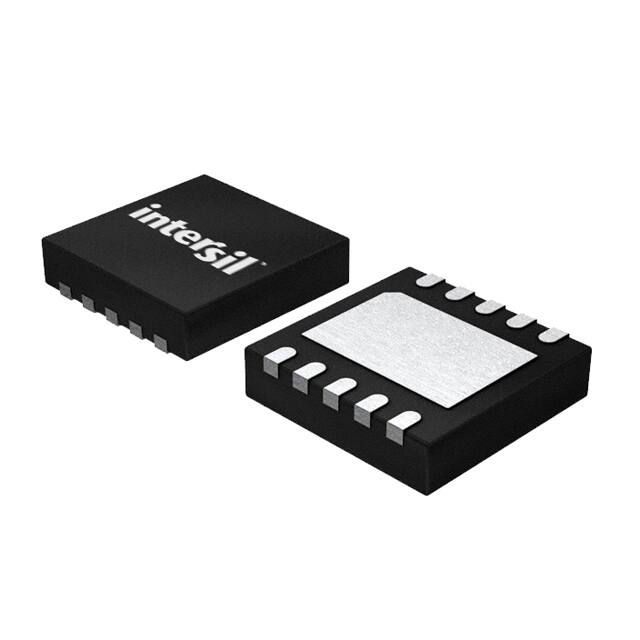
The ISL97702 comes in the 10 Ld 3x3 DFN package and is
specified for operation over the -40°C to 85°C temperature
range.
Ordering Information
• 2.3V to 5.5V input
• Up to 28V output
• 50mA at 18V
• Integrated boost Schottky diode
• Input voltage disconnect switch
• Dual output voltage selectable
• Synchronization input
• Chip enable
• 10 Ld 3x3 DFN package
• Pb-free plus anneal available (RoHS compliant)
Applications
• OLED display power
PART
TAPE &
MARKING REEL
PACKAGE
PKG.
DWG. #
ISL97702IRZ
(Note)
97702IRZ
-
10 Ld 3x3 DFN MDP0047
(Pb-Free)
ISL97702IRZ-T7
(Note)
97702IRZ
7”
10 Ld 3x3 DFN MDP0047
(Pb-Free)
ISL97702IRZ-T13 97702IRZ
(Note)
• Up to 87% efficiency
13”
• LED display power
• Adjustable power supplies
Typical Application Diagram
L1
10 Ld 3x3 DFN MDP0047
(Pb-Free)
NOTE: Intersil Pb-free plus anneal products employ special Pb-free
material sets; molding compounds/die attach materials and 100%
matte tin plate termination finish, which are RoHS compliant and
compatible with both SnPb and Pb-free soldering operations. Intersil
Pb-free products are MSL classified at Pb-free peak reflow
temperatures that meet or exceed the Pb-free requirements of
IPC/JEDEC J STD-020.
6.8µ
VDDOUT
LX
2.3V-5.5V
VDD
C0
5µ
NEN
OSCILLATOR
AND
CONTROL
PART
NUMBER
Features
VOUT
VDD+2V - 30V
C1
R1
3.3µ 390k
NSYNC
FB0
GND
Pinout
26.1k
ISL97702
(10 LD 3X3 DFN)
TOP VIEW
GND 1
VDD 3
FB1
9 VOUT
THERMAL
PAD
8 NEN
NSYNC 4
7 SEL
FB0 5
6 FB1
FN7462 Rev 0.00
October 13, 2005
R2
39k
SEL
BOOST WITH
DUAL REFERENCE
10 LX
VDDOUT 2
R3
V(VOUT)0 = (390k + 39k) / 39k * 1.15V = 12.65V
V(VOUT)1 = (390k + 26.1k) / 26.1k * 1.15V = 18.33V
NEN
SEL
VOUT
1
X
High Z
0
0
VOUT0
0
1
VOUT1
Page 1 of 13
�ISL97702
Block Diagram
VDD
Synchronization
Signal Detector
Under-Voltage
Detector
Over-Temperature
Detector
NSYNC
1
Over-Current
Detector (DC)
MUX
Oscillator
VDD
S2
0
VDD
CLK
NEW
START
RESTART
State Machine
(Default Sequence)
1. Soft Inrush
2. VDDOUT Enable
3. Soft Boost 25
4. Soft Boost 50
5. Soft Boost 75
6. Normal
VDD
SEL
AND
OverVoltage
Detector
2
Vout
AND
Slope
Compensation
Ramp-Generator
FB1
S1
VDDout
DISABLE & WAIT
Error
Amplifier
Av
Ccomp
FB0
As
Clamp
Ai
LX
EN
Control Logic
-PWM Timing
-Current Limit
-Pulse Skipping
Gate
Driver
Current
Limit
Comparator
S0
Voltage
Reference
Rsense
Rsense
GND
ISL97702
FIGURE 1. ISL97702 BLOCK DIAGRAM
FN7462 Rev 0.00
October 13, 2005
Page 2 of 13
�ISL97702
Absolute Maximum Ratings (TA = 25°C)
Continuous Current in VDD, GND, VDDOUT, LX . . . . . . . . . 650mA
Continuos Current in NSYNC, FB0, FB1, SEL, NEN. . . . . . . . 10mA
Storage Temperature . . . . . . . . . . . . . . . . . . . . . . . .-65°C to +150°C
TA Ambient Operating Temperature. . . . . . . . . . . . .-40°C to +85°C
TJ Operating Junction Temperature. . . . . . . . . . . . . . . . . . . +125°C
VDD to GND . . . . . . . . . . . . . . . . . . . . . . . . . . . . . . . . . . . -0.3 to 6V
VOUT to GND. . . . . . . . . . . . . . . . . . . . . . . . . . . . . . . . . . -0.3 to 31V
LX to GND . . . . . . . . . . . . . . . . . . . . . . . . . . . . . . . . . . . . . VOUT+1V
VDDOUT, NSYNC, FB0, FB1, SEL, NEN
to GND . . . . . . . . . . . . . . . . . . . . . . . . . . . . . . . . -0.3V to VDD+0.3V
CAUTION: Stresses above those listed in “Absolute Maximum Ratings” may cause permanent damage to the device. This is a stress only rating and operation of the
device at these or any other conditions above those indicated in the operational sections of this specification is not implied.
IMPORTANT NOTE: All parameters having Min/Max specifications are guaranteed.
Electrical Specifications
VDD = 3.6V, GND = NEN = 0V, SEL = NSYNC = VDD, R1 = 390k, R2 = 39k, R3 = 26.1k,
L = 10µH, TA = -40°C to +85°C unless otherwise stated
PARAMETER
DESCRIPTION
CONDITION
MIN
TYP
MAX
UNIT
5.5
V
0.1
3
µA
250
350
k
1
µA
SUPPLY
VDD
Supply Operating Voltage Range
IDIS
Supply Current when Disabled
2.3
NEN = VDD
LOGIC INPUTS – NEN, NSYNC, SEL
Rup
Pull-up Resistor
Enabled, Input at GND
150
IIL
Leakage Current when Disabled
Disabled, Input at GND
-1
VHI
Logic High Threshold
VLO
Logic Low Threshold
1.8
V
0.7
V
2.3
V
POWER-ON RESET – VDD
VRES_ON
Power On Reset Threshold
VDD rising
VRES_OFF
Power Off Threshold
VDD falling
2.2
1.9
2
0.9
1
V
LX OUTPUT DRIVER
fosc
LX Switching Frequency with Internal
Oscillator
fsync
LX Switching Frequency when
Externally Synchronized at NSYNC
ton-min
Minimum On-Time
toff-min
1.1
MHz
f
(NSYNC)
-
FB1 = 0V, I(LX) > Ilim(LX)
60
ns
Minimum Off-time
( Maximum Duty Cycle)
FB1 = 0V, I(LX) < Ilim(LX)
60
ns
Ron
LX On-Resistance
I(LX) = 100mA
0.4
Ileak
LX Leakage Current
NEN = VDD, V(LX) = 30V
Ipeak
LX Peak Current Limit
t > 8.32ms (end of soft-start)
1
5
1200
µA
mA
SCHOTTKY DIODE – LX, VOUT
Vdiode
Forward Voltage from LX to VOUT
I = 10mA, TA = +25°C
0.4
0.5
0.6
V
I = 10mA, TA = -40°C to +85°C
0.3
0.5
0.7
V
SEL = GND, TA = +25°C
1.13
1.15
1.17
V
SEL = GND, TA = -40°C to +85°C
1.12
1.15
1.18
V
SEL = VDD, TA = +25°C
1.135
1.15
1.165
V
SEL = GND, TA = -40°C to +85°C
1.125
1.15
1.175
V
FEEDBACK INPUTS AND SELECTION – FB0, FB1, SEL
VrefFB0
VrefFB1
Input Reference Voltage on FB0
Input Reference Voltage on FB1
IFB0
Input Current in FB0
SEL = GND, FB0 = 1.3V
-0.2
0.2
µA
IFB1
Input Current in FB1
SEL = VDD, FB1 = 1.3V
-0.2
0.2
µA
FN7462 Rev 0.00
October 13, 2005
Page 3 of 13
�ISL97702
Electrical Specifications
VDD = 3.6V, GND = NEN = 0V, SEL = NSYNC = VDD, R1 = 390k, R2 = 39k, R3 = 26.1k,
L = 10µH, TA = -40°C to +85°C unless otherwise stated (Continued)
PARAMETER
DESCRIPTION
CONDITION
MIN
TYP
MAX
UNIT
RFB0
FB0 Pull-Down Switch Resistance
SEL = VDD, IFB0 = 10mA
15
25
RFB1
FB1 Pull-Down Switch Resistance
SEL = GND, IFB1 = 10mA
15
25
1400
kHz
100
ns
SYNCHRONIZATION INPUT – NSYNC
fNSYNC
External Sync. Frequency Range
tdNSYNC
NSYNC Falling Edge to LX Falling Edge
Delay
600
fNSYNC = 600kHz
80
OVERVOLTAGE DETECTOR - VOUT
VOUT
Overvoltage Threshold
FB1 = GND
31
35
V
t > 2.048ms, DC current
800
mA
OVERCURRENT DETECTOR
IOCTVDDOUT
Overcurrent Threshold
OVER-TEMPERATURE DETECTOR
toff
Shut-Down Temperature Threshold
T rising
135
°C
ton
Turn-On Temperature Threshold
T falling
100
°C
FAULT SWITCH – VDD, VDDOUT
RonFS
On-Resistance from VDD to VDDOUT
IOUT = 50mA, t > 2.048ms
0.2
IleakVDDOUT
Leakage Current
VDDOUT = 0V
0.01
ISS_VDDOUT
Soft Inrush Current Source at VDDOUT
VDD-VDDOUT = 0.5V, ton < 2.048ms
Output Voltage Accuracy, Assuming
Resistor Divider Tolerances of 0.1% or
Better
IOUT = 10mA, TA = +25°C
-1.5
1.5
%
IOUT = 10mA, TA = -40°C to +85°C
-2.5
2.5
%
VOUT/IOUT
Load Regulation
IOUT = 0mA to 50mA
0.05
%
VOUT/VDD
Line Regulation
VDD = 3.6V to 2.6V, IOUT = 30mA
0.1
%/V
3
50
µA
mA
REGULATION
ACC
FN7462 Rev 0.00
October 13, 2005
Page 4 of 13
�ISL97702
Typical Performance Curves
90
90
4.2V
4.2V
85
80
EFFICIENCY (%)
EFFICIENCY (%)
85
3.6V
2.7V
75
3.6V
2.7V
75
70
70
65
80
65
0
50
100
150
0
50
100
150
IOUT (mA)
LOAD CURRENT (mA)
FIGURE 2. EFFICIENCY vs LOAD CURRENT (VOUT = 18.3V)
L = 10µH (CDRH4D28C-100NC) C = 6.6µF
FIGURE 3. EFFICIENCY vs IOUT (VOUT = 18.3V)
L = 6.8µH (TDK RLF7030) C = 6.6µF
90
90
4.2V
4.2V
85
EFFICIENCY (%)
EFFICIENCY (%)
85
3.6V
80
2.7V
75
70
65
3.6V
80
2.7V
75
70
0
50
100
150
IOUT (mA)
200
65
0
50
100
150
FIGURE 4. EFFICIENCY vs IOUT (VOUT = 12.6V)
L = 6.8µH (TDK RLF7030) C = 6.6µF
FIGURE 5. EFFICIENCY vs IOUT (VOUT = 12.7V)
L = 10µH (CDRH4D28C-100NC) C = 6.6µF
FIGURE 6. START-UP TO 12V @ SEL = 0
(VDD = 3.6V, RL = 360)
FIGURE 7. START-UP TO 18V @ SEL = 1
(VDD = 3.6V, RL = 360)
FN7462 Rev 0.00
October 13, 2005
200
IOUT (mA)
Page 5 of 13
�ISL97702
Typical Performance Curves
(Continued)
FIGURE 8. 12V->18V TRANSITION (VDD = 3.6V, RL = 360)
FIGURE 9. 18V->12V TRANSITION (VDD = 3.6V, RL = 360)
FIGURE 10. SHUT DOWN @ SEL = 1 (VDD = 3.6V, RL = 360)
FN7462 Rev 0.00
October 13, 2005
Page 6 of 13
�ISL97702
Typical Performance Curves (Continued)
18.20
18.29
18.19
18.28
18.18
18.27
18.16
VOUT (V)
VOUT (V)
18.17
18.15
18.14
18.13
18.26
18.25
18.12
18.11
18.24
18.10
18.09
0
50
100
18.23
2.6
150
3.1
LOAD CURRENT (mA)
3.6
4.1
4.6
5.1
VIN (V)
FIGURE 11. LOAD REGULATION (VIN = 3.6V)
FIGURE 12. LINE REGULATION (IOUT = 30mA)
QUIESCENT CURRENT (µA)
1200
1000
800
600
400
200
0
0
1
2
3
4
5
6
VIN (V)
(CH1 = VOUT; CH4 = iL; CH2 = IOUT)
FIGURE 14. TRANSIENT RESPONSE (VIN = 3.3V;
VOUT = 18.3V; STEP LOAD CURRENT FROM
2.6mA TO 70mA)
FIGURE 13. QUIESCENT CURRENT vs VIN
3.2
2.9
POUT (W)
2.6
2.3
2.0
1.7
1.4
1.1
0.8
0.5
2.3
2.7
3.1
3.5
3.9
4.3
4.7
5.1
5.5
VIN (V)
FIGURE 15. RECOMMENDED MAXIMUM OUTPUT POWER vs INPUT VOLTAGE
FN7462 Rev 0.00
October 13, 2005
Page 7 of 13
�ISL97702
Description of Operation
Pin Descriptions
Enable Pin (active low) - NEN
PIN
NUMBER
PIN NAME
1
GND
2
VDDOUT
3
VDD
4
NSYNC
5
FB0
Feedback Input 0
6
FB1
Feedback Input 1
7
SEL
Select Input
8
NEN
Enable Input (Active Low)
9
VOUT
Boost Output Voltage
10
LX
PIN FUNCTION
Ground
Protection Switch Output
Supply Input
Synchronization Input (Falling Edge)
Boost FET
Function Overview
The ISL97702 is a high frequency, high efficiency boost
regulator which operates in constant frequency PWM mode.
The boost converter generates a stable, higher output voltage
from a variable, low voltage input source (e.g. Li-Ion battery).
Two output voltage levels are pin selectable with values
defined from the feedback resistor network.
The switching frequency is either generated from the fixed
1MHz internal oscillator or provided externally at the
synchronization pin in the range from 600kHz to 1.4MHz. The
compensation network and soft-start functions are built in with
fixed parameters without any need for further external
components.
If NEN is high the ISL97702 shuts down all its internal
functions and deactivates its I/Os. Only the internal pull-up
resistor at NEN remains active. If NEN is high the input
disconnect switch between VDD and VDDOUT interrupts the
circuit path from the input voltage VDD through inductor and
diode to the output load at VOUT. If shut down the total supply
current in VDD is typically less than 0.1µA.
When NEN is driven low the ISL97702 begins with the start-up
sequence.
Start-Up Sequence
After pin NEN is pulled low or a restart is triggered from Fault
Control during operation, the ISL97702 goes through a start-up
sequence with the following six states: Soft Inrush -> VDDOUT
Enable -> Soft Boost 25 -> Soft Boost 50 -> Soft Boost 75 ->
Normal.
If the sequence has completed, the ISL97702 stays in the
“Normal” state until NEN is high again or any fault is detected.
Soft Inrush: State Duration ~2.048ms
The switch at VDDOUT is configured as current source and
provides a limited current through the inductor to pre-charge
the capacitor at VOUT.
VDDOUT Enable: State Duration ~128µs
The switch at VDDOUT is fully enabled and connects the
inductor to VDD with a low on-resistance.
Soft Boost 25 -> 50 -> 75: State Duration 3x ~2.048ms
To stop battery discharge into the output load when disabled
the inductor is disconnected from the input supply with a low
on resistance power switch.
The boost regulator begins to switch at LX.
Built in fault protection monitors inductor current and output
voltage as well as junction temperature in order to interrupt the
high current circuit path through the inductor and diode in the
event of a load failure.
Normal
Low logic input thresholds allow the ISL97702 to interface
directly to micro controllers with lower supply voltage.
Alternatively the internal pull-up resistors on all logic inputs
provide level shifting when driven from open collector outputs.
FN7462 Rev 0.00
October 13, 2005
The LX current limit increases in three steps representing 25%,
50% 75% of its final value.
If no fault was detected Normal state is entered ~8.256ms after
NEN is pulled low.
The LX current limit steps up to 100%.
In all states Fault Control can force the sequence to restart or
even to shut down (see Table 1).
Page 8 of 13
�ISL97702
With external synchronization at pin NSYNC
Dmax(NSYNC) = 1 - toff(LX)min*f(NSYNC)
The duty cycle at LX can be 0% (pulse skipping), if the output
voltage exceeds the target voltage set with the feedback
resistors.
Internal Schottky Diode – LX, VOUT
The inductor node LX internally connects to the power FET
and to the anode of the integrated power Schottky diode. The
cathode of the diode is pin VOUT. An overvoltage detector at
VOUT continuously monitors the cathode voltage and
immediately disables the boost regulator if the voltage exceeds
the maximum allowable voltage.
Feedback Input Pins – FB0, FB1
FIGURE 16.
Fault Control
The input voltage at VDD, current in the VDDOUT switch,
voltage at VOUT and junction temperature Tj are continuously
monitored and can either restart the start-up sequence or in
some cases disable the ISL97702 boost function as long as
the fault is present.
TABLE 1. FAULT PROTECTION
FAULT
DESCRIPTION
Undervoltage at
VDD
FAULT
CONDITION
V(VDD) <
V(VDD)off
ISL97702 FAULT
REACTION
Disables I/Os and waits until
V(VDD) reaches V(VDD)on
to begin with the start-up
sequence
Overcurrent drawn
from VDDOUT
I(VDDOUT) >
Disables VDDOUT switch
It(VDDOUT)err and LX driver and
immediately restarts the
start-up sequence
Overvoltage at
VOUT
V(VOUT) >
Vt(VOUT)err
Disables VDDOUT switch
and LX driver and waits until
output voltage V(VOUT)
drops to Vt(VOUT) to restart
the start-up sequence
Over Temperature
on chip
Tj > Toff
Disables VDDOUT switch
and LX driver and waits until
junction temp drops to “Ton”
to restart the start-up
sequence
Each feedback pin is either configured as feedback input pin or
as ground reference output pin for the external feedback
resistor chain. Configured as output the feedback pin is
switched to the internal reference ground via a low Ron MOS
transistor to achieve maximum accuracy of the regulated
output voltage. A current limit at FB0 and FB1 prevents
overloading in a fault condition.
TABLE 2. PIN FEEDBACK CONFIGURATION DEPENDENT ON
SEL
SEL
FB0
FB1
0
Feedback Input
Ground Reference Output
1
Ground Reference Output
Feedback Input
External Synchronization Pin - NSYNC
Pin NSYNC can be used to synchronize the LX output pin with an
external clock signal in the range from 600kHz to 1.4MHz.
A frequency detector monitoring NSYNC enables external
synchronization if f(NSYNC) is higher than about 300kHz. If
the pin is e.g. static high the internal oscillator defines the LX
output frequency and phase. When externally synchronized all
falling edges at LX are timed from the falling edge of the clock
signal applied at NSYNC. The timing of the rising edge at LX is
defined by the boost controller.
Maximum Duty Cycle – LX
The maximum duty cycle Dmax, at which the power FET can
operate defines the upper limit of the regulator output to input
voltage ratio according to the formula: VOUT/VIN = 1/
(1-Dmax). In the ISL97702, Dmax is defined from the minimum
off-time toff(LX)min and the switching frequency.
If NSYNC is tied to VDD the internal oscillator defines Dmax to:
Dmax(fosc) = 1 - toff(LX)min*fosc
FN7462 Rev 0.00
October 13, 2005
Page 9 of 13
�ISL97702
FIGURE 17. NSYNC TO LX SYNCHRONIZATION DELAY
FIGURE 18. LX SYNCHRONIZATION WITH f(SYNC) = 600kHz
FIGURE 19. LX SYNCHRONIZATION WITH f(SYNC) = 1.4MHz
FN7462 Rev 0.00
October 13, 2005
Page 10 of 13
�ISL97702
C7
3.3µF/50V
C3
OPEN
R1
390K
J2
VOUT
C6
1nF/50V
C8
100n
R2
OPEN
L1
J7
J3
6.8µH
U1
VDD_IN
J4
VDD
VDD
100n
JP3
C9
4.7µ/10V
C2
10µ
2
3
4
5
FB0
FB1
R4
OPEN
R3
R5
OPEN
26.1K
C4
OPEN
GND_OUT
C5
VDD
OPEN
1
C1
J1
R6
39K
LX 10
GND
VDDOUT VOUT 9
8
VDD
NEN
NSYNC
SEL 7
J6
J1 2
VDD
6
NEN
J5
3
1
1
GND_IN
J2 2
ISL97702
SEL
3
NSYNC
FIGURE 20. ISL97702 APPLICATION BOARD
Typical Application
Typical applications are passive- or active-matrix organic light
emitting diode displays (PMOLED, AMOLED) in handheld
devices. Applications with low power or screen saver/ reduced
brightness modes are also directly supported.
Motivation: In the low power mode the OLED display
brightness (~pixel current) is reduced so that the display
drivers can operate with equally reduced power. Usually the
supply voltage is kept at the same level, although the pixel
voltage drops by several volts when the pixel current levels are
reduced. Here a further power reduction can be achieved if the
supply voltage for the display drivers is reduced according to
the pixel diode characteristic.
V IN V OUT – V IN
I L = --------------------------------------------------L V OUT f OSC
(EQ. 3)
Where:
• IL is the peak-to-peak inductor current ripple in Amperes
• L inductance in H
• fOSC switching frequency, typically 1.0MHz
Optimal combination of the boost inductor L and the output
capacitor Cout are listed in table:
CAPACITOR (µF)
INDUCTOR (µH)
MIN
MAX
The ISL97702 allows selection between a nominal and a
reduced output voltage level in order to supply more effectively
OLED display drivers.
4.7
2.2
10
6.8
3.3
10
10
4.7
10
Components Selection
15
6.8
10
The input capacitance is normally 10µf~15µF and the output
capacitor is 3.3µf to 6.6µF. X5R or X7R type of ceramic
capacitor with correct voltage rating is recommended. The
output capacitor value will affect the output voltage ripple.
Higher value of the output capacitor, lower ripple of the output
voltage.
When choosing an inductor, make sure the inductor can
handle the average and peak currents given by following
formulas (80% efficiency assumed):
I OUT V OUT
I LAVG = ---------------------------------0.8 V IN
(EQ. 1)
1
I LPK = I LAVG + --- I L
2
(EQ. 2)
FN7462 Rev 0.00
October 13, 2005
Recommended Inductor and Ceramic capacitor manufactures
are listed in the following table:
INDUCTOR
CERAMIC CAPACITOR
Sumida: www.sumida.com
Taiyo Yuden: www.t-yuden.com
TDK:
www.tdk.co.jp
AVX:
www.avxcorp.com
Toko:
www.tokoam.com
Murata:
www.murata.com
PCB layout Considerations
The layout is very important for the converter to function
properly. To ensure the high pulse current in the power ground
does not interfere with the sensitive feedback signals, the
current loops (VIN-L1-LX-GND, and VIN-L1-VOUT-COUT-GND)
should be as short as possible. For the DFN package, there is
Page 11 of 13
�ISL97702
no separated GND. All return GNDs should be connected in
GND pin but with no sharing branch.
is preferable. In addition, a solid ground plane is helpful for the
EMI performance.
The heat of the IC is mainly dissipated through the thermal
pad. Maximizing the copper area connected to the thermal pad
The demo board is a good example layout based on the
principle. The overview, top layer and bottom layer of the demo
board layout are shown in Figures 21, 22 and 23.
Demo Board Layout
FIGURE 21. OVERVIEW of DEMO BOARD
FIGURE 22. BOTTOM LAYER of the DEMO BOARD
FIGURE 23. TOP LAYER of the DEMO BOARD
© Copyright Intersil Americas LLC 2005. All Rights Reserved.
All trademarks and registered trademarks are the property of their respective owners.
For additional products, see www.intersil.com/en/products.html
Intersil products are manufactured, assembled and tested utilizing ISO9001 quality systems as noted
in the quality certifications found at www.intersil.com/en/support/qualandreliability.html
Intersil products are sold by description only. Intersil may modify the circuit design and/or specifications of products at any time without notice, provided that such
modification does not, in Intersil's sole judgment, affect the form, fit or function of the product. Accordingly, the reader is cautioned to verify that datasheets are
current before placing orders. Information furnished by Intersil is believed to be accurate and reliable. However, no responsibility is assumed by Intersil or its
subsidiaries for its use; nor for any infringements of patents or other rights of third parties which may result from its use. No license is granted by implication or
otherwise under any patent or patent rights of Intersil or its subsidiaries.
For information regarding Intersil Corporation and its products, see www.intersil.com
FN7462 Rev 0.00
October 13, 2005
Page 12 of 13
�ISL97702
Dual Flat No-Lead Package Family (DFN)
MDP0047
A
DUAL FLAT NO-LEAD PACKAGE FAMILY (JEDEC REG: MO-229)
D
N N-1
0.075 C
2X
PIN #1
I.D.
E
1
2
0.075 C
B
2X
TOP VIEW
(D2)
4
L1
N-1
N
L
SYMBOL
DFN8
DFN10
TOLERANCE
A
0.85
0.90
±0.10
A1
0.02
0.02
+0.03/-0.02
b
0.30
0.25
±0.05
c
0.20
0.20
Reference
D
4.00
3.00
Basic
D2
3.00
2.25
Reference
E
4.00
3.00
Basic
E2
2.20
1.50
Reference
e
0.80
0.50
Basic
L
0.50
0.50
±0.10
L1
0.10
0
Maximum
(N LEADS)
Rev. 1 10/03
NOTES:
1. Dimensioning and tolerancing per ASME Y14.5M-1994.
(E2)
2. Exposed lead at side of package is a non-functional feature.
PIN #1 I.D.
2
5
1
e
b
0.10 M C A B
BOTTOM VIEW
0.10
3
3. Bottom-side pin #1 I.D. may be a diepad chamfer, an extended
tiebar tab, or a small square as shown.
4. Exposed leads may extend to the edge of the package or be
pulled back. See dimension “L1”.
5. Inward end of lead may be square or circular in shape with radius
(b/2) as shown.
6. N is the total number of leads on the device.
C
C
SEATING
PLANE
0.08
C
SEE DETAIL "X"
(N LEADS
& EXPOSED PAD)
2
C
A
(c)
A1
DETAIL X
FN7462 Rev 0.00
October 13, 2005
Page 13 of 13
�