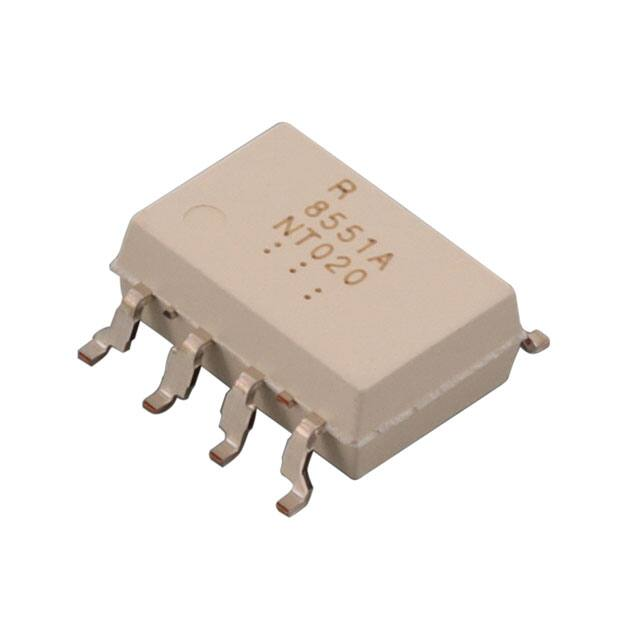
Preliminary Data Sheet
PS8551AL4
R08DS0123EJ0100
Rev.1.00
Jun 27, 2014
ANALOG OUTPUT TYPE
OPTICAL COUPLED ISOLATION AMPLIFIER
DESCRIPTION
The PS8551AL4 is an optically coupled isolation amplifier that uses an IC with a high-accuracy sigma-delta A/D
converter and a GaAIAs light-emitting diode with high-speed response and high luminance efficiency on the input side,
and an IC with a high-accuracy D/A converter on the output side.
The PS8551AL4 is designed specifically for high common mode transient immunity (CMTI) and high linearity (nonlinearity). The PS8551AL4 is designed for current and voltage sensing.
FEATURES
PIN CONNECTION
(Top View)
1
2
3
Gain: 8 V/V TYP.
• Package: 8-pin DIP lead bending type (Gull-wing) for long creepage distance for
surface mount (L4)
• Embossed tape product: PS8551AL4-E3: 1 000 pcs/reel
6
–
7
+
• Gain tolerance (G = 7.92 to 8.08 (±1%))
8
–
• High isolation voltage (BV = 5 000 Vr.m.s.)
+
• High common mode transient immunity (CMTI = 10 kV/μs MIN.)
5
SHIELD
• Non-linearity (NL200 = 0.35% MAX.)
4
1. VDD1
2. VIN+
3. VIN–
4. GND1
5. GND2
6. VOUT–
7. VOUT+
8. VDD2
• Pb-Free product
• Safety standards
• UL approved: No. E72422
• CSA approved: No. CA 101391 (CA5A, CAN/CSA-C22.2 60065, 60950)
• SEMKO approved (EN60065, EN60950)
• DIN EN60747-5-5 (VDE0884-5) approved (Option)
APPLICATIONS
• AC Servo, inverter
• Solar power conditioner
• Measurement equipment
R08DS0123EJ0100 Rev.1.00
Jun 27, 2014
Page 1 of 18
�PS8551AL4
Chapter Title
PACKAGE DIMENSIONS (UNIT: mm)
Lead Bending Type (Gull-wing) For Long Creepage Distance For Surface Mount (L4)
+0.5
9.25–0.25
10.05±0.4
+0.4
–0.2
+0.5
1.01
0.5±0.15
2.54
3.7±0.35
3.5±0.2
0.2±0.15
6.5–0.1
0.62±0.25
PHOTOCOUPLER CONSTRUCTION
Parameter
Unit (MIN.)
Air Distance
8 mm
Outer Creepage Distance
8 mm
Isolation Distance
R08DS0123EJ0100 Rev.1.00
Jun 27, 2014
0.4 mm
Page 2 of 18
�PS8551AL4
Chapter Title
MARKING EXAMPLE
No. 1 pin
Mark
R
8551A
NT131
Company Initial
Type Number
Assembly Lot
N T 1 31
Week Assembled
Year Assembled
(Last 1 Digit)
In-house Code
(T: Pb-Free)
Rank Code
ORDERING INFORMATION
Part Number
Order Number
Solder Plating
Specification
Packing Style
Safety Standard
Approval
PS8551AL4
PS8551AL4-AX
Pb-Free
Magazine case 50 pcs
Standard products
PS8551AL4-E3
PS8551AL4-E3-AX
(Ni/Pd/Au)
Embossed Tape 1 000
pcs/reel
(UL, CSA, SEMKO
approved)
PS8551AL4-V
PS8551AL4-V-AX
Magazine case 50 pcs
UL, CSA, SEMKO,
PS8551AL4-V-E3
PS8551AL4-V-E3-AX
Embossed Tape 1 000
DIN EN60747-5-2
pcs/reel
(VDE0884-5)
Application Part
1
Number*
PS8551AL4
Approved
*1 For the application of the Safety Standard, following part number should be used.
R08DS0123EJ0100 Rev.1.00
Jun 27, 2014
Page 3 of 18
�PS8551AL4
Chapter Title
ABSOLUTE MAXIMUM RATINGS (TA = 25°C, unless otherwise specified)
Parameter
Symbol
Ratings
Unit
Operating Ambient Temperature
TA
-40 to +105
°C
Storage Temperature
Tstg
-55 to+125
°C
VDD1, VDD2
0 to 5.5
V
Input Voltage
VIN+, VIN−
-2 to VDD1+0.5
V
2 Seconds Transient Input Voltage
VIN+, VIN−
-6 to VDD1+0.5
V
VOUT+, VOUT−
-0.5 to VDD2+0.5
V
BV
5 000
Vr.m.s.
Supply Voltage
Output Voltage
Isolation Voltage
*1
*1 AC voltage for 1 minute at TA = 25°C, RH = 60% between input and output.
Pins 1-4 shorted together, 5-8 shorted together.
RECOMMENDED OPERATING CONDITIONS
Parameter
Operating Ambient Temperature
Supply Voltage
Input Voltage
*1
(Accurate and Linear)
Symbol
MIN.
MAX.
Unit
TA
−40
105
°C
VDD1, VDD2
4.5
5.5
V
VIN+, VIN−
−200
200
mV
*1 Using VIN− = 0 V (to be connected to GND1) is recommended. Avoid using VIN− of 2.5 V or more, because the
internal test mode is activated when the voltage VIN− reaches more than 2.5 V.
R08DS0123EJ0100 Rev.1.00
Jun 27, 2014
Page 4 of 18
�PS8551AL4
Chapter Title
ELECTRICAL CHARACTERISTICS (DC Characteristics)
(TYP.: TA = 25°C, VIN+ = VIN− = 0 V, VDD1 = VDD2 = 5 V,
MIN., MAX.: refer to RECOMMENDED OPERATING CONDITIONS, unless otherwise specified)
Parameter
Symbol
Input Offset Voltage
Vos
TA = 25°C
MIN.
TYP.
MAX.
Unit
−2
−0.25
2
mV
−3
−0.25
3
1.6
10
μV/°C
8
8.08
V/V
⏐dVos/dTA⏐
Input Offset Voltage Drift
vs. Temperature
Gain
Conditions
*1
G
−200 mV ≤ VIN+ ≤ 200 mV,
7.92
TA = 25°C
⏐dG/dTA⏐
Gain Drift vs. Temperature
VOUT Non-linearity (200 mV)
*2
VOUT Non-linearity (200 mV) Drift
NL200
0.0006
−200 mV ≤ VIN+ ≤ 200 mV
0.014
⏐dNL200/dTA⏐
V/V°C
0.35
0.0001
%
%/°C
vs. Temperature
VOUT Non-linearity (100 mV)
*2
Maximum Input Voltage before VOUT
Clipping
NL100
−100 mV ≤ VIN+ ≤ 100 mV
0.011
⏐VIN+⏐MAX.
0.2
320
%
mV
Input Supply Current
IDD1
VIN+ = 400 mV
13.5
16
mA
Output Supply Current
IDD2
VIN+ = −400 mV
7.8
16
mA
Input Bias Current
IIN+
VIN+ = 0V
−0.65
1
μA
Input Bias Current Drift
−1
⏐dIIN+/dTA⏐
0.3
nA/°C
vs. Temperature
Low Level Saturated Output Voltage
VOL
VIN+ = −400 mV
1.29
V
High Level Saturated Output Voltage
VOH
VIN+ = 400 mV
3.8
V
Output Voltage (VIN+ = VIN− = 0 V)
VOCM
VIN+ = VIN− = 0 V
2.2
2.55
2.8
V
Output Short-circuit Current
⏐IOSC⏐
20
mA
Equivalent Input Resistance
RIN
450
kΩ
ROUT
4
Ω
CMRRIN
76
dB
VOUT Output Resistance
Input DC Common-Mode Rejection
Ratio
*3
*1 The differential output voltage (VOUT+ − VOUT−) with respect to the differential input voltage (VIN+ − VIN−), where VIN+ =
−200 mV to 200 mV and VIN− = 0 V) is measured under the circuit shown in Fig. 2 NL200, G Test Circuit. Upon
the resulting chart, the gain is defined as the slope of the optimum line obtained by using the method of least
squares.
*2 The differential output voltage (VOUT+ − VOUT−) with respect to the differential input voltage (VIN+ − VIN−) is measured
under the circuit shown in Fig. 2 NL200, G Test Circuit. Upon the resulting chart, the optimum line is obtained by
using the method of least squares. Non-linearity is defined as the ratio (%) of the optimum line obtained by dividing
[Half of the peak to peak value of the (residual) deviation] by [full-scale differential output voltage].
For example, if the differential output voltage is 3.2 V, and the peak to peak value of the (residual) deviation is 22.4
mV, while the input VIN+ is ±200 mV, the output non-linearity is obtained as follows:
NL200 = 22.4/(2 × 3 200) = 0.35%
*3 CMRRIN is defined as the ratio of the differential signal gain (when the differential signal is applied between the
input pins) to the common-mode signal gain (when both input pins are connected and the signal is applied). This
value is indicated in dB.
R08DS0123EJ0100 Rev.1.00
Jun 27, 2014
Page 5 of 18
�PS8551AL4
Chapter Title
ELECTRICAL CHARACTERISTICS (AC Characteristics)
(TYP.: TA = 25°C, VIN+ = VIN− = 0 V, VDD1 = VDD2 = 5 V,
MIN., MAX.: refer to RECOMMENDED OPERATING CONDITIONS, unless otherwise specified)
Parameter
Symbol
VOUT Bandwidth (−3 dB)
fC
Conditions
VIN+ = 200 mVp-p, sine wave
MIN.
TYP.
MAX.
50
100
kHz
mVr.m.s.
VOUT Noise
NOUT
VIN+ = 0 V
15.6
VIN to VOUT Signal Delay (50 to 10%)
tPD10
VIN+ = 0 to 150 mV step
2.4
3.3
VIN to VOUT Signal Delay (50 to 50%)
tPD50
4.2
5.6
VIN to VOUT Signal Delay (50 to 90%)
tPD90
6.1
9.9
3.1
6.6
VOUT Rise Time/Fall Time (10 to 90%)
*1
Common Mode Transient Immunity
Power Supply Noise Rejection
*2
tr/tf
VIN+ = 0 to 150 mV step
CMTI
VCM = 0.5 kV, tr = 20 ns, TA = 25°C
PSR
f = 1 MHz
10
Unit
μs
μs
28
kV/μs
40
mVr.m.s.
*1 CMTI is tested by applying a pulse that rises and falls suddenly (VCM = 0.5 kV) between GND1 on the input side
and GND2 on the output side (pins 4 and 5) by using the circuit shown in Fig. 9 CMTI Test Circuit. CMTI is
defined at the point where the differential output voltage (VOUT+ − VOUT−) fluctuates 200 mV (>1 μs) or more from the
average output voltage.
*2 This is the value of the transient voltage at the differential output when 1 Vp-p, 1 MHz, and 40 ns rise/fall time
square wave is applied to both VDD1 and VDD2.
R08DS0123EJ0100 Rev.1.00
Jun 27, 2014
Page 6 of 18
�PS8551AL4
Chapter Title
TEST CIRCUIT
Fig. 1 VOS Test Circuit
VDD2
VDD1
+15 V
1
8
0.1 μF 2
7 0.1 μF
+
+
3
–
–
4
0.1 μF
10 kΩ
+
6
10 kΩ
AD624CD
(x100)
5
0.47 μF 0.47 μF
VOUT
−
0.1 μF
SHIELD
–15 V
Fig. 2 NL200, G Test Circuit
VDD2
VDD1
+15 V
1
VIN
404 Ω
13.2 Ω
0.1 μF 2
7 0.1 μF
+
+
3
0.01 μF
+15 V
8
–
–
4
0.1 μF
10 kΩ
+
6
10 kΩ
AD624CD
(x4)
5
0.47 μF 0.47 μF
0.1 μF
+
AD624CD
(x10)
−
VOUT
−
0.1 μF
SHIELD
0.1 μF
–15 V
10 kΩ
–15 V
0.47 μF
Fig. 3 IDD1 Test Circuit
IDD1
Fig. 4 IDD2 Test Circuit
1
2
+
0.1μ F
5V
0.01 μF
400 mV
3
–
+
–
4
1
7
2
8
0.1μ F
6
5V
– 400
mV
0.01 μF
IDD2
7
+
5
SHIELD
R08DS0123EJ0100 Rev.1.00
Jun 27, 2014
8
3
–
+
–
4
6
5
0.1μ F
5V
SHIELD
Page 7 of 18
�PS8551AL4
Chapter Title
Fig. 5 IIN+ Test Circuit
8
1
IIN+
2
7
+
0.1μ F
0.01 μF
+
3
–
–
4
5V
6
5
SHIELD
Fig. 6 VOUT Test Circuit
VOL
8
1
2
7
+
0.1μ F
5V
– 400
0.01 μF
mV
3
–
+
–
4
VOL
6
5
0.1μ F
5V
SHIELD
VOCM
1
8
2
7
+
0.1μ F
0.01 μF
3
–
+
–
4
5V
VOCM
6
5
0.1μ F
5V
SHIELD
VOH
8
1
2
7
+
0.1μ F
5V
400 mV
0.01 μF
3
–
+
–
4
VOH
6
5
0.1μ F
5V
SHIELD
R08DS0123EJ0100 Rev.1.00
Jun 27, 2014
Page 8 of 18
�PS8551AL4
Chapter Title
Fig. 7 |IOSC| Test Circuit
1
8
2
7
+
0.1μ F
0.01 μF
3
–
+
–
4
5V
1
IOSC
8
2
7
+
6
0.1μ F
0.1μ F
5
5V
0.01 μF
+
3
–
–
4
5V
6
5
SHIELD
IOSC
0.1μ F
5V
SHIELD
Fig. 8 tPD Test Circuit
10 kΩ
VDD2
VDD1
+15 V
1
0.1 μF 2
VIN
8
+
+
3
0.01 μF
–
–
4
7 0.1 μF
2 kΩ
6
2 kΩ
0.1 μF
−
VOUT
NE5534
+
5
0.1 μF
10 kΩ
SHIELD
–15 V
Fig. 9 CMTI Test Circuit
150 pF
10 kΩ
VDD2
78L05
IN
9V
OUT
0.1 μF
+15 V
1
0.1 μF 2
8
+
+
3
–
–
4
7 0.1 μF
2 kΩ
6
2 kΩ
5
SHIELD
+
–
−
μPC813
+
0.1 μF
VOUT
0.1 μF
150 pF 10 kΩ
–15 V
VCM
R08DS0123EJ0100 Rev.1.00
Jun 27, 2014
Page 9 of 18
�PS8551AL4
Chapter Title
TYPICAL CHARACTERISTICS (TA = 25°C, unless otherwise specified)
INPUT OFFSET VOLTAGE vs.
AMBIENT TEMPERATURE
2.0
VDD1 = VDD2 = 5 V
VIN+ = VIN- = 0 V
2.0�
Input Offset Voltage VOS (mV)
Input Offset Voltage VOS (mV)
3.0
INPUT OFFSET VOLTAGE vs.
SUPPLY VOLTAGE
1.0�
0.0�
−1.0�
−2.0�
−3.0
−50
−25
0
25
50
75
100
1.0
0.5
0.0
−0.5
−1.0
−1.5
−2.0
4.5
125
Ambient Temperature TA (°C)
−25
0
25
50
75
100
VIN+ = −200 mV to +200 mV,
VIN- = 0 V
8.0
7.8
4.5
125
4.75
5
5.25
Ambient Temperature TA (°C)
Supply Voltage VDD1, VDD2 (V)
NON-LINEARITY vs.
AMBIENT TEMPERATURE
NON-LINEARITY vs.
SUPPLY VOLTAGE
0.35
0.35
0.25
0.20
0.15
0.10
0.05
5.5
VIN+ = −200 mV to +200 mV,
VIN- = 0 V
0.30
Non-linearity NL200 (%)
VDD1 = VDD2 = 5 V
VIN+ = −200 mV to +200 mV,
VIN- = 0 V
0.30
Non-linearity NL200 (%)
5.5
7.9
7.9
0.00
−50
5.25
8.1
Gain G (V/V)
Gain G (V/V)
8.0
7.8
−50
5
GAIN vs. SUPPLY VOLTAGE
8.2
VDD1 = VDD2 = 5 V
VIN+ = −200 mV to +200 mV,
VIN- = 0 V
8.1
4.75
Supply Voltage VDD1, VDD2 (V)
GAIN vs. AMBIENT TEMPERATURE
8.2
VIN+ = VIN- = 0 V
1.5
0.25
0.20
0.15
0.10
0.05
−25
0
25
50
75
100
125
Ambient Temperature TA (°C)
0.00
4.5
4.75
5
5.25
5.5
Supply Voltage VDD1, VDD2 (V)
Remark The graphs indicate nominal characteristics.
R08DS0123EJ0100 Rev.1.00
Jun 27, 2014
Page 10 of 18
�PS8551AL4
Chapter Title
OUTPUT VOLTAGE vs. INPUT VOLTAGE
SUPPLY CURRENT vs. INPUT VOLTAGE
4
16
14
Supply Current IDD (mA)
3.5
Output Voltage VO (V)
VOUT−
3
2.5
2
VOUT+
1.5
0
8
4
0.2
0
−0.4
0.4
VDD1 = VDD2 = 5 V
−0.2
0
0.2
Input Voltage VIN (V)
INPUT CURRENT vs. INPUT VOLTAGE
GAIN vs. FREQUENCY
2
0
−1
Gain GV (dB)
1
0
−1
−3
−0.4
0.4
1
VDD1 = VDD2 = 5 V
VIN- = 0 V
−2
−3
−4
−5
−6
VDD1 = VDD2 = 5 V,
−7 VIN- = 0 V
−8 VIN+ = 200 mVp-p sine wave
10
100
1 000 10 000 100 000
−2
−0.2
0
0.2
0.4
Input Voltage VIN+ (V)
FREQUENCY vs. SUPPLY VOLTAGE
120
100
100
Frequency fC−3 dB (Hz)
120
80
60
40
20 VDD1 = VDD2 = 5 V,
VIN- = 0 V
VIN+ = 200 mVp-p sine wave
0
−50 −25
0
25
50
75
1 000 000
Frequency f (Hz)
FREQUENCY vs.
AMBIENT TEMPERATURE
Frequency fC−3 dB (Hz)
IDD2
6
Input Voltage VIN+ (V)
3
Input Current IIN+ (μA)
−0.2
10
2
VDD1 = VDD2 = 5 V
1
−0.4
IDD1
12
100
125
Ambient Temperature TA (°C)
80
60
40
20 VDD1 = VDD2 = 5 V,
VIN- = 0 V
VIN+ = 200 mVp-p sine wave
0
4.5
4.75
5
5.25
5.5
Supply Voltage VDD1, VDD2 (V)
Remark The graphs indicate nominal characteristics.
R08DS0123EJ0100 Rev.1.00
Jun 27, 2014
Page 11 of 18
�PS8551AL4
Chapter Title
SIGNAL DELAY TIME vs.
AMBIENT TEMPERATURE
Signal Delay Time PD (μs)
7
6
tPD90
5
tPD50
4
tf
3
tr
tPD10
2
1
VDD1 = VDD2 = 5 V,
VIN- = 0 V
VIN+ = 0 to 150 mVstep
0
−50
−25
0
25
50
75
100
125
Ambient Temperature TA (°C)
Remark The graphs indicate nominal characteristics.
R08DS0123EJ0100 Rev.1.00
Jun 27, 2014
Page 12 of 18
�PS8551AL4
Chapter Title
TAPING SPECIFICATIONS (UNIT: mm)
4.65 MAX.
10.55±0.1
7.5±0.1
1.5 +0.1
–0
16.0±0.3
2.0±0.1
4.0±0.1
1.75±0.1
Outline and Dimensions (Tape)
4.2±0.1
9.95±0.1
1.55±0.1
12.0±0.1
0.3±0.05
Tape Direction
PS8551AL4-E3
Outline and Dimensions (Reel)
2.0±0.5
21.0±0.8
100±1.0
R 1.0
330±2.0
2.0±0.5
13.0±0.2
17.5±1.0
21.5±1.0
Packing: 1 000 pcs/reel
R08DS0123EJ0100 Rev.1.00
Jun 27, 2014
Page 13 of 18
�PS8551AL4
Chapter Title
RECOMMENDED MOUNT PAD DIMENSIONS (UNIT: mm)
B
C
D
A
Part Number
Lead Bending
PS8551AL4
lead bending type (Gull-wing)
for surface mount
R08DS0123EJ0100 Rev.1.00
Jun 27, 2014
A
B
C
D
9.0
2.54
1.7
2.0
Page 14 of 18
�PS8551AL4
Chapter Title
NOTES ON HANDLING
1. Recommended soldering conditions
(1) Infrared reflow soldering
• Peak reflow temperature
260°C or below (package surface temperature)
• Time of peak reflow temperature
10 seconds or less
• Time of temperature higher than 220°C
60 seconds or less
• Time to preheat temperature from 120 to 180°C
120±30 s
• Number of reflows
Three
• Flux
Rosin flux containing small amount of chlorine (The flux with a
maximum chlorine content of 0.2 Wt% is recommended.)
Package Surface Temperature T (°C)
Recommended Temperature Profile of Infrared Reflow
(heating)
to 10 s
260°C MAX.
220°C
to 60 s
180°C
120°C
120±30 s
(preheating)
Time (s)
(2) Wave soldering
• Temperature
260°C or below (molten solder temperature)
• Time
10 seconds or less
• Preheating conditions
120°C or below (package surface temperature)
• Number of times
One (Allowed to be dipped in solder including plastic mold portion.)
• Flux
Rosin flux containing small amount of chlorine (The flux with a maximum chlorine content
of 0.2 Wt% is recommended.)
(3) Soldering by Soldering Iron
• Peak Temperature (lead part temperature)
350°C or below
• Time (each pins)
3 seconds or less
• Flux
Rosin flux containing small amount of chlorine (The flux with a
maximum chlorine content of 0.2 Wt% is recommended.)
(a) Soldering of leads should be made at the point 1.5 to 2.0 mm from the root of the lead
R08DS0123EJ0100 Rev.1.00
Jun 27, 2014
Page 15 of 18
�PS8551AL4
Chapter Title
(4) Cautions
• Fluxes
Avoid removing the residual flux with freon-based and chlorine-based cleaning solvent.
2. Cautions regarding noise
Be aware that when voltage is applied suddenly between the photocoupler’s input and output at startup, the output
transistor may enter the on state, even if the voltage is within the absolute maximum ratings.
USAGE CAUTIONS
1. This product is weak for static electricity by designed with high-speed integrated circuit so protect against static
electricity when handling.
2. Board designing
(1) By-pass capacitor of more than 0.1 μF is used between VCC and GND near device. Also, ensure that the
distance between the leads of the photocoupler and capacitor is no more than 10 mm.
(2) Keep the pattern connected the input (VIN+, VIN-) and the output (VOUT+, VOUT-), respectively, as short as possible.
(3) Do not connect any routing to the portion of the frame exposed between the pins on the package of the
photocoupler. If connected, it will affect the photocoupler's internal voltage and the photocoupler will not
operate normally.
(4) Because the maximum frequency of the signal input to the photocoupler must be lower than the allowable
frequency band, be sure to connect an anti-aliasing filter (an RC filter with R = 68 Ω and C = 0.01 μF, for
example).
(5) The signals output from the PS8551A include noise elements such as chopping noise and quantization noise
generated internally. Therefore, be sure to restrict the output frequency to the required bandwidth by adding a
low-pass filter function (an RC filter with R =10 kΩ and C = 150 pF, for example) to the operational amplifier
(post amplifier) in the next stage to the PS8551A.
(6) When the primary power supply (VDD1) is off and only the secondary power supply (VDD2) is being applied
(VDD1 = 0 V and VDD2 = 5 V), VOUT+ outputs a low level, and VOUT− outputs a high level (VOUT+ = 1.3 V TYP.,
VOUT– = 3.8 V TYP.), regardless of the input voltages (VIN+ and VIN−).
(7) The output level of VOUT+ and VOUT− might be unstable for several seconds immediately after the secondary
power supply (VDD2) is applied while the primary power supply (VDD1) is being applied.
3. Avoid storage at a high temperature and high humidity.
R08DS0123EJ0100 Rev.1.00
Jun 27, 2014
Page 16 of 18
�PS8551AL4
Chapter Title
SPECIFICATION OF VDE MARKS LICENSE DOCUMENT
Parameter
Symbol
Climatic test class (IEC 60068-1/DIN EN 60068-1)
Spec.
Unit
40/105/21
Dielectric strength
maximum operating isolation voltage
Test voltage (partial discharge test, procedure a for type test and random test)
Upr = 1.5 × UIORM, Pd < 5 pC
Test voltage (partial discharge test, procedure b for all devices)
UIORM
Upr
1 130
1 695
Vpeak
Vpeak
Upr
2 119
Vpeak
UTR
8 000
Vpeak
Upr = 1.875 × UIORM, Pd < 5 pC
Highest permissible overvoltage
Degree of pollution (DIN EN 60664-1 VDE0110 Part 1)
Comparative tracking index (IEC 60112/DIN EN 60112 (VDE 0303 Part 11))
2
CTI
Material group (DIN EN 60664-1 VDE0110 Part 1)
175
III a
Storage temperature range
Tstg
–55 to +125
°C
Operating temperature range
TA
–40 to +105
°C
Ris MIN.
Ris MIN.
10
11
10
Package temperature
Tsi
175
°C
Current (input current IF, Psi = 0)
Isi
400
mA
Power (output or total power dissipation)
Psi
700
mW
Ris MIN.
10
Isolation resistance, minimum value
VIO = 500 V dc at TA = 25°C
VIO = 500 V dc at TA MAX. at least 100°C
12
Ω
Ω
Safety maximum ratings (maximum permissible in case of fault, see thermal
derating curve)
Isolation resistance
VIO = 500 V dc at TA = Tsi
R08DS0123EJ0100 Rev.1.00
Jun 27, 2014
9
Ω
Page 17 of 18
�PS8551AL4
Caution
Chapter Title
GaAs Products
This product uses gallium arsenide (GaAs).
GaAs vapor and powder are hazardous to human health if inhaled or ingested, so please observe
the following points.
• Follow related laws and ordinances when disposing of the product. If there are no applicable laws
and/or ordinances, dispose of the product as recommended below.
1. Commission a disposal company able to (with a license to) collect, transport and dispose of
materials that contain arsenic and other such industrial waste materials.
2. Exclude the product from general industrial waste and household garbage, and ensure that the
product is controlled (as industrial waste subject to special control) up until final disposal.
• Do not burn, destroy, cut, crush, or chemically dissolve the product.
• Do not lick the product or in any way allow it to enter the mouth.
R08DS0123EJ0100 Rev.1.00
Jun 27, 2014
Page 18 of 18
�Revision History
PS8551AL4 Data Sheet
Description
Rev.
Date
1.00
Jun 27, 2014
Page
−
Summary
First edition issued
All trademarks and registered trademarks are the property of their respective owners.
C-1
�Notice
1.
Descriptions of circuits, software and other related information in this document are provided only to illustrate the operation of semiconductor products and application examples. You are fully responsible for
the incorporation of these circuits, software, and information in the design of your equipment. Renesas Electronics assumes no responsibility for any losses incurred by you or third parties arising from the
use of these circuits, software, or information.
2.
Renesas Electronics has used reasonable care in preparing the information included in this document, but Renesas Electronics does not warrant that such information is error free. Renesas Electronics
3.
Renesas Electronics does not assume any liability for infringement of patents, copyrights, or other intellectual property rights of third parties by or arising from the use of Renesas Electronics products or
assumes no liability whatsoever for any damages incurred by you resulting from errors in or omissions from the information included herein.
technical information described in this document. No license, express, implied or otherwise, is granted hereby under any patents, copyrights or other intellectual property rights of Renesas Electronics or
others.
4.
You should not alter, modify, copy, or otherwise misappropriate any Renesas Electronics product, whether in whole or in part. Renesas Electronics assumes no responsibility for any losses incurred by you or
5.
Renesas Electronics products are classified according to the following two quality grades: "Standard" and "High Quality". The recommended applications for each Renesas Electronics product depends on
third parties arising from such alteration, modification, copy or otherwise misappropriation of Renesas Electronics product.
the product's quality grade, as indicated below.
"Standard": Computers; office equipment; communications equipment; test and measurement equipment; audio and visual equipment; home electronic appliances; machine tools; personal electronic
equipment; and industrial robots etc.
"High Quality": Transportation equipment (automobiles, trains, ships, etc.); traffic control systems; anti-disaster systems; anti-crime systems; and safety equipment etc.
Renesas Electronics products are neither intended nor authorized for use in products or systems that may pose a direct threat to human life or bodily injury (artificial life support devices or systems, surgical
implantations etc.), or may cause serious property damages (nuclear reactor control systems, military equipment etc.). You must check the quality grade of each Renesas Electronics product before using it
in a particular application. You may not use any Renesas Electronics product for any application for which it is not intended. Renesas Electronics shall not be in any way liable for any damages or losses
incurred by you or third parties arising from the use of any Renesas Electronics product for which the product is not intended by Renesas Electronics.
6.
You should use the Renesas Electronics products described in this document within the range specified by Renesas Electronics, especially with respect to the maximum rating, operating supply voltage
range, movement power voltage range, heat radiation characteristics, installation and other product characteristics. Renesas Electronics shall have no liability for malfunctions or damages arising out of the
use of Renesas Electronics products beyond such specified ranges.
7.
Although Renesas Electronics endeavors to improve the quality and reliability of its products, semiconductor products have specific characteristics such as the occurrence of failure at a certain rate and
malfunctions under certain use conditions. Further, Renesas Electronics products are not subject to radiation resistance design. Please be sure to implement safety measures to guard them against the
possibility of physical injury, and injury or damage caused by fire in the event of the failure of a Renesas Electronics product, such as safety design for hardware and software including but not limited to
redundancy, fire control and malfunction prevention, appropriate treatment for aging degradation or any other appropriate measures. Because the evaluation of microcomputer software alone is very difficult,
please evaluate the safety of the final products or systems manufactured by you.
8.
Please contact a Renesas Electronics sales office for details as to environmental matters such as the environmental compatibility of each Renesas Electronics product. Please use Renesas Electronics
products in compliance with all applicable laws and regulations that regulate the inclusion or use of controlled substances, including without limitation, the EU RoHS Directive. Renesas Electronics assumes
no liability for damages or losses occurring as a result of your noncompliance with applicable laws and regulations.
9.
Renesas Electronics products and technology may not be used for or incorporated into any products or systems whose manufacture, use, or sale is prohibited under any applicable domestic or foreign laws or
regulations. You should not use Renesas Electronics products or technology described in this document for any purpose relating to military applications or use by the military, including but not limited to the
development of weapons of mass destruction. When exporting the Renesas Electronics products or technology described in this document, you should comply with the applicable export control laws and
regulations and follow the procedures required by such laws and regulations.
10. It is the responsibility of the buyer or distributor of Renesas Electronics products, who distributes, disposes of, or otherwise places the product with a third party, to notify such third party in advance of the
contents and conditions set forth in this document, Renesas Electronics assumes no responsibility for any losses incurred by you or third parties as a result of unauthorized use of Renesas Electronics
products.
11. This document may not be reproduced or duplicated in any form, in whole or in part, without prior written consent of Renesas Electronics.
12. Please contact a Renesas Electronics sales office if you have any questions regarding the information contained in this document or Renesas Electronics products, or if you have any other inquiries.
(Note 1)
"Renesas Electronics" as used in this document means Renesas Electronics Corporation and also includes its majority-owned subsidiaries.
(Note 2)
"Renesas Electronics product(s)" means any product developed or manufactured by or for Renesas Electronics.
http://www.renesas.com
SALES OFFICES
Refer to "http://www.renesas.com/" for the latest and detailed information.
California Eastern Laboratories, Inc.
4590 Patrick Henry Drive, Santa Clara, California 95054, U.S.A.
Tel: +1-408-919-2500, Fax: +1-408-988-0279
Renesas Electronics Europe Limited
Dukes Meadow, Millboard Road, Bourne End, Buckinghamshire, SL8 5FH, U.K
Tel: +44-1628-585-100, Fax: +44-1628-585-900
Renesas Electronics Europe GmbH
Arcadiastrasse 10, 40472 D üsseldorf, Germany
Tel: +49-211-6503-0, Fax: +49-211-6503-1327
Renesas Electronics (China) Co., Ltd.
Room 1709, Quantum Plaza, No.27 ZhiChunLu Haidian District, Beijing 100191, P.R.China
Tel: +86-10-8235-1155, Fax: +86-10-8235-7679
Renesas Electronics (Shanghai) Co., Ltd.
Unit 301, Tower A, Central Towers, 555 Langao Road, Putuo District, Shanghai, P. R. China 200333
Tel: +86-21-2226-0888, Fax: +86-21-2226-0999
Renesas Electronics Hong Kong Limited
Unit 1601-1613, 16/F., Tower 2, Grand Century Place, 193 Prince Edward Road West, Mongkok, Kowloon, Hong Kong
Tel: +852-2265-6688, Fax: +852 2886-9022/9044
Renesas Electronics Taiwan Co., Ltd.
13F, No. 363, Fu Shing North Road, Taipei 10543, Taiwan
Tel: +886-2-8175-9600, Fax: +886 2-8175-9670
Renesas Electronics Singapore Pte. Ltd.
80 Bendemeer Road, Unit #06-02 Hyflux Innovation Centre, Singapore 339949
Tel: +65-6213-0200, Fax: +65-6213-0300
Renesas Electronics Malaysia Sdn.Bhd.
Unit 906, Block B, Menara Amcorp, Amcorp Trade Centre, No. 18, Jln Persiaran Barat, 46050 Petaling Jaya, Selangor Darul Ehsan, Malaysia
Tel: +60-3-7955-9390, Fax: +60-3-7955-9510
Renesas Electronics Korea Co., Ltd.
12F., 234 Teheran-ro, Gangnam-Ku, Seoul, 135-920, Korea
Tel: +82-2-558-3737, Fax: +82-2-558-5141
© 2014 Renesas Electronics Corporation. All rights reserved.
Colophon 4.0
�