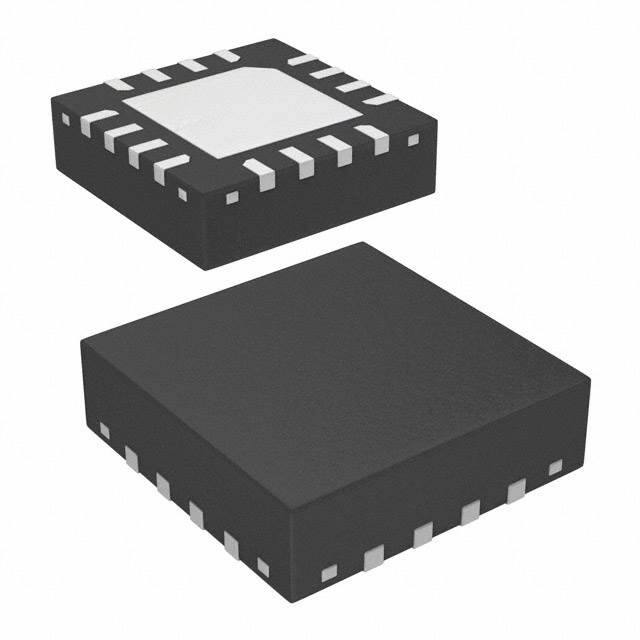
RT2859A/B
3A, 18V, 650kHz, ACOT® Synchronous Step-Down Converter
1 General Description
2 Features
The RT2859A/B are high-performance 650kHz 3A
⚫
Fast Transient Response
step-down regulators with internal power switches and
⚫
Steady 650kHz Switching Frequency at all Load
Current (RT2859B)
synchronous rectifiers. They feature quick transient
response using their Advanced Constant On-Time
⚫
Discontinuous Operating Mode at Light Load
(RT2859A)
(ACOT® ) control architecture that provides stable
operation with small ceramic output capacitors and
⚫
3A Output Current
without complicated external compensation, among
⚫
Advanced Constant On-Time (ACOT® Control
other benefits. The input voltage range is from 4.5V to
⚫
Optimized for Ceramic Output Capacitors
18V and the output is adjustable from 0.765V to 7V.
⚫
4.5V to 18V Input Voltage Range
The proprietary ACOT® control improves upon other
⚫
Internal 70m Switch and 70m Synchronous
fast-response
constant
on-time
Rectifier
architectures,
achieving nearly constant switching frequency over
line, load, and output voltage ranges. Since there is no
⚫
0.765V to 7V Adjustable Output Voltage
⚫
Externally-Adjustable, Pre-Biased Compatible
Soft-Start
internal clock, response to transients is nearly
instantaneous and inductor current can ramp quickly
to maintain output regulation without large bulk output
capacitance. The RT2859A/B are stable with and
optimized for ceramic output capacitors.
With internal 70m switches and 70m synchronous
rectifiers, the RT2859A/B display excellent efficiency
and good behavior across a range of applications,
especially for low output voltages and low duty cycles.
Cycle-by-cycle current limit, input under-voltage
lockout, externally-adjustable soft-start, output underand over-voltage protection, and thermal shutdown
provide safe and smooth operation in all operating
conditions.
The RT2859A and RT2859B are each available in the
WQFN-16L 3x3 package, with exposed thermal pads.
⚫
Cycle-by-Cycle Current Limit
⚫
Optional Output Discharge Function
⚫
Output Over- and Under-voltage Shut Down
⚫
Latched (RT2859ALGQW/RT2859BLGQW Only)
⚫
With Hiccup Mode
(RT2859AHGQW/RT2859BHGQW Only)
⚫
Input Under-Voltage Lockout
⚫
Thermal Shutdown
3 Applications
⚫
Industrial and Commercial Low Power Systems
⚫
Computer Peripherals
⚫
LCD Monitors and TVs
⚫
Green Electronics/Appliances
⚫
Point of Load Regulation for High-Performance
DSPs, FPGAs, and ASICs
The RT2859B switches continuously even at light
loads to avoid low-frequency interference while the
RT2859A features a power-saving discontinuous
operating mode at light loads. The recommended
junction temperature range is −40C to 125C and
ambient temperature range is −40C to 85C.
Copyright © 2024 Richtek Technology Corporation. All rights reserved.
DS2859A/B-08
March
2024
is a registered trademark of Richtek Technology Corporation.
www.richtek.com
1
�RT2859A/B
4 Simplified Application Circuit
VIN
RT2859A/B
VIN
SW
VCC
Power Good
VREG5
Input Signal
PGOOD
VOUT
BOOT
VS
FB
EN
SS
VREG5
GND PGND
5 Ordering Information
RT2859A/B
6 Marking Information
RT2859AHGQW
Package Type
QW : WQFN-16L 3x3 (W-Type)
Lead Plating System
G : Richtek Green Policy Compliant
48= : Product Code
YMDNN : Date Code
48=YM
DNN
H : Hiccup Mode OVP & UVP
L : Latched OVP & UVP
A : PSM
B : PWM
Note:
Richtek products are Richtek Green Policy compliant
RT2859ALGQW
45= : Product Code
YMDNN : Date Code
45=YM
DNN
and compatible with the current require ments of
IPC/JEDEC J-STD-020
RT2859BHGQW
3Z=YM
DNN
3Z= : Product Code
YMDNN : Date Code
RT2859BLGQW
3Y=YM
DNN
Copyright © 2024 Richtek Technology Corporation. All rights reserved.
www.richtek.com
2
3Y= : Product Code
YMDNN : Date Code
is a registered trademark of Richtek Technology Corporation.
DS2859A/B-08
March
2024
�RT2859A/B
Table of Contents
1
General Description --------------------------------- 1
15.11 PGOOD Comparator ---------------------- 17
2
Features ------------------------------------------------- 1
15.12 External Bootstrap Capacitor ------------ 17
3
Applications ------------------------------------------- 1
15.13 Over-Temperature Protection ----------- 17
4
Simplified Application Circuit -------------------- 2
15.14 Output Discharge Control ---------------- 17
5
Ordering Information ------------------------------- 2
15.15 OVP/UVP Protection ---------------------- 17
6
Marking Information -------------------------------- 2
7
Pin Configuration ------------------------------------ 4
16.1
Soft-Start (SS) ------------------------------ 18
8
Functional Pin Description ----------------------- 4
16.2
Enable Operation (EN) -------------------- 18
9
Functional Block Diagram ------------------------ 6
16.3
Output Voltage Setting -------------------- 19
10
Absolute Maximum Ratings ---------------------- 7
16.4
Under-Voltage Lockout Protection ----- 19
11
Recommended Operating Conditions -------- 7
16.5
External BOOT Bootstrap Diode ------- 19
12
Electrical Characteristics ------------------------- 8
16.6
External BOOT Capacitor
13
Typical Application Circuit ---------------------- 10
14
Typical Operating Characteristics -------------11
16.7
VREG5 Capacitor Selection ------------- 20
15
16
Application Information -------------------------- 18
Series Resistance -------------------------- 20
Detailed Description ------------------------------ 14
16.8
Thermal Considerations ------------------ 20
15.1
Constant On-Time (COT) Control ------ 14
16.9
Layout Considerations -------------------- 22
15.2
ACOT Control Architecture ------------- 14
16.10 Layout Considerations -------------------- 22
15.3
ACOT One-Shot Operation ------------- 15
17
Outline Dimension --------------------------------- 24
15.4
Discontinuous Operating Mode
18
Footprint Information ----------------------------- 25
(RT2859A Only) ---------------------------- 15
19
Packing Information ------------------------------- 26
®
®
15.5
Current Limit -------------------------------- 15
19.1
Tape and Reel Data ----------------------- 26
15.6
Hiccup Mode -------------------------------- 16
19.2
Tape and Reel Packing ------------------- 27
15.7
Latch-Off Mode ----------------------------- 16
19.3
Packing Material Anti-ESD Property --- 28
15.8
Input Under-Voltage Lockout ------------ 16
15.9
Shut-Down, Start-Up and Enable (EN) 16
20
Datasheet Revision History --------------------- 29
15.10 Soft-Start (SS) ------------------------------ 16
Copyright © 2024 Richtek Technology Corporation. All rights reserved.
DS2859A/B-08
March
2024
is a registered trademark of Richtek Technology Corporation.
www.richtek.com
3
�RT2859A/B
7 Pin Configuration
VS
VCC
VIN
VIN
(TOP VIEW)
16 15 14 13
FB
VREG5
SS
GND
1
12
2
11
GND
3
10
17
4
9
6
7
8
PGOOD
EN
PGND
PGND
5
BOOT
SW
SW
SW
WQFN-16L 3x3
8 Functional Pin Description
Pin No.
Pin Name
Pin Function
1
FB
Feedback voltage input. Connect FB to the midpoint of the external feedback
resistive divider to sense the output voltage. Place the resistive divider within
5mm from the FB pin. The IC regulates VFB at 0.765V (typical).
2
VREG5
Internal regulator output. Connect a 1F capacitor to GND to stabilize output
voltage.
3
SS
Soft-start control. Connect an external capacitor between this pin and GND
to set the soft-start time.
4
GND
Ground.
5
PGOOD
Open-drain power-good output. PGOOD connects to VREG5 through a pullup resistor
6
EN
Enable control input. A logic-high enables the converter; a logic-low forces
the IC into shutdown mode reducing the supply current to less than 10A.
PGND
Power ground. PGND connects to the Source of the internal N-channel
MOSFET synchronous rectifier and to other power ground nodes of the IC.
The exposed pad and the 2 PGND pins should be well soldered to the input
and output capacitors and to a large PCB area for good power dissipation.
SW
Switch node. SW is the Source of the internal N-channel MOSFET switch
and the Drain of the internal N-channel MOSFET synchronous rectifier.
Connect SW to the inductor with a wide short PCB trace and minimize its
area to reduce EMI.
BOOT
Bootstrap supply for high-side gate driver. Connect a 0.1F capacitor
between BOOT and SW to power the internal gate driver.
13, 14
VIN
Power input. The input voltage range is from 4.5V to 18V. Must bypass with
a suitably large (10F x 2) ceramic capacitors at this pin.
15
VCC
Internal linear regulator supply input. VCC supplies power for the internal
linear regulator that powers the IC. Connect VIN to the input voltage and
bypass to ground with a 0.1F ceramic capacitor.
16
VS
Output voltage sense input.
7, 8,
17 (Exposed pad)
9, 10, 11
12
Copyright © 2024 Richtek Technology Corporation. All rights reserved.
www.richtek.com
4
is a registered trademark of Richtek Technology Corporation.
DS2859A/B-08
March
2024
�RT2859A/B
Copyright © 2024 Richtek Technology Corporation. All rights reserved.
DS2859A/B-08
March
2024
is a registered trademark of Richtek Technology Corporation.
www.richtek.com
5
�RT2859A/B
9 Functional Block Diagram
VCC VREG5
EN
POR &
Reg
VBIAS
BOOT
Min.
Off-Time
VREG5
VIN
VREF
OC
Control
Driver
SW
UV & OV
PGND
SW
VREG5
2µA
SS
VIN
FB
VS
ZC
Ripple
Gen.
FB
+
+
Comparator
FB
0.9 x VREF
Comparator
+
PGOOD
On-Time
Copyright © 2024 Richtek Technology Corporation. All rights reserved.
www.richtek.com
6
GND
is a registered trademark of Richtek Technology Corporation.
DS2859A/B-08
March
2024
�RT2859A/B
10 Absolute Maximum Ratings
(Note 1)
⚫
Supply Voltage, VIN, VCC ----------------------------------------------------------------------------------- −0.3V to 20V
⚫
Switch Voltage, SW ------------------------------------------------------------------------------------------ −0.3V to (VIN + 0.3V)
< 10ns ------------------------------------------------------------------------------------------------------------ −5V to 25V
⚫
BOOT to SW ---------------------------------------------------------------------------------------------------- −0.3V to 6V
⚫
VREG5 to VIN or VCC --------------------------------------------------------------------------------------- −17V to 0.3V
⚫
EN, VS Pin ------------------------------------------------------------------------------------------------------ −0.3V to 20V
⚫
Other Pins ------------------------------------------------------------------------------------------------------- −0.3V to 6V
⚫
Power Dissipation, PD @ TA = 25C
WQFN-16L 3x3------------------------------------------------------------------------------------------------- 2.1W
⚫
Power Dissipation, PD @ TA = 25C
⚫
Package Thermal Resistance
(Note 2)
WQFN-16L 3x3, JA------------------------------------------------------------------------------------------- 47.4C/W
WQFN-16L 3x3, JC ------------------------------------------------------------------------------------------ 7.5C/W
⚫
Lead Temperature (Soldering, 10 sec.) ------------------------------------------------------------------ 260C
⚫
Junction Temperature ---------------------------------------------------------------------------------------- 150C
⚫
Storage Temperature Range ------------------------------------------------------------------------------- −65C to 150C
11 Recommended Operating Conditions
(Note 3)
⚫
Supply Input Voltage, VIN ----------------------------------------------------------------------------------- 4.5V to 18V
⚫
Junction Temperature Range ------------------------------------------------------------------------------- −40C to 125C
⚫
Ambient Temperature Range ------------------------------------------------------------------------------- −40C to 85C
Note 1. Stresses beyond those listed under “Absolute Maximum Ratings” may cause permanent damage to the device. These
are stress ratings only, and functional operation of the device at these or any other conditions beyond those indicated
in the operational sections of the specifications is not implied. Exposure to absolute maximum rating conditions may
affect device reliability.
Note 2. JA is measured at TA = 25C on a high effective thermal conductivity four-layer test board per JEDEC 51-7. JC is
measured at the exposed pad of the package.
Note 3. The device is not guaranteed to function outside its operating conditions.
Copyright © 2024 Richtek Technology Corporation. All rights reserved.
DS2859A/B-08
March
2024
is a registered trademark of Richtek Technology Corporation.
www.richtek.com
7
�RT2859A/B
12 Electrical Characteristics
(VIN =12V, TA =
−40C to 85C unless otherwise noted.
Parameter
Symbol
Test Conditions
Min
Typ
Max
Unit
Supply Current
Shutdown Current
ISHDN
TA = 25C, VEN = 0V
--
1
10
A
Quiescent Current
IQ
TA = 25C, VEN = 5V, VFB = 0.8V
--
1
1.3
mA
Logic-High
1.5
--
18
Logic-Low
--
--
0.4
Logic Threshold
EN Input
Voltage
V
VFB Voltage and Discharge Resistance
TA = 25C
0.757
TA = −40C to 85C
0.755
--
0.775
VFB = 0.8V, TA = 25C
--
0.01
0.1
A
RDIS
VEN = 0V, VS = 0.5V
--
50
100
VREG5
TA = 25C, 6V VIN 18V,
0 < IVREG5 5mA
4.8
5.1
5.4
V
Feedback Threshold Voltage
VFB
Feedback Input Current
IFB
VOUT Discharge Resistance
0.765 0.773
V
VREG5 Output
VREG5 Output Voltage
Line Regulation
6V VIN 18V, IVREG5 = 5mA
--
--
20
mV
Load Regulation
0 IVREG5 5mA
--
--
100
mV
IVREG5
VIN = 6V, VREG5 = 4V, TA = 25C
--
70
--
mA
High-Side
RDS(ON)_H
TA = 25C (VBOOT − VSW) = 5.5V
--
70
--
Low-Side
RDS(ON)_L
TA = 25C
--
70
--
4
5
6
--
150
--
--
20
--
Output Current
RDS(ON)
Switch On
Resistance
m
Current Limit
Current Limit
ILIM
A
Thermal Shutdown
Thermal Shutdown Threshold TSD
Thermal Shutdown
TSD
Hysteresis
On-Time Timer Control
Shutdown temperature
On-Time
tON
VIN = 12V, VOUT = 1.05V
--
135
--
ns
Minimum Off-Time
tOFF(MIN)
VFB = 0.7V, TA = 25C
--
260
310
ns
VSS = 0V
1.4
2
2.6
A
VSS = 0.5V (Latch Mode)
0.1
0.2
--
mA
--
0.5
--
A
3.6
3.85
4.1
0.13
0.35
0.47
VFB rising
85
90
95
VFB falling
--
85
--
C
Soft-Start
SS Charge Current
SS Discharge Current
VSS = 0.5V (Hiccup Mode)
UVLO
UVLO Threshold
Wake up VREG5
Hysteresis
V
Power Good
PGOOD Threshold
Copyright © 2024 Richtek Technology Corporation. All rights reserved.
www.richtek.com
8
%
is a registered trademark of Richtek Technology Corporation.
DS2859A/B-08
March
2024
�RT2859A/B
Parameter
Symbol
Min
Typ
Max
Unit
2.5
5
--
mA
114
120
126
%
OVP Prop Delay
--
5
--
s
UVP Trip Threshold
65
70
75
UVP Hysteresis
--
10
--
UVP Prop Delay
--
250
--
s
--
ms
PGOOD Sink Current
Test Conditions
PGOOD = 0.5V
Output Under-Voltage and Over-Voltage Protection
OVP Trip Threshold
OVP detect
%
UVP Enable Delay
tUVPEN
Relative to soft-start time
Copyright © 2024 Richtek Technology Corporation. All rights reserved.
DS2859A/B-08
March
2024
--
tSS
x 1.7
is a registered trademark of Richtek Technology Corporation.
www.richtek.com
9
�RT2859A/B
13 Typical Application Circuit
RT2859A/B
VIN
13, 14
C1
10μF x 2
C2
0.1μF
15
VIN
VCC
Output Signal
VREG5
SW
BOOT
VS
R3 100k
5 PGOOD
9, 10, 11
L1
1.4μH
VOUT
1.05V/3A
C6
0.1μF
12
CFF
16
C5
3.3nF
COUT
22μF x 2
FB 1
6 EN
Input Signal
R1
8.25k
R2
22.1k
VREG5 2
VREG5
C4
3 SS
1μF
GND PGND
4
7, 8, 17 (Exposed Pad)
Table 1. Suggested Component Values (VIN = 12V)
VOUT (V)
R1 (k)
R2 (k)
CFF (pF)
L1 (H)
COUT (F)
1
6.81
22.1
--
1
22 to 68
1.05
8.25
22.1
--
1
22 to 68
1.2
12.7
22.1
--
1
22 to 68
1.8
30.1
22.1
5 to 22
1.5
22 to 68
2.5
49.9
22.1
5 to 22
2.2
22 to 68
3.3
73.2
22.1
5 to 22
2.2
22 to 68
5
124
22.1
5 to 22
3.3
22 to 68
7
180
22.1
5 to 22
3.3
22 to 68
Note :
Considering the effective capacitance de-rated with biased voltage level and size, the effective capacitance of
COUT should be above 22F at targeted output level for stable and normal operation.
Copyright © 2024 Richtek Technology Corporation. All rights reserved.
www.richtek.com
10
is a registered trademark of Richtek Technology Corporation.
DS2859A/B-08
March
2024
�RT2859A/B
14 Typical Operating Characteristics
Copyright © 2024 Richtek Technology Corporation. All rights reserved.
DS2859A/B-08
March
2024
is a registered trademark of Richtek Technology Corporation.
www.richtek.com
11
�RT2859A/B
Copyright © 2024 Richtek Technology Corporation. All rights reserved.
www.richtek.com
12
is a registered trademark of Richtek Technology Corporation.
DS2859A/B-08
March
2024
�RT2859A/B
Copyright © 2024 Richtek Technology Corporation. All rights reserved.
DS2859A/B-08
March
2024
is a registered trademark of Richtek Technology Corporation.
www.richtek.com
13
�RT2859A/B
15 Detailed Description
The RT2859A/B are high-performance 650kHz 3A step-down regulators with internal power switches and
synchronous rectifiers. They feature an Advanced Constant On-Time (ACOT® control architecture that provides
stable operation with ceramic output capacitors without complicated external compensation, among other benefits.
The input voltage range is from 4.5V to 18V and the output is adjustable from 0.765V to 7V.
The proprietary ACOT® control scheme improves upon other constant on-time architectures, achieving nearly
constant switching frequency over line, load, and output voltage ranges. The RT2859A/B are optimized for ceramic
output capacitors. Since there is no internal clock, response to transients is nearly instantaneous and inductor
current can ramp quickly to maintain output regulation without large bulk output capacitance.
15.1 Constant On-Time (COT) Control
The heart of any COT architecture is the on-time one-shot. Each on-time is a pre-determined “fixed” period that
is triggered by a feedback comparator. This robust arrangement has high noise immunity and is ideal for low duty
cycle applications. After the on-time one-shot period, there is a minimum off-time period before any further
regulation decisions can be considered. This arrangement avoids the need to make any decisions during the noisy
time periods just after switching events, when the switching node (SW) rises or falls. Because there is no fixed
clock, the high-side switch can turn on almost immediately after load transients and further switching pulses can
ramp the inductor current higher to meet load requirements with minimal delays.
Traditional current mode or voltage mode control schemes typically must monitor the feedback voltage, current
signals (also for current limit), and internal ramps and compensation signals, to determine when to turn off the
high-side switch and turn on the synchronous rectifier. Weighing these small signals in a switching environment is
difficult to do just after switching large currents, making those architectures problematic at low duty cycles and in
less than ideal board layouts.
Because no switching decisions are made during noisy time periods, COT architectures are preferable in low duty
cycle and noisy applications. However, traditional COT control schemes suffer from some disadvantages that
preclude their use in many cases. Many applications require a known switching frequency range to avoid
interference with other sensitive circuitry. True constant on-time control, where the on-time is actually fixed, exhibits
variable switching frequency. In a step-down converter, the duty factor is proportional to the output voltage and
inversely proportional to the input voltage. Therefore, if the on-time is fixed, the off-time (and therefore the
frequency) must change in response to changes in input or output voltage.
Modern pseudo-fixed frequency COT architectures greatly improve COT by making the one-shot on-time
proportional to VOUT and inversely proportional to VIN. In this way, an on-time is chosen as approximately what it
would be for an ideal fixed-frequency PWM in similar input/output voltage conditions. The result is a big
improvement but the switching frequency still varies considerably over line and load due to losses in the switches
and inductor and other parasitic effects.
Another problem with many COT architectures is their dependence on adequate ESR in the output capacitor,
making it difficult to use highly-desirable, small, low-cost, but low-ESR ceramic capacitors. Most COT architectures
use AC current information from the output capacitor, generated by the inductor current passing through the ESR,
to function in a way like a current mode control system. With ceramic capacitors, the inductor current information
is too small to keep the control loop stable, like a current mode system with no current information.
15.2 ACOT® Control Architecture
Making the on-time proportional to VOUT and inversely proportional to VIN is not sufficient to achieve good constantfrequency behavior for several reasons. First, voltage drops across the MOSFET switches and inductor cause the
Copyright © 2024 Richtek Technology Corporation. All rights reserved.
www.richtek.com
14
is a registered trademark of Richtek Technology Corporation.
DS2859A/B-08
March
2024
�RT2859A/B
effective input voltage to be less than the measured input voltage and the effective output voltage to be greater
than the measured output voltage. As the load changes, the switch voltage drops change causing a switching
frequency variation with load current. Also, at light loads if the inductor current goes negative, the switch deadtime between the synchronous rectifier turn-off and the high-side switch turn-on allows the switching node to rise
to the input voltage. This increases the effective on-time and causes the switching frequency to drop noticeably.
One way to reduce these effects is to measure the actual switching frequency and compare it to the desired range.
This has the added benefit eliminating the need to sense the actual output voltage, potentially saving one pin
connection. ACOT® uses this method, measuring the actual switching frequency (at SW) and modifying the ontime with a feedback loop to keep the average switching frequency in the desired range.
To achieve good stability with low-ESR ceramic capacitors, ACOT® uses a virtual inductor current ramp generated
inside the IC. This internal ramp signal replaces the ESR ramp normally provided by the output capacitor's ESR.
The ramp signal and other internal compensations are optimized for low-ESR ceramic output capacitors.
15.3 ACOT® One-Shot Operation
The RT2859A/B control algorithm is simple to understand. The feedback voltage, with the virtual inductor current
ramp added, is compared to the reference voltage. When the combined signal is less than the reference the ontime one-shot is triggered, as long as the minimum off-time one-shot is clear and the measured inductor current
(through the synchronous rectifier) is below the current limit. The on-time one-shot turns on the high-side switch
and the inductor current ramps up linearly. After the on-time, the high-side switch is turned off and the synchronous
rectifier is turned on and the inductor current ramps down linearly. At the same time, the minimum off-time oneshot is triggered to prevent another immediate on-time during the noisy switching time and allow the feedback
voltage and current sense signals to settle. The minimum off-time is kept short (260ns typical) so that rapidlyrepeated on-times can raise the inductor current quickly when needed.
15.4 Discontinuous Operating Mode (RT2859A Only)
After soft-start, the RT2859B operates in fixed frequency mode to minimize interference and noise problems. The
RT2859A uses variable-frequency discontinuous switching at light loads to improve efficiency. During
discontinuous switching, the on-time is immediately increased to add “hysteresis” to discourage the IC from
switching back to continuous switching unless the load increases substantially.
The IC returns to continuous switching as soon as an on-time is generated before the inductor current reaches
zero. The on-time is reduced back to the length needed for 650kHz switching and encouraging the circuit to remain
in continuous conduction, preventing repetitive mode transitions between continuous switching and discontinuous
switching.
15.5 Current Limit
The RT2859A/B current limit is cycle-by-cycle measuring the inductor current through the synchronous rectifier
during the off-time while the inductor current ramps down. The current is determined by measuring the voltage
between Source and Drain of the synchronous rectifier, adding temperature compensation for greater accuracy. If
the current exceeds the current limit (ILIM) once minimum off-time end, the on-time one-shot is inhibited until the
inductor current ramps down below the current limit with an additional wide hysteresis band (IHYS) of about 0.6A
to 1A. This arrangement prevents the average output current from greatly exceeding the guaranteed current limit
value, as typically occurs with other valley-type current limits. If the output current exceeds the available inductor
current (controlled by the current limit mechanism), the output voltage will drop. If it drops below the output undervoltage protection level (see next section) the IC will stop switching to avoid excessive heat.
The RT2859B also includes a negative current limit to protect the IC against sinking excessive current and possibly
Copyright © 2024 Richtek Technology Corporation. All rights reserved.
DS2859A/B-08
March
2024
is a registered trademark of Richtek Technology Corporation.
www.richtek.com
15
�RT2859A/B
damaging the IC. If the voltage across the synchronous rectifier indicates the negative current is too high, the
synchronous rectifier turns off until after the next high-side on-time. The RT2859A does not sink current and
therefore does not need a negative current limit.
15.6 Hiccup Mode
The RT2859AHGQW/ RT2859BHGQW, use hiccup mode OVP and UVP. When the protection function is triggered,
the IC will shut down for a period of time and then attempt to recover automatically. Hiccup mode allows the circuit
to operate safely with low input current and power dissipation, and then resume normal operation as soon as the
overload or short circuit is removed. During hiccup mode, the shutdown time is determined by the capacitor at SS.
A 0.5A current source discharges VSS from its starting voltage (normally VREG5). The IC remains shut down
until VSS reaches 0.2V, about 38ms for a 3.9nF capacitor. At that point the IC begins to charge the SS capacitor
at 2A, and a normal start-up occurs. If the fault remains, OVP and UVP protection will be enabled when V SS
reaches 2.2V (typical). The IC will then shut down and discharge the SS capacitor from the 2.2V level, taking about
16ms for a 3.9nF SS capacitor.
15.7 Latch-Off Mode
The RT2859ALGQW/ RT2859BLGQW, uses latch-off mode OVP and UVP. When the protection function is
triggered, the IC will shut down. The IC stops switching, leaving both switches open, and is latched off. To restart
operation, toggle EN or power the IC off and then on again.
15.8 Input Under-Voltage Lockout
In addition to the enable function, the RT2859A/B feature an under-voltage lockout (UVLO) function that monitors
the internal linear regulator output (VREG5). To prevent operation without fully-enhanced internal MOSFET
switches, this function inhibits switching when VREG5 drops below the UVLO-falling threshold. The IC resumes
switching when VREG5 exceeds the UVLO-rising threshold.
15.9 Shut-Down, Start-Up and Enable (EN)
The enable input (EN) has a logic-low level of 0.4V. When VEN is below this level the IC enters shutdown mode
and supply current drops to less than 10A. When VEN exceeds its logic-high level of 2V the IC is fully operational.
EN is a high voltage input that can be safely connected to VIN (up to 18V) for automatic start-up.
15.10 Soft-Start (SS)
The RT2859A/B soft-start uses an external pin (SS) to clamp the output voltage and allow it to slowly rise. After
VEN is high and VREG5 exceeds its UVLO threshold, the IC begins to source 2A from the SS pin. An external
capacitor at SS is used to adjust the soft-start timing. The available capacitance range is from 2.7nF to 220nF. Do
not leave SS unconnected.
During start-up, while the SS capacitor charges, the RT2859A/B operates in discontinuous mode with very small
pulses. This prevents negative inductor currents and keeps the circuit from sinking current. Therefore, the output
voltage may be pre-biased to some positive level before start-up. Once the VSS ramp charges enough to raise the
internal reference above the feedback voltage, switching will begin and the output voltage will smoothly rise from
the pre-biased level to its regulated level. After VSS rises above about 2.2V output over-and under-voltage
protections are enabled and the RT2859B begins continuous-switching operation.
An internal linear regulator (VREG5) produces a 5.1V supply from VIN that powers the internal gate drivers, PWM
logic, reference, analog circuitry, and other blocks. If VIN is 6V or greater, VREG5 is guaranteed to provide
significant power for external loads.
Copyright © 2024 Richtek Technology Corporation. All rights reserved.
www.richtek.com
16
is a registered trademark of Richtek Technology Corporation.
DS2859A/B-08
March
2024
�RT2859A/B
15.11 PGOOD Comparator
The PGOOD pin is an VREG5 power-good indication which is connected to PVCC through a pull-up resistor. After
VREG5 raises up, the PGOOD is actively held low and only allowed to transition high after soft-start is over. If VFB
rises above a power-good threshold VTH_PGH (typically 90% of the target value), the PGOOD pin will be in high
impedance and VPGOOD will be held high. When VFB drops under a VFB falling threshold VTH_PGL (typically 85%
of the target value) or exceeds OVP threshold VOVP
(typically 120% of the target value), the PGOOD pin will be
pulled low. Note that, PGOOD pin is not recommended to connect to external voltage source because PGOOD is
unable to pull low with VVREG5 lower than 1.5V.
Once being started-up, if any protection is triggered (UVP, OVP and OTP) or EN is from high to low, PGOOD will
be pulled to GND.
15.12 External Bootstrap Capacitor
Connect a 0.1F low ESR ceramic capacitor between BOOT and SW. This bootstrap capacitor provides the gate
driver supply voltage for the high side N-channel MOSFET switch.
15.13 Over-Temperature Protection
The RT2859A/B includes an over-temperature protection (OTP) circuitry to prevent overheating due to excessive
power dissipation. The OTP will shut down switching operation when the junction temperature exceeds 150C.
Once the junction temperature cools down by approximately 20C the IC will resume normal operation with a
complete soft-start. For continuous operation, provide adequate cooling so that the junction temperature does not
exceed 150C.
15.14 Output Discharge Control
When EN pin is low, the RT2859A/B will discharge the output with an internal 50 MOSFET connected between
VOUT to GND pin.
15.15 OVP/UVP Protection
The RT2859A/B detects over- and under-voltage conditions by monitoring the feedback voltage on FB pin. The
two functions are enabled after approximately 1.7 times the soft-start time. When the feedback voltage becomes
higher than 120% of the target voltage, the OVP comparator will go high to turn off both internal high-side and lowside MOSFETs for hiccup version, and the latched version is turn off the high-side MOSFET but turn on the lowside MOSFET to sink the over-voltage source current on output terminal to avoid the damage risk of connected
device, the current limit function will shut down after the OVP function is triggered, it derestrict the maximum sinking
current value from output terminal through the low- side MOSFET. When the feedback voltage is lower than 70%
of the target voltage for 250s, the UVP comparator will go high to turn off both internal high-side and low-side
MOSFETs.
Copyright © 2024 Richtek Technology Corporation. All rights reserved.
DS2859A/B-08
March
2024
is a registered trademark of Richtek Technology Corporation.
www.richtek.com
17
�RT2859A/B
16 Application Information
Richtek’s component specification does not include the following information in the Application Information section.
Thereby no warranty is given regarding its validity and accuracy. Customers should take responsibility to verify their own
designs and reserve suitable design margin to ensure the functional suitability of their components and systems.
16.1 Soft-Start (SS)
The RT2859A/B soft-start uses an external capacitor at SS to adjust the soft-start timing according to the following
equation :
tSS (ms) =
CSS (nF) 0.765V
ISS (μA)
The soft-start timing is the output voltage rising time from 0V to settled level and can be programmed by the
external capacitor between the SS and GND pins. The available capacitance range is from 2.7nF to 220nF. If a
3.9nF capacitor is used, the typical soft-start will be 1.5ms. Do not leave SS unconnected.
16.2 Enable Operation (EN)
For automatic start-up the high-voltage EN pin can be connected to VIN, either directly or through a 100k resistor.
Its large hysteresis band makes EN useful for simple delay and timing circuits. EN can be externally pulled to V IN
by adding a resistor-capacitor delay (REN and CEN in Figure 1). Calculate the delay time using EN's internal
threshold where switching operation begins (1.2V, typical).
An external MOSFET can be added to implement digital control of EN when no system voltage above 2V is
available (Figure 2). In this case, a 100k pull-up resistor, REN, is connected between VIN and the EN pin.
MOSFET Q1 will be under logic control to pull down the EN pin. To prevent enabling circuit when VIN is smaller
than the VOUT target value or some other desired voltage level, a resistive voltage divider can be placed between
the input voltage and ground and connected to EN to create an additional input under-voltage lockout threshold
(Figure 3).
EN
VIN
REN
EN
RT2859A/B
CEN
GND
Figure 1. External Timing Control
VIN
Enable
REN
100k
EN
Q1
RT2859A/B
GND
Figure 2. Digital Enable Control Circuit
Copyright © 2024 Richtek Technology Corporation. All rights reserved.
www.richtek.com
18
is a registered trademark of Richtek Technology Corporation.
DS2859A/B-08
March
2024
�RT2859A/B
REN1
VIN
EN
REN2
RT2859A/B
GND
Figure 3. Resistor Divider for Lockout Threshold Setting
16.3 Output Voltage Setting
Set the desired output voltage using a resistive divider from the output to ground with the midpoint connected to
FB. The output voltage is set according to the following equation :
VOUT = 0.765 (1+
R1
)
R2
VOUT
R1
FB
RT2859A/B
R2
GND
Figure 4. Output Voltage Setting
Place the FB resistors within 5mm of the FB pin. Choose R2 between 10k and 100k to minimize power
consumption without excessive noise pick-up and calculate R1 as follows :
R1 =
R2 (VOUT − 0.765V)
0.765V
For output voltage accuracy, use divider resistors with 1% or better tolerance.
16.4 Under-Voltage Lockout Protection
The RT2859A/B feature an under-voltage lock-out (UVLO) function that monitors the internal linear regulator output
(VREG5) and prevents operation if VVREG5 is too low. In some multiple input voltage applications, it may be
desirable to use a power input that is too low to allow VVREG5 to exceed the UVLO threshold.
16.5 External BOOT Bootstrap Diode
When the input voltage is lower than 5.5V it is recommended to add an external bootstrap diode between VIN (or
VINR) and the BOOT pin to improve enhancement of the internal MOSFET switch and improve efficiency. The
bootstrap diode can be a low cost one such as 1N4148 or BAT54.
5V
BOOT
RT2859A/B
0.1μF
SW
Figure 5. External Bootstrap Diode
Copyright © 2024 Richtek Technology Corporation. All rights reserved.
DS2859A/B-08
March
2024
is a registered trademark of Richtek Technology Corporation.
www.richtek.com
19
�RT2859A/B
16.6 External BOOT Capacitor Series Resistance
The internal power MOSFET switch gate driver is optimized to turn the switch on fast enough for low power loss
and good efficiency, but also slow enough to reduce EMI. Switch turn-on is when most EMI occurs since VSW rises
rapidly. During switch turn-off, SW is discharged relatively slowly by the inductor current during the dead-time
between high-side and low-side switch on-times.
In some cases it is desirable to reduce EMI further, at the expense of some additional power dissipation. The
switch turn-on can be slowed by placing a small (