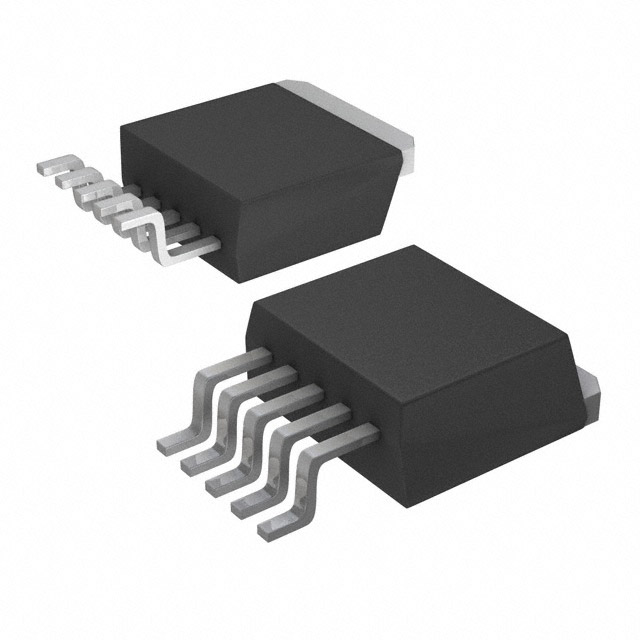
5.5 A, Buck Converter IC
SI-8008HD
Data Sheet
Description
Package
SI-8008HD is a buck converter IC whose maximum
output current is 5.5 A. Output voltage is adjusted by
external resistors.
The IC has various functions including the Soft Start
Function, the Output On/Off Function, the Overcurrent
Protection and the Thermal Shutdown, and achieves a
buck converter circuit with few external components.
TO263-5L
Not to scale
Features
● High Efficiency 83% (VIN = 15 V, IOUT = 3 A)
● Few Components
● Downsized Choke Coil
(Switching Frequency150 kHz (typ.))
● Soft Start Function
● On/Off Function
● Low Supply Current during Output Off
● Protection Functions
Overcurrent Protections (OCP): Drooping Type,
Auto-restart
Thermal Shutdown (TSD): Auto-restart
Specifications
Typical Application
● Audio Visual Equipment
● Office Automation Equipment (e.g., Printer)
● Onboard power supply
●
●
●
●
●
Input Voltage: VOUT + 3 V to 40 V
Output Voltage: 0.8 V to 24 V
Output Current: 0 to 5.5 A
Reference Voltage: 0.8 V
Efficiency: 83% (typ.)
(VIN = 15 V, IOUT = 3 A, VOUT = 5 V)
Applications
For the systems requiring power supplies such as:
VIN
SW
GND
ADJ
SS
SI-8008HD
VIN
1
2
3
4
5
VOUT
L1
R1
CIN
C4
C3
D1
R2
GND
COUT
GND
SI-8008HD-DSE Rev.2.1
SANKEN ELECTRIC CO., LTD.
Aug. 17, 2020
https://www.sanken-ele.co.jp/en
© SANKEN ELECTRIC CO., LTD. 2009
1
�SI-8008HD
Contents
Description ------------------------------------------------------------------------------------------------------ 1
Contents --------------------------------------------------------------------------------------------------------- 2
1. Absolute Maximum Ratings----------------------------------------------------------------------------- 3
2. Thermal Resistance Characteristics ------------------------------------------------------------------- 3
3. Recommended Operating Conditions ----------------------------------------------------------------- 4
4. Electrical Characteristics -------------------------------------------------------------------------------- 4
5. Block Diagram --------------------------------------------------------------------------------------------- 5
6. Pin Configuration Definitions --------------------------------------------------------------------------- 5
7. Typical Application --------------------------------------------------------------------------------------- 6
8. Physical Dimensions -------------------------------------------------------------------------------------- 7
8.1. Land Pattern Example ----------------------------------------------------------------------------- 7
9. Marking Diagram ----------------------------------------------------------------------------------------- 8
10. Operational Description --------------------------------------------------------------------------------- 9
10.1. PWM Output Voltage Control-------------------------------------------------------------------- 9
10.2. Input/output Current and Inductor Current -------------------------------------------------- 9
10.3. Output Voltage Setting --------------------------------------------------------------------------- 10
10.4. Overcurrent Protection Function (OCP) ----------------------------------------------------- 10
10.5. Thermal Shutdown (TSD) ----------------------------------------------------------------------- 10
10.6. Soft Start Function -------------------------------------------------------------------------------- 10
10.7. Output On/Off Function ------------------------------------------------------------------------- 11
11. Design Notes ---------------------------------------------------------------------------------------------- 12
11.1. Selecting External Components ---------------------------------------------------------------- 12
11.1.1. Inductor, L1 ---------------------------------------------------------------------------------- 12
11.1.2. Input Capacitor, CIN ------------------------------------------------------------------------ 12
11.1.3. Output Capacitor, COUT -------------------------------------------------------------------- 13
11.1.4. Freewheeling Diode, D1 -------------------------------------------------------------------- 14
11.1.5. Spike Noise Reduction ---------------------------------------------------------------------- 14
11.1.6. Reverse Biasing Protection ---------------------------------------------------------------- 15
11.2. PCB Layout----------------------------------------------------------------------------------------- 15
11.2.1. High Current Line -------------------------------------------------------------------------- 15
11.2.2. Input/ Output Capacitor ------------------------------------------------------------------- 15
11.2.3. ADJ Pin---------------------------------------------------------------------------------------- 15
11.3. Operational Waveforms Confirmation ------------------------------------------------------- 15
11.4. Thermal Design ------------------------------------------------------------------------------------ 17
12. Pattern Layout Example ------------------------------------------------------------------------------- 18
13. Typical Characteristics --------------------------------------------------------------------------------- 19
Important Notes ---------------------------------------------------------------------------------------------- 21
SI-8008HD-DSE Rev.2.1
SANKEN ELECTRIC CO., LTD.
Aug. 17, 2020
https://www.sanken-ele.co.jp/en
© SANKEN ELECTRIC CO., LTD. 2009
2
�SI-8008HD
1.
Absolute Maximum Ratings
Current polarities are defined as follows: current going into the IC (sinking) is positive current (+); current coming out
of the IC (sourcing) is negative current (−). Unless specifically noted, TA = 25 °C.
Parameter
Symbol
Conditions
Rating
Unit
Remarks
Input Voltage
Allowable Power Dissipation
VIN
PD
(1)
(2)
43
V
3
W
Junction Temperature
TJ
150
°C
Storage Temperature
TSTG
−40 to 150
°C
(3)
(1)
Limited by the thermal shutdown.
Glass-epoxy board (40 mm × 40 mm), copper area 100%
(3)
When the junction temperature increases to 130 °C or more, the thermal shutdown is activated.
(2)
2.
Thermal Resistance Characteristics
Parameter
Symbol
Thermal Resistance between
Junction and Ambient
Thermal Resistance between
Junction and Lead
θJ-A
θJ-L
Conditions
Mounted on the board.*
See Figure 2-1.
Min.
Typ.
Max.
Unit
—
—
33.3
°C/W
—
—
3
°C/W
TC
Figure 2-1.
*
Case Temperature Measurement Point
Glass-epoxy board (40 mm × 40 mm), copper area 100%
SI-8008HD-DSE Rev.2.1
SANKEN ELECTRIC CO., LTD.
Aug. 17, 2020
https://www.sanken-ele.co.jp/en
© SANKEN ELECTRIC CO., LTD. 2009
3
�SI-8008HD
3.
Recommended Operating Conditions
Parameter
Symbol
Conditions
Min.
Max.
Unit
Input Voltage (1)
VIN
VOUT + 3 V
40
V
Output Voltage
VOUT
0.8
24
V
Output Current
IOUT
0
5.5
A
TJOP
−30
100
°C
TOP
−30
85
°C
Operating Junction Temperature
Operating Ambient Temperature
(1)
(2)
4.
(2)
VIN ≥ VOUT + 3 V
The minimum input voltage is either 4.5 V or VOUT + 3 V, whichever is higher.
Must be used in the range of thermal derating (see Figure 13-6).
Electrical Characteristics
Current polarities are defined as follows: a current flow going into the IC (sinking) is positive current (+); and a current
flow coming out of the IC (sourcing) is negative current (−).
Unless otherwise specified, TA = 25 °C, VIN = 15 V, VOUT = 5 V, R1 = 4.2 kΩ, and R2 = 0.8 kΩ.
Parameter
Reference Voltage
Reference Voltage Temperature
Coefficient
VADJ
ΔVADJ/ΔT
Conditions
IOUT = 1 A
Min.
Typ.
Max.
Unit
0.784
0.800
0.816
V
IOUT = 1 A,
TC = 0 °C to 100 °C
—
±0.1
—
mV/°C
Efficiency*
η
IOUT = 3 A
—
83
—
%
Operating Frequency
fO
IOUT = 3 A
—
150
—
kHz
Line Regulation
VLINE
VIN = 10 V to 30 V,
IOUT = 3 A
—
60
80
mV
Load Regulation
VLOAD
IOUT = 0.2 V to 5.5 A
—
20
50
mV
IS
5.6
6.5
7.5
A
SS Pin Low Level Voltage
VSSL
—
—
0.5
V
SS Pin Source Current at Low Level
ISSL
VSSL = 0 V
—
10
30
μA
Quiescent Current 1
IQ
IOUT = 0 A
—
6
—
mA
Quiescent Current 2
IQ(OFF)
VSS = 0 V
—
200
400
μA
Overcurrent Protection Start Current
*
Symbol
Efficiency is calculated by the following equation.
η(%) =
VOUT × IOUT
× 100
VIN × IIN
SI-8008HD-DSE Rev.2.1
SANKEN ELECTRIC CO., LTD.
Aug. 17, 2020
https://www.sanken-ele.co.jp/en
© SANKEN ELECTRIC CO., LTD. 2009
4
�SI-8008HD
5.
Block Diagram
VIN
1
2 SW
Overcurrent
Protection
Pre Reg
SS
5
ON/OFF
Soft Start
Reset
Latch and
Driver
OSC
Comp.
Thermal
Shutdown
4
ADJ
Error amp.
Regulator
Voltage
3
GND
Pin Configuration Definitions
VIN
SW
GND
ADJ
SS
6.
1
2
3
4
5
Pin
Number
1
Pin
Name
VIN
2
SW
3
GND
Ground
4
ADJ
5
SS
Output voltage setting
Soft start period adjustment capacitor connection,
on/off signal input
Description
Input pin
Output pin
SI-8008HD-DSE Rev.2.1
SANKEN ELECTRIC CO., LTD.
Aug. 17, 2020
https://www.sanken-ele.co.jp/en
© SANKEN ELECTRIC CO., LTD. 2009
5
�SI-8008HD
7.
Typical Application
VIN
SW
GND
ADJ
SS
SI-8008HD
1
2
3
4
5
L1
VIN
VOUT
R1
CIN
C4
C3
D1
COUT
R2
GND
GND
Figure 7-1.
Typical Application
Table 7-1. Reference Value of External Components
Symbol
Part Type
Reference Value
Remarks
CIN
Electrolytic capacitor
1000 μF
See Section 11.1.2.
COUT
Electrolytic capacitor
1500 μF
See Section 11.1.3.
C3
Ceramic capacitor
0.1 μF
C4
Ceramic capacitor
4.7 μF
R1
Resistor
—
R2
Resistor
—
D1
Schottky diode
L1
Choke coil
Soft start period adjustment capacitor. See Section 10.6.
VIN pin noise filter capacitor. For stable operation, C4 is
connected to the IC with a minimum length of traces.
Adjust resistance according to the output voltage. See
Section 10.3.
60 V, 6 A
See Section 11.1.4.
100 μH
See Section 11.1.1.
SI-8008HD-DSE Rev.2.1
SANKEN ELECTRIC CO., LTD.
Aug. 17, 2020
https://www.sanken-ele.co.jp/en
© SANKEN ELECTRIC CO., LTD. 2009
6
�SI-8008HD
8.
Physical Dimensions
● TO263-5L
E
L1
A
(E)
H
D
D1
L4
(L1)
C2
E1
A2
A1
c
e
L
c
Symbol
A
A1
A2
b
b1
c
c1
C2
D
D1
E
E1
e
b
L3
b
PLATING
b1
c
c1
BASE METAL
SECTION C-C
H
L
L1
L3
L4
θ
θ1
θ2
Min.
4.40
0
2.59
0.77
0.76
0.34
0.33
1.22
9.05
6.86
10.06
7.50
Nom.
4.57
0.10
2.69
—
0.81
—
0.38
—
9.15
—
10.16
—
1.70
BSC
14.70 15.10
2.00
2.30
1.17
1.27
0.25 BSC
2.00 REF
0°
—
5°
7°
1°
3°
Max.
4.70
0.25
2.79
0.90
0.86
0.47
0.43
1.32
9.25
7.50
10.26
8.30
15.50
2.60
1.40
8°
9°
5°
NOTES:
● Dimensions in millimeters
● Bare lead frame: Pb-free (RoHS compliant)
● Dimensions do not include mold burrs.
8.1.
Land Pattern Example
11 ±0.2
9 ±0.2
6.8 ±0.1
9 ±0.1
3.7 ±0.05
4 ±0.1
1.7 ±0.1
1 ±0.05
Dimensions in millimeters
SI-8008HD-DSE Rev.2.1
SANKEN ELECTRIC CO., LTD.
Aug. 17, 2020
https://www.sanken-ele.co.jp/en
© SANKEN ELECTRIC CO., LTD. 2009
7
�SI-8008HD
9.
Marking Diagram
Specific Device Code (See Table 9-1)
YMDXXX
8008HD
1
Lot Number
Y is the last digit of the year of manufacture (0 to 9)
M is the month of the year (1 to 9, O, N, or D)
D is the period of days represented by:
1: the first 10 days of the month (1st to 10th)
2: the second 10 days of the month (11th to 20th)
3: the last 10–11 days of the month (21st to 31st)
XXX is the control number
5
Table 9-1. Specific Device Code
Specific Device Code
Part Number
8008HD
SI-8008HD
SI-8008HD-DSE Rev.2.1
SANKEN ELECTRIC CO., LTD.
Aug. 17, 2020
https://www.sanken-ele.co.jp/en
© SANKEN ELECTRIC CO., LTD. 2009
8
�SI-8008HD
10. Operational Description
All the characteristic values given in this section are
typical values, unless they are specified as minimum or
maximum.
10.1. PWM Output Voltage Control
The SI-8008HD controls the output voltage by the
PWM method and has a built-in PWM comparator,
oscillator, error amplifier, reference voltage, output
transistor drive circuit, etc. The PWM comparator outputs
the switching transistor control signal as a square wave by
comparing the triangular wave output (≈150 kHz) from
the oscillator with the error amplifier output. The PWM
comparator controls the switching transistor to turn on
during the period when the error amplifier output exceeds
the oscillator output. When the output voltage rises, the
output of the error amplifier decreases because the error
amplifier is an inverting type. When the error amplifier
output decreases, the period below the oscillator triangle
wave level decreases. Thus, the turn-on period of the
switching transistor is shortened. In this way, the output
voltage is regulated by changing the turn-on time of the
switching transistor with the switching frequency fixed.
The higher the VIN, the shorter the turn-on period of the
switching transistor. The square wave output of the
switching transistor is smoothed by an LC low-pass filter
consisting of an inductor and a capacitor. As a result, a
regulated DC voltage is supplied to the load.
Switching
Transistor
VIN
L1
PWM
Comparator
VOUT
10.2. Input/output Current and Inductor
Current
The square wave output generated by the switching
transistor built in the IC is smoothed by the LC filter
composed of the inductor and the output capacitor, and
converted to the DC output voltage. The operation of the
LC filter significantly affects the stable operation of the
switching regulator. Figure 10-3 shows the schematic
diagram of the current flowing through the circuit, and
Figure 10-4 shows the waveforms of the current flowing
through each element.
ITR
IL = ITR + IDI
L1
TR
VIN
D1
Figure 10-3.
IDI
COUT
IOUT
Schematic Diagram of Circuit Current
TON TOFF
TR
Emitter Voltage
(Switching Output)
VIN
ITR
ILP
D1
Drive
Circuit
COUT
0
IIN
IDI
Oscillator
Error Amplifier
ILP
0
Reference
Voltage
IL
ΔIL
Figure 10-1.
Basic Structure of Switching Regulator
with PWM Control
Oscillator Output
IOUT
ILP
0
Figure 10-4.
Waveforms of Current through Each
Element
Error Amplifier Output
ON OFF
Figure 10-2.
Switching Transistor Output
PWM Comparator Operation Diagram
As shown in Figure 10-3, the current, IL, flowing
through the inductor has a triangular waveform. This
triangular waveform is composed of two types of current
components, ITR and IDI. The current, ITR, is the current
supplied from the input side through the transistor at
transistor turn-on, and the average value is the input
current, IIN. The current, IDI, is the current that the energy
SI-8008HD-DSE Rev.2.1
SANKEN ELECTRIC CO., LTD.
Aug. 17, 2020
https://www.sanken-ele.co.jp/en
© SANKEN ELECTRIC CO., LTD. 2009
9
�SI-8008HD
stored in the inductor is commutated through the
freewheeling diode at transistor turn-off.
The inductor current, IL, is the sum of ITR and IDI.
Moreover, the average IL is the DC output current, IOUT,
because the triangular wave component on which IL is
superimposed is smoothed by the capacitor, COUT.
Oscillation frequency
decreases as output
voltage decreases
Output
Voltage
Output Current
10.3. Output Voltage Setting
Output voltage is adjusted by external resistors, R1 and
R2 (see Figure 7-1). The ADJ pin is for feedback signal
input to control the output voltage. Do not apply any
voltage other than this feedback signal to the ADJ pin.
The feedback current flowing through R1 and R2 is set
to about 1 mA. The setting reference voltage, VADJ, is
0.800 V. R2 is calculated by Equation (1).
R2 =
VADJ 0.8 (V)
=
= 0.8 (kΩ)
IADJ 1 (mA)
(1)
Output voltage, VOUT, is calculated by Equation (2).
VOUT =
R1 + R2
× VADJ
R2
(2)
Figure 10-5.
Overcurrent Protection Characteristics
10.5. Thermal Shutdown (TSD)
The thermal shutdown (TSD) circuit of the IC detects
the junction temperature of the IC. When the junction
temperature exceeds the set value, the TSD turns off the
output by stopping the output transistor. When the
junction temperature drops for about 15 °C from the
thermal shutdown set value, the TSD automatically
restarts the normal operation.
Output Voltage
Thus, R1 is calculated by Equation (3).
R1 =
R2 × (VOUT − VADJ )
VADJ
=
0.8 kΩ × (VOUT − 0.8 V)
0.8 V
Protection Set
Temperature
Restart Set
Temperature
Junction Temperature
(3)
If the calculation result does not match the value
defined by the E series, adjustment resistors should be
added in series or parallel to R1.
When setting the output voltage to 0.8 V, add R2 for
stable operation. Set the output duty cycle to ≥ 8%.
10.4. Overcurrent Protection Function
(OCP)
The IC has the drooping type overcurrent protection
(OCP) circuit. The overcurrent protection circuit detects
the peak current of the switching transistor. When the peak
current exceeds the set value, the current is limited by
forcibly shortening the on-time of the transistor and
reducing the output voltage. When the output voltage
decreases further, the switching frequency is decreased to
about 30 kHz. As a result, the current increase at the low
output voltage is suppressed. When the overcurrent state
is released, the output voltage restarts automatically.
Figure 10-6.
Thermal Shutdown Characteristics
10.6. Soft Start Function
When a capacitor, C3, is connected to the SS pin, soft
start is activated at input voltage turned-on. The soft start
time, tSS, until VOUT rises is determined by the capacitance
of C3. tSS is calculated by the Equation (4).
t SS =
C3 × 2.3 V
ISSL
(4)
Where:
ISSL is SS pin source current at low
VIN
VOUT
tSS
Figure 10-7.
SI-8008HD-DSE Rev.2.1
SANKEN ELECTRIC CO., LTD.
Aug. 17, 2020
https://www.sanken-ele.co.jp/en
© SANKEN ELECTRIC CO., LTD. 2009
Soft Start Waveform
10
�SI-8008HD
10.7. Output On/Off Function
U1
Output can be turned on/off using the SS pin. To use
on/off function, connect a transistor as shown in Figure
10-10. When the SS pin voltage decreases to be VSSL or
lower, the output is stopped.
SS 5
GND
C3
3
Figure 10-8.
ISSL
U1
Soft Start Function
The voltage cannot be externally applied because the SS
pin is pulled up (3.7 V (typ.)) to the internal power supply.
Leave the SS pin open if the soft start function is not used.
Increasing the capacitance of C3 increases the
discharging time at input voltage off. A capacitor of ≤
10 μF should be used. When the input voltage drops, the
charge of C3 is discharged from the VIN pin.
Figure 10-9 shows the relationship between the
capacitance of C3 and tSS. When the SS pin is open or the
capacitance of C3 is extremely small, the soft start time is
the time to charge COUT with the overcurrent protection
start current, IS (see Figure 10-9). The soft start time (at no
load) is calculated by the Equation (5)
t SS =
COUT × VOUT
IS
SS 5
GND
3
Figure 10-10.
On/Off Function
The soft start function can be used in combination with
on/off function by connecting a transistor and a capacitor
as shown in Figure 10-11. In this case, the discharge
current of C3 flows through the transistor for on/off
function. Therefore, protection such as current limiting is
required when the capacitance of C3 is large.
U1
(5)
GND
With a load, subtract the load current value from the I S
value.
SS 5
C3
3
10000
Soft Start Time, tss (ms)
VOUT = 5 V, COUT = 680 μF
Figure 10-11.
Soft Start Function, On/Off Function
1000
100
The voltage cannot be externally applied because the SS
pin is pulled up (3.7 V (typ.)) to the internal power supply.
Leave the SS pin open if the soft start function is not used.
Depends on IS and COUT
10
Depends on C3
1
0.1
0.001
0.01
0.1
1
10
C3 Capacitance (μF)
Figure 10-9.
C3 Capacitance vs. tSS
SI-8008HD-DSE Rev.2.1
SANKEN ELECTRIC CO., LTD.
Aug. 17, 2020
https://www.sanken-ele.co.jp/en
© SANKEN ELECTRIC CO., LTD. 2009
11
�SI-8008HD
11. Design Notes
Low Inductance
11.1. Selecting External Components
11.1.1. Inductor, L1
a)
An inductor should be for switching regulator
Do not use an inductor for noise filter because it has
a large loss.
b) Rated current
The inductor rated current must be larger than the
maximum load current according to your application.
When the load current exceeds the rated current of the
inductor, the inductance decreases significantly,
resulting in saturation. Note that in this state, the high
frequency impedance decreases and an excessive
current flows.
c)
Low noise
In the open magnetic circuit core such as drum type,
the peripheral circuit may be significantly affected by
noise because the magnetic flux passes outside the
coil. It is recommended to use a closed magnetic
circuit core coil such as a toroidal type, EI type, or EE
type.
d) Inductance value should be appropriate
The larger the inductance of the choke coil, the larger
the external size of the coil. On the other hand, the
ripple current flowing through the coil decreases and
the output ripple voltage also decreases (see Figure
11-1).
The smaller the inductance, the larger the peak current
that flows through the switching transistor or diode.
Thus, the loss increases and the ripple voltage also
increases (see Figure 11-2).
High Inductance
COUT
Figure 11-2.
The inductor, L, supplies the current to the load side at
switching transistor turn-off. For the regulator stable
operation, it is required to avoid saturating the inductor
and excessive self-heating. The following are the key
considerations and the guidelines for selecting an inductor.
Small Ripple Voltage, Current
COUT
Large Ripple Voltage, Current
Ripple Voltage and Current (Low
Inductance)
Inductance is calculated by the Equation, (1)(6).
L=
(VIN − VOUT ) × VOUT
∆IL × VIN × f
(6)
In the Equation, (6), ΔIL shows the ripple current value
of the choke coil, and the reference value is set as follows:
● When the output current in your application is close to
the maximum rating (5.5 A): 0.1 times the output
current
● When the output current in your application is
approximately 3 A or less: 0.3 to 0.4 times the output
current
For example, when VIN = 25 V, VOUT = 5 V, ΔIL = 0.5 A,
and f = 150 kHz, L is calculated as follows:
L=
(25 − 5) × 5
≒ 53.3 μH
0.5 × 25 × 150 × 103
Thus, the inductor of about 54 μH should be selected.
11.1.2. Input Capacitor, CIN
The input capacitor, CIN, operates as a bypass capacitor
for the input circuit. CIN compensates for the voltage drop
in the input side by supplying a steep current at switching
to the regulator. Therefore, CIN should be placed as close
as possible to the IC. When the smoothing capacitor of AC
rectifier circuit is in the input circuit, the smoothing
capacitor can also be used as the input capacitor.
The following are the key considerations and the
guidelines for selecting CIN.
a) Within the rated voltage
b) Within the allowable ripple current
Figure 11-1. Ripple Voltage and Current
(High Inductance)
SI-8008HD-DSE Rev.2.1
SANKEN ELECTRIC CO., LTD.
Aug. 17, 2020
https://www.sanken-ele.co.jp/en
© SANKEN ELECTRIC CO., LTD. 2009
12
�SI-8008HD
IL
U1
IIN
VIN
L1
1 VIN
Ripple current
Ripple current
ESR
GND
CIN
VOUT
3
RL
IOUT
COUT
CIN current waveform
COUT current waveform
IP
0
T
ΔIL
0
IV
TON
The ripple current of the output capacitor is
equal to the ripple current of the choke coil and
does not change even if the load current
increases or decreases.
D = TON / T
As the load current increases, the ripple
current of the input capacitor increases.
Figure 11-4.
Figure 11-3.
CIN Current Flow
Exceeding the rated voltage or the allowable ripple
current or using without considering the derating may
cause abnormal oscillation of the switching regulator as
well as shorten the life of the capacitor. Therefore, select
CIN with sufficient margin for the rated voltage and
allowable ripple current. The ripple effective current, IRMS,
flowing through the input capacitor is calculated by
Equation (7).
IRMS
VOUT
≈ 1.2 ×
× IOUT
VIN
(7)
For example, when IOUT = 3 A, VIN = 20 V, and
VOUT = 5 V, IRMS is calculated as follows:
IRMS
5
≈ 1.2 ×
× 3 = 0.9 A
20
Thus, select a capacitor that has an allowable ripple
current of > 0.9 A.
11.1.3. Output Capacitor, COUT
The output capacitor, COUT, operates as an LC low-pass
filter along with the inductor, L1, and operates as a
smoothing capacitor for switching output. The output
capacitor is charged and discharged with a current equal
to the ripple current of the choke coil, ΔIL. Therefore, as
in the input capacitor CIN, COUT is selected with sufficient
margin and equivalent series resistance (ESR) for the rated
voltage and allowable ripple current. The following are the
key considerations and the guidelines for selecting COUT.
COUT Current Flow
● Allowable ripple current
The ripple effective current of the output capacitor is
calculated by Equation (8).
IRMS =
∆IL
(8)
2√3
For example, when ΔIL is 0.5 A, IRMS is calculated as
follows:
IRMS =
0.5
2√3
≈ 0.14 A
Thus, select a capacitor that has an allowable ripple
current of > 0.14 A.
● Equivalent series resistance (ESR)
Select an appropriate value for ESR for stable operation.
If the ESR is too large, the output ripple voltage increases,
and abnormal oscillation may be caused. On the other
hand, if the ESR is too small, the phase margin becomes
insufficient. The output ripple voltage is determined by the
product of the inductor ripple current, ΔIL (= COUT
charge/discharge current) and ESR. For stable operation,
the output ripple voltage should be 0.5% to 2% of the
output voltage. The output ripple voltage is calculated
using equations (9) and (10). ESR changes with
temperature. Note that the ESR decreases at high
temperatures.
VRIP ≈
(VIN − VOUT ) × VOUT
× ESR
L1 × VIN × f
SI-8008HD-DSE Rev.2.1
SANKEN ELECTRIC CO., LTD.
Aug. 17, 2020
https://www.sanken-ele.co.jp/en
© SANKEN ELECTRIC CO., LTD. 2009
(9)
13
�SI-8008HD
VRIP ≈ ∆IL × ESR
(10)
If the ESR is too small (about 10 mΩ to 30 mΩ or less),
the phase delay becomes large and abnormal oscillation
may occur. Do not use tantalum capacitors and monolithic
ceramic capacitors alone for COUT as they have low ESR.
When used at low temperature (0 °C or less), connecting
a tantalum capacitor or a laminated ceramic capacitor in
parallel with the electrolytic capacitor is effective in
reducing the output ripple voltage.
The output capacitor should be placed as close as
possible to the IC.
Figure 11-6.
Without Noise Reduction Circuit
11.1.4. Freewheeling Diode, D1
The freewheel diode is used to release the energy stored
in the inductor at switching off. Be sure to use a Schottky
barrier diode for the freewheeling diode. If a diode with a
long recovery time and a large forward voltage, such as a
general-purpose rectifier diode, is used, a reverse voltage
is applied to the IC, which may damage the IC.
The voltage output from the SW pin is close to the input
voltage. Therefore, use a freewheeling diode whose
reverse breakdown voltage is higher than the input voltage.
Do not add ferrite beads to the freewheeling diode.
Figure 11-7.
11.1.5. Spike Noise Reduction
With Noise Reduction Circuit
To reduce spike noise, add a noise reduction circuit
between the input and output of the IC and both ends of
the freewheeling diode, D1. Note that the efficiency is
decreased.
When measuring spike noise with an oscilloscope,
connect the probe to the root of the output capacitor with
the shortest probe lead wire. If the probe ground lead wire
is long, the spike noises may be measured abnormally
large because the lead wire acts as an antenna.
about 10 Ω
about 1000 pF
U1
1 VIN
SW 2
about 10 Ω
GND
3
Figure 11-5.
D1
about 1000 pF
Spike Noise Reduction
SI-8008HD-DSE Rev.2.1
SANKEN ELECTRIC CO., LTD.
Aug. 17, 2020
https://www.sanken-ele.co.jp/en
© SANKEN ELECTRIC CO., LTD. 2009
14
�SI-8008HD
11.1.6. Reverse Biasing Protection
For the applications where the output pin voltage is
higher than the input pin voltage (e.g., battery charger),
add a diode for reverse bias protection between the input
and output.
used as the input capacitor. When the input smoothing
capacitor and the IC are distant, connect an input capacitor
separated from the smoothing capacitor. Since the large
current is charged and discharged to the input/output
capacitor at high speed, the lead wire should be as short as
possible. The pattern of the capacitor should also be the
shortest.
Protection Diode
CIN, COUT
CIN, COUT
U1
1 VIN
SW 2
Improper Pattern Example
Figure 11-8.
Addition of Reverse Bias Protection
Diode
11.2.1. High Current Line
Traces where the switching current flows (bold line in
Figure 11-9) should be as wide and short as possible.
U1
VOUT
SW 2
R1
CIN
C4
GND ADJ 4
3
COUT
D1
R2
GND
GND
Figure 11-9.
Traces from ADJ pin to R2 should be as short as
possible. The traces of ADJ pin, R1, and R2 should not
run in parallel with the freewheeling diode trace.
Switching noise may interfere with the ADJ pin and cause
abnormal oscillation.
11.3. Operational Waveforms Confirmation
L1
1 VIN
Pattern Example
11.2.3. ADJ Pin
11.2. PCB Layout
VIN
Figure 11-10.
Proper Pattern Example
High Current Line
11.2.2. Input/ Output Capacitor
The input capacitor, CIN, and the output capacitor, COUT,
must be placed as close as possible to the IC. When CIN
and COUT are far from the IC, it may cause poor regulation
or abnormal oscillation due to increased switching ripple.
When a smoothing capacitor for the AC rectifier circuit
is in the input side, the smoothing capacitor can also be
Whether the switching operation is normal can be
confirmed by the waveform between the SW and GND
pins of the IC. Figure 11-11 shows examples of
waveforms in normal operation and abnormal oscillation.
When the load current is large, the IC operates in
continuous conduction mode. In continuous conduction
mode, the period when the current through inductor
becomes zero does not occur. The switching waveform
has the shape of a normal square wave (waveform 1).
When the load current is small, the IC operates in
discontinuous conduction mode. In discontinuous
conduction mode, the period when the current through
inductor becomes zero occurs. The damped oscillation
occurs in the switching waveform, which is normal
operation (waveform 2).
If the IC and CIN, COUT are distant from each other,
abnormal on/off time of switching is disturbed, and
abnormal oscillation occurs as shown in waveform 3 and
waveform 4.
SI-8008HD-DSE Rev.2.1
SANKEN ELECTRIC CO., LTD.
Aug. 17, 2020
https://www.sanken-ele.co.jp/en
© SANKEN ELECTRIC CO., LTD. 2009
15
�SI-8008HD
1. Normal operation (continuous conduction mode)
2. Normal operation (discontinuous conduction mode)
3. Abnormal oscillation (when CIN is distant)
4. Abnormal oscillation (when COUT is distant)
Figure 11-11.
Waveform Examples
SI-8008HD-DSE Rev.2.1
SANKEN ELECTRIC CO., LTD.
Aug. 17, 2020
https://www.sanken-ele.co.jp/en
© SANKEN ELECTRIC CO., LTD. 2009
16
�SI-8008HD
11.4. Thermal Design
Generally, the heat dissipation of an IC depends on the
size and material of the board and the copper area. To
improve the thermal performance, the copper area of the
part where the backside of the IC is soldered should be as
large as possible.
Figure 13-6 shows the thermal derating of the IC. When
using the IC, ensure a sufficient margin.
Follow the procedure below to design heat dissipation.
Junction-to-Ambient Thermal Resistance θJ-A (°C/W)
(1) Measure the maximum ambient temperature, TA(MAX)
of the IC.
(2) PD(MAX) is calculated by changing the input/output
conditions and checking the power dissipation, PD.
PD is calculated by Equation (11).
100
VO
PD = VO × IO (
− 1) − VF × IO (1 −
)
η
VIN
(11)
Where:
VOUT is the output voltage
VIN is the input voltage
IOUT is the output current
η is the efficiency (%) (calculated by Figure 13-1)
VF is D1 forward voltage
(3) Determine the copper area by confirming the
intersection of ambient temperature and power
dissipation by the thermal derating characteristics
shown in Figure 13-6.
For reference, Figure 11-12 shows the relationship
between the copper area and thermal resistance of a singlesided copper foil board, FR-4.
55
Glass-epoxy Board (40 mm × 40 mm)
50
45
40
35
30
0
200
400
600
800
1000
1200
1400
1600
1800
2
Copper Area (mm )
Figure 11-12.
Thermal Resistance - Copper Area Reference Characteristics
(Single-sided Copper Foil Board, FR-4)*
*
Limited by the condition of the input voltage and output current because the power dissipation of the IC package is
3 W.
SI-8008HD-DSE Rev.2.1
SANKEN ELECTRIC CO., LTD.
Aug. 17, 2020
https://www.sanken-ele.co.jp/en
© SANKEN ELECTRIC CO., LTD. 2009
17
�SI-8008HD
12. Pattern Layout Example
Connect the ground traces to the GND pin at a single point. Place control components near the IC with a minimal length
of PCB traces.
Figure 12-1.
Pattern Layout Example
SI-8008HD-DSE Rev.2.1
SANKEN ELECTRIC CO., LTD.
Aug. 17, 2020
https://www.sanken-ele.co.jp/en
© SANKEN ELECTRIC CO., LTD. 2009
18
�SI-8008HD
13. Typical Characteristics
Unless specifically noted, TA = 25 °C, VOUT = 5 V, R1 = 4.2 kΩ, and R2 = 0.8 kΩ.
VIN = 30 V
VIN = 40 V
VIN = 8 V
Out Voltage, VOUT (V)
Efficiency, η (%)
VIN = 5 V
VIN = 10 V
VIN = 15 V
VIN = 20 V
VIN = 30 V
VIN = 40 V
Output Current, IOUT (A)
Figure 13-1.
Output Current, IOUT (A)
Efficiency
Figure 13-2.
VIN = 15 V, IOUT = 10 mA
IOUT = 5.5 A
IOUT = 4 A
IOUT = 3 A
IOUT = 2 A
IOUT = 1 A
Input Voltage, VIN (V)
Rising Characteristics
Output Voltage, VOUT (V)
Output Voltage, VOUT (V)
IOUT = 0 A
Figure 13-3.
Overcurrent Protection Characteristics
Junction Temperature, TJ (°C)
Figure 13-4.
SI-8008HD-DSE Rev.2.1
SANKEN ELECTRIC CO., LTD.
Aug. 17, 2020
https://www.sanken-ele.co.jp/en
© SANKEN ELECTRIC CO., LTD. 2009
Thermal Shutdown Characteristics
19
�Output Voltage, VOUT (V)
SI-8008HD
VIN = 40 V
VIN = 30 V
VIN = 20 V
VIN = 15 V
VIN = 8 V
Output Current, IOUT (A)
Figure 13-5.
Load Regulation
3.5
銅箔
面積20
40mm
(θ=
j-a:37
℃/W)
20
mm
× 40×mm
(θJ-A
37 °C/W)
Copper area 20×40mm
2.5
20
mm×
20 ×
mm
(θJ-A
=j-a:44
44 °C/W)
銅箔
面積20
20mm
(θ
℃/W)
Copper area 20×20mm
Power Dissipation
Power PDissipation,
Allowable許容損失
PD (W)
D[W]
3
Copper area
銅箔
面積40
40mm
(θ=
j-a:33.3
℃/W)
40
mm
× 40×mm
(θJ-A
33 °C/W)
Copper area 40×40mm
mm
× 10×mm
(θJ-A
53 °C/W)
2 10
銅箔
面積10
10mm
(θ=
j-a:53
℃/W)
Copper area 10×10mm
1.5
1
0.5
0
-25
0
25
50
75
100
125
周囲温度
Ta[℃] TA (°C)
Ambient
Temperature,
Ambient Temperature
Figure 13-6.
Thermal Derating
SI-8008HD-DSE Rev.2.1
SANKEN ELECTRIC CO., LTD.
Aug. 17, 2020
https://www.sanken-ele.co.jp/en
© SANKEN ELECTRIC CO., LTD. 2009
20
�SI-8008HD
Important Notes
● All data, illustrations, graphs, tables and any other information included in this document (the “Information”) as to Sanken’s products
listed herein (the “Sanken Products”) are current as of the date this document is issued. The Information is subject to any change
without notice due to improvement of the Sanken Products, etc. Please make sure to confirm with a Sanken sales representative that
the contents set forth in this document reflect the latest revisions before use.
● The Sanken Products are intended for use as components of general purpose electronic equipment or apparatus (such as home
appliances, office equipment, telecommunication equipment, measuring equipment, etc.). Prior to use of the Sanken Products, please
put your signature, or affix your name and seal, on the specification documents of the Sanken Products and return them to Sanken.
When considering use of the Sanken Products for any applications that require higher reliability (such as transportation equipment
and its control systems, traffic signal control systems or equipment, disaster/crime alarm systems, various safety devices, etc.), you
must contact a Sanken sales representative to discuss the suitability of such use and put your signature, or affix your name and seal,
on the specification documents of the Sanken Products and return them to Sanken, prior to the use of the Sanken Products. The
Sanken Products are not intended for use in any applications that require extremely high reliability such as: aerospace equipment;
nuclear power control systems; and medical equipment or systems, whose failure or malfunction may result in death or serious injury
to people, i.e., medical devices in Class III or a higher class as defined by relevant laws of Japan (collectively, the “Specific
Applications”). Sanken assumes no liability or responsibility whatsoever for any and all damages and losses that may be suffered by
you, users or any third party, resulting from the use of the Sanken Products in the Specific Applications or in manner not in
compliance with the instructions set forth herein.
● In the event of using the Sanken Products by either (i) combining other products or materials or both therewith or (ii) physically,
chemically or otherwise processing or treating or both the same, you must duly consider all possible risks that may result from all
such uses in advance and proceed therewith at your own responsibility.
● Although Sanken is making efforts to enhance the quality and reliability of its products, it is impossible to completely avoid the
occurrence of any failure or defect or both in semiconductor products at a certain rate. You must take, at your own responsibility,
preventative measures including using a sufficient safety design and confirming safety of any equipment or systems in/for which the
Sanken Products are used, upon due consideration of a failure occurrence rate and derating, etc., in order not to cause any human
injury or death, fire accident or social harm which may result from any failure or malfunction of the Sanken Products. Please refer
to the relevant specification documents and Sanken’s official website in relation to derating.
● No anti-radioactive ray design has been adopted for the Sanken Products.
● The circuit constant, operation examples, circuit examples, pattern layout examples, design examples, recommended examples, all
information and evaluation results based thereon, etc., described in this document are presented for the sole purpose of reference of
use of the Sanken Products.
● Sanken assumes no responsibility whatsoever for any and all damages and losses that may be suffered by you, users or any third
party, or any possible infringement of any and all property rights including intellectual property rights and any other rights of you,
users or any third party, resulting from the Information.
● No information in this document can be transcribed or copied or both without Sanken’s prior written consent.
● Regarding the Information, no license, express, implied or otherwise, is granted hereby under any intellectual property rights and
any other rights of Sanken.
● Unless otherwise agreed in writing between Sanken and you, Sanken makes no warranty of any kind, whether express or implied,
including, without limitation, any warranty (i) as to the quality or performance of the Sanken Products (such as implied warranty of
merchantability, and implied warranty of fitness for a particular purpose or special environment), (ii) that any Sanken Product is
delivered free of claims of third parties by way of infringement or the like, (iii) that may arise from course of performance, course
of dealing or usage of trade, and (iv) as to the Information (including its accuracy, usefulness, and reliability).
● In the event of using the Sanken Products, you must use the same after carefully examining all applicable environmental laws and
regulations that regulate the inclusion or use or both of any particular controlled substances, including, but not limited to, the EU
RoHS Directive, so as to be in strict compliance with such applicable laws and regulations.
● You must not use the Sanken Products or the Information for the purpose of any military applications or use, including but not
limited to the development of weapons of mass destruction. In the event of exporting the Sanken Products or the Information, or
providing them for non-residents, you must comply with all applicable export control laws and regulations in each country including
the U.S. Export Administration Regulations (EAR) and the Foreign Exchange and Foreign Trade Act of Japan, and follow the
procedures required by such applicable laws and regulations.
● Sanken assumes no responsibility for any troubles, which may occur during the transportation of the Sanken Products including the
falling thereof, out of Sanken’s distribution network.
● Although Sanken has prepared this document with its due care to pursue the accuracy thereof, Sanken does not warrant that it is
error free and Sanken assumes no liability whatsoever for any and all damages and losses which may be suffered by you resulting
from any possible errors or omissions in connection with the Information.
● Please refer to our official website in relation to general instructions and directions for using the Sanken Products, and refer to the
relevant specification documents in relation to particular precautions when using the Sanken Products.
● All rights and title in and to any specific trademark or tradename belong to Sanken and such original right holder(s).
DSGN-CEZ-16003
SI-8008HD-DSE Rev.2.1
SANKEN ELECTRIC CO., LTD.
Aug. 17, 2020
https://www.sanken-ele.co.jp/en
© SANKEN ELECTRIC CO., LTD. 2009
21
�