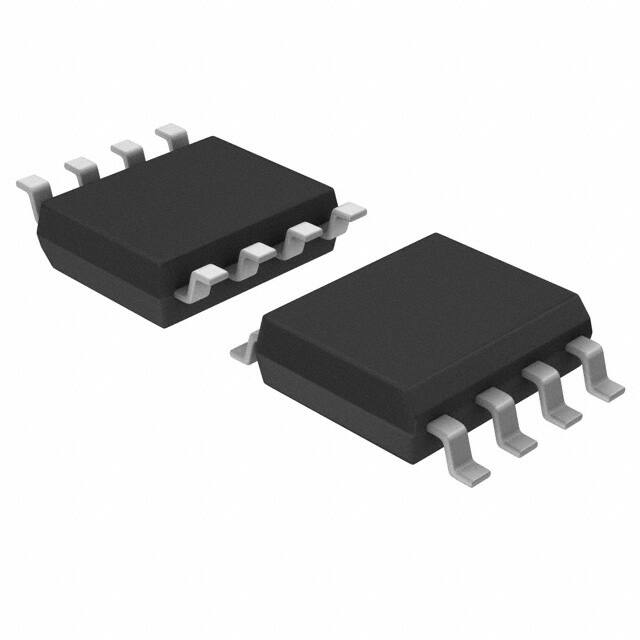
SP4082E
5V RS-485/RS-422 Transceivers
1/8th Unit Load, Slew-Rate Limited, ±15kV ESD-Protected
FEATURES
• 5.0V single supply operation
• Receiver failsafe on open or shorted lines
• 1/8th Unit Load, 256 transceivers on bus
• Robust ESD protection for RS-485 pins
±15kV Human Body Model
• Controlled driver slew rates
115kbps, Low EMI
•Driver short circuit current limit and
thermal shutdown for overload protection
•Industry standard package footprints
RO 1
RE 2
DE 3
DI 4
8 PIN NSOIC
SP4082E
8 Vcc
7 B
6 A
Half Duplex
5 GND
APPLICATIONS
• Motor Control
• Building Automation
• Security Systems
• Remote Meter Reading
• Long or un-terminated transmission lines
DESCRIPTION
The SP4082E is designed for reliable, bidirectional communication on multipoint bus transmission
lines. The device contains one differential driver and one differential receiver. It is a half-duplex device. The device complys with TIA/EIA-485 and TIA/EIA-422 standards. Lead-free and RoHS compliant packages are available.
This device is ruggedized for use in harsh operating conditions over the entire common-mode voltage range from -7V to +12V. Receivers are specially designed to fail-safe to a logic high output state
if the inputs are un-driven or shorted. All RS-485 bus-pins are protected against severe ESD events
up to ±15kV (Human Body Model). Drivers are protected from excess current flow caused by bus
contention or output short-circuits by both an internal current limit and a thermal-overload shutdown.
Devices are rated for industrial (-40 to +85ºC) operating temperatures. Receivers have exceptionally
high input impedance, which places only 1/8th the standard load on a shared bus. Up to 256 transceivers may coexist while preserving full signal margin.
The device operates from a single 5.0V power supply and draws negligible quiescent power. The
device has an independent enable and disable for the driver and receiver and will enter a low power
shutdown mode if both driver and receiver are disabled. All outputs maintain high impedance during
shutdown or when powered-off.
SP4082E_101_012920
1
�PIN ASSIGNMENTS
Pin Number Pin Name
Pin Function
1
RO
Receiver Output. When RE is low and if (A – B) ≥ -40mV, RO
is high. If (A – B) ≤ - 200mV, RO is low.
2
RE
Receiver Output Enable. When RE is low, RO is enabled.
When RE is high, RO is high impedance. Drive RE high and
DE low to enter shutdown mode.
3
DE
Driver Output Enable. When DE is high, outputs are enabled.
When DE is low, outputs are high impedance. Drive DE low
and RE high to enter shutdown mode.
4
DI
Driver Input. With DE high, a low level on DI forces noninverting output low and inverting output high. A high level on
DI forces non-inverting output high and inverting output low.
5
GND
6
7
A
B
8
Vcc
REREE
Ground
Non-inverting Receiver Input and Non-inverting Driver Output
Inverting Receiver Input and Inverting Driver Output
Positive Supply VCC. Bypass to GND with a 0.1uF capacitor.
DEVICE ARCHITECTURE AND BLOCK DIAGRAM
RO
1
R
2
RE
DE 3
DI
4
D
8 VCC
7 B
6
A
5
8-Pin Half Duplex
GND
SP4082E_101_012920
2
�ABSOLUTE MAXIMUM RATINGS
These are stress ratings only and functional operation of the device at these ratings or any other above
those indicated in the operation sections of the specifications below is not implied. Exposure to absolute
maximum rating conditions for extended periods of
time may affect reliability.
Supply Voltage (VCC)...............................................+ 7.0V
Input voltage at control input pins (RE, DE) ..... -0.3V to Vcc+0.3V
Driver input voltage (DI) .....................-0.3V to Vcc+0.3V
Driver output voltage (A, B, Y, and Z) ...................+/-13V
Receiver output voltage (RO) ........-0.3V to (Vcc + 0.3V)
Receiver input voltage (A, B) ................................+/-13V
Package Power Dissipation:
Maximum Junction Temperature 150°C
8-Pin SO Øja = 128.4°C/W
Storage Temperature.............................-65°C to +150°C
Lead Temperature (soldering, 10s)..................... +300°C
RECOMMENDED OPERATING CONDITIONS
Vcc=5V ±5%, Tmin to Tmax, unless otherwise noted, Typical values are Vcc=5V and Ta=25°C
Recommended Operating Conditions
Min.
Nom.
Max.
Unit
Supply Voltage, Vcc
4.5
5
5.5
V
Input Voltage on A and B pins
-7
12
V
High-level input voltage (DI, DE or RE), Vih
2
Vcc
V
Low-level input voltage (DI, DE or RE), Vih
0
0.8
V
Driver
-60
60
Receiver
-8
8
Industrial Grade (E)
-40
85
Output Current
Operating Free Air
Temperature, Ta
mA
°C
Note: The least positive (most negative) limit is designated as the maxium value.
SP4082E_101_012920
3
�ELECTRICAL CHARACTERISTICS
PARAMETER
TEST CONDITIONS
MIN
TYP
MAX
UNIT
Digital Input Signals: DI, DE, RE
Logic input thresholds
High, Vih
2.0
Low, Vil
0.8
Logic Input Current
Ta = 25°C, after first transition
±1
Input Hysteresis
Ta = 25°C
100
V
μA
mV
Driver
Differential Driver Output (Vod)
Differential Driver Output, Test 1
No Load
Vcc
Rl=100Ω (RS-422)
2
Rl=54Ω (RS-485)
1.5
Differential Driver Output, Test 2
Vcm = -7 to +12V
1.5
Change in Magnitude of Differential Output
Voltage (ΔVod) (Note 1)
Rl=54 or 100Ω
Driver Common Mode Output Voltage (Voc)
Rl=54 or 100Ω
Change in Common Mode Output Voltage
(ΔVoc)
Driver Short Circuit Current Limit
Output Leakage Current
V
Vcc
2.7
Vcc
V
Vcc
±0.2
V
3
V
Rl=54 or 100Ω
±0.2
V
-7V ≤ Vout ≤ +12V
±250
mA
DE=0,
Vout=12V
125
RE=0,
Vcc=0 or
5.5V
Vout= -7V
1
μA
-100
Receiver
Receiver Input Resistance
-7V ≤ Vcm ≤ 12V
Input Current (A, B pins)
DE=0,
RE=0,
Vcc=0 or
5.5V
Receiver Differential Threshold (VA-VB)
-7V ≤ Vcm ≤ 12V
96
Vin= -7V
125
-100
-200
Receiver Input Hysteresis
Receiver
Output
Voltage
KΩ
Vin= 12V
μA
-125
-40
25
mV
mV
Voh
Iout = -8mA, Vid = -40mV
Vol
Iout = 8mA, Vid = -200mV
Vcc-1.5
0.4
V
High-Z Receiver Output Current
Vcc =5.5V, 0 ≤ Vout ≤ Vcc
±1
μA
Receiver Output Short Circuit Current
0V ≤ Vro ≤ Vcc
± 95
mA
900
μA
1
μA
Supply and Protection
Supply
Current
IQ, Active Mode
No load, DI=0 or Vcc
Shutdown Mode, Note 2
DE=0, RE=Vcc, DI=Vcc
Thermal Shutdown Temperature
Junction temperature
Thermal Shutdown Hysteresis
400
165
15
o
C
Notes:
1. Change in Magnitude of Differential Output Voltage and Change in Magnitude of Common Mode Output Voltage are the changes in output voltage when DI input changes state.
2. The transceivers are put into shutdown by bringing RE high and DE low. If the inputs are in this state for less than 50ns the device does not enter shutdown. If the enable inputs
are held in this state for at least 600ns the device is assured to be in shutdown. In this low power mode most circuitry is disabled and supply current is typically 1nA.
3.Characterized, not 100% tested.
SP4082E_101_012920
4
�TIMING CHARACTERISTICS
Unless otherwise noted Vcc= +5.0±0.5V, ambient temperature TA from -40 to +85ºC
DRIVER CHARACTERISTICS:
Conditions
Data Signaling Rate (1 / tUI)
Duty Cycle 40 to 60%
Driver Propagation Delay (tPHL, tPLH)
RL = 54Ω, CL = 50pF,
Driver Output Rise/Fall Time (tR, tF)
Min. Typ. Max. Unit
115
Kbps
3500
ns
667 1200 2500
ns
Driver Differential Skew (tPLH – tPHL)
±500
ns
Driver Enable to Output High (tDZH)
3500
ns
Driver Enable to Output Low (tDZL)
3500
ns
Driver Disable from Output High (tDHZ)
100
ns
Driver Disable from Output Low (tDLZ)
100
ns
Shutdown to Driver Output Valid (tDZV)
6000
ns
RECEIVER CHARACTERISTICS:
Receiver Propagation Delay
Conditions
Min. Typ. Max Unit
CL = 15pF, VID = ±2V
250
ns
±50
ns
50
ns
Receiver Enable to Output High (tZH)
100
ns
Receiver Enable to Output Low (tZL)
100
ns
Receiver Disable from Output High (tHZ)
100
ns
Receiver Disable from Output Low (tLZ)
100
ns
Shutdown to Receiver Output Valid (tROV)
3500
ns
600
ns
Prop. Delay Skew (tPLH – tPHL)
Receiver Output Rise / Fall Time (tR, tF)
CL = 15pF
Time to Shutdown (Note 2,3)
50
SP4082E_101_012920
5
�DESCRIPTION
A
R/2
DI
VID
VOD
D
B
R/2 VOC
VCC
RE
Receiver DC Test Circuit
Driver DC Test Circuit
DI
RL
54Ω
Y
VOD
D
OUT
R
CL
50pF
Z
3.3V
Driver Propagation Delay Time Test Circuit and Timing Diagram
DI
0
VCC
Z
Y
VO
VDIFF
-VO
VCC/2
tPLH
tPHL
VO
1/2 VO
10%
tR
1/2 VO
VDIFF = V(Y) - V(Z)
90%
90%
VSKEW = tPLH - tPHL
10%
tF
SP4082E_101_012920
6
�DESCRIPTION
Driver Differential Output Test Circuit
375
DE= 3V
A/Y
D
DI= 0 or VCC
VOD
60
B/Z
VCM
375
Driver Enable and Disable Times Test Circuit and Timing Diagram
0 or VCC
DI
Y
OUT
D
Z
GENERATOR
S1
CL=50pF
RL= 500Ω
50Ω
VCC
DE
VCC /2
0
tZL, tZL(SHDN)
VOM = (VOL + VCC)/2
OUT
0.25V
tLZ
0
SP4082E_101_012920
7
�tLZ
VCC OUT
VOM = (VOL+ VCC)/2
VOL
DESCRIPTION
0.25V
Receiver Propagation Delay Test Circuit and Timing Diagram
A
VID
B
R
RE
OUT
CL
15pF
A
+1V
B
-1V
tPHL
tPLH
1.5V
OUT
VOH
VOL
SP4082E_101_012920
8
�DESCRIPTION
Receiver Enable and Disable Times Test Circuit
1.5V
S3
B
-1.5V
S1
1KΩ
A
S2
RE
GENERATOR
VCC
CL=15pF
50Ω
Receiver Enable and DisableTiming Diagram
S1 is closed, S2 is open, S3= -1.5V
S1 is open, S2 is closed, S3=1.5V
3V
3V
1.5V
RE
1.5V
RE
tZH, tZH(SHDN)
tZL, tZL(SHDN)
0V
VOH
OUT
VOH/2
VCC
OUT
0V
VOL = VCC/2
VOL
S1 is open, S2 is closed, S3=1.5V
RE
0.25V
OUT
S1 is closed, S2 is open, S3= -1.5V
3V
3V
1.5V
RE
1.5V
tLZ
VOH
0V
VCC
0V
OUT
0.25V
VOL
SP4082E_101_012920
9
�FUNCTION TABLES
Transmitting
RE
X
X
0
1
Inputs
DE
1
1
0
0
Receiving
Outputs
DI
1
0
X
X
A
1
0
Inputs
B
0
1
High-Z
Shutdown
Output
RE
DE
VA - VB
RO
0
X
≥ -40mV
1
0
X
≤-200mV
0
0
X
Open/shorted
1
1
1
X
High-Z
1
0
X
Shutdown
Note: Receiver inputs -200mV < VA - VB < -40mV, should be considered indeterminate
SP4082E_101_012920
10
�DESCRIPTION
DETAILED DESCRIPTION
The SP4082E is a 5V half-duplex RS-485 transceiver.
the SP4082E is characterized for protection to
the following limits:
±15kV using the Human Body Model
The SP4082E contains one driver and one receiver. These devices feature fail-safe circuitry
that will guarantee a logic-high receiver output
when the receiver inputs are open or shorted.
ESD TEST CONDITIONS
ESD performance depends on a variety of conditions. Contact Sipex for a reliability report
that documents test setup, methodology and
results.
The SP4082E features reduced slew-rate drivers that minimize EMI and reduce reflections
caused by improperly terminated cables, allowing error-free data transmission up to 115kbps.
MACHINE MODEL
The machine model for ESD tests all pins using
a 200pF storage capacitor and zero discharge
resistance. The objective is to emulate the
stress caused when I/O pins are contacted by
handling equipment during test and assembly.
It operates from a single 5.0V supply. Drivers
are output short-circuit current limited. Thermal-shutdown circuitry protects drivers against
excessive power dissipation. When activated,
the thermal-shutdown circuitry places the driver
outputs into a high-impedance state.
256 TRANSCEIVERS ON THE BUS
The standard RS-485 receiver input impedance is 12kΩ (1 unit load). A standard driver
can drive up to 32 unit loads. The SP4032E has
only a 1/8th unit load receiver input impedance
(96kΩ), thereby allowing eight times as many,
up to 256, transceivers to be connected in parallel on a communication line. Any combination
of these devices and other RS-485 transceivers
up to a total of 32 unit loads may be connected
to the line.
Receiver FAILSAFE
Ordinary RS-485 differential receivers will be in
an indeterminate state whenever A - B is less
than ±200mV. This situation can occur whenever the data bus is not being actively driven.
The Failsafe feature guarantees a logic-high receiver output if the receiver’s differential inputs
are shorted or open-circuit.
LOW POWER SHUTDOWN MODE
Low-power shutdown mode is initiated by bringing both RE high and DE low simultaneously.
While in shutdown devices typically draw only
50nA of supply current. DE and RE may be tied
together and driven by a single control signal.
Devices are guaranteed not to enter shutdown
if RE is high and DE is low for less than 50ns. If
the inputs are in this state for at least 600ns, the
parts are shutdown.
The receiver thresholds of the SP4082E are
very precise and offset by at least a 40mV noise
margin from ground. This results in a logic-high
receiver output at zero volts input differential
while maintaining compliance with the EIA/TIA485 standard of ±200mV.
±15KV ESD PROTECTION
ESD-protection structures are incorporated on
all pins to protect against electrostatic discharges encountered during handling and assembly.
The driver output and receiver inputs have extra protection against static electricity. Sipex
uses state of the art structures to protect these
pins against ESD of ±15kV without damage.
The ESD structures withstand high ESD in all
states: normal operation, shutdown, and powered down. After an ESD event, the SP4082E
keeps working without latch-up or damage.
Enable times tZH and tZL apply when the part is
not in low-power shutdown state. Enable times
tZH(SHDN) and tZL(SHDN) apply when the parts
are shut down. The drivers and receivers take
longer to become enabled from low power shutdown mode tZL(SHDN) and tZL(SHDN) than from
driver/receiver-disable mode (tZH, tZL).
DRIVER OUTPUT PROTECTION
Two mechanisms prevent excessive output current and power dissipation caused by faults or
by bus contention. First, a driver current limit
on the output stage provides immediate protec-
ESD protection can be tested in various ways.
The transmitter outputs and receiver inputs of
SP4082E_101_012920
11
�DESCRIPTION
tion against short circuits over the whole common-mode voltage range. Second, a thermalshutdown circuit forces the driver outputs into
a high-impedance state if junction temperature
becomes excessive.
LINE LENGTH, EMI, AND REFLECTIONS
It features controlled slew-rate drivers that minimize EMI and reduce reflections caused by improperly terminated cables.
Driver rise and fall times are limited to no faster
than 667ns, allowing error-free data transmission up to 115kbps.
The RS-485/RS-422 standard covers line
lengths up to 4,000ft. Maximum achievable
line length is a function of signal attenuation
and noise. Use of slew-controlled drivers may
help to reduce crosstalk interference and permit
communication over longer transmission lines.
Termination prevents reflections by eliminating
the impedance mismatches on a transmission
line. Line termination is typically used if rise and
fall times are shorter than the round-trip signal
propagation time. Slew-limited drivers may reduce or eliminate the need for cable termination
in many applications.
TYPICAL APPLICATIONS:
Half-Duplex
Network
H alf -D uplex N etw ork
SP4082E_101_012920
12
�θ
θ1
θ2
θ
θ
θ2
SP4082E_101_012920
13
�ORDERING INFORMATION(1)
Part Number
Temperature Range
Package
-400C to +850C
8 pin NSOIC
SP4082EEN-L/TR
Package Method Lead-Free(2)
Tape and Reel
Yes
NOTES:
1. Refer to www.maxlinear.com/SP4082E for most up to date Ordering Information.
2. Visit www.maxlinear.com for additional information on Environmental Rating.
REVISION HISTORY
Date
Revision
Description
12/20/07
1.0.0
Legacy Sipex datasheet.
1/29/20
1.0.1
Update to MaxLinear logo. Update ordering information.
Add Revision History.
MaxLinear, Inc.
5966 La Place Court, Suite 100
Carlsbad, CA 92008
760.692.0711 p.
760.444.8598 f.
www.maxlinear.com
The content of this document is furnished for informational use only, is subject to change without notice, and should not be construed as a commitment by
MaxLinear, Inc. MaxLinear, Inc. assumes no responsibility or liability for any errors or inaccuracies that may appear in the informational content contained in this
guide. Complying with all applicable copyright laws is the responsibility of the user. Without limiting the rights under copyright, no part of this document may be
reproduced into, stored in, or introduced into a retrieval system, or transmitted in any form or by any means (electronic, mechanical, photocopying, recording, or
otherwise), or for any purpose, without the express written permission of MaxLinear, Inc.
Maxlinear, Inc. does not recommend the use of any of its products in life support applications where the failure or malfunction of the product can reasonably be
expected to cause failure of the life support system or to significantly affect its safety or effectiveness. Products are not authorized for use in such applications
unless MaxLinear, Inc. receives, in writing, assurances to its satisfaction that: (a) the risk of injury or damage has been minimized; (b) the user assumes all such
risks; (c) potential liability of MaxLinear, Inc. is adequately protected under the circumstances.
MaxLinear, Inc. may have patents, patent applications, trademarks, copyrights, or other intellectual property rights covering subject matter in this document. Except as expressly provided in any written license agreement from MaxLinear, Inc., the furnishing of this document does not give you any license to these patents,
trademarks, copyrights, or other intellectual property.
MaxLinear, the MaxLinear logo, and any MaxLinear trademarks, MxL, Full-Spectrum Capture, FSC, G.now, AirPHY and the MaxLinear logo are all on the products
sold, are all trademarks of MaxLinear, Inc. or one of MaxLinear’s subsidiaries in the U.S.A. and other countries. All rights reserved. Other company trademarks and
product names appearing herein are the property of their respective owners.
© 2007 - 2020 MaxLinear, Inc. All rights reserved.
SP4082E_101_012920
14
�