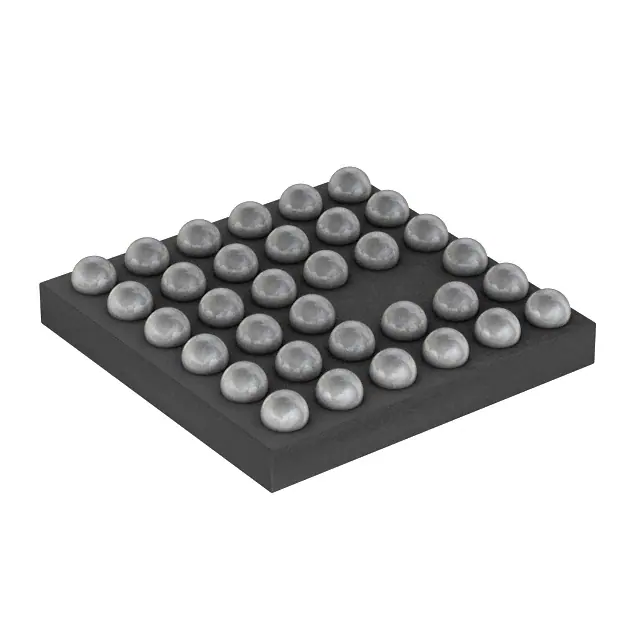
BlueNRG
Upgradable Bluetooth® Low Energy network processor
Datasheet - production data
x
x
x
x
x
x
x
x
x
x
x
Features
x
x
x
x
x
x
x
x
x
x
x
x
Bluetooth specification v4.0 compliant, slave
single-mode Bluetooth low energy network
processor
Embedded Bluetooth low energy protocol
stack: GAP, GATT, SM, L2CAP, LL, RFPHY
Bluetooth low energy profiles provided
separately
Operating supply voltage: from 2.0 to 3.6 V
8.2 mA maximum TX current (@0 dBm, 3.0
V)
Down to 1.7 μA current consumption with
active BLE stack
Integrated linear regulator and DC-DC stepdown converter
Up to +8 dBm available output power (at
antenna connector)
Excellent RF link budget (up to 96 dB)
Accurate RSSI to allow power control
Proprietary application controller interface
(ACI), SPI based, allows interfacing with an
external host application microcontroller
Full link controller and host security
January 2016
High performance, ultra-low power CortexM0 32-bit based architecture core
Upgradable BLE stack (stored in embedded
Flash memory, via SPI)
AES security co-processor
Low power modes
16 or 32 MHz crystal oscillator
12 MHz ring oscillator
32 kHz crystal oscillator
32 kHz ring oscillator
Compliant with the following radio frequency
regulations: ETSI EN 300 328, EN 300 440,
FCC CFR47 Part 15, ARIB STD-T66
Available in QFN32 (5 x 5 mm) and
WLCSP34 (2.66 x 2.56 mm) packages
Operating temperature range:
-40 °C to 85 °C
Applications
x
x
x
x
x
x
x
x
x
Watches
Fitness, wellness and sports
Consumer medical
Security/proximity
Remote control
Home and industrial automation
Assisted living
Mobile phone peripherals
PC peripherals
Table 1: Device summary
Order code
Package
Packing
BLUENRGQTR
QFN32
(5 x 5 mm)
Tape and reel
BLUENRGCSP
WLCSP34
(2.66 x 2.56 mm)
Tape and reel
DocID025108 Rev 10
This is information on a product in full production.
1/44
www.st.com
�Contents
BlueNRG
Contents
1
Description....................................................................................... 5
2
General description......................................................................... 6
3
Pin description ................................................................................ 8
4
5
Application circuits ....................................................................... 11
Block diagram and descriptions .................................................. 15
5.1
Core, memory and peripherals........................................................ 15
5.2
Power management ........................................................................ 16
5.3
Clock management ......................................................................... 17
5.4
Bluetooth low energy radio.............................................................. 17
6
Operating modes ........................................................................... 19
7
Application controller interface.................................................... 22
8
9
Absolute maximum ratings and thermal data ............................. 23
General characteristics................................................................. 24
10
Electrical specification.................................................................. 25
10.1
Electrical characteristics.................................................................. 25
10.2
RF general characteristics .............................................................. 27
10.3
RF transmitter characteristics.......................................................... 28
10.4
RF receiver characteristics.............................................................. 29
10.5
High speed crystal oscillator (HSXOSC) characteristics ................. 30
10.5.1
11
High speed crystal oscillator (HSXOSC) .......................................... 31
10.6
Low speed crystal oscillator (LSXOSC) characteristics................... 32
10.7
High speed ring oscillator (HSROSC) characteristics ..................... 32
10.8
Low speed ring oscillator (LSROSC) characteristics....................... 32
10.9
N-fractional frequency synthesizer characteristics .......................... 33
10.10
SPI characteristics .......................................................................... 33
Package information ..................................................................... 35
11.1
QFN32 package information ........................................................... 36
11.2
WLCSP34 package information ...................................................... 38
12
PCB assembly guidelines ............................................................. 40
13
Revision history ............................................................................ 42
2/44
DocID025108 Rev 10
�BlueNRG
List of tables
List of tables
Table 1: Device summary ........................................................................................................................... 1
Table 2: Pinout description ......................................................................................................................... 9
Table 3: External component list ..............................................................................................................13
Table 4: SPI interface ...............................................................................................................................15
Table 5: Operating modes ........................................................................................................................20
Table 6: Transition times...........................................................................................................................21
Table 7: Absolute maximum ratings .........................................................................................................23
Table 8: Thermal data...............................................................................................................................23
Table 9: Recommended operating conditions ..........................................................................................24
Table 10: Electrical characteristics ...........................................................................................................25
Table 11: RF general characteristics ........................................................................................................27
Table 12: RF Transmitter characteristics..................................................................................................28
Table 13: RF receiver characteristics .......................................................................................................29
Table 14: High speed crystal oscillator characteristics.............................................................................30
Table 15: Low speed crystal oscillator characteristics..............................................................................32
Table 16: High speed ring oscillator characteristics .................................................................................32
Table 17: Low speed ring oscillator characteristics ..................................................................................32
Table 18: N-fractional frequency synthesizer characteristics ...................................................................33
Table 19: SPI characteristics ....................................................................................................................33
Table 20: QFN32 (5 x 5 x 1 pitch 0.5 mm) mechanical data ....................................................................37
Table 21: WLCSP34 (2.66 x 2.56 x 0.5 pitch 0.4 mm) mechanical data..................................................39
Table 22: Flip Chip CSP (2.66 x 2.56 x 0.5 pitch 0.4 mm) package reflow profile recommendation .......40
Table 23: Document revision history ........................................................................................................42
DocID025108 Rev 10
3/44
�List of figures
BlueNRG
List of figures
Figure 1: BlueNRG application block diagram............................................................................................ 7
Figure 2: Pinout top view (QFN32) ............................................................................................................. 8
Figure 3: Pinout top view (WLCSP34) ........................................................................................................ 8
Figure 4: Pinout bottom view (WLCSP34) .................................................................................................. 9
Figure 5: BlueNRG application circuit: active DC-DC converter QFN32 package ...................................11
Figure 6: BlueNRG application circuit: non active DC-DC converter QFN32 package ............................12
Figure 7: BlueNRG application circuit: active DC-DC converter WLCSP package ..................................12
Figure 8: BlueNRG application circuit: non active DC-DC converter WLCSP package...........................13
Figure 9: Block diagram ............................................................................................................................15
Figure 10: Power management strategy using LDO ................................................................................16
Figure 11: Power management strategy using step-down DC-DC converter ..........................................17
Figure 12: Simplified state machine..........................................................................................................20
Figure 13: Simplified block diagram of the amplitude regulated oscillator ...............................................31
Figure 14: SPI timings...............................................................................................................................34
Figure 15: QFN32 (5 x 5 x 1 pitch 0.5 mm) package outline ....................................................................36
Figure 16: QFN32 (5 x 5 x 1 pitch 0.5 mm) package detail "A" ................................................................37
Figure 17: WLCSP34 (2.66 x 2.56 x 0.5 pitch 0.4 mm) package outline..................................................38
Figure 18: Flip Chip CSP (2.66 x 2.56 x 0.5 pitch 0.4 mm) package reflow profile recommendation ......40
4/44
DocID025108 Rev 10
�BlueNRG
1
Description
Description
The BlueNRG is a very low power Bluetooth Low Energy (BLE) single-mode network
processor, compliant with Bluetooth specification v4.0. The BlueNRG can act as slave. The
Bluetooth Low Energy stack runs on the embedded ARM Cortex-M0 core. The stack is
stored on the on-chip non-volatile Flash memory and can be easily upgraded via SPI. The
device comes pre-programmed with a production-ready stack image (whose version could
change at any time without notice). A different or more up-to-date stack image can be
downloaded from the ST web site and programmed on the device through the ST provided
software tools. The BlueNRG allows applications to meet the tight advisable peak current
requirements imposed by the use of standard coin cell batteries. The maximum peak
current is only 10 mA at 1 dBm of output power. Ultra low-power sleep modes and very
short transition times between operating modes allow very low average current
consumption, resulting in longer battery life. The BlueNRG offers the option of interfacing
with external microcontrollers using SPI transport layer.
DocID025108 Rev 10
5/44
�General description
2
BlueNRG
General description
The BlueNRG is a single-mode Bluetooth low energy slave network processor, compliant
with the Bluetooth specification v4.0.
It integrates a 2.4 GHz RF transceiver and a powerful Cortex-M0 microcontroller, on which
a complete power-optimized stack for Bluetooth single mode protocol runs, providing:
x
x
x
x
x
x
Slave role support
GAP: peripheral, broadcaster roles
ATT/GATT: client and server
SM: privacy, authentication and authorization
L2CAP
Link Layer: AES-128 encryption and decryption
An on-chip non-volatile Flash memory allows on-field Bluetooth low energy stack upgrade.
The device allows applications to meet the tight advisable peak current requirements
imposed by the use of standard coin cell batteries. If the high efficiency embedded DC-DC
step-down converter is used, the maximum input current is only 15 mA at the highest
output power (+8 dBm). Even if the DC-DC converter is not used, the maximum input
current is only 29 mA at the highest output power, still preserving battery life.
Ultra low-power sleep modes and very short transition time between operating modes
result in very low average current consumption during real operating conditions, providing
very long battery life.
Two different external matching networks are suggested: standard mode (TX output power
up to +5 dBm) and high power mode (TX output power up to +8 dBm).
The external host application processor, where the application resides, is interfaced with
the BlueNRG through an application controller interface protocol based on a standard SPI
interface.
6/44
DocID025108 Rev 10
�BlueNRG
General description
Figure 1: BlueNRG application block diagram
Application processor
Application
Bluetooth
Low Energy
Profiles
BlueNRG
Application
Controller Interface
SPI
Application
Controller Interface
Bluetooth
Low Energy
Stack
2.4GHz
Radio
GAMS20150507EC-1213
DocID025108 Rev 10
7/44
�Pin description
3
BlueNRG
Pin description
The device pinout is shown in Figure 2: "Pinout top view (QFN32)", Figure 3: "Pinout top
view (WLCSP34)" and Figure 4: "Pinout bottom view (WLCSP34)". In Table 2: "Pinout
description" a short description of the pins is provided.
Figure 2: Pinout top view (QFN32)
Figure 3: Pinout top view (WLCSP34)
Note: Top view (balls are underneath).
8/44
DocID025108 Rev 10
�BlueNRG
Pin description
Figure 4: Pinout bottom view (WLCSP34)
Table 2: Pinout description
Pins
Name
I/O
Description
E2
SPI_MOSI
I
SPI_MOSI
2
E1
SPI_CLK
I
SPI_CLK
3
D2
SPI_IRQ
O
SPI_IRQ
4
D1
TEST1
I/O
Test pin
5
C1
VBAT3
VDD
2.0-3.6 battery voltage input
6
C2
TEST2
I/O
Test pin connected to GND
7
B1
TEST3
I/O
Test pin connected to GND
8
B2
TEST4
I/O
Test pin connected to GND
9
A1
TEST5
I/O
Test pin connected to GND
10
B3
TEST6
I/O
Test pin connected to GND
QFN32
WLCSP
1
11
A2
TEST7
I/O
Test pin connected to GND
12
A3
VDD1V8
O
1.8 V digital core
13
A4
TEST8
I/O
Test pin not connected
14
A5
TEST9
I/O
Test pin not connected
15
B4
TEST11
I/O
Test pin not connected (QFN32)
Test pin connected to GND (WLCSP)
16
B5
TEST12
I/O
Test pin not connected (QFN32)
Test pin connected to GND (WLCSP)
17
A6
FXTAL1
I
16/32 MHz crystal
18
B6
FXTAL0
I
16/32 MHz crystal
19
-
VBAT2
VDD
2.0-3.6 battery voltage input
20
C6
RF1
I/O
Antenna + matching circuit
21
D6
RF0
I/O
Antenna + matching circuit
22
E6
SXTAL1
I
32 kHz crystal
23
E5
SXTAL0
I
32 kHz crystal
24
D5
VBAT1
VDD
2.0-3.6 battery voltage input
25
E4
RESETN
I
Reset
DocID025108 Rev 10
9/44
�Pin description
BlueNRG
Pins
10/44
Name
I/O
F6
SMPSFILT1
O
SMPS output
-
NO_SMPS
I
Power management strategy selection
28
F5
SMPSFILT2
I/O
SMPS input/output
29
F3
VDD1V2
O
1.2 V digital core
30
E3
TEST10
I/O
TEST pin connected to GND
31
F2
SPI_CS
I
SPI_CS
32
F1
SPI_MISO
O
SPI_MISO
-
C3
GND
GND
Ground
-
D3
GND
GND
Ground
-
D4
GND
GND
Ground
-
F4
SMPS-GND
GND
SMPS ground
QFN32
WLCSP
26
27
DocID025108 Rev 10
Description
�BlueNRG
4
Application circuits
Application circuits
The schematics below are purely indicative. For more detailed schematics, please refer to
the "Reference design" and "Layout guidelines" which are provided as separate
documents.
Figure 5: BlueNRG application circuit: active DC-DC converter QFN32 package
DocID025108 Rev 10
11/44
�Application circuits
BlueNRG
Figure 6: BlueNRG application circuit: non active DC-DC converter QFN32 package
Figure 7: BlueNRG application circuit: active DC-DC converter WLCSP package
12/44
DocID025108 Rev 10
�BlueNRG
Application circuits
Figure 8: BlueNRG application circuit: non active DC-DC converter WLCSP package
Table 3: External component list
Component
Description
C1
Decoupling capacitor
C2
DC-DC converter output capacitor
C3
DC-DC converter output capacitor
C4
Decoupling capacitor for 1.2 V digital regulator
C5
Decoupling capacitor for 1.2 V digital regulator
C6
Decoupling capacitor
C7
32 kHz crystal loading capacitor (1)
C8
32 kHz crystal loading capacitor (1)
C9
RF balun/matching network capacitor High Performance
RF balun/matching network capacitor Standard mode
C10
RF balun/matching network capacitor High Performance
RF balun/matching network capacitor Standard mode
C11
RF balun/matching network capacitor High Performance
RF balun/matching network capacitor Standard mode
C12
Decoupling capacitor
C13
Decoupling capacitor
C14
RF balun/matching network capacitor High Performance
RF balun/matching network capacitor Standard mode
C15
RF balun/matching network capacitor High Performance
RF balun/matching network capacitor Standard mode
C16
RF balun/matching network capacitor High Performance
RF balun/matching network capacitor Standard mode
DocID025108 Rev 10
13/44
�Application circuits
BlueNRG
Component
Description
C17
16/32 MHz crystal loading capacitor
C18
16/32 MHz crystal loading capacitor
C19
Decoupling capacitor for 1.8 V digital regulator
C20
Decoupling capacitor for 1.8 V digital regulator
C21
RF balun/matching network capacitor High Performance, RF balun/matching
network capacitor Standard mode
L1
DC-DC converter input inductor, Isat > 100 mA, Q > 25
L2
RF balun/matching network inductor High Performance
RF balun/matching network inductor Standard mode
L3
RF balun/matching network inductor High Performance
RF balun/matching network inductor Standard mode
L4
RF balun/matching network inductor High Performance
RF balun/matching network inductor Standard mode
R1
Pull-down resistor on the SPI_IRQ line
(can be replaced by the internal pull-down of the Application MCU)
XTAL1
32 kHz crystal (optional)
XTAL2
16/32 MHz crystal
Notes:
(1)Values valid only for the crystal NDK NX3215SA-32.768 kHz-EXS00A-MU00003. For other crystals refer to
what specified in their datasheet.
14/44
DocID025108 Rev 10
�BlueNRG
5
Block diagram and descriptions
Block diagram and descriptions
A block diagram of the device is shown in Figure 9: "Block diagram". In the following
subsections a short description of each module is given.
Figure 9: Block diagram
5.1
Core, memory and peripherals
The device contains an ARM Cortex-M0 microcontroller core that supports ultra-low
leakage state retention mode and almost instantaneously returning to fully active mode on
critical events.
The memory subsystem consists of 64 KB Flash, and 12 KB RAM , divided in two blocks of
6 KB (RAM1 and RAM2). Flash is used for the M0 program. No RAM or FLASH resources
are available to the external microcontroller driving the BlueNRG.
The application controller interface (ACI) uses a standard SPI slave interface as transport
layer, basing in five physical wires:
x
x
x
2 control wires (clock and slave select)
2 data wires with serial shift-out (MOSI and MISO) in full duplex
1 wire to indicate data availability from the slave
Table 4: SPI interface
Name
Direction
Width
Description
SPI_CS
In
1
SPI slave select = SPI enable.
SPI_CLK
In
1
SPI clock (max 8 MHz).
SPI_MOSI
In
1
Master output, slave input.
SPI_MISO
Out
1
Master input, slave output.
DocID025108 Rev 10
15/44
�Block diagram and descriptions
Name
SPI_IRQ
BlueNRG
Direction
Width
Out
1
Description
Slave has data for master.
All the SPI pins have an internal pull-down except for the CSN that has a pull-up. All the
SPI pins, except the CSN, are in high impedance state during the low-power states. The
IRQ pin needs a pull-down external resistor.
5.2
Power management
The device integrates both a low dropout voltage regulator (LDO) and a step-down DC-DC
converter, and one of them can be used to power the internal circuitry. However even when
the LDO is used, the stringent maximum current requirements, which are advisable when
coin cell batteries are used, can be met and further improvements can be obtained with the
DC-DC converter at the sole additional cost of an inductor and a capacitor.
The internal LDOs supplying both the 1.8 V digital blocks and 1.2 V digital blocks require
decoupling capacitors for stable operation.
Figure 10: "Power management strategy using LDO" and Figure 11: "Power management
strategy using step-down DC-DC converter", show the simplified power management
schemes using LDO and DC-DC converter.
Figure 10: Power management strategy using LDO
16/44
DocID025108 Rev 10
�BlueNRG
Block diagram and descriptions
Figure 11: Power management strategy using step-down DC-DC converter
5.3
Clock management
The device integrates two low-speed frequency oscillators (LSOSC) and two High speed
(16 MHz or 32 MHz) frequency oscillators (HSOSC).
The low frequency clock is used in Low Power mode and can be supplied either by a 32.7
kHz oscillator that uses an external crystal and guarantee up to ±50 ppm frequency
tolerance, or by a ring oscillator with maximum ±500 ppm frequency tolerance, which does
not require any external components.
The primary high frequency clock is a 16 MHz or 32 MHz crystal oscillator. There is also a
fast-starting 12 MHz ring oscillator that provides the clock while the crystal oscillator is
starting up. Frequency tolerance of high speed crystal oscillator is ±50 ppm.
The usage of the 16 MHz (or 32 MHz) crystal is strictly necessary.
5.4
Bluetooth low energy radio
The device integrates an RF transceiver compliant with the Bluetooth specification and the
standard national regulations in the unlicensed 2.4 GHz ISM band.
The RF transceiver requires very few external discrete components. It provides 96 dB link
budgets with excellent link reliability, keeping the maximum peak current below 15 mA.
In Transmit mode, the power amplifier (PA) drives the signal generated by the frequency
synthesizer out to the antenna terminal through a very simple external network. The power
delivered as well as the harmonic content depends on the external impedance seen by the
PA.
DocID025108 Rev 10
17/44
�Block diagram and descriptions
BlueNRG
The output power is programmable from -18 dBm to +8 dBm, to allow a user-defined power
control system and to guarantee optimum power consumption for each scenario.
18/44
DocID025108 Rev 10
�BlueNRG
6
Operating modes
Operating modes
Several operating modes are defined for the BlueNRG:
x
x
x
x
x
Reset mode
Sleep mode
Standby mode
Active mode
Radio mode
�
Receive Radio mode
�
Transmit Radio mode
In Reset mode, the device is in ultra-low power consumption: all voltage regulators, clocks
and the RF interface are not powered. The device enters Reset mode by asserting the
external reset signal. As soon as it is de-asserted, the device follows the normal activation
sequence to transit to Active mode.
In Sleep mode either the low speed crystal oscillator or the low speed ring oscillator are
running, whereas the high speed oscillators are powered down as well as the RF interface.
The state of the device is retained and the content of the RAM is preserved. Depending on
the application, part of the RAM (RAM2 block) can be switched off during sleep to save
more power (refer to stack mode 1, described in UM1868).
While in Sleep mode, the device waits until an internal timer expires and then it goes into
Active mode. The transition from Sleep mode to Active mode can also be activated through
the SPI interface.
Standby mode and Sleep mode are equivalent but the low speed frequency oscillators are
powered down. In Standby mode the device can be activated through the SPI interface.
In Active mode the device is fully operational: all interfaces, including SPI and RF, are
active as well as all internal power supplies together with the high speed frequency
oscillator. The MCU core is also running.
Radio mode differs from Active mode as also the RF transceiver is active and it is capable
of either transmitting or receiving.
Figure 12: "Simplified state machine" reports the simplified state machine:
DocID025108 Rev 10
19/44
�Operating modes
BlueNRG
Figure 12: Simplified state machine
Table 5: Operating modes
State
Digital LDO
SPI
LSOSC
HSOSC
Core
RF synt.
RX chain
TX chain
OFF
OFF
OFF
OFF
OFF
OFF
OFF
ON
OFF
OFF
OFF
OFF
OFF
OFF
ON
ON
OFF
OFF
OFF
OFF
OFF
ON
-
ON
ON
OFF
OFF
OFF
ON
-
ON
ON
ON
ON
OFF
ON
-
ON
ON
ON
OFF
ON
OFF
Reset
Register contents
lost
ON
Standby
Register contents
retained
ON
Sleep
Register contents
retained
ON
Active
Register contents
retained
ON
RX
Register contents
retained
ON
TX
20/44
Register contents
retained
DocID025108 Rev 10
�BlueNRG
Operating modes
Table 6: Transition times
Transition
Maximum time
1.5 ms
Reset-active
(1)
Standby-active
Sleep-active (1)
Active-RX
Active-TX
RX-TX or TX-RX
32 kHz not available
7 ms
32 kHz RO
94 ms
32 kHz XO
0.42 ms
(1)
Condition
32 kHz not available
6.2 ms
32 kHz RO
93 ms
32 kHz XO
0.42 ms
125 μs
Channel change
61 μs
No channel change
131 μs
Channel change
67 μs
No channel change
150 μs
Notes:
(1)
These measurements are taken using NX3225SA-16.000 MHz-EXS00A-CS05997.
DocID025108 Rev 10
21/44
�Application controller interface
7
BlueNRG
Application controller interface
The application controller interface (ACI) is based on a standard SPI module with speeds
up to 8 MHz. The ACI defines a protocol providing access to all the services offered by the
layers of the embedded Bluetooth stack. The ACI commands are described in the
associated document on ACI command interface (UM1755). In addition, the ACI provides a
set of commands that allow to program BlueNRG firmware from an external device
connected to SPI. The complete description of updater commands and procedures is
provided in a separate application note (AN4491).
22/44
DocID025108 Rev 10
�BlueNRG
8
Absolute maximum ratings and thermal data
Absolute maximum ratings and thermal data
Absolute maximum ratings are those values above which damage to the device may occur.
Functional operation under these conditions is not implied. All voltages are referred to
GND.
Table 7: Absolute maximum ratings
Pin
Parameter
Value
Unit
5, 19, 24, 26, 28
DC-DC converter supply voltage input
and output
-0.3 to
+3.9
V
12, 29
DC voltage on linear voltage regulator
-0.3 to
+3.9
V
1, 2, 3, 4, 6, 7, 8, 9, 10, 11, 25, 27,
30, 31, 32
DC voltage on digital input/output pins
-0.3 to
+3.9
V
13, 14, 15,16
DC voltage on analog pins
-0.3 to
+3.9
V
17, 18, 22, 23
DC voltage on XTAL pins
-0.3 to
+1.4
V
DC voltage on RF pins
-0.3 to
+1.4
V
Storage temperature range
-40 to
+125
°C
±2.0
kV
20, 21 (1)
TSTG
VESD-HBM
Electrostatic discharge voltage
Notes:
(1)+8
dBm input power at antenna connector in Standard mode, +11 dBm in High Power mode, with given
reference design.
Table 8: Thermal data
Symbol
Rthj-amb
Rthj-c
Parameter
Thermal resistance junction-ambient
Thermal resistance junction-case
DocID025108 Rev 10
Value
34 (QFN32)
50 (WLCSP36)
2.5 (QFN32)
25 (WLCSP36)
Unit
°C/W
°C/W
23/44
�General characteristics
9
BlueNRG
General characteristics
Table 9: Recommended operating conditions
Symbol
VBAT
TA
24/44
Parameter
Min.
Typ.
Max.
Unit
Operating Battery supply voltage
2.0
3.6
V
Operating Ambient temperature range
-40
+85
°C
DocID025108 Rev 10
�BlueNRG
Electrical specification
10
Electrical specification
10.1
Electrical characteristics
Characteristics measured over recommended operating conditions unless otherwise
specified. Typical value are referred to TA = 25 °C, VBAT = 3.0 V. All performance data are
referred to a 50 W antenna connector, via reference design, QFN32 package version.
Table 10: Electrical characteristics
Symbol
Parameter
Test conditions
Min.
Typ.
Max.
Unit
Power consumption when DC-DC converter active
Reset
Standby
Sleep
Active
IBAT
Supply current
RX
TX Standard
mode
TX High Power
mode
DocID025108 Rev 10
5
RAM2 OFF
1.3
RAM2 ON
2
32 kHz XO ON
(RAM2 OFF)
1.7
32 kHz XO ON
(RAM2 ON)
2.4
32 kHz RO ON
(RAM2 OFF)
2.8
32 kHz RO ON
(RAM2 ON)
3.5
CPU, Flash and
RAM off
2
CPU, Flash and
RAM on
3.3
High Power
mode
7.7
Standard mode
7.3
+5 dBm
11
0 dBm
8.2
-2 dBm
7.2
-6 dBm
6.7
-9 dBm
6.3
-12 dBm
6.1
-15 dBm
5.9
nA
μA
μA
mA
-18 dBm
5.8
+8 dBm
15.1
+4 dBm
10.9
+2 dBm
9
-2 dBm
8.3
-5 dBm
7.7
mA
mA
mA
25/44
�Electrical specification
Symbol
BlueNRG
Parameter
Test conditions
Min.
Typ.
-8 dBm
7.1
-11 dBm
6.8
-14 dBm
6.6
Max.
Unit
Power consumption when DC-DC converter not active
5
Reset
Standby
Sleep
RAM2 ON
IBAT
Supply current
TX Standard
mode
TX High Power
mode
μA
2
32 kHz XO ON
(RAM2 OFF)
1.7
32kHz XO ON
(RAM2 ON)
2.4
32 kHz RO ON
(RAM2 OFF)
2.8
32 kHz RO ON
(RAM2 ON)
3.5
μA
Active
CPU, Flash and
RAM off
RX
nA
1.4
RAM2 OFF
2.3
High Power
mode
14.5
Standard mode
14.3
+5 dBm
21
0 dBm
15.4
-2 dBm
13.3
-6 dBm
12.2
-9 dB
11.5
-12 dBm
11
-15 dBm
10.6
-18 dBm
10.4
+8 dBm
28.8
+4 dBm
20.5
+2 dBm
17.2
-2 dBm
15.3
-5 dBm
14
-8 dBm
13
-11 dBm
12.3
-14 dBm
mA
mA
mA
mA
12
Digital I/O
CIN
26/44
Port I/O capacitance
1.29
DocID025108 Rev 10
1.38
1.67
pF
�BlueNRG
Electrical specification
Symbol
Test conditions
Min.
Typ.
Max.
Unit
TRISE
Rise time
0.1*VDD to
0.9*VDD, CL =
50 pF
5
19
ns
TFALL
Fall time
0.9*VDD to
0.1*VDD, CL =
50 pF
6
22
ns
T(RST)
10.2
Parameter
Hold time for reset
1.5
ms
TC
VBAT range
3.0
3.3
3.6
V
TC1
VBAT range
2.25
2.5
2.75
V
VIL
Input low voltage
VIH
Input high voltage
VOL
Output low voltage
VOH
Output high voltage
IOL
IOH
VBAT range: TC
-0.3
0.8
VBAT range: TC1
-0.3
0.7
VBAT range: TC
2.0
3.6
VBAT range: TC1
1.7
3.6
VBAT range: TC
0.4
VBAT range: TC1
0.7
VBAT range: TC
2.4
VBAT range: TC1
1.7
Low level output
current @ VOL
(max.)
VBAT range: TC
3.4
5.6
7.9
VBAT range: TC1
3.8
6.6
10.1
High level output
current @ VOH (min)
VBAT range: TC
5.5
10.6
17.6
VBAT range: TC1
3.7
7.2
12.0
V
V
V
V
mA
mA
RF general characteristics
Characteristics measured over recommended operating conditions unless otherwise
specified. Typical value are referred to TA = 25 °C, VBAT =3.0 V. All performance data are
referred to a 50 W antenna connector, via reference design, QFN32 package version.
Table 11: RF general characteristics
Symbol
Parameter
FREQ
Frequency range
FCH
Channel spacing
RFch
RF channel center frequency
Test conditions
Min.
Typ.
2400
Max.
Unit
2483.5
MHz
2
DocID025108 Rev 10
2402
MHz
2480
MHz
27/44
�Electrical specification
10.3
BlueNRG
RF transmitter characteristics
Characteristics measured over recommended operating conditions unless otherwise
specified. Typical value are referred to TA = 25 °C, VBAT = 3.0 V. All performance data are
referred to a 50 W antenna connector, via reference design, QFN32 package version.
Table 12: RF Transmitter characteristics
Symbol
Test conditions
MOD
Modulation scheme
BT
Bandwidth-bit period
product
Mindex
Min.
Typ.
Max.
Unit
GFSK
0.5
Modulation index
0.45
0.5
0.55
DR
Air data rate
STacc
Symbol time
accuracy
PMAX
Maximum output
power at antenna
connector
PRFC
Minimum output
power
PRFC
RF power accuracy
PBW1M
6 dB bandwidth for
modulated carrier (1
Mbps)
Using resolution bandwidth of
100 kHz
PRF1
1st adjacent channel
transmit power 2
MHz
Using resolution bandwidth of
100 kHz and average
detector
-20
dBm
PRF2
2nd adjacent channel
transmit power >3
MHz
Using resolution bandwidth of
100 kHz and average
detector
-30
dBm
PSPUR
Spurious emission
Harmonics included. Using
resolution bandwidth of 1
MHz and average detector
-41
dBm
CFdev
Center frequency
deviation
During the packet and
including both initial
frequency offset and drift
±150
kHz
Freqdrift
Frequency drift
During the packet
±50
kHz
IFreqdrift
Initial carrier
frequency drift
±20
kHz
Maximum drift rate
400
Hz/μs
DriftRatemax
ZLOAD
28/44
Parameter
1
Optimum differential
load
Mbps
50
ppm
High power
+8
+10
dBm
Standard mode
+5
+7
dBm
High power
-15
Standard mode
-18
dB
±2
500
kHz
Standard mode @ 2440 MHz
25.9 +
j44.4
High power mode @ 2440
MHz
25.4 +
j20.8
DocID025108 Rev 10
dB
�BlueNRG
10.4
Electrical specification
RF receiver characteristics
Characteristics measured over recommended operating conditions unless otherwise
specified. Typical value are referred to TA = 25 °C, VBAT =3.0 V. All performance data are
referred to a 50 W antenna connector, via reference design, QFN32 package version.
Table 13: RF receiver characteristics
Symbol
Parameter
Test conditions
RXSENS
Sensitivity
BER