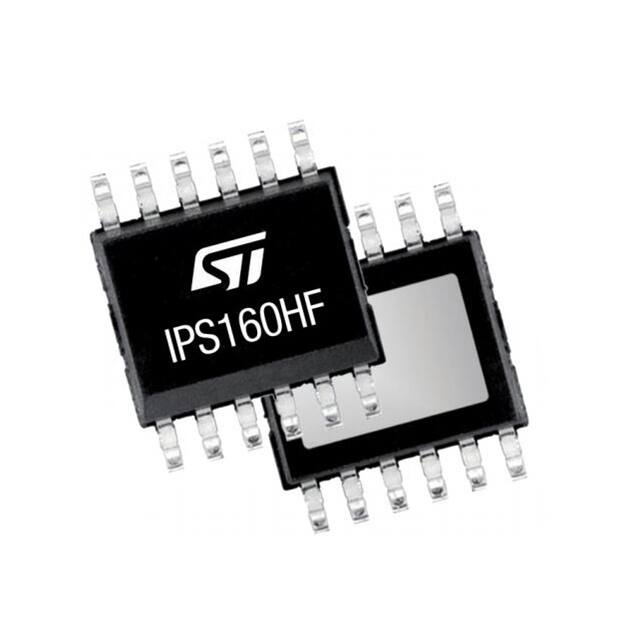
IPS160HF, IPS161HF
Datasheet
Single channel high-side switches
Features
•
•
•
•
•
•
•
•
8 V to 60 V operating voltage range
Minimum output current limitation: 0.7 A (IPS161HF) or 2.5 A (IPS160HF)
Short propagation delay at start-up
Fast demagnetization of inductive load
Non-dissipative short-circuit protection (cut-off)
Programmable cut-off delay time using external capacitor
Ground disconnection protection
VCC disconnection protection
•
•
•
Thermal shutdown protection
Undervoltage lock-out
Diagnostic signalization for: open load in off-state, cut-off and junction thermal
shutdown
Designed to meet IEC 61131-2
PowerSSO12 package
•
•
Applications
Product status
IPS160HF
IPS161HF
•
•
•
•
•
Programmable logic control
Industrial PC peripheral input/output
Numerical control machines
Domotics
General power supply switch
Description
Product label
The IPS160HF (Iout = 2.4 A) and IPS161HF (Iout = 0.6 A) are monolithic devices
which can drive capacitive, resistive or inductive loads with one side connected to
ground.
The 60 V operating range and Ron = 60 mΩ, combined with the extended diagnostic
(Open Load, Over Load, Overtemperature) and the < 60 us propagation delay time
at startup (enabling Class 3 for interface types C and D), make the IC suitable for
applications implementing the proper architectures to address higher SIL levels.
Product summary
Order
code
Package
Packing
IPS160HF
IPS160HFTR
IPS161HF
IPS161HFTR
PowerSSO12
Tube
Tape and reel
The built-in overload and thermal shutdown protections guarantee the ICs, the
application and the load against electrical and thermal overstress. Furthermore, in
order to minimize the power dissipation when the output is shorted, a low-dissipative
short-circuit protection (cut-off) is implemented to limit the output average current
value and consequent device overheating. Cut-off delay time can be set by soldering
an external capacitor or disabled by a resistor on pin 4 (CoD).
The DIAG common diagnostic open drain pin reports the open load in off-state,
cut-off (overload) and thermal shutdown.
DS13271 - Rev 5 - July 2021
For further information contact your local STMicroelectronics sales office.
www.st.com
�IPS160HF, IPS161HF
Block diagram
1
Block diagram
Figure 1. Block diagram
IN
DIAG
Logic interface
Undervoltage
detection
Vcc
Vcc clamp
Output clamp
Current limitation
cut -off
Open load in off-state
OUT
CoD
Junction
Overtemperature
GND
DS13271 - Rev 5
GIPG1702151307LM
page 2/27
�IPS160HF, IPS161HF
Pin description
2
Pin description
Figure 2. Pin connection (top view)
VCC
1
12 VCC
IN
2
11
OUT
DIAG
3
10
OUT
CoD
4
9
OUT
NC
5
8
OUT
NC
6
7
GND
TAB=Vcc
GIPG1702151321LM
Table 1. Pin configuration
Number
Name
Function
Type
1, 12, TAB
VCC
Device supply voltage
Supply
2
IN
Channel input
Input
3
DIAG
Common diagnostic pin for thermal shutdown, cut-off and open load
Output open
drain
Cut-off delay pin, cannot be left floating.
4
CoD
Connected to GND by 1 kΩ resistor to disable the cut-off function. Connect to a CCoD
capacitor to set the cut-off delay see Table 8. Protection and diagnostic
5, 6
NC
Not connected
7
GND
Device ground
Ground
Channel power stage output
Output
8, 9, 10, 11 OUT
Input
IN
This pin drives the output stage to pin OUT. IN pin has internal weak pull-down resistors, see Table 7. Logic
inputs.
OUT
Output power transistor is in high-side configuration, with active clamp for fast demagnetization.
DIAG
This pin is used for diagnostic purposes and is internally wired to an open drain transistor. The open drain
transistor is turned on in case of junction thermal shutdown, cut-off, or open load in off-state.
DS13271 - Rev 5
page 3/27
�IPS160HF, IPS161HF
Pin description
CoD
This pin cannot be left floating and can be used to program the cut-off delay time tcoff, see Table 8. Protection and
diagnostic through an external capacitor (CCoD). The cut-off function can be completely disabled by connecting
the CoD pin to GND through 1 kΩ resistor: in this condition, the output channel remains in limitation condition,
supplying the current to the load until the input is forced LOW or the thermal shutdown threshold is triggered.
GND
IC ground.
VCC
IC supply voltage.
Reverse polarity
The IC can be protected against reverse polarity using two different solutions:
1. Placing a resistor RGND between IC GND pin and load connection point to GND (RGND > VCC/Icc, see Table 2.
Absolute maximum rating). Note that power dissipated by RGND during reverse polarity condition is Vcc^2/RGND.
2. Placing a diode in parallel to RGND
The diode must be selected such that its VRRM > |VCC| and power dissipation capability is higher than VF*IS
(see Table 4).
In normal operation (no reverse polarity), there is a voltage drop (ΔV) between GND of the device and GND of the
module.
Using option 1, ΔV = RGND * ICC.
Using option 2, ΔV = VF@(IS).
Figure 3. Reverse polarity protection schematic
DS13271 - Rev 5
page 4/27
�IPS160HF, IPS161HF
Absolute maximum ratings
3
Absolute maximum ratings
Table 2. Absolute maximum ratings
Symbol
Parameter
Value
Unit
-0.3 to 65
V
Vcc-Vclamp to Vcc+0.3
V
-10 to +10
mA
VCC
Supply voltage
VOUT
Output channel voltage
IIN
Input current
VIN
IN voltage
VCC
V
VCOD
Output cut-off voltage pin
5.5
V
ICOD
Input current on cut-off pin
-1 to +10
mA
VDIAG
Fault voltage
VCC
V
IDIAG
Fault current
-5 to +10
mA
ICC
Maximum DC reverse current flowing through the IC
from GND to VCC
-250
mA
IOUT
Output stage current
-IOUT (1)
Maximum DC reverse current flowing through the IC
from OUT to VCC
5
Single pulse avalanche energy (TAMB = 125 °C, VCC
= 24 V, Iload = 0.5 A)
3000
Single pulse avalanche energy (TAMB = 125 °C, VCC
= 24 V, Iload = 1 A)
1000
EAS
(1)
Internally limited
A
mJ
PTOT
Power dissipation at TC = 25 °C (2)
TSTG
Storage temperature range
-55 to 150
TJ
Junction temperature
-40 to 150
Internally limited
W
°C
1. Verified on STEVAL-IFP028V1 and STEVAL-IFP034V1 application board
2. (TJSD(MAX)-TC)/ Rth(JA)
Note:
Absolute maximum ratings are the values beyond which damage to the device may occur. Functional operation
under these conditions is not implied. All voltages are referenced to GND.
Table 3. Thermal data
Value
Symbol
Note:
DS13271 - Rev 5
Parameter
1s
2s2p
2s2p (with 4
thermal vias)
Rth(JC)
Thermal resistance junction-case
0.4
0.9
0.5
Rth(JA)
Thermal resistance junction-ambient
117
57
29
Unit
°C/W
Rth(JC) is intended between the die and the bottom case surface measured by cold plate as per JESD51. Rth(JA)
according JESD51-3 (1s) JESD51-5 (2s2p) and JESD51-7 (2s2p and thermal vias).
page 5/27
�IPS160HF, IPS161HF
Electrical characteristics
4
Electrical characteristics
(8 V < VCC < 60 V; -40 °C < TJ < 125 °C, unless otherwise specified)
Table 4. Supply
Symbol
Parameter
Test conditions
Min.
Typ.
Max.
Unit
VUVON
60
V
VCC
Supply voltage
VUVON
Undervoltage on threshold
6.9
8
V
VUVOFF
Undervoltage off threshold
6.5
7.8
V
VUVH
Undervoltage hysteresis
0.15
Supply current in off-state
IS
Supply current in on-state
ILGND
GND disconnection output current
0.5
V
VCC = 24 V
300
500
VCC = 60 V
350
600
VCC = 24 V
1
1.4
VCC = 60 V
1.4
2.1
VGND = VIN = VCC, VOUT = 0 V; TJ = 25oC
0.5
VGND = VIN = VCC, VOUT = 0 V; TJ = 125oC
0.55
μA
mA
mA
Table 5. Output stage
Symbol
Parameter
Test conditions
Min.
VCC = 24 V
RDS(on)
IOUT =1 A @ TJ = 25 °C
On-state resistance
Typ.
Max.
60
80
mΩ
VCC = 24 V
120
IOUT =1 A @ TJ = 125 °C
VOUT(OFF)
Off-state output voltage
IOUT(OFF)
Off-state output current
IOUT(OFF-min)
Off-state output current
VIN = 0 V and IOUT = 0 A
2
VCC = 24 V, VIN = 0 V, VOUT = 0 V
3
VCC = 60 V, VIN = 0 V, VOUT = 0 V
10
VIN = 0 V, VOUT = 4 V
Unit
-35
V
μA
0
Table 6. Switching (VCC = 24 V; -40 °C < TJ < 125 °C, RLOAD = 48 Ω)
Symbol
DS13271 - Rev 5
Parameter
tr
Rise time
tf
Fall time
tPD(H-L)
Propagation delay time off
tPD(L-H)
Propagation delay time on
tD(VCC-ON)
Power-on delay time from
VCC rising edge
Test conditions
Min. Typ. Max.
Unit
10
IOUT = 0.5 A, (see Figure 4. Timing in normal operation )
10
20
μs
30
IOUT = 0.5 A, (see Figure 5. Propagation delay at startup)
32
60
page 6/27
�IPS160HF, IPS161HF
Electrical characteristics
Figure 4. Timing in normal operation
DS13271 - Rev 5
page 7/27
�IPS160HF, IPS161HF
Electrical characteristics
Figure 5. Propagation delay at start-up
VIN
t
VCC
VUVON
t
td(Vcc-on)
VOUT
10%
t
Table 7. Logic inputs
Symbol
DS13271 - Rev 5
Parameter
VIL
Input low level voltage
VIH
Input high level voltage
VI(HYST)
Input hysteresis voltage
IIN
Input current
Test conditions
Min.
Typ.
Max.
Unit
0.8
V
2.2
0.4
VCC = VIN = 36 V
200
VCC = VIN = 60 V
550
μA
page 8/27
�IPS160HF, IPS161HF
Electrical characteristics
Table 8. Protection and diagnostic
Symbol
Parameter
Test conditions
Vclamp
VCC active clamp
ICC = 10 mA
Vdemag
Demagnetization voltage
IOUT = 0.5 A; load =1 mH
VOLoff
Open load (off-state) or short to VCC
detection threshold
tBKT
Open load blanking time
VDIAG
Voltage drop on DIAG
IDIAG
DIAG pin leakage current
IPK
Output current limitation
activation threshold
ILIM
tcoff
Output current limitation
IPS161HF
Max.
65.5
68.5
71.5
Unit
VCC-71.5 VCC-68.5 VCC-65.5
V
4
200
μs
IDIAG = 4 mA
1
V
VCC ≤ 36 V
110
36 V ˂ VCC ≤ 60 V
180
VCC ≤ 24 V, RLOAD ≤ 10 mΩ
IPS160HF
Cut-off current delay time
Typ.
2
IPS161HF
IPS160HF
Min.
Programmable by the external
capacitor on CoD pin. Cut-off is
disabled when CoD pin is connected
to GND through 1 kΩ resistor.
1.3
2.1
3.0
4.6
0.7
1.7
2.5
4.2
50xCCOD[nf] ± 35%(1)
μA
A
μs
TJ˂ TJSD
tres
Output stage restart delay time
TJSD
Junction temperature shutdown
TJHYST
Junction temperature thermal
hysteresis
TJ˂ TJSD
32xtCOFF[μs] ±40%
150
170
15
190
°C
1. The formula is guaranteed in the range 10 nF ≤ CCOD ≤ 100 nF.
DS13271 - Rev 5
page 9/27
�IPS160HF, IPS161HF
Output logic
5
Output logic
Table 9. Output stage truth table
Operation
Normal
Cut-off
Overtemperature
Open load
UVLO
IN
OUT
DIAG
L
L
H
H
H
H
L
L
L
H
L
L
L
L
L
H
L
L
L
H(1)
L (1)
H
H
H
X
L
X
X
L
X
1. External pull-up resistor is used
DS13271 - Rev 5
page 10/27
�IPS160HF, IPS161HF
Protection and diagnostic
6
Protection and diagnostic
The IC integrates several protections to ease the design of a robust application.
6.1
Undervoltage lock-out
The device turns off if the supply voltage falls below the turn-off threshold (VUV(off)). Normal operation restarts
after VCC exceeds the turn-on threshold (VUV(on)). Turn-on and turn-off thresholds are defined in Table 4. Supply.
6.2
Overtemperature
The output stage turns off when its internal junction temperature (TJ) exceeds the shutdown threshold TJSD.
Normal operation restarts when TJ comes back below the reset threshold (TJSD - TJHYST), see Table 8. Protection
and diagnostic. The internal fault signal is set when the channel is off due to thermal protection and it is reset
when the junction triggers the reset threshold. This same behavior is signaled on the DIAG pin.
6.3
Cut-off
The IC can limit the output current at the power stage by its embedded output current limitation circuit.
This circuit continuously monitor the output current and, when load is increasing, at the triggering of its activation
threshold (Ipk) it starts limiting to ILIM limitation level: while current limitation is active the IC enters an high
dissipation status.
The IC implements the cut-off feature which limits the duration of the current limitation condition.
The duration of the current limitation condition (Tcoff) can be set by a capacitor (CCoD) placed between CoD and
GND pins. The design rule for CCoD is:
tcoff[us] ±35% = 50 x Ccod[nF]
The ±35% drift is guaranteed in the range of 10 nF < Ccod < 100 nF; lower capacitance than 10 nF can be used.
If ILIM threshold is triggered, the output stage remains in the current limitation condition (IOUT = ILIM) no longer
than tCOFF. If tCOFF elapses, the output stage turns off and restarts after the tRES restart time.
Thermal shutdown protection has higher priority than cut-off:
•
IC is forced off if TJSD is triggered before tCOFF elapses
•
DS13271 - Rev 5
if TJSD is triggered, IC is maintained off even after the tRES has elapsed and until the TJ falls below
TJSD-TJHYST
page 11/27
�IPS160HF, IPS161HF
Cut-off
Figure 6. Current limitation and cut-off
I OUT
t COFF
t
ILIM
TJ 36 V), the cut-off
function requires activation in order to avoid damaging the IC.
The following table shows the suggested cut-off delay for different operating voltages.
Table 10. Minimum cut-off delay for TAMB less than -20 °C
DS13271 - Rev 5
VCC [V]
Cut-off delay [μs]
Cut-off capacitance [nF]
36-48
100
2.2
48-60
50
1
page 12/27
�IPS160HF, IPS161HF
Open load in off-state
6.4
Open load in off-state
The IC provides the open load detection feature which detects if the load is disconnected from the OUT pin. This
feature can be activated by a resistor (RPU) between OUT and VCC pins.
Figure 7. Open load off-state
Application board
VCC
SUPPLY RAIL
IC
VCC
EXPOSED PAD
Open load
detection signal
R PU
+
-
OUT
VOLOFF
RI
R LED
R LOAD
PGND
GROUND PLANE
In case of wire break and during the OFF state (IN = low), the output voltage VOUT rises according to the
partitioning between the external pull-up resistor and the internal impedance of the IC (130 kΩ < RI < 360 kΩ).
The effect of the LED (if any) on the output pin has to be considered as well. In case of wire break and during the
ON state (IN = high), the output voltage VOUT is pulled up to VCC by the low resistive integrated switch. If the load
is not connected, in order to guarantee the correct open load signalization it must result:
VOUT > VOLoff(max.)
Referring to the circuit in Figure 7. Open load off-state:
therefore:
VOUT = VCC − RPU × IPU = VCC − RPU × IRI + ILED + IRL
VCC min − VOLoff max
RPU < V
VOLoff max − VLED
OLoff max
+
RLED
RI min
(1)
(2)
If the load is connected, in order to avoid any false signalization of the open load, the following condition must
hold:
VOUT < VOLoff(min)
By taking into account the circuit in figure 6:
so:
VOUT = VCC − RPU × IPU = VCC − RPU ×
VOUT VOUT − VLED VOUT
+ R
RI +
RLED
L
VCC max − VOLoff min
RPU > V
VOLoff min − VLED VOLoff min
OLoff min
+
+
RL
RLED
RI max
(3)
(4)
The fault condition is signaled on the DIAG pin and the fault reset occurs when load is reconnected.
If the channel is switched on by the IN pin, the fault condition is no longer detected.
DS13271 - Rev 5
page 13/27
�IPS160HF, IPS161HF
VCC disconnection protection
When an inductive load is driven, some ringing of the output voltage may be observed at the end of the
demagnetization. In fact, the load is completely demagnetized when ILOAD = 0 A and the OUT pin remains floating
until next turn-on. In order to avoid false detection of the open load event when driving inductive loads, the open
load signal is masked for tBKT. So, the open load is reported on the DIAG pin with a delay of tBKT and if the open
load event is triggered for more than tBKT.
6.5
VCC disconnection protection
The IC is protected despite the VCC disconnection event. This event is intended as the disconnection of the
VCC wire from the application board, see figure below. When this condition happens, the IC continues working
normally until the voltage on the VCC pin is ≥ VUVOFF. Once the VUVOFF is triggered, the output channel is turned
off independently on the input status. In case of inductive load, if the VCC is disconnected while the output channel
is still active, the IC allows the discharge of the energy still stored in the inductor through the integrated power
switch.
Figure 8. VCC disconnection
APPLICATION BOARD
VCC >VUVOFF
VCC
EXPOSED
PAD
CVCC
SUPPLY RAIL
DRIVING
CIRCUITRY
ON
OUT
IC
GROUND PLANE
DS13271 - Rev 5
GND
page 14/27
�IPS160HF, IPS161HF
GND disconnection protection
6.6
GND disconnection protection
GND disconnection is intended as the disconnection event of the application ground, see figure below. When
this event happens, the IC continues working normally until the voltage between VCC and GND pins of the
IC is ≥ VUVOFF. The voltage on GND pin of the IC rises up to the supply rail voltage level. In case of GND
disconnection event, a current (ILGND) flows through OUT pin. Table 4. Supply shows IOUT = ILGND for the worst
case GND disconnection event where the output is shorted to ground.
Figure 9. GND disconnection
APPLICATION BOARD
SUPPLY RAIL
VCC
VCC
EXPOSED
PAD
CVCC
DRIVING
CIRCUITRY
ON
OUT
IC
LOAD
GROUND PLANE
DS13271 - Rev 5
GND
page 15/27
�IPS160HF, IPS161HF
Active VDS clamp
7
Active VDS clamp
Active clamp is also known as fast demagnetization of inductive loads or fast current decay. When a high-side
driver turns off an inductance, an undervoltage is detected on output.
The OUT pin is pulled down to Vdemag. The conduction state is modulated by internal circuitry in order to keep the
OUT pin voltage at about Vdemag until the load energy has been dissipated. The energy is dissipated both in the
IC internal switch and in the load resistance.
Figure 10. Active clamp equivalent principle schematic
APPLICATION BOARD
SUPPLY RAIL
IC
VCC
EXPOSED PAD
Clamp
circuitry
OUT
L LOAD
GROUND PLANE
DS13271 - Rev 5
GND
page 16/27
�IPS160HF, IPS161HF
Active VDS clamp
Figure 11. Fast demag waveforms
IOUT
tDEMAG
~
ILOAD
tON
t
VOUT
~
VCC
t
VCC-VDEMAG
VIN
~
t
DS13271 - Rev 5
page 17/27
�IPS160HF, IPS161HF
Active VDS clamp
The demagnetization of inductive load causes large electrical and thermal stress on the IC. The plot below shows
the maximum demagnetization energy that the IC can tolerate in a single demagnetization pulse with VCC = 24
V and TAMB = 125 °C. If higher demagnetization energy is required, then an external free-wheeling Schottky
diode has to be connected between OUT (cathode) and GND (anode) pins. Note that in this case the fast
demagnetization is inhibited.
Figure 12. Typical demagnetization energy (single pulse) at VCC = 24 V and TAMB = 125 °C
4000
3500
EDEMAG [mJ]
3000
2500
2000
1500
1000
500
0
500
700
900
1100
1300
ILOAD
DS13271 - Rev 5
1500
1700
1900
2100
2300
2500
[mA]
page 18/27
�IPS160HF, IPS161HF
Package information
8
Package information
In order to meet environmental requirements, ST offers these devices in different grades of ECOPACK packages,
depending on their level of environmental compliance. ECOPACK specifications, grade definitions and product
status are available at: www.st.com. ECOPACK is an ST trademark.
DS13271 - Rev 5
page 19/27
�IPS160HF, IPS161HF
PowerSSO12 package information
8.1
PowerSSO12 package information
Figure 13. PowerSSO12 package outline
7392413 rev. D
DS13271 - Rev 5
page 20/27
�IPS160HF, IPS161HF
PowerSSO12 package information
Table 11. PowerSSO12 package mechanical data
Dim.
mm
Min.
Typ.
A
1.250
1.700
A1
0.000
0.100
A2
1.100
1.600
B
0.230
0.410
C
0.190
0.250
D
4.800
5.000
E
3.800
4.000
e
0.800
H
5.800
6.200
h
0.250
0.55
L
0.400
1.270
k
0d
8d
X
1.900
2.500
Y
3.600
4.200
ddd
Note:
Max.
0.100
Dimension D doesn't include mold flash protrusions or gate burrs. Mold flash protrusions or gate burrs don't
exceed 0.15 mm in total both side.
Figure 14. PowerSSO12 recommended footprint
DS13271 - Rev 5
page 21/27
�IPS160HF, IPS161HF
PowerSSO12 package information
Figure 15. PowerSSO12 tape packing information [mm]
Figure 16. PowerSS012 reel packing information [mm]
DS13271 - Rev 5
page 22/27
�IPS160HF, IPS161HF
Revision history
Table 12. Document revision history
DS13271 - Rev 5
Date
Revision
Changes
23-Apr-2020
1
Initial release.
26-Jun-2020
2
IPS161HF RPN added to document
03-Mar-2021
3
Minor changes in Section Applications
29-Mar-2021
4
Updated ILGND maximum value in Table 4
30-Jul-2021
5
Updated thermal data in Table 3 according to Jedec conditions.
page 23/27
�IPS160HF, IPS161HF
Contents
Contents
1
Block diagram . . . . . . . . . . . . . . . . . . . . . . . . . . . . . . . . . . . . . . . . . . . . . . . . . . . . . . . . . . . . . . . . . . . . .2
2
Pin description . . . . . . . . . . . . . . . . . . . . . . . . . . . . . . . . . . . . . . . . . . . . . . . . . . . . . . . . . . . . . . . . . . . .3
3
Absolute maximum ratings . . . . . . . . . . . . . . . . . . . . . . . . . . . . . . . . . . . . . . . . . . . . . . . . . . . . . . . . 5
4
Electrical characteristics. . . . . . . . . . . . . . . . . . . . . . . . . . . . . . . . . . . . . . . . . . . . . . . . . . . . . . . . . . . 6
5
Output logic . . . . . . . . . . . . . . . . . . . . . . . . . . . . . . . . . . . . . . . . . . . . . . . . . . . . . . . . . . . . . . . . . . . . . .10
6
Protection and diagnostic. . . . . . . . . . . . . . . . . . . . . . . . . . . . . . . . . . . . . . . . . . . . . . . . . . . . . . . . .11
6.1
Undervoltage lock-out. . . . . . . . . . . . . . . . . . . . . . . . . . . . . . . . . . . . . . . . . . . . . . . . . . . . . . . . . . 11
6.2
Overtemperature . . . . . . . . . . . . . . . . . . . . . . . . . . . . . . . . . . . . . . . . . . . . . . . . . . . . . . . . . . . . . . 11
6.3
Cut-off . . . . . . . . . . . . . . . . . . . . . . . . . . . . . . . . . . . . . . . . . . . . . . . . . . . . . . . . . . . . . . . . . . . . . . . 11
6.4
Open load in off-state . . . . . . . . . . . . . . . . . . . . . . . . . . . . . . . . . . . . . . . . . . . . . . . . . . . . . . . . . . 13
6.5
VCC disconnection protection . . . . . . . . . . . . . . . . . . . . . . . . . . . . . . . . . . . . . . . . . . . . . . . . . . . 14
6.6
GND disconnection protection . . . . . . . . . . . . . . . . . . . . . . . . . . . . . . . . . . . . . . . . . . . . . . . . . . . 15
7
Active clamp . . . . . . . . . . . . . . . . . . . . . . . . . . . . . . . . . . . . . . . . . . . . . . . . . . . . . . . . . . . . . . . . . . . . .16
8
Package information. . . . . . . . . . . . . . . . . . . . . . . . . . . . . . . . . . . . . . . . . . . . . . . . . . . . . . . . . . . . . .19
8.1
PowerSSO12 package information . . . . . . . . . . . . . . . . . . . . . . . . . . . . . . . . . . . . . . . . . . . . . . . 20
Revision history . . . . . . . . . . . . . . . . . . . . . . . . . . . . . . . . . . . . . . . . . . . . . . . . . . . . . . . . . . . . . . . . . . . . . . .23
DS13271 - Rev 5
page 24/27
�IPS160HF, IPS161HF
List of tables
List of tables
Table 1.
Table 2.
Table 3.
Table 4.
Table 5.
Table 6.
Table 7.
Table 8.
Table 9.
Table 10.
Table 11.
Table 12.
Pin configuration . . . . . . . . . . . . . . . . . . . . . . . . . . . . . . .
Absolute maximum ratings . . . . . . . . . . . . . . . . . . . . . . . .
Thermal data. . . . . . . . . . . . . . . . . . . . . . . . . . . . . . . . . .
Supply . . . . . . . . . . . . . . . . . . . . . . . . . . . . . . . . . . . . . .
Output stage . . . . . . . . . . . . . . . . . . . . . . . . . . . . . . . . . .
Switching (VCC = 24 V; -40 °C < TJ < 125 °C, RLOAD = 48 Ω).
Logic inputs. . . . . . . . . . . . . . . . . . . . . . . . . . . . . . . . . . .
Protection and diagnostic . . . . . . . . . . . . . . . . . . . . . . . . .
Output stage truth table . . . . . . . . . . . . . . . . . . . . . . . . . .
Minimum cut-off delay for TAMB less than -20 °C . . . . . . . . .
PowerSSO12 package mechanical data . . . . . . . . . . . . . . .
Document revision history . . . . . . . . . . . . . . . . . . . . . . . . .
DS13271 - Rev 5
.
.
.
.
.
.
.
.
.
.
.
.
.
.
.
.
.
.
.
.
.
.
.
.
.
.
.
.
.
.
.
.
.
.
.
.
.
.
.
.
.
.
.
.
.
.
.
.
.
.
.
.
.
.
.
.
.
.
.
.
.
.
.
.
.
.
.
.
.
.
.
.
.
.
.
.
.
.
.
.
.
.
.
.
.
.
.
.
.
.
.
.
.
.
.
.
.
.
.
.
.
.
.
.
.
.
.
.
.
.
.
.
.
.
.
.
.
.
.
.
.
.
.
.
.
.
.
.
.
.
.
.
.
.
.
.
.
.
.
.
.
.
.
.
.
.
.
.
.
.
.
.
.
.
.
.
.
.
.
.
.
.
.
.
.
.
.
.
.
.
.
.
.
.
.
.
.
.
.
.
.
.
.
.
.
.
.
.
.
.
.
.
.
.
.
.
.
.
.
.
.
.
.
.
.
.
.
.
.
.
.
.
.
.
.
.
.
.
.
.
.
.
.
.
.
.
.
.
.
.
.
.
.
.
.
.
.
.
.
.
.
.
.
.
.
.
.
.
.
.
.
.
.
.
.
.
.
.
.
.
.
.
.
.
.
.
.
.
.
.
.
.
.
.
.
.
.
.
.
.
.
.
.
.
.
.
.
.
.
.
.
.
.
.
.
.
.
.
.
.
.
.
.
.
.
.
.
.
.
.
.
.
.
.
.
.
.
.
.
.
.
.
.
.
.
.
.
.
.
.
.
.
.
.
.
.
.
.
.
.
.
.
.
.
.
.
.
.
.
.
.
.
.
.
.
.
.
.
.
.
.
.
.
.
.
.
.
.
.
.
.
.
.
.
.
.
.
.
.
.
.
.
.
.
.
.
.
.
.
.
.
.
.
.
.
.
.
.
.
.
.
.
.
.
.
.
.
.
.
.
.
.
.
.
.
.
.
.
.
.
.
.
.
.
.
.
.
.
.
.
.
.
. 3
. 5
. 5
. 6
. 6
. 6
. 8
. 9
10
12
21
23
page 25/27
�IPS160HF, IPS161HF
List of figures
List of figures
Figure 1.
Figure 2.
Figure 3.
Figure 4.
Figure 5.
Figure 6.
Figure 7.
Figure 8.
Figure 9.
Figure 10.
Figure 11.
Figure 12.
Figure 13.
Figure 14.
Figure 15.
Figure 16.
DS13271 - Rev 5
Block diagram . . . . . . . . . . . . . . . . . . . . . . . . . . . . . . . . . . . . . . . . . . . . . .
Pin connection (top view) . . . . . . . . . . . . . . . . . . . . . . . . . . . . . . . . . . . . . . .
Reverse polarity protection schematic . . . . . . . . . . . . . . . . . . . . . . . . . . . . . .
Timing in normal operation . . . . . . . . . . . . . . . . . . . . . . . . . . . . . . . . . . . . .
Propagation delay at start-up . . . . . . . . . . . . . . . . . . . . . . . . . . . . . . . . . . . .
Current limitation and cut-off. . . . . . . . . . . . . . . . . . . . . . . . . . . . . . . . . . . . .
Open load off-state . . . . . . . . . . . . . . . . . . . . . . . . . . . . . . . . . . . . . . . . . . .
VCC disconnection . . . . . . . . . . . . . . . . . . . . . . . . . . . . . . . . . . . . . . . . . . .
GND disconnection . . . . . . . . . . . . . . . . . . . . . . . . . . . . . . . . . . . . . . . . . . .
Active clamp equivalent principle schematic . . . . . . . . . . . . . . . . . . . . . . . . . .
Fast demag waveforms . . . . . . . . . . . . . . . . . . . . . . . . . . . . . . . . . . . . . . . .
Typical demagnetization energy (single pulse) at VCC = 24 V and TAMB = 125 °C
PowerSSO12 package outline . . . . . . . . . . . . . . . . . . . . . . . . . . . . . . . . . . .
PowerSSO12 recommended footprint . . . . . . . . . . . . . . . . . . . . . . . . . . . . . .
PowerSSO12 tape packing information [mm] . . . . . . . . . . . . . . . . . . . . . . . . .
PowerSS012 reel packing information [mm] . . . . . . . . . . . . . . . . . . . . . . . . . .
.
.
.
.
.
.
.
.
.
.
.
.
.
.
.
.
.
.
.
.
.
.
.
.
.
.
.
.
.
.
.
.
.
.
.
.
.
.
.
.
.
.
.
.
.
.
.
.
.
.
.
.
.
.
.
.
.
.
.
.
.
.
.
.
.
.
.
.
.
.
.
.
.
.
.
.
.
.
.
.
.
.
.
.
.
.
.
.
.
.
.
.
.
.
.
.
.
.
.
.
.
.
.
.
.
.
.
.
.
.
.
.
.
.
.
.
.
.
.
.
.
.
.
.
.
.
.
.
.
.
.
.
.
.
.
.
.
.
.
.
.
.
.
.
.
.
.
.
.
.
.
.
.
.
.
.
.
.
.
.
.
.
.
.
.
.
.
.
.
.
.
.
.
.
.
.
.
.
.
.
.
.
.
.
.
.
.
.
.
.
.
.
.
.
.
.
.
.
.
.
.
.
.
.
.
.
.
.
.
.
.
.
.
.
.
.
.
.
.
.
.
.
.
.
.
.
.
.
.
.
.
.
.
.
.
.
.
.
.
.
.
.
.
.
.
.
.
.
.
.
.
.
.
.
.
.
.
.
.
.
.
.
.
.
.
.
.
.
.
.
.
.
.
.
.
.
.
.
.
.
.
.
.
.
.
.
.
.
.
.
.
.
.
.
.
.
.
.
.
.
.
.
.
.
.
.
.
.
.
.
.
.
.
.
.
.
.
.
.
.
.
.
.
.
.
.
.
.
.
.
.
.
.
.
.
.
. 2
. 3
. 4
. 7
. 8
12
13
14
15
16
17
18
20
21
22
22
page 26/27
�IPS160HF, IPS161HF
IMPORTANT NOTICE – PLEASE READ CAREFULLY
STMicroelectronics NV and its subsidiaries (“ST”) reserve the right to make changes, corrections, enhancements, modifications, and improvements to ST
products and/or to this document at any time without notice. Purchasers should obtain the latest relevant information on ST products before placing orders. ST
products are sold pursuant to ST’s terms and conditions of sale in place at the time of order acknowledgement.
Purchasers are solely responsible for the choice, selection, and use of ST products and ST assumes no liability for application assistance or the design of
Purchasers’ products.
No license, express or implied, to any intellectual property right is granted by ST herein.
Resale of ST products with provisions different from the information set forth herein shall void any warranty granted by ST for such product.
ST and the ST logo are trademarks of ST. For additional information about ST trademarks, please refer to www.st.com/trademarks. All other product or service
names are the property of their respective owners.
Information in this document supersedes and replaces information previously supplied in any prior versions of this document.
© 2021 STMicroelectronics – All rights reserved
DS13271 - Rev 5
page 27/27
�










 工商网监
湘ICP备2023018690号
工商网监
湘ICP备2023018690号