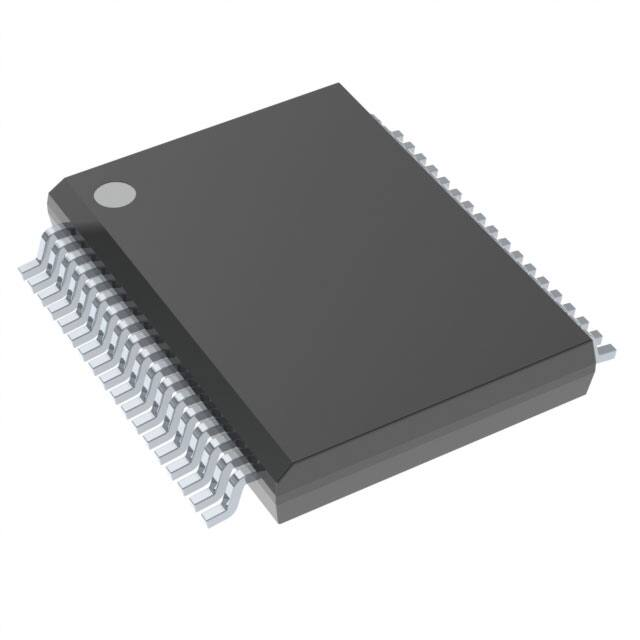
L99SM81V
Programmable stepper motor driver for automotive applications
with micro-stepping and stall detection
Datasheet - Production data
Features
AEC-Q100 qualified
Stepper motor driver with up to 1.35 A
current capability
Programmable Step mode:
Full step, Half step, Mini step, 1/8 Micro
step, 1/16 Micro step
Current regulation by integrated PWM
control with fully integrated current sensing
Equivalent 10 bit resolution on current
regulation loop:
Two 4-bit programmable full scale
current amplitudes: one for RUN and
one for HOLD mode
6-bit DAC for reference current
generation (whatever programmed full
scale amplitude)
4 programmable decay modes:
Slow-mode, mixed-mode and 2x
automatically selected decay-modes
3x programmable inputs for direct control of
step clock, direction, hold and step modes
1x programmable analog output for Tj
measurement or band-gap reference
2x programmable digital outputs for
internally generated PWM ON duty cycles,
June 2017
error signals, coils voltage measurement
synchronization signals
Programmable MOSFETs switching speed:
four options for EMC and power dissipation
trade-off optimization
PWM frequency wobbling for reduction of
conducted EM energy
Outputs protection and diagnosis (open
load, short to battery, short to GND)
Integrated ADC for coil voltage
measurement and stall detection
5 V low drop voltage regulator short-circuit
protected
Very low current consumption in standby
mode (typ. 10 µA)
Thermal warning and shutdown
ST SPI 4.1 interface for control and
diagnostics
Applications
Bipolar 2 phase stepper motor driver for
automotive applications like adaptive front light
systems or projectors for head-up displaying
Description
The L99SM81V is an automotive grade
integrated driver for bipolar two-phase stepper
motors capable of current controlled microstepping with programmable amplitude. The
device features a 5 V voltage regulator to supply
external sensors.
The integrated Serial Peripheral Interface (SPI)
makes it possible to adjust device parameters,
control all operating modes and read out
diagnostic information. Digital I/Os are also
optionally usable for more flexible and reliable
application control.
DocID027599 Rev 4
This is information on a product in full production.
1/85
www.st.com
�Contents
L99SM81V
Contents
1
Block diagram and pin description ................................................ 8
2
Device description......................................................................... 11
2.1
Supply pins (VS, VREG, VDD) ........................................................ 11
2.2
Voltage regulator (V5V) ................................................................... 11
2.3
Charge Pump (CP).......................................................................... 11
2.4
Standby mode (EN)......................................................................... 11
2.5
Application block diagram ............................................................... 12
2.6
Stepping modes and step update.................................................... 12
2.7
Current references generation and PWM regulation ....................... 16
2.8
HOLD mode .................................................................................... 17
2.9
Decay modes .................................................................................. 17
2.10
2.11
DMR[1:0] bits = 01b, DMH = 0 - Slow decay mode always applied . 18
2.9.2
DMR[1:0] bits = 10b, DMH = 1 - Mixed decay mode always applied .. 19
2.9.3
DMR[1:0] bits = 00b - Auto decay mode 1 ....................................... 21
2.9.4
DMR[1:0] bits = 11b - Auto decay mode 2 ....................................... 24
Control pins (CTRLx) ...................................................................... 26
2.10.1
Step Control (STEP) ......................................................................... 26
2.10.2
Direction Control (DIR) ..................................................................... 26
2.10.3
Step mode Control (SMODE) and HOLD mode ............................... 26
Digital outputs ................................................................................. 27
2.11.1
Error/ warning indicator (ERR) ......................................................... 27
2.11.2
Error/ warning change indicator (EC) ............................................... 27
2.11.3
PWM ................................................................................................. 28
2.11.4
Coil Voltage Conversion Ready (CVRDY) ....................................... 28
2.11.5
Coil Voltage Runaway (CVRUN) ...................................................... 28
2.11.6
Coil Voltage Lower Limit Underrun (CVLL) ...................................... 28
2.12
Analog output .................................................................................. 28
2.13
Motor coil voltage measurement for stall detection ......................... 29
2.14
3
2.9.1
2.13.1
Coil voltage measurement triggering ................................................ 30
2.13.2
Coil voltage measurement processing ............................................. 30
Serial peripheral interface (ST SPI standard) .................................. 31
Protections and diagnostics ......................................................... 33
3.1
Supply diagnostics .......................................................................... 33
3.1.1
2/85
VS overvoltage and undervoltage .................................................... 33
DocID027599 Rev 4
�L99SM81V
4
5
Contents
VREG overvoltage and undervoltage ............................................... 33
3.1.3
CP failure .......................................................................................... 33
3.1.4
V5V undervoltage warning ............................................................... 33
3.1.5
V5V failure ........................................................................................ 33
3.1.6
VDD failure ....................................................................................... 34
3.2
Thermal warning and thermal shutdown ......................................... 34
3.3
Cross current protection (dead-time)............................................... 34
3.4
Driver diagnostic ............................................................................. 34
3.4.1
Overcurrent detection ....................................................................... 34
3.4.2
Open load detection ......................................................................... 34
Electrical characteristics .............................................................. 35
4.1
Absolute maximum ratings .............................................................. 35
4.2
Operating range .............................................................................. 35
4.3
ESD protection ................................................................................ 35
4.4
Thermal data ................................................................................... 36
4.5
Main electrical characteristics ......................................................... 36
4.6
SPI bus (CSN, SCK, SDI, SDO)...................................................... 43
ST SPI protocol .............................................................................. 46
5.1
Physical layer .................................................................................. 46
5.2
Protocol ........................................................................................... 47
5.3
5.4
5.5
5.6
6
3.1.2
5.2.1
SDI frame ......................................................................................... 47
5.2.2
SDO Frame ...................................................................................... 49
Address and data definition ............................................................. 51
5.3.1
Device Information Register ............................................................. 51
5.3.2
Device Application Registers ............................................................ 53
Protocol failure detection ................................................................. 53
5.4.1
Clock monitor .................................................................................... 53
5.4.2
SCK Polarity (CPOL) check ............................................................. 53
5.4.3
SCK Phase (CPHA) check ............................................................... 53
5.4.4
CSN timeout ..................................................................................... 53
5.4.5
Data Stuck ........................................................................................ 54
Implementation remarks .................................................................. 54
5.5.1
Register change during communication ........................................... 54
5.5.2
GSB and Payload inconsistency ...................................................... 54
Timings ........................................................................................... 54
SPI registers .................................................................................. 55
DocID027599 Rev 4
3/85
�Contents
7
L99SM81V
6.1
Register map overview .................................................................... 55
6.2
Global Status Register GSR (0x01) ................................................ 56
6.3
Motor and driver Status Register MSR (0x02)................................. 58
6.4
Global Configuration Register 1 GCR1 (0x03) ................................ 60
6.5
Global Configuration Register 2 GCR2 (0x04) ................................ 62
6.6
Motor Control Register 1 MCR1 (0x05) ........................................... 63
6.7
Motor Control Register 2 MCR2 (0x06) ........................................... 65
6.8
Motor Control Register 3 MCR3 (0x07) ........................................... 67
6.9
Motor current reference register MCREF (0x08) ............................. 68
6.10
Motor Coil Voltage 0° MCVA (0x09) ................................................ 69
6.11
Motor Coil Voltage 90° MCVB (0x0A) ............................................. 70
6.12
Motor Coil Voltage 180° MCVC (0x0B) ........................................... 71
6.13
Motor Coil Voltage 270° MCVD (0x0C) ........................................... 72
6.14
Motor Coil Voltage Low Limit B MCVLLB (0x0D) ............................ 73
6.15
Motor Coil Voltage Low Limit A MCVLLA (0x0E) ............................ 74
6.16
Motor Coil Voltage Upper Limit MCVUL (0x0F)............................... 75
Package information ..................................................................... 76
7.1
QFN40L package information ......................................................... 76
7.2
PowerSSO-36 package information ................................................ 78
7.3
Marking information ......................................................................... 80
8
Order codes ................................................................................... 81
9
Revision history ............................................................................ 82
4/85
DocID027599 Rev 4
�L99SM81V
List of tables
List of tables
Table 1: Pin definition and function ............................................................................................................. 9
Table 2: Coil voltage synopsis table ......................................................................................................... 30
Table 3: Absolute maximum ratings ......................................................................................................... 35
Table 4: Operating range .......................................................................................................................... 35
Table 5: ESD protection ............................................................................................................................ 35
Table 6: Thermal data ............................................................................................................................... 36
Table 7: Thermal warning and thermal shutdown .................................................................................... 36
Table 8: Supply and supply monitoring ..................................................................................................... 36
Table 9: Power on reset ............................................................................................................................ 38
Table 10: Voltage regulator V5V ............................................................................................................... 38
Table 11: AOUT electrical characteristics................................................................................................. 39
Table 12: OUTxn outputs (x = A,B; n = 1,2) ............................................................................................. 39
Table 13: Charge pump ............................................................................................................................ 40
Table 14: PWM control ............................................................................................................................. 41
Table 15: Clock characteristics ................................................................................................................. 42
Table 16: Digital inputs CTRL1, CTRL2, CTRL3, EN ............................................................................... 42
Table 17: Coil voltage acquisition ............................................................................................................. 42
Table 18: Digital outputs DOUT1, DOUT2................................................................................................ 43
Table 19: CSN, SCK, SDI input ................................................................................................................ 43
Table 20: SDO output ............................................................................................................................... 43
Table 21: SPI timing.................................................................................................................................. 44
Table 22: Operation codes ....................................................................................................................... 47
Table 23: Device application access ........................................................................................................ 48
Table 24: Device information read access................................................................................................ 48
Table 25: Address range .......................................................................................................................... 48
Table 26: Global Status Byte GSB ........................................................................................................... 49
Table 27: Global Status Byte GSB (bit description) .................................................................................. 50
Table 28: Device information read access operation code....................................................................... 51
Table 29: Device information registers ..................................................................................................... 51
Table 30: SPI mode .................................................................................................................................. 52
Table 31: SPI Burst Read ......................................................................................................................... 52
Table 32: SPI data length ......................................................................................................................... 52
Table 33: SPI data consistency check ...................................................................................................... 52
Table 34: Complete device SPI register table .......................................................................................... 55
Table 35: Global Status Register GSR ..................................................................................................... 56
Table 36: Global Status Register GSR (bit description) ........................................................................... 56
Table 37: Motor and driver Status Register MSR ..................................................................................... 58
Table 38: Motor and driver Status Register MSR (bit description) ........................................................... 58
Table 39: Global Configuration Register 1 GCR1 .................................................................................... 60
Table 40: Global Configuration Register 1 GCR1 (bit description) ........................................................... 60
Table 41: Global Configuration Register 2 GCR2 .................................................................................... 62
Table 42: Global Configuration Register 2 GCR2 (bit description) ........................................................... 62
Table 43: Motor Control Register 1 MCR1 ............................................................................................... 63
Table 44: Motor Control Register 1 MCR1 (bit description)...................................................................... 63
Table 45: Motor Control Register 2 MCR2 ............................................................................................... 65
Table 46: Motor Control Register 2 MCR2 (bit description) ...................................................................... 65
Table 47: Motor Control Register 3 MCR3 ............................................................................................... 67
Table 48: Motor Control Register 3 MCR3 (bit description)...................................................................... 67
Table 49: Motor current reference register MCREF ................................................................................. 68
Table 50: Motor Current reference register MCREF (bit description) ....................................................... 68
Table 51: Motor Coil Voltage 0° MCVA .................................................................................................... 69
Table 52: Motor Coil Voltage 0° MCVA (bit description)........................................................................... 69
Table 53: Motor Coil Voltage 90° MCVB .................................................................................................. 70
DocID027599 Rev 4
5/85
�List of tables
L99SM81V
Table 54: Motor Coil Voltage 90° MCVB (bit description)......................................................................... 70
Table 55: Motor Coil Voltage 180° MCVC ................................................................................................ 71
Table 56: Motor Coil Voltage 180° MCVC (bit description) ...................................................................... 71
Table 57: Motor Coil Voltage 270° MCVD ................................................................................................ 72
Table 58: Motor Coil Voltage 270° MCVD (bit description) ...................................................................... 72
Table 59: Motor Coil Voltage Low Limit B MCVLLB ................................................................................. 73
Table 60: Motor Coil Voltage Low Limit B MCVLLB (bit description) ....................................................... 73
Table 61: Motor Coil Voltage Low Limit A MCVLLA ................................................................................. 74
Table 62: Motor Coil Voltage Low Limit A MCVLLA (bit description) ....................................................... 74
Table 63: Motor Coil Voltage Upper Limit MCVUL ................................................................................... 75
Table 64: Motor Coil Voltage Upper Limit MCVUL (bit description) ......................................................... 75
Table 65: QFN40L package mechanical data .......................................................................................... 77
Table 66: PowerSSO-36 package mechanical data ................................................................................. 78
Table 67: Device summary ....................................................................................................................... 81
Table 68: Document revision history ........................................................................................................ 82
6/85
DocID027599 Rev 4
�L99SM81V
List of figures
List of figures
Figure 1: Block diagram (QFN40L) ............................................................................................................. 8
Figure 2: Block diagram (PowerSSO-36) ................................................................................................... 8
Figure 3: QFN40 pin connections (top view) .............................................................................................. 9
Figure 4: PSSO36 pin connections (top view) ............................................................................................ 9
Figure 5: Stepper motor driver application block diagram ........................................................................ 12
Figure 6: Electrical revolution in 1/16th micro step (current profile and phase counter values) ............... 13
Figure 7: Electrical revolution in 1/8th micro step (current profile and phase counter values) ................. 13
Figure 8: Electrical revolution in mini step (current profiles and phase counter values) .......................... 14
Figure 9: Electrical revolution in half step (current profiles and phase counter values) ........................... 14
Figure 10: Electrical revolution in full step mode (current profiles and phase counter values) ................ 15
Figure 11: Current reference generation block diagram ........................................................................... 16
Figure 12: PWM ON and PWM OFF switching states .............................................................................. 17
Figure 13: PWM switching sequence (slow decay) .................................................................................. 18
Figure 14: Mixed decay............................................................................................................................. 19
Figure 15: Mixed decay (current undershoot / limit not reached) ............................................................. 20
Figure 16: Electrical revolution in auto decay mode 1 (DIR = 1) .............................................................. 21
Figure 17: Electrical revolution in auto decay mode 1 (DIR = 0) .............................................................. 22
Figure 18: Auto decay mode 1 with direction change ............................................................................... 23
Figure 19: Auto decay mode 2, DIR = 0 ................................................................................................... 24
Figure 20: Auto decay mode 2, behavior at micro-step change (dead-time omitted) .............................. 25
Figure 21: Comparative Auto decay mode 1 vs. Auto decay mode 2 ...................................................... 25
Figure 22: CTRL pin multiplex options ...................................................................................................... 26
Figure 23: Configurable I/O multiplex options .......................................................................................... 27
Figure 24: PWM signal generation ........................................................................................................... 28
Figure 25: Coil voltage registers content (DIR = 0, positive current flowing from OUTx1 to OUTx2; x = A, B) .. 29
Figure 26: Coil voltage measurement sequence example ....................................................................... 30
Figure 27: SPI transfer timing diagram ..................................................................................................... 43
Figure 28: SPI timing diagram .................................................................................................................. 45
Figure 29: SPI pin description ................................................................................................................... 46
Figure 30: SDI frame................................................................................................................................. 47
Figure 31: SDO frame ............................................................................................................................... 49
Figure 32: QFN40L package outline ......................................................................................................... 76
Figure 33: PowerSSO-36 package outline ............................................................................................... 78
Figure 34: QFN40L marking information .................................................................................................. 80
Figure 35: PowerSSO-36 marking information ......................................................................................... 80
DocID027599 Rev 4
7/85
�Block diagram and pin description
1
L99SM81V
Block diagram and pin description
Figure 1: Block diagram (QFN40L)
VREG
V5V
5V protected
regulator
CSN
SPI, logic
and
registers
CLK
SDI
V3V
CP+
CP-
CPOUT
VSA1
VSA2
Internal regulator
Current profile
generator
Charge pump
Current regulation
and gate driving
Shunt-less
I-sense
SDO
PGNDA2
PGNDA1
VSB1
VSB2
Tj/Band gap
sensing
EN
CTRL1
OUTA2
OUTA1
Bemf sense
ADC
I/O
CTRL2
OUTB2
OUTB1
CTRL3
PGNDB2
PGNDB1
VDD
DOUT1 DOUT2
AOUT
GND
GAPG1802151618CFT
Figure 2: Block diagram (PowerSSO-36)
VREG
V5V
5V protected
regulator
CSN
SPI, logic
and
registers
CLK
SDI
V3V
CP+
CP-
CPOUT
VSA
Internal regulator
Current profile
generator
Charge pump
Current regulation
and gate driving
Shunt-less
I-sense
SDO
PGNDA
VSB
Tj/Band gap
sensing
EN
CTRL1
OUTA2
OUTA1
Bemf sense
ADC
I/O
OUTB2
OUTB1
CTRL2
CTRL3
PGNDB
VDD
DOUT1 DOUT2
AOUT
GND
GAPG1802151620CFT
8/85
DocID027599 Rev 4
�L99SM81V
Block diagram and pin description
40
CPOUT
CP+
CP-
NC
AOUT
NC
VSA2
VSA1
NC
OUTA1
Figure 3: QFN40 pin connections (top view)
31
NC 1
30 SDO
OUTA2
SDI
NC
CLK
PGNDA1
CSN
PGNDA2
DOUT1
PGNDB2
DOUT2
PGNDB1
EN
NC
GND
OUTB2
V3V
NC 10
21
CTRL2
CTRL1
V5V
NC
VREG
VSB2
VSB1
NC
CTRL3
20
11
OUTB1
VDD
GAPG1802151631CFT
Figure 4: PSSO36 pin connections (top view)
NC
1
36
CP-
AOUT
2
35
CP+
VSA
3
34
CPOUT
NC
4
33
NC
OUTA1
5
32
SDO
NC
6
31
SDI
OUTA2
7
30
CLK
NC
8
29
CSN
PGNDA
9
28
DOUT1
PGNDB
10
27
DOUT2
NC
11
26
EN
OUTB2
12
25
GND
NC
13
24
V3V
OUTB1
14
23
VDD
NC
15
22
CTRL3
VSB
16
21
CTRL2
VREG
17
20
CTRL1
NC
18
19
V5V
(1) Pin 1 is connected to the slug. Slug connection to GND is recommended.
GAPG1802151633CFT
Table 1: Pin definition and function
Symbol
Function
I/O Type
Not connected
—
OUTA1
Output of leg 1 of H-Bridge A
O
OUTA2
Output of leg 2 of H-Bridge A
O
NC
PGNDAn
Power ground for leg n of H-Bridge A (QFN40 option only;
n = 1,2)
PGND
PGNDA
Power ground for H-Bridge A (PSSO36 only)
PGND
DocID027599 Rev 4
9/85
�Block diagram and pin description
L99SM81V
Symbol
I/O Type
PGNDBn
Power ground for leg n of H-Bridge B (QFN40 option only;
n = 1,2)
PGND
PGNDB
Power ground for H-Bridge B (PSSO36 option only)
PGND
OUTB2
Output of leg 2 of H-Bridge B
O
OUTB1
Output of leg 1 of H-Bridge B
O
VSBn
Supply voltage for leg n of H-Bridge B (QFN40 option only;
n = 1,2)
Supply
VSB
Supply voltage for H-Bridge B (PSSO36 option only)
Supply
VSAn
Supply voltage for leg n of H-Bridge A (QFN40 option only;
n = 1,2)
Supply
VSA
Supply voltage for H-Bridge A (PSSO36 option only)
Supply
CTRL3
Configurable control pin 3
I
CTRL2
Configurable control pin 2
I
CTRL1
Configurable control pin 1
I
VREG
Supply voltage for 5 V regulator
V5V
5 V regulator output
VDD
Digital I/Os supply
V3V
Internal 3V regulator decoupling output
GND
GND connection
EN
Supply
O
Supply
O
GND
Enable input
I
DOUT2
Configurable digital output 2
O
DOUT1
Configurable digital output 1
O
CSN
SPI chip select NOT input
I
CLK
SPI serial clock input
I
SDI
SPI serial data input
I
SDO
SPI serial data output
O
CPOUT
Charge pump output
O
CP+
Charge pump pin for capacitor, positive side
O
CP-
Charge pump pin for capacitor, negative side
O
Analog Output
O
AOUT
10/85
Function
DocID027599 Rev 4
�L99SM81V
Device description
2
Device description
2.1
Supply pins (VS, VREG, VDD)
The device has three different supply input pins:
2.2
VSx pins are used to supply the four H-bridges, VSA pin(s) is (are) also used to supply
the charge pump. All of VS pins must be protected against negative voltages.
VREG pin supplies the embedded 5 V LDO regulator and the 3.3 V regulator
supplying internal logic. It must be protected against negative voltages
VDD supplies all of the digital I/Os, it is intended to be equal to the voltage used to
supply the application micro-controller; both 3.3 V and 5 V are supported.
Voltage regulator (V5V)
The device integrates a low-drop voltage regulator capable of supplying external devices
(e.g. external sensors) with a continuous load current up to 50 mA. The output voltage is
stable with ceramic output capacitors equal to 220 nF or bigger, placed close to the device.
The voltage regulator is protected against short circuit to both GND and battery (for the
latter, VREG must be present).
2.3
Charge Pump (CP)
L99SM81V embeds a single stage charge pump which requires a ‘flying’ external ceramic
capacitor placed in between pins CP+ and CP- and an additional ceramic capacitor on pin
CP. The charge pump operation is internally monitored and a condition that avoids proper
operation of the charge pump will be indicated by the respective SPI diagnosis flag. The
charge pump frequency can be modulated with a wobble frequency generator to optimize
EMC performance.
2.4
Standby mode (EN)
The EN input has an internal pull-down resistor. The device is in standby mode if EN input
is set to logic low level. In this case the voltage regulator, the charge pump and all of the
outputs are turned off, registers content is also set to default value.
If EN is set to logic high level then the device enters the active mode after a start-up time
equal to tSTART. In active mode all functions are available and the device is controlled by the
ST SPI interface and the digital control pins.
DocID027599 Rev 4
11/85
�Device description
2.5
L99SM81V
Application block diagram
Figure 5: Stepper motor driver application block diagram
C4
4.7µ
C5
VREG
External supply
V5V
C1
220n
Voltage
regulator
CP+
CP-
100n
CP
VS
22µ
V3V
100nF
C2
C6
100n
100n
PGND
VDD
C3
100n
OUTA1
M
CSN
OUTA2
SCK
SDI
L99SM81V
SDO
OUTB1
EN
µC
CTRL1
OUTB2
CTRL2
CTRL3
AOUT
VS
22µ
100n
100p
DOUT1
PGND
DOUT2
Optional connection
GAPG1802151645CFT
As it can be seen from the application block diagram, the device may be driven either by
Serial Peripheral Intreface (SPI) or by digital inputs/outputs.
2.6
Stepping modes and step update
Depending on desired step resolution - as shown in Figure 6: "Electrical revolution in 1/16th
micro step (current profile and phase counter values)" to Figure 10: "Electrical revolution in
full step mode (current profiles and phase counter values)" - one stepper motor electrical
cycle can consist of 64 micro steps (1/16th micro step mode), 32 micro steps (1/8th micro
step mode), 16 mini steps (mini step mode), 8 half steps (half step mode) or 4 full steps
(full step mode).
12/85
DocID027599 Rev 4
�L99SM81V
Device description
Figure 6: Electrical revolution in 1/16th micro step (current profile and phase counter values)
Figure 7: Electrical revolution in 1/8th micro step (current profile and phase counter values)
DocID027599 Rev 4
13/85
�Device description
L99SM81V
Figure 8: Electrical revolution in mini step (current profiles and phase counter values)
Figure 9: Electrical revolution in half step (current profiles and phase counter values)
14/85
DocID027599 Rev 4
�L99SM81V
Device description
Figure 10: Electrical revolution in full step mode (current profiles and phase counter values)
The current profile generated by the device depends on the phase counter value (stored in
PH[5:0] bits in MCR1 register) and it can be altered in an exclusive way either via the SPI
interface (MX1 bit = 0) by directly writing PH[5:0] bits or through the CTRL1 pin (MX1
bit = 1) on each rising edge.
Phase counter update becomes effective on next PWM period.
In case MX1 bit is set, user has read-only rights to PH[5:0] bits and the phase counter can
only be updated through rising edges on CTRL1 pin. In particular, PH[5:0] is incremented
or decremented (depending on running motor direction) by a quantity automatically
computed and dependent on the applied Step mode (normally SM[2:0]). Additionally, in
case MX3[1:0] (in GCR1 register) is equal to 0x01, the CTRL3 pin can also be used to
simultaneously select whether the current Step mode is the one specified by SM[2:0] bits or
ASM[2:0] bits (MCR1 register). The automatic increment/decrement of the phase counter
amounts to 1 LSB in case of 1/16th microstep mode (SM[2:0] or ASM[2:0] equal to 0x00),
2LSBs in case of 1/8 th microstep mode (SM[2:0] or ASM[2:0] equal to 0x01), 4 LSBs in
case of mini-step mode (SM[2:0] or ASM[2:0] equal to 0x02), 8 LSBs in case of half-step
mode (SM[2:0] or ASM[2:0] equal to 0x03), 16 LSBs in case of full-step mode (SM[2:0] or
ASM[2:0] equal to 0x04).
Whenever changing the step mode from a higher resolution to a lower one, the phase
counter is adjusted to the next closer phase counter value coherently with the new Step
mode. This adjustment is actually applied on the first PWM period after a phase counter
change command.
On the contrary, in case MX1 bit is reset, phase counter can only be accessed via SPI and
logic level on CTRL1 input is discarded. In order to ensure the maximum flexibility for the
application, the computation of the next phase counter value to be written in PH[5:0] is
totally left to the application microcontroller. The step mode control bits, which will usually
have no impact on the current profile generation when the PHase counter is updated via
SPI, will impact the current profile generation only in full step mode.
DocID027599 Rev 4
15/85
�Device description
L99SM81V
Any modification of the step mode (either through CTRL3 pin in case MX3[1:0]=0x01 or
through SPI writing of bit SM[2:0] and ASM[2:0] in MCR1 register) becomes effective at the
beginning of the first PWM cycle following a phase counter update command (either
received via CTRL1 pin with MX1=1 or through a SPI writing of PH[5:0] bits with MX1=0).
2.7
Current references generation and PWM regulation
L99SM81V embeds a look-up table composed by 17 entries synthetizing a quarter of a
sinusoidal cycle; table elements have 6 bit accuracy. In 1/16th microstep mode each of
these table entries represent the value that, once multiplied by the full scale factor stored
into CA[3:0] bit of MCREF register, constitute in RUN mode the digital current references
for a whole micro step. In HOLD mode, bits HC[3:0] are automatically used instead as full
scale factor (see Figure 11: "Current reference generation block diagram").
Figure 11: Current reference generation block diagram
Synthetized sine wave
look-up table
Ref 0
Ref 1
Ref 2
IFSR: Programmable full
scale current in RUN mode
(CA[3:0] in MCREF reg)
IFSH: Programmable full
scale current in HOLD mode
(HC[3:0] in MCREF reg)
Ref 15
Ref 16
Phase A current
reference (6 bit)
X
RUN or
HOLD mode
Step counter
(PH[5:0] in MCR1 reg)
Phase B current
reference (6 bit)
GAPG1902150937CFT
Due to the symmetry of the sinusoidal waveform, all the 64 target motor current pairs of an
electrical revolution (in 1/16th micro step) can be referenced by both the 17 table entries
and the phase counter register. The 6 bit step (phase) counter - in fact - defines both the
sign of the current flowing through phases A and B and which of the 17 current entries is to
be used for current reference computation
In full step mode - the full scale current defined by either CA[3:0] or HC[3:0] bits in MCREF
is entirely applied to the two motor phases (sine-wave look-up table not used), being
current direction dependent on step counter value (see Figure 10: "Electrical revolution in
full step mode (current profiles and phase counter values)").
In order to achieve the motor current regulation, the current references generated in this
way are then compared with the internal motor current mirror (no external shunt resistor).
At the beginning of each PWM period, H-bridges A and B are actively driven (PWM ON
phase) until the related current reference is reached.
Once a H-bridge reaches its current reference, it is switched to one of the two possible
PWM OFF configurations depending on the selected decay mode (see Figure 12: "PWM
ON and PWM OFF switching states" for an overview of the switching states).
The PWM frequency for the current regulation is configurable (MCR2 FREQ[1:0]) and can
be modulated with a wobble frequency generator by activating this option via SPI (GCR1
MWBE).
16/85
DocID027599 Rev 4
�L99SM81V
Device description
In order to avoid spurious misleading triggering of the comparator used for the current
regulation loop, a minimum PWM on-time, equal to the sum of the programmable
comparator blanking time (tB) plus the glitch filter delay time (tTF), is always applied.
2.8
HOLD mode
The L99SM81V features a HOLD mode intended to be used when it’s required to hold the
motor in a given position; HOLD mode is entered either by setting via SPI the HOLDM bit in
register MCR1 (if MX3[1:0] ≠ 10b) or by setting a logic high value on pin CTRL3 (if
MX3[1:0] = 10b).
In case bit AHMSD in MCR3 register is set, then HOLDM bit is set automatically
(regardless of MX3 bits value and CTRL3 input level) after a stall condition is detected for a
number of consecutive times equal to SD[2:0] (in this case it’s necessary either to clear the
SDF bit in the Status Register or to reset the AHMSD in the MCR3 Register before HOLDM
bit can be cleared).
When In HOLD mode:
2.9
The motor current reference is computed automatically for both motor phases starting
from the full scale factor stored in bits HC[3:0] of MCREF register.
The applied decay mode is set accordingly to DMH bit in MCR2
The PH[5:0] bits can be still updated unless the HOLDM bit is set because of the
AHMSD control bit set to one on a stall event detection pointed out by the SDF flag;
only in this latter case the phase counter will be frozen as long as both bits (SDF and
AHMSD) are set.
Decay modes
This device features different types of current decay modes. They are implemented to allow
a flexible adaptation of the current regulation loop properties to the application
requirements. The decay mode can be selected via SPI register MCR2 (DMR[1:0] bits for
RUN mode, DMH bit for HOLD mode).
Figure 12: "PWM ON and PWM OFF switching states" shows an overview of the basic
switching states during the PWM ON phase and the PWM OFF phase. Each decay mode
is a combination of these basic switching states with different trigger events.
Figure 12: PWM ON and PWM OFF switching states
PWM ON Phase
Fast Decay
Slow Decay HS
ON
OFF
OFF
ON
OFF
ON
ON
OFF OFF
PWM ON
ON
Slow Decay LS
ON
OFF
OFF
OFF
ON
ON
PWM OFF
GAPG1902150941CFT
For the slow decay state it is configurable which freewheeling current path will be used
(either high-side or low-side) see SPI Register MCR2 SDAFW&SDBFW.
DocID027599 Rev 4
17/85
�Device description
L99SM81V
In Fast Decay state the opposite switches in each half - bridge are active – like when
driving the current in the opposite direction in PWM ON phase. This allows decreasing the
motor phase current faster if compared to Slow Decay but results in a higher current ripple.
In order to combine the advantages of a low current ripple with those of a fast and
responsive current regulation, L99SM81V features a dedicated configuration (auto decay
mode 2) in which the decay mode is dynamically and automatically adjusted by the device
as described in Section 2.9.4: "DMR[1:0] bits = 11b - Auto decay mode 2".
2.9.1
DMR[1:0] bits = 01b, DMH = 0 - Slow decay mode always applied
If DMR[1:0] bits are equal to 01b, Slow Decay Mode is always applied in RUN mode after
the PWM ON phase. Likewise, slow decay mode is also always applied in HOLD mode if
DMH = 0.
Figure 13: PWM switching sequence (slow decay)
Cross current
protection
ON
OFF
OFF
ON
Load
Current
Slow decay
High side
Cross current
protection
ON
OFF
ON
ON
OFF
OFF
OFF
OFF
OFF
OFF
OFF
OFF
Cross current
protection
Cross current
protection
Slow decay
Low side
OFF
OFF
OFF
OFF
OFF
OFF
OFF
ON
ON
ON
OFF
OFF
ON
OFF
OFF
ON
tFT
PWM ON
PWM ON
Current
reference
tB
tCC : Cross current protection time
tB
: Comparator blanking time
tFT : Glitch filter delay time
tCC
Time
Internal
PWM clock
GAPG1902151335CFT
18/85
DocID027599 Rev 4
�L99SM81V
2.9.2
Device description
DMR[1:0] bits = 10b, DMH = 1 - Mixed decay mode always applied
If DMR[1:0] bits are equal to 10b, Mixed Decay Mode is always applied in RUN mode.
Likewise, mixed decay mode is also always applied in HOLD mode if DMH = 1. In Mixed
Decay Mode the PWM ON phase is followed by a fast decay state, which is followed in turn
by a slow decay. The start of the slow decay is triggered as soon as the actual current
crosses the reference current and the filter time tFT has elapsed.
Figure 14: Mixed decay
Slow decay
High side
Cross current
protection
Cross current
protection
ON
OFF
Fast decay
OFF OFF
OFF OFF
ON
ON
OFF
OFF
OFF
Load
Current
ON
Cross current
protection
OFF
ON
ON
ON
OFF
OFF
OFF
OFF
OFF
OFF
OFF
OFF
Cross current
protection
Slow decay
Low side
Cross current
protection
OFF
OFF OFF
OFF
OFF
OFF
ON
OFF
ON
OFF
OFF
ON
ON
OFF
OFF
ON
tFT
tCC
PWM ON
PWM ON
tB
tFT
Step
Limit
tB
tCC
tCC : Cross current protection time
tB
: Comparator blanking time
tFT : Glitch filter delay time
Time
Internal
PWM clock
Mixed decay: Fast decay until current undershoot, than slow decay
GAPG1902151343CFT
DocID027599 Rev 4
19/85
�Device description
L99SM81V
Figure 15: Mixed decay (current undershoot / limit not reached)
20/85
DocID027599 Rev 4
�L99SM81V
2.9.3
Device description
DMR[1:0] bits = 00b - Auto decay mode 1
In Auto Decay Mode1 the phase counter value and the motor spinning direction (DIR bit)
are taken into account to select the appropriate switching state specifically, either a slow
decay or a mixed decay are applied.
The next two figures show the dependency of the applied decay mode from the phase
counter and the direction bit. See also paragraph Section 2.9.2: "DMR[1:0] bits = 10b, DMH
= 1 - Mixed decay mode always applied" for mixed decay mode description.
Figure 16: Electrical revolution in auto decay mode 1 (DIR = 1)
DocID027599 Rev 4
21/85
�Device description
L99SM81V
Figure 17: Electrical revolution in auto decay mode 1 (DIR = 0)
22/85
DocID027599 Rev 4
�L99SM81V
Device description
Figure 18: Auto decay mode 1 with direction change
DocID027599 Rev 4
23/85
�Device description
2.9.4
L99SM81V
DMR[1:0] bits = 11b - Auto decay mode 2
Auto decay mode 2 allows combining at the best the advantages of a low current ripple
together with those of a fast and responsive current regulation. In Auto Decay Mode2, the
phase counter value, the motor spinning direction (DIR bit) and the status of the real
current vs. the current reference are taken into account to select the appropriate switching
state. Figure 19: "Auto decay mode 2, DIR = 0" shows the dependence of the decay mode
from the phase counter in case DIR=0 (applied decay mode are opposite in case of DIR
=1)
In particular, with reference to the areas where a combination of slow and mixed decay
modes is applied, mixed decay is used - in order to achieve the fastest current
responsiveness - as soon as a new step begins and till the moment the motor phase
current crosses the new (lower in absolute value) current reference, slow decay is then
applied in order to reduce the switching losses and the current ripple vs. the mixed decay
mode. See also paragraph Section 2.9.2: "DMR[1:0] bits = 10b, DMH = 1 - Mixed decay
mode always applied" for mixed decay mode description.
Figure 19: Auto decay mode 2, DIR = 0
24/85
DocID027599 Rev 4
�L99SM81V
Device description
Figure 20: Auto decay mode 2, behavior at micro-step change (dead-time omitted)
New current reference crossed within t
tFT
tON min
Current reference
PWM OFF PWM OFF
Fast decay Slow decay
Actual motor current
PWM
ON
PWM OFF
Slow decay
PWM
ON
tPWM
Slow decay mode
Mixed decay mode
Slow decay mode
New current reference crossed within 2 x t
tFT
PWM
tON min
Current reference
PWM OFF
Fast decay
Actual motor current
PWM
ON
PWM
ON
PWM OFF
Slow decay
tFT
tFT
PWM
ON
PWM
PWM
ON
PWM OFF
Slow decay
PWM OFF
Slow decay
PWM OFF
Fast decay
tON min
tFT
PWM OFF
Slow decay
PWM
ON
tFT
tPWM
Slow decay mode
Mixed decay mode Mixed decay mode
Slow decay mode
GAPG1902151143CFT
Figure 21: Comparative Auto decay mode 1 vs. Auto decay mode 2
DocID027599 Rev 4
25/85
�Device description
2.10
L99SM81V
Control pins (CTRLx)
Some of the functions in the L99SM81V can be controlled directly by application
microcontroller I/Os (without using SPI communications) through the CTRLx digital input
pins. The action to be executed by these pins is defined by MX bits in GCR1 registers.
Figure 22: CTRL pin multiplex options
CTRL1
OFF
STEP
CTRL2
OFF
DIR
CTRL3
OFF
HOLD
SMODE
CTRLx functions defined by GCR1 register
GCPA1902151349CFT
2.10.1
Step Control (STEP)
If MX1 bit in GCR1 register is reset, no function is associated to the CTRL1 pin. Any step
change can only be achieved by writing to the SPI PH[5:0] bits via SPI. If MX1 bit is set, a
rising edge on this digital input causes the phase counter to be immediately updated
(according to DIR bit) whereas the reference current is updated with the new value at the
beginning of next PWM cycle (PH[5:0] can only be read through SPI in this case). If the
DIR bit in the motor control register is reset then the phase counter will be incremented; if
the DIR bit is set, then the phase counter will be decremented.
The decrement or increment value depends on the currently applied Step mode.
2.10.2
Direction Control (DIR)
If MX1 bit is reset in GCR1 register, the update of the phase counter (via SPI) is totally left
to the application microcontroller. As a consequence, whatever is the value of MX2 bit, the
direction is thus as well managed by the external microcontroller.
If MX1 is set, CTRL1 input holds the STEP functionality; the motor spinning direction is set
in this case either via SPI or through direct input (CTRL2) depending on the value of MX2
bit.
If MX2 bit in GCR1 register is reset, no function is associated to the CTRL2 pin; DIR bit in
MCR1 can only be written through SPI in this case.
If MX2 bit is set, the DIR bit can only be altered by CTRL2 pin: a high (low) logic level on
this digital input will cause the direction bit DIR to be synchronously set (reset).
2.10.3
Step mode Control (SMODE) and HOLD mode
If MX3[1:0] bits in GCR1 register are equal to 0x00 or 0x03, no function is associated to the
CTRL3 pin. The Step mode utilized in this case is either defined by SM[2:0] bits (MX1
bit = 1) or left to application microcontroller (MX1 bit = 0, full step mode apart). HOLD mode
is entered by setting HOLDM bit in MCR1 through SPI.
If MX3[1:0] bits in GCR1 register are equal to 0x01, CTRL3 input selects the Step mode to
be used: if CTRL3 = 0, the active step mode is the one defined by SM[2:0], otherwise the
26/85
DocID027599 Rev 4
�L99SM81V
Device description
active step mode is the one defined by ASM[2:0]. To be noticed that if MX1 is reset, Step
mode is intrinsically managed by the application microcontroller as it defines by itself the
amount of increment or decrement to be applied on the phase counter. HOLD mode is
entered by setting HOLDM bit in MCR1 through SPI.
If MX3[1:0] bits in GCR1 register are equal to 0x02, CTRL3 pin is used as HOLD input,
HOLDM bit reflects the logic state on CTRL3 and can’t be altered through SPI. In case
AHMSD is set, HOLDM bit is set in case of stall detection (SDF flag set) independently
from CTRL3 pin logic level.
2.11
Digital outputs
The device features several diagnostic functions that can be reported to the microcontroller
without starting an SPI communication. These signals can be assigned to device outputs
by programming SPI configuration bits [11:7] in register GCR2.
If bits DOUT1[1:0] or DOUT2[1:0] in GCR2 register are set to 00b, the device will not drive
the corresponding DOUTn pin.
Figure 23: Configurable I/O multiplex options
DOUT1
OFF
CVRDY
CVLL
CVRUN
DOUT2
OFF
PWM
ERR
EC
GCPA1902151351CFT
2.11.1
Error/ warning indicator (ERR)
This signal is a logical OR combination of all diagnostic and warning flags contained in
Global Status Register (GSR).
2.11.2
Error/ warning change indicator (EC)
This signal is set every time any of the diagnostic and warning flags contained in GSR is
set. Any read access to the GSR register will reset this signal to low level.
DocID027599 Rev 4
27/85
�Device description
2.11.3
L99SM81V
PWM
As shown in Figure 24: "PWM signal generation" this signal reflects the PWM control signal
applied to the H-bridge A outputs.
Figure 24: PWM signal generation
Reference
current direction
G1
Positive current
G2
G1
G1 AND G4 for positive
current references
G4
PWM
G3
G4
G2
G2 AND G3 for negative
current references
G3
GCPA1902151353CFT
2.11.4
Coil Voltage Conversion Ready (CVRDY)
A rising edge on this signal indicates that averaged coil voltage measurement is available
in the respective MCV register.
A falling edge on this signal occurs when a new zero-current micro-step begins.
2.11.5
Coil Voltage Runaway (CVRUN)
CVRUN signal is updated every time a new coil voltage measurement is available. If the
latest stored coil voltage value is higher than CVUL threshold or lower than CVLLA
threshold, the signal is set, otherwise is reset.
2.11.6
Coil Voltage Lower Limit Underrun (CVLL)
CVLL signal is updated every time a new coil voltage measurement is available (rising
edge of signal CVRDY). If the latest stored coil voltage value is lower than CVLLB, the
signal is set, otherwise it is reset.
2.12
Analog output
The device features an analog output which - depending on AOUT[1:0] bits in GCR1
register - can be used either to feed back the device embedded thermal sensor output
(AOUT[1:0]=01b) or a precise band-gap voltage reference (AOUT[1:0]=10b).
28/85
DocID027599 Rev 4
�L99SM81V
2.13
Device description
Motor coil voltage measurement for stall detection
Setting CVE bit in MCR3 enables the automatic measurement of the voltage across the
motor terminals during each zero-current step; this makes it possible to measure the
voltage induced by the rotor movement (BEMF) and thus have information about motor
speed.
In order for the motor coil voltage measurement to be correctly performed, it's
required that bit MWBE in GCR1 is reset.
Four BEMF values are converted within a complete electrical cycle (Figure 25: "Coil
voltage registers content (DIR = 0, positive current flowing from OUTx1 to OUTx2; x = A,
B)"), related digital values are stored into registers MCVA, MCVB, MCVC, MCVD and bits
CVLUR[1:0] in MCR3 indicate which of MCVx registers was lastly updated.
The motor terminal to be sampled is automatically selected depending on the rotation
direction and on phase counter value so that only positive BEMF is always measured (see
also Table 2: "Coil voltage synopsis table").
Figure 25: Coil voltage registers content (DIR = 0, positive current flowing from OUTx1 to
OUTx2; x = A, B)
In order for the sampled coil voltage to be really equal to the BEMF induced by the rotor,
the PWM signals applied to the H-bridge driving the coil under examination are switched off
as soon as the zero-current step begins. In addition - after a dead-time and according to
Table 2: "Coil voltage synopsis table" - the low side power switch opposite to the output to
be converted is switched on (see Figure 26: "Coil voltage measurement sequence
example") in order to have coil voltage measurement referred to GND.
DocID027599 Rev 4
29/85
�Device description
L99SM81V
Figure 26: Coil voltage measurement sequence example
Sampled motor
terminal
ON
A1
A2
A1
A1
A2
A2
ON
Phase counter < 32
Non-zero current
µstep
PWM applied to the H-bridge
Phase counter = 32
Dead-time
Phase counter = 32
In zero current µsteps
- after a dead-time - a low side is
permanently turned on (no PWM)
GAPG1902151411CFT
Table 2: Coil voltage synopsis table
2.13.1
DIR bit = 0
DIR bit = 1
(phase counter increasing)
(phase counter decreasing)
Phase
counter
Output to
GND
Motor terminal
sampled
Output to
GND
Motor terminal
sampled
Updated
register
0
A2
A1
A1
A2
MCVA
16
B1
B2
B2
B1
MCVB
32
A1
A2
A2
A1
MCVC
48
B2
B1
B1
B2
MCVD
Coil voltage measurement triggering
In order to filter out any PWM commutation noise, several A/D conversions are carried out
and averaged over each PWM period (the number of averaged samples ranges from 8 to
16, depending on programmed PWM frequency). The digital averaged value is then
transferred into proper MCVx register on a triggering event which depends on bits D[4:0] in
register MCR3:
1.
2.
2.13.2
D[4:0] = 00000b; trigger at the end of the zero-current step.
Digital averaged coil voltage is transferred into MCVx register at the end of a zero
current step (that is as soon as a step counter change becomes effective, default
option).
D[4:0] > 00001b; trigger delayed from the start of the zero-current step.
During a zero-current step, the digital averaged coil voltage is transferred into MCVx
register after a given number of PWM cycles – defined by bits D[4:0] in register MCR3
– have elapsed. In case the step counter update command is given before the
programmed PWM cycles have elapsed, the zero-current step duration is extended till
that time, thus delaying the actual phase counter update.
Coil voltage measurement processing
As soon as the triggering event occurs, both proper MCVx register and bits CVLUR[1:0] in
MCR3 (indicating which of MCVx registers lastly changed) are updated. Also, CVRDY
signal goes from low to high (falling edge of CVRDY signal indicates that zero-current step
has started).
As soon as a new value is stored into MCVx register, the same value is automatically
compared with user-configurable thresholds:
30/85
DocID027599 Rev 4
�L99SM81V
Device description
CVUL, stored in MCVUL register
CVLLA, stored in MCVLLA register
CVLLB, stored in MCVLLB register
Depending on the comparison result, flags CVULF, CVLLAF and CVLLBF are also updated
in MSR:
CVULF is set if sampled coil voltage exceeds CVUL threshold, it is reset otherwise
CVLLAF is set if sampled coil voltage falls below CVLLA threshold, it is reset
otherwise
CVLLBF is set if sampled coil voltage falls below CVLLB threshold, it is reset
otherwise
Additionally
CVRUN signal is set if latest stored coil voltage value is higher than CVUL or lower
than CVLLA, it is reset otherwise
CVLL signal is set if the latest sampled coil voltage value is lower than CVLLB, it is
reset otherwise
If the sampled coil voltage value is out of the range [CVLLA; CVUL] for a number of
consecutive acquisitions (zero-current steps) equal to SD[2:0], then the bit SDF of the GSR
is set. If the bit AHMSD in MCR3 register is set, then the HOLDM bit (in MCR1) is also
automatically set and the driver enters HOLD mode. See also Section 2.8: "HOLD mode"
for more information about HOLD mode.
The SDF status flag is also reported in the Global Status Byte as FE.
2.14
Serial peripheral interface (ST SPI standard)
This device features a 24-bit ST SPI in slave configuration for bi-directional communication
with an external microcontroller. This device supports burst read access and shall be
operated in the following mode: CPOL = 0 and CPHA = 0.
For this mode, input data is sampled on the rising edge of the clock signal SCK and output
data is changed on the falling edge of SCK.
During standby mode, the SPI interface is deactivated.
Signal Description:
Chip Select Not (CSN)
The input pin is used to select the serial interface of this device. When CSN is high,
the output pin (SDO) will be in high-impedance state. In case CSN is stuck at GND, a
timeout is implemented which sets the SDO line back to high-impedance to release
the SPI network. A low signal activates the output driver and a serial communication
can be started. The state during CSN = 0 is called a communication frame.
Serial Data In (SDI)
The input pin is used to transfer data serially into the device. The data applied to SDI
will be sampled on the rising edge of the SCK signal and shifted into an internal 24-bit
shift register. On the rising edge of the CSN signal, the contents of the shift register
will be transferred to the Data Input Register. Only communication frames with 0 (read
GSBN bit), 24 (standard communication frame), or 24 + (n * 16) (burst read/write)
clock pulses are accepted. All others will be ignored and a communication error will be
reported with the next SPI command.
Serial Data Out (SDO)
The data output driver is activated by a logic low level at the CSN input. After a falling
edge of the CSN pin, the SDO pin will leave the tri-state condition and present the
GSBN bit. At all following falling edges of the SCK signal, the following bits of the SPI
frame are shifted out to the SDO pin.
DocID027599 Rev 4
31/85
�Device description
32/85
L99SM81V
Serial Clock (SCK)
The SCK input is used to synchronize the input and output serial bit streams. The data
input (SDI) is sampled on the rising edge of the SCK and the data output (SDO) will
change with the falling edge of the SCK signal. The SPI can be driven with a SCK
frequency up to 4 MHz.
DocID027599 Rev 4
�L99SM81V
Protections and diagnostics
3
Protections and diagnostics
3.1
Supply diagnostics
3.1.1
VS overvoltage and undervoltage
If the voltage on the supply pins VS rises above the overvoltage threshold, VSOV flag in
GSR register is set and latched, the charge pump is switched off and ME bit (MCR1
register) is cleared, thus putting the device outputs in high impedance. VS has to drop
below the overvoltage threshold minus the over-voltage hysteresis to allow the clearing of
VSOV bit.
Likewise, if the voltage on the supply pins VS falls below its undervoltage threshold, the
corresponding undervoltage diagnosis flag (VSUV bit in GSR register) is set, ME bit is
cleared and charge pump is switched off. VSUV bit can be cleared (and consequently, ME
bit can be set) by the microcontroller when VS voltage has risen above the undervoltage
threshold plus the undervoltage hysteresis.
3.1.2
VREG overvoltage and undervoltage
If the voltage on the supply pin VREG rises above its overvoltage threshold, the
corresponding overvoltage diagnosis flag (VREGOV bit in GSR register) is set and the V5V
regulator is switched off. VREGOV bit can be cleared by the microcontroller when VREG
voltage has dropped below the overvoltage threshold minus the overvoltage hysteresis.
If the voltage on the supply pin VREG falls below its undervoltage threshold warning, the
corresponding undervoltage diagnosis flag (VREGUV bit in GSR register) is set. VREGUV
flag can be cleared by the microcontroller when VREG voltage has risen above the
undervoltage threshold plus the undervoltage hysteresis. If VREG voltage decreases
further below the VREG POR threshold, the device is reset and the registers are reset to
their default value.
3.1.3
CP failure
The charge pump operation is internally monitored. If the charge pump voltage falls below
the VCPLOW threshold, the CP failure flag CPFAIL in GSR is set and the charge pump is
switched off. This clear also the ME bit, thus disabling the output drivers. The CP failure
flag can be cleared through a dedicated Read & Clear SPI command. Once the flag is
cleared, the ME bit can be set.
3.1.4
V5V undervoltage warning
If the output voltage on pin V5V drops below the undervoltage warning threshold V5UVW,
the V5V undervoltage warning flag V5UVW in GSR is set.
This flag can be cleared by a Read & Clear SPI command.
3.1.5
V5V failure
If the output voltage on pin V5V rises above the V5V overvoltage threshold (V5VOV), then
the V5V failure flag is set and the voltage regulator is disabled.
In case the 5V regulator output drops below the V5VFAIL threshold, the L99SM81V detects
a short circuit to ground, the V5V failure flag (V5VUV) is latched and the voltage regulator
is disabled. If the output of the regulator doesn’t exceed the V5VFAIL threshold after a time
equal to tFTO, the device detects a short-circuit condition, the regulator is switched off and
DocID027599 Rev 4
33/85
�Protections and diagnostics
L99SM81V
the corresponding failure flag is set. To re-enable the voltage regulator, the failure flag has
to be cleared.
3.1.6
VDD failure
In case VDD voltage falls below the threshold VDDPORF, the internal registers are reset to
their default values. The power-on reset is released once VDD rises above VDDPORR.
3.2
Thermal warning and thermal shutdown
If the junction temperature reaches the TW threshold, the TW flag in GSR is set and
latched. In case the junction temperature increases and reaches the TSD threshold, the
two full-bridges, the charge pump and the voltage regulator V5V are disabled to protect the
device and the TSD flag in GSR is set and latched. In order to re-enable the driver, the
junction temperature must decrease below the thermal shutdown threshold, the thermal
shutdown error flag must be cleared by the microcontroller and the ME bit must be set
again.
3.3
Cross current protection (dead-time)
The device features an internal dead-time generator for cross current protection. The
duration of the dead-time is automatically adjusted according to the SR[1:0] bits in MCR2
register which set the turn-on and turn-off speed of the integrated power MOSFETs.
3.4
Driver diagnostic
3.4.1
Overcurrent detection
If the current through any of the switches in the output driver exceeds the output
overcurrent limit IOCxn for longer than tOC, then the corresponding overcurrent error flag
in the motor status register MSR is set and the outputs are set in high impedance state (ME
bit reset in MCR1).
To re-enable the output drivers, the error flag OC has to be cleared in GSR by the
application microcontroller and the ME bit must be set again.
3.4.2
Open load detection
Starting from the beginning of any PWM cycle, if the motor current doesn’t reach the
current reference for a period of time longer then a programmable delay (OLDLY bit in
MCR2), then the corresponding open load flag (OLA or OLB bits, depending on which of
the motor phase is failing) is set in MSR register.
These flags don't affect the output drivers and can be cleared by clearing the OL flag in
GSR.
34/85
DocID027599 Rev 4
�L99SM81V
Electrical characteristics
4
Electrical characteristics
4.1
Absolute maximum ratings
Table 3: Absolute maximum ratings
Symbol
Parameter
Value
Unit
Power supply voltage
-0.3 to 40
V
Voltage regulator power supply
-0.3 to 40
V
VDD
Digital I/Os supply
-0.3 to 6
V
V5V
Voltage regulator output
-0.3 to 40
V
VSA - 0.3 to 45 V (in case VSA
>28V) or VSA +17 V (in case
VSA