LNBS21
LNB SUPPLY AND CONTROL IC WITH
STEP-UP CONVERTER AND I2C INTERFACE
■
■
COMPLETE INTERFACE BETWEEN LNB
AND I2CTM BUS
BUILT-IN DC/DC CONTROLLER FOR
SINGLE 12V SUPPLY OPERATION
ACCURATE BUILT-IN 22KHz TONE
OSCILLATOR
SUITS WIDELY ACCEPTED STANDARDS
FAST OSCILLATOR START-UP FACILITATES
DiSEqCTM ENCODING
BUILT-IN 22KHz TONE DETECTOR
SUPPORTS BI-DIRECTIONAL DiSEqCTM
LOOP-THROUGH FUNCTION FOR SLAVE
OPERATION
LNB SHORT CIRCUIT PROTECTION AND
DIAGNOSTIC
CABLE LENGTH DIGITAL COMPENSATION
INTERNAL OVER TEMPERATURE
PROTECTION
)
s
(
t
c
u
d
o s)
r
(
P
t
c
e u
t
e
l od
o
s Pr
b
O ete
l
)
o
s
(
s
t
b
c
u -O
d
o s)
r
P
(
t
e uc
t
e
l od
o
s Pr
b
O te
e
l
o
s
b
■
■
■
■
■
■
■
■
DESCRIPTION
Intended for analog and digital satellite STB
receivers/SatTV, sets/PC cards, the LNBS21 is a
monolithic voltage regulator and interface IC,
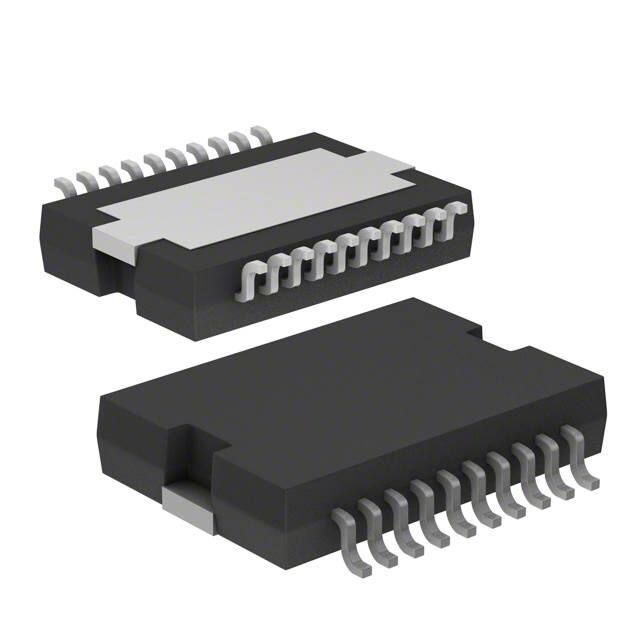
PowerSO-20
assembled in PowerSO-20, specifically designed
to provide the power and the 13/18V, 22KHz tone
signalling to the LNB downconverter in the
antenna or to the multiswitch box. In this
application field, it offers a complete solution with
extremely low component count, low power
dissipation together with simple design and I2CTM
standard interfacing.
This IC has a built in DC/DC step-up controller
that, from a single supply source ranging from 8 to
15V, generates the voltages that let the linear
Figure 1: Schematic Diagram
LNBS21
Gate
LT1
Sense
Step-up
Controller
Feedback
LT2
Vup
Vcc
OUT
Preregul.+
U.V.lockout
O
Byp
+P.ON res.
Enable
I Select
V Select
Linear Post-reg
+Modulator
+Protections
SDA
SCL
ADDR
DSQIN
October 2004
EXTM
Diagnostics
I²C
interf.
DETIN
22KHz
Oscill.
Tone
Detector
DSQOUT
Rev. 3
1/21
�LNBS21
post-regulator to work at a minimum dissipated
power. An UnderVoltage Lockout circuit will
disable the whole circuit when the supplied VCC
drops below a fixed threshold (6.7V typically). The
internal 22KHz tone generator is factory trimmed
in accordance to the standards, and can be
controlled either by the I2CTM interface or by a
dedicated pin (DSQIN) that allows immediate
DiSEqCTM data encoding (*). All the functions of
this IC are controlled via I2CTM bus by writing 6
bits on the System Register (SR, 8 bits). The
same register can be read back, and two bits will
report the diagnostic status. When the IC is put in
Stand-by (EN bit LOW), the power blocks are
disabled and the loop-through switch between
LT1 and LT2 pins is closed, thus leaving all LNB
powering and control functions to the Master
Receiver (**). When the regulator blocks are
active (EN bit HIGH), the output can be logic
controlled to be 13 or 18 V (typ.) by mean of the
VSEL bit (Voltage SELect) for remote controlling
of non-DiSEqC LNBs. Additionally, it is possible to
increment by 1V (typ.) the selected voltage value
to compensate for the excess voltage drop along
the coaxial cable (LLC bit HIGH). In order to
minimize the power dissipation, the output voltage
of the internal step-up converter is adjusted to
allow the linear regulator to work at minimum
dropout. Another bit of the SR is addressed to the
remote control of non-DiSEqC LNBs: the TEN
(Tone ENable) bit. When it is set to HIGH, a
continuous 22KHz tone is generated regardless of
the DSQIN pin logic status. The TEN bit must be
set LOW when the DSQIN pin is used for
DiSEqCTM encoding. The fully bi-directional
DiSEqCTM interfacing is completed by the built-in
22KHz tone detector. Its input pin (DETIN) must
be AC coupled to the DiSEqCTM bus, and the
extracted PWK data are available on the
DSQOUT pin (*).
The current limitation block has two thresholds
that can be selected by the ISEL bit of the SR; the
lower threshold is between 650 and 900mA
(ISEL=HIGH), while the higher threshold is
between 750 and 1000mA (ISEL=LOW).
In order to improve design flexibility and to allow
implementation of newcoming LNB remote control
standards, an analogic modulation input pin is
available (EXTM). An appropriate DC blocking
capacitor must be used to couple the modulating
signal source to the EXTM pin. When external
modulation is not used, the relevant pin can be left
open.
This IC is also protected against overheating:
when the junction temperature exceeds 150°C
(typ.), the step-up converter and the linear
regulator are shut off, the loop-trough switch is
opened, and the OTF bit of the SR is set to HIGH.
Normal operation is resumed and the OTF bit is
reset to LOW when the junction is cooled down to
140°C (typ.).
The current protection block is SOA type. This
limits the short circuit current (ISC) typically at
300mA with ISEL=HIGH and at 400mA with
ISEL=LOW when the output port is connected to
ground.
It is possible to set the Short Circuit Current
protection either statically (simple current clamp)
or dynamically by the PCL bit of the SR; when the
PCL (Pulsed Current Limiting) bit is set to LOW,
the
overcurrent
protection
circuit
works
dynamically: as soon as an overload is detected,
the output is shut-down for a time toff, typically
900ms. Simultaneously the OLF bit of the System
Register is set to HIGH. After this time has
elapsed, the output is resumed for a time ton=1/
10toff (typ.). At the end of ton, if the overload is still
detected, the protection circuit will cycle again
through Toff and Ton. At the end of a full Ton in
which no overload is detected, normal operation is
resumed and the OLF bit is reset to LOW. Typical
Ton+Toff time is 990ms and it is determined by an
internal timer. This dynamic operation can greatly
reduce the power dissipation in short circuit
condition, still ensuring excellent power-on start
up in most conditions (**).
)
s
(
t
c
u
d
o s)
r
(
P
t
c
e u
t
e
l od
o
s Pr
b
O ete
l
)
o
s
(
s
t
b
c
u -O
d
o s)
r
P
(
t
e uc
t
e
l od
o
s Pr
b
O te
e
l
o
s
b
O
However, there could be some cases in which an
highly capacitive load on the output may cause a
difficult start-up when the dynamic protection is
chosen. This can be solved by initiating any power
start-up in static mode (PCL=HIGH) and then
switching to the dynamic mode (PCL=LOW) after
a chosen amount of time. When in static mode,
the OLF bit goes HIGH when the current clamp
limit is reached and returns LOW when the
overload condition is cleared.
(*): External components are needed to comply to bi-directional DiSEqCTM bus hardware requirements. Full compliance of the whole application to DiSEqCTM specifications is not implied by the use of this IC.
(**): The current limitation circuit has no effect on the loop-through switch. When EN bit is LOW, the current flowing from LT1 to LT2 must be
externally limited.
2/21
�LNBS21
Table 1: Ordering Codes
TYPE
PowerSO-20
(Tube)
PowerSO-20
(Tape & Reel)
LNBS21
LNBS21PD
LNBS21PD-TR
Table 2: Absolute Maximum Ratings
Symbol
Parameter
Value
Unit
VCC
DC Input Voltage
16
V
VUP
DC Input Voltage
25
V
VLT1, VLT2 DC Input Voltage
20
V
Internally Limited
mA
DC Output Pin Voltage
-0.3 to 22
V
Logic Input Voltage (SDA, SCL, DSQIN)
-0.3 to 7
V
2
VPP
)
s
(
t
c
u
d
o s)
r
(
P
t
c
e u
t
e
l od
o
s Pr
b
O ete
l
)
o
s
(
s
t
b
c
u -O
d
o s)
r
P
(
t
e uc
t
e
l od
o
s Pr
b
O te
e
l
o
s
b
IO
Output Current
VO
VI
VDETIN
VOH
Detector Input Signal Amplitude
Logic High Output Voltage (DSQOUT)
7
V
900
mA
ILT
Bypass Switch ON Current
VLT
Bypass Switch OFF Voltage
±20
V
Gate Current
±400
mA
-0.3 to 1
V
-0.3 to 7
V
IGATE
VSENSE
Current Sense Voltage
VADDRESS Address Pin Voltage
Tstg
Storage Temperature Range
-40 to +150
°C
Top
Operating Junction Temperature Range
-40 to +125
°C
Absolute Maximum Ratings are those values beyond which damage to the device may occur. Functional operation under these condition is
not implied.
Table 3: Thermal Data
Symbol
Rthj-case
Parameter
Thermal Resistance Junction-case
PowerSO-20
Unit
2
°C/W
Figure 2: Pin Connection (top view)
O
PowerSO-20
3/21
�LNBS21
Table 4: Pin Description
SYMBOL
VCC
NAME
Supply Input
GATE
External Switch Gate
SENSE
Current Sense Input
Vup
Step-up Voltage
FUNCTION
8V to 15V supply. A 220µF bypass capacitor to
GND with a 470nF (ceramic) in parallel is
recommended
External MOS switch Gate connection of the
step-up converter
Current Sense comparator input. Connected to
current sensing resistor
Input of the linear post-regulator. The voltage on this
pin is monitored by internal step-ut controller to
keep a minimum dropout across the linear pass
transistor
Output of the linear post regulator modulator to the
LNB. See truth table for voltage selections.
PIN NUMBER
vs. PACKAGE
18
17
16
19
)
s
(
t
c
u
d
o s)
r
(
P
t
c
e u
t
e
l od
o
s Pr
b
O ete
l
)
o
s
(
s
t
b
c
u -O
d
o s)
r
P
(
t
e uc
t
e
l od
o
s Pr
b
O te
e
l
o
s
b
OUT
Output Port
SDA
Serial Data
Bidirectional data from/to I2C bus.
12
SCL
Serial Clock
Clock from I2C bus.
When the TEN bit of the System Register is LOW,
this pin will accept the DiSEqC code from the main
µcontroller. The LNBS21 will use this code to
modulate the internally generated 22kHz carrier. Set
to GND the pin if not used.
22kHz Tone Detector Input. Must be AC coupled to
the DiSEqC bus.
Open collector output of the tone Detector to the
main µcontroller for DiSEqC data decoding. It is
LOW when tone is detected.
External Modulation Input. Need DC decoupling to
the AC source. If not used, can be left open.
Pins to be connected to ground.
Needed for internal preregulator filtering
In standby mode the power switch between LT1 and
LT2 is closed. Max allowed current is 900mA. this
pin can be left open if loop through function is not
needed.
Same as above
13
DSQIN
DiSEqC Input
DETIN
Detector In
DSQOUT DiSEqC Output
EXTM
External Modulator
GND
BYP
LT1
Ground
Bypass Capacitor
Loop Through Switch
LT2
ADDR
Loop Through Switch
Address Setting
O
4/21
I2C
bus addresses available by setting the
Four
Address Pin level voltage
2
14
9
15
5
1, 6, 10, 11, 20
8
4
3
7
�LNBS21
Figure 3: Typical Application Circuit
D1 1N4001
IC1
Master STB
LT1
Vup
C2
220µF
C3
470nF
C7
10nF
Ceramic
IC2
(Note 3)
LT2
STS4DNFS30L
270µH
to LNB
Gate
Vo
C8
10nF
D2
BAT43
)
s
(
t
c
u
d
o s)
r
(
P
t
c
e u
t
e
l od
o
s Pr
b
O ete
l
)
o
s
(
s
t
b
c
u -O
d
o s)
r
P
(
t
e uc
t
e
l od
o
s Pr
b
O te
e
l
o
s
b
LNBS21
Sense
L1=22µH
Rsc
0.1Ω
Ω
15 ohm
see Note 2
DETIN
(Note 1)
(Note 4)
C6
10nF
Byp
C5
470nF
Vcc
Vin
12V
C1
220µF
C4
470nF
Ceramic
EXTM
DSQIN(Note 1)
ADDRESS
SCL
SDA
GND
0
很抱歉,暂时无法提供与“LNBS21PD-TR”相匹配的价格&库存,您可以联系我们找货
免费人工找货- 国内价格 香港价格
- 600+22.13479600+2.86327