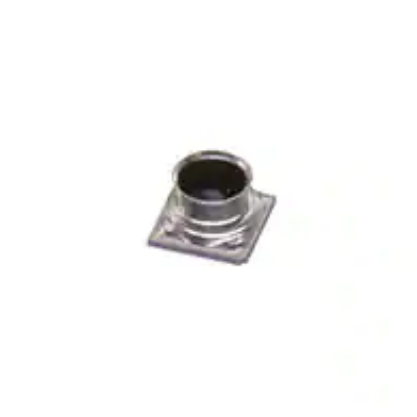
LPS27HHW
MEMS pressure sensor: 260-1260 hPa absolute digital output
barometer with water-resistant package
Datasheet - production data
Description
The LPS27HHW is an ultra-compact
piezoresistive absolute pressure sensor which
functions as a digital output barometer. The
device comprises a sensing element and an IC
interface which communicates through I²C, MIPI
I3CSM or SPI from the sensing element to the
application.
Features
Pressure sensor with water-resistant package
Potting gel & grounded metal cap
260 to 1260 hPa absolute pressure range
Current consumption down to 4 μA
Absolute pressure accuracy: 0.5 hPa
Low pressure sensor noise: 0.7 Pa
Embedded temperature compensation
The sensing element, which detects absolute
pressure, consists of a suspended membrane
manufactured using a dedicated process
developed by ST.
The LPS27HHW is available in a ceramic LGA
package with metal lid. It is guaranteed to operate
over a temperature range extending from -40 °C
to +85 °C. The package is holed to allow external
pressure to reach the sensing element. Gel inside
the IC protects the electrical components from
water and the metal cap is grounded electrically
for better ESD robustness.
24-bit pressure data output
ODR from 1 Hz to 200 Hz
SPI, I²C or MIPI
Table 1. Device summary
I3CSM interfaces
Order code
Embedded FIFO
Interrupt functions: Data-Ready, FIFO flags,
pressure thresholds
Supply voltage: 1.7 to 3.6 V
LPS27HHWTR
Temp. range
[°C]
Package
Packing
Tape
-40 to +85°C CCLGA-10L and reel
LPS27HHW
Tray
ECOPACK lead-free compliant
Applications
Product label
Altimeters and barometers for portable devices
GPS applications
Weather station equipment
Sport watches
e-cigarettes
Water depth monitoring
Gas metering
July 2019
This is information on a product in full production.
DocID032730 Rev 1
1/60
www.st.com
�Contents
LPS27HHW
Contents
1
Block diagrams . . . . . . . . . . . . . . . . . . . . . . . . . . . . . . . . . . . . . . . . . . . . . 7
2
Pin description . . . . . . . . . . . . . . . . . . . . . . . . . . . . . . . . . . . . . . . . . . . . . 8
3
Mechanical and electrical specifications . . . . . . . . . . . . . . . . . . . . . . . . 9
3.1
Mechanical characteristics . . . . . . . . . . . . . . . . . . . . . . . . . . . . . . . . . . . . . 9
3.2
Electrical characteristics . . . . . . . . . . . . . . . . . . . . . . . . . . . . . . . . . . . . . . 10
3.3
Communication interface characteristics . . . . . . . . . . . . . . . . . . . . . . . . . 11
3.4
4
5
6
2/60
SPI - serial peripheral interface . . . . . . . . . . . . . . . . . . . . . . . . . . . . . . . 11
3.3.2
I²C - inter-IC control interface . . . . . . . . . . . . . . . . . . . . . . . . . . . . . . . . 12
Absolute maximum ratings . . . . . . . . . . . . . . . . . . . . . . . . . . . . . . . . . . . . 13
Functionality . . . . . . . . . . . . . . . . . . . . . . . . . . . . . . . . . . . . . . . . . . . . . . 14
4.1
Sensing element . . . . . . . . . . . . . . . . . . . . . . . . . . . . . . . . . . . . . . . . . . . . 14
4.2
IC interface . . . . . . . . . . . . . . . . . . . . . . . . . . . . . . . . . . . . . . . . . . . . . . . . 14
4.3
Factory calibration . . . . . . . . . . . . . . . . . . . . . . . . . . . . . . . . . . . . . . . . . . 14
4.4
Device structure . . . . . . . . . . . . . . . . . . . . . . . . . . . . . . . . . . . . . . . . . . . . 15
4.5
Interpreting pressure readings . . . . . . . . . . . . . . . . . . . . . . . . . . . . . . . . . 16
4.6
Interpreting temperature readings . . . . . . . . . . . . . . . . . . . . . . . . . . . . . . 17
FIFO . . . . . . . . . . . . . . . . . . . . . . . . . . . . . . . . . . . . . . . . . . . . . . . . . . . . . 18
5.1
Bypass mode . . . . . . . . . . . . . . . . . . . . . . . . . . . . . . . . . . . . . . . . . . . . . . 19
5.2
FIFO mode . . . . . . . . . . . . . . . . . . . . . . . . . . . . . . . . . . . . . . . . . . . . . . . . 20
5.3
Continuous (Dynamic-Stream) mode . . . . . . . . . . . . . . . . . . . . . . . . . . . . 21
5.4
Bypass-to-FIFO mode . . . . . . . . . . . . . . . . . . . . . . . . . . . . . . . . . . . . . . . 22
5.5
Bypass-to-Continuous (Dynamic-Stream) mode . . . . . . . . . . . . . . . . . . . 23
5.6
Continuous (Dynamic-Stream)-to-FIFO mode . . . . . . . . . . . . . . . . . . . . . 24
5.7
Retrieving data from FIFO . . . . . . . . . . . . . . . . . . . . . . . . . . . . . . . . . . . . 24
Application hints . . . . . . . . . . . . . . . . . . . . . . . . . . . . . . . . . . . . . . . . . . . 25
6.1
7
3.3.1
Soldering information . . . . . . . . . . . . . . . . . . . . . . . . . . . . . . . . . . . . . . . . 26
Digital interfaces . . . . . . . . . . . . . . . . . . . . . . . . . . . . . . . . . . . . . . . . . . . 27
DocID032730 Rev 1
�LPS27HHW
Contents
7.1
Serial interfaces . . . . . . . . . . . . . . . . . . . . . . . . . . . . . . . . . . . . . . . . . . . . 27
7.2
I²C serial interface (CS = high) . . . . . . . . . . . . . . . . . . . . . . . . . . . . . . . . . 27
7.2.1
7.3
7.4
SPI bus interface (CS = low) . . . . . . . . . . . . . . . . . . . . . . . . . . . . . . . . . . 30
7.3.1
SPI read . . . . . . . . . . . . . . . . . . . . . . . . . . . . . . . . . . . . . . . . . . . . . . . . . 31
7.3.2
SPI write . . . . . . . . . . . . . . . . . . . . . . . . . . . . . . . . . . . . . . . . . . . . . . . . 32
7.3.3
SPI read in 3-wire mode . . . . . . . . . . . . . . . . . . . . . . . . . . . . . . . . . . . . 33
MIPI I3CSM slave interface . . . . . . . . . . . . . . . . . . . . . . . . . . . . . . . . . . . . 34
7.4.1
7.5
I²C operation . . . . . . . . . . . . . . . . . . . . . . . . . . . . . . . . . . . . . . . . . . . . . 28
MIPI I3CSM CCC supported commands . . . . . . . . . . . . . . . . . . . . . . . . 34
I²C/MIPI I3CSM coexistence in LPS27HHW . . . . . . . . . . . . . . . . . . . . . . . 36
8
Register mapping . . . . . . . . . . . . . . . . . . . . . . . . . . . . . . . . . . . . . . . . . . 38
9
Register description . . . . . . . . . . . . . . . . . . . . . . . . . . . . . . . . . . . . . . . . 40
9.1
INTERRUPT_CFG (0Bh) . . . . . . . . . . . . . . . . . . . . . . . . . . . . . . . . . . . . . 40
9.2
THS_P_L (0Ch) . . . . . . . . . . . . . . . . . . . . . . . . . . . . . . . . . . . . . . . . . . . . 42
9.3
THS_P_H (0Dh) . . . . . . . . . . . . . . . . . . . . . . . . . . . . . . . . . . . . . . . . . . . . 42
9.4
IF_CTRL (0Eh) . . . . . . . . . . . . . . . . . . . . . . . . . . . . . . . . . . . . . . . . . . . . . 43
9.5
WHO_AM_I (0Fh) . . . . . . . . . . . . . . . . . . . . . . . . . . . . . . . . . . . . . . . . . . . 43
9.6
CTRL_REG1 (10h) . . . . . . . . . . . . . . . . . . . . . . . . . . . . . . . . . . . . . . . . . . 44
9.7
CTRL_REG2 (11h) . . . . . . . . . . . . . . . . . . . . . . . . . . . . . . . . . . . . . . . . . . 46
9.8
CTRL_REG3 (12h) . . . . . . . . . . . . . . . . . . . . . . . . . . . . . . . . . . . . . . . . . . 48
9.9
FIFO_CTRL (13h) . . . . . . . . . . . . . . . . . . . . . . . . . . . . . . . . . . . . . . . . . . 49
9.10
FIFO_WTM (14h) . . . . . . . . . . . . . . . . . . . . . . . . . . . . . . . . . . . . . . . . . . . 50
9.11
REF_P_L (15h) . . . . . . . . . . . . . . . . . . . . . . . . . . . . . . . . . . . . . . . . . . . . 50
9.12
REF_P_H (16h) . . . . . . . . . . . . . . . . . . . . . . . . . . . . . . . . . . . . . . . . . . . . 50
9.13
RPDS_L (18h) . . . . . . . . . . . . . . . . . . . . . . . . . . . . . . . . . . . . . . . . . . . . . 51
9.14
RPDS_H (19h) . . . . . . . . . . . . . . . . . . . . . . . . . . . . . . . . . . . . . . . . . . . . . 51
9.15
INT_SOURCE (24h) . . . . . . . . . . . . . . . . . . . . . . . . . . . . . . . . . . . . . . . . . 51
9.16
FIFO_STATUS1 (25h) . . . . . . . . . . . . . . . . . . . . . . . . . . . . . . . . . . . . . . . 52
9.17
FIFO_STATUS2 (26h) . . . . . . . . . . . . . . . . . . . . . . . . . . . . . . . . . . . . . . . 52
9.18
STATUS (27h) . . . . . . . . . . . . . . . . . . . . . . . . . . . . . . . . . . . . . . . . . . . . . 52
9.19
PRESS_OUT_XL (28h) . . . . . . . . . . . . . . . . . . . . . . . . . . . . . . . . . . . . . . 53
9.20
PRESS_OUT_L (29h) . . . . . . . . . . . . . . . . . . . . . . . . . . . . . . . . . . . . . . . 53
DocID032730 Rev 1
3/60
60
�Contents
10
11
4/60
LPS27HHW
9.21
PRESS_OUT_H (2Ah) . . . . . . . . . . . . . . . . . . . . . . . . . . . . . . . . . . . . . . . 53
9.22
TEMP_OUT_L (2Bh) . . . . . . . . . . . . . . . . . . . . . . . . . . . . . . . . . . . . . . . . 54
9.23
TEMP_OUT_H (2Ch) . . . . . . . . . . . . . . . . . . . . . . . . . . . . . . . . . . . . . . . . 54
9.24
LPFP_RES (3Ch) . . . . . . . . . . . . . . . . . . . . . . . . . . . . . . . . . . . . . . . . . . . 54
9.25
FIFO_DATA_OUT_PRESS_XL (78h) . . . . . . . . . . . . . . . . . . . . . . . . . . . . 54
9.26
FIFO_DATA_OUT_PRESS_L (79h) . . . . . . . . . . . . . . . . . . . . . . . . . . . . . 55
9.27
FIFO_DATA_OUT_PRESS_H (7Ah) . . . . . . . . . . . . . . . . . . . . . . . . . . . . 55
9.28
FIFO_DATA_OUT_TEMP_L (7Bh) . . . . . . . . . . . . . . . . . . . . . . . . . . . . . . 55
9.29
FIFO_DATA_OUT_TEMP_H (7Ch) . . . . . . . . . . . . . . . . . . . . . . . . . . . . . 55
Package information . . . . . . . . . . . . . . . . . . . . . . . . . . . . . . . . . . . . . . . . 56
10.1
CCLGA-10L package information . . . . . . . . . . . . . . . . . . . . . . . . . . . . . . 56
10.2
CCLGA-10L packing information . . . . . . . . . . . . . . . . . . . . . . . . . . . . . . . 57
Revision history . . . . . . . . . . . . . . . . . . . . . . . . . . . . . . . . . . . . . . . . . . . 59
DocID032730 Rev 1
�LPS27HHW
List of tables
List of tables
Table 1.
Table 2.
Table 3.
Table 4.
Table 5.
Table 6.
Table 7.
Table 8.
Table 9.
Table 10.
Table 11.
Table 12.
Table 13.
Table 14.
Table 15.
Table 16.
Table 17.
Table 18.
Table 19.
Table 20.
Table 21.
Table 22.
Table 23.
Table 24.
Table 25.
Device summary . . . . . . . . . . . . . . . . . . . . . . . . . . . . . . . . . . . . . . . . . . . . . . . . . . . . . . . . . . 1
Pin description . . . . . . . . . . . . . . . . . . . . . . . . . . . . . . . . . . . . . . . . . . . . . . . . . . . . . . . . . . . 8
Pressure and temperature sensor characteristics . . . . . . . . . . . . . . . . . . . . . . . . . . . . . . . . 9
Electrical characteristics . . . . . . . . . . . . . . . . . . . . . . . . . . . . . . . . . . . . . . . . . . . . . . . . . . . 10
DC characteristics. . . . . . . . . . . . . . . . . . . . . . . . . . . . . . . . . . . . . . . . . . . . . . . . . . . . . . . . 10
SPI slave timing values. . . . . . . . . . . . . . . . . . . . . . . . . . . . . . . . . . . . . . . . . . . . . . . . . . . . 11
I²C slave timing values . . . . . . . . . . . . . . . . . . . . . . . . . . . . . . . . . . . . . . . . . . . . . . . . . . . . 12
Absolute maximum ratings . . . . . . . . . . . . . . . . . . . . . . . . . . . . . . . . . . . . . . . . . . . . . . . . . 13
Potting gel properties . . . . . . . . . . . . . . . . . . . . . . . . . . . . . . . . . . . . . . . . . . . . . . . . . . . . . 15
Serial interface pin description . . . . . . . . . . . . . . . . . . . . . . . . . . . . . . . . . . . . . . . . . . . . . . 27
I²C terminology . . . . . . . . . . . . . . . . . . . . . . . . . . . . . . . . . . . . . . . . . . . . . . . . . . . . . . . . . . 27
SAD+Read/Write patterns . . . . . . . . . . . . . . . . . . . . . . . . . . . . . . . . . . . . . . . . . . . . . . . . . 28
Transfer when master is writing one byte to slave . . . . . . . . . . . . . . . . . . . . . . . . . . . . . . . 28
Transfer when master is writing multiple bytes to slave . . . . . . . . . . . . . . . . . . . . . . . . . . . 29
Transfer when master is receiving (reading) one byte of data from slave . . . . . . . . . . . . . 29
Transfer when master is receiving (reading) multiple bytes of data from slave . . . . . . . . . 29
MIPI I3CSM CCC commands . . . . . . . . . . . . . . . . . . . . . . . . . . . . . . . . . . . . . . . . . . . . . . . 34
Registers address map . . . . . . . . . . . . . . . . . . . . . . . . . . . . . . . . . . . . . . . . . . . . . . . . . . . . 38
Output data rate bit configurations . . . . . . . . . . . . . . . . . . . . . . . . . . . . . . . . . . . . . . . . . . . 44
Low-pass filter configurations . . . . . . . . . . . . . . . . . . . . . . . . . . . . . . . . . . . . . . . . . . . . . . . 45
RMS noise and power consumption . . . . . . . . . . . . . . . . . . . . . . . . . . . . . . . . . . . . . . . . . . 47
Interrupt configurations . . . . . . . . . . . . . . . . . . . . . . . . . . . . . . . . . . . . . . . . . . . . . . . . . . . . 48
FIFO mode selection. . . . . . . . . . . . . . . . . . . . . . . . . . . . . . . . . . . . . . . . . . . . . . . . . . . . . . 49
Reel dimensions for carrier tape of CCLGA-10L package . . . . . . . . . . . . . . . . . . . . . . . . . 58
Document revision history. . . . . . . . . . . . . . . . . . . . . . . . . . . . . . . . . . . . . . . . . . . . . . . . . . 59
DocID032730 Rev 1
5/60
60
�List of figures
LPS27HHW
List of figures
Figure 1.
Figure 2.
Figure 3.
Figure 4.
Figure 5.
Figure 6.
Figure 7.
Figure 8.
Figure 9.
Figure 10.
Figure 11.
Figure 12.
Figure 13.
Figure 14.
Figure 15.
Figure 16.
Figure 17.
Figure 18.
Figure 19.
Figure 20.
Figure 21.
Figure 22.
Figure 23.
Figure 24.
Figure 25.
Figure 26.
Figure 27.
Figure 28.
Figure 29.
Figure 30.
6/60
Device architecture block diagram . . . . . . . . . . . . . . . . . . . . . . . . . . . . . . . . . . . . . . . . . . . . 7
Digital logic . . . . . . . . . . . . . . . . . . . . . . . . . . . . . . . . . . . . . . . . . . . . . . . . . . . . . . . . . . . . . . 7
Pin connections (bottom view) . . . . . . . . . . . . . . . . . . . . . . . . . . . . . . . . . . . . . . . . . . . . . . . 8
SPI slave timing diagram . . . . . . . . . . . . . . . . . . . . . . . . . . . . . . . . . . . . . . . . . . . . . . . . . . 11
I²C slave timing diagram . . . . . . . . . . . . . . . . . . . . . . . . . . . . . . . . . . . . . . . . . . . . . . . . . . . 12
LPS27HHW internal structure. . . . . . . . . . . . . . . . . . . . . . . . . . . . . . . . . . . . . . . . . . . . . . . 15
Pressure readings. . . . . . . . . . . . . . . . . . . . . . . . . . . . . . . . . . . . . . . . . . . . . . . . . . . . . . . . 16
Temperature readings. . . . . . . . . . . . . . . . . . . . . . . . . . . . . . . . . . . . . . . . . . . . . . . . . . . . . 17
Bypass mode . . . . . . . . . . . . . . . . . . . . . . . . . . . . . . . . . . . . . . . . . . . . . . . . . . . . . . . . . . . 19
FIFO mode . . . . . . . . . . . . . . . . . . . . . . . . . . . . . . . . . . . . . . . . . . . . . . . . . . . . . . . . . . . . . 20
Continuous (Dynamic-Stream) mode . . . . . . . . . . . . . . . . . . . . . . . . . . . . . . . . . . . . . . . . . 21
Bypass-to-FIFO mode. . . . . . . . . . . . . . . . . . . . . . . . . . . . . . . . . . . . . . . . . . . . . . . . . . . . . 22
Bypass-to-Continuous (Dynamic-Stream) mode . . . . . . . . . . . . . . . . . . . . . . . . . . . . . . . . 23
Continuous (Dynamic-Stream)-to-FIFO mode . . . . . . . . . . . . . . . . . . . . . . . . . . . . . . . . . . 24
LPS27HHW electrical connections (top view). . . . . . . . . . . . . . . . . . . . . . . . . . . . . . . . . . . 25
LPS27HHW power-off sequence . . . . . . . . . . . . . . . . . . . . . . . . . . . . . . . . . . . . . . . . . . . . 26
Read and write protocol . . . . . . . . . . . . . . . . . . . . . . . . . . . . . . . . . . . . . . . . . . . . . . . . . . . 30
SPI read protocol . . . . . . . . . . . . . . . . . . . . . . . . . . . . . . . . . . . . . . . . . . . . . . . . . . . . . . . . 31
Multiple byte SPI read protocol (2-byte example) . . . . . . . . . . . . . . . . . . . . . . . . . . . . . . . . 31
SPI write protocol . . . . . . . . . . . . . . . . . . . . . . . . . . . . . . . . . . . . . . . . . . . . . . . . . . . . . . . . 32
Multiple byte SPI write protocol (2-byte example). . . . . . . . . . . . . . . . . . . . . . . . . . . . . . . . 32
SPI read protocol in 3-wire mode . . . . . . . . . . . . . . . . . . . . . . . . . . . . . . . . . . . . . . . . . . . . 33
I²C and MIPI I3CSM both active (INT_DRDY pin not connected) . . . . . . . . . . . . . . . . . . . . 36
Only MIPI I3CSMactive (INT_DRDY pin connected to VDD_IO). . . . . . . . . . . . . . . . . . . . . 37
“Threshold-based” interrupt event. . . . . . . . . . . . . . . . . . . . . . . . . . . . . . . . . . . . . . . . . . . . 41
Interrupt events on INT_DRDY pin . . . . . . . . . . . . . . . . . . . . . . . . . . . . . . . . . . . . . . . . . . . 48
CCLGA - 10L (2.7 x 2.7 x 1.7 typ. mm) package outline and mechanical data . . . . . . . . . 56
Carrier tape information for CCLGA-10L package . . . . . . . . . . . . . . . . . . . . . . . . . . . . . . . 57
Package orientation in carrier tape . . . . . . . . . . . . . . . . . . . . . . . . . . . . . . . . . . . . . . . . . . . 57
Reel information for carrier tape of CCLGA-10L package . . . . . . . . . . . . . . . . . . . . . . . . . 58
DocID032730 Rev 1
�LPS27HHW
1
Block diagrams
Block diagrams
Figure 1. Device architecture block diagram
dĞŵƉĞƌĂƚƵƌĞ�
^ĞŶƐŽƌ
/Ϯ�
�ŶĂůŽŐ�
&ƌŽŶƚͲ�ŶĚ
Dhy
�ŝŐŝƚĂů�
>ŽŐŝĐ
���
D/W/�/ϯ�^D
^W/
^ĞŶƐŝŶŐ��ůĞŵĞŶƚ
^ĞŶƐŽƌ��ŝĂƐ
sŽůƚĂŐĞ�ĂŶĚ��ƵƌƌĞŶƚ��ŝĂƐ
�ůŽĐŬ�ĂŶĚ�ƚŝŵŝŶŐ
Figure 2. Digital logic
�ŝŐŝƚĂů
>W�&ŝůƚĞƌ
>W&ϭ
�ŝŐŝƚĂů
>W�&ŝůƚĞƌ
�ŶĂůŽŐ�
&ƌŽŶƚͲ�ŶĚ
>W&Ϭ
�Eͺ>W&W
ϭ
WŽƵƚ
WƌĞƐƐƵƌĞ�
�ŽŵƉĞŶƐĂƚŝŽŶ
Ϭ
���
dĞŵƉĞƌĂƚƵƌĞ�
�ŽŵƉĞŶƐĂƚŝŽŶ
DocID032730 Rev 1
KƵƚƉƵƚ�
ZĞŐŝƐƚĞƌƐ
/Ϯ�
D/W/�/ϯ�^D
dŽƵƚ
&/&K
^W/
7/60
60
�Pin description
2
LPS27HHW
Pin description
*1'
�
*1'
�
6&/�63&
�
*1'
�
�
&6
��
�
,17B'5'<
9''
9GGB,2
Figure 3. Pin connections (bottom view)
�
5(6
�
6'$�6',�6'2
�
6'2�6$�
Table 2. Pin description
8/60
Pin number
Name
Function
1
Vdd_IO
2
SCL
SPC
3
Reserved
Connect to GND
4
SDA
SDI
SDI/SDO
I²C / MIPI I3CSM serial data (SDA)
4-wire SPI serial data input (SDI)
3-wire serial data input/output (SDI/SDO)
5
SDO
SA0
Power supply for I/O pins
I²C / MIPI I3CSM serial clock (SCL)
SPI serial port clock (SPC)
4-wire SPI serial data output (SDO)
I²C least significant bit of the device address (SA0)
MIPI I3CSM least significant bit of the static address (SA0)
SPI enable
I²C and MIPI I3CSM / SPI mode selection
(1: SPI idle mode / I²C and MIPI I3CSM communication enabled;
0: SPI communication mode / I²C and MIPI I3CSM disabled)
6
CS
7
INT_DRDY
8
GND
0 V supply
9
GND
0 V supply
10
VDD
Power supply
Interrupt or Data-Ready
DocID032730 Rev 1
�LPS27HHW
Mechanical and electrical specifications
3
Mechanical and electrical specifications
3.1
Mechanical characteristics
VDD = 1.8 V, T = 25 °C, unless otherwise noted.
Table 3. Pressure and temperature sensor characteristics
Symbol
Parameter
Test condition
Min.
Typ.(1)
Max.
Unit
+85
°C
1260
hPa
Pressure sensor characteristics
PTop
Operating temperature range
-40
260
Pop
Operating pressure range
Pbits
Pressure output data
Psens
Pressure sensitivity
PAccRel
PAccT
Pnoise
ODRPres
Relative accuracy over pressure(2)
Absolute accuracy over temperature
RMS pressure sensing noise(3)
bits
4096
LSB/
hPa
P = 800 - 1100 hPa
T = 25 °C
±0.025
hPa
P = 860 ~ 1160 hPa
T = 25 ~ 65°C
±0.5
hPa
P = 260 ~ 1260 hPa
T = 0 ~ 65 °C
±1
with embedded filter
and at T = 25 °C
0.007
hPa
RMS
1
10
25
50
75
100
200
Hz
0.75
Pa/°C
1
hPa/year
±0.5
hPa
Pressure output data rate(4)
TCO
Temperature coefficient offset
P_longterm
Pressure accuracy, long-term
stability
P_drift
24
P = 860 ~ 1160 hPa
T = 25 ~ 65°C
Soldering drift
Temperature sensor characteristics
Top
Tsens
ODRT
Operating temperature range
-40
+85
°C
Temperature sensitivity
100
LSB/°C
Output temperature data rate(4)
1
10
25
50
75
100
200
Hz
DocID032730 Rev 1
9/60
60
�Mechanical and electrical specifications
LPS27HHW
1. Typical specifications are not guaranteed.
2. By design, the typ. value is defined based characterization data with 10 hPa pressure interval.
3. Pressure noise RMS evaluated in a controlled environment, based on the average standard deviation of 50 measurements
with LOW_NOISE_EN = 1, EN_LPFP = 1, LPFP_CFG = 1.
4. Output data rate is configured acting on ODR[2:0] in CTRL_REG1 (10h).
3.2
Electrical characteristics
VDD = 1.8 V, T = 25 °C, unless otherwise noted.
Table 4. Electrical characteristics
Symbol
VDD
Parameter
Test condition
Supply voltage
Vdd_IO IO supply voltage
Idd
IddPdn
Supply current
Min.
Typ.(1)
Max.
Unit
1.7
3.6
V
1.7
Vdd+0.1
V
@ ODR 1 Hz
LOW_NOISE_EN = 0
4
@ ODR 1 Hz
LOW_NOISE_EN = 1
12
μA
Supply current in
power-down mode
0.9
μA
1. Typical specifications are not guaranteed.
Table 5. DC characteristics
Symbol
Parameter
Condition
Min.
Typ.
Max.
Unit
DC input characteristics
Vil
Low-level input voltage
(Schmitt buffer)
-
-
-
0.2 * Vdd_IO
V
Vih
High-level input voltage
(Schmitt buffer)
-
0.8 * Vdd_IO
-
-
V
DC output characteristics
10/60
Vol
Low-level output voltage
-
-
0.2
V
Voh
High-level output voltage
Vdd_IO - 0.2
-
-
V
DocID032730 Rev 1
�LPS27HHW
Mechanical and electrical specifications
3.3
Communication interface characteristics
3.3.1
SPI - serial peripheral interface
Subject to general operating conditions for Vdd and TOP.
Table 6. SPI slave timing values
Value(1)
Symbol
Parameter
Unit
Min
tc(SPC)
SPI clock cycle
Max
100
ns
(2)
fc(SPC)
SPI clock frequency
tsu(CS)
CS setup time
6
th(CS)
CS hold time
8
tsu(SI)
SDI input setup time
5
th(SI)
SDI input hold time
15
tv(SO)
SDO valid output time
th(SO)
SDO output hold time
tdis(SO)
SDO output disable time
10
MHz
ns
50
9
50
1. Values are guaranteed at 10 MHz clock frequency for SPI with both 4 and 3 wires, based on characterization results, not
tested in production.
2. Recommended to set max SPI clock 8 MHz to ≤50 Hz ODR.
Figure 4. SPI slave timing diagram
Note:
Measurement points are done at 0.2·Vdd_IO and 0.8·Vdd_IO, for both ports.
DocID032730 Rev 1
11/60
60
�Mechanical and electrical specifications
3.3.2
LPS27HHW
I²C - inter-IC control interface
Subject to general operating conditions for Vdd and TOP.
Table 7. I²C slave timing values
I²C standard mode(1)
Parameter (1)
Symbol
f(SCL)
SCL clock frequency
I²C fast mode(1)
Min
Max
Min
Max
Unit
0
100
0
400
kHz
tw(SCLL)
SCL clock low time
4.7
1.3
tw(SCLH)
SCL clock high time
4.0
0.6
tsu(SDA)
SDA setup time
250
100
th(SDA)
SDA data hold time
0
th(ST)
START condition hold time
4
0.6
tsu(SR)
Repeated START condition
setup time
4.7
0.6
tsu(SP)
STOP condition setup time
4
0.6
4.7
1.3
Bus free time between STOP
and START condition
tw(SP:SR)
3.45
μs
ns
0
0.9
μs
μs
1. Data based on standard I²C protocol requirement, not tested in production.
Figure 5. I²C slave timing diagram
5(3($7('
67$57�
67$57�
WVX�65��
WZ�63�65��
6'$�
WVX�6'$�
�
WK�6'$�
WVX�63��
6&/�
WK�67��
Note:
12/60
WZ�6&//��
67$57
WZ�6&/+��
Measurement points are done at 0.2·Vdd_IO and 0.8·Vdd_IO, for both ports.
DocID032730 Rev 1
6723
�LPS27HHW
3.4
Mechanical and electrical specifications
Absolute maximum ratings
Stress above those listed as “Absolute maximum ratings” may cause permanent damage to
the device. This is a stress rating only and functional operation of the device under these
conditions is not implied. Exposure to maximum rating conditions for extended periods may
affect device reliability.
Table 8. Absolute maximum ratings
Symbol
Vdd
Vdd_IO
Vin
P(water)
Note:
Ratings
Maximum value
Unit
Supply voltage
-0.3 to 4.8
V
I/O pins supply voltage
-0.3 to 4.8
V
-0.3 to Vdd_IO +0.3
V
1
MPa
-40 to +125
°C
2 (HBM)
kV
Input voltage on any control pin
Overpressure
TSTG
Storage temperature range
ESD
Electrostatic discharge protection
Supply voltage on any pin should never exceed 4.8 V.
This device is sensitive to mechanical shock, improper handling can cause
permanent damage to the part.
This device is sensitive to electrostatic discharge (ESD), improper handling can
cause permanent damage to the part.
DocID032730 Rev 1
13/60
60
�Functionality
4
LPS27HHW
Functionality
The LPS27HHW is a high-resolution, digital output pressure sensor packaged in a CCLGA
package with metal lid. The complete device includes a sensing element based on a
piezoresistive Wheatstone bridge approach, and an IC interface which communicates a
digital signal from the sensing element to the application.
4.1
Sensing element
An ST proprietary process is used to obtain a silicon membrane for MEMS pressure
sensors. When pressure is applied, the membrane deflection induces an imbalance in the
Wheatstone bridge piezoresistances whose output signal is converted by the IC interface.
4.2
IC interface
The complete measurement chain is composed of a low-noise amplifier which converts the
resistance unbalance of the MEMS sensors (pressure and temperature) into an analog
voltage using an analog-to-digital converter.
The pressure and temperature data may be accessed through an I²C/MIPI I3CSM/SPI
interface thus making the device particularly suitable for direct interfacing with a
microcontroller.
The LPS27HHW features a Data-Ready signal which indicates when a new set of measured
pressure and temperature data are available, thus simplifying data synchronization in the
digital system that uses the device.
4.3
Factory calibration
The trimming values are stored inside the device in a non-volatile structure. When the
device is turned on, the trimming parameters are downloaded into the registers to be
employed during the normal operation which allows the device to be used without requiring
any further calibration.
14/60
DocID032730 Rev 1
�LPS27HHW
4.4
Functionality
Device structure
The LPS27HHW has a unique cylindrical package solution with a full metal lid assembled on
ceramic substrate and this cylindrical package provides an easy assembly with O-rings in
the end user’s application.
Figure 6. LPS27HHW internal structure
This structure (Figure 6) is designed and verified to resist water pressure up to 10 ATM and
the potting gel in the LPS27HHW has been proven to protect electronic components from
long-term exposure to harsh environments such as water mixed with chlorine, bromine,
commercial washing detergent and fuels, solvents and chemicals. It also provides excellent
low-stress encapsulation performance for sensitive electronic components from severe
environmental conditions such as high temperature and humidity, refer to the properties of
the gel which are given in the following table.
Table 9. Potting gel properties
Properties
Potting gel
Permeability g/m2·24 hr
7
Hardness (penetration) based on ASTM D1403
70
Ultra-low Young's modulus
Less than 0.01 GPa
TCE (Thermal Coefficient of Expansion)
DocID032730 Rev 1
300 ppm/°C
15/60
60
�Functionality
4.5
LPS27HHW
Interpreting pressure readings
The pressure data are stored in 3 registers: PRESS_OUT_H (2Ah), PRESS_OUT_L (29h),
and PRESS_OUT_XL (28h). The value is expressed as a 24-bit signed number (in 2’s
complement).
To obtain the pressure in hPa, take the complete 24-bit word and then divide by the
sensitivity 4096 LSB/hPa. This same interpretation is applied to pressure readings when
FIFO is enabled and the pressure data are stored in 3 registers:
FIFO_DATA_OUT_PRESS_XL (78h), FIFO_DATA_OUT_PRESS_L (79h), and
FIFO_DATA_OUT_PRESS_H (7Ah).
Figure 7. Pressure readings
Equation 1
3UHVVXUH�9DOXH��/6%�� �35(66B287B+���$K�� �35(66B287B/����K�� �35(66B287B;/����K�
��))��'K� ���������/6%��VLJQHG�GHFLPDO�
Equation 2
3UHVVXUH��K3D�� �
16/60
3UHVVXUH�9DOXH��/6%�
��������/6%
6HQVLWLYLW\
�����/6%�K3D
DocID032730 Rev 1
��������K3$
�LPS27HHW
4.6
Functionality
Interpreting temperature readings
The temperature data are stored in 2 registers: TEMP_OUT_H (2Ch) and TEMP_OUT_L
(2Bh).
The value is expressed as 2’s complement. To obtain the temperature in °C, take the two’s
complement of the complete 16-bit word and then divide by the sensitivity 100 LSB/°C. This
same interpretation is applied to temperature readings when FIFO is enabled and the
temperature data are stored in 2 registers: FIFO_DATA_OUT_TEMP_H (7Ch) and
FIFO_DATA_OUT_TEMP_L (7Bh).
Figure 8. Temperature readings
7(03B287B+�
� � � � � � � �
7(03B287B/�
� � � � � � � �
7HPSHUDWXUH�9DOXH��/6%�� 7(03B287B+���&K�� �7(03B287B/���%K�
���&�� �����/6%��GHFLPDO�VLJQHG��
7HPSHUDWXUH��&�� �
7HPSHUDWXUH 9DOXH �/6%�
6HQVLWLYLW\
DocID032730 Rev 1
���� /6%
������&
��� /6%�&
17/60
60
�FIFO
5
LPS27HHW
FIFO
The LPS27HHW embeds 128 slots of 40-bit data FIFO to store the pressure and
temperature output values. This allows consistent power saving for the system, since the
host processor does not need to continuously poll data from the sensor, but it can wake up
only when needed and burst the significant data out from the FIFO. This buffer can work
according to six different modes:
Bypass mode
FIFO mode
Continuous (Dynamic-Stream) mode
Continuous (Dynamic-Stream)-to-FIFO mode
Bypass-to-Continuous (Dynamic-Stream)
Bypass-to-FIFO mode
The FIFO buffer is enabled when a configuration different from all bits '0' are written in
FIFO_CTRL (13h) and each mode is selected by the TRIG_MODES bit and F_MODE[1:0]
bits in FIFO_CTRL (13h). Programmable FIFO threshold status, FIFO overrun events and
the number of unread samples stored are available in the FIFO_STATUS1 (25h) and
FIFO_STATUS2 (26h) registers and can be set to generate dedicated interrupts on the
INT_DRDY pad using the CTRL_REG3 (12h) register.
FIFO_STATUS2 (26h)(FIFO_WTM_IA) goes to '1' when the number of unread samples
(FIFO_STATUS1 (25h)(FSS[7:0]) is greater than or equal to WTM[6:0] in FIFO_WTM
(14h). If FIFO_WTM (14h)(WTM[6:0]) is equal to 0, FIFO_STATUS2 (26h)(FIFO_WTM_IA)
stays at '0'.
FIFO_STATUS2 (26h)(FIFO_OVR_IA) is equal to '1' if a FIFO slot is overwritten.
FIFO_STATUS1 (25h)(FSS[7:0]) contains stored data levels of unread samples; when
FSS[7:0] is equal to ‘00000000’, FIFO is empty; when FSS[7:0] is equal to ‘10000000’,
FIFO is full and the unread samples are 128.
18/60
DocID032730 Rev 1
�LPS27HHW
5.1
FIFO
Bypass mode
In Bypass mode (FIFO_CTRL (13h)(TRIG_MODES and F_MODE[1:0] = ‘000’ or ‘100’), the
FIFO is not operational and it remains empty.
Switching to Bypass mode is also used to reset the FIFO. Passing through Bypass mode is
mandatory when switching between different FIFO buffer operating modes.
As described in the next figure, for each channel only the first address is used. When new
data is available, the older data is overwritten.
Figure 9. Bypass mode
3 L �7 L
3�
7�
3�
7�
3�
7�
3���
7���
HPSW\
DocID032730 Rev 1
19/60
60
�FIFO
5.2
LPS27HHW
FIFO mode
In FIFO mode (FIFO_CTRL (13h)(TRIG_MODES and F_MODE[1:0] = ‘001’) data from the
output PRESS_OUT_XL (28h), PRESS_OUT_L (29h), PRESS_OUT_H (2Ah),
TEMP_OUT_L (2Bh), and TEMP_OUT_H (2Ch) are stored in the FIFO until it is full.
To reset FIFO content, in order to select Bypass mode the value '000' must be written in
FIFO_CTRL (13h)(TRIG_MODE & F_MODE[1:0]). After this reset command it is possible to
restart FIFO mode by writing the value '001' in FIFO_CTRL (13h)(TRIG_MODE &
F_MODE[1:0]).
The FIFO buffer memorizes 128 levels of data, but the depth of the FIFO can be
resized/reduced by setting the FIFO_CTRL (13h)(STOP_ON_WTM) bit. If the
STOP_ON_WTM bit is set to '1', FIFO depth is limited to FIFO_WTM (14h)(WTM[6:0]) data.
Figure 10. FIFO mode
3 L �7 L
20/60
3�
7�
3�
7�
3�
7�
3���
7���
DocID032730 Rev 1
�LPS27HHW
5.3
FIFO
Continuous (Dynamic-Stream) mode
In Continuous (Dynamic-Stream) mode (FIFO_CTRL (13h)(TRIG_MODES and
F_MODE[1:0] = ‘011’) after emptying the FIFO, the first new sample that arrives becomes
the first to be read in a subsequent read burst. In this way, the number of new data available
in FIFO does not depend on the previous read.
In Continuous (Dynamic-Stream) mode FIFO_STATUS1 (25h)(FSS[7:0]) is the number of
new pressure and temperature samples available in the FIFO buffer.
Continuous (Dynamic-Stream) is intended to be used to read FIFO_STATUS1
(25h)(FSS[7:0]) samples when it is not possible to guarantee reading data within 1/ODR
time period.
Also, a FIFO threshold interrupt on the INT_DRDY pad through CTRL_REG3
(12h)(INT_F_WTM) can be enabled in order to read data from the FIFO and leave free
memory slots for incoming data.
Figure 11. Continuous (Dynamic-Stream) mode
DocID032730 Rev 1
21/60
60
�FIFO
5.4
LPS27HHW
Bypass-to-FIFO mode
In Bypass-to-FIFO mode (FIFO_CTRL (13h)(TRIG_MODES and F_MODE[1:0] = ‘101’),
FIFO behavior switches when the INT_SOURCE (24h)(IA) bit rises for the first time. When
the INT_SOURCE (24h)(IA) bit is equal to '0', FIFO behaves like in Bypass mode. Once the
INT_SOURCE (24h)(IA) bit rises to '1', FIFO behavior switches and keeps behaving like in
FIFO mode.
An interrupt generator has to be set to the desired configuration through INTERRUPT_CFG
(0Bh).
Figure 12. Bypass-to-FIFO mode
3 L �7 L
3 L �7 L
3�
7�
7�
3�
7�
3�
7�
3�
7�
3���
7���
3���
7���
3�
7�
3�
HPSW\
%\SDVV�0RGH
),)2�0RGH
7ULJJHU�HYHQW
22/60
DocID032730 Rev 1
�LPS27HHW
5.5
FIFO
Bypass-to-Continuous (Dynamic-Stream) mode
In Bypass-to-Continuous (Dynamic-Stream) mode (FIFO_CTRL (13h)(TRIG_MODES and
F_MODE[1:0] = ‘110’), FIFO operates in Bypass mode until it switches to Continuous
(Dynamic-Stream) mode behavior when INT_SOURCE (24h)(IA) rises to '1', then FIFO
behavior keeps behaving like in Continuous (Dynamic-Stream) mode.
An interrupt generator has to be set to the desired configuration through INTERRUPT_CFG
(0Bh).
Figure 13. Bypass-to-Continuous (Dynamic-Stream) mode
3 L �7 L
3 L �7 L
3�
7�
7�
3�
7�
7�
3�
7�
3���
7���
3���
7���
3�
7�
3�
3�
HPSW\
3���
7���
%\SDVV�0RGH
'\QDPLF�6WUHDP�0RGH
7ULJJHU�HYHQW
DocID032730 Rev 1
23/60
60
�FIFO
5.6
LPS27HHW
Continuous (Dynamic-Stream)-to-FIFO mode
In Continuous (Dynamic-Stream)-to-FIFO mode (FIFO_CTRL (13h)(TRIG_MODES and
F_MODE[1:0] = ‘111’), data are stored in FIFO and FIFO operates in Continuous (DynamicStream) mode behavior until it switches to FIFO mode behavior when INT_SOURCE
(24h)(IA) rises to '1'.
An interrupt generator has to be set to the desired configuration through INTERRUPT_CFG
(0Bh).
Figure 14. Continuous (Dynamic-Stream)-to-FIFO mode
3 L �7 L
3�
7�
3�
3 L �7 L
3�
7�
7�
3�
7�
3�
7�
3�
7�
3���
7���
3���
7���
3���
7���
'\QDPLF�6WUHDP�0RGH
),)2�0RGH
7ULJJHU�HYHQW
5.7
Retrieving data from FIFO
FIFO data is read through FIFO_DATA_OUT_PRESS (78h, 79h and 7Ah) and
FIFO_DATA_OUT_TEMP (7Bh, 7Ch).
The read address is automatically updated by the device and it rolls back to 78h when
register 7Ch is reached. In order to read all FIFO levels in a multiple byte read, 640 bytes
(5 output registers by 128 levels) must be read.
24/60
DocID032730 Rev 1
�LPS27HHW
6
Application hints
Application hints
Figure 15. LPS27HHW electrical connections (top view)
The device power supply must be provided through the VDD line; a power supply
decoupling capacitor C1 (100 nF) must be placed as near as possible to the supply pads of
the device. The C1 capacitor can be tied to VDD and VDDIO, but it is recommended to use
2 capacitors, one on each VDD and VDDIO line, in case VDD are VDDIO are separate.
Depending on the application, an additional capacitor of 4.7 μF could be placed on VDD
line.
The functionality of the device and the measured data outputs are selectable and accessible
through the I²C, MIPI I3CSM, SPI interface. When using the I²C and MIPI I3CSM, CS must be
tied to Vdd_IO.
All the voltage and ground supplies must be present at the same time to have proper
behavior of the IC (refer to Figure 15). It is possible to remove VDD while maintaining
Vdd_IO without blocking the communication bus, in this condition the measurement chain is
powered off.
Note:
To guarantee proper power-off of the device, it is recommended to maintain the duration of
the VDD line to GND for at least 10 ms.
DocID032730 Rev 1
25/60
60
�Application hints
LPS27HHW
Figure 16. LPS27HHW power-off sequence
9''
���9
0LQ���PV
7LPH
6.1
9''�5LVLQJ���)DOOLQJ�WLPH������V�a�����PV
9''�PXVW�EH�ORZHU�WKDQ�����9�IRU�DW�OHDVW����PV�GXULQJ�SRZHU�RII�VHTXHQFH�IRU�FRUUHFW�325
Soldering information
The CCLGA package is compliant with the ECOPACK standard and it is qualified for
soldering heat resistance according to JEDEC J-STD-020.
26/60
DocID032730 Rev 1
�LPS27HHW
Digital interfaces
7
Digital interfaces
7.1
Serial interfaces
The registers embedded in the LPS27HHW may be accessed through either the I²C, MIPI
I3CSM or SPI serial interfaces. The latter may be SW configured to operate either in 3-wire
or 4-wire interface mode.
The serial interfaces are mapped onto the same pads. To select/exploit the I²C interface, the
CS line must be tied high (i.e. connected to Vdd_IO).
Table 10. Serial interface pin description
Pin name
SPI enable
I²C/SPI mode selection
(1: SPI idle mode / I²C communication enabled;
0: SPI communication mode / I²C disabled)
CS
SCL/SPC
I²C serial clock (SCL)
SPI serial port clock (SPC)
SDA
SDI
SDI/SDO
I²C serial data (SDA)
4-wire SPI serial data input (SDI)
3-wire serial data input /output (SDI/SDO)
SDO
SAO
7.2
Pin description
4-wire SPI serial data output (SDO)
I²C less significant bit of the device address (SA0)
I²C serial interface (CS = high)
The LPS27HHW I²C is a bus slave. The I²C is employed to write data into registers whose
content can also be read back.
The relevant I²C terminology is given in Table 11.
Table 11. I²C terminology
Term
Description
Transmitter The device which sends data to the bus
Receiver
The device which receives data from the bus
Master
The device which initiates a transfer, generates clock signals and terminates a transfer
Slave
The device addressed by the master
There are two signals associated with the I²C bus: the serial clock line (SCL) and the serial
data line (SDA). The latter is a bidirectional line used for sending and receiving the data
to/from the interface. Both lines have to be connected to Vdd_IO through pull-up resistors.
The I²C interface is compliant with fast mode (400 kHz) I²C standards as well as with the
normal mode.
DocID032730 Rev 1
27/60
60
�Digital interfaces
7.2.1
LPS27HHW
I²C operation
The transaction on the bus is started through a START (ST) signal. A start condition is
defined as a HIGH-to-LOW transition on the data line while the SCL line is held HIGH. After
the master has transmitted this, the bus is considered busy. The next data byte transmitted
after the start condition contains the address of the slave in the first 7 bits and the eighth bit
tells whether the master is receiving data from the slave or transmitting data to the slave.
When an address is sent, each device in the system compares the first seven bits after a start
condition with its address. If they match, the device considers itself addressed by the master.
The 7-bit slave address (SAD) associated to the LPS27HHW is 101110xb. The SDO/SA0
pad can be used to modify the less significant bit of the device address. If the SA0 pad is
connected to voltage supply, LSb is ‘1’ (7-bit address 1011101b=5Dh), otherwise if the SA0
pad is connected to ground, the LSb value is ‘0’ (7-bit address 1011100b=5Ch). This
solution permits connecting and addressing two different LPS27HHW devices to the same
I²C lines.
Data transfer with acknowledge is mandatory. The transmitter must release the SDA line
during the acknowledge pulse. The receiver must then pull the data line LOW so that it
remains stable low during the HIGH period of the acknowledge clock pulse. A receiver which
has been addressed is obliged to generate an acknowledge after each byte of data received.
The I²C embedded inside the ASIC behaves like a slave device and the following protocol
must be adhered to. After the start condition (ST) a slave address is sent, once a slave
acknowledge has been returned (SAK), an 8-bit sub-address will be transmitted (SUB): the
7 LSB represent the actual register address while the MSB has no meaning. The
IF_ADD_INC bit in CTRL_REG2 (11h) enables sub-address auto increment (IF_ADD_INC
is '1' by default), so if IF_ADD_INC = '1' the SUB (sub-address) will be automatically
increased to allow multiple data read/write.
The slave address is completed with a Read/Write bit. If the bit is ‘1’ (Read), a repeated
START (SR) condition must be issued after the two sub-address bytes; if the bit is ‘0’ (Write)
the master will transmit to the slave with direction unchanged. Table 12 explains how the
SAD+read/write bit pattern is composed, listing all the possible configurations.
Table 12. SAD+Read/Write patterns
Command
SAD[6:1]
SAD[0] = SA0
R/W
SAD+R/W
Read
101110
0
1
10111001 (B9h)
Write
101110
0
0
10111000 (B8h)
Read
101110
1
1
10111011 (BBh)
Write
101110
1
0
10111010 (BAh)
Table 13. Transfer when master is writing one byte to slave
Master
Slave
28/60
ST
SAD + W
SUB
SAK
DocID032730 Rev 1
DATA
SAK
SP
SAK
�LPS27HHW
Digital interfaces
Table 14. Transfer when master is writing multiple bytes to slave
Master
ST
SAD + W
SUB
Slave
SAK
DATA
DATA
SAK
SAK
SP
SAK
Table 15. Transfer when master is receiving (reading) one byte of data from slave
Master
ST
SAD + W
Slave
SUB
SAK
SR
SAD + R
SAK
NMAK
SAK
SP
DATA
Table 16. Transfer when master is receiving (reading) multiple bytes of data from slave
Master
Slave
ST SAD+W
SUB
SAK
SR SAD+R
SAK
MAK
SAK
DATA
MAK
DATA
NMAK SP
DATA
Data are transmitted in byte format (DATA). Each data transfer contains 8 bits. The number
of bytes transferred per transfer is unlimited. Data is transferred with the most significant bit
(MSb) first. If a receiver cannot receive another complete byte of data until it has performed
some other functions, it can hold the clock line, SCL LOW to force the transmitter into a wait
state. Data transfer only continues when the receiver is ready for another byte and releases
the data line. If a slave receiver does not acknowledge the slave address (i.e. it is not able to
receive because it is performing some real-time function), the data line must be kept HIGH
by the slave. The master can then abort the transfer. A LOW-to-HIGH transition on the SDA
line while the SCL line is HIGH is defined as a STOP condition. Each data transfer must be
terminated by the generation of a STOP (SP) condition.
In the presented communication format MAK is Master acknowledge and NMAK is no
master acknowledge.
DocID032730 Rev 1
29/60
60
�Digital interfaces
7.3
LPS27HHW
SPI bus interface (CS = low)
The LPS27HHW SPI is a bus slave. The SPI allows writing to and reading from the registers
of the device.
The serial interface interacts with the application using 4 wires: CS, SPC, SDI and SDO.
Figure 17. Read and write protocol
&6
63&
6',
',� ',� ',� ',� ',� ',� ',� ',�
5:
$'� $'� $'� $'� $'� $'� $'�
6'2
'2� '2� '2� '2� '2� '2� '2� '2�
CS is the serial port enable and it is controlled by the SPI master. It goes low at the start of
the transmission and returns to high at the end. SPC is the serial port clock and it is
controlled by the SPI master. It is stopped high when CS is high (no transmission). SDI and
SDO are respectively the serial port data input and output. Those lines are driven at the
falling edge of SPC and should be captured at the rising edge of SPC.
Both the read register and write register commands are completed in 16 clock pulses or
multiples of 8 in the case of multiple read/write bytes. Bit duration is the time between two
falling edges of SPC. The first bit (bit 0) starts at the first falling edge of SPC after the falling
edge of CS while the last bit (bit 15, bit 23,...) starts at the last falling edge of SPC just before
the rising edge of CS.
bit 0: RW bit. When 0, the data DI(7:0) is written into the device. When 1, the data DO(7:0)
from the device is read. In the latter case, the chip will drive SDO at the start of bit 8.
bit 1-7: address AD(6:0). This is the address field of the indexed register.
bit 8-15: data DI(7:0) (write mode). This is the data that is written into the device (MSb first).
bit 8-15: data DO(7:0) (read mode). This is the data that is read from the device (MSb first).
In multiple read/write commands further blocks of 8 clock periods are added. When the
IF_ADD_INC bit is 0, the address used to read/write data remains the same for every block.
When the IF_ADD_INC bit is 1, the address used to read/write data is incremented at every
block.
The function and the behavior of SDI and SDO remain unchanged.
30/60
DocID032730 Rev 1
�LPS27HHW
7.3.1
Digital interfaces
SPI read
Figure 18. SPI read protocol
The SPI read command is performed with 16 clock pulses. The multiple byte read command
is performed by adding blocks of 8 clock pulses to the previous one.
bit 0: READ bit. The value is 1.
bit 1-7: address AD(6:0). This is the address field of the indexed register.
bit 8-15: data DO(7:0) (read mode). This is the data that is read from the device (MSb first).
bit 16-...: data DO(...-8). Further data in multiple byte reads.
Figure 19. Multiple byte SPI read protocol (2-byte example)
DocID032730 Rev 1
31/60
60
�Digital interfaces
7.3.2
LPS27HHW
SPI write
Figure 20. SPI write protocol
&6
63&
6',
',� ',� ',� ',� ',� ',� ',� ',�
5:
$'� $'� $'� $'� $'� $'� $'�
The SPI write command is performed with 16 clock pulses. The multiple byte write command
is performed by adding blocks of 8 clock pulses to the previous one.
bit 0: WRITE bit. The value is 0.
bit 1-7: address AD(6:0). This is the address field of the indexed register.
bit 8-15: data DI(7:0) (write mode). This is the data that is written in the device (MSb first).
bit 16-...: data DI(...-8). Further data in multiple byte writes.
Figure 21. Multiple byte SPI write protocol (2-byte example)
&6
63&
6',
',� ',� ',� ',� ',� ',� ',� ',� ',���',���',���',���',���',���',� ',�
5:
$'� $'� $'� $'� $'� $'� $'�
32/60
DocID032730 Rev 1
�LPS27HHW
7.3.3
Digital interfaces
SPI read in 3-wire mode
A 3-wire mode is entered by setting bit SIM to ‘1’ (SPI serial interface mode selection) in
CTRL_REG1 (10h).
Figure 22. SPI read protocol in 3-wire mode
&6
63&
6',�2
'2� '2� '2� '2� '2� '2� '2� '2�
5:
06
$'� $'� $'� $'� $'� $'� $'�
The SPI read command is performed with 16 clock pulses:
bit 0: READ bit. The value is 1.
bit 1-7: address AD(6:0). This is the address field of the indexed register.
bit 8-15: data DO(7:0) (read mode). This is the data that is read from the device (MSb first).
A multiple read command is also available in 3-wire mode.
DocID032730 Rev 1
33/60
60
�Digital interfaces
7.4
LPS27HHW
MIPI I3CSM slave interface
The LPS27HHW interface includes a MIPI I3CSM SDR only slave interface with MIPI I3CSM
SDR embedded features:
CCC command
Direct CCC communication (SET and GET)
Broadcast CCC communication
Private communications
Private read and write for single byte
Multiple read and write
In-band interrupt and hot-join requests
7.4.1
MIPI I3CSM CCC supported commands
The list of MIPI I3CSM CCC commands supported by the device is detailed in the following
table.
Table 17. MIPI I3CSM CCC commands
Command
34/60
Command
code
Default
Description
ENEC
0x80 / 0x00
Slave activity control (direct and broadcast)
RSTDAA
0x86 / 0x06
Reset the assigned dynamic address
(direct and broadcast)
DISEC
0x81 / 0x01
Slave activity control (direct and broadcast)
ENTAS0
0x82 / 0x02
Enter activity state (direct and broadcast)
ENTAS1
0x83 / 0x03
Enter activity state (direct and broadcast)
ENTAS2
0x84 / 0x04
Enter activity state (direct and broadcast)
ENTAS3
0x85 / 0x05
Enter activity state (direct and broadcast)
SETMWL
0x89 / 0x08
0x00
0x08
Define maximum write length during private write
(direct and broadcast)
SETMRL
0x8A / 0x09
0x00
0x10
0x04
Define maximum read length during private read
(direct and broadcast)
SETDASA
0x87
Assign dynamic address using static address
(0x5C/0x5D depending on the SDO level)
SETNEWDA
0x88
Change dynamic address
GETMWL
0x8B
0x00
0x08
Get maximum write length during private write
GETMRL
0x8C
0x00
0x10
0x04
Get maximum read length during private read
DocID032730 Rev 1
�LPS27HHW
Digital interfaces
Table 17. MIPI I3CSM CCC commands (continued)
Command
Command
code
Default
Description
GETPID
0x8D
0x02
0x08
0x00
0xB3
0x00
0x00
GETBCR
0x8E
0x07
Bus characteristics register
GETDCR
0x8F
0x62
DCR
GETSTATUS
0x90
GETMXDS
0x94
0x00
0x20
Return max data speed
0x99
0x07
0x04
0x0A
0x64
Get exchange time information
GETXTIME
Device ID register
Status register
DocID032730 Rev 1
35/60
60
�Digital interfaces
7.5
LPS27HHW
I²C/MIPI I3CSM coexistence in LPS27HHW
In the LPS27HHW, the SDA and SCL lines are common to both I²C and MIPI I3CSM. The
I²C bus requires anti-spike filters on the SDA and SCL pins that are not compatible with MIPI
I3CSM timing.
The device can be connected to both I²C and MIPI I3CSM or only to the MIPI I3CSM bus
depending on the connection of the INT1 pin when the device is powered up:
INT_DRDY pin floating (internal pull-down): I²C/MIPI I3CSM both active, see Figure 23
–
I²C case: INT_DRDY pin is by default an input with pull-down. If I²C is used,
INT_DRDY must be left unconnected or eventually pulled down during device
initialization. After power-on, during device configuration, the INT_DRDY pin can
be programmed as an interrupt output pin and it is recommended to set bit
I3C_disable to '1'.
–
I3C case: INT_DRDY pin is by default an input with pull-down. If I3C is used and
the INT_DRDY pin is unconnected, dynamic address assignment must be
performed using I²C Fast Mode Plus Timing (max 1 MHz clock). After dynamic
address assignment, I3C can be used in full speed mode.
INT_DRDY pin connected to VDD_IO: only MIPI I3CSM active, see Figure 24
–
Only I3C: INT_DRDY pin is by default an input with pull-down. If INT_DRDY is set
to Vdd_IO, I3C slave is selected and device can be initialized at full speed through
the SETDASA command. If the I3C bus is available for more than 10 msec and
the device is not yet addressed, a hot join request is performed (SDA line kept to
ground from slave) and the master must manage the request. After device
address assignment, a private write can be performed to disconnect the
INT_DRDY pull-down.
Figure 23. I²C and MIPI I3CSM both active (INT_DRDY pin not connected)
INT_DRDY pin not connected
I²C/MIPI I3CSM both active
I²C/MIPI I3CSM
(both active)
MIPI I3CSM bus case
I²C bus case
Master sends
I²C r/w
Slave performs
requested r/w
Master assigns DA
to the slave(1)
Master resets
DA
MIPI I3CSM private R/W with and without
7EhCCC commands
Slave event management
Error detection and recovery
1. Address assignment (SETDASA) must be performed with I²C Fast Mode Plus Timing. When the slave is
addressed, the I²C slave is disabled and the timing is compatible with MIPI I3CSM specifications.
36/60
DocID032730 Rev 1
�LPS27HHW
Digital interfaces
Figure 24. Only MIPI I3CSMactive (INT_DRDY pin connected to VDD_IO)
INT_DRDY pin connected to VDD_IO
Only MIPI I3CSM active
I²C/MIPI I3CSM
MIPI I3CSM bus case
Dynamic
Address
Assignment (1)
Master resets
DA
MIPI I3CSM private R/W with and without
7Eh CCC commands
Slave event management
Error detection and recovery
1. When the slave is MIPI I3CSM only, the I²C slave is always disabled. The address can be assigned using
MIPI I3CSM SDR timing.
DocID032730 Rev 1
37/60
60
�Register mapping
8
LPS27HHW
Register mapping
Table 18 provides a quick overview of the 8-bit registers embedded in the device.
Table 18. Registers address map
Name
Register address
Default
Hex
Binary
00 – 0A
-
Function and comment
Type
Reserved
Reserved
INTERRUPT_CFG
R/W
0B
00000000 Interrupt register
THS_P_L
R/W
0C
00000000
THS_P_H
R/W
0D
00000000
IF_CTRL
R/W
0E
00000000 Interface control register
WHO_AM_I
R
0F
10110011 Who am I
CTRL_REG1
R/W
10
00000000
CTRL_REG2
R/W
11
00010000 Control registers
CTRL_REG3
R/W
12
00000000
FIFO_CTRL
R/W
13
00000000 FIFO configuration register
FIFO_WTM
R/W
14
00000000
REF_P_L
R
15
00000000
REF_P_H
R
16
00000000
17
-
Reserved
RPDS_L
R/W
18
00000000
RPDS_H
R/W
19
00000000
1A-23
-
Reserved
INT_SOURCE
R
24
Output
FIFO_STATUS1
R
25
Output
FIFO_STATUS2
R
26
Output
STATUS
R
27
Output
PRESSURE_OUT_XL
R
28
Output
PRESSURE_OUT_L
R
29
Output
PRESSURE_OUT_H
R
2A
Output
TEMP_OUT_L
R
2B
Output
TEMP_OUT_H
R
2C
Output
2D - 3B
-
3C
Output
3D - 77
-
Reserved
LPFP_RES
Reserved
38/60
R
DocID032730 Rev 1
Pressure threshold registers
Reference pressure registers
Reserved
Pressure offset registers
Reserved
Interrupt register
FIFO status registers
Status register
Pressure output registers
Temperature output registers
Reserved
Low-pass filter reset
Reserved
�LPS27HHW
Register mapping
Table 18. Registers address map (continued)
Name
Register address
Default
Hex
Binary
Function and comment
Type
FIFO_DATA_OUT_PRESS_XL
R
78
Output
FIFO_DATA_OUT_PRESS_L
R
79
Output
FIFO_DATA_OUT_PRESS_H
R
7A
Output
FIFO_DATA_OUT_TEMP_L
R
7B
Output
FIFO_DATA_OUT_TEMP_H
R
7C
Output
FIFO pressure output registers
FIFO temperature output registers
Registers marked as Reserved must not be changed. Writing to those registers may cause
permanent damage to the device.
To guarantee the proper behavior of the device, all register addresses not listed in the above
table must not be accessed and the content stored in those registers must not be changed.
The content of the registers that are loaded at boot should not be changed. They contain the
factory calibration values. Their content is automatically restored when the device is
powered up.
DocID032730 Rev 1
39/60
60
�Register description
9
LPS27HHW
Register description
The device contains a set of registers which are used to control its behavior and to retrieve
pressure and temperature data. The register address, made up of 7 bits, is used to identify
them and to read/write the data through the serial interface.
9.1
INTERRUPT_CFG (0Bh)
Interrupt mode for pressure acquisition configuration (R/W)
7
6
5
4
3
2
1
0
AUTOREFP
RESET_ARP
AUTOZERO
RESET_AZ
DIFF_EN
LIR
PLE
PHE
AUTOREFP
Enable AUTOREFP function. Default value: 0
(0: normal mode; 1: AUTOREFP enabled)
RESET_ARP Reset AUTOREFP function. Default value: 0
(0: normal mode; 1: reset AUTOREFP function)
AUTOZERO
Enable AUTOZERO function. Default value: 0
(0: normal mode; 1: AUTOZERO enabled)
RESET_AZ
Reset AUTOZERO function. Default value: 0
(0: normal mode; 1: reset AUTOZERO function)
DIFF_EN
Enable interrupt generation. Default value: 0
(0: interrupt generation disabled; 1: interrupt generation enabled)
LIR
Latch interrupt request to the INT_SOURCE (24h) register. Default value: 0
(0: interrupt request not latched; 1: interrupt request latched)
PLE
Enable interrupt generation on pressure low event. Default value: 0
(0: disable interrupt request;
1: enable interrupt request on pressure value lower than preset threshold)
PHE
Enable interrupt generation on pressure high event. Default value: 0
(0: disable interrupt request;
1: enable interrupt request on pressure value higher than preset threshold)
Referring to Figure 25: “Threshold-based” interrupt event, the LPS27HHW can be set by the
user to support the interrupt function when P_DIFF_IN (defined below) is higher or lower
than the threshold value stored in THS_P_L (0Ch) and THS_P_H (0Dh).
It is enabled when the DIFF_EN bit in INTERRUPT_CFG (0Bh) register is set to '1' and
either PHE bit or PLE bit (or both bits) = '1'. Then, the differential pressure can be compared
to a user-defined threshold stored in the 15-bit THS_P (0Ch and 0Dh) registers.
The threshold pressure value defined by the user is a 15-bit unsigned value in a 16-bit
register composed of THS_P_L (0Ch) and THS_P_H (0Dh) The value is:
THS_P (15-bit unsigned) = Desired Interrupt threshold (hPa) x 16
The PHE and PLE bits in INTERRUPT_CFG (0Bh) enable the differential pressure interrupt
generation on the positive or negative event respectively.
The differential interrupt must be used with AUTOREFP or AUTOZERO mode.
40/60
DocID032730 Rev 1
�LPS27HHW
Register description
Figure 25. “Threshold-based” interrupt event
7KUHVKROG�SRVLWLYH�YDOXH
3RVLWLYH
3B',))B,1
7KUHVKROG�QHJDWLYH�YDOXH
1HJDWLYH
To enable the AUTOZERO mode, the AUTOZERO bit must be set to '1' and then the
measured pressure value is used as the reference and stored in the register REF_P
(REF_P_L (15h), REF_P_H (16h)). From this point on, the output pressure value
(PRESS_OUT_XL (28h), PRESS_OUT_L (29h), PRESS_OUT_H (2Ah)) is updated with
the difference between the measured pressure and REF_P.
–
P_DIFF_IN = measured pressure - REF_P
–
PRESS_OUT = measured pressure - REF_P
After the first conversion, the AUTOZERO bit is automatically set back to '0'. In order to
return back to normal mode, the RESET_AZ bit in the INTERRUPT_CFG (0Bh) register has
to be set to '1'. This also resets the content of the REF_P registers to 0.
AUTOREFP mode allows using the pressure differential for the generation of the interrupt
keeping the output pressure registers PRESS_OUT (PRESS_OUT_XL (28h),
PRESS_OUT_L (29h), PRESS_OUT_H (2Ah)) without comparing REF_P. If the
AUTOREFP bit is set to '1', the measured output pressure is used as the reference in the
register REF_P (REF_P_L (15h), REF_P_H (16h)) for interrupt generation with following:
–
P_DIFF_IN = measured pressure - REF_P
The output registers PRESS_OUT (28h, 29h and 2Ah) are not changed by REF_P and
shows as follows.
–
PRESS_OUT = measured pressure
After the first conversion, the AUTOREFP bit is automatically set to '0'. In order to return
back to normal mode, the RESET_ARP bit has to be set to '1'
DocID032730 Rev 1
41/60
60
�Register description
9.2
LPS27HHW
THS_P_L (0Ch)
User-defined threshold value for pressure interrupt event (Least significant bits) (R/W)
7
6
5
4
3
2
1
0
THS7
THS6
THS5
THS4
THS3
THS2
THS1
THS0
THS[7:0]
This register contains the low part of threshold value for pressure interrupt generation.
Default value: 00h
The threshold value for pressure interrupt generation is a 15-bit unsigned right-justified
value composed of THS_P_H (0Dh) and THS_P_L (0Ch).The value is expressed as:
THS_P (15-bit unsigned) = Desired interrupt threshold (hPa) x 16
To enable the interrupt event based on this user-defined threshold, the DIFF_EN bit in
INTERRUPT_CFG (0Bh) must be set to '1', the PHE bit or PLE bit (or both bits) in
INTERRUPT_CFG (0Bh) has to be enabled.
9.3
THS_P_H (0Dh)
User-defined threshold value for pressure interrupt event (Most significant bits) (R/W)
7
6
5
4
3
2
1
0
-
THS14
THS13
THS12
THS11
THS10
THS9
THS8
THS[14:8]
42/60
This register contains the high part of threshold value for pressure interrupt generation.
Refer to THS_P_L (0Ch).
Default value: 00h
DocID032730 Rev 1
�LPS27HHW
9.4
Register description
IF_CTRL (0Eh)
Interface control register (R/W)
7
6
5
4
3
INT_EN_I3C
0
0
SDA_PU_EN
SDO_PU_EN
2
1
0
PD_DIS_INT1 I3C_DISABLE I2C_DISABLE
INT_EN_I3C
Enable INT1 pad with MIPI I3CSM. If the INT_EN_I3C bit is set, the INT1 pad is
polarized as OUT. Default value: 0
(0: INT1 disabled with MIPI I3CSM; 1: INT1 enabled with MIPI I3CSM)
SDA_PU_EN
Enable pull-up on the SDA pin. Default value: 0
(0: SDA pin pull-up disconnected; 1: SDA pin with pull-up)
SDO_PU_EN
Enable pull-up on the SDO pin. Default value: 0
(0: SDO pin pull-up disconnected; 1: SDO pin with pull-up)
PD_DIS_INT1
Disable pull down on the INT1 pin. Default value: 0
(0: INT1 pin with pull-down; 1: INT1 pin pull-down disconnected)
I3C_DISABLE(1)
Disable MIPI I3CSM interface. Default value: 0
(0: MIPI I3CSM enabled; 1: MIPI I3CSM disabled)
I2C_DISABLE(2)
Disable I²C interface. Default value: 0
(0: I²C enabled; 1: I²C disabled)
1. I3C_DISABLE bit disables the MIPI I3CSM communication protocol.
2. I2C_DISABLE bit disables the I²C interface, by default both SPI and I²C interfaces are enabled.
9.5
WHO_AM_I (0Fh)
Device Who am I
7
6
5
4
3
2
1
0
1
0
1
1
0
0
1
1
DocID032730 Rev 1
43/60
60
�Register description
9.6
LPS27HHW
CTRL_REG1 (10h)
Control register 1 (R/W)
7
6
5
4
3
2
1
0
0
ODR2
ODR1
ODR0
EN_LPFP
LPFP_CFG
BDU
SIM
ODR[2:0]
Output data rate selection. Default value: 000
Refer to Table 19.
EN_LPFP
Enable low-pass filter on pressure data when Continuous mode is used.
Default value: 0
(0: Low-pass filter disabled; 1: Low-pass filter enabled)
LPFP_CFG
LPFP_CFG: Low-pass configuration register. Default value: 0
Refer to Table 20.
BDU(1)
Block data update. Default value: 0
(0: continuous update;
1: output registers not updated until MSB and LSB have been read)
SIM
SPI Serial Interface Mode selection. Default value: 0
(0: 4-wire interface; 1: 3-wire interface)
1. To guarantee the correct behavior of BDU feature, PRESS_OUT_H (2Ah) must be the last address read.
Table 19. Output data rate bit configurations
ODR[2:0]
Temperature, Pressure
000
One-shot
001
1 Hz
010
10 Hz
011
25 Hz
100
50 Hz
101
75 Hz
(1)
100 Hz
(1)
200 Hz
110
111
1. This option disables the low-noise mode automatically.
When the ODR bits are set to '000', the device is in Power-down mode. When the device is
in power-down mode, almost all internal blocks of the device are switched off to minimize
power consumption. The I²C interface is still active to allow communication with the device.
The content of the configuration registers is preserved and output data registers are not
updated, therefore keeping the last data sampled in memory before going into power-down
mode.
If the ONE_SHOT bit in CTRL_REG2 (11h) is set to '1', One-shot mode is triggered and a
new acquisition starts when it is required. Enabling this mode is possible only if the device
was previously in power-down mode (ODR bits set to '000'). Once the acquisition is
completed and the output registers updated, the device automatically enters in power-down
mode. ONE_SHOT bit self-clears itself.
44/60
DocID032730 Rev 1
�LPS27HHW
Register description
When the ODR bits are set to a value different than '000', the device is in Continuous
mode and automatically acquires a set of data (pressure and temperature) at the frequency
selected through the ODR[2:0] bits.
Once the additional low-pass filter has been enabled through the EN_LPFP bit, it is possible
to configure the device bandwidth acting on the LPFP_CFG bit. See Table 20 for low-pass
filter configurations.
Table 20. Low-pass filter configurations
EN_LPFP
LPFP_CFG
Additional low-pass filter status
Device bandwidth
0
x
Disabled
ODR/2
1
0
Enabled
ODR/9
1
1
Enabled
ODR/20
The BDU bit is used to inhibit the update of the output registers until both upper and lower
(and XLOW) register parts are read. In default mode (BDU = ‘0’) the output register values
are updated continuously. If for any reason it is not sure to read faster than the output data
rate, it is recommended to set the BDU bit to ‘1’. In this way, the content of the output
registers is not updated until MSB, LSB and XLSB have been read which avoids reading
values related to different sample times.
DocID032730 Rev 1
45/60
60
�Register description
9.7
LPS27HHW
CTRL_REG2 (11h)
Control register 2 (R/W)
7
6
5
4
3
2
1
0
BOOT
INT_H_L
PP_OD
IF_ADD_INC
0
SWRESET
LOW_NOISE_EN
ONE_SHOT
BOOT
Reboots memory content. Default value: 0
(0: normal mode; 1: reboot memory content)
INT_H_L
Interrupt active-high, active-low. Default value: 0
(0: active high; 1: active low)
PP_OD
Push-pull/open-drain selection on interrupt pad. Default value: 0
(0: push-pull; 1: open-drain)
IF_ADD_INC
Register address automatically incremented during a multiple byte access with a
serial interface (I²C or SPI). Default value: 1
(0: disable; 1: enable)
SWRESET
Software reset. Default value: 0
(0: normal mode; 1: software reset).
The bit is self-cleared when the reset is completed.
LOW_NOISE_EN Enables low noise (used only if ODR is lower than 100 Hz). Default value: 0
(0: low-current mode; 1: low-noise mode)
ONE_SHOT
Enables one-shot. Default value: 0
(0: idle mode; 1: a new dataset is acquired)
The BOOT bit is used to refresh the content of the internal registers stored in the Flash
memory block. At device power-up, the content of the Flash memory block is transferred to
the internal registers related to the trimming functions to allow correct behavior of the device
itself. If for any reason the content of the trimming registers is modified, it is sufficient to use
this bit to restore the correct values. When the BOOT bit is set to '1', the content of the
internal Flash is copied into the corresponding internal registers and is used to calibrate the
device. These values are factory trimmed and they are different for every device. They allow
the correct behavior of the device and normally they should not be changed. At the end of
the boot process, the BOOT bit is set again to '0' by hardware. The BOOT bit takes effect
immediately after it is set to 1.
INT_H_L selects an interrupt active-high/low value.
PP_OD selects push-pull/open-drain on the interrupt pad.
The IF_ADD_INC bit enables the address to be automatically incremented during a multiple
byte access with a serial interface (SPI or I²C).
The SWRESET bit resets the volatile registers to default value ‘0’. It returns to ‘0’ by
hardware.
46/60
DocID032730 Rev 1
�LPS27HHW
Register description
LOW_NOISE_EN is disabled by default and must be changed when the device is in powerdown mode. It enables low-noise mode but can be used when the ODR is lower than
100 Hz. If ODR = 100 Hz or ODR = 200 Hz, this option is automatically switched off and the
value of the low-noise enable bit is ignored.
LOW_NOISE_EN mode is enabled to have less RMS noise and the best performance is
achieved with LOW_NOISE_EN set to 1 and filter at ODR/20. Depending on the application,
the LOW_NOISE_EN bit can be enabled (low-noise mode) or disabled (low-current mode)
to have less RMS noise or less power consumption (refer to the following table).
Table 21. RMS noise and power consumption
Mode
Additional low-pass
Device bandwidth RMS noise [Pa]
filter status
Disabled
Low noise
1.8
12
Enabled
ODR/9
1
12
Enabled
ODR/20
0.7
12
5.6
4
Disabled
Low current
Supply current
@ ODR = 1 Hz [μA]
Enabled
ODR/9
3.2
4
Enabled
ODR/20
2.1
4
The ONE_SHOT bit is used to start a new conversion when the ODR[2:0] bits in
CTRL_REG1 (10h) are set to '000'. Writing a '1' in ONE_SHOT triggers a single
measurement of pressure and temperature. Once the measurement is done, the
ONE_SHOT bit will self-clear, the new data are available in the output registers, and the
STATUS (27h) bits are updated.
DocID032730 Rev 1
47/60
60
�Register description
9.8
LPS27HHW
CTRL_REG3 (12h)
Control register 3 - INT_DRDY pin control register (R/W)
7
6
5
4
3
2
1
0
0
0
INT_F_FULL
INT_F_WTM
INT_F_OVR
DRDY
INT_S1
INT_S0
INT_F_FULL
FIFO full flag on INT_DRDY pin. Default value: 0
(0: FIFO empty; 1: FIFO full - 128 unread samples)
INT_F_WTM
FIFO threshold (watermark) status on INT_DRDY pin. Default value: 0
(0: FIFO is lower than FTH level; 1: FIFO is equal to or higher than FTH level)
INT_F_OVR
FIFO overrun status on INT_DRDY pin. Default value: 0
(0: not overwritten; 1: at least one sample in the FIFO has been overwritten)
DRDY
Data-ready signal on INT_DRDY pin. Default value: 0
(0: disable; 1: enable)
INT_S[1:0]
Data signal on INT_DRDY pin control bits. Default value: 00
Refer to Table 22.
Table 22. Interrupt configurations
INT_S1 INT_S0
INT_DRDY pin configuration
0
0
Data signal (in order of priority: DRDY or INT_F_WTM or INT_F_OVR or
INT_F_FULL)
0
1
Pressure high (P_high)
1
0
Pressure low (P_low)
1
1
Pressure low OR high
Figure 26. Interrupt events on INT_DRDY pin
�dZ>ͺZ�'ϯ�;ΛϭϮŚͿ
EĞǁ�ĚĂƚĂ�ƐĞƚ�ŝƐ�ĂǀĂŝůĂďůĞ
�Z�z
&/&K�dŚƌĞƐŚŽůĚ�;tĂƚĞƌŵĂƌŬͿ
/Edͺ&ͺtdD
&/&K�KǀĞƌƌƵŶ
/Edͺ&ͺKsZ
&/&K�&Ƶůů
/Edͺ&ͺ&h>>
/Edͺ^ϭ͗Ϭ
ϬϬ
WƌĞƐƐƵƌĞ�ŚŝŐŚĞƌ�ƚŚĂŶ�ƚŚƌĞƐŚŽůĚ
Ϭϭ
WƌĞƐƐƵƌĞ�ůŽǁĞƌ�ƚŚĂŶ�ƚŚƌĞƐŚŽůĚ
ϭϬ
ϭϭ
48/60
DocID032730 Rev 1
/Edͺ�Z�z�ƉŝŶ
�LPS27HHW
9.9
Register description
FIFO_CTRL (13h)
FIFO control register (R/W)
7
6
5
4
0
0
0
0
3
2
STOP_ON_WTM TRIG_MODES
1
0
F_MODE1
F_MODE0
STOP_ON_WTM Stop-on-FIFO watermark. Enables FIFO watermark level use. Default value: 0
(0: disable; 1: enable)
TRIG_MODES
Enables triggered FIFO modes. Default value: 0
F_MODE[1:0]
Selects triggered FIFO modes. Default value: 00
Refer to Table 23.
Table 23. FIFO mode selection
TRIG_MODES
F_MODE[1:0]
Mode
x
00
Bypass
0
01
FIFO mode
0
1x
Continuous (Dynamic-Stream)
1
01
Bypass-to-FIFO
1
10
Bypass-to-Continuous (Dynamic-Stream)
1
11
Continuous (Dynamic-Stream)-to-FIFO
The STOP_ON_WTM bit enables the use of the FIFO watermark level: when the number of
samples in FIFO is equal to the watermark level (set using the WTM[4:0] bits in FIFO_WTM
(14h)) then FIFO is full.
The TRIG_MODES bit enables the triggered FIFO modes.
The F_MODE[1:0] bits select one of the FIFO modes as described in Table 23.
Output data (pressure and temperature) are read through FIFO_DATA_OUT_PRESS_XL
(78h), FIFO_DATA_OUT_PRESS_L (79h), FIFO_DATA_OUT_PRESS_H (7Ah),
FIFO_DATA_OUT_TEMP_L (7Bh) and FIFO_DATA_OUT_TEMP_H (7Ch); both single
read and multiple read operations can be used.
DocID032730 Rev 1
49/60
60
�Register description
9.10
LPS27HHW
FIFO_WTM (14h)
FIFO threshold setting register (R/W)
7
6
5
4
3
2
1
0
0
WTM6
WTM5
WTM4
WTM3
WTM2
WTM1
WTM0
WTM[6:0]
9.11
FIFO threshold. Watermark level setting. Default value: 0000000
REF_P_L (15h)
Reference pressure LSB data (R)
7
6
5
4
3
2
1
0
REFL7
REFL6
REFL5
REFL4
REFL3
REFL2
REFL1
REFL0
REFL[7:0]
This register contains the low part of the reference pressure value.
Default value: 00000000
The Reference pressure value is 16-bit data and it is composed of REF_P_H (16h) and
REF_P_L (15h). The value is expressed as 2’s complement.
The reference pressure value is stored and used when the AUTOZERO or AUTOREFP
function is enabled. Please refer to the INTERRUPT_CFG (0Bh) register description.
9.12
REF_P_H (16h)
Reference pressure MSB data (R)
7
6
5
4
3
2
1
0
REFL15
REFL14
REFL13
REFL12
REFL11
REFL10
REFL9
REFL8
REFL[15:8] This register contains the high part of the reference pressure value.
Default value: 00000000
50/60
DocID032730 Rev 1
�LPS27HHW
9.13
Register description
RPDS_L (18h)
Pressure offset (LSB data)
7
6
5
4
3
2
1
0
RPDS7
RPDS6
RPDS5
RPDS4
RPDS3
RPDS2
RPDS1
RPDS0
RPDS[7:0]
This register contains the low part of the pressure offset value.
Default value: 00000000
The pressure offset value is 16-bit data that can be used to implement one-point calibration
(OPC) after soldering. This value is composed of RPDS_H (19h) and RPDS_L (18h). The
value is expressed as 2’s complement.
9.14
RPDS_H (19h)
Pressure offset (MSB data)
7
6
5
4
3
2
1
0
RPDS15
RPDS14
RPDS13
RPDS12
RPDS11
RPDS10
RPDS9
RPDS8
RPDS[15:8]
9.15
This register contains the high part of the pressure offset value.
Refer to RPDS_L (18h). Default value: 00000000
INT_SOURCE (24h)
Interrupt source (read only)
7
6
5
4
3
2
1
0
BOOT_ON
0
0
0
0
IA
PL
PH
BOOT_ON
Indication of Boot phase.
(0: Boot phase has ended;
1: Boot phase is running).
IA
Interrupt active.
(0: no interrupt has been generated;
1: one or more interrupt events have been generated).
PL
Differential pressure Low.
(0: no interrupt has been generated;
1: low differential pressure event has occurred).
PH
Differential pressure High.
(0: no interrupt has been generated;
1: high differential pressure event has occurred).
DocID032730 Rev 1
51/60
60
�Register description
9.16
LPS27HHW
FIFO_STATUS1 (25h)
FIFO status register (read only)
7
6
5
4
3
2
1
0
FSS7
FSS6
FSS5
FSS4
FSS3
FSS2
FSS1
FSS0
FSS[7:0]
9.17
FIFO stored data level, number of unread samples stored in FIFO.
(00000000: FIFO empty; 10000000: FIFO full, 128 unread samples)
FIFO_STATUS2 (26h)
FIFO status register (read only)
7
6
5
FIFO_WTM_IA FIFO_OVR_IA FIFO_FULL_IA
9.18
4
3
2
1
0
-
-
-
-
-
FIFO_WTM_IA
FIFO threshold (watermark) status. Default value: 0
(0: FIFO filling is lower than treshold level;
1: FIFO filling is equal or higher than treshold level).
FIFO_OVR_IA
FIFO overrun status. Default value: 0
(0: FIFO is not completely full;
1: FIFO is full and at least one sample in the FIFO has been overwritten).
FIFO_FULL_IA
FIFO full status. Default value: 0
(0: FIFO is not completely filled;
1: FIFO is completely filled, no samples overwritten)
STATUS (27h)
Status register (read only)
7
6
5
4
3
2
1
0
--
--
T_OR
P_OR
--
--
T_DA
P_DA
T_OR
Temperature data overrun.
(0: no overrun has occurred;
1: a new data for temperature has overwritten the previous data)
P_OR
Pressure data overrun.
(0: no overrun has occurred;
1: new data for pressure has overwritten the previous data)
T_DA
Temperature data available.
(0: new data for temperature is not yet available;
1: a new temperature data is generated)
P_DA
Pressure data available.
(0: new data for pressure is not yet available;
1: a new pressure data is generated)
This register is updated every ODR cycle.
52/60
DocID032730 Rev 1
�LPS27HHW
9.19
Register description
PRESS_OUT_XL (28h)
Pressure output value LSB data (read only)
7
6
5
4
3
2
1
0
POUT7
POUT6
POUT5
POUT4
POUT3
POUT2
POUT1
POUT0
POUT[7:0]
This register contains the low part of the pressure output value.
The pressure output value is a 24-bit data that contains the measured pressure. It is
composed of PRESS_OUT_H (2Ah), PRESS_OUT_L (29h) and PRESS_OUT_XL (28h).
The value is expressed as 2’s complement.
The output pressure register PRESS_OUT is provided as the difference between the
measured pressure and the content of the register RPDS (18h, 19h)*.
Please refer to Section 4.5: Interpreting pressure readings for additional info.
*DIFF_EN = '0', AUTOZERO = '0', AUTOREFP = '0'
9.20
PRESS_OUT_L (29h)
Pressure output value middle data (read only)
7
6
5
4
3
2
1
0
POUT15
POUT14
POUT13
POUT12
POUT11
POUT10
POUT9
POUT8
POUT[15:8]
9.21
This register contains the mid part of the pressure output value.
Refer to PRESS_OUT_XL (28h)
PRESS_OUT_H (2Ah)
Pressure output value MSB data (read only)
7
6
5
4
3
2
1
0
POUT23
POUT22
POUT21
POUT20
POUT19
POUT18
POUT17
POUT16
POUT[23:16]
This register contains the high part of the pressure output value.
Refer to PRESS_OUT_XL (28h)
DocID032730 Rev 1
53/60
60
�Register description
9.22
LPS27HHW
TEMP_OUT_L (2Bh)
Temperature output value LSB data (read only)
7
6
5
4
3
2
1
0
TOUT7
TOUT6
TOUT5
TOUT4
TOUT3
TOUT2
TOUT1
TOUT0
TOUT[7:0]
This register contains the low part of the temperature output value.
The temperature output value is 16-bit data that contains the measured temperature. It is
composed of TEMP_OUT_H (2Ch), and TEMP_OUT_L (2Bh). The value is expressed as
2’s complement.
9.23
TEMP_OUT_H (2Ch)
Temperature output value MSB data (read only)
7
6
5
4
3
2
1
0
TOUT15
TOUT14
TOUT13
TOUT12
TOUT11
TOUT10
TOUT9
TOUT8
TOUT[15:8]
9.24
This register contains the high part of the temperature output value.
LPFP_RES (3Ch)
Low-pass filter reset (read only)
If the LPFP is active, in order to avoid the transitory phase, the filter can be reset by reading
this register before generating pressure measurements.
9.25
FIFO_DATA_OUT_PRESS_XL (78h)
FIFO pressure output LSB data (read only)
7
6
5
4
3
2
1
0
FIFO_P7
FIFO_P6
FIFO_P5
FIFO_P4
FIFO_P3
FIFO_P2
FIFO_P1
FIFO_P0
FIFO_P[7:0]
54/60
Pressure LSB data in FIFO buffer
DocID032730 Rev 1
�LPS27HHW
9.26
Register description
FIFO_DATA_OUT_PRESS_L (79h)
FIFO pressure output middle data (read only)
7
6
5
4
3
2
1
0
FIFO_P15
FIFO_P14
FIFO_P13
FIFO_P12
FIFO_P11
FIFO_P10
FIFO_P9
FIFO_P8
FIFO_P[15:8]
9.27
Pressure middle data in FIFO buffer
FIFO_DATA_OUT_PRESS_H (7Ah)
FIFO pressure output MSB data (read only)
7
6
5
4
3
2
1
0
FIFO_P23
FIFO_P22
FIFO_P21
FIFO_P20
FIFO_P19
FIFO_P18
FIFO_P17
FIFO_P16
FIFO_P[23:16]
9.28
Pressure middle data in FIFO buffer
FIFO_DATA_OUT_TEMP_L (7Bh)
FIFO temperature output LSB data (read only)
7
6
5
4
3
2
1
0
FIFO_T7
FIFO_T6
FIFO_T5
FIFO_T4
FIFO_T3
FIFO_T2
FIFO_T1
FIFO_T0
FIFO_T[7:0]
9.29
Temperature LSB data in FIFO buffer
FIFO_DATA_OUT_TEMP_H (7Ch)
FIFO temperature output MSB data (read only)
7
6
5
4
3
2
1
0
FIFO_T15
FIFO_T14
FIFO_T13
FIFO_T12
FIFO_T11
FIFO_T10
FIFO_T9
FIFO_T8
FIFO_T[15:8]
Temperature MSB data in FIFO buffer
DocID032730 Rev 1
55/60
60
�Package information
10
LPS27HHW
Package information
In order to meet environmental requirements, ST offers these devices in different grades of
ECOPACK packages, depending on their level of environmental compliance. ECOPACK
specifications, grade definitions and product status are available at: www.st.com.
ECOPACK is an ST trademark.
10.1
CCLGA-10L package information
Figure 27. CCLGA - 10L (2.7 x 2.7 x 1.7 typ. mm) package outline and mechanical data
'LPHQVLRQV�DUH�LQ�PLOOLPHWHU�XQOHVV�RWKHUZLVH�VSHFLILHG�
*HQHUDO�7ROHUDQFH�LV��������PP�XQOHVV�RWKHUZLVH�VSHFLILHG�
287(5�',0(16,216�
,7(0
/HQJWK�>/@�
: LGWK�>: @�
+HLJKW�>+@�
',0(16,21�>PP@
����
����
�����0$;�
72/(5$1&(�>PP@
�����
�����
��
'0��������B�
56/60
DocID032730 Rev 1
�LPS27HHW
10.2
Package information
CCLGA-10L packing information
Figure 28. Carrier tape information for CCLGA-10L package
Figure 29. Package orientation in carrier tape
DocID032730 Rev 1
57/60
60
�Package information
LPS27HHW
Figure 30. Reel information for carrier tape of CCLGA-10L package
7
��PP�PLQ�
$FFHVV�KROH�DW�
VORW�ORFDWLRQ�
%
&
$
1
'
)XOO�UDGLXV�
*�PHDVXUHG�DW�KXE �
7DSH�VORW�
LQ�FRUH�IRU�
WDSH�VWDUW
���PP�PLQ��ZLGWK�
Table 24. Reel dimensions for carrier tape of CCLGA-10L package
Reel dimensions (mm)
58/60
A (max)
330
B (min)
1.5
C
13 ±0.25
D (min)
20.2
N (min)
60
G
12.4 +2/-0
T (max)
18.4
DocID032730 Rev 1
�LPS27HHW
11
Revision history
Revision history
Table 25. Document revision history
Date
Revision
31-Jul-2019
1
Changes
Initial release
DocID032730 Rev 1
59/60
60
�LPS27HHW
IMPORTANT NOTICE – PLEASE READ CAREFULLY
STMicroelectronics NV and its subsidiaries (“ST”) reserve the right to make changes, corrections, enhancements, modifications, and
improvements to ST products and/or to this document at any time without notice. Purchasers should obtain the latest relevant information on
ST products before placing orders. ST products are sold pursuant to ST’s terms and conditions of sale in place at the time of order
acknowledgement.
Purchasers are solely responsible for the choice, selection, and use of ST products and ST assumes no liability for application assistance or
the design of Purchasers’ products.
No license, express or implied, to any intellectual property right is granted by ST herein.
Resale of ST products with provisions different from the information set forth herein shall void any warranty granted by ST for such product.
ST and the ST logo are trademarks of ST. For additional information about ST trademarks, please refer to www.st.com/trademarks. All other
product or service names are the property of their respective owners.
Information in this document supersedes and replaces information previously supplied in any prior versions of this document.
© 2019 STMicroelectronics – All rights reserved
60/60
DocID032730 Rev 1
�