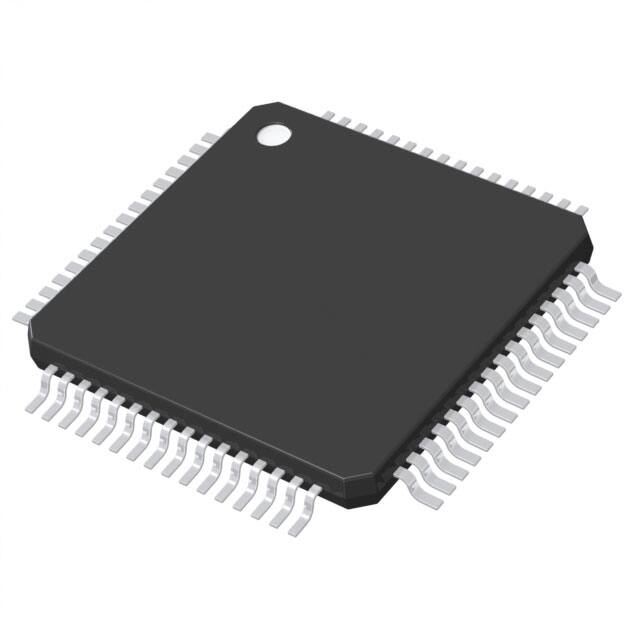
SPC582Bx
SPC58 2B Line - 32 bit Power Architecture automotive MCU
Single core 80Mhz, 1MByte Flash, ASIL-B
Datasheet - production data
– Cyclic redundancy check (CRC) unit
– End-to-end Error Correction Code
(e2eECC) logic
eTQFP64 (10 x 10 x 1.0 mm)
eTQFP100 (14 x 14 x 1.0 mm)
QFN48 (7 x 7 x 0.9 mm)
Features
• AEC-Q100 qualified
• High performance e200z2 single core
– 32-bit Power Architecture technology CPU
– Core frequency as high as 80 MHz
– Variable Length Encoding (VLE)
– Floating Point, End-to-End Error Correction
• 1088 KB (1024 KB code flash + 64 KB data
flash) on-chip flash memory: supports read
during program and erase operations, and
multiple blocks allowing EEPROM emulation
• 96 KB on-chip general-purpose SRAM
• Multi-channel direct memory access controller
(eDMA) with 16 channels
• 1 interrupt controller (INTC)
• Comprehensive new generation ASIL-B safety
concept
– ASIL-B of ISO 26262
– FCCU for collection and reaction to failure
notifications
– Memory Error Management Unit (MEMU)
for collection and reporting of error events
in memories
December 2020
This is information on a product in full production.
• Crossbar switch architecture for concurrent
access to peripherals, Flash, or RAM from
multiple bus masters with end-to-end ECC
• Body cross triggering unit (BCTU)
– Triggers ADC conversions from any eMIOS
channel
– Triggers ADC conversions from up to 2
dedicated PIT_RTIs
– 1 event configuration register dedicated to
each timer event allows to define the
corresponding ADC channel
– Synchronization with ADC to avoid collision
• 1 enhanced 12-bit SAR analog-to-digital
converters
– Up to 27 channels
– enhanced diagnosis feature
• Communication interfaces
– 6 LINFlexD modules
– 4 deserial serial peripheral interface (DSPI)
modules
– 7 MCAN interfaces with advanced shared
memory scheme and ISO CAN FD support
• Dual phase-locked loops with stable clock
domain for peripherals and FM modulation
domain for computational shell
• Nexus Class 3 debug and trace interface
• Boot assist Flash (BAF) supports factory
programming using a serial bootload through
the asynchronous CAN or LIN/UART.
• Enhanced modular IO subsystem (eMIOS): up
to 32 timed I/O channels with 16-bit counter
resolution
• Advanced and flexible supply scheme
– On-chip voltage regulator for 1.2 V core
logic supply.
• Junction temperature range -40 °C to 150 °C
DS11597 Rev 4
1/115
www.st.com
�Table 1. Device summary
Part number
Package
2/115
1 MB
768 kB
512 kB
eTQFP64
SPC582B60E1
SPC582B54E1
SPC582B50E1
eTQFP100
SPC582B60E3
SPC582B54E3
SPC582B50E3
QFN48
SPC582B60Q3
SPC582B54Q3
SPC582B50Q3
DS11597 Rev 4
�SPC582Bx
Contents
Contents
1
Introduction . . . . . . . . . . . . . . . . . . . . . . . . . . . . . . . . . . . . . . . . . . . . . . . . 5
2
Description . . . . . . . . . . . . . . . . . . . . . . . . . . . . . . . . . . . . . . . . . . . . . . . . . 6
2.1
Device feature summary . . . . . . . . . . . . . . . . . . . . . . . . . . . . . . . . . . . . . . 6
2.2
Block diagram . . . . . . . . . . . . . . . . . . . . . . . . . . . . . . . . . . . . . . . . . . . . . . . 7
2.3
Feature overview . . . . . . . . . . . . . . . . . . . . . . . . . . . . . . . . . . . . . . . . . . . 10
3
Package pinouts and signal descriptions . . . . . . . . . . . . . . . . . . . . . . . 12
4
Electrical characteristics . . . . . . . . . . . . . . . . . . . . . . . . . . . . . . . . . . . . 13
4.1
Introduction . . . . . . . . . . . . . . . . . . . . . . . . . . . . . . . . . . . . . . . . . . . . . . . 13
4.2
Absolute maximum ratings . . . . . . . . . . . . . . . . . . . . . . . . . . . . . . . . . . . . 14
4.3
Operating conditions . . . . . . . . . . . . . . . . . . . . . . . . . . . . . . . . . . . . . . . . 16
4.3.1
Power domains and power up/down sequencing . . . . . . . . . . . . . . . . . 17
4.4
Electrostatic discharge (ESD) . . . . . . . . . . . . . . . . . . . . . . . . . . . . . . . . . 19
4.5
Electromagnetic compatibility characteristics . . . . . . . . . . . . . . . . . . . . . . 20
4.6
Temperature profile . . . . . . . . . . . . . . . . . . . . . . . . . . . . . . . . . . . . . . . . . 21
4.7
Device consumption . . . . . . . . . . . . . . . . . . . . . . . . . . . . . . . . . . . . . . . . . 22
4.8
I/O pad specification . . . . . . . . . . . . . . . . . . . . . . . . . . . . . . . . . . . . . . . . . 24
4.8.1
I/O input DC characteristics . . . . . . . . . . . . . . . . . . . . . . . . . . . . . . . . . . 24
4.8.2
I/O output DC characteristics . . . . . . . . . . . . . . . . . . . . . . . . . . . . . . . . . 27
4.8.3
I/O pad current specifications . . . . . . . . . . . . . . . . . . . . . . . . . . . . . . . . 32
4.9
Reset pad (PORST) electrical characteristics . . . . . . . . . . . . . . . . . . . . . 35
4.10
PLLs . . . . . . . . . . . . . . . . . . . . . . . . . . . . . . . . . . . . . . . . . . . . . . . . . . . . . 38
4.11
4.12
4.10.1
PLL0 . . . . . . . . . . . . . . . . . . . . . . . . . . . . . . . . . . . . . . . . . . . . . . . . . . . 38
4.10.2
PLL1 . . . . . . . . . . . . . . . . . . . . . . . . . . . . . . . . . . . . . . . . . . . . . . . . . . . 40
Oscillators . . . . . . . . . . . . . . . . . . . . . . . . . . . . . . . . . . . . . . . . . . . . . . . . . 41
4.11.1
Crystal oscillator 40 MHz . . . . . . . . . . . . . . . . . . . . . . . . . . . . . . . . . . . . 41
4.11.2
RC oscillator 16 MHz . . . . . . . . . . . . . . . . . . . . . . . . . . . . . . . . . . . . . . . 42
4.11.3
Low power RC oscillator . . . . . . . . . . . . . . . . . . . . . . . . . . . . . . . . . . . . 44
ADC system . . . . . . . . . . . . . . . . . . . . . . . . . . . . . . . . . . . . . . . . . . . . . . . 45
4.12.1
ADC input description . . . . . . . . . . . . . . . . . . . . . . . . . . . . . . . . . . . . . . 45
4.12.2
SAR ADC 12 bit electrical specification . . . . . . . . . . . . . . . . . . . . . . . . . 46
DS11597 Rev 4
3/115
4
�Contents
SPC582Bx
4.13
5
Power management . . . . . . . . . . . . . . . . . . . . . . . . . . . . . . . . . . . . . . . . . 51
4.13.1
Power management integration . . . . . . . . . . . . . . . . . . . . . . . . . . . . . . . 51
4.13.2
Voltage regulators . . . . . . . . . . . . . . . . . . . . . . . . . . . . . . . . . . . . . . . . . 55
4.13.3
Voltage monitors . . . . . . . . . . . . . . . . . . . . . . . . . . . . . . . . . . . . . . . . . . 55
4.14
Flash . . . . . . . . . . . . . . . . . . . . . . . . . . . . . . . . . . . . . . . . . . . . . . . . . . . . 58
4.15
AC Specifications . . . . . . . . . . . . . . . . . . . . . . . . . . . . . . . . . . . . . . . . . . . 61
4.15.1
Debug and calibration interface timing . . . . . . . . . . . . . . . . . . . . . . . . . 61
4.15.2
DSPI timing with CMOS pads . . . . . . . . . . . . . . . . . . . . . . . . . . . . . . . . 67
4.15.3
CAN timing . . . . . . . . . . . . . . . . . . . . . . . . . . . . . . . . . . . . . . . . . . . . . . . 77
4.15.4
UART timing . . . . . . . . . . . . . . . . . . . . . . . . . . . . . . . . . . . . . . . . . . . . . . 78
4.15.5
I2C timing . . . . . . . . . . . . . . . . . . . . . . . . . . . . . . . . . . . . . . . . . . . . . . . . 78
Package information . . . . . . . . . . . . . . . . . . . . . . . . . . . . . . . . . . . . . . . . 81
5.1
eTQFP64 package information . . . . . . . . . . . . . . . . . . . . . . . . . . . . . . . . 81
5.1.1
5.2
eTQFP100 package information . . . . . . . . . . . . . . . . . . . . . . . . . . . . . . . 86
5.2.1
5.3
Package mechanical drawings and data information . . . . . . . . . . . . . . 95
QFN48 package information . . . . . . . . . . . . . . . . . . . . . . . . . . . . . . . . . . 96
5.4.1
5.5
Package mechanical drawings and data information . . . . . . . . . . . . . . 90
eTQFP144 package information . . . . . . . . . . . . . . . . . . . . . . . . . . . . . . . 91
5.3.1
5.4
Package mechanical drawings and data information . . . . . . . . . . . . . . 85
Package mechanical drawings and data information . . . . . . . . . . . . . . 98
Package thermal characteristics . . . . . . . . . . . . . . . . . . . . . . . . . . . . . . 100
5.5.1
eTQFP64 . . . . . . . . . . . . . . . . . . . . . . . . . . . . . . . . . . . . . . . . . . . . . . . 100
5.5.2
eTQFP100 . . . . . . . . . . . . . . . . . . . . . . . . . . . . . . . . . . . . . . . . . . . . . . 100
5.5.3
QFN48 . . . . . . . . . . . . . . . . . . . . . . . . . . . . . . . . . . . . . . . . . . . . . . . . . 101
5.5.4
General notes for specifications at maximum junction temperature . . 101
6
Ordering information . . . . . . . . . . . . . . . . . . . . . . . . . . . . . . . . . . . . . . 104
7
Revision history . . . . . . . . . . . . . . . . . . . . . . . . . . . . . . . . . . . . . . . . . . 106
4/115
DS11597 Rev 4
�SPC582Bx
1
Introduction
Introduction
This document describes the features of the family and options available within the family
members, and highlights important electrical and physical characteristics of the device. To
ensure a complete understanding of the device functionality, refer also to the device
reference manual and errata sheet.
DS11597 Rev 4
5/115
11
�Description
2
SPC582Bx
Description
The SPC582Bx microcontroller is the entry member of a new family of devices superseding
the SPC560Bx family.
SPC582Bx is built on the legacy of the SPC5x products, while introducing new features to
answer the future requirements like the ASIL-B classification, high number of ISO CAN-FD
channels, and provide significant power and performance improvement (MIPS per mW).
2.1
Device feature summary
Table 2 lists a summary of major features for the SPC582Bx device. The feature column
represents a combination of module names and capabilities of certain modules. A detailed
description of the functionality provided by each on-chip module is given later in this
document.
Table 2. SPC582Bx device feature summary
Feature
Description
SPC58 family
40 nm
Number of Cores
1
Single Precision Floating Point
Yes
SIMD
No
VLE
Yes
MPU
Yes
CRC Channels
2x4
Software Watchdog Timer (SWT)
1
Core Nexus Class
3+
4 x SCU
Event Processor
6/115
4 x PMC
Run control Module
Yes
System SRAM
96 KB (including 64 KB of standby RAM)
Flash
1088 KB (1024 code flash + 64 KB data flash)
Flash fetch accelerator
2 x 4 x 256-bit
DMA channels
16
DMA Nexus Class
3
LINFlexD
6
MCAN (ISO CAN-FD)
7
DSPI
4
I2C
1
DS11597 Rev 4
�SPC582Bx
Description
Table 2. SPC582Bx device feature summary (continued)
Feature
Description
8 PIT channels
4 AUTOSAR® (STM)
System Timers
RTC/API
eMIOS
32 channels
BCTU
32 channels
Interrupt controller
1 x 151 sources
ADC (SAR)
One 12-bit, up to 27 channels
Self Test Controller
Yes
PLL
Dual PLL with FM
Integrated linear voltage regulator
Yes
External Power Supplies
5 V, 3.3 V
STOP Mode
Low Power Modes
HALT Mode
Standby Mode
2.2
Block diagram
The figures below show the top-level block diagrams.
DS11597 Rev 4
7/115
11
�Description
SPC582Bx
Figure 1. Block diagram
JTAGM
JTAGC
DCI
SPU
NPC
INTC
VLE
16 Ch
eDMA
Nexus3p
EFPU2
Core Memory Protection Unit
(CMPU)
32 ADD
32 DATA
Instruction
32 ADD
32 DATA
E2E ECC
Nexus Data
Trace
Load / Store
32 ADD
32 DATA
Delayed Lock-step with Redundancy Checkers
DMA CHMUX
SWT IAC
e200 z215n3 – 80 MHz
single issue
Main Core
BIU with E2E ECC
Decorated Storage Access
Instruction
32 ADD
32 DATA
32 ADD
32 DATA
M2
AHB_M4
AHB_M6
Load / Store
32 ADD
32 DATA
AHB_M5 M0
M1
Cross Bar Switch (XBAR) AMBA 2.0 v6 AHB – 32 bit
8/115
System Memory Protection Unit
S0
S2
S5
S4
32 ADD
32 DATA
32 ADD
32 DATA
32 ADD
32 DATA
Periph. Bridge
AIPS_2
E2E ECC
Periph. Bridge
AIPS_1
E2E ECC
PRAMC_2
with E2E
ECC
32 ADD
32 DATA
32 ADD
32 DATA
32 ADD
32 DATA
Peripheral
Cluster 2
Peripheral
Cluster 1
SRAM
Array 2
96 KB
DS11597 Rev 4
32 ADD
32 DATA
S1
32 ADD
32 DATA
PFLASHC
Set-Associative
MiniCache
with E2E ECC
128 Page Line
FLASH
1 MB
EEPROM
4x16 KB
Non Volatile Memory
Multiple RWW partitions
�SPC582Bx
Description
Figure 2. Periphery allocation
BCTU_0
PBRIDGE_2
eMIOS_0
XBAR_1
SMPU_1
SAR_ADC_12bit_B0
XBIC_1
I2C_0
PCM_0
DSPI_0, 2
PFLASH_1
LINFLEX_0, 2, 10
CAN_SUB_0_MESSAGE_RAM
INTC_1
CAN_SUB_0_M_CAN_0..3
SWT_2
CCCU
STM_2
DTS
eDMA_1
JDC
PRAM_2
STCU
TDM_0
JTAGM
MEMU
IMA
DMAMUX_0
PIT_0
RTC/API
WKPU
MC_PCU
PMC_DIG
MC_RGM
PBRIDGE_2 – Peripheral Cluster 2
CRC_0
RCOSC_DIG
RC1024K_DIG
DSPI_1, 3
OSC_DIG
LINFlex_1, 7, 15
PLL_DIG
CAN_SUB_1_MESSAGE_RAM
CAN_SUB_1_M_CAN_1..3
MC_CGM
FCCU
MC_ME
CRC_1
SIUL2
CMU_1_CORE_XBAR
FLASH_0
CMU_2_HPBM
PASS
CMU_3_PBRIDGE
SSCM
CMU_6_SARADC
CMU_11_FBRIDGE
PBRIDGE_1 – Peripheral Cluster 1
CMU_0_PLL0_XOSC_IRCOSC
PBRIDGE_1
CMU_12_EMIOS
CMU_14_PFBRIDGE
Note: In this diagram, ON-platform modules are shown in orange color and OFF-platform modules
are shown in blue color.
DS11597 Rev 4
9/115
11
�Description
2.3
SPC582Bx
Feature overview
On-chip modules within SPC582Bx include the following features:
•
•
One main CPU, single issue, 32-bit CPU core complexes (e200z2).
–
Power Architecture embedded specification compliance
–
Instruction set enhancement allowing variable length encoding (VLE), encoding a
mix of 16-bit and 32-bit instructions, for code size footprint reduction
–
Single-precision floating point operations
1088 KB (1024 KB code flash + 64 KB data flash) on-chip Flash memory
–
•
96 KB on-chip general-purpose SRAM
•
Multi channel direct memory access controllers
–
16 eDMA channels
•
One interrupt controller (INTC)
•
Dual phase-locked loops with stable clock domain for peripherals and FM modulation
domain for computational shell
•
Crossbar switch architecture for concurrent access to peripherals, Flash, or RAM from
multiple bus masters with end-to-end ECC
•
System integration unit lite (SIUL)
•
Boot assist Flash (BAF) supports factory programming using a serial bootload through
the asynchronous CAN or LIN/UART.
•
Hardware support for safety ASIL-B level related applications
•
Enhanced modular IO subsystem (eMIOS): up to 32 timed I/O channels with 16-bit
counter resolution
–
•
•
10/115
Supports read during program and erase operations, and multiple blocks allowing
EEPROM emulation
Buffered updates
–
Support for shifted PWM outputs to minimize occurrence of concurrent edges
–
Supports configurable trigger outputs for ADC conversion for synchronization to
channel output waveforms
–
Shared or independent time bases
–
DMA transfer support available
Body cross triggering unit (BCTU)
–
Triggers ADC conversions from any eMIOS channel
–
Triggers ADC conversions from up to 2 dedicated PIT_RTIs
–
One event configuration register dedicated to each timer event allows to define the
corresponding ADC channel
–
Synchronization with ADC to avoid collision
One 12-bit SAR analog-to-digital converter
–
up to 27 channels
–
enhanced diagnosis features
•
Four deserial serial peripheral interface (DSPI) modules
•
Six LIN and UART communication interface (LINFlexD) modules
–
LINFlexD_0 is a Master/Slave
–
All others are Masters
DS11597 Rev 4
�SPC582Bx
Description
•
Seven modular controller area network (MCAN) modules, all supporting flexible data
rate (ISO CAN-FD)
•
Nexus development interface (NDI) per IEEE-ISTO 5001-2003 standard, with some
support for 2010 standard
•
Device and board test support per Joint Test Action Group (JTAG) (IEEE 1149.1 and
IEEE 1149.7), 2-pin JTAG interface
•
On-chip voltage regulator controller manages the supply voltage down to 1.2 V for core
logic
•
Self-test capability
DS11597 Rev 4
11/115
11
�Package pinouts and signal descriptions
3
SPC582Bx
Package pinouts and signal descriptions
Refer to the SPC582Bx IO_ Definition document.
It includes the following sections:
12/115
1.
Package pinouts
2.
Pin descriptions
a)
Power supply and reference voltage pins
b)
System pins
c)
Generic pins
DS11597 Rev 4
�SPC582Bx
Electrical characteristics
4
Electrical characteristics
4.1
Introduction
The present document contains the target Electrical Specification for the 40 nm family 32-bit
MCU SPC582Bx products.
In the tables where the device logic provides signals with their respective timing
characteristics, the symbol “CC” (Controller Characteristics) is included in the “Symbol”
column.
In the tables where the external system must provide signals with their respective timing
characteristics to the device, the symbol “SR” (System Requirement) is included in the
“Symbol” column.
The electrical parameters shown in this document are guaranteed by various methods. To
give the customer a better understanding, the classifications listed in Table 3 are used and
the parameters are tagged accordingly in the tables where appropriate.
Table 3. Parameter classifications
Classification tag
Tag description
P
Those parameters are guaranteed during production testing on each individual device.
C
Those parameters are achieved by the design characterization by measuring a statistically
relevant sample size across process variations.
T
Those parameters are achieved by design validation on a small sample size from typical
devices.
D
Those parameters are derived mainly from simulations.
DS11597 Rev 4
13/115
13
�Electrical characteristics
4.2
SPC582Bx
Absolute maximum ratings
Table 4 describes the maximum ratings for the device. Absolute maximum ratings are stress
ratings only, and functional operation at the maxima is not guaranteed. Exposure to
absolute maximum rating conditions for extended periods may affect device reliability.
Stress beyond the listed maxima, even momentarily, may affect device reliability or cause
permanent damage to the device.
Table 4. Absolute maximum ratings
Value
Symbol
C
Parameter
Conditions
Unit
Min
Typ
Max
VDD_LV
SR
D
Core voltage
operating life
range(1)
—
–0.3
—
1.4
V
VDD_HV_IO_MAIN
VDD_HV_OSC
VDD_HV_FLA
SR
D
I/O supply
voltage(2)
—
–0.3
—
6.0
V
VSS_HV_ADV
SR
D
ADC ground
voltage
Reference to
digital ground
–0.3
—
0.3
V
VDD_HV_ADV
SR
D
ADC Supply
voltage(2)
Reference to
VSS_HV_ADV
–0.3
—
6.0
V
VSS_HV_ADR_S
SR
D
SAR ADC
ground
reference
—
–0.3
—
0.3
V
VDD_HV_ADR_S
SR
D
SAR ADC
voltage
reference(2)
Reference to
VSS_HV_ADR_S
–0.3
—
6.0
V
VSS-VSS_HV_ADR_S
SR
D
VSS_HV_ADR_S
differential
voltage
—
–0.3
—
0.3
V
VSS-VSS_HV_ADV
SR
D
VSS_HV_ADV
differential
voltage
—
–0.3
—
0.3
V
—
–0.3
—
6.0
Relative to Vss
–0.3
—
—
Relative to
VDD_HV_IO and
VDD_HV_ADV
—
—
0.3
VIN
TTRIN
IINJ
14/115
SR
SR
SR
D
I/O input voltage
range(2)(3) (4)
V
D
Digital Input pad
transition time(5)
—
—
—
1
ms
T
Maximum DC
injection current
for each
analog/digital
PAD(6)
—
–5
—
5
mA
DS11597 Rev 4
�SPC582Bx
Electrical characteristics
Table 4. Absolute maximum ratings (continued)
Value
Symbol
TSTG
TPAS
C
SR
SR
Parameter
Conditions
Unit
Min
Typ
Max
T
Maximum nonoperating
Storage
temperature
range
—
–55
—
125
°C
C
Maximum nonoperating
temperature
during passive
lifetime
—
–55
—
150(7)
°C
—
—
20
years
TSTORAGE
SR
—
Maximum
No supply; storage
storage time,
temperature in
assembled part
range –40 °C to
programmed in
60 °C
ECU
TSDR
SR
T
Maximum solder
temperature Pbfree packaged(8)
—
—
—
260
°C
MSL
SR
T
Moisture
sensitivity
level(9)
—
—
—
3
—
Maximum
cumulated
XRAY dose
Typical range for
X-rays source
during
inspection:80 ÷
130 KV; 20 ÷
50 μA
—
—
1
grey
TXRAY dose
SR
T
1. VDD_LV: allowed 1.335 V - 1.400 V for 60 seconds cumulative time at the given temperature profile. Remaining time allowed
1.260 V - 1.335 V for 10 hours cumulative time at the given temperature profile. Remaining time as defined in Section 4.3:
Operating conditions.
2. VDD_HV: allowed 5.5 V – 6.0 V for 60 seconds cumulative time at the given temperature profile, for 10 hours cumulative
time with the device in reset at the given temperature profile. Remaining time as defined in Section 4.3: Operating
conditions.
3. The maximum input voltage on an I/O pin tracks with the associated I/O supply maximum. For the injection current
condition on a pin, the voltage will be equal to the supply plus the voltage drop across the internal ESD diode from I/O pin
to supply. The diode voltage varies greatly across process and temperature, but a value of 0.3 V can be used for nominal
calculations.
4. Relative value can be exceeded if design measures are taken to ensure injection current limitation (parameter IINJ).
5. This limitation applies to pads with digital input buffer enabled. If the digital input buffer is disabled, there are no maximum
limits to the transition time.
6. The limits for the sum of all normal and injected currents on all pads within the same supply segment can be found in
Section 4.8.3: I/O pad current specifications.
7. 175°C are allowed for limited time. Mission profile with passive lifetime temperature >150°C have to be evaluated by ST to
confirm that are granted by product qualification.
8. Solder profile per IPC/JEDEC J-STD-020D.
9. Moisture sensitivity per JDEC test method A112.
DS11597 Rev 4
15/115
15
�Electrical characteristics
4.3
SPC582Bx
Operating conditions
Table 5 describes the operating conditions for the device, and for which all the specifications
in the data sheet are valid, except where explicitly noted. The device operating conditions
must not be exceeded or the functionality of the device is not guaranteed.
Table 5. Operating conditions
Value(1)
Symbol
C
Parameter
Conditions
Unit
Min
Typ
Max
FSYS
SR
P
Operating
system clock
frequency(4)
—
—
—
80
MHz
TJ
SR
C
Operating
Junction
temperature
—
–40
—
150
°C
TA
SR
P
Operating
Ambient
temperature
—
–40
—
125
°C
VDD_LV
SR
P
Core supply
voltage(2)
—
1.14
1.20
1.26(3) (4)
V
SR
P
IO supply
voltage
—
3.0
—
5.5
V
VDD_HV_ADV
SR
P
ADC supply
voltage
—
3.0
—
5.5
V
VSS_HV_ADVVSS
SR
D
ADC ground
differential
voltage
—
–25
—
25
mV
VDD_HV_ADR_S
SR
P
SAR ADC
reference
voltage
—
3.0
—
5.5
V
D
SAR ADC
reference
differential
voltage
—
—
—
25
mV
—
VDD_HV_IO_MAIN
VDD_HV_FLA
VDD_HV_OSC
VDD_HV_ADR_SVDD_HV_ADV
SR
VSS_HV_ADR_S
SR
P
SAR ADC
ground
reference
voltage
VSS_HV_ADR_SVSS_HV_ADV
SR
D
VSS_HV_ADR_S
differential
voltage
—
–25
—
25
mV
VRAMP_HV
SR
D
Slew rate on
HV power
supply
—
—
—
100
V/ms
16/115
DS11597 Rev 4
V
VSS_HV_ADV
�SPC582Bx
Electrical characteristics
Table 5. Operating conditions (continued)
Value(1)
Symbol
VIN
IINJ1
C
SR
SR
P
T
Parameter
I/O input
voltage range
Injection
current (per
pin) without
performance
degradation(5)
Conditions
Unit
Min
Typ
Max
—
0
—
5.5
V
Digital pins and
analog pins
–3.0
—
3.0
mA
Digital pins and
analog pins
–10
—
10
mA
(6) (7)
IINJ2
SR
D
Dynamic
Injection
current (per
pin) with
performance
degradation(7)
(8)
1. The ranges in this table are design targets and actual data may vary in the given range.
2. Core voltage as measured on device pin to guarantee published silicon performance.
3. Core voltage can exceed 1.26 V with the limitations provided in Section 4.2: Absolute maximum ratings, provided that
HVD134_C monitor reset is disabled.
4. 1.260 V - 1.290 V range allowed periodically for supply with sinusoidal shape and average supply value below or equal to
1.236 V at the given temperature profile.
5. Full device lifetime. I/O and analog input specifications are only valid if the injection current on adjacent pins is within these
limits. See Section 4.2: Absolute maximum ratings for maximum input current for reliability requirements.
6. The I/O pins on the device are clamped to the I/O supply rails for ESD protection. When the voltage of the input pins is
above the supply rail, current will be injected through the clamp diode to the supply rails. For external RC network
calculation, assume typical 0.3 V drop across the active diode. The diode voltage drop varies with temperature.
7. The limits for the sum of all normal and injected currents on all pads within the same supply segment can be found in
Section 4.8.3: I/O pad current specifications.
8.
Positive and negative Dynamic current injection pulses are allowed up to this limit. I/O and ADC specifications are not
granted. See the dedicated chapters for the different specification limits. See the Absolute Maximum Ratings table for
maximum input current for reliability requirements. Refer to the following pulses definitions: Pulse1 (ISO 7637-2:2011),
Pulse 2a(ISO 7637-2:2011 5.6.2), Pulse 3a (ISO 7637-2:2011 5.6.3), Pulse 3b (ISO 7637-2:2011 5.6.3).
4.3.1
Power domains and power up/down sequencing
The following table shows the constraints and relationships for the different power domains.
Supply1 (on rows) can exceed Supply2 (on columns), only if the cell at the given row and
column is reporting ‘ok’. This limitation is valid during power-up and power-down phases, as
well as during normal device operation.
DS11597 Rev 4
17/115
18
�Electrical characteristics
SPC582Bx
Table 6. Device supply relation during power-up/power-down sequence
Supply2
VDD_HV_IO_MAIN
VDD_LV
VDD_HV_FLA
VDD_HV_ADV
VDD_HV_ADR
ok
ok
Supply1
VDD_HV_OSC
VDD_HV_IO_MAIN
VDD_HV_FLA
VDD_HV_OSC(1)
ok
VDD_HV_ADV
ok
not allowed
VDD_HV_ADR
ok
not allowed
ok
not allowed
1. The application shall grant that these supplies are always at the same voltage level.
During power-up, all functional terminals are maintained in a known state as described in
the device pinout Microsoft Excel file attached to the IO_Definition document.
18/115
DS11597 Rev 4
�SPC582Bx
4.4
Electrical characteristics
Electrostatic discharge (ESD)
The following table describes the ESD ratings of the device:
•
All ESD testing are in conformity with CDF-AEC-Q100 Stress Test Qualification for
Automotive Grade Integrated Circuits,
•
Device failure is defined as: “If after exposure to ESD pulses, the device does not meet
the device specification requirements, which include the complete DC parametric and
functional testing at room temperature and hot temperature, maximum DC parametric
variation within 10% of maximum specification”.
Table 7. ESD ratings
Parameter
ESD for Human Body Model (HBM)(1)
ESD for field induced Charged Device Model (CDM)(2)
C
Conditions
Value
Unit
T
All pins
2000
V
T
All pins
500
V
T
Corner Pins
750
V
1. This parameter tested in conformity with ANSI/ESD STM5.1-2007 Electrostatic Discharge Sensitivity Testing.
2. This parameter tested in conformity with ANSI/ESD STM5.3-1990 Charged Device Model - Component Level.
DS11597 Rev 4
19/115
19
�Electrical characteristics
4.5
SPC582Bx
Electromagnetic compatibility characteristics
EMC measurements at IC-level IEC standards are available from STMicroelectronics on
request.
20/115
DS11597 Rev 4
�SPC582Bx
4.6
Electrical characteristics
Temperature profile
The device is qualified in accordance to AEC-Q100 Grade1 requirements, such as HTOL
1,000 h and HTDR 1,000 hrs, TJ = 150 °C.
DS11597 Rev 4
21/115
21
�Electrical characteristics
4.7
SPC582Bx
Device consumption
Table 8. Device consumption
Value(1)
Symbol
IDD_LKG(2),(3)
C
CC
Parameter
Conditions
Typ
Max
C
TJ = 40 °C
—
—
2
D
TJ = 25 °C
—
0.65
1
D Leakage current on the
VDD_LV supply
D
TJ = 55 °C
—
—
2.5
TJ = 95 °C
—
—
6
D
TJ = 120 °C
—
—
14
P
TJ = 150 °C
—
—
35
—
—
—
50
mA
mA
IDD_LV(3)
CC
P
Dynamic current on
the VDD_LV supply,
very high consumption
profile(4)
IDD_HV
CC
P
Total current on the
VDD_HV supply(4)
fMAX
—
—
37
mA
IDD_LV_GW
CC
T
Dynamic current on
the VDD_LV supply,
gateway profile(5)
—
—
—
48
mA
IDD_HV_GW
CC
T
Dynamic current on
the VDD_HV supply,
gateway profile(5)
—
—
—
17
mA
T
Dynamic current on
the VDD_LV supply
+Total current on the
VDD_HV supply
—
—
26
37
mA
T
Dynamic current on
the VDD_LV supply
+Total current on the
VDD_HV supply
—
—
6.5
9
mA
TJ = 25 °C
—
40
90
TJ = 40 °C
—
—
135
TJ = 55 °C
—
—
210
TJ = 120 °C
—
—
1.2
P
TJ = 150 °C
—
—
2.5
D
TJ = 25 °C
—
55
125
TJ = 40 °C
—
—
190
TJ = 55 °C
—
—
290
TJ = 120 °C
—
—
1.6
TJ = 150 °C
—
—
3.5
IDDHALT(6)
IDDSTOP(7)
CC
CC
D
C
IDDSTBY8
CC
D
D
C
IDDSTBY64
CC
D
D
Total standby mode
current on VDD_LV and
VDD_HV supply, 8 KB
RAM(8)
Total standby mode
current on VDD_LV and
VDD_HV supply, 64 KB
RAM(8)
P
1. The ranges in this table are design targets and actual data may vary in the given range.
22/115
Unit
Min
DS11597 Rev 4
µA
mA
µA
mA
�SPC582Bx
Electrical characteristics
2. The leakage considered is the sum of core logic and RAM memories. The contribution of analog modules is not considered,
and they are computed in the dynamic IDD_LV and IDD_HV parameters.
3. IDD_LKG (leakage current) and IDD_LV (dynamic current) are reported as separate parameters, to give an indication of the
consumption contributors. The tests used in validation, characterization and production are verifying that the total
consumption (leakage+dynamic) is lower or equal to the sum of the maximum values provided (IDD_LKG + IDD_LV). The two
parameters, measured separately, may exceed the maximum reported for each, depending on the operative conditions and
the software profile used.
4. Use case: 1 x e200Z2 @80 MHz, all IPs clock enabled, Flash access with prefetch disabled, Flash consumption includes
parallel read and program/erase, 1xSARADC in continuous conversion, DMA continuously triggered by ADC conversion, 4
DSPI / 3 CAN / 2 LINFlex transmitting, RTC and STM running, 1xEMIOS running (12 channels in OPWMT mode), FIRC,
SIRC, FXOSC, PLL0-1 running. The switching activity estimated for dynamic consumption does not include I/O toggling,
which is highly dependent on the application. Details of the software configuration are separately. The total device
consumption is IDD_LV + IDD_HV + IDD_LKG for the selected temperature.
5. Gateway use case: One core running at 80 MHz, DMA, PLL, FLASH read only 25%, 7xCAN, 1xSARADC.
6. Flash in Low Power. Sysclk at 80 MHz, PLL0_PHI at 80 MHz, XTAL at 8 MHz, FIRC 16 MHz ON, RCOSC1M off. FlexCAN:
instances: 0, 1, 2, 3, 4, 5, 6 ON (configured but no reception or transmission), ADC ON (continuously converting). All others
IPs clock-gated.
7. Sysclk = RC16 MHz, RC16 MHz ON, RC1 MHz ON, PLL OFF. All possible peripherals off and clock gated. Flash in power
down mode.
8. STANDBY mode: device configured for minimum consumption, RC16 MHz off, RC1 MHz on.
DS11597 Rev 4
23/115
23
�Electrical characteristics
4.8
SPC582Bx
I/O pad specification
The following table describes the different pad type configurations.
Table 9. I/O pad specification descriptions
Pad type
Description
Weak configuration
Provides a good compromise between transition time and low electromagnetic emission.
Medium configuration
Strong configuration
Very strong
configuration
Input only pads
Standby pads
Note:
Provides transition fast enough for the serial communication channels with controlled
current to reduce electromagnetic emission.
Provides fast transition speed; used for fast interface.
Provides maximum speed and controlled symmetric behavior for rise and fall transition.
Used for fast interface requiring fine control of rising/falling edge jitter.
These low input leakage pads are associated with the ADC channels.
Some pads are active during Standby. Low Power Pads input buffer can only be
configured in TTL mode. When the pads are in Standby mode, the Pad-Keeper feature is
activated: if the pad status is high, the weak pull-up resistor is automatically enabled; if
the pad status is low, the weak pull-down resistor is automatically enabled.
Each I/O pin on the device supports specific drive configurations. See the signal description
table in the device reference manual for the available drive configurations for each I/O pin.
PMC_DIG_VSIO register has to be configured to select the voltage level (3.3 V or 5.0 V) for
each IO segment.
Logic level is configurable in running mode while it is TTL not-configurable in STANDBY for
LP (low power) pads, so if a LP pad is used to wakeup from STANDBY, it should be
configured as TTL also in running mode in order to prevent device wrong behavior in
STANDBY.
4.8.1
I/O input DC characteristics
The following table provides input DC electrical characteristics, as described in Figure 3.
24/115
DS11597 Rev 4
�SPC582Bx
Electrical characteristics
Figure 3. I/O input electrical characteristics
VIN
VDD
VIH
VHYS
VIL
VINTERNAL
(SIUL register)
Table 10. I/O input electrical characteristics
Value
Symbol
C
Parameter
Conditions
Unit
Min
Typ
Max
TTL
Vihttl
SR
P
Input high level
TTL
—
2
—
VDD_HV_IO
+ 0.3
V
Vilttl
SR
P
Input low level
TTL
—
–0.3
—
0.8
V
Vhysttl
CC
C
Input hysteresis
TTL
—
0.3
—
—
V
CMOS
Vihcmos
SR
P
Input high level
CMOS
—
0.65 * VDD
—
VDD_HV_IO
+ 0.3
V
Vilcmos
SR
P
Input low level
CMOS
—
–0.3
—
0.35 * VDD
V
Vhyscmos
CC
C
Input hysteresis
CMOS
—
0.10 * VDD
—
—
V
COMMON
ILKG
CC
P
Pad input
leakage
INPUT-ONLY pads
TJ = 150 °C
—
—
200
nA
ILKG
CC
P
Pad input
leakage
STRONG pads
TJ = 150 °C
—
—
1,000
nA
ILKG
CC
P
Pad input
leakage
VERY STRONG pads,
TJ = 150 °C
—
—
1,000
nA
DS11597 Rev 4
25/115
34
�Electrical characteristics
SPC582Bx
Table 10. I/O input electrical characteristics (continued)
Value
Symbol
C
Parameter
Conditions
Unit
Min
Typ
Max
CP1
CC
D
Pad
capacitance
—
—
—
10
pF
Vdrift
CC
D
Input Vil/Vih
temperature
drift
In a 1 ms period, with a
temperature variation
3 V
–4
4
–6
6
TJ < 150 °C,
VDD_HV_ADV > 3 V,
Total unadjusted error VDD_HV_ADR_S > 3 V
in 12-bit
TJ < 150 °C,
configuration(7)
> 3 V,
V
µA
mA
LSB
–6
6
D
High frequency mode,
TJ < 150 °C,
VDD_HV_ADV > 3 V,
VDD_HV_ADR_S > 3 V
–12
12
D
Mode 1, TJ < 150 °C,
VDD_HV_ADV > 3 V
VDD_HV_ADR_S > 3 V
–1.5
1.5
–2.0
2.0
DD_HV_ADV
µA
(12b)
3 V > VDD_HV_ADR_S > 2 V
D
TUE10
CC
C
C
48/115
Mode 1, TJ < 150 °C,
VDD_HV_ADV > 3 V,
Total unadjusted error 3 V > V
DD_HV_ADR_S > 2 V
in 10-bit
Mode 2, TJ < 150 °C,
configuration(7)
VDD_HV_ADV > 3 V
VDD_HV_ADR_S > 3 V
Mode 3, TJ < 150 °C,
VDD_HV_ADV > 3 V
VDD_HV_ADR_S > 3 V
DS11597 Rev 4
LSB
(10b)
–3.0
3.0
–4.0
4.0
�SPC582Bx
Electrical characteristics
Table 25. SARn ADC electrical specification (continued)
Value
Symbol
ΔTUE12
C
CC
D
Parameter
Differential nonlinearity
CC
T
Unit
Min
Max
VIN < VDD_HV_ADV
VDD_HV_ADR − VDD_HV_ADV
∈ [0:25 mV]
–1
1
VIN < VDD_HV_ADV
VDD_HV_ADR − VDD_HV_ADV
∈ [25:50 mV]
–2
2
VIN < VDD_HV_ADV
VDD_HV_ADR − VDD_HV_ADV
∈ [50:75 mV]
–4
4
VIN < VDD_HV_ADV
VDD_HV_ADR − VDD_HV_ADV
∈ [75:100 mV]
–6
6
–2.5
2.5
VDD_HV_ADV < VIN <
VDD_HV_ADR
VDD_HV_ADR − VDD_HV_ADV
∈ [25:50 mV]
–4
4
VDD_HV_ADV < VIN <
VDD_HV_ADR
VDD_HV_ADR − VDD_HV_ADV
∈ [50:75 mV]
–7
7
VDD_HV_ADV < VIN <
VDD_HV_ADR
VDD_HV_ADR − VDD_HV_ADV
∈ [75:100 mV]
–12
12
Standard frequency mode,
VDD_HV_ADV > 4 V
VDD_HV_ADR_S > 4 V
–1
2
High frequency mode,
VDD_HV_ADV > 4 V
VDD_HV_ADR_S > 4 V
–1
TUE degradation due V
DD_HV_ADV < VIN <
to VDD_HV_ADR offset V
DD_HV_ADR
with respect to
VDD_HV_ADR − VDD_HV_ADV
VDD_HV_ADV
∈ [0:25 mV]
P
DNL(8)
Conditions
LSB
(12b)
LSB
(12b)
2
1. Minimum ADC sample times are dependent on adequate charge transfer from the external driving circuit to the internal
sample capacitor. The time constant of the entire circuit must allow the sampling capacitor to charge within 1/2 LSB within
the sampling window. Refer to Figure 8 for models of the internal ADC circuit, and the values to use in external RC sizing
and calculating the sampling window duration.
2. Mode1: 6 sampling cycles + 10 conversion cycles at 13.33 MHz.
3. Mode2: 5 sampling cycles + 10 conversion cycles at 13.33 MHz.
4. Mode3: 6 sampling cycles + 10 conversion cycles at 16 MHz.
5. IADCREFH and IADCREFL are independent from ADC clock frequency. It depends on conversion rate: consumption is driven
by the transfer of charge between internal capacitances during the conversion.
6. Current parameter values are for a single ADC.
DS11597 Rev 4
49/115
50
�Electrical characteristics
SPC582Bx
7. TUE is granted with injection current within the range defined in Table 24, for parameters classified as T and D.
8. DNL is granted with injection current within the range defined in Table 24, for parameters classified as T and D.
50/115
DS11597 Rev 4
�SPC582Bx
4.13
Electrical characteristics
Power management
The power management module monitors the different power supplies as well as it
generates the required internal supplies. The device can operate in the following
configurations:
Table 26. Power management regulators
Device
External
regulator
Internal
SMPS
regulator
SPC582Bx
—
—
Internal
linear
regulator
external
ballast
Internal
linear
regulator
internal
ballast
Auxiliary
regulator
Clamp
regulator
Internal
standby
regulator(1)
—
X
—
—
X
1. Standby regulator is automatically activated when the device enters standby mode.
4.13.1
Power management integration
Use the integration schemes provided below to ensure the proper device function,
according to the selected regulator configuration.
The internal regulators are supplied by VDD_HV_IO_MAIN supply and are used to generate
VDD_LV supply.
Place capacitances on the board as near as possible to the associated pins and limit the
serial inductance of the board to less than 5 nH.
It is recommended to use the internal regulators only to supply the device itself.
DS11597 Rev 4
51/115
57
�Electrical characteristics
SPC582Bx
Figure 9. Internal regulator with internal ballast mode
52/115
DS11597 Rev 4
�SPC582Bx
Electrical characteristics
Figure 10. Standby regulator with internal ballast mode
&)/$
&(
966
9''B+9B,2
9''B+9B)/$
&%9
9''B+9B,2
&+9Q
6WDQGE\ 5HJ
9''B/9
966
&/9Q
966
966B+9B$'9
9''B+9B$'9
&$'&
Table 27. External components integration
Symbol
C
Value
Conditions(1)
Parameter
Unit
Min
Typ
Max
—
—
1
—
µF
Total resistance including
board track
5
—
50
mΩ
Each VDD_LV/VSS pair
—
100
—
nF
Common Components
CE
SR
D
Internal voltage regulator stability
external capacitance(2) (3)
RE
SR
D
Stability capacitor equivalent
serial resistance
CLVn
SR
Internal voltage regulator
D decoupling external capacitance
RLVn
SR
D
Stability capacitor equivalent
serial resistance
—
—
—
50
mΩ
CBV
SR
Bulk capacitance for HV supply
D (2)
on one VDD_HV_IO_MAIN/
VSS pair
—
4.7
—
µF
CHVn
SR
D
Decoupling capacitance for
ballast and IOs (2)
on all VDD_HV_IO/VSS and
VDD_HV_ADR/VSS pairs
—
100
—
nF
(2) (4) (5)
DS11597 Rev 4
53/115
57
�Electrical characteristics
SPC582Bx
Table 27. External components integration (continued)
Symbol
C
Value
Conditions(1)
Parameter
CFLA
SR
D
Decoupling capacitance for Flash
supply (2) (6)
CADC
SR
D
ADC supply external
capacitance(2) (6)
Unit
Min
Typ
Max
—
—
10
—
nF
VDD_HV_ADV/VSS_HV_ADV
pair
—
0.5
—
µF
1. VDD = 3.3 V ± 10% / 5.0 V ± 10%, TJ = –40 / 150 °C, unless otherwise specified.
2. Recommended X7R or X5R ceramic –50% / +35% variation across process, temperature, voltage and after aging.
3. CE capacitance is required both in internal and external regulator mode.
4. For noise filtering, add a high frequency bypass capacitance of 10 nF.
5. For applications it is recommended to implement at least 5 CLV capacitances.
6. Recommended X7R capacitors. For noise filtering, add a high frequency bypass capacitance of 100 nF.
54/115
DS11597 Rev 4
�SPC582Bx
4.13.2
Electrical characteristics
Voltage regulators
Table 28. Linear regulator specifications
Value
Symbol
C
Parameter
Conditions
CC P
Main regulator output voltage
VMREG
CC P
Unit
Min
Typ
Max
Power-up, before
trimming, no load
1.13
1.21
1.29
After trimming,
maximum load
1.09
1.19
1.26
—
—
85
mA
Power-up condition
—
—
40
mA
20 µs observation
window
-50
—
50
mA
IMREG = max
—
—
1.1
IMREG = 0 mA
—
—
1.1
V
Main regulator current provided to
VDD_LV domain
The maximum current required by
T the device (IDD_LV) may exceed
the maximum current which can
be provided by the internal linear
regulator. In this case, the internal
regulator mode cannot be used.
IDDMREG
CC
IDDCLAMP
Main regulator rush current
sinked from VDD_HV_IO_MAIN
CC D
domain during VDD_LV domain
loading
ΔIDDMREG
CC
T
IMREGINT
CC
D Main regulator current
D consumption
Main regulator output current
variation
—
mA
Table 29. Standby regulator specifications
Value
Symbol
VSBY
IDDSBY
4.13.3
C
Parameter
Conditions
CC P Standby regulator output voltage
CC T
After trimming,
maximum load
Standby regulator current
provided to VDD_LV domain
—
Unit
Min
Typ
Max
0.92
0.98
1.19
V
—
0.984
5
mA
Voltage monitors
The monitors and their associated levels for the device are given in Table 30. Figure 11
illustrates the workings of voltage monitoring threshold.
DS11597 Rev 4
55/115
57
�Electrical characteristics
SPC582Bx
Figure 11. Voltage monitor threshold definition
VDD_xxx
VHVD
VLVD
TVMFILTER
TVMFILTER
HVD TRIGGER
(INTERNAL)
TVMFILTER
TVMFILTER
LVD TRIGGER
(INTERNAL)
Table 30. Voltage monitor electrical characteristics
Symbol
C
Supply/Parameter(1)
Value(2)
Conditions
Unit
Min
Typ
Max
1.80
2.02
2.40
V
PowerOn Reset HV
VPOR200_C
CC P VDD_HV_IO_MAIN
—
Minimum Voltage Detectors HV
VMVD270_C
CC P VDD_HV_IO_MAIN
—
2.71
2.76
2.80
V
VMVD270_F
CC P VDD_HV_FLA
—
2.71
2.76
2.80
V
CC P VDD_HV_IO_MAIN (in Standby)
—
2.68
2.76
2.84
V
VMVD270_SBY
Low Voltage Detectors HV
VLVD290_C
CC P VDD_HV_IO_MAIN
—
2.89
2.94
2.99
V
VLVD290_F
CC P VDD_HV_FLA
—
2.89
2.94
2.99
V
VLVD290_AS
CC P VDD_HV_ADV (ADCSAR pad)
—
2.89
2.94
2.99
V
VLVD400_AS
CC P VDD_HV_ADV (ADCSAR pad)
—
4.15
4.23
4.31
V
VLVD400_IM
CC P VDD_HV_IO_MAIN
—
4.15
4.23
4.31
V
56/115
DS11597 Rev 4
�SPC582Bx
Electrical characteristics
Table 30. Voltage monitor electrical characteristics (continued)
Symbol
C
Supply/Parameter(1)
Value(2)
Conditions
Unit
Min
Typ
Max
Minimum Voltage Detectors LV
VMVD082_C
CC P VDD_LV
—
0.85
0.88
0.91
V
VMVD094_C
CC P VDD_LV
—
0.98
1.00
1.02
V
VMVD094_FA
CC P VDD_LV (Flash)
—
1.00
1.02
1.04
V
VMVD094_FB
CC P VDD_LV (Flash)
—
1.00
1.02
1.04
V
Low Voltage Detectors LV
VLVD100_C
CC P VDD_LV
—
1.06
1.08
1.11
V
VLVD100_SB
CC P VDD_LV (In Standby)
—
0.91
0.93
0.95
V
VLVD100_F
CC P VDD_LV (Flash)
—
1.08
1.10
1.12
V
1.28
1.31
1.33
V
—
1.34
1.37
1.39
V
—
5
—
25
μs
High Voltage Detectors LV
VHVD134_C
CC P VDD_LV
—
Upper Voltage Detectors LV
VUVD140_C
CC P VDD_LV
Common
TVMFILTER
CC D Voltage monitor
filter(3)
1. Even if LVD/HVD monitor reaction is configurable, the application ensures that the device remains in the operative
condition range, and the internal LVDx monitors are disabled by the application. Then an external voltage monitor with
minimum threshold of VDD_LV(min) = 1.08 V measured at the device pad, has to be implemented.
For HVDx, if the application disables them, then they need to grant that VDD_LV and VDD_HV voltage levels stay withing
the limitations provided in Section 4.2: Absolute maximum ratings.
2. The values reported are Trimmed values, where applicable.
3. See Figure 11. Transitions shorter than minimum are filtered. Transitions longer than maximum are not filtered, and will be
delayed by TVMFILTER time. Transitions between minimum and maximum can be filtered or not filtered, according to
temperature, process and voltage variations.
DS11597 Rev 4
57/115
57
�Electrical characteristics
4.14
SPC582Bx
Flash
The following table shows the Wait State configuration.
Table 31. Wait State configuration
RWSC
CORE FREQUENCY (MHZ)
2
f < 80
1
f < 54
0
f < 27
The following table shows the Program/Erase Characteristics.
Table 32. Flash memory program and erase specifications
Value
Characteristics(1)(2)
Symbol
Lifetime
Initial max
Typ(3) C
(6)
All
temp
C
25 °C
(7)
Typical
end of
life(4)
max(5)
Unit
C
< 1 K < 250 K
cycles cycles
tdwprogram
Double Word (64 bits)
program time [Packaged part]
51
C
156
—
—
168
500
C
µs
tpprogram
Page (256 bits) program time
86
C
288
—
—
288
1000
C
µs
tpprogrameep
Page (256 bits) program time
Data Flash - EEPROM
(partition 1) [Packaged part]
100
C
316
—
—
331
1000
C
µs
Quad Page (1024 bits)
program time
264
C
1248
1440
P
1020
2000
C
µs
tqprogrameep
Quad Page (1024 bits)
program time Data Flash EEPROM (partition 1)
[Packaged part]
294
C
1368
1584
P
1173
2000
C
µs
t16kpperase
16 KB block pre-program and
erase time
230
C
500
550
P
265
1000
—
C ms
t32kpperase
32 KB block pre-program and
erase time
320
C
584
670
P
370
1200
—
C ms
t64kpperase
64 KB block pre-program and
erase time
500
C
800
850
P
575
1600
—
C ms
t128kpperase
128 KB block pre-program
and erase time
850
C
1520
1870
P
930
4000
—
C ms
—
—
C
—
—
P
—
—
—
C ms
t16kprogram
16 KB block program time
40
C
54
60
P
48
1000
—
C ms
t32kprogram
32 KB block program time
80
C
108
120
P
90
1200
—
C ms
t64kprogram
64 KB block program time
162
C
210
240
P
180
1600
—
C ms
tqprogram
—
58/115
DS11597 Rev 4
�SPC582Bx
Electrical characteristics
Table 32. Flash memory program and erase specifications (continued)
Value
Symbol
Characteristics
Typ(3) C
(6)
All
temp
C
25 °C
t128kprogram
(7)
Typical
end of
life(4)
max(5)
Unit
C
< 1 K < 250 K
cycles cycles
324
C
420
516
P
360
2000
—
C ms
—
C
—
—
P
—
—
—
C ms
47
C
62
70
P
77
1750
C ms
Erase 16 KB Data Flash EEPROM (partition 1)
[Packaged part]
250
C
584
864
P
475
3600
C ms
tprr
Program rate(8)
2.59
C
3.36
4.12
C
2.88
—
C
s/M
B
terr
Erase rate(8)
6.8
C
12.1
14.9
C
7.44
—
C
s/M
B
tprfm
Program rate Factory Mode(8)
1.76
C
2.25
2.75
C
—
—
C
s/M
B
terfm
Erase rate Factory Mode(8)
5.0
C
8.2
9.8
C
—
—
C
s/M
B
Full flash programming time(9)
2.59
C
3.37
4.12
P
2.89
—
—
C
s
5.16
C
13.8
16.4
P
7.81
—
—
C
s
—
128 KB block program time
Lifetime
Initial max
(1)(2)
—
Program 16 KB Data Flash t16kprogrameep EEPROM (partition 1)
[Packaged part]
t16keraseeep
tffprogram
time(9)
tfferase
Full flash erasing
tESRT
Erase suspend request
rate(10)
200
T
—
—
—
—
—
— µs
tPSRT
Program suspend request
rate(10)
30
T
—
—
—
—
—
— µs
tAMRT
Array Integrity Check - Margin
Read suspend request rate
15
T
—
—
—
—
—
— µs
tPSUS
Program suspend latency(11)
—
—
—
—
—
—
12
T
µs
tESUS
Erase suspend latency(11)
—
—
—
—
—
—
22
T
µs
tAIC0S
Array Integrity Check (1.0 MB,
sequential)(12)
60
T
—
—
—
—
—
—
— ms
Array Integrity Check (128
KB, sequential)(12)
2.5
T
—
—
—
—
—
—
— ms
tAIC0P
Array Integrity Check (1.0 MB,
proprietary)(12)
7.2
T
—
—
—
—
—
—
—
tMR0S
Margin Read (1.0 MB,
sequential)(12)
300
T
—
—
—
—
—
—
— ms
tMR256KS
Margin Read (128 KB,
sequential)(12)
12.5
T
—
—
—
—
—
—
— ms
tAIC256KS
DS11597 Rev 4
s
59/115
60
�Electrical characteristics
SPC582Bx
1. Characteristics are valid both for Data Flash and Code Flash, unless specified in the characteristics column.
2. Actual hardware operation times; this does not include software overhead.
3. Typical program and erase times assume nominal supply values and operation at 25 °C.
4. Typical End of Life program and erase times represent the median performance and assume nominal supply values.
Typical End of Life program and erase values may be used for throughput calculations. These values are characteristic, but
not tested.
5. Lifetime maximum program & erase times apply across the voltages and temperatures and occur after the specified
number of program/erase cycles. These maximum values are characterized but not tested or guaranteed.
6. Initial factory condition: < 100 program/erase cycles, 25 °C typical junction temperature and nominal (± 5%) supply
voltages.
7. Initial maximum “All temp” program and erase times provide guidance for time-out limits used in the factory and apply for
less than or equal to 100 program or erase cycles, –40 °C < TJ < 150 °C junction temperature and nominal (± 5%) supply
voltages.
8. Rate computed based on 128 KB sectors.
9. Only code sectors, not including EEPROM.
10. Time between suspend resume and next suspend. Value stated actually represents Min value specification.
11. Timings guaranteed by design.
12. AIC is done using system clock, thus all timing is dependent on system frequency and number of wait states. Timing in the
table is calculated at max frequency.
All the Flash operations require the presence of the system clock for internal
synchronization. About 50 synchronization cycles are needed: this means that the timings of
the previous table can be longer if a low frequency system clock is used.
Table 33. Flash memory Life Specification
Symbol
Value
Characteristics(1) (2)
Unit
Min
C
Typ
C
NCER16K
16 KB CODE Flash endurance
10
—
100
— Kcycles
NCER32K
32 KB CODE Flash endurance
10
—
100
— Kcycles
NCER64K
64 KB CODE Flash endurance
10
—
100
— Kcycles
1
—
100
— Kcycles
1
—
100
— Kcycles
10
—
100
— Kcycles
16 KB DATA EEPROM Flash endurance
250
—
—
— Kcycles
tDR1k
Minimum data retention Blocks with 0 - 1,000 P/E
cycles
25
—
—
—
Years
tDR10k
Minimum data retention Blocks with 1,001 - 10,000
P/E cycles
20
—
—
—
Years
tDR100k
Minimum data retention Blocks with 10,001 - 100,000
P/E cycles
15
—
—
—
Years
tDR250k
Minimum data retention Blocks with 100,001 250,000 P/E cycles
10
—
—
—
Years
NCER128K 128 KB CODE Flash endurance
NCER256K
NDER16K
128 KB CODE Flash endurance
128 KB CODE Flash
endurance(3)
1. Program and erase cycles supported across specified temperature specifications.
2. It is recommended that the application enables the core cache memory.
3. 10K cycles on 4-128 KB blocks is not intended for production. Reduced reliability and degraded erase time
are possible.
60/115
DS11597 Rev 4
�SPC582Bx
4.15
Electrical characteristics
AC Specifications
All AC timing specifications are valid up to 150 °C, except where explicitly noted.
4.15.1
Debug and calibration interface timing
4.15.1.1
JTAG interface timing
Table 34. JTAG pin AC electrical characteristics
Value(1),(2)
#
Symbol
C
Characteristic
Unit
Min
Max
1
tJCYC
CC D TCK cycle time
100
—
ns
2
tJDC
CC T TCK clock pulse width
40
60
%
3
tTCKRISE
CC D TCK rise and fall times (40%–70%)
—
3
ns
4
tTMSS, tTDIS
CC D TMS, TDI data setup time
5
—
ns
5
tTMSH, tTDIH
CC D TMS, TDI data hold time
5
—
ns
ns
6
tTDOV
CC D TCK low to TDO data valid
—
15(3)
7
tTDOI
CC D TCK low to TDO data invalid
0
—
ns
8
tTDOHZ
CC D TCK low to TDO high impedance
—
15
ns
9
tJCMPPW
CC D JCOMP assertion time
100
—
ns
10
tJCMPS
CC D JCOMP setup time to TCK low
40
—
ns
ns
11
tBSDV
CC D TCK falling edge to output valid
—
600(4)
12
tBSDVZ
CC D TCK falling edge to output valid out of high impedance
—
600
ns
13
tBSDHZ
CC D TCK falling edge to output high impedance
—
600
ns
14
tBSDST
CC D Boundary scan input valid to TCK rising edge
15
—
ns
15
tBSDHT
CC D TCK rising edge to boundary scan input invalid
15
—
ns
1. These specifications apply to JTAG boundary scan only. See Table 35 for functional specifications.
2. JTAG timing specified at VDD_HV_IO_JTAG = 4.0 to 5.5 V and max. loading per pad type as specified in the I/O section of the
datasheet.
3. Timing includes TCK pad delay, clock tree delay, logic delay and TDO output pad delay.
4. Applies to all pins, limited by pad slew rate. Refer to IO delay and transition specification and add 20 ns for JTAG delay.
DS11597 Rev 4
61/115
80
�Electrical characteristics
SPC582Bx
Figure 12. JTAG test clock input timing
TCK
2
3
2
1
3
Figure 13. JTAG test access port timing
TCK
4
TMS, TDI
6
8
7
TDO
62/115
DS11597 Rev 4
�SPC582Bx
Electrical characteristics
Figure 14. JTAG JCOMP timing
TCK
10
JCOMP
9
Figure 15. JTAG boundary scan timing
TCK
11
13
Output
Signals
12
Output
Signals
14
15
Input
Signals
DS11597 Rev 4
63/115
80
�Electrical characteristics
4.15.1.2
SPC582Bx
Nexus interface timing
Table 35. Nexus debug port timing
Value(1)
#
Symbol
C
Characteristic
7
tEVTIPW
8
tEVTOPW CC D EVTO pulse width
tTCYC
Max
4
—
tCYC(2)
40
CC D EVTI pulse width
—
ns
(3),(4)
—
tCYC(2)
Absolute minimum TCK cycle time(5) (TDO sampled on posedge
CC D of TCK)
40(6)
—
Absolute minimum TCK cycle time(7) (TDO sampled on negedge
of TCK)
(6)
TCK cycle time
9
Unit
Min
2
ns
20
—
11
tNTDIS
CC D TDI data setup time
5
—
ns
12
tNTDIH
CC D TDI data hold time
5
—
ns
13
tNTMSS
CC D TMS data setup time
5
—
ns
14
tNTMSH
CC D TMS data hold time
5
—
ns
15
—
CC D TDO propagation delay from falling edge of TCK(8)
—
16
ns
16
—
CC D
2.25
—
ns
TDO hold time with respect to TCK falling edge (minimum TDO
propagation delay)
1. Nexus timing specified at VDD_HV_IO_JTAG = 3.0 V to 5.5 V, and maximum loading per pad type as specified in the I/O
section of the data sheet.
2. tCYC is system clock period.
3. Achieving the absolute minimum TCK cycle time may require a maximum clock speed (system frequency / 8) that is less
than the maximum functional capability of the design (system frequency / 4) depending on the actual peripheral frequency
being used. To ensure proper operation TCK frequency should be set to the peripheral frequency divided by a number
greater than or equal to that specified here.
4. This is a functionally allowable feature. However, it may be limited by the maximum frequency specified by the Absolute
minimum TCK period specification.
5. This value is TDO propagation time 36 ns + 4 ns setup time to sampling edge.
6. This may require a maximum clock speed (system frequency / 8) that is less than the maximum functional capability of the
design (system frequency / 4) depending on the actual system frequency being used.
7. This value is TDO propagation time 16 ns + 4 ns setup time to sampling edge.
8. Timing includes TCK pad delay, clock tree delay, logic delay and TDO output pad delay.
64/115
DS11597 Rev 4
�SPC582Bx
Electrical characteristics
Figure 16. Nexus output timing
1
2
MCKO
3
4
6
MDO
MSEO
EVTO
Output Data Valid
Figure 17. Nexus event trigger and test clock timings
TCK
EVTI
EVTO
9
TCK
EVTI
EVTO
9
DS11597 Rev 4
7
7
8
8
65/115
80
�Electrical characteristics
SPC582Bx
Figure 18. Nexus TDI, TMS, TDO timing
TCK
11
13
12
14
TMS, TDI
15
16
TDO
4.15.1.3
External interrupt timing (IRQ pin)
Table 36. External interrupt timing
Characteristic
Symbol
Min
Max
Unit
IRQ Pulse Width Low
tIPWL
3
—
tcyc
IRQ Pulse Width High
tIPWH
3
—
tcyc
tICYC
6
—
tcyc
IRQ Edge to Edge
Time(1)
1. Applies when IRQ pins are configured for rising edge or falling edge events, but not both.
66/115
DS11597 Rev 4
�SPC582Bx
Electrical characteristics
Figure 19. External interrupt timing
IRQ
2
1
3
Figure 20. External interrupt timing
D_CLKOUT
4
IRQ
2
1
3
4.15.2
DSPI timing with CMOS pads
DSPI channel frequency support is shown in Table 37.
Timing specifications are shown in the tables below.
DS11597 Rev 4
67/115
80
�Electrical characteristics
SPC582Bx
Table 37. DSPI channel frequency support
Max usable
frequency
(MHz)(2),(3)
DSPI use mode(1)
CMOS (Master
mode)
Full duplex – Classic timing (Table 38)
DSPI_0, DSPI_1,
DSPI_2, DSPI_3,
10
Full duplex – Modified timing (Table 39)
DSPI_0, DSPI_1,
DSPI_2, DSPI_3,
10
Output only mode (SCK/SOUT/PCS) (Table 38 and DSPI_0, DSPI_1,
Table 39)
DSPI_2, DSPI_3,
10
DSPI_0, DSPI_1,
DSPI_2, DSPI_3,
10
Output only mode TSB mode (SCK/SOUT/PCS)
CMOS (Slave mode Full duplex) (Table 40)
—
10
1. Each DSPI module can be configured to use different pins for the interface. Refer to the device pinout Microsoft Excel file
attached to the IO_Definition document for the available combinations. It is not possible to reach the maximum
performance with every possible combination of pins.
2. Maximum usable frequency can be achieved if used with fastest configuration of the highest drive pads.
3. Maximum usable frequency does not take into account external device propagation delay.
4.15.2.1
DSPI master mode full duplex timing with CMOS pads
4.15.2.1.1 DSPI CMOS master mode – classic timing
Note:
In the following table, all output timing is worst case and includes the mismatching of rise
and fall times of the output pads.
Table 38. DSPI CMOS master classic timing (full duplex and output only)
MTFE = 0, CPHA = 0 or 1
Value(1)
Condition
#
Symbol
C
Characteristic
Unit
Pad drive(2)
Load (CL)
Min
Max
SCK drive strength
1
tSCK
CC D SCK cycle time
Very strong
25 pF
59.0
—
Strong
50 pF
80.0
—
Medium
50 pF
200.0
—
ns
SCK and PCS drive strength
2
tCSC
68/115
PCS to SCK
CC D
delay
Very strong
25 pF
(N(3) × tSYS(4)) –
16
—
Strong
50 pF
(N(3) × tSYS(4)) –
16
—
Medium
50 pF
(N(3) × tSYS(4)) –
16
—
PCS medium
and SCK
strong
PCS = 50 pF
SCK = 50 pF
(N(3) × tSYS(4)) –
29
—
DS11597 Rev 4
ns
�SPC582Bx
Electrical characteristics
Table 38. DSPI CMOS master classic timing (full duplex and output only)
MTFE = 0, CPHA = 0 or 1 (continued)
Value(1)
Condition
#
Symbol
C
Characteristic
Unit
Pad drive(2)
Load (CL)
Min
Max
SCK and PCS drive strength
3
tASC
Very strong
PCS = 0 pF
SCK = 50 pF
(M(5) × tSYS(4)) –
35
—
Strong
PCS = 0 pF
SCK = 50 pF
(M(5) × tSYS(4)) –
35
—
Medium
PCS = 0 pF
SCK = 50 pF
(M(5) × tSYS(4)) –
35
—
PCS medium
and SCK
strong
PCS = 0 pF
SCK = 50 pF
(M(5) × tSYS(4)) –
35
—
CC D After SCK delay
ns
SCK drive strength
4
tSDC
CC D
SCK duty
cycle(6)
Very strong
Strong
Medium
0 pF
1/
0 pF
1/
0 pF
1/
2tSCK
2tSCK
2tSCK
–2
1/
2tSCK
+2
–2
1/
2tSCK
+2
–5
1/
2tSCK
+5
ns
PCS strobe timing
5
tPCSC
CC D
PCSx to PCSS
time(7)
PCS and PCSS drive strength
6
tPASC
CC D
PCSS to PCSx
time(7)
PCS and PCSS drive strength
Strong
25 pF
Strong
16.0
—
ns
16.0
—
ns
25 pF
25.0
—
50 pF
31.0
—
50 pF
52.0
—
25 pF
SIN setup time
SCK drive strength
7
tSUI
CC D
SIN setup time to Very strong
SCK(8)
Strong
Medium
ns
SIN hold time
SCK drive strength
8
tHI
CC D
SIN hold time
from SCK(8)
Very strong
0 pF
–1.0
—
Strong
0 pF
–1.0
—
Medium
0 pF
–1.0
—
25 pF
—
7.0
50 pF
—
8.0
50 pF
—
16.0
ns
SOUT data valid time (after SCK edge)
SOUT and SCK drive strength
9
tSUO
CC D
SOUT data valid Very strong
time from SCK(9) Strong
Medium
DS11597 Rev 4
ns
69/115
80
�Electrical characteristics
SPC582Bx
Table 38. DSPI CMOS master classic timing (full duplex and output only)
MTFE = 0, CPHA = 0 or 1 (continued)
Value(1)
Condition
#
Symbol
C
Characteristic
Pad drive(2)
Unit
Load (CL)
Min
Max
25 pF
–7.7
—
50 pF
–11.0
—
50 pF
–15.0
—
SOUT data hold time (after SCK edge)
SOUT and SCK drive strength
10
tHO
CC D
SOUT data hold Very strong
time after SCK(9) Strong
Medium
ns
1. All timing values for output signals in this table are measured to 50% of the output voltage.
2. Timing is guaranteed to same drive capabilities for all signals, mixing of pad drives may reduce operating speeds and may
cause incorrect operation.
3. N is the number of clock cycles added to time between PCS assertion and SCK assertion and is software programmable
using DSPI_CTARx[PSSCK] and DSPI_CTARx[CSSCK]. The minimum value is 2 cycles unless TSB mode or Continuous
SCK clock mode is selected, in which case, N is automatically set to 0 clock cycles (PCS and SCK are driven by the same
edge of DSPI_CLKn).
4. tSYS is the period of DSPI_CLKn clock, the input clock to the DSPI module. Maximum frequency is 100 MHz (min
tSYS = 10 ns).
5. M is the number of clock cycles added to time between SCK negation and PCS negation and is software programmable
using DSPI_CTARx[PASC] and DSPI_CTARx[ASC]. The minimum value is 2 cycles unless TSB mode or Continuous SCK
clock mode is selected, in which case, M is automatically set to 0 clock cycles (PCS and SCK are driven by the same edge
of DSPI_CLKn).
6. tSDC is only valid for even divide ratios. For odd divide ratios the fundamental duty cycle is not 50:50. For these odd divide
ratios cases, the absolute spec number is applied as jitter/uncertainty to the nominal high time and low time.
7. PCSx and PCSS using same pad configuration.
8. Input timing assumes an input slew rate of 1 ns (10% – 90%) and uses TTL voltage thresholds.
9. SOUT Data Valid and Data hold are independent of load capacitance if SCK and SOUT load capacitances are the same
value.
70/115
DS11597 Rev 4
�SPC582Bx
Electrical characteristics
Figure 21. DSPI CMOS master mode — classic timing, CPHA = 0
tCSC
tASC
PCSx
tSCK
tSDC
SCK Output
(CPOL = 0)
SCK Output
(CPOL = 1)
tSDC
tSUI
tHI
First Data
SIN
Data
Last Data
tSUO
SOUT
tHO
Data
First Data
Last Data
Figure 22. DSPI CMOS master mode — classic timing, CPHA = 1
3&6[
6&.�2XWSXW�
�&32/ ���
6&.�2XWSXW�
�&3 2/ =� 1)
�
(CPOL
W68,
6,1�
W+,
)LUVW�'DWD
'DWD�
W682
6287�
)LUVW�'DWD�
DS11597 Rev 4
'DWD�
/DVW�'DWD�
W+2
/DVW�'DWD�
71/115
80
�Electrical characteristics
SPC582Bx
Figure 23. DSPI PCS strobe (PCSS) timing (master mode)
tPCSC
tPASC
PCSS
PCSx
4.15.2.1.2 DSPI CMOS master mode — modified timing
Note:
In the following table, all output timing is worst case and includes the mismatching of rise
and fall times of the output pads.
Table 39. DSPI CMOS master modified timing (full duplex and output only)
MTFE = 1, CPHA = 0 or 1
Value(1)
Condition
#
Symbol
C
Characteristic
Pad drive(2)
Unit
Load (CL)
Min
Max
SCK drive strength
1
tSCK
CC D SCK cycle time
Very strong
25 pF
33.0
—
Strong
50 pF
80.0
—
Medium
50 pF
200.0
—
ns
SCK and PCS drive
strength
2
tCSC
CC D
PCS to SCK
delay
Very strong
25 pF
(N(3) × tSYS(4)) – 16
—
Strong
50 pF
(N(3) × tSYS(4)) – 16
—
Medium
50 pF
PCS
PCS = 50 pF
medium and
SCK = 50 pF
SCK strong
(3)
(4)
× tSYS ) – 16
—
(N(3) × tSYS(4)) – 29
—
(N
ns
SCK and PCS drive
strength
3
tASC
72/115
CC D After SCK delay
Very strong
PCS = 0 pF
SCK = 50 pF
(M(5) × tSYS(4)) – 35
—
Strong
PCS = 0 pF
SCK = 50 pF
(M(5) × tSYS(4)) – 35
—
Medium
PCS = 0 pF
SCK = 50 pF
(M(5) × tSYS(4)) – 35
—
PCS
PCS = 0 pF
medium and
SCK = 50 pF
SCK strong
(M(5) × tSYS(4)) – 35
—
DS11597 Rev 4
ns
�SPC582Bx
Electrical characteristics
Table 39. DSPI CMOS master modified timing (full duplex and output only)
MTFE = 1, CPHA = 0 or 1 (continued)
Value(1)
Condition
#
Symbol
C
Characteristic
Pad drive(2)
Unit
Load (CL)
Min
Max
SCK drive strength
4
tSDC
CC D SCK duty cycle(6)
Very strong
Strong
Medium
0 pF
1
1
/2tSCK + 2
0 pF
1
1
/2tSCK + 2
0 pF
1
1
/2tSCK + 5
/2tSCK – 2
/2tSCK – 2
/2tSCK – 5
ns
PCS strobe timing
5
6
tPCSC CC D
PCSx to PCSS
time(7)
PCSS to PCSx
tPASC CC D
time(7)
PCS and PCSS drive
strength
Strong
25 pF
16.0
—
ns
16.0
—
ns
PCS and PCSS drive
strength
Strong
25 pF
SIN setup time
SCK drive strength
SIN setup time to Very strong
SCK
Strong
CPHA = 0(8)
7
tSUI
Medium
CC D
25 pF
50 pF
50 pF
25 – (P(9) × tSYS(4))
—
×
tSYS(4))
—
×
tSYS(4))
—
(9)
31 – (P
52 –
(P(9)
ns
SCK drive strength
SIN setup time to Very strong
SCK
Strong
CPHA = 1(8)
Medium
25 pF
25.0
—
50 pF
31.0
—
50 pF
52.0
—
ns
SIN hold time
SCK drive strength
SIN hold time
from SCK
CPHA = 0(8)
8
tHI
CC D
Very strong
0 pF
–1 + (P(9) × tSYS(3))
—
tSYS(3))
—
(9)
×
Strong
0 pF
–1 + (P
Medium
0 pF
–1 + (P(9) × tSYS(3))
—
ns
SCK drive strength
SIN hold time
from SCK
CPHA = 1(8)
Very strong
0 pF
–1.0
—
Strong
0 pF
–1.0
—
Medium
0 pF
–1.0
—
DS11597 Rev 4
ns
73/115
80
�Electrical characteristics
SPC582Bx
Table 39. DSPI CMOS master modified timing (full duplex and output only)
MTFE = 1, CPHA = 0 or 1 (continued)
Value(1)
Condition
#
Symbol
C
Characteristic
Pad drive(2)
Unit
Load (CL)
Min
Max
SOUT data valid time (after SCK edge)
SOUT data valid
time from SCK
CPHA = 0, (10)
9
tSUO
SOUT and SCK drive
strength
Very strong
25 pF
—
7.0 + tSYS(4)
Strong
50 pF
—
8.0 + tSYS(4)
—
tSYS(4)
Medium
CC D
SOUT data valid
time from SCK
CPHA = 1(10)
50 pF
16.0 +
ns
SOUT and SCK drive
strength
Very strong
25 pF
—
7.0
Strong
50 pF
—
8.0
Medium
50 pF
—
16.0
25 pF
–7.7 + tSYS(4)
—
50 pF
–11.0 +
tSYS(4)
—
–15.0 +
tSYS(4)
—
ns
SOUT data hold time (after SCK edge)
SOUT data hold
time after SCK
CPHA = 0(10)
10
tHO
SOUT and SCK drive
strength
Very strong
Strong
Medium
CC D
SOUT data hold
time after SCK
CPHA = 1(10)
50 pF
ns
SOUT and SCK drive
strength
Very strong
25 pF
–7.7
—
Strong
50 pF
–11.0
—
Medium
50 pF
–15.0
—
ns
1. All timing values for output signals in this table are measured to 50% of the output voltage.
2. Timing is guaranteed to same drive capabilities for all signals, mixing of pad drives may reduce operating speeds and may
cause incorrect operation.
3. N is the number of clock cycles added to time between PCS assertion and SCK assertion and is software programmable
using DSPI_CTARx[PSSCK] and DSPI_CTARx[CSSCK]. The minimum value is 2 cycles unless TSB mode or Continuous
SCK clock mode is selected, in which case, N is automatically set to 0 clock cycles (PCS and SCK are driven by the same
edge of DSPI_CLKn).
4. tSYS is the period of DSPI_CLKn clock, the input clock to the DSPI module. Maximum frequency is 100 MHz (min
tSYS = 10 ns).
5. M is the number of clock cycles added to time between SCK negation and PCS negation and is software programmable
using DSPI_CTARx[PASC] and DSPI_CTARx[ASC]. The minimum value is 2 cycles unless TSB mode or Continuous SCK
clock mode is selected, in which case, M is automatically set to 0 clock cycles (PCS and SCK are driven by the same edge
of DSPI_CLKn).
6. tSDC is only valid for even divide ratios. For odd divide ratios the fundamental duty cycle is not 50:50. For these odd divide
ratios cases, the absolute spec number is applied as jitter/uncertainty to the nominal high time and low time.
7. PCSx and PCSS using same pad configuration.
8. Input timing assumes an input slew rate of 1 ns (10% – 90%) and uses TTL voltage thresholds.
9. P is the number of clock cycles added to delay the DSPI input sample point and is software programmable using DSPI_
MCR[SMPL_PT]. The value must be 0, 1 or 2. If the baud rate divide ratio is /2 or /3, this value is automatically set to 1.
74/115
DS11597 Rev 4
�SPC582Bx
Electrical characteristics
10. SOUT Data Valid and Data hold are independent of load capacitance if SCK and SOUT load capacitances are the same
value.
Figure 24. DSPI CMOS master mode — modified timing, CPHA = 0
tCSC
tASC
PCSx
tSCK
tSDC
SCK Output
(CPOL = 0)
SCK Output
(CPOL = 1)
SIN
tSDC
tSUI
tHI
First Data
Data
Last Data
tSUO
SOUT
tHO
Data
First Data
Last Data
Figure 25. DSPI CMOS master mode — modified timing, CPHA = 1
PCSx
SCK Output
(CPOL = 0)
SCK Output
(CPOL = 1)
tSUI
SIN
tHI
tHI
Data
First Data
tSUO
SOUT
First Data
DS11597 Rev 4
Data
Last Data
tHO
Last Data
75/115
80
�Electrical characteristics
SPC582Bx
Figure 26. DSPI PCS strobe (PCSS) timing (master mode)
tPCSC
tPASC
PCSS
PCSx
4.15.2.2
Slave mode timing
Table 40. DSPI CMOS slave timing — full duplex — normal and modified transfer formats
(MTFE = 0/1)
Condition
#
1
Symbol
tSCK
CC
C
D
Characteristic
SCK Cycle Time(1)
Pad Drive
Load
Min
Max
Unit
—
—
62
—
ns
Delay(1)
—
—
16
—
ns
2
tCSC
SR
D
SS to SCK
3
tASC
SR
D
SCK to SS Delay(1)
—
—
16
—
ns
4
tSDC
CC
D
SCK Duty Cycle(1)
—
—
30
—
ns
Very
strong
25 pF
—
50
ns
Strong
50 pF
—
50
ns
Medium
50 pF
—
60
ns
Slave SOUT Disable Time(1)
Very
strong
25 pF
—
5
ns
(SS inactive to SOUT HighZ or invalid)
Strong
50 pF
—
5
ns
Medium
50 pF
—
10
ns
5
6
tA
tDIS
CC
CC
D
D
(1) (2) (3)
Slave Access Time
(SS active to SOUT driven)
(2) (3)
9
tSUI
CC
D
Data Setup Time for
Inputs(1)
—
—
10
—
ns
10
tHI
CC
D
Data Hold Time for Inputs(1)
—
—
10
—
ns
Very
strong
25 pF
—
30
ns
Strong
50 pF
—
30
ns
Medium
50 pF
—
50
ns
Very
strong
25 pF
2.5
—
ns
Strong
50 pF
2.5
—
ns
Medium
50 pF
2.5
—
ns
11
12
tSUO
tHO
CC
CC
D
D
SOUT Valid Time(1) (2) (3)
(after SCK edge)
(1) (2) (3)
SOUT Hold Time
(after SCK edge)
1. Input timing assumes an input slew rate of 1 ns (10% - 90%) and uses TTL voltage thresholds.
2. All timing values for output signals in this table, are measured to 50% of the output voltage.
3. All output timing is worst case and includes the mismatching of rise and fall times of the output pads.
76/115
DS11597 Rev 4
�SPC582Bx
Electrical characteristics
Figure 27. DSPI slave mode — modified transfer format timing (MFTE = 0/1) CPHA = 0
tASC
tCSC
SS
tSCK
SCK Input
(CPOL = 0)
tSDC
tSDC
SCK Input
(CPOL = 1)
tSUO
tA
First Data
SOUT
Data
tDIS
Last Data
tSUI
tHI
Data
First Data
SIN
tHO
Last Data
Figure 28. DSPI slave mode — modified transfer format timing (MFTE = 0/1) CPHA = 1
SS
SCK Input
(CPOL = 0)
SCK Input
(CPOL = 1)
tSUO
tA
SOUT
tHO
First Data
tSUI
SIN
4.15.3
Data
Last Data
Data
Last Data
tDIS
tHI
First Data
CAN timing
The following table describes the CAN timing.
DS11597 Rev 4
77/115
80
�Electrical characteristics
SPC582Bx
Table 41. CAN timing
Value
Symbol
tP(RX:TX)
tPLP(RX:TX)
4.15.4
C
CC
D
CC
D
CC
D
CC
D
CC
D
CC
D
CC
D
CC
D
Parameter
Condition
CAN
controller
propagation
delay time
standard
pads
CAN
controller
propagation
delay time
low power
pads
Unit
Min
Typ
Max
Medium type pads 25pF load
—
—
70
Medium type pads 50pF load
—
—
80
STRONG, VERY STRONG type pads
25pF load
—
—
60
STRONG, VERY STRONG type pads
50pF load
—
—
65
Medium type pads 25pF load
—
—
90
Medium type pads 50pF load
—
—
100
STRONG, VERY STRONG type pads
25pF load
—
—
80
STRONG, VERY STRONG type pads
50pF load
—
—
85
ns
ns
UART timing
UART channel frequency support is shown in the following table.
Table 42. UART frequency support
LINFlexD clock
frequency LIN_CLK
(MHz)
Oversampling rate
16
8
80
6
5
4
16
8
100
6
5
4
4.15.5
Voting scheme
Max usable frequency
(Mbaud)
3:1 majority voting
Limited voting on one
sample with configurable
sampling point
3:1 majority voting
Limited voting on one
sample with configurable
sampling point
5
10
13.33
16
20
6.25
12.5
16.67
20
25
I2C timing
The I2C AC timing specifications are provided in the following tables.
Note:
78/115
In the following table, I2C input timing is valid for Automotive and TTL inputs levels,
hysteresis enabled, and an input edge rate no slower than 1 ns (10% – 90%).
DS11597 Rev 4
�SPC582Bx
Electrical characteristics
Table 43. I2C input timing specifications – SCL and SDA
Value
No. Symbol C
Parameter
Unit
Min
Max
1
—
CC
D Start condition hold time
2
—
PER_CLK
Cycle(1)
2
—
CC
D Clock low time
8
—
PER_CLK Cycle
3
—
CC
D Bus free time between Start and Stop condition
4.7
—
µs
4
—
CC
D Data hold time
0.0
—
ns
5
—
CC
D Clock high time
4
—
PER_CLK Cycle
6
—
CC
D Data setup time
0.0
—
ns
7
—
CC
D Start condition setup time (for repeated start condition only)
2
—
PER_CLK Cycle
8
—
CC
D Stop condition setup time
2
—
PER_CLK Cycle
2
1. PER_CLK is the SoC peripheral clock, which drives the I C BIU and module clock inputs. See the Clocking chapter in the
device reference manual for more detail.
Note:
In the following table:
•
All output timing is worst case and includes the mismatching of rise and fall times of the
output pads.
•
Output parameters are valid for CL = 25 pF, where CL is the external load to the device
(lumped). The internal package capacitance is accounted for, and does not need to be
subtracted from the 25 pF value.
•
Timing is guaranteed to same drive capabilities for all signals, mixing of pad drives may
reduce operating speeds and may cause incorrect operation.
•
Programming the IBFD register (I2C bus Frequency Divider) with the maximum
frequency results in the minimum output timings listed. The I2C interface is designed to scale
the data transition time, moving it to the middle of the SCL low period. The actual position is
affected by the pre-scale and division values programmed in the IBC field of the IBFD
register.
Table 44. I2C output timing specifications — SCL and SDA
Value
No. Symbol C
Parameter
Unit
Min
Max
1
—
CC
D Start condition hold time
6
—
PER_CLK
Cycle(1)
2
—
CC
D Clock low time
10
—
PER_CLK Cycle
3
—
CC
D Bus free time between Start and Stop condition
4.7
—
µs
4
—
CC
D Data hold time
7
—
PER_CLK Cycle
5
—
CC
D Clock high time
10
—
PER_CLK Cycle
6
—
CC
D Data setup time
2
—
PER_CLK Cycle
7
—
CC
D Start condition setup time (for repeated start condition only)
20
—
PER_CLK Cycle
8
—
CC
D Stop condition setup time
10
—
PER_CLK Cycle
DS11597 Rev 4
79/115
80
�Electrical characteristics
SPC582Bx
1. PER_CLK is the SoC peripheral clock, which drives the I2C BIU and module clock inputs. See the Clocking chapter in the
device reference manual for more detail.
Figure 29. I2C input/output timing
2
5
SCL
1
4
7
SDA
80/115
8
6
DS11597 Rev 4
3
�SPC582Bx
5
Package information
Package information
In order to meet environmental requirements, ST offers these devices in different grades of
ECOPACK packages, depending on their level of environmental compliance. ECOPACK
specifications, grade definitions and product status are available at: www.st.com.
ECOPACK is an ST trademark.
The following table lists the case numbers for SPC582Bx.
Table 45. Package case numbers
Package type
Device type
eTQFP64
Production
eTQFP100
Production
eTQFP144(1)
Emulation
QFN48
Production
1. eTQFP144 package is for emulation purpose only and not suitable for production. This package is not
AEC-Q100 qualified.
5.1
eTQFP64 package information
Refer to Section 5.1.1: Package mechanical drawings and data information for full
description of below figures and table notes.
DS11597 Rev 4
81/115
99
�Package information
SPC582Bx
Figure 30. eTQFP64 package outline
life.augmented
82/115
DS11597 Rev 4
�SPC582Bx
Package information
Figure 31. eTQFP64 section A-A
ș�
ș�
ș
ș�
Figure 32. eTQFP64 section B-B
DS11597 Rev 4
83/115
99
�Package information
SPC582Bx
Table 46. eTQFP64 package mechanical data
Dimensions(7),(17)
Symbol
Min.
Typ.
Max.
Ө
0°
3.5°
7°
Ө1
0°
—
—
Ө2
10°
12°
14°
Ө3
10°
12°
14°
(15)
—
—
1.20
(12)
A1
0.05
—
0.15
A2(15)
0.95
1.00
1.05
0.17
0.22
0.27
A
(8),(9),(11)
b
(11)
0.17
0.20
0.23
c(11)
0.09
—
0.20
c1(11)
0.09
—
0.16
b1
D(4)
D1
12 BSC
(2),(5)
D2
(13)
D3(14)
10 BSC
—
—
4.65
2.90
—
—
e
0.50 BSC
(4)
12 BSC
E
E1(2),(5)
E2(13)
—
—
4.65
(14)
2.90
—
—
L
0.45
0.60
0.75
E3
L1
1 REF
N(16)
64
R1
0.08
—
—
R2
0.08
—
0.20
S
0.20
—
—
aaa(1),(18)
0.20
(1),(18)
0.20
(1),(18)
ccc
0.08
ddd(1),(18)
0.08
bbb
84/115
10 BSC
DS11597 Rev 4
�SPC582Bx
5.1.1
Package information
Package mechanical drawings and data information
The following notes are related to Figure 30, Figure 31, Figure 32 and Table 46:
1.
Dimensioning and tolerancing schemes conform to ASME Y14.5M-1994.
2.
The Top package body size may be smaller than the bottom package size by as much
as 0.15 mm.
3.
Datums A-B and D to be determined at datum plane H.
4.
To be determined at seating datum plane C.
5.
Dimensions D1 and E1 do not include mold flash or protrusions. Allowable mold flash
or protrusions is “0.25 mm” per side. D1 and E1 are Maximum plastic body size
dimensions including mold mismatch.
6.
Details of pin 1 identifier are optional but must be located within the zone indicated.
7.
All dimensions are in millimeter except where explicitly noted.
8.
No intrusion allowed inwards the leads.
9.
Dimension “b” does not include dambar protrusion. Allowable dambar protrusion shall
not cause the lead width to exceed the maximum “b” dimension by more than 0.08 mm.
Dambar cannot be located on the lower radius or the foot. Minimum space between
protrusion and an adjacent lead is 0.07 mm for 0.4 mm and 0.5 mm pitch packages.
10. Exact shape of each corner is optional.
11. These dimensions apply to the flat section of the lead between 0.10 mm and 0.25 mm
from the lead tip.
12. A1 is defined as the distance from the seating plane to the lowest point on the package
body.
13. Dimensions D2 and E2 show the maximum exposed metal area on the package
surface where the exposed pad is located (if present). It includes all metal protrusions
from exposed pad itself. Type of exposed pad on SPC582Bx is as Figure 33. End user
should verify D2 and E2 dimensions according to the specific device application.
14. Dimensions D3 and E3 show the minimum solderable area, defined as the portion of
exposed pad which is guaranteed to be free from resin flashes/bleeds, bordered by
internal edge of inner groove.
15. The optional exposed pad is generally coincident with the top or bottom side of the
package and not allowed to protrude beyond that surface.
16. “N” is the max number of terminal positions for the specified body size.
17. Critical dimensions:
a)
Stand-Off
b)
Overall Width
c)
Lead Coplanarity
18. For symbols, recommended values and tolerances, see Table 47.
19. Notch may be present in this area (MAX 1.5mm square) if center top gate molding
technology is applied. Resin gate residual not protruding out of package top surface.
DS11597 Rev 4
85/115
99
�Package information
SPC582Bx
Figure 33. eTQFP64 leadframe pad design
Note: number,
Table 47. eTQFP64 symbol definitions
5.2
Symbol
Definition
Notes
aaa
The tolerance that controls the position of
the terminal pattern with respect to Datum A
and B. The center of the tolerance zone for
each terminal is defined by basic dimension
e as related to Datum A and B.
For flange-molded packages, this tolerance
also applies for basic dimensions D1 and
E1. For packages tooled with intentional
terminal tip protrusions, aaa does not apply
to those protrusions.
bbb
The bilateral profile tolerance that controls
the position of the plastic body sides. The
centers of the profile zones are defined by
the basic dimensions D and E.
ccc
The unilateral tolerance located above the
This tolerance is commonly know as the
seating plane where in the bottom surface of
“coplanarity” of the package terminals.
all terminals must be located.
ddd
The tolerance that controls the position of
the terminals to each other. The centers of
the profile zones are defined by basic
dimension e.
—
This tolerance is normally compounded with
tolerance zone defined by “b”.
eTQFP100 package information
Refer to Section 5.2.1: Package mechanical drawings and data information for full
description of below figures and table notes.
86/115
DS11597 Rev 4
�SPC582Bx
Package information
Figure 34. eTQFP100 package outline
OLIH�DXJPHQWHG
DS11597 Rev 4
87/115
99
�Package information
SPC582Bx
Figure 35. eTQFP100 section A-A
ș�
ș�
ș
ș�
Figure 36. eTQFP100 section B-B
88/115
DS11597 Rev 4
�SPC582Bx
Package information
Table 48. eTQFP100 package mechanical data
Dimensions(7),(17)
Symbol
Min.
Typ.
Max.
θ
0ο
3.5ο
7ο
θ1
0ο
—
—
θ2
10ο
12ο
14ο
θ3
10ο
12ο
14ο
A(15)
—
—
1.20
(12)
A1
0.05
—
0.15
A2(15)
0.95
1.00
1.05
0.17
0.22
0.27
(8),(9),(11)
b
(11)
0.17
0.20
0.23
c(11)
0.09
—
0.20
c1(11)
0.09
—
0.16
b1
D(4)
16.00 BSC
(2),(5)
14.00 BSC
D1
D2
(13)
D3(14)
—
—
5.35
3.60
—
—
e
0.50 BSC
(4)
16.00 BSC
E
E1(2),(5)
E2(13)
14.00 BSC
—
—
5.35
(14)
3.60
—
—
L
0.45
0.60
0.75
E3
L1
1.00 REF
N(16)
100
R1
0.08
—
—
R2
0.08
—
0.20
S
0.20
—
—
aaa(1),(18)
0.20
(1),(18)
0.20
(1),(18)
ccc
0.08
ddd(1),(18)
0.08
bbb
DS11597 Rev 4
89/115
99
�Package information
5.2.1
SPC582Bx
Package mechanical drawings and data information
The following notes are related to Figure 34, Figure 35, Figure 36 and Table 48:
1.
Dimensioning and tolerancing schemes conform to ASME Y14.5M-1994.
2.
The Top package body size may be smaller than the bottom package size by as much
as 0.15 mm.
3.
Datums A-B and D to be determined at datum plane H.
4.
To be determined at seating datum plane C.
5.
Dimensions D1 and E1 do not include mold flash or protrusions. Allowable mold flash
or protrusions is “0.25 mm” per side. D1 and E1 are Maximum plastic body size
dimensions including mold mismatch.
6.
Details of pin 1 identifier are optional but must be located within the zone indicated.
7.
All dimensions are in millimeter except where explicitly noted.
8.
No intrusion allowed inwards the leads.
9.
Dimension “b” does not include dambar protrusion. Allowable dambar protrusion shall
not cause the lead width to exceed the maximum “b” dimension by more than 0.08 mm.
Dambar cannot be located on the lower radius or the foot. Minimum space between
protrusion and an adjacent lead is 0.07 mm for 0.4 mm and 0.5 mm pitch packages.
10. Exact shape of each corner is optional.
11. These dimensions apply to the flat section of the lead between 0.10 mm and 0.25 mm
from the lead tip.
12. A1 is defined as the distance from the seating plane to the lowest point on the package
body.
13. Dimensions D2 and E2 show the maximum exposed metal area on the package
surface where the exposed pad is located (if present). It includes all metal protrusions
from exposed pad itself. Type of exposed pad on SPC582Bx is as Figure 37. End user
should verify D2 and E2 dimensions according to the specific device application.
14. Dimensions D3 and E3 show the minimum solderable area, defined as the portion of
exposed pad which is guaranteed to be free from resin flashes/bleeds, bordered by
internal edge of inner groove.
15. The optional exposed pad is generally coincident with the top or bottom side of the
package and not allowed to protrude beyond that surface.
16. “N” is the max number of terminal positions for the specified body size.
17. Critical dimensions:
a)
Stand-Off
b)
Overall Width
c)
Lead Coplanarity
18. For symbols, recommended values and tolerances, see Table 49.
90/115
DS11597 Rev 4
�SPC582Bx
Package information
Figure 37. eTQFP100 leadframe pad design
Note: number, dimensions and positions of grooves are for reference only.
Table 49. eTQFP100 symbol definitions
Symbol
Definition
Notes
aaa
The tolerance that controls the position of the
terminal pattern with respect to Datum A and B. The
center of the tolerance zone for each terminal is
defined by basic dimension e as related to Datum A
and B.
For flange-molded packages, this tolerance also
applies for basic dimensions D1 and E1. For
packages tooled with intentional terminal tip
protrusions, aaa does not apply to those
protrusions.
bbb
The bilateral profile tolerance that controls the
position of the plastic body sides. The centers of the
profile zones are defined by the basic dimensions D
and E.
—
ccc
The unilateral tolerance located above the seating
plane where in the bottom surface of all terminals
must be located.
This tolerance is commonly know as the
“coplanarity” of the package terminals.
ddd
The tolerance that controls the position of the
terminals to each other. The centers of the profile
zones are defined by basic dimension e.
This tolerance is normally compounded with
tolerance zone defined by “b”.
5.3
eTQFP144 package information
Refer to Section 5.3.1: Package mechanical drawings and data information for full
description of below figures and table notes.
DS11597 Rev 4
91/115
99
�Package information
SPC582Bx
Figure 38. eTQFP144 package outline
OLIH�DXJPHQWHG
92/115
DS11597 Rev 4
�SPC582Bx
Package information
Figure 39. eTQFP144 section A-A
ș�
ș�
ș
ș�
Figure 40. eTQFP144 section B-B
DS11597 Rev 4
93/115
99
�Package information
SPC582Bx
Table 50. eTQFP144 package mechanical data
Dimensions(7),(17)
Symbol
Min.
Typ.
Max.
θ
0.0°
3.5°
7.0°
θ1
0.0°
—
—
θ2
10.0°
12.0°
14.0°
θ3
10.0°
12.0°
14.0°
(15)
—
—
1.20
(12)
A1
0.05
—
0.15
A2(15)
0.95
1.00
1.05
0.17
0.22
0.27
A
(8),(9),(11)
b
(11)
0.17
0.20
0.23
c(11)
0.09
—
0.20
c1(11)
0.09
—
0.16
D(4)
b1
—
22.00 BSC
—
(2),(5)
—
20.00 BSC
—
(13)
—
—
6.77
5.10
—
—
—
22.00 BSC
—
D1
D2
D3(14)
(4)
E
(2),(5)
—
20.00 BSC
—
E2(13)
—
—
6.77
E3(14)
5.10
—
—
E1
e
0.50 BSC
L
0.45
0.60
0.75
L1
—
1.00 REF
—
N(16)
R1
0.08
—
—
R2
0.08
—
0.20
S
0.20
—
—
aaa(1),(18)
0.20
(1),(18)
0.20
(1),(18)
ccc
0.08
ddd(1),(18)
0.08
bbb
94/115
144
DS11597 Rev 4
�SPC582Bx
5.3.1
Package information
Package mechanical drawings and data information
The following notes are related to Figure 38, Figure 39, Figure 40 and Table 50:
1.
Dimensioning and tolerancing schemes conform to ASME Y14.5M-1994.
2.
The Top package body size may be smaller than the bottom package size by as much
as 0.15 mm.
3.
Datums A-B and D to be determined at datum plane H.
4.
To be determined at seating datum plane C.
5.
Dimensions D1 and E1 do not include mold flash or protrusions. Allowable mold flash
or protrusions is “0.25 mm” per side. D1 and E1 are Maximum plastic body size
dimensions including mold mismatch.
6.
Details of pin 1 identifier are optional but must be located within the zone indicated.
7.
All dimensions are in millimeter except where explicitly noted.
8.
No intrusion allowed inwards the leads.
9.
Dimension “b” does not include dambar protrusion. Allowable dambar protrusion shall
not cause the lead width to exceed the maximum “b” dimension by more than 0.08 mm.
Dambar cannot be located on the lower radius or the foot. Minimum space between
protrusion and an adjacent lead is 0.07 mm for 0.4 mm and 0.5 mm pitch packages.
10. Exact shape of each corner is optional.
11. These dimensions apply to the flat section of the lead between 0.10 mm and 0.25 mm
from the lead tip.
12. A1 is defined as the distance from the seating plane to the lowest point on the package
body.
13. Dimensions D2 and E2 show the maximum exposed metal area on the package
surface where the exposed pad is located (if present). It includes all metal protrusions
from exposed pad itself. Type of exposed pad on SPC582Bx is as Figure 41. End user
should verify D2 and E2 dimensions according to the specific device application.
14. Dimensions D3 and E3 show the minimum solderable area, defined as the portion of
exposed pad which is guaranteed to be free from resin flashes/bleeds, bordered by
internal edge of inner groove.
15. The optional exposed pad is generally coincident with the top or bottom side of the
package and not allowed to protrude beyond that surface.
16. “N” is the max number of terminal positions for the specified body size.
17. Critical dimensions:
a)
Stand-Off
b)
Overall Width
c)
Lead Coplanarity
18. For symbols, recommended values and tolerances, see Table 51.
DS11597 Rev 4
95/115
99
�Package information
SPC582Bx
Figure 41. eTQFP144 leadframe pad design
Note: number, dimensions and positions of grooves are for reference only.
Table 51. eTQFP144 symbol definitions
Symbol
Definition
Notes
aaa
The tolerance that controls the position of the
terminal pattern with respect to Datum A and B. The
center of the tolerance zone for each terminal is
defined by basic dimension e as related to Datum A
and B.
For flange-molded packages, this tolerance also
applies for basic dimensions D1 and E1. For
packages tooled with intentional terminal tip
protrusions, aaa does not apply to those
protrusions.
bbb
The bilateral profile tolerance that controls the
position of the plastic body sides. The centers of the
profile zones are defined by the basic dimensions D
and E.
—
ccc
The unilateral tolerance located above the seating
plane where in the bottom surface of all terminals
must be located.
This tolerance is commonly know as the
“coplanarity” of the package terminals.
ddd
The tolerance that controls the position of the
terminals to each other. The centers of the profile
zones are defined by basic dimension e.
This tolerance is normally compounded with
tolerance zone defined by “b”.
5.4
QFN48 package information
Refer to Section 5.4.1: Package mechanical drawings and data information for full
description of below figures and table notes.
96/115
DS11597 Rev 4
�SPC582Bx
Package information
Figure 42. QFN48 package outline
DS11597 Rev 4
97/115
99
�Package information
SPC582Bx
Table 52. QFN48 package mechanical data
Dimensions
Symbol
A(4)
(11)
A1
Min.
Typ.
Max.
0.80
0.90
1.00
0.00
0.02
0.05
A2
0.2 REF
(11)
0.10
—
—
(4),(9)
0.20
0.25
0.30
(4)
—
7.00
—
D2
4.70
4.80
4.90
e(4)
—
0.5
—
(4)
—
7.00
—
E2
4.70
4.80
4.90
L(4)
0.45
0.50
0.55
L1(4)
0.35
—
—
A3
b
D
E
N
(4)
k
48
0.25
aaa(1),(4)
0.15
(1),(4)
0.10
(1),(4)
0.08
ddd(1),(4)
0.05
eee(1),(4)
0.10
bbb
ccc
5.4.1
—
Package mechanical drawings and data information
The following notes are related to Figure 42 and Table 52:
98/115
DS11597 Rev 4
—
�SPC582Bx
Package information
1.
Dimensioning and tolerancing schemes conform to ASME Y14.5M-1994.
2.
The Top package body size may be smaller than the bottom package size by much as
0.15 mm.
3.
Datum A-B and D to be determined at datum plane H.
4.
To be determined at setting datum plane C.
5.
Detail of pin 1 identifier are optional but must be located within the zone indicated.
6.
All Dimensions are in millimeters.
7.
No intrusion allowed inwards the leads.
8.
Exact shape of each corner is optional.
9.
These dimensions apply to the flat section of the lead between 0.10 mm and 0.25 mm
from the lead tip.
10. A1 is defined as the distance from the seating plane to the lowest point on the package
body.
11. The optional exposed pad is generally coincident with the top or bottom side of the
package and not allowed to protrude beyond that surface.
12. “N” is the max number of terminal positions for the specified body size.
13. For Tolerance of Form and Position see Table.
14. Critical dimensions:
a)
A
b)
A1
c)
A3
d)
D&E
e)
b&L
f)
D2 & E2
15. For Symbols, recommended values and tolerances see table below: (ACCORDING TO
PACKAGE OR JEDEC SPEC IF REGISTERED)
Table 53. QFN48 symbol definitions
Symbol
Definition
Notes
aaa
The tolerance that controls the position of the
terminal pattern with respect to Datum A and B. The
center of the tolerance zone for each terminal is
defined by basic dimension e as related to Datum A
and B.
For flange-molded packages, this tolerance also
applies for basic dimensions D1 and E1. For
packages tooled with intentional terminal tip
protrusions, aaa does not apply to those
protrusions.
bbb
The bilateral profile tolerance that controls the
position of the plastic body sides. The centers of the
profile zones are defined by the basic dimensions D
and E.
—
ccc
The unilateral tolerance located above the seating
plane where in the bottom surface of all terminals
must be located.
This tolerance is commonly known as the
“coplanarity” of the package terminals.
ddd
The tolerance that controls the position of the
terminals to each other. The centers of the profile
zones are defined by basic dimension e.
This tolerance is normally compounded with
tolerance zone defined by “b”.
DS11597 Rev 4
99/115
99
�Package information
5.5
SPC582Bx
Package thermal characteristics
The following tables describe the thermal characteristics of the device. The parameters in
this chapter have been evaluated by considering the device consumption configuration
reported in the Section 4.7: Device consumption.
5.5.1
eTQFP64
Table 54. Thermal characteristics for 64 exposed pad eTQFP package
Symbol
RθJA
C
CC
D Junction-to-Ambient, Natural Convection(2)
RθJB
CC
D
RθJCtop
CC
D
RθJCbottom
ΨJT
CC
CC
Parameter(1)
D
D
Junction-to-board
(3)
Junction-to-case top(4)
Junction-to-case
bottom(5)
Junction-to-package
top(6)
Conditions
Value
Unit
Four layer board (2s2p)
43.9
°C/W
—
23.8
°C/W
—
28.9
°C/W
—
12.8
°C/W
Natural convection
11.5
°C/W
1. Junction temperature is a function of die size, on-chip power dissipation, package thermal resistance, mounting site (board)
temperature, ambient temperature, air flow, power dissipation of other components on the board, and board thermal
resistance.
2. Per JEDEC JESD51-6 with the board (JESD51-7) horizontal.
3. Thermal resistance between the die and the printed circuit board per JEDEC JESD51-8. Board temperature is measured
on the top surface of the board near the package.
4. Thermal resistance between the die and the case top surface as measured by the cold plate method (MIL SPEC-883
Method 1012.1).
5. Thermal resistance between the die and the exposed pad ground on the bottom of the package based on simulation
without any interface resistance.
6. Thermal characterization parameter indicating the temperature difference between package top and the junction
temperature per JEDEC JESD51-2.
5.5.2
eTQFP100
Table 55. Thermal characteristics for 100 exposed pad eTQFP package
Symbol
C
Parameter(1)
RθJA
CC
D Junction-to-Ambient, Natural Convection
RθJB
CC
D
RθJCtop
RθJCbottom
ΨJT
CC
CC
CC
D
D
D
(2)
Junction-to-board(3)
Junction-to-case top
(4)
(5)
Junction-to-case bottom
Junction-to-package
top(6)
Conditions
Value
Unit
Four layer board (2s2p)
43.3
°C/W
—
26.1
°C/W
—
27
°C/W
—
12.6
°C/W
Natural convection
11.4
°C/W
1. Junction temperature is a function of die size, on-chip power dissipation, package thermal resistance, mounting site (board)
temperature, ambient temperature, air flow, power dissipation of other components on the board, and board thermal
resistance.
2. Per JEDEC JESD51-6 with the board (JESD51-7) horizontal.
3. Thermal resistance between the die and the printed circuit board per JEDEC JESD51-8. Board temperature is measured
on the top surface of the board near the package.
4. Thermal resistance between the die and the case top surface as measured by the cold plate method (MIL SPEC-883
Method 1012.1).
5. Thermal resistance between the die and the exposed pad ground on the bottom of the package based on simulation
without any interface resistance.
100/115
DS11597 Rev 4
�SPC582Bx
Package information
6. Thermal characterization parameter indicating the temperature difference between package top and the junction
temperature per JEDEC JESD51-2.
5.5.3
QFN48
Table 56. Thermal characteristics for QFN48 package
Symbol
Parameter(1)
C
RθJA
CC
D Junction-to-Ambient, Natural Convection
RθJB
CC
D
RθJCtop
RθJCbottom
ΨJT
CC
CC
CC
D
D
D
(3)
Conditions
Value(2)
Unit
Four layer board (2s2p)
43.9
°C/W
—
28.8
°C/W
—
28.9
°C/W
—
22.5
°C/W
Natural convection
11.5
°C/W
Junction-to-board(4)
Junction-to-case top
(5)
Junction-to-case bottom
Junction-to-package
(6)
top(7)
1. Junction temperature is a function of die size, on-chip power dissipation, package thermal resistance, mounting site (board)
temperature, ambient temperature, air flow, power dissipation of other components on the board, and board thermal
resistance.
2. These values are preliminary, therefore they are subject to change.
3. Per JEDEC JESD51 with the board (JESD51-7) horizontal.
4. Thermal resistance between the die and the printed circuit board per JEDEC JESD51-8. Board temperature is measured
on the top surface of the board near the package.
5. Thermal resistance between the die and the top case surface in ideal contact and measured by cold plate as per JEDEC
best practice guidelines (JESD51-12).
6. Thermal resistance between the die and the bottom case surface in ideal contact and measured by cold plate as per
JEDEC best practice guidelines (JESD51-12).
7. Thermal characterization parameter indicating the temperature difference between package top and the junction
temperature per JEDEC JESD51-2.
5.5.4
General notes for specifications at maximum junction temperature
An estimation of the chip junction temperature, TJ, can be obtained from the equation:
Equation 1
TJ = TA + (RθJA * PD)
where:
TA = ambient temperature for the package (°C)
RθJA = junction-to-ambient thermal resistance (°C/W)
PD = power dissipation in the package (W)
The thermal resistance values used are based on the JEDEC JESD51 series of standards
to provide consistent values for estimations and comparisons. The differences between the
values determined for the single-layer (1s) board compared to a four-layer board that has
two signal layers, a power and a ground plane (2s2p), demonstrate that the effective
thermal resistance is not a constant. The thermal resistance depends on the:
•
Construction of the application board (number of planes)
•
Effective size of the board which cools the component
•
Quality of the thermal and electrical connections to the planes
•
Power dissipated by adjacent components
DS11597 Rev 4
101/115
103
�Package information
SPC582Bx
Connect all the ground and power balls to the respective planes with one via per ball. Using
fewer vias to connect the package to the planes reduces the thermal performance. Thinner
planes also reduce the thermal performance. When the clearance between the vias leaves
the planes virtually disconnected, the thermal performance is also greatly reduced.
As a general rule, the value obtained on a single-layer board is within the normal range for
the tightly packed printed circuit board. The value obtained on a board with the internal
planes is usually within the normal range if the application board has:
•
One oz. (35 micron nominal thickness) internal planes
•
Components are well separated
•
Overall power dissipation on the board is less than 0.02 W/cm2
The thermal performance of any component depends on the power dissipation of the
surrounding components. In addition, the ambient temperature varies widely within the
application. For many natural convection and especially closed box applications, the board
temperature at the perimeter (edge) of the package is approximately the same as the local
air temperature near the device. Specifying the local ambient conditions explicitly as the
board temperature provides a more precise description of the local ambient conditions that
determine the temperature of the device.
At a known board temperature, the junction temperature is estimated using the following
equation:
Equation 2
TJ = TB + (RθJB * PD)
where:
TB = board temperature for the package perimeter (°C)
RθJB = junction-to-board thermal resistance (°C/W) per JESD51-8
PD = power dissipation in the package (W)
When the heat loss from the package case to the air does not factor into the calculation, the
junction temperature is predictable if the application board is similar to the thermal test
condition, with the component soldered to a board with internal planes.
The thermal resistance is expressed as the sum of a junction-to-case thermal resistance
plus a case-to-ambient thermal resistance:
Equation 3
RθJA = RθJC + RθCA
where:
RθJA = junction-to-ambient thermal resistance (°C/W)
RθJC = junction-to-case thermal resistance (°C/W)
RθCA = case to ambient thermal resistance (°C/W)
RθJC is device related and is not affected by other factors. The thermal environment can be
controlled to change the case-to-ambient thermal resistance, RθCA. For example, change
the air flow around the device, add a heat sink, change the mounting arrangement on the
printed circuit board, or change the thermal dissipation on the printed circuit board
surrounding the device. This description is most useful for packages with heat sinks where
90% of the heat flow is through the case to heat sink to ambient. For most packages, a
better model is required.
102/115
DS11597 Rev 4
�SPC582Bx
Package information
A more accurate two-resistor thermal model can be constructed from the junction-to-board
thermal resistance and the junction-to-case thermal resistance. The junction-to-case
thermal resistance describes when using a heat sink or where a substantial amount of heat
is dissipated from the top of the package. The junction-to-board thermal resistance
describes the thermal performance when most of the heat is conducted to the printed circuit
board. This model can be used to generate simple estimations and for computational fluid
dynamics (CFD) thermal models. More accurate compact Flotherm models can be
generated upon request.
To determine the junction temperature of the device in the application on a prototype board,
use the thermal characterization parameter (ΨJT) to determine the junction temperature by
measuring the temperature at the top center of the package case using the following
equation:
Equation 4
TJ = TT + (ΨJT x PD)
where:
TT = thermocouple temperature on top of the package (°C)
ΨJT = thermal characterization parameter (°C/W)
PD = power dissipation in the package (W)
The thermal characterization parameter is measured in compliance with the JESD51-2
specification using a 40-gauge type T thermocouple epoxied to the top center of the
package case. Position the thermocouple so that the thermocouple junction rests on the
package. Place a small amount of epoxy on the thermocouple junction and approximately 1
mm of wire extending from the junction. Place the thermocouple wire flat against the
package case to avoid measurement errors caused by the cooling effects of the
thermocouple wire.
When board temperature is perfectly defined below the device, it is possible to use the
thermal characterization parameter (ΨJPB) to determine the junction temperature by
measuring the temperature at the bottom center of the package case (exposed pad) using
the following equation:
Equation 5
TJ = TB + (ΨJPB x PD)
where:
TT = thermocouple temperature on bottom of the package (°C)
ΨJT = thermal characterization parameter (°C/W)
PD = power dissipation in the package (W)
DS11597 Rev 4
103/115
103
�Ordering information
6
SPC582Bx
Ordering information
Figure 43. Ordering information scheme
Example code:
SPC58
2
B
60
E3
M
H
X
1
Product identifier Core Product Memory Package Frequency Custom Reserved Silicon
version
revision
X
Packing
Y = Tray
X = Tape and Reel (pin 1 top right)
0 = 1st version
1 = 2nd version
0 = 3x standard CAN
D = 3x ISO CAN FD
G = 7x standard CAN
H = 7x ISO CAN FD
A = 48 MHz at 105 oC
B = 64 MHz at 105 oC
C = 80 MHz at 105 oC
K = 48 MHz at 125 oC
L = 64 MHz at 125 oC
M = 80 MHz at 125 oC
E3 = eTQFP100
E1 = eTQFP64
Q3 = QFN48
60 = 1 MB
54 = 768 KB
50 = 512 KB
B = SPC582Bx family
2 = Single computing e200z2 core
SPC58 = Power Architecture in 40 nm
Note: eTQFP144 package (SPC582B60E5-ENG) is available for emulation purpose only (with NEXUS port I/O).
Note: For the number of CAN Interfaces available by package, refer to the IO_Definition file.
Note:
Please contact your ST sales office to ask for the availability of a particular commercial
product.
Features (for instance, flash, RAM or peripherals) not included in the commercial product
cannot be used.
ST cannot be called to take any liability for features used outside the commercial product.
104/115
DS11597 Rev 4
�SPC582Bx
Ordering information
Table 57. Code Flash options
SPC582B60 (1M)
SPC582B54
(768K)
SPC582B50
(512K)
Partition
Start address
End address
16
16
16
0
0x00FC0000
0x00FC3FFF
16
16
16
0
0x00FC4000
0x00FC7FFF
16
16
16
0
0x00FC8000
0x00FCBFFF
16
16
16
0
0x00FCC000
0x00FCFFFF
32
32
32
0
0x00FD0000
0x00FD7FFF
32
32
32
0
0x00FD8000
0x00FDFFFF
64
64
64
0
0x00FE0000
0x00FEFFFF
64
64
64
0
0x00FF0000
0x00FFFFFF
128
128
128
0
0x01000000
0x0101FFFF
128
128
128
0
0x01020000
0x0103FFFF
128
128
NA
0
0x01040000
0x0105FFFF
128
128
NA
0
0x01060000
0x0107FFFF
128
NA
NA
0
0x01080000
0x0109FFFF
128
NA
NA
0
0x010A0000
0x010BFFFF
Type
Start address
End address
Table 58. RAM options
SPC582B60
SPC582B54
SPC582B50
96(1)
80(1)
64(1)
8
8
8
PRAMC_2
(STBY)
0x400A8000
0x400A9FFF
24
24
24
PRAMC_2
(STBY)
0x400AA000
0x400AFFFF
32
32
32
PRAMC_2
(STBY)
0x400B0000
0x400B7FFF
16
16
NA
PRAMC_2
0x400B8000
0x400BBFFF
16
NA
NA
PRAMC_2
0x400BC000
0x400BFFFF
1. Total KRAM (SRAM).
DS11597 Rev 4
105/115
105
�Revision history
7
SPC582Bx
Revision history
Table 59. Document revision history
Date
Revision
07-April-2016
1
Changes
Initial version.
The following are the changes in this version of the Datasheet.
29-Jun-2017
106/115
2
– Removed QFN32 package from the document.
– Replaced RPNs SPC582B60E1, SPC582B60E3, and SPC582B60Q2 with
“SPC582B60x, SPC582B54x, and SPC582B50x”
Table 1: Device summary:
– Updated the table.
Section 3.1: Introduction:
– Removed text “The IPs and...for the details”.
– Removed the two notes.
Table 3: Parameter classifications:
– Updated the description of classification tag “T”.
Table 4: Absolute maximum ratings:
– For parameter “IINJ”, text “DC” removed from description.
– Added text “Exposure to absolute ... reliability”
– Added text “even momentarily”
– Updated values in conditions column.
– Added parameter TTRIN.
– For parameter “TSTG”, maximum value updated from “175” to “125”
– Added new parameter “TPAS”
– For parameter “IINJ”, description updated from “maximum...PAD” to
“maximum DC...pad”
Table 5: Operating Conditions:
– Footnote “1.260 V - 1.290 V range .. temperature profile” updated to Text “...
average supply value below or equal to 1.236 V ...”
– For parameter “IINJ1” description, text “DC” removed.
– For parameter “VDD_LV”, changed the classification from “D” to “P”
– Removed note “Core voltage as ....”
– Added parameter IINJ2.
– Removed parameter “VRAMP_LV”.
– Updated the table footnote “Positive and negative Dynamic current....”
Table 6: Device supply relation during power-up/power-down sequence:
– “VDD_HV_PMC” updated to “VDD_HV_OSC”.
– Parameter “VDD_LV” removed
Section 3.4: Electromagnetic emission characteristics:
– Updated this section.
DS11597 Rev 4
�SPC582Bx
Revision history
Table 59. Document revision history (continued)
Date
29-Jun-2017
Revision
Changes
2 (cont’)
Table 8: Device consumption:
– Updated the table and its values.
Section 3.8.2: I/O output DC characteristics:
– “WEAK” to “WEAK/SLOW”
– “STRONG” to “STRONG/FAST”
– “VERY STRONG” to “VERY STRONG / VERY FAST”
– Added note “10%/90% is the....”
Table 14: I/O input electrical characteristics:
– Parameter “ILKG” (Medium Pads (P), TJ=150°C/360 mA) removed.
Table 11: I/O pull-up/pull-down electrical characteristics:
– Added note “When the device enters into standby mode... an ADC function.”
Table 12: WEAK/SLOW I/O output characteristics:
– Added “10%-90% in description of parameter “tTR_W”.
– For parameter “Fmax_W”, updated condition “25 pF load” to “CL=25pF”
– For parameter “tTR_S”, changed min value (25 pF load) from “4” to “3”
– Changed min value (50 pF load) from “6” to “5”
– For parameter “|tSKEW_W|”, changed max value from “30” to “25”.
Table 13: MEDIUM I/O output characteristics:
– Added “10%-90% in description of parameter “tTR_M”.
– For parameter “|tSKEW_W|”, changed max value from “30” to “25”.
Table 14: STRONG/FAST I/O output characteristics:
– Added “10%-90% in description of parameter “tTR_S”.
– Parameter “IDCMAX_S” updated:
– Condition added “VDD=5V+10%
– Condition added “VDD=3.3V+10%, Max value updated to 5.5mA
– For parameter “|tSKEW_W|”, changed max value from “30” to “25”.
Table 16: I/O consumption:
– Updated all the max values of parameters IDYN_W and IDYN_M
Section 3.8.3: I/O pad current specifications:
– Replaced all occurences of “50 pF load” with “CL=50pF”.
– Removed note “The external ballast....”
Table 19: PLL0 electrical characteristics:
– For parameter “IPLL0”, classification changed from “C” to “T”.
– Footnote “Jitter values...measurement” added for parameters:
– |ΔPLL0PHI0SPJ|
– |ΔPLL0PHI1SPJ|
– ΔPLL0LTJ
Table 20: PLL1 electrical characteristics:
– For parameter “IPLL1”, classification changed from “C” to “T”.
– Footnote “Jitter values...measurement” added for parameter “|ΔPLL1PHI0SPJ|”
– Removed figure “Test circuit”
DS11597 Rev 4
107/115
114
�Revision history
SPC582Bx
Table 59. Document revision history (continued)
Date
29-Jun-2017
108/115
Revision
Changes
2 (cont’)
Table 21: External 40 MHz oscillator electrical specifications:
– Footnote “Ixatl is the oscillator...Test circuit is shown in Figure 8” modified to
“Ixatl is the oscillator...startup of the oscillator”.
– Minimum value of parameter “VIHEXT” updated from “VREF+0.6” to
“VREF+0.75”
– Maximum value of parameter “VILEXT” updated from “VREF-0.6” to “VREF0.75”
– Parameter “gm”, value “D” updated to “P” for “fXTAL < 8 MHz”, and “D” for
others.
– Footnote “This parameter is...100% tested” updated to “Applies to an...to
crystal mode”. Also added to parameter “VI
– For parameters “VIHEXT” and “VILEXT”, Condition “–” updated to “VREF = 0.29
* VDD_HV_OSC”
– Classification for parameters “CS_EXTAL” and “CS_EXTAL” changed from “T” to
“D”.
– Updated classification, conditions, min and max values for parameter “gm”.
– Min and Max value of parameters CS_EXTAL and CS_XTAL updated to “3” (min)
and “7” (max).
Renamed the section “RC oscillator 1024 kHz” to Section 3.11.3: Low power
RC oscillator
Table 22: Internal RC oscillator electrical specifications:
– For parameter “IFIRC”, replaced max value of 300 with 600.
– Added footnote to the description.
– For parameter IFIRC, changed the max value to 600 and added footnote.
– Min, Typ and Max value of ”δfvar_SW” updated from “-1”, “-”, “1” to “-0.5”,
“+0.3” and “0.5” respectively.
Table 23: 1024 kHz internal RC oscillator electrical characteristics:
– For parameter “δfvar_V”, minimum and maximum value updated from “-0.05”
and “+0.05” to “-5” and “+5”.
– For parameter “δfvar_T”, and “δfvar_V “ changed the cassification to “P”.
Table 24: ADC pin specification:
– For ILKG, changed condition “C” to “—”.
– For parameter CP2, updated the max value to “1”.
Table 25: SARn ADC electrical specification:
– Classification for parameter “IADCREFH” changed from “C” to “T”.
– For parameter fADCK (High frequency mode), changed min value from “7.5” to
“> 13.33”.
– Deleted footnote “Values are subject to change (possibly improved to ±2
LSB) after characterization”
Table 28: Linear regulator specifications:
– Updated the min and typ values of parameter VMREG (After trimming,
maximum load).
DS11597 Rev 4
�SPC582Bx
Revision history
Table 59. Document revision history (continued)
Date
29-Jun-2017
Revision
Changes
2 (cont’)
Table 29: Standby regulator specifications:
– Updated the min and max values for parameter VSBY.
– For parameter IDDSBY, added “0.984” to typ column.
Table 30: Voltage monitor electrical characteristics:
– Updated the Typ value of parameter VPOR200_C
– Updated the min, typ, and max values of parameter VLVD100_SB,.
– Updated the min and max values for parameter VMVD270_SBY.
– Removed “PowerOn Reset LV”
Updated Section 3.14: Flash
Updated Figure 8: Input equivalent circuit (Fast SARn and SARB channels)
Updated Figure 22: DSPI CMOS master mode — classic timing, CPHA = 1
Table 35: Nexus debug port timing:
– Classification of parameters “tEVTIPW” and “tEVTOPW” changed from “P” to “D”.
Table 38: DSPI CMOS master classic timing (full duplex and output only) —
MTFE = 0, CPHA = 0 or 1:
– Changed the Min value of tSCK (very strong) from 33 to 59.
Added Section 3.15.3: CAN timing
Table 46: eTQFP64 package mechanical data:
– Updated the values.
Table 47: eTQFP100 package mechanical data:
– Updated the values.
Table 48: eTQFP144 package mechanical data:
– Updated the values.
Table 37: DSPI channel frequency support:
– Added column to show slower and faster frequencies..
Table 49: Thermal characteristics for 64 exposed pad eTQFP package:
– Removed parameter RθJMA.
Table 50: Thermal characteristics for 100 exposed pad eTQFP package:
– Removed parameter RθJMA.
– Updated the values of all the parameters.
Table 51: Thermal characteristics for 144 exposed pad eTQFP package:
– Removed parameter RθJMA.
DS11597 Rev 4
109/115
114
�Revision history
SPC582Bx
Table 59. Document revision history (continued)
Date
Revision
Changes
The following are the changes in this version of the Datasheet.
04-Jun-2018
110/115
3
Replaced reference to IO_definition excel file by “the device pin out IO
definition excel file”, throughout the document.
Minor formatting changes throughout the document.
Section 2: Package pinouts and signal descriptions:
Changed introduction sentence since the pinout excel file will no longer be
attached to the Datasheet.
Table 6: Device supply relation during power-up/power-down sequence: Added
a note “The application.....” to parameter VDD_HV_OSC
Table 8: Device consumption:
– “IDD_LKG”: added footnote “IDD_LKG and IDD_LV are reported as...”
– “IDD_LV”: added Footnote “IDD_LKG and IDD_LV are reported as...”
– Updated table footnote 4.
– Updated all the typical and maximum values for IDD_LKG, IDDSTBY8, and
IDDSTBY64 parameters.
Table 9: I/O pad specification descriptions:
Removed latest sentence at Standby pads description.
Table 14: STRONG/FAST I/O output characteristics:
Updated values for tTR_S for condition CL = 25 pF and CL = 50 pF
Table 15: VERY STRONG/VERY FAST I/O output characteristics:
– “tTR20-80” replaced by “tTR20-8_V”
– “tTRTTL” replaced by “tTRTTL_V”
– “ΣtTR20-80” replaced by “ΣtTR20-80_V”
Table 19: PLL0 electrical characteristics:
– Added “fINFIN”
– Symbol “fINFIN” : changed “C” by “—” in column “C”
– |ΔPLL0PHI0SPJ|: changed “T” by “D” and added pk-pk to Conditions value
– |ΔPLL0PHI1SPJ|: added pk-pk to Conditions value
– The maximum value of fPLL0PHI0 is changed from “400” to “FSYS” with a
footnote.
Table 20: PLL1 electrical characteristics:
Added “fINFIN”.
Table 21: External 40 MHz oscillator electrical specifications:
– Changed “i.e.” by “that is” in note “Amplitude on the EXTAL...
– Changed table footnote 3 by: This value is determined by the crystal
manufacturer and board design, and it can potentially be higher than the
maximum provided.
– Table footnote 1 updated: “DCF clients XOSC_LF_EN and
XOSC_EN_40MHZ” changed by “XOSC_FREQ_SEL”
DS11597 Rev 4
�SPC582Bx
Revision history
Table 59. Document revision history (continued)
Date
04-Jun-2018
Revision
Changes
3 (cont’d)
Table 24: ADC pin specification:
– Updated Max value for CS
– For parameter CP2, updated the max value from “1” to “2”.
– Changed Max value = 1 by 2 for Cp2 SARB channels
Table 25: SARn ADC electrical specification:
– Added symbols tADCINIT and tADCBIASINIT
– Column “C” splitted and added “D” for IADV_S
Figure 11: Voltage monitor threshold definition:
Right blue line adjusted on the top figure.
Section 3.13.1: Power management integration:
Added sentence “It is recommended...device itself”.
Table 28: Linear regulator specifications:
Updated values for symbol “ΔIDDMREG”, Min: 50 changed to -50.
Section 3.14: Flash:
Updated the section.
Table 41: CAN timing:
Added columns for “CC” and “D”.
Section 4.4: Package thermal characteristics:
Removed table “Thermal characteristics for 144 exposed pad eTQFP package”
Figure 33: Ordering information scheme:
For Packing, replaced “R” with “X” and removed description related to “R”.
Updated the description of “X”.
Added Table 52: RAM options and Table 51: Code Flash options.
The following are the changes in this version of the Datasheet.
Minor formatting changes throughout the document.
Updated Title of the document
Updated the sub-title of the document
Added picture and dimension for QFN48
Updated Table 1: Device summary
01-Dec-2020
4
Updated Chapter 1: Introduction:
Removed “Document overview” section title.
Updated section 1.2 Description to Chapter 2: Description
Chapter 4: Electrical characteristics
Section 4.2: Absolute maximum ratings
Table 4: Absolute maximum ratings:
– Added cross reference to footnote 2. to all VDD_HV* and VIN
– Removed Symbol VDD_HV_IO_FLEX for Parameter “I/O supply voltage”
DS11597 Rev 4
111/115
114
�Revision history
SPC582Bx
Table 59. Document revision history (continued)
Date
Revision
Changes
Section 4.3: Operating conditions
Table 5: Operating conditions:
– VDD_HV_ADR_S: removed line for C condition.:
– TJ: changed value in column C from “P” to “C”.
– Removed Symbol VDD_HV_IO_FLEX for Parameter “I/O supply voltage”
Section 4.5: Electromagnetic compatibility characteristics
Updated section title from Electromagnetic emission characteristics to
Electromagnetic compatibility characteristics.
Updated Section 4.6: Temperature profile
Section 4.7: Device consumption
Table 8: Device consumption: move table footnote 1. from table title to “Value”.
Section 4.9: Reset pad (PORST) electrical characteristics
Figure 5: Startup Reset requirements: deleted VDDMIN
01-Dec-2020
4
(Cont’d)
Section 4.10: PLLs
Section 4.10.1: PLL0
Table 19: PLL0 electrical characteristics: changed condition from T to D for
|ΔPLL0PHI1SPJ|, ΔPLL0LTJ and IPLL0.
Section 4.10.2: PLL1
Table 20: PLL1 electrical characteristics: changed condition from T to D for
IPLL1
Section 4.11: Oscillators
Section 4.11.2: RC oscillator 16 MHz
Table 22: Internal RC oscillator electrical specifications:
– updated Max value for IFIRC.
– Updated 2.
Section 4.12: ADC system
Figure 8: Input equivalent circuit (Fast SARn and SARB channels): added
parameter “CEXT: external capacitance” and component to scheme.
Table 24: ADC pin specification: added row for symbol “CEXT / SR”
Updated Section 4.12.1: ADC input description
Updated Section 4.12.2: SAR ADC 12 bit electrical specification
Section 4.13: Power management
Section 4.13.1: Power management integration
Table 27: External components integration:
– Updated Conditions for CBV.
– Updated notes content and numbering
112/115
DS11597 Rev 4
�SPC582Bx
Revision history
Table 59. Document revision history (continued)
Date
Revision
Changes
– Updated Min value for RE
– Updated Typ value for CLVN
– Added note 2 for CFLA
– Added note 6 for CADC
Section 4.13.3: Voltage monitors
Table 30: Voltage monitor electrical characteristics: added footnote “Even if
LVD/HVD...”
Section 4.14: Flash
Updated Table 31: Wait State configuration
Updated Table 32: Flash memory program and erase specifications
Updated Table 33: Flash memory Life Specification
Section 4.15: AC Specifications
Updated Figure 22: DSPI CMOS master mode — classic timing, CPHA = 1
Chapter 5: Package information
Added introduction sentence in each Package section.
Added sub-section “Package mechanical drawings and data information” and
introduction sentence to the notes list.
Table 45: Package case numbers: removed package reference column.
01-Dec-2020
4
(Cont’d)
Figure 30: eTQFP64 package outline: updated.
Figure 31: eTQFP64 section A-A: added this figure.
Figure 32: eTQFP64 section B-B: added this figure.
Table 46: eTQFP64 package mechanical data: updated table, notes content
and numbering.
Moved notes to new section Section 5.1.1: Package mechanical drawings and
data information
Figure 33: eTQFP64 leadframe pad design: added this figure.
Table 47: eTQFP64 symbol definitions: added this table.
Figure 34: eTQFP100 package outline: updated.
Figure 35: eTQFP100 section A-A: added this figure.
Figure 36: eTQFP100 section B-B: added this figure.
Table 48: eTQFP100 package mechanical data: updated table, notes content
and numbering.
Moved notes to new section Section 5.2.1: Package mechanical drawings and
data information
Table 49: eTQFP100 symbol definitions: added this table.
Figure 37: eTQFP100 leadframe pad design: added this figure.
Figure 38: eTQFP144 package outline: updated figure.
Table 50: eTQFP144 package mechanical data: updated table, notes content
and numbering.
DS11597 Rev 4
113/115
114
�Revision history
SPC582Bx
Table 59. Document revision history (continued)
Date
Revision
Changes
Moved notes to new section Section 5.3.1: Package mechanical drawings and
data information
Added Section 5.4: QFN48 package information
01-Dec-2020
4
(Cont’d)
Section 5.5: Package thermal characteristics
Added Section 5.5.3: QFN48
Chapter 6: Ordering information
Figure 43: Ordering information scheme:
– Added figure footnote
– For Package: added information for QFN48
114/115
DS11597 Rev 4
�SPC582Bx
IMPORTANT NOTICE – PLEASE READ CAREFULLY
STMicroelectronics NV and its subsidiaries (“ST”) reserve the right to make changes, corrections, enhancements, modifications, and
improvements to ST products and/or to this document at any time without notice. Purchasers should obtain the latest relevant information on
ST products before placing orders. ST products are sold pursuant to ST’s terms and conditions of sale in place at the time of order
acknowledgement.
Purchasers are solely responsible for the choice, selection, and use of ST products and ST assumes no liability for application assistance or
the design of Purchasers’ products.
No license, express or implied, to any intellectual property right is granted by ST herein.
Resale of ST products with provisions different from the information set forth herein shall void any warranty granted by ST for such product.
ST and the ST logo are trademarks of ST. For additional information about ST trademarks, please refer to www.st.com/trademarks. All other
product or service names are the property of their respective owners.
Information in this document supersedes and replaces information previously supplied in any prior versions of this document.
© 2020 STMicroelectronics – All rights reserved
DS11597 Rev 4
115/115
115
�