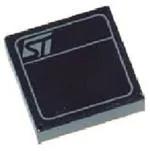
SPMD150STP
1.5 A stepper motor driver module
Features
■
Wide supply voltage range, up to 42 V
■
1.5 A output average working current
■
Full/half step and micro-stepping drive
capability
■
Logic signals TTL/CMOS compatible
■
Programmable motor phase current
■
Selectable slow/fast current decay
■
Non dissipative overcurrent protection
■
Remote shutdown
■
Thermal shutdown
■
Module size: 50.8 x 50.8 x 14.7 mm
■
Operating temperature range -40°C to 85 °C
Table 1.
Device summary
Order code
Description
SPMD150STP
The SPMD150STP is a highly integrated stepper
motor driver module, that allows the user to easily
design a complete motor control system for twophase bipolar stepper motors, interfacing directly
the microprocessor to the motor.
The SPMD150STP is an easy-to-use fully
integrated answer to motion control issues.
The phase current is chopper controlled, allowing
good performances and high speed.
Modules offer an extensive range of protection
such as overcurrent and thermal shut-down, that
make it “bullet” proof as required in modern
motion control systems.
Metallic case allows module to operate without
external heat-sink or ventilation; moreover the
sealed and molded package offers a complete
protection against harsh environments.
February 2010
Doc ID 17160 Rev 1
1/23
www.st.com
23
�Contents
SPMD150STP
Contents
1
Block diagram and pin connection . . . . . . . . . . . . . . . . . . . . . . . . . . . . . 3
2
Maximum ratings . . . . . . . . . . . . . . . . . . . . . . . . . . . . . . . . . . . . . . . . . . . . 6
3
Electrical characteristics . . . . . . . . . . . . . . . . . . . . . . . . . . . . . . . . . . . . . 7
4
Function description and application information . . . . . . . . . . . . . . . . 11
4.1
Power stage . . . . . . . . . . . . . . . . . . . . . . . . . . . . . . . . . . . . . . . . . . . . . . . 11
4.2
Logic interface . . . . . . . . . . . . . . . . . . . . . . . . . . . . . . . . . . . . . . . . . . . . . 11
4.3
PWM current controller . . . . . . . . . . . . . . . . . . . . . . . . . . . . . . . . . . . . . . . 12
4.4
Decay modes . . . . . . . . . . . . . . . . . . . . . . . . . . . . . . . . . . . . . . . . . . . . . . 15
4.5
Stepping sequence generation . . . . . . . . . . . . . . . . . . . . . . . . . . . . . . . . . 16
4.5.1
Half step mode . . . . . . . . . . . . . . . . . . . . . . . . . . . . . . . . . . . . . . . . . . . . 16
4.5.2
Normal drive mode (full-step two-phase-on) . . . . . . . . . . . . . . . . . . . . . 17
4.5.3
Wave drive mode (Full-step one-phase-on) . . . . . . . . . . . . . . . . . . . . . . 17
4.5.4
Microstepping . . . . . . . . . . . . . . . . . . . . . . . . . . . . . . . . . . . . . . . . . . . . 18
4.6
Non-dissipative overcurrent protection . . . . . . . . . . . . . . . . . . . . . . . . . . . 19
4.7
Thermal characteristics . . . . . . . . . . . . . . . . . . . . . . . . . . . . . . . . . . . . . . 20
4.8
Case grounding . . . . . . . . . . . . . . . . . . . . . . . . . . . . . . . . . . . . . . . . . . . . 20
5
Package mechanical data . . . . . . . . . . . . . . . . . . . . . . . . . . . . . . . . . . . . 21
6
Revision history . . . . . . . . . . . . . . . . . . . . . . . . . . . . . . . . . . . . . . . . . . . 22
2/23
Doc ID 17160 Rev 1
�SPMD150STP
1
Block diagram and pin connection
Block diagram and pin connection
Figure 1.
Block diagram
Figure 2.
Connection diagram (top view)
Doc ID 17160 Rev 1
3/23
�Block diagram and pin connection
Table 2.
Pin description
Pin N.
Name
Function
1
VSS
Logic stage supply voltage. This pin must be supplied with 3.3V or 5V source.
2
REF
Voltage reference output. A voltage of 1.225V is available at this pin. It can be
used to set the output current level.
3
RESET
Reset pin. A logic level low restores the home state (State 1) on the phase
sequence generator. A 10kΩ pull-up resistor is internally connected to VSS.
4
CLOCK
Step clock. On the rising edge of this signal, the phase sequence generator
changes its state position, consequently the motor performs a step. A 10kΩ
pull-up resistor is internally connected to VSS.
CW/CCW
Spin direction control input. A logic level high sets clockwise motor rotation.
A logic level Low sets counter clockwise motor rotation.Physical direction of
rotation depends on windings connection also. A 10 kΩ pull-up resistor is
internally connected to VSS.
5
6
7
8
VREFA
Phase A/B current setting input. Connect this pin to a properly scaled REF
(Pin2) voltage, to fix the maximum phase output current. Connecting a variable
voltage source (i.e. microcontroller DAC), it is possible to perform microstepping drive.
The pin is internally connected to a 100kΩ pull-down resistor, with a 470pF
parallel capacitor.
RCA
Phase A/B current controller Off-Time set pin.
Use this pin to set the desired Off-time of the switching current controller.
A 470pF capacitor and 56kΩ resistor are internally connected between this pin
and GND1 (Pin13), giving a 16μs -time.
EN
Module enable input. A high logic level enables module operation.
EN (pin8) must be low, during power-up and power-down sequence, High
during normal operation. (When this input is low, the output phases are in high
impedance state, enabling the manual positioning of the motor).
A 100kΩ pull-up resistor is internally connected to VSS.
A 100nF capacitor is internally connected to GND1
9
Phase current decay mode selection input.
A logic level high sets the slow decay mode.
CONTROL
A logic level low sets the fast decay mode
A 10kΩ pull-up resistor is internally connected to VSS.
10
Half/Full step mode selection input.
A logic level high sets the half step mode.
HALF/FULL
A logic level low sets the full step mode.
A 10kΩ pull-up resistor is internally connected to VSS.
11
4/23
SPMD150STP
VREFB
Phase C/D current setting input.
Connect this pin to a properly scaled REF (Pin2) voltage, to fix the maximum
phase output current. Connecting a variable voltage source (i.e.
microcontroller DAC), it is possible to perform micro-stepping drive.
The pin is internally connected to a 100kΩ pull-down resistor, with a 470pF
parallel capacitor.
Doc ID 17160 Rev 1
�SPMD150STP
Block diagram and pin connection
Table 2.
Pin N.
Pin description (continued)
Name
Function
12
RCB
Phase C/D current controller -Time set pin.
Use this pin to set the desired Off-time of the switching current controller.
A 470pF capacitor and 56kΩ resistor are internally connected between this pin
and GND1 (Pin13), giving a 16 µs -time.
13
GND1
Logic stage GND. Return path for the logic signals and VSS (pin1) supply
voltage.
14
GND2
Power stage GND. Return path for the power stage and VS (pin19) supply
voltage.
15
PHD
Phase D output
16
PHC
Phase C output
17
PHB
Phase B output
18
PHA
Phase A output
19
VS
Power stage supply voltage. Module and motor supply voltage.
Maximum voltage must not exceed the specified values.
Doc ID 17160 Rev 1
5/23
�Maximum ratings
2
SPMD150STP
Maximum ratings
Table 3.
Absolute maximum ratings
Symbol
6/23
Parameter
Value
Unit
VS
DC supply voltage (pin19)
50
V
VSS
DC logic supply voltage (pin1)
7
V
-0.3 to 7
V
2.5
A
Vinput
Voltage range at pins VREFA, VREFB, RCA, RCB, EN,
CLOCK, CW/CCW, HALF/FULL, CONTROL
Io-pk
Output peak current
Tstg
Storage temperature range
– 40 to +105
°C
Top
Operating case temperature range
– 40 to +85
°C
Doc ID 17160 Rev 1
�SPMD150STP
3
Electrical characteristics
Electrical characteristics
TA = 25 °C and VS = 24 V, VSS = 5 V unless otherwise specified.
Table 4.
Electrical characteristics
Value
Symbol
Parameter
Test conditions
Unit
Min
Typ
Max
Power stage
VS
DC supply voltage
IS
Quiescent supply current (pin19)
10
All bridges
42
V
5
10
mA
VSth(ON)
Turn-on Input threshold
6.6
7
7.4
V
VSth(OFF)
Turn-off Input threshold
5.6
6
6.4
V
ΔVVS-PH
Output voltage drop (VS to pins
15,16,17,18)
0.9
V
Output voltage drop (Pins15,16,17,18 to
Io = 1.5A
GND2)
1.1
V
Phase average working current
±1.5
A
7.1
A
ΔVPH-GND
Io
Io = -1.5A
Protections block
Io-sc
Phase short circuit current
Internally limited by overcurrent
protection
(Figure 7)
4
5.6
tOCD(ON)
Overcurrent detection turn-on delay time (Figure 7)
200
ns
tOCD(OFF)
Overcurrent detection turn-off delay time (Figure 7)
100
ns
Tj(OFF)
Junction shutdown temperature
165
°C
Logic interface
VSS
DC logic supply voltage
ISS
Quiescent supply current (pin 1)
All inputs open
VIL
Low level input voltage
Pin 5,9,10
VSS = 3 to 5.25V
VIH
High level input voltage
Pin 5,9,10
VSS=3 to 5.25V
Vth(ON)
Turn-on input threshold
Pin 3,4,8 VSS=3 to 5.25V
(Figure 1, 2, 3, 4)
Vth(OFF)
Turn-off input threshold
Pin 3,4,8 VSS=3 to 5.25V
(Figure 1, 2, 3, 4)
0.8
1.3
V
Vth(HYS)
Input threshold hysteresis
Pin 3,4,8 VSS=3 to 5.25V
(Figure 1, 2, 3, 4)
0.25
0.5
V
Low level Input current
Pin 3,4,5,8,9,10
-0.5
mA
IIL
3.0
Doc ID 17160 Rev 1
5
5.25
V
1.2
mA
-0.3
0.8
V
2
Vss
V
2.0
V
1.8
7/23
�Electrical characteristics
Table 4.
SPMD150STP
Electrical characteristics (continued)
Value
Symbol
Parameter
Test conditions
Unit
Min
IIH
VREF
High level Input current
Pin 3,4,5,8,9,10
Reference output voltage (pin 2)
Typ
Max
10
uA
1.21 1.225 1.24
V
REF_res
Reference output resistance (pin2)
10
kΩ
VREFx_res
Current setting input resistance (pin
6,11)
100
kΩ
Timing definition
tD(ON)EN
Enable to output turn-on delay
Io=2.5A, resistive load
(Figure 3)
100
250
400
ns
tD(OFF)EN
Enable to output turn-off delay
Io=2.5A, resistive load
(Figure 3)
300
550
800
ns
tRISE
Output rise time
Io=2.5A, resistive load
(Figure 3)
40
250
ns
tFALL
Output fall time
Io=2.5A, resistive load
(Figure 3)
40
250
ns
tDCLK
Clock to output delay time
Io=2.5A, resistive load
(Figure 4)
tCLK(MIN)L
Clock minimum low level time
(Figure 5)
1
µs
tCLK(MIN)H
Clock minimum high level time
(Figure 5)
1
µs
50
kHz
fCLK
Clock frequency
2
µs
tS(MIN)
Minimum set-up time
(Figure 6)
1
µs
tH(MIN)
Minimum hold time
(Figure 6)
1
µs
tR(MIN)
Minimum reset time
(Figure 6)
1
µs
Minimum reset to clock delay time
(Figure 6)
1
µs
tRCLK(MIN)
8/23
Doc ID 17160 Rev 1
�SPMD150STP
Figure 3.
Electrical characteristics
Switching characteristic definition
(1
9WK�21�
9WK�2))�
W
,287
���
���
W
'��,1����
W)$//
W'�2))�(1
Figure 4.
W5,6(
W'�21�(1
Clock to output delay time
&/2&.
9WK�21�
W
,287
W
'��,1����
Figure 5.
W'&/.
Minimum timing definition: clock
&/2&.
9WK�2))�
9WK�21�
W&/.�0,1�/
Doc ID 17160 Rev 1
9WK�2))�
W&/.�0,1�+
'��,1����
9/23
�Electrical characteristics
Figure 6.
SPMD150STP
Minimum timing definition: logic inputs
&/2&.
9WK�21�
/2*,&�,13876
W6�0,1�
5(6(7
9WK�2))�
9WK�21�
W5�0,1�
Figure 7.
W+�0,1�
W5&/.�0,1�
'��,1����
Overcurrent detection timing definition
,287
,629(5
21
%5,'*(
2))
9(1
���
���
W2&'�21�
10/23
Doc ID 17160 Rev 1
W2&'�2))�
'��,1����
�SPMD150STP
4
Function description and application information
Function description and application information
SPMD150STP can be seen divided in several main blocks (see Figure 1):
4.1
●
Power stage, to drive the motor windings
●
Logic interface, to interface the external signals to the internal circuitry
●
PWM current controller, to fix and control the current flowing in the motor phase
windings
●
Decay control block, to control the phase current decay mode
●
Phase sequence generator, to generate the motor phases driving sequence
●
Protection block, performing over current protectionand thermal shut-down to protect
the power bridges
Power stage
STMD150STP integrates two independent MOSFET full bridges, with intrinsic fast
freewheeling diodes. Switching patterns are generated by the phase sequence generator
and by the PWM current controller.
The power MOSFET cross conduction in one bridge leg, is avoided introducing a dead time
(tDT = 1 μs typical), between FETs switch off and the switch on.
VS (pin19) and GND2 (pin14) must be connected to the supply voltage, which can range
from 10 V to 42 V.
4.2
Logic interface
Logic interface connects the external logic signal to the proper internal blocks.
RESET (pin3), CLOCK (pin4), CW/CCW (pin5), CONTROL (pin9) and HALF/FULL (pin10)
have a 10kΩ pull-up resistor to VSS (pin1), in order to prevent floating pins;
VSS can be connected to 3.3 V or 5 V, allowing the interface with the most popular
microcontroller. The internal structure is shown in Figure 8.
EN (pin8) has identical input structure, with the exception that the MOSFET drain of the
over-current and thermal protection is also connected to this pin (see Figure 9).
Due to this connection some care needs to be taken in driving this pin.
Inside the module a 100 kΩ resistor and a 100 nF capacitor is provided, an open collector
driving is therefore the suggested solution.
Doc ID 17160 Rev 1
11/23
�Function description and application information
4.3
Figure 8.
Logic inputs internal structure
Figure 9.
EN pin open collector driving
SPMD150STP
PWM current controller
The control block is composed by a constant Off-time PWM current controller for both two
bridges. The current control circuit senses the bridge current, by sensing the voltage drop
across a sense resistor connected between the source of the two lower power MOSFETs
and ground. As the current in the motor buildup, the voltage across the sense resistor
increases proportionally. When the voltage on the sense resistor becomes greater than the
voltage at the reference inputs VREFA (pin6) or VREFB (pin11), the sense comparator
triggers a mono-stable circuit, switching the bridge off.
The bridge MOSFETs remain off for the time set by pin RCA (pin7) or RCB (pin12);
during this Off-time (see Figure 11, toff versus Roff and Coff), the motor phase current recirculates as defined by the selected decay mode, described in the next section. When the
mono-stable circuit times out, the bridge will turn on again. Since the internal dead time tDT,
used to prevent cross conduction in the bridge, delays the turn on of the power MOSFETs,
the effective Off-time is the sum of the mono-stable time plus the tDT (1µs). To set the toff
relative to Bridge A, it is necessary to connect a proper resistor Ra and/or a proper capacitor
Ca in parallel between pin RCA and GND1, see Figure 10 and Figure 11; To set the toff
relative to Bridge B, it is necessary to connect a proper resistor Rb and/or a proper capacitor
Cb in parallel between pin RCB and GND1, see Figure 10 and Figure 11; A 56 kΩ resistor
and a 470 pF capacitor are already present between pin RCA/B and GND1 inside the
12/23
Doc ID 17160 Rev 1
�SPMD150STP
Function description and application information
module, fixing a typical 16 µs off time for both bridges. The toff value can be modified adding
a capacitor to GND1, increasing the off time, or adding a resistor to GND1 decreasing the
Off-time.
Figure 10. toff setting circuit
Roff = Ra // 56kΩ [kΩ], Coff = Ca + 470pF [pF]
Figure 11. toff versus Roff and Coff
To set the maximum motor phase current it is necessary to give the proper reference voltage
at input VREFA (pin6) and VREFB (pin11).
The relationship between the voltage at VREFx pin and the phase current IOUTx is the
following:
IOUTx = VREFx / 0.192 [A]
An internal 100 kΩ resistor and a 470 pF capacitor are connected in parallel between
VREFx and GND1 (see Figure 12).
Doc ID 17160 Rev 1
13/23
�Function description and application information
SPMD150STP
Figure 12. VREFA and VREFB internal connection
The voltage at VREFA and VREFB can be supplied in two way:
●
Using an external source (see Figure 13), driving VREFA and VREFB pins together or
separately as in the micro-stepping mode (i.e: a micro-controller fixes a variable voltage
to get variable current in the stepper motor phases).
Figure 13. VREFx from an external source
●
Using the module reference voltage source, REF (pin2) (see Figure 14), which supplies
1.225 V. The REF pin has a 10 kΩ resistor in series, take that in account during design.
●
In this case a proper resistor Rx must be connected between REF and GND1, VREFA
and VREFB will be connected together to REF pin (see Figure 14).
Use following equation to calculate Rx:
Rx = (500 x IOUTx) / [319 - (60 x IOUTx)] [kΩ]
14/23
Doc ID 17160 Rev 1
where IOUTx = [A]
�SPMD150STP
Function description and application information
Figure 14. VREFx from internal source
4.4
Decay modes
The CONTROL input is used to select the behavior of the bridge during the off time. When
the CONTROL pin is low, the fast decay mode is selected and both transistors in the bridge
are switched off during the off time.
When the CONTROL pin is high, the slow decay mode is selected and only the low side
transistor of the bridge is switched off during the off time.
Figure 15 shows the operation of the bridge in the fast decay mode. At the start of the off
time, both of the power MOSFETs are switched off and the current recirculates through the
two opposite free wheeling diodes. The current decays with a high di/dt, since the voltage
across the coil is essentially the power supply voltage. After the dead time, the lower power
MOSFET in parallel with the conducting diode is turned on in synchronous rectification
mode. In applications where the motor current is low it is possible that the current can decay
completely to zero during the off time. At this point if both of the power MOS were operating
in the synchronous rectification mode it would then be possible for the current to build in the
opposite direction. To prevent this only the lower power MOS is operated in synchronous
rectification mode. This operation is called quasi-synchronous rectification mode. When the
mono-stable circuit times out, the power FETs are turned on again after some delay set by
the dead time to prevent cross conduction.
Doc ID 17160 Rev 1
15/23
�Function description and application information
SPMD150STP
Figure 15. Fast decay mode output stage configurations
$��21�7,0(
%���MV�'($'�7,0(
'��,1����
&��48$6,�6