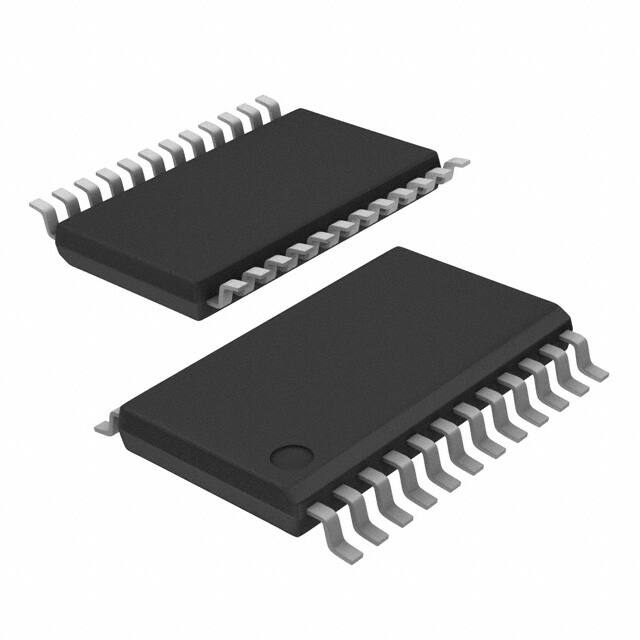
STP16CPC26
Low voltage 16-bit constant current LED sink driver
Datasheet - production data
Description
The STP16CPC26 is a monolithic, low voltage,
16-bit constant current LED sink driver. The
device contains a 16-bit shift register and data
latches, which convert serial input data into
parallel output format. In the output stage sixteen
regulated current generators provide 5 mA to
90 mA constant current to drive LEDs. The
current is externally adjusted through a resistor.
LED brightness can be adjusted from 0% to
100% via OE pin.
The STP16CPC26 guarantees a 20 V driving
capability, allowing users to connect more LEDs
in series to each current source.
Features
16 constant current output channels
Adjustable output current through external
resistor
Output current: 5 mA to 90 mA
±1% typical current accuracy bit to bit
Max clock frequency: 30 MHz
20 V current generators rated voltage
3 - 5.5 V power supply
Thermal shutdown for overtemperature
protection
The high 30 MHz clock frequency makes the
device suitable for high data rate transmission.
The thermal shutdown (170 °C with about 15 °C
hysteresis) assures protection from
overtemperature events.
The STP16CPC26 is housed in four different
packages: QSOP24, SO-24, TSSOP-24 and
HTSSOP-24 (with exposed pad).
Applications
Video display panel LED driver
Special lighting
Table 1: Device summary
Order code
Package
Packing
STP16CPC26MTR
SO-24
1000 parts per reel
STP16CPC26TTR
TSSOP24
2500 parts per reel
STP16CPC26XTR
TSSOP24 exposed pad
2500 parts per reel
STP16CPC26PTR
QSOP-24
2500 parts per reel
April 2017
DocID18469 Rev 6
This is information on a product in full production.
1/28
www.st.com
�Contents
STP16CPC26
Contents
1
Pin description ................................................................................ 3
2
Electrical ratings ............................................................................. 4
2.1
Absolute maximum ratings ................................................................ 4
2.2
Thermal data ..................................................................................... 4
3
Electrical characteristics ................................................................ 5
4
Simplified internal block diagram .................................................. 8
5
Typical application circuit............................................................... 8
6
7
Equivalent circuit and outputs ....................................................... 9
Typical test circuits ....................................................................... 11
8
Timing diagrams ............................................................................ 12
9
Current generators characteristics .............................................. 15
9.1
Current setting................................................................................. 15
9.2
Current accuracy ............................................................................. 15
9.3
Generators voltage drop ................................................................. 16
10
Thermal shutdown......................................................................... 16
11
Package information ..................................................................... 17
11.1
QSOP-24 package information ....................................................... 18
11.2
SO-24 package information ............................................................ 20
11.3
TSSOP24 package information ....................................................... 21
11.4
TSSOP24 exposed pad package information ................................. 23
11.5
TSSOP24, TSSOP24 exposed pad and ............................................
SO-24 packing information .............................................................. 25
12
2/28
Revision history ............................................................................ 27
DocID18469 Rev 6
�STP16CPC26
1
Pin description
Pin description
Figure 1: Pin connection
The exposed-pad (if present) should be electrically connected to a metal land
electrically isolated or connected to ground.
Table 2: Pin description
Pin n°
Symbol
Name and function
1
GND
Ground terminal
2
SDI
Serial data input terminal
3
CLK
Clock input terminal
4
LE
Latch input terminal
5-20
OUT 0-15
21
OE
Input terminal of output enable (active low)
22
SDO
Serial data out terminal
23
R-EXT
24
VDD
Output terminal
Input terminal for an external resistor for constant current programming
Supply voltage terminal
DocID18469 Rev 6
3/28
�Electrical ratings
STP16CPC26
2
Electrical ratings
2.1
Absolute maximum ratings
Stressing the device above the rating listed in the “absolute maximum ratings” table may
cause permanent damage to the device. These are stress ratings only and operation of the
device at these or any other conditions above those indicated in the operating sections of
this specification is not implied. Exposure to absolute maximum rating conditions for
extended periods may affect device reliability.
Table 3: Absolute maximum ratings
Symbol
2.2
Parameter
Value
Unit
VDD
Supply voltage
0 to 7
V
VO
Output voltage
-0.5 to 20
V
IO
Output current
90
mA
VI
Input voltage
-0.4 to VDD+0.4
V
1600
mA
IGND
GND terminal current
ESD
Electrostatic discharge protection HBM human body model
±2
kV
fCLK
Clock frequency
30
MHz
Value
Unit
Operating free-air temperature range
-40 to +125
°C
TOPR
Operating temperature range
-40 to +150
°C
TSTG
Storage temperature range
-55 to +150
°C
60
°C/W
85
°C/W
TSSOP24
exposed pad
37.5
°C/W
QSOP-24
72
°C/W
Thermal data
Table 4: Thermal data
Symbol
TA
Parameter
SO-24
TSSOP24
RthJA
Thermal resistance junction-ambient(1)
(2)
Notes:
4/28
(1)
According with JEDEC standard 51-7.
(2)
The exposed pad should be soldered directly to the PCB to realize the thermal benefits.
DocID18469 Rev 6
�STP16CPC26
3
Electrical characteristics
Electrical characteristics
VDD = 3.3 V - 5 V, TA = 25 °C, unless otherwise specified.
Table 5: Electrical characteristics
Symbol
Parameter
Test conditions
Min.
Typ.
Max.
Vdd
Supply voltage
VIH
Input voltage high level
0.8*Vdd
-
Vdd
VIL
Input voltage low level
GND
-
0.2*Vdd
VOL
VOH
Serial data output voltage
(SDO) (1)
IOH = - 1 mA
IOL = + 1 mA
IOH
Output leakage current
ΔIOL1
Current accuracy
channel to channel (2)(3)
3
5.5
-
-
0.4
VDD -0.4
-
-
Vo = 20 V,
Outn = OFF
-
-
0.5
Vds = 0.3 V,
REXT = 900 W,
IOL = 22 mA
-
±1
±3
ΔIOL2
-
±1
±3
DIOL3
Vds = 0.3 V,
REXT = 900 W,
IOL = 22 mA
-
-
±6
ΔIOL4
Vds = 0.6 V,
REXT = 360 W,
IOL = 55 mA
-
±6
Pull-up resistor for OE pin
250
500
800
Pull-down resistor for LE pin
250
500
800
REXT = OPEN
OUT 0 to 15 = OFF
-
3
7
REXT = 900 W
OUT 0 to 15 = OFF
-
7
10
IDD(OFF3)
REXT = 360 W
OUT 0 to 15 = OFF
-
11
13.5
IDD(ON1)
REXT = 900 W
OUT 0 to 15 = ON
-
7
11
REXT = 360 W
OUT 0 to 15 = ON
-
11
15
VDS from 1.0 V to 3.0 V
Io = 22 mA
Io = 55 mA
-
±0.1
-
RIN(down)
IDD(OFF1)
IDD(OFF2)
Supply current (OFF)
µA
%
-
RIN(up)
V
%
Vds = 0.6 V,
REXT = 360 W,
IOL = 55 mA
Current accuracy
device to device (2)
Unit
KW
mA
Supply current (ON)
IDD(ON2)
%/dVDS
Output current vs. output voltage
regulation
DocID18469 Rev 6
%/V
5/28
�Electrical characteristics
Symbol
%/dVDD
Tsd
Tsd-hy
STP16CPC26
Parameter
Test conditions
Output current vs. supply voltage
regulation (4)
Io = 22 mA;
VDS = 0.3 V
Io = 55 mA;
VDS = 0.6 V
Thermal shutdown
Thermal shutdown hysteresis
Min.
Typ.
Max.
Unit
-
±1
-
%/V
-
170
-
-
15
20
°C
(4)
Notes:
(1)
Specification referred to TJ from -40 °C to +125 °C. Specification over the -40 to +125 °C TJ temperature range are assured by
design, characterization and statistical correlation.
(2)
Tested with just one output ON.
(3)
ΔIOL+ = ((IOLmax - IOLmean)/ IOLmean)*100, DIOL- = ((IOLmin - IOLmean)/ IOLmean)*100, where IOLmean = (IOLout1+IOLout2+…+IOLout16) /
16.
(4)
Guaranteed by design.
6/28
DocID18469 Rev 6
�STP16CPC26
VDD = 3.3 V - 5 V, Tj = 25 °C, unless otherwise specified.
Electrical characteristics
Table 6: Switching characteristics
Symbol
Parameter
fclk
Clock frequency
tPLH1
CLK - OUTn
tPLH2
LE - OUTn
tPLH3
tPLHa
tPLHb
OE – OUTn
CLK - OUTn
tPHL2
LE - OUTn
tPHL3
OE – OUTn
tPHLb
CLK
tw(L)
LE
tw(OE)
OE
Typ.
Max.
Unit
-
-
30
MHz
-
100
-
-
100
-
-
100
-
VDD = 3.3 V
-
30
-
VDD = 5 V
-
20
-
-
28
-
-
28
-
Propagation delay time
(“H” to “L”)
CLK - SDO
tw(CLK)
Min.
Propagation delay time
(“L” to “H”)
CLK - SDO
tPHL1
tPHLa
Conditions
Pulse width
VDS = 0.8 V
VIH = VDD
VIL = GND
REXT = 900 Ω
RL = 50 Ω
CL = 10 pF
-
25
-
VDD = 3.3 V
-
30
-
VDD = 5 V
-
20
-
20
-
-
20
-
-
150
-
-
tsu(L)
Setup time for LE
5
-
-
th(L)
Hold time for LE
5
-
-
tsu(D)
Setup time for SDI
5
-
-
th(D)
Hold time for SDI
10
-
-
tr (1)
Maximum CLK rise time
-
-
5000
(1)
Maximum CLK fall time
-
-
5000
tor1a
Output rise time of Vout
tor1b
Output rise time of Vout
tof1a
Output fall time of Vout
tof1b
Output fall time of Vout
tor2a
Output rise time of Vout
tor2b
Output rise time of Vout
tof2a
Output fall time of Vout
tof2b
Output fall time of Vout
tf
Iout-ov
Output current turn-on overshoot
VIH = VDD,
VIL = GND
VDS = 0.8 V,
RL = 50 Ω
CL = 10 pF
Iout = 22 mA
VDD = 3.3 V
-
95
-
VDD = 5 V
-
85
-
VDD = 3.3 V
-
40
-
VDD = 5 V
-
25
-
VIH = VDD,
VIL = GND
VDS = 0.8 V
RL = 50 Ω
CL = 10 pF
Iout = 55 mA
VDD = 3.3 V
-
80
-
VDD = 5 V
-
70
-
VDD = 3.3 V
-
40
-
VDD = 5 V
-
30
-
-
-
0
VDS = 0.6 to 3V
CL = 10 pF
Iout = 5 to 60 mA
ns
%
Notes:
(1)If
devices are connected in cascade and tr or tf is large, it may be critical to achieve the timing required for data transfer
between two cascaded devices.
DocID18469 Rev 6
7/28
�Simplified internal block diagram
4
STP16CPC26
Simplified internal block diagram
Figure 2: STP16CPC26 simplified block diagram
5
Typical application circuit
Figure 3: Typical application circuit
8/28
DocID18469 Rev 6
�STP16CPC26
6
Equivalent circuit and outputs
Equivalent circuit and outputs
Figure 4: OE terminal
Figure 5: LE terminal
Figure 6: CLK, SDI terminal
DocID18469 Rev 6
9/28
�Equivalent circuit and outputs
STP16CPC26
Figure 7: SDO terminal
10/28
DocID18469 Rev 6
�STP16CPC26
7
Typical test circuits
Typical test circuits
Figure 8: "Typical test circuit for electrical characteristics" and Figure 9: "Typical test circuit
for switching characteristics" show respectively the typical test circuit used measuring
electrical (e.g. input voltage high/low level, output leakage current, supply current, etc.) and
switching characteristics (propagation delays, set-up and hold time, rise and fall time of
VOUT, etc.). The resistor RL and capacitor CL in parallel connected to each output in Figure
8: "Typical test circuit for electrical characteristics" simulate a LED behavior.
Figure 8: Typical test circuit for electrical characteristics
Figure 9: Typical test circuit for switching characteristics
DocID18469 Rev 6
11/28
�Timing diagrams
8
STP16CPC26
Timing diagrams
The timing diagram shown in Figure 10: "Timing diagram" and the truth table in Table 7:
"Truth table" explain how to send data to the device. This can be summarized in the
following points:
LE and OE are level sensitive and not synchronized with the CLK signal
When LE is at low level, the latch circuit holds previous data
If LE is high level, data present in the shift register are latched
When OE is at low level, the status of the outputs OUT0 to OUT15 depends on the
data in the latch circuits
With OE at high level, all outputs are switched off independently on the data stored
in the latch circuits
Every rising edge of the CLK signal, a new data on SDI pin is sampled. This data is
loaded into the shift register, whereas a bit is shifted out from SDO
Figure 10: Timing diagram
Table 7: Truth table
LE
OE
_|¯
H
L
Dn
Dn ..... Dn - 7 ..... Dn -15
Dn - 15
_|¯
L
L
Dn + 1
No change
Dn - 14
_|¯
H
L
Dn + 2
Dn + 2 ..... Dn - 5 ..... Dn -13
Dn - 13
¯|_
X
L
Dn + 3
Dn + 2 ..... Dn - 5 ..... Dn -13
Dn - 13
¯|_
X
H
Dn + 3
OFF
Dn - 13
Serial-IN
OUT0 ............. OUT7 ................ OUT15
Notes:
(1)
12/28
(1)
Clock
OUTn = ON when Dn = H, OUTn = OFF when Dn = L.
DocID18469 Rev 6
SDO
�STP16CPC26
Timing diagrams
Figure 11: Timing for clock signal, serial-in and serial out data
The correct sampling of the data depends on the stability of the data at SDI on the rising
edge of the clock signal and it is assured by a proper data setup and hold time (tSETUP1 And
tHOLD), as shown in Figure 11: "Timing for clock signal, serial-in and serial out data". The
same figure shows the propagation delay from CLK to SDO (t PLH/tPHL). Figure 12: "Timing
for clock signal serial-in data, latch enable, output enable and outputs" describes the setup
times for LE and OE signals (tSETUP2 and tSETUP3 respectively), the minimum duration of
these signals (tWLAT and tWENA respectively) and the propagation delay from CLK to OUT n,
LE to OUTn and OE to OUTn (tPLH1/tPHL1, tPLH2/tPHL2 and tPLH3/tPHL3 respectively). Finally
Figure 13: "Outputs" defines the turn-on and turn-off time (tr and tf) of the current
generators.
DocID18469 Rev 6
13/28
�Timing diagrams
STP16CPC26
Figure 12: Timing for clock signal serial-in data, latch enable, output enable and outputs
Figure 13: Outputs
14/28
DocID18469 Rev 6
�STP16CPC26
Current generators characteristics
9
Current generators characteristics
9.1
Current setting
The current of all outputs is programmed through an external resistor connected to R-EXT
pin, as shown in Figure 14: "Resistor for current programming". The curve in Figure 15:
"Output current vs R-EXT resistor" describes the relation between the current and the
resistor connected to R-EXT pin, whereas the Table 8: "Recommended values of Rext for
some output current value" shows how to set some typical current values.
Figure 14: Resistor for current programming
Figure 15: Output current vs R-EXT resistor
Table 8: Recommended values of Rext for some output current value
9.2
Output current [mA]
Rext [Ω]
Closer standard value (E24 series) [Ω]
5
4129
4300
10
2005
200
20
999
1000
40
471
470
60
322
330
90
217
220
Current accuracy
A typical current accuracy of ±1% (±3% maximum) between channels is guaranteed at 22
mA and 55 mA output current (refer to Table 6: "Switching characteristics") and ± 6%
(maximum) current accuracy between ICs.
DocID18469 Rev 6
15/28
�Thermal shutdown
9.3
STP16CPC26
Generators voltage drop
In order to correctly regulate the current, a minimum dropout voltage must be assured
across the current generators.
Figure 16: "Dropout voltage vs output current" and Table 9: "Dropout voltage vs output
current" provides just an indicative idea about the dropout voltage to assure over the
current range. However it is recommended to use value of VDROP slightly higher than those
indicated in Figure 16: "Dropout voltage vs output current" and Table 9: "Dropout voltage vs
output current".
Figure 16: Dropout voltage vs output current
Table 9: Dropout voltage vs output current
10
Output current [mA]
VDROP @ 3.3 V [mV]
VDROP @ 5 V [mV]
5
44
44
10
85
85
20
170
170
40
350
330
60
530
500
90
820
770
Thermal shutdown
The STP16CPC26 is featured with a thermal shutdown. This protection is triggered if the
junction temperature reaches 170 °C. When the thermal shutdown is activated, all outputs
are turned off independently on the data latched. Once the temperature decreases (thermal
shutdown hysteresis is typically 15 °C), the outputs are enabled again and the device
keeps on working.
Once the temperature decreases (thermal shutdown hysteresis is typically 15°C), the
outputs are enabled again and the device keeps on working.
16/28
DocID18469 Rev 6
�STP16CPC26
11
Package information
Package information
In order to meet environmental requirements, ST offers these devices in different grades of
ECOPACK® packages, depending on their level of environmental compliance. ECOPACK ®
specifications, grade definitions and product status are available at: www.st.com.
ECOPACK® is an ST trademark.
DocID18469 Rev 6
17/28
�Package information
11.1
STP16CPC26
QSOP-24 package information
Figure 17: QSOP-24 package outline
18/28
DocID18469 Rev 6
�STP16CPC26
Package information
Table 10: QSOP-24 mechanical data
mm
Dim.
Min.
Typ.
Max.
A
1.54
1.62
1.73
A1
0.10
0.15
0.25
A2
1.47
b
0.20
0.31
c
0.17
0.254
D
8.56
8.66
8.76
E
5.80
6.00
6.20
E1
3.80
3.91
4.01
e
0.635
L
0.40
0.635
0.89
h
0.25
0.33
0.41
<
0°
DocID18469 Rev 6
8°
19/28
�Package information
11.2
STP16CPC26
SO-24 package information
Figure 18: SO-24 package outline
20/28
DocID18469 Rev 6
�STP16CPC26
Package information
Table 11: SO-24 mechanical data
mm
Dim.
Min.
Typ.
A
2.35
2.65
A1
0.10
0.30
B
0.33
0.51
C
0.23
0.32
D
15.20
15.60
E
7.40
e
7.60
1.27
H
10.00
10.65
h
0.25
0.75
L
0.40
1.27
k
0
8
ddd
11.3
Max.
0.10
TSSOP24 package information
Figure 19: TSSOP24 package outline
DocID18469 Rev 6
21/28
�Package information
STP16CPC26
Table 12: TSSOP24 mechanical data
mm
Dim.
Min.
Typ.
A
A1
1.1
0.05
A2
0.15
0.9
b
0.19
0.30
c
0.09
0.20
D
7.7
7.9
E
4.3
4.5
e
22/28
Max.
0.65 BSC
H
6.25
6.5
K
0°
8°
L
0.50
0.70
DocID18469 Rev 6
�STP16CPC26
11.4
Package information
TSSOP24 exposed pad package information
Figure 20: TSSOP24 exposed pad package outline
DocID18469 Rev 6
23/28
�Package information
STP16CPC26
Table 13: TSSOP24 exposed pad mechanical data
mm
Dim.
Min.
Max.
A
1.20
A1
0.15
A2
0.80
b
0.19
0.30
c
0.09
0.20
1.00
1.05
D
7.70
7.80
7.90
D1
4.80
5.00
5.2
E
6.20
6.40
6.60
E1
4.30
4.40
4.50
E2
3.00
3.20
3.40
e
L
0.65
0.45
L1
k
060
075
1.00
0°
aaa
24/28
Typ.
8°
0.10
DocID18469 Rev 6
�STP16CPC26
11.5
Package information
TSSOP24, TSSOP24 exposed pad and SO-24 packing
information
Figure 21: TSSOP24, TSSOP24 exposed pad and SO-24 reel outline
Table 14: TSSOP24 and TSSOP24 exposed pad tape and reel mechanical data
mm
Dim.
Min.
A
Typ.
Max.
-
330
13.2
C
12.8
-
D
20.2
-
N
60
-
T
-
22.4
Ao
6.8
-
7
Bo
8.2
-
8.4
Ko
1.7
-
1.9
Po
3.9
-
4.1
P
11.9
-
12.1
DocID18469 Rev 6
25/28
�Package information
STP16CPC26
Table 15: SO-24 tape and reel mechanical data
mm
Dim.
Min.
A
Max.
-
330
13.2
C
12.8
-
D
20.2
-
N
60
-
T
26/28
Typ.
-
30.4
Ao
10.8
-
11.0
Bo
15.7
-
15.9
Ko
2.9
-
3.1
Po
3.9
-
4.1
P
11.9
-
12.1
DocID18469 Rev 6
�STP16CPC26
12
Revision history
Revision history
Table 16: Document revision history
Date
Revision
04-Mar-2011
1
First release
05-Apr-2011
2
Updated Table 6
19-Jul-2012
3
Updated Table 7.
19-Jul-2012
4
Updated characteristics in Table 5: Electrical characteristics and
Table 6: Switching characteristics.
Minor text changes.
1-Jun-2014
5
Updated template and value Table 13: TSSOP24 exposed pad
mechanical data.
6
Updated Figure 11: "Timing for clock signal, serial-in and serial out
data" and Figure 12: "Timing for clock signal serial-in data, latch
enable, output enable and outputs", Section 11.1: "QSOP-24
package information".
Minor text changes.
13-Apr-2017
Changes
DocID18469 Rev 6
27/28
�STP16CPC26
IMPORTANT NOTICE – PLEASE READ CAREFULLY
STMicroelectronics NV and its subsidiaries (“ST”) reserve the right to make changes, corrections, enhancements, modifications, and
improvements to ST products and/or to this document at any time without notice. Purchasers should obtain the latest relevant information on ST
products before placing orders. ST products are sold pursuant to ST’s terms and conditions of sale in place at the time of order
acknowledgement.
Purchasers are solely responsible for the choice, selection, and use of ST products and ST assumes no liability for application assistance or the
design of Purchasers’ products.
No license, express or implied, to any intellectual property right is granted by ST herein.
Resale of ST products with provisions different from the information set forth herein shall void any warranty granted by ST for such product.
ST and the ST logo are trademarks of ST. All other product or service names are the property of their respective owners.
Information in this document supersedes and replaces information previously supplied in any prior versions of this document.
© 2017 STMicroelectronics – All rights reserved
28/28
DocID18469 Rev 6
�