TDA7405
EQUALIZER CARRADIO SIGNAL PROCESSOR
1
■
■
■
FEATURES
3 STEREO INPUTS
3 MONO INPUTS
DYNAMIC-COMPRESSION-STAGE FOR CD
BASS, TREBLE AND LOUDNESS CONTROL
EQ-FILTERS FOR SEPARATE FRONT/REAREQUALIZATION
VOICE-BAND-FILTER FOR MIXING-CHANNEL
DIRECT MUTE AND SOFTMUTE
INTERNAL BEEP
FOUR INDEPENDENT SPEAKER-OUTPUTS
INDEPENDENT SECOND SOURCE-SELECTOR
FULL MIXING CAPABILITY
PAUSE DETECTOR
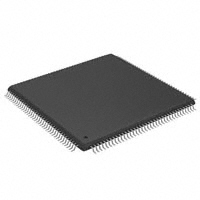
Figure 1. Package
)
s
(
t
c
u
d
o s)
r
(
P
t
c
e u
t
e
l od
o
s Pr
b
O ete
l
)
o
s
(
s
t
b
c
u -O
d
o s)
r
P
(
t
e uc
t
e
l od
o
s Pr
b
O te
e
l
o
s
b
■
■
■
■
■
■
■
■
■
TQFP44
Table 1. Order Codes
Package
TDA7405
TQFP44
1.2 Digital control:
■
1.1 Stereodecoder
■ RDS MUTE
■ NO EXTERNAL ADJUSTMENTS
■ AM/FM NOISEBLANKER WITH SEVERAL
TRIGGER CONTROLS
■ PROGRAMMABLE MULTIPATH DETECTOR
■ QUALITY DETECTOR OUTPUT
Part Number
2
I2C-BUS INTERFACE
DESCRIPTION
The device includes a high performance audioprocessor
and a stereodecoder-noiseblanker combination with the
whole low frequency signal processing necessary for
state-of-the-art as well as future carradios. The digital
control allows a programming in a wide range of all the
filter characteristics. Also the stereodecoder part offers
several possibilities of programming especially for the
adaptation to different IF-devices.
Figure 2. BLOCK DIAGRAM
O
May 2004
REV. 2
1/57
�TDA7405
Table 2. SUPPLY
Symbol
Parameter
Test Condition
Min.
Typ.
Max.
Unit
7.5
9
10.5
V
45
65
85
mA
Vs
Supply Voltage
Is
Supply Current
Vs = 9V
Ripple Rejection @ 1KHz
Audioprocessor(all Filters flat)
60
dB
Stereodecoder + Audioprocessor
55
dB
SVRR
Table 3. THERMAL DATA
)
s
(
t
c
u
d
o s)
r
(
P
t
c
e u
t
e
l od
o
s Pr
b
O ete
l
)
o
s
(
s
t
b
c
u -O
d
o s)
r
P
(
t
e uc
t
e
l od
o
s Pr
b
O te
e
l
o
s
b
Symbol
Parameter
RTh j-pins Thermal Resistance Junction-pins max
Value
Unit
65
°C/W
Value
Unit
10.5
V
-40 to 85
°C
-55 to +150
°C
Table 4. ABSOLUTE MAXIMUM RATINGS
Symbol
Vs
Parameter
Operating Supply Voltage
Tamb
Operating Temperature Range
Tstg
Storage Temperature Range
3
ESD
All pins are protected against ESD according to the MIL883 standard.
Figure 3. PIN CONNECTION (Top view)
O
2/57
�TDA7405
Figure 4. BLOCK DIAGRAM (Enlarged view)
)
s
(
t
c
u
d
o s)
r
(
P
t
c
e u
t
e
l od
o
s Pr
b
O ete
l
)
o
s
(
s
t
b
c
u -O
d
o s)
r
P
(
t
e uc
t
e
l od
o
s Pr
b
O te
e
l
o
s
b
O
3/57
�TDA7405
4
AUDIOPROCESSOR PART
Features:
Input Multiplexer
2 fully differential CD stereo inputs with programmable attenuation
1 single-ended stereo input
2 differential mono input
1 single-ended mono input
In-Gain 0..15dB, 1dB steps
internal Offset-cancellation (AutoZero)
separate second source-selector
Beep
internal Beep with 3 frequencies + diagnostic setting (19kHz tone)
Mixing stage
Beep, Phone,Navigation and FM mixable to all speaker-outputs (see Figure 20)
)
s
(
t
c
u
d
o s)
r
(
P
t
c
e u
t
e
l od
o
s Pr
b
O ete
l
)
o
s
(
s
t
b
c
u -O
d
o s)
r
P
(
t
e uc
t
e
l od
o
s Pr
b
O te
e
l
o
s
b
programmabe Voice-Band Filter
Loudness
programmable center frequency and frequency response
15 x 1dB steps
selectable flat-mode (constant attenuation)
Volume
0.5dB attenuator
100dB range
soft-step control with programmable times
Bass
2nd order frequency response
center frequency programmable in 8 steps
DC gain programmable
± 15 x 0.5dB steps
Treble
2nd order frequency response
center frequency programmable in 4 steps
± 15 x 1dB steps
Equalizer
two stereo equalizing-filters for separate front/rear adaption
1st filter center-frequency programmable in 16 steps (4 steps/octave, min 63Hz, max
840Hz)
2nd filter center-frequency programmable in 16 steps (4 steps/octave, min 300Hz,
max 4kHz)
quality factor programmable in 4 steps
± 15 x 1dB steps
selectable flat-mode
Speaker
4 independent speaker controls in 1dB steps
control range 95dB
O
Mute Functions
separate Mute
direct mute
digitally controlled SoftMute with 4 programmable mute-times
Pause Detector
programmable threshold
Compander
dynamic range compression for use with CD
2:1 compression rate
programmable max. gain
4/57
�TDA7405
Table 5. ELECTRICAL CHARACTERISTICS
(VS=9V; Tamb=25°C; RL=10kΩ; all gains=0dB; f=1kHz; unless otherwise specified)
Symbol
Parameter
Test Condition
Min.
Typ.
Max.
Unit
70
100
130
kΩ
INPUT SELECTOR
Rin
Input Resistance
all single ended Inputs
VCL
Clipping Level
2.0
2.2
VRMS
SIN
Input Separation
80
100
dB
GIN MIN
Min. Input Gain
-1
0
+1
dB
GIN MAX
Max. Input Gain
13
15
17
dB
GSTEP
Step Resolution
0.5
1
1.5
dB
Adjacent Gain Steps
-5
1
5
mV
GMIN to GMAX
-10
1
10
mV
)
s
(
t
c
u
d
o s)
r
(
P
t
c
e u
t
e
l od
o
s Pr
b
O ete
l
)
o
s
(
s
t
b
c
u -O
d
o s)
r
P
(
t
e uc
t
e
l od
o
s Pr
b
O te
e
l
o
s
b
VDC
Voffset
DC Steps
Remaining offset with AutoZero
0.5
mV
DIFFERENTIAL STEREO INPUTS
Rin
GCD
CMRR
eNO
Input Resistance
(see Fig. 1)
Differential
70
100
130
kΩ
Gain
only at true differential input
-1
0
1
dB
-5
-6
-7
dB
-13
dB
Common Mode Rejection Ratio
-11
-12
VCM = 1VRMS @ 1kHz
46
70
dB
VCM = 1VRMS @ 10kHz
46
60
dB
Output-Noise @ Speaker-Outputs 20Hz - 20kHz, flat; all stages 0dB
9
15
µV
72
kΩ
DIFFERENTIAL MONO INPUTS
Rin
CMRR
Input Impedance
Differential
40
56
Common Mode Rejection Ratio
VCM = 1VRMS @ 1kHz
46
70
dB
VCM = 1VRMS @ 10kHz
46
60
dB
BEEP CONTROL
O
VRMS
Beep Level
Mix-Gain = 6dB
250
3501)
500
mV
fBeep
Beep Frequency
fBeep1
470
500
530
Hz
fBeep2
740
780
820
Hz
fBeep3
1.7
1.8
1.9
kHz
fBeep4
18
19
20
kHz
1. The Level for the 19kHz-Testtone is 2.1VRMS
MIXING CONTROL
MLEVEL
Mixing Ratio
Main / Mix-Source
-6/-6
dB
GMAX
Max. Gain
13
15
17
dB
AMAX
Max. Attenuation
-83
-79
-75
dB
ASTEP
Attennuation Step
0.5
1
1.5
dB
5/57
�TDA7405
Table 5. ELECTRICAL CHARACTERISTICS (continued)
(VS=9V; Tamb=25°C; RL=10kΩ; all gains=0dB; f=1kHz; unless otherwise specified)
Symbol
Parameter
MULTIPLEXER
ROUT
Test Condition
Output Impedance
Output Load Capacitance
RL
Min.
Typ.
Max.
Unit
800
1000
Ω
OUTPUT2)
2
kΩ
CL
VDC
DC Voltage Level
4.3
4.5
10
nF
4.7
V
2. If confgured as Multiplexer-Output
)
s
(
t
c
u
d
o s)
r
(
P
t
c
e u
t
e
l od
o
s Pr
b
O ete
l
)
o
s
(
s
t
b
c
u -O
d
o s)
r
P
(
t
e uc
t
e
l od
o
s Pr
b
O te
e
l
o
s
b
LOUDNESS CONTROL
ASTEP
Step Resolution
0.5
1
1.5
dB
AMAX
Max. Attenuation
-21
-19
-17
dB
fPeak
Peak Frequency
fP1
180
200
220
Hz
fP2
360
400
440
Hz
fP3
540
600
660
Hz
fP4
720
800
880
Hz
VOLUME CONTROL
GMAX
Max. Gain
30
32
34
dB
AMAX
Max. Attenuation
-83
-79.5
-75
dB
ASTEP
Step Resolution
0
0.5
1
dB
G = -20 to +20dB
-0.75
0
+0.75
dB
G = -80 to -20dB
-4
0
3
dB
2
dB
Attenuation Set Error
EA
Tracking Error
ET
VDC
DC Steps
Adjacent Attenuation Steps
0.1
3
mV
From 0dB to GMIN
0.5
5
mV
SOFT MUTE
AMUTE
Mute Attenuation
Delay Time
TD
80
dB
T1
0.48
1
ms
T2
0.96
2
ms
T3
70
123
170
ms
T4
200
324
600
ms
1
V
VTH low
Low Threshold for SM-Pin3)
VTH high
High Threshold for SM - Pin
2.5
RPU
Internal pull-up resistor
32
VPU
Internal pull-up Voltage
O
100
V
45
58
3.3
kΩ
V
3. The SM-Pin is active low (Mute = 0)
BASS CONTROL
CRANGE
Control Range
±14
+15.5
±16
dB
ASTEP
Step Resolution
0.1
0.5
1.0
dB
6/57
�TDA7405
Table 5. ELECTRICAL CHARACTERISTICS (continued)
(VS=9V; Tamb=25°C; RL=10kΩ; all gains=0dB; f=1kHz; unless otherwise specified)
Symbol
fC
Parameter
Center Frequency
Min.
Typ.
Max.
Unit
fC1
Test Condition
54
60
66
Hz
fC2
63
70
77
Hz
fC3
72
80
88
Hz
fC4
81
90
99
Hz
fC5
90
100
110
Hz
fC6
117
130
143
Hz
fC7
135
150
165
Hz
fC8
180
200
220
Hz
Q1
0.9
1
1.1
Q2
1.1
1.25
1.4
Q3
1.3
1.5
1.7
Q4
1.8
2
2.2
DC = off
-1
0
+1
dB
DC = on
4
4.4
6
dB
)
s
(
t
c
u
d
o s)
r
(
P
t
c
e u
t
e
l od
o
s Pr
b
O ete
l
)
o
s
(
s
t
b
c
u -O
d
o s)
r
P
(
t
e uc
t
e
l od
o
s Pr
b
O te
e
l
o
s
b
QBASS
DCGAIN
Quality Factor
Bass-DC-Gain
TREBLE CONTROL
CRANGE
Control Range
±14
+15
±16
dB
ASTEP
Step Resolution
0.5
1
1.5
dB
fC1
8
10
12
kHz
fC2
10
12.5
15
kHz
fC3
12
15
18
kHz
fC4
14
17.5
21
kHz
Center Frequency
fC
PAUSE DETECTOR4)
VTH
Zero Crossing Threshold
IDELAY
Pull-Up Current
VTHP
Pause Threshold
Window 1
40
mV
Window 2
80
mV
Window 3
160
mV
15
25
35
3.0
µA
V
4. If configured as Pause-Output
SPEAKER ATTENUATORS
O
Rin
Input Impedance
35
50
65
kΩ
GMAX
Max. Gain
14
15
16
dB
AMAX
Max. Attenuation
-83
-79
-75
dB
ASTEP
Step Resolution
0.5
1
1.5
dB
AMUTE
Output Mute Attenuation
80
90
dB
7/57
�TDA7405
Table 5. ELECTRICAL CHARACTERISTICS (continued)
(VS=9V; Tamb=25°C; RL=10kΩ; all gains=0dB; f=1kHz; unless otherwise specified)
Symbol
EE
VDC
Parameter
Test Condition
Min.
Typ.
Attenuation Set Error
DC Steps
Adjacent Attenuation Steps
Max.
Unit
2
dB
0.1
5
mV
MONO VOICE BANDPASS
fHP
Highpass corner frequency
fHP1
81
90
99
Hz
fHP2
120
135
150
Hz
fHP3
162
180
198
Hz
fHP4
193
215
237
Hz
fHP5
270
300
330
Hz
fHP6
405
450
495
Hz
fHP7
540
600
660
Hz
fHP8
675
750
825
Hz
fLP1
2.7
3
3.3
kHz
fLP2
5.4
6
6.6
kHz
)
s
(
t
c
u
d
o s)
r
(
P
t
c
e u
t
e
l od
o
s Pr
b
O ete
l
)
o
s
(
s
t
b
c
u -O
d
o s)
r
P
(
t
e uc
t
e
l od
o
s Pr
b
O te
e
l
o
s
b
fLP
Lowpass corner frequency
COMPANDER
GMAX
tAtt
tRel
VREF
CF
max. Compander Gain
Attack time
Release time
Compander Reference InputLevel (equals 0dB)
Compression Factor
Vi < -46dB
19
dB
Vi < -46dB, Anti-Clip=On
29
dB
tAtt1
6
ms
tAtt2
12
ms
tAtt3
24
ms
tAtt4
49
ms
tRel1
390
ms
tRel2
780
ms
tRel3
1.17
s
tRel4
1.56
s
VREF1
0.5
VRMS
VREF2
1.0
VRMS
VREF3
2.0
VRMS
Output Signal / Input Signal
0.5
AUDIO OUTPUTS
O
VCLIP
Clipping Level
RL
Output Load Resistance
CL
Output Load Capacitance
ROUT
Output Impedance
VDC
DC Voltage Level
8/57
d = 0.3%
2.0
2.2
VRMS
2
4.3
kΩ
10
nF
30
120
Ω
4.5
4.7
V
�TDA7405
Table 5. ELECTRICAL CHARACTERISTICS (continued)
(VS=9V; Tamb=25°C; RL=10kΩ; all gains=0dB; f=1kHz; unless otherwise specified)
Symbol
Parameter
Test Condition
Min.
Typ.
Max.
Unit
BW = 20Hz - 20kHz;output muted
3
15
µV
BW = 20Hz - 20kHz
all gains = 0dB
single ended inputs
10
20
µV
GENERAL
eNO
S/N
Output Noise
Signal to Noise Ratio
all gains = 0dB
flat; VO = 2VRMS
106
dB
)
s
(
t
c
u
d
o s)
r
(
P
t
c
e u
t
e
l od
o
s Pr
b
O ete
l
)
o
s
(
s
t
b
c
u -O
d
o s)
r
P
(
t
e uc
t
e
l od
o
s Pr
b
O te
e
l
o
s
b
100
bass, treble at +12dB;
a-weighted; VO = 2.6VRMS
d
distortion
SC
Channel Separation left/right
ET
Total Tracking Error
dB
VIN = 1VRMS ; all stages 0dB
0.005
0.1
%
VOUT = 1VRMS ; Bass & Treble = 12dB
0.05
0.1
%
80
100
dB
AV = 0 to -20dB
-1
0
1
dB
AV = -20 to -60dB
-2
0
2
dB
O
9/57
�TDA7405
5
DESCRIPTION OF THE AUDIOPROCESSOR PART
5.1 Input stages
In the basic configuration two full-differential, two mono-differential, one single ended stereo and one singleended mono input are available. In addition a dedicated input for the stereodecoder MPX-signal is present.
Figure 5. Input stages
)
s
(
t
c
u
d
o s)
r
(
P
t
c
e u
t
e
l od
o
s Pr
b
O ete
l
)
o
s
(
s
t
b
c
u -O
d
o s)
r
P
(
t
e uc
t
e
l od
o
s Pr
b
O te
e
l
o
s
b
5.1.1 Full-differential stereo Input 1 (FD1)
O
The FD1-input is implemented as a buffered full-differential stereo stage with 100kΩ input-impedance at each
input. The attenuation is programmable in 3 steps from 0 to -12dB in order to adapt the incoming signal level.
A 6dB attenuation is included in the differential stage, the additional 6dB are done by a following resistive divider. This input is also configurable as two single-ended stereo inputs (see pin-out).
5.1.2 Full-differential stereo Input 2 (FD2)
The FD2-input has the same general structure as FD1, but with a programmable attenuation of 0 or 6dB embedded in the differential stage.
10/57
�TDA7405
5.1.3 Mono-differential Input 1 (MD1)
The MD1-input is designed as a basic differential stage with 56kΩ input-impedance. This input is configurable
as a single-ended stereo input (see pin-out).
5.1.4 Mono-differential Input 2 (MD2)
The MD2-input has the same topology as MD1, but without the possibility to configure it to single ended.
5.1.5 Single-ended stereo Input (SE1), single-ended mono input (AM) and FM-MPX input
All single ended inputs offer an input impedance of 100kW. The AM-pin can be connected by software to the
input of the stereodecoder in order to use the AM-Noiseblanker and AM-High-Cut feature.
5.2 AutoZero
)
s
(
t
c
u
d
o s)
r
(
P
t
c
e u
t
e
l od
o
s Pr
b
O ete
l
)
o
s
(
s
t
b
c
u -O
d
o s)
r
P
(
t
e uc
t
e
l od
o
s Pr
b
O te
e
l
o
s
b
The AutoZero allows a reduction of the number of pins as well as external components by canceling any offset
generated by or before the In-Gain-stage (Please notice that externally generated offsets, e.g. generated
through the leakage current of the coupling capacitors, are not canceled).
The auto-zeroing is started every time the DATA-BYTE 0 is selected and needs max. 0.3ms for the alignment.
To avoid audible clicks the Audioprocessor is muted before the loudness stage during this time. The AutoZerofeature is only present in the main signal-path.
5.2.1 AutoZero for Stereodecoder-Selection
A special procedure is recommended for selecting the stereodecoder at the main input-selector to guarantee
an optimum offset-cancellation:
(Step 0: SoftMute or Mute the signal-path)
Step 1: Temporary deselect the stereodecoder at all input-selectors
Step 2: Configure the stereodecoder via IIC-Bus
Step 3: Wait 1ms
Step 4: Select the stereodecoder at the main input-selector first
The root cause of this procedure is, that after muting the stereodecoder (Step 1), the internal stereodecoder
filters have to settle in order to perform a proper offset-cancellation.
5.2.2 AutoZero-Remain
In some cases, for example if the µP is executing a refresh cycle of the IIC-Bus-programming, it is not useful
to start a new AutoZero-action because no new source is selected and an undesired mute would appear at the
outputs. For such applications the A631 could be switched in the AutoZero-Remain-Mode (Bit 6 of the subaddress-byte). If this bit is set to high, the DATABYTE 0 could be loaded without invoking the AutoZero and the
old adjustment-value remains.
5.3 Pause Detector / MUX-Output
The pin number 40(Pause/MUX) is configurable for two different functions:
O
1. During Pause-Detector OFF this pin is used as a mono-output of the main input-selector. This signal is
often used to drive a level-/equalizer-display on the carradio front-panel.
2. During Pause-Detector ON the pin is used to define the time-constant of the detector by an external capacitor.
The pause-detector is driven by the internal stereodecoder-outputs in order to use pauses in the FM-signal for
alternate-frequency-jumps. If the signal-level of both stereodecoder channels is outside the programmed voltage-window, the external capacitor is abruptly discharged. Inside the pause-condition the capacitor is slowly recharged by a constant current of 25µA. The pause information is also available via IIC-Bus (see IIC-Bus
programming).
11/57
�TDA7405
5.4 Loudness
There are four parameters programmable in the loudness stage:
5.4.1 Attenuation
Figure 6 shows the attenuation as a function of frequency at fP = 400Hz.
Figure 6. Loudness Attenuation @ fP = 400Hz
0.0
)
s
(
t
c
u
d
o s)
r
(
P
t
c
e u
t
e
l od
o
s Pr
b
O ete
l
)
o
s
(
s
t
b
c
u -O
d
o s)
r
P
(
t
e uc
t
e
l od
o
s Pr
b
O te
e
l
o
s
b
-5.0
-10.0
dB
-15.0
-20.0
-25.0
10.0
100.0
1.0K
10.0K
Hz
5.4.2 Peak Frequency
Figure 7 shows the four possible peak-frequencies at 200, 400, 600 and 800Hz
Figure 7. Loudness Center frequencies @ Attn. = 15dB
0.0
-5.0
dB
-10.0
O
-15.0
-20.0
10.0
100.0
1.0K
Hz
12/57
10.0K
�TDA7405
5.4.3 Loudness Order
Different shapes of 1st and 2nd-Order Loudness
Figure 8. 1st and 2nd Order Loudness @ Attn. = 15dB, fP=400Hz
0.0
-5.0
dB
)
s
(
t
c
u
d
o s)
r
(
P
t
c
e u
t
e
l od
o
s Pr
b
O ete
l
)
o
s
(
s
t
b
c
u -O
d
o s)
r
P
(
t
e uc
t
e
l od
o
s Pr
b
O te
e
l
o
s
b
-10.0
-15.0
-20.0
10.0
100.0
Hz
1.0K
10.0K
5.4.4 Flat Mode
In flat mode the loudness stage works as a 0dB to -19dB attenuator.
5.5 SoftMute
The digitally controlled SoftMute stage allows muting/demuting the signal with a I2C-bus programmable slope.
The mute process can either be activated by the SoftMute pin or by the I2C-bus. This slope is realized in a special S-shaped curve to mute slow in the critical regions (see Figure 9). For timing purposes the Bit of the I2Cbus output register is set to 1 from the start of muting until the end of de-muting.
Figure 9. Softmute-Timing
O
Note: Please notice that a started Mute-action is always terminated and could not be interrupted by a change of the mute -signal.
13/57
�TDA7405
5.6 SoftStep-Volume
When the volume-level is changed audible clicks could appear at the output. The root cause of those clicks
could either be a DC-Offset before the volume-stage or the sudden change of the envelope of the audiosignal.
With the SoftStep-feature both kinds of clicks could be reduced to a minimum and are no more audible. The
blend-time from one step to the next is programmable in four steps.
Figure 10. SoftStep-Timing
1dB
)
s
(
t
c
u
d
o s)
r
(
P
t
c
e u
t
e
l od
o
s Pr
b
O ete
l
)
o
s
(
s
t
b
c
u -O
d
o s)
r
P
(
t
e uc
t
e
l od
o
s Pr
b
O te
e
l
o
s
b
0.5dB
SS Time
-0.5dB
-1dB
Note: For steps more than 0.5dB the SoftStep mode should be deactivated because it could generate a hard 1dB step during the blend-time
5.7 Bass
There are four parameters programmable in the bass stage:
5.7.1 Attenuation
Figure 11 shows the attenuation as a function of frequency at a center frequency of 80Hz.
Figure 11. Bass Control @ fC = 80Hz, Q = 1
15.0
10.0
5.0
dB
0.0
O
-5.0
-10.0
-15.0
10.0
14/57
100.0
Hz
1.0K
10.0K
�TDA7405
5.7.2 Center Frequency
Figure 12 shows the eight possible center frequencies 60, 70, 80, 90, 100, 130, 150 and 200Hz.
Figure 12. Bass center Frequencies @ Gain = 14dB, Q = 1
15.0
12.5
10.0
)
s
(
t
c
u
d
o s)
r
(
P
t
c
e u
t
e
l od
o
s Pr
b
O ete
l
)
o
s
(
s
t
b
c
u -O
d
o s)
r
P
(
t
e uc
t
e
l od
o
s Pr
b
O te
e
l
o
s
b
7.5
dB
5.0
2.5
0.0
10.0
100.0
Hz
1.0K
10.0K
5.7.3 Quality Factors
Figure 13 shows the four possible quality factors 1, 1.25, 1.5 and 2.
Figure 13. Bass Quality factors @ Gain = 14dB, fC = 80Hz
15.0
12.5
10.0
7.5
O
5.0
2.5
0.0
10.0
100.0
1.0K
10.0K
15/57
�TDA7405
5.7.4 DC Mode
In this mode the DC-gain is increased by 4.4dB. In addition the programmed center frequency and quality factor
is decreased by 25% which can be used to reach alternative center frequencies or quality factors.
Figure 14. Bass normal and DC Mode @ Gain = 14dB, fC = 80Hz
15.0
12.5
10.0
)
s
(
t
c
u
d
o s)
r
(
P
t
c
e u
t
e
l od
o
s Pr
b
O ete
l
)
o
s
(
s
t
b
c
u -O
d
o s)
r
P
(
t
e uc
t
e
l od
o
s Pr
b
O te
e
l
o
s
b
7.5
5.0
2.5
0.0
10.0
100.0
1.0K
10.0K
Note: The center frequency, Q and DC-mode can be set fully independently.
5.8 Treble
There are two parameters programmable in the treble stage:
5.8.1 Attenuation
Figure 15 shows the attenuation as a function of frequency at a center frequency of 17.5kHz.
Figure 15. Treble Control @ fC = 17.5kHz
15.0
10.0
5.0
0.0
O
-5.0
-10.0
-15.0
10.0
16/57
100.0
1.0K
10.0K
�TDA7405
5.8.2 Center Frequency
Figure 16 shows the four possible center frequencies 10k, 12.5k, 15k and 17.5kHz.
Figure 16. Treble Center Frequencies @ Gain = 14dB
15.0
12.5
10.0
)
s
(
t
c
u
d
o s)
r
(
P
t
c
e u
t
e
l od
o
s Pr
b
O ete
l
)
o
s
(
s
t
b
c
u -O
d
o s)
r
P
(
t
e uc
t
e
l od
o
s Pr
b
O te
e
l
o
s
b
7.5
5.0
2.5
0.0
10.0
100.0
1.0K
10.0K
5.9 EQ-Filter
There are two EQ-Filters present in the A631: one for the High-Frequency-Range and one for the Low-Frequency-Range with a certain overlap. They are programmable in center-frequeny (4 frequencies/octave), in Q(4 settings) and in Attenuation (1dB-steps). In addition several configurations are possible to use the filters in the frontor rear-path.
Table 6. Gain, Center Frequency and Quality Factor of Equalizer Filters
Parameter
Min
Max
Unit
Gain
-15
15
dB
Center Frequency Filter 1
63
840
Hz
Center Frequency Filter 2
300
4000
Hz
1
4
Quality Factor
O
17/57
�TDA7405
5.9.1 Equalizer-Setup
The two Filters can be configured in multiple ways in order to cover as most as possible applications. Both filters
can be programmed to be either in the front- or in the rear-path, respectively. This feature enables to have e.g.
the High-Filter in the front- and both filters in the rear-path.
Figure 17. Equalizer Configuration
)
s
(
t
c
u
d
o s)
r
(
P
t
c
e u
t
e
l od
o
s Pr
b
O ete
l
)
o
s
(
s
t
b
c
u -O
d
o s)
r
P
(
t
e uc
t
e
l od
o
s Pr
b
O te
e
l
o
s
b
5.9.2 Attenuation
Figure 18 shows the attenuation as a function of frequency at a center frequency of 625 Hz.
Figure 18. Gain/Attenuation of EQ-Filter
15
dB
10
5
0
O
-5
-10
-15
2e+01
18/57
1e+02
1e+03
1e+04
Hz 2e+04
�TDA7405
5.9.3 Frequencies
Figure 19 shows the different center frequencies of the EQ-Filter at 12 dB gain
Figure 19. Center-Frequencies of EQ-Filter
14
dB
12
10
)
s
(
t
c
u
d
o s)
r
(
P
t
c
e u
t
e
l od
o
s Pr
b
O ete
l
)
o
s
(
s
t
b
c
u -O
d
o s)
r
P
(
t
e uc
t
e
l od
o
s Pr
b
O te
e
l
o
s
b
8
6
4
2
0
-2
2e+01
1e+02
1e+03
1e+04 Hz 2e+04
5.9.4 Q-Factor
Figure 20 shows the four possible quality factors 1, 2, 3 and 4.
Figure 20. Different Q-factors of Equalizer-Filter
14
dB
12
10
8
6
O
4
2
0
-2
2e+01
1e+02
1e+03
1e+04 Hz
2e+04
19/57
�TDA7405
5.10 Compander
5.10.1Signal-Compression
A fully integrated signal-compressor with programmable Attack- and Decay-times is present in the A631 (see
Figure 20). The compander consists of a signal-level detection, an A/D-Converter plus adder and the normal
SoftStep-Volume-stage. First of all the left and the right InGain-signal is rectified, respectively, and the logarithm
is build from the summed signal. The following low-pass smooth the output-signal of the logarithm-amplifier and
improves the low-frequency suppression. The low-pass output-voltage then is A/D-converted an added to the
current volume-word defined by the IIC-Bus. Assuming reference-level or higher at the compander input, the
output of the ADC is 0. At lower levels the voltage is increasing with 1 Bit/dB. It is obvious that with this configuration and a 0.5dB-step volume-stage the compression rate is fixed to 2:1 (1dB less at the input leads to 0.5dB
less at the output). The internal reference-level of the compander is programmable in three steps from 0.5VRMS
to 2VRMS. For a proper behavior of the compression-circuit it is mandatory to have at a 0dB input-signal exactly
the programmed reference-level after the InGain-stage. E.g. at a configured reference-level of 0.5VRMS the output of the InGain-stage has to have also 0.5VRMS at 0dB source-signal (Usually the 0dB for CD is defined as
the maximum possible signal-level). To adapt the external level to the internal reference-level the programmable
attenuation in the differential-stages and the InGain can be used.
)
s
(
t
c
u
d
o s)
r
(
P
t
c
e u
t
e
l od
o
s Pr
b
O ete
l
)
o
s
(
s
t
b
c
u -O
d
o s)
r
P
(
t
e uc
t
e
l od
o
s Pr
b
O te
e
l
o
s
b
Figure 21. Compander Block Diagram
5.10.2Anti-Clipping
O
In a second application the compander-circuit can be used for a Anti-Clipping or Limiting function. In this case one of
the dedicated inputs (AM or MPin) is connected directly to the Clip-Detector of the Power-Amplifier. If no clipping is
detected, the open-collector output of the Power-Amplifier is highohmic and the input-voltage of the rectifier is VREF.
The level-detector interprets this as a very small signal and reacts with the maximum programmed compander-gain.
In the application this gain has to be compensated by decreasing the volume with the same value in order to get the
desired output-level. In clipping situation the open-collector-current generates a voltage-drop at the rectifier-input,
which forces the compander to decrease the gain until the clipping disappears.
It is even possible to run the compression-mode and the Anti-Clipping mode in parallel. In this case the maximum compander-Gain should be set to 29 dB.
20/57
�TDA7405
5.10.3Characteristic
To achieve the desired compression characteristic like shown below the volume has to be decreased by 4dB.
Figure 22. Compander Characteristic
0
-8dB
-10
2:1
Output Level
-20
-38dB
dB
)
s
(
t
c
u
d
o s)
r
(
P
t
c
e u
t
e
l od
o
s Pr
b
O ete
l
)
o
s
(
s
t
b
c
u -O
d
o s)
r
P
(
t
e uc
t
e
l od
o
s Pr
b
O te
e
l
o
s
b
-30
15dB
-40
-50
-60
0
-10
-20
-30
-40
Input Level
-50
-60
dB
5.10.4I²C -BUS-Timing
When the Compander is active a volume- word coming from this stage is added to the I2C-Bus volume-word
and the volume is changed with a soft slope between adjacent steps (SoftStep-stage). As mentioned in the description of this stage it is not recommended to change the volume during this slope. To avoid this behaviourwhile the Compander is working, and the volume has to be changed, the compander-hold-bit is implemented
(Bit 7 in the subaddress-byte). The recommended timing for changing the volume during compander-ON is the
following:
1. Set the compander-hold-bit
2. Wait the actual SoftStep-time
3. Change the volume
4. Reset the compander-hold-bit
The SoftStep-times are in compander-ON condition automatically adapted to the attack-time of the Compander.
In the following table the related SoftStep-times are shown:
O
Attack-Time
SoftStep-Time
6ms
0.16ms
12ms
0.32ms
24ms
0.64ms
48ms
1.28ms
5.10.5AC-Coupling
In some applications additional signal manipulations are desired, for example surround-sound or more-bandequalizing. For this purpose an AC-Coupling is placed before the speaker-attenuators, which can be activated
or internally shorted by I²C-Bus. In short condition the input-signal of the speaker-attenuator is available at the
AC-Outputs. The input-impedance of this AC-Inputs is 50kΩ.
21/57
�TDA7405
5.10.6Output Selector
The output-selector allows to connect the main- or the second-source to the Front-, Rear-speaker-attenuator,
respectively. As an example of this programming the device is able to connect via software the main-source to
the back (rear) and the second-source to the front (see Figure 23).
Figure 23. Output Selector
)
s
(
t
c
u
d
o s)
r
(
P
t
c
e u
t
e
l od
o
s Pr
b
O ete
l
)
o
s
(
s
t
b
c
u -O
d
o s)
r
P
(
t
e uc
t
e
l od
o
s Pr
b
O te
e
l
o
s
b
5.10.7Speaker-Attenuator and Mixing
A Mixing-stage is placed after each speaker-attenuator and can be set independently to mixing-mode. Having
a full volume for the Mix-signal the stage offers a wide flexibility to adapt the mixing levels.
Figure 24. Mixing Configuration
O
5.10.8Audioprocessor Testing
During the Testmode, which can be activated by setting bit D0 of the stereodecoder testing-byte and the audioprocessor testing byte, several internal signals are available at the FD2R- pin. During this mode the input resistance of 100kOhm is disconnected from the pin. The internal signals available are shown in the Data-byte
specification.
22/57
�TDA7405
6
STEREODECODER-PART
6.1 Features:
■
no external components necessary
■
PLL with adjustment free, fully integrated VCO
■
automatic pilot dependent MONO/STEREO switching
■
very high suppression of intermodulation and interference
■
programmable Roll-Off compensation
■
dedicated RDS-Softmute
■
Highcut- and Stereoblend-characterisctics programmable in a wide range
)
s
(
t
c
u
d
o s)
r
(
P
t
c
e u
t
e
l od
o
s Pr
b
O ete
l
)
o
s
(
s
t
b
c
u -O
d
o s)
r
P
(
t
e uc
t
e
l od
o
s Pr
b
O te
e
l
o
s
b
FM/AMNoiseblanker with several threshold controls
■
Multipath-detector with programmable internal/external influence
■
I2C-bus control of all necessary functions
■
Table 7. ELECTRICAL CHARACTERISTICS
VS = 9V, deemphasis time constant = 50µs, MPX input voltage VMPX = 500mV (75kHz deviation),
modulation frequency = 1kHz, input gain = 6dB, Tamb = 27°C, unless otherwise specified.
Symbol
Parameter
Test Conditions
Min.
Input Gain = 3.5dB
Typ.
Max.
Unit
0.5
1.25
Vrms
Vin
MPX Input Level
Rin
Input Resistance
70
100
130
kΩ
Gmin
Min. Input Gain
1.5
3.5
4.5
dB
Gmax
Max. Input Gain
8.5
11
12.5
dB
Gstep
Step Resolution
1.75
2.5
3.25
dB
SVRR
Supply Voltage Ripple Rejection
Vripple = 100mV, f = 1kHz
55
dB
50
dB
α
Max. Channel Separation
THD
Total Harmonic Distortion
fin=1kHz, mono
S+N
-------------N
Signal plus Noise to Noise Ratio
A-weighted, S = 2Vrms
80
91
30
0.02
0.3
%
dB
MONO/STEREO-SWITCH
VPTHST1
Pilot Threshold Voltage
for Stereo, PTH = 1
10
15
25
mV
VPTHST0
Pilot Threshold Voltage
for Stereo, PTH = 0
15
25
35
mV
VPTHMO1 Pilot Threshold Voltage
for Mono, PTH = 1
7
12
17
mV
VPTHMO0 Pilot Threshold Voltage
for Mono, PTH = 0
10
19
25
mV
O
PLL
∆f/f
Capture Range
0.5
%
DEEMPHASIS and HIGHCUT
23/57
�TDA7405
Table 7. ELECTRICAL CHARACTERISTICS (continued)
VS = 9V, deemphasis time constant = 50µs, MPX input voltage VMPX = 500mV (75kHz deviation),
modulation frequency = 1kHz, input gain = 6dB, Tamb = 27°C, unless otherwise specified.
Symbol
τDeempF
Parameter
Deemphasis Timeconstants FM
Test Conditions
Min.
Typ.
Max.
Unit
VLEVEL >> VHCH
25
50
75
µs
VLEVEL >> VHCH
44
62.5
80
µs
VLEVEL >> VHCH
50
75
100
µs
VLEVEL >> VHCH
70
100
130
µs
M
)
s
(
t
c
u
d
o s)
r
(
P
t
c
e u
t
e
l od
o
s Pr
b
O ete
l
)
o
s
(
s
t
b
c
u -O
d
o s)
r
P
(
t
e uc
t
e
l od
o
s Pr
b
O te
e
l
o
s
b
MFM
τDeempA
Highcut Timeconstant Multiplier FM VLEVEL > VHCH
37.5
µs
VLEVEL >> VHCH
47
µs
VLEVEL >> VHCH
56
µs
VLEVEL >> VHCH
75
µs
VLEVEL Transmission-Mode (Data could be received by µP)
ACK = Acknowledge
P = Stop
MAX CLOCK SPEED 500kbits/s
12.1.1Auto increment
If bit I in the subaddress byte is set to "1", the autoincrement of the subaddress is enabled.
12.1.2TRANSMITTED DATA (send mode)
MSB
X
LSB
X
X
X
X
P
ST
SM
SM = Soft mute activated
ST = Stereo
P = Pause
X = Not Used
The transmitted data is automatically updated after each ACK. Transmission can be repeated without new chipaddress.
12.1.3Reset Condition
A Power-On-Reset is invoked if the Supply-Voltage is below than 3.5V. After that the following data is written
automatically into the registers of all subaddresses :
O
MSB
1
LSB
1
1
1
1
1
1
0
The programming after POR is marked bold-face / underlined in the programming tables.
With this programming all the outputs are muted to VREF (VOUT= VDD/2).
39/57
�TDA7405
12.2 SUBADDRESS (receive mode)
MSB
LSB
FUNCTION
I2
I1
I0
A4
A3
A2
A1
A0
Compander Hold
off
on
0
1
AutoZero Remain
off
on
0
1
Auto-Increment Mode
off
on
)
s
(
t
c
u
d
o s)
r
(
P
t
c
e u
t
e
l od
o
s Pr
b
O ete
l
)
o
s
(
s
t
b
c
u -O
d
o s)
r
P
(
t
e uc
t
e
l od
o
s Pr
b
O te
e
l
o
s
b
0
1
0
0
0
0
0
0
0
0
0
0
0
0
0
0
0
0
1
1
1
1
1
1
1
1
1
1
1
1
1
1
1
1
O
40/57
0
0
0
0
0
0
0
0
1
1
1
1
1
1
1
1
0
0
0
0
0
0
0
0
1
1
1
1
1
1
1
1
0
0
0
0
1
1
1
1
0
0
0
0
1
1
1
1
0
0
0
0
1
1
1
1
0
0
0
0
1
1
1
1
0
0
1
1
0
0
1
1
0
0
1
1
0
0
1
1
0
0
1
1
0
0
1
1
0
0
1
1
0
0
1
1
0
1
0
1
0
1
0
1
0
1
0
1
0
1
0
1
0
1
0
1
0
1
0
1
0
1
0
1
0
1
0
1
Subaddress
Main Source Selector
Loudness
Volume
Treble
Bass
Mixing Programming
SoftMute
Voice-Band
Second Source Selector
Equalizer Frequencies
Equalizer-Config. / Bass
Compander
Configuration Audioprocessor I
Configuration Audioprocessor II
Equalizer Low-Filter
Equalizer High-Filter
Speaker attenuator LF
Speaker attenuator RF
Speaker attenuator LR
Speaker attenuator RR
Mixing Level Control
Testing Audioprocessor
Stereodecoder
Noise-Blanker I
Noise-Blanker II
AM / AM-Noiseblanker
High-Cut Control
Fieldstr. & Quality
Multipath-Detector
Stereodecoder Adjustment
Configuration Stereodecoder
Testing Sterodecoder
�TDA7405
12.3 DATA BYTE SPECIFICATION
The status after Power-On-Reset is marked bold-face / underlined in the programming tables.
Table 11. Main Selector (0)
MSB
LSB
FUNCTION
D7
D6
D5
D4
D3
D2
D1
D0
0
0
0
0
1
1
1
1
0
0
1
1
0
0
1
1
0
1
0
1
0
1
0
1
Source Selector
FD1 / SE2
SE3
FD2
SE1
MD2
MD1 / SE4
Stereodecoder
AM
)
s
(
t
c
u
d
o s)
r
(
P
t
c
e u
t
e
l od
o
s Pr
b
O ete
l
)
o
s
(
s
t
b
c
u -O
d
o s)
r
P
(
t
e uc
t
e
l od
o
s Pr
b
O te
e
l
o
s
b
0
0
:
1
1
0
0
:
1
1
0
0
:
1
1
Input Gain
0dB
1dB
:
14dB
15dB
0
1
:
0
1
Mute
off
on
0
1
Table 12. Loudness (1)
MSB
LSB
FUNCTION
D7
O
D6
0
0
1
1
0
1
D5
0
1
0
1
D4
D3
D2
D1
D0
0
0
:
0
0
:
1
:
0
0
:
1
1
:
0
:
0
0
:
1
1
:
0
:
0
0
:
1
1
:
1
:
0
1
:
0
1
:
1
:
Attenuation
0 dB
-1 dB
:
-14 dB
-15 dB
:
-19 dB
not allowed
Center Frequency
200Hz
400Hz
600Hz
800Hz
Loudness Order
First Order
Second Order
41/57
�TDA7405
Table 13. Volume1) (2)
MSB
LSB
ATTENUATION
D7
D6
D5
D4
D3
D2
D1
D0
0
0
:
0
0
0
:
0
0
0
:
1
1
0
0
:
0
0
0
:
0
1
1
:
1
1
0
0
:
0
0
0
:
1
0
0
:
0
0
0
0
:
1
1
1
:
1
0
0
:
1
1
0
0
:
1
1
1
:
1
0
0
:
1
1
0
0
:
0
0
0
:
1
0
0
:
1
1
0
0
:
0
0
1
:
1
0
0
:
1
1
0
1
:
0
1
0
:
1
0
1
:
0
1
Gain/Attenuation
(+32.0dB)
(+31.5dB)
:
+20.0dB
+19.5dB
+19.0dB
:
+0.5dB
0.0dB
-0.5dB
:
-79.0dB
-79.5dB
)
s
(
t
c
u
d
o s)
r
(
P
t
c
e u
t
e
l od
o
s Pr
b
O ete
l
)
o
s
(
s
t
b
c
u -O
d
o s)
r
P
(
t
e uc
t
e
l od
o
s Pr
b
O te
e
l
o
s
b
Note: 1. It is not recommended to use a gain more than 20dB for system performance reason. In general, the max. gain should be limited
by software to the maximum value, which is needed for the system.
Table 14. Treble Filter (3)
MSB
D7
LSB
D6
0
0
1
1
0
1
O
42/57
D5
0
1
0
1
D4
D3
D2
D1
D0
0
0
:
0
0
1
1
:
1
1
0
0
:
1
1
1
1
:
0
0
0
0
:
1
1
1
1
:
0
0
0
0
:
1
1
1
1
:
0
0
0
1
:
0
1
1
0
:
1
0
FUNCTION
Treble Steps
-15dB
-14dB
:
-1dB
0dB
0dB
+1dB
:
+14dB
+15dB
Treble Center-frequency
10.0 kHz
12.5 kHz
15.0 kHz
17.5 kHz
Bass DC-Mode
On
Off
�TDA7405
Table 15. Bass Filter (4)
MSB
LSB
FUNCTION
D7
D6
D5
D4
D3
D2
D1
D0
0
0
:
0
0
1
1
:
1
1
0
0
:
1
1
1
1
:
0
0
0
0
:
1
1
1
1
:
0
0
0
0
:
1
1
1
1
:
0
0
0
0
:
1
1
1
1
:
0
0
0
1
:
0
1
1
0
:
1
0
Bass Steps
-15.5dB
-15.0dB
:
-0.5 dB
0dB
0dB
+0.5 dB
:
+15.0 dB
+15.5 dB
)
s
(
t
c
u
d
o s)
r
(
P
t
c
e u
t
e
l od
o
s Pr
b
O ete
l
)
o
s
(
s
t
b
c
u -O
d
o s)
r
P
(
t
e uc
t
e
l od
o
s Pr
b
O te
e
l
o
s
b
0
0
1
1
Bass Q-Factor
1.0
1.25
1.5
2.0
0
1
0
1
Table 16. Mixing Programming (5)
MSB
LSB
FUNCTION
D7
D6
D5
D4
D3
D2
D1
D0
0
1
0
0
1
1
0
1
0
1
0
1
0
1
O
0
1
0
1
0
1
Mixing
Mute
enable
Mixing Source
Beep
MD1
MD2
FM mono
Mixing Target
Speaker LF off
Speaker LF on
Speaker RF off
Speaker RF on
Speaker LR off
Speaker LR on
Speaker RR off
Speaker RR on
Loudness Main/2nd
2nd
Main
43/57
�TDA7405
Table 17. SoftMute (6)
MSB
D7
LSB
D6
D5
D4
D3
D2
D1
0
1
0
0
1
1
FUNCTION
D0
SoftMute
On (Mute)
Off
MuteTime
0.48 ms
0.96 ms
123 ms
324 ms
0
1
0
1
Influence on Stereodecoder Highohmic-Mute
on
off
)
s
(
t
c
u
d
o s)
r
(
P
t
c
e u
t
e
l od
o
s Pr
b
O ete
l
)
o
s
(
s
t
b
c
u -O
d
o s)
r
P
(
t
e uc
t
e
l od
o
s Pr
b
O te
e
l
o
s
b
0
1
Influence on Pilot-detector Hold and MP-Hold
on
off
0
1
Influence on SoftMute
on
off
0
1
0
0
1
1
Beep Frequencies
500 Hz
780 Hz
1.8 kHz
19 kHz
0
1
0
1
Table 18. VoiceBand (7)
MSB
D7
LSB
D6
D5
D4
D3
D2
D1
0
1
0
1
0
1
0
0
0
1
1
1
1
1
O
0
1
0
1
44/57
0
0
1
1
0
0
1
1
0
1
0
1
0
1
0
1
FUNCTION
D0
Voice-Band Low-Pass Enable
Filter off
Filter on
Voice-Band Low-Pass Frequency
3 kHz
6 kHz
Voice-Band High-Pass Enable
Filter off
Filter on
High-Pass Cut-Off-Frequency
90Hz
135Hz
180Hz
215Hz
300Hz
450Hz
600Hz
750Hz
Anti-Clipping Enable
on
off
Anti-Clipping Input
MP-In
AM
�TDA7405
Table 19. Second Source Selector (8)
MSB
D7
D6
D5
D4
D3
D2
D1
LSB
D0
0
0
0
0
1
1
1
1
0
0
1
1
0
0
1
1
0
1
0
1
0
1
0
1
FUNCTION
Source Selector
FD1 / SE2
SE3
FD2
SE1
MD2
MD1 / SE4
Stereodecoder
AM
Input Gain
0dB
1dB
:
14dB
15dB
Mute
off
on
)
s
(
t
c
u
d
o s)
r
(
P
t
c
e u
t
e
l od
o
s Pr
b
O ete
l
)
o
s
(
s
t
b
c
u -O
d
o s)
r
P
(
t
e uc
t
e
l od
o
s Pr
b
O te
e
l
o
s
b
0
0
:
1
1
0
0
:
1
1
0
0
:
1
1
0
1
:
0
1
0
1
Table 20. Equalizer (9)
MSB
D7
O
0
0
0
0
0
0
0
0
1
1
1
1
1
1
1
1
D6
0
0
0
0
1
1
1
1
0
0
0
0
1
1
1
1
D5
0
0
1
1
0
0
1
1
0
0
1
1
0
0
1
1
D4
0
1
0
1
0
1
0
1
0
1
0
1
0
1
0
1
D3
D2
D1
LSB
D0
0
0
0
0
0
0
0
0
1
1
1
1
1
1
1
1
0
0
0
0
1
1
1
1
0
0
0
0
1
1
1
1
0
0
1
1
0
0
1
1
0
0
1
1
0
0
1
1
0
1
0
1
0
1
0
1
0
1
0
1
0
1
0
1
FUNCTION
Frequencies EQ Low-Filter
63 Hz
74 Hz
88 Hz
105 Hz
125 Hz
149 Hz
177Hz
210 Hz
250 Hz
297 Hz
353 Hz
421 Hz
500 Hz
595 Hz
707 Hz
841 Hz
Frequencies EQ High-Filter
297 Hz
353 Hz
421 Hz
500 Hz
595 Hz
707 Hz
841 Hz
1.0 kHz
1.19 kHz
1.41 kHz
1.68 kHz
2.0 kHz
2.38 kHz
2.83 kHz
3.36 kHz
4.0 kHz
45/57
�TDA7405
Table 21. EQ-Configuration / Bass (10)
MSB
D7
LSB
D6
D5
D4
D3
0
0
1
1
D2
D1
D0
0
0
1
1
0
1
0
1
FUNCTION
EQ Filter Rear Path
no Filter
High-Filter
Low-Filter
High+Low-Filter
EQ Filter Front Path
no Filter
High-Filter
Low-Filter
High+Low-Filter
0
1
0
1
)
s
(
t
c
u
d
o s)
r
(
P
t
c
e u
t
e
l od
o
s Pr
b
O ete
l
)
o
s
(
s
t
b
c
u -O
d
o s)
r
P
(
t
e uc
t
e
l od
o
s Pr
b
O te
e
l
o
s
b
AM Noisebl. SoftUnMute
On
Off
0
1
0
0
0
0
1
1
1
1
0
0
1
1
0
0
1
1
Bass Center-Frequency
60Hz
80Hz
70Hz
90Hz
100Hz
130Hz
150Hz
200Hz
0
1
0
1
0
1
0
1
Table 22. Compander (11)
MSB
D7
LSB
D6
D5
D4
D3
0
0
1
1
0
0
1
1
0
0
0
0
1
1
1
1
O
0
1
0
1
0
1
0
1
0
1
D1
D0
0
0
1
1
0
1
0
1
FUNCTION
Activity / Reference Level
off
0.5VRMS
1VRMS
2VRMS
Attack-Times
6ms
12ms
24ms
49ms
Release-Times
390ms
780ms
1.17s
1.56s
0
1
0
1
0
0
1
1
0
0
1
1
D2
0
1
0
1
SoftStep-Time1)
160µs
320µs
640µs
1.28ms
2.56ms
5.12ms
10.2ms
20.4ms
Compander max. Gain
29dB
19dB
Note: 1. The SoftStep-Times are only programmable while the Compander is not used.
46/57
�TDA7405
Table 23. Configuration Audioprocessor I (12)
MSB
D7
LSB
D6
D5
D4
D3
D2
D1
FUNCTION
D0
0
1
Compander Source
Main Selector
Second Source Selector
SoftStep
off
on
0
1
Main Loudness
flat
Filter ON
0
1
)
s
(
t
c
u
d
o s)
r
(
P
t
c
e u
t
e
l od
o
s Pr
b
O ete
l
)
o
s
(
s
t
b
c
u -O
d
o s)
r
P
(
t
e uc
t
e
l od
o
s Pr
b
O te
e
l
o
s
b
Second Loudness
flat
Filter ON
0
1
0
0
1
1
0
0
1
1
Front Speaker
Mute
Second Source internal coupled
Main Source AC-coupled
Main Source internal coupled
0
1
0
1
Rear Speaker
Mute
Second Source internal coupled
Main Source AC-coupled
Main Source internal coupled
0
1
0
1
Table 24. Configuration Audioprocessor II (13)
MSB
D7
LSB
D6
D5
D4
D3
D2
D1
0
1
0
0
1
1
0
1
0
0
1
1
O
0
1
0
1
0
1
0
1
0
1
0
1
FUNCTION
D0
Pause Detector
off
on
Pause ZC Window
160mV
80mV
40mV
not allowed
FD1 Mode
single ended
differential
FD1 Attenuation
-12dB
-6dB
-6dB
0dB
FD2 Attenuation
-6dB
0dB
MD1 Mode
single ended
differential
47/57
�TDA7405
Table 25. Equalizer Low-Filter (14)
MSB
LSB
FUNCTION
D7
D6
D5
D4
D3
D2
D1
D0
0
0
:
0
0
1
1
:
1
1
0
0
:
1
1
1
1
:
0
0
0
0
:
1
1
1
1
:
0
0
0
0
:
1
1
1
1
:
0
0
0
1
:
0
1
1
0
:
1
0
Gain / Attenuation
-15dB
-14dB
:
-1dB
0dB
0dB
+1dB
:
+14dB
+15dB
)
s
(
t
c
u
d
o s)
r
(
P
t
c
e u
t
e
l od
o
s Pr
b
O ete
l
)
o
s
(
s
t
b
c
u -O
d
o s)
r
P
(
t
e uc
t
e
l od
o
s Pr
b
O te
e
l
o
s
b
0
0
1
1
Equalizer Q
1
2
3
4
0
1
0
1
Pause-Detector Source
Rear Input-Selector
Front Input-Selector
0
1
Table 26. Equalizer High-Filter (15)
MSB
LSB
FUNCTION
D7
D6
0
0
1
1
O
0
1
48/57
D5
0
1
0
1
D4
D3
D2
D1
D0
0
0
:
0
0
1
1
:
1
1
0
0
:
1
1
1
1
:
0
0
0
0
:
1
1
1
1
:
0
0
0
0
:
1
1
1
1
:
0
0
0
1
:
0
1
1
0
:
1
0
Gain / Attenuation
-15dB
-14dB
:
-1dB
0dB
0dB
+1dB
:
+14dB
+15dB
Equalizer Q
1
2
3
4
Switch Qual.-Detector Noise Content
Off
On
�TDA7405
Table 27. Speaker, Subwoofer and Mixer Level-Control (16-20)
The programming of all Speaker-, Subwoofer and Mixing Level-Controls are the same.
MSB
LSB
ATTENUATION
D7
D6
D5
D4
D3
D2
D1
D0
1
:
1
1
0
0
:
0
0
:
0
0
0
:
0
0
0
0
:
0
0
:
1
1
0
:
0
0
0
0
:
0
0
:
0
0
0
:
0
0
0
0
:
0
1
:
0
0
1
:
0
0
0
0
:
1
0
:
1
1
1
:
0
0
0
0
:
1
0
:
1
1
1
:
0
0
0
0
:
1
0
:
1
1
1
:
1
0
0
1
:
1
0
:
0
1
+15 dB
:
+1 dB
0 dB
0 dB
-1 dB
:
-15 dB
-16 dB
:
-78 dB
-79 dB
x
1
1
x
x
x
x
x
Mute
)
s
(
t
c
u
d
o s)
r
(
P
t
c
e u
t
e
l od
o
s Pr
b
O ete
l
)
o
s
(
s
t
b
c
u -O
d
o s)
r
P
(
t
e uc
t
e
l od
o
s Pr
b
O te
e
l
o
s
b
Table 28. Testing Audioprocessor (21)
MSB
LSB
FUNCTION
D7
D6
D5
D4
D3
D2
D1
D0
0
1
0
0
0
0
1
1
1
1
0
1
0
1
O
0
1
0
1
0
0
1
1
0
0
1
1
0
1
0
1
0
1
0
1
Audioprocessor Testmode
off
on
Test-Multiplexer
Compander Log-Amp. Output
Compander Low-Pass Output
Compander DAC Output
200kHz Oscillator
not allowed
AM NB Mute
NB-Hold
internal Reference
Compander Testmode
off
on
Clock
external
internal
AZ Function
off
on
SC-Clock
Fast Mode
Normal Mode
Note : This byte is used for testing or evaluation purposes only and must not set to other values than "11101110" in the application!
49/57
�TDA7405
Table 29. Stereodecoder (22)
MSB
LSB
FUNCTION
D7
D6
D5
D4
D3
D2
D1
D0
0
1
0
0
1
1
0
1
0
1
STD Unmuted
STD Muted
IN-Gain 11dB
IN-Gain 8.5dB
IN-Gain 6dB
IN-Gain 3.5dB
0
1
Input AM-Pin
Input MPX-Pin
)
s
(
t
c
u
d
o s)
r
(
P
t
c
e u
t
e
l od
o
s Pr
b
O ete
l
)
o
s
(
s
t
b
c
u -O
d
o s)
r
P
(
t
e uc
t
e
l od
o
s Pr
b
O te
e
l
o
s
b
0
1
Forced MONO
MONO/STEREO switch automatically
0
1
0
0
0
1
1
0
1
1
Pilot Threshold HIGH
Pilot Threshold LOW
Deemphasis
Deemphasis
Deemphasis
Deemphasis
50µs (37.5µs1)
62.5µs (46.9µs1)
75µs (56.3µs1)
100µs (75µs1)
Note: 1. If Deemphasis-Shift enabled (Subaddr.26/Bit7 = 0)
Table 30. Noiseblanker I (23)
MSB
LSB
FUNCTION
D7
D6
D5
D4
D3
D2
D1
D0
0
1
0
0
0
0
1
1
1
1
0
0
1
1
O
0
0
1
1
50/57
0
1
0
1
0
1
0
1
0
0
1
1
0
0
1
1
0
1
0
1
0
1
0
1
Noiseblanker off
Noiseblanker on
Low Threshold 65mV
Low Threshold 60mV
Low Threshold 55mV
Low Threshold 50mV
Low Threshold 45mV
Low Threshold 40mV
Low Threshold 35mV
Low Threshold 30mV
Noise
Noise
Noise
Noise
Controlled
Controlled
Controlled
Controlled
Threshold
Threshold
Threshold
Threshold
320mV
260mV
200mV
140mV
Overdeviation Adjust 2.8V
Overdeviation Adjust 2.0V
Overdeviation Adjust 1.2V
Overdeviation Detector OFF
�TDA7405
Table 31. Noiseblanker II (24)
MSB
D7
LSB
D6
D5
D4
D3
D2
D1
0
1
0
0
1
1
FUNCTION
D0
PEAK charge current
low
high
Fieldstrength adjust
2.3V
1.8V
1.3V
OFF
0
1
0
1
)
s
(
t
c
u
d
o s)
r
(
P
t
c
e u
t
e
l od
o
s Pr
b
O ete
l
)
o
s
(
s
t
b
c
u -O
d
o s)
r
P
(
t
e uc
t
e
l od
o
s Pr
b
O te
e
l
o
s
b
0
0
1
1
0
0
1
1
Blank Time FM / AM
38µs / 1.2ms
25.5µs / 800µs
32µs / 1.0s
22µs / 640µs
0
1
0
1
Noise Rectifier Discharge Resistor
R = infinite
RDC = 56k
RDC = 33k
RDC = 18k
0
1
0
1
Strong Multipath influence on PEAK 18k
off
on (18k discharge if VMPout< 2.5V)
0
1
Table 32. AM / FM-Noiseblanker (25)
MSB
D7
LSB
D6
D5
D4
D3
D2
D1
0
1
0
0
0
0
1
1
1
1
0
0
1
1
O
0
1
0
1
0
1
0
1
0
0
1
1
0
0
1
1
0
1
0
1
0
1
0
1
FUNCTION
D0
Stereodecoder Mode
FM
AM
AM Rectifier Gain
6dB
8dB
10dB
12dB
14dB
16dB
18dB
20dB
Rectifier Cut-Off Frequency
14.0kHz
18.5kHz
28.0kHz
56.0kHz
Overdeviation Time Constant
on
off
AM Blank-Mode
High-Ohmic Mute
Sample&Hold
51/57
�TDA7405
Table 33. High-Cut (26)
MSB
D7
LSB
D6
D5
D4
D3
D2
D1
0
1
0
0
1
1
FUNCTION
D0
High-Cut
off
on
max. High-Cut
2dB
5dB
7dB
10dB
0
1
0
1
VHCH to be at
42% REF5V
50% REF5V
58% REF5V
66% REF5V
)
s
(
t
c
u
d
o s)
r
(
P
t
c
e u
t
e
l od
o
s Pr
b
O ete
l
)
o
s
(
s
t
b
c
u -O
d
o s)
r
P
(
t
e uc
t
e
l od
o
s Pr
b
O te
e
l
o
s
b
0
0
1
1
0
0
1
1
0
1
0
1
VHCL to be at
16.7% VHCH
22.2% VHCH
27.8% VHCH
33.3% VHCH
0
1
0
1
Deemphasis Shift
On
Off
0
1
Table 34. Fieldstrength Control (27)
MSB
D7
LSB
D6
O
D5
0
0
1
1
0
0
1
1
52/57
0
1
0
1
D4
0
1
0
1
D3
D2
D1
D0
0
0
0
0
0
0
0
0
1
1
1
1
1
1
1
1
0
0
0
0
1
1
1
1
0
0
0
0
1
1
1
1
0
0
1
1
0
0
1
1
0
0
1
1
0
0
1
1
0
1
0
1
0
1
0
1
0
1
0
1
0
1
0
1
FUNCTION
VSBL to be at
20.0% REF5V
23.3% REF5V
26.6% REF5V
30.0% REF5V
33.3% REF5V
36.6% REF5V
40.0% REF5V
43.3% REF5V
46.6% REF5V
50.0% REF5V
53.3% REF5V
56.6% REF5V
60.0% REF5V
63.3% REF5V
66.6% REF5V
70.0% REF5V
Quality Detector Coefficient
a=0.7
a=0.85
a=1.0
a=1.15
HCC-Level-Shift (only Level through MPD)
0.0V
500mV
1.0 V
1.5 V
�TDA7405
Table 35. Multipath Detector (28)
MSB
LSB
FUNCTION
D7
D6
D5
D4
D3
D2
D1
D0
0
1
0
0
1
1
Fast Load
on
off
Bandpass Gain
6dB
12dB
16dB
18dB
0
1
0
1
)
s
(
t
c
u
d
o s)
r
(
P
t
c
e u
t
e
l od
o
s Pr
b
O ete
l
)
o
s
(
s
t
b
c
u -O
d
o s)
r
P
(
t
e uc
t
e
l od
o
s Pr
b
O te
e
l
o
s
b
0
0
1
1
Rectifier Gain
Gain = 7.6dB
Gain = 4.6dB
Gain = 0dB
disabled
0
1
0
1
Charge Current at MP-Out
0.25µA
0.50µA
0
1
Multipath on High-Cut Decay-Time
2ms
10ms
0
1
Multipath influence on PEAK Discharge
off
-1V/ms
0
1
Table 36. Stereodecoder Adjustment (29)
MSB
LSB
FUNCTION
D2
D1
D0
0
0
0
:
0
:
0
0
0
0
:
1
:
1
0
0
1
:
0
:
1
0
1
0
:
0
:
1
Roll-Off Compensation
not allowed
7.2%
9.4%
:
13.7%
:
20.2%
1
1
1
:
1
:
1
0
0
0
:
1
:
1
0
0
1
:
0
:
1
0
1
0
:
0
:
1
not allowed
19.6%
21.5%
:
25.3%
:
31.0%
D7
O
D6
0
0
0
:
1
D5
0
0
0
:
1
D4
0
0
1
:
1
D3
0
1
0
:
1
LEVEL Gain
0dB
0.4dB
0.8dB
:
6dB
53/57
�TDA7405
Table 37. Stereodecoder Configuration (30)
MSB
D7
D6
D5
D4
D3
D2
D1
LSB
D0
0
1
0
1
0
1
1
x
1
x
FUNCTION
Multipath Influence on High-Cut
On
Off
Multipath Influence on Stereo-Blend
On
Off
Level-Input over Multipath-Detector1
On
Off
Dual MPX Mode
On
Off
Weak-Signal-Mute
on
off
WSMute Threshold
0.3 V
0.5V
WS-Mute-Depth
-20 dB
-24 dB
-28 dB
-32 dB
)
s
(
t
c
u
d
o s)
r
(
P
t
c
e u
t
e
l od
o
s Pr
b
O ete
l
)
o
s
(
s
t
b
c
u -O
d
o s)
r
P
(
t
e uc
t
e
l od
o
s Pr
b
O te
e
l
o
s
b
0
1
0
1
0
1
0
0
1
1
0
1
0
1
Note: 1. Using the Multipath Time-Constants for Stereo-Bland and High-Cut
Table 38. Testing Stereodecoder(31)
MSB
D7
D6
D5
D4
D3
D2
D1
LSB
D0
0
1
0
1
0
0
0
0
0
0
0
0
1
1
1
1
1
1
1
1
O
0
1
0
1
0
0
0
0
1
1
1
1
0
0
0
0
1
1
1
1
0
0
1
1
0
0
1
1
0
0
1
1
0
0
1
1
0
1
0
1
0
1
0
1
0
1
0
1
0
1
0
1
FUNCTION
Main Testmode
off
on
Stereodecoder Testmode
off
on
Testsignals
F228
NB threshold
Level for Stereo-Blend
Pilot magnitude
VHCCL
Pilot threshold
VHCCH
REF5V
HOLDN
NB Peak
AM-Rectifier
VCOCON; VCO Control Voltage
VSBL
Pilot threshold
Level for High-Cut
REF5V
Audioprocessor Oscillator
Off
On
Disable Noiseblanker @ FS > 2.5V
On
Off
Note : This byte is used for testing or evaluation purposes only and must not set to other values than "11111100" in the application
54/57
�TDA7405
Figure 40. TQFP44 (10 x 10) Mechanical Data & Package Dimensions
mm
inch
DIM.
MIN.
TYP.
A
MAX.
MIN.
TYP.
1.60
A1
0.05
A2
1.35
B
0.30
C
0.09
D
11.80
D1
9.80
OUTLINE AND
MECHANICAL DATA
MAX.
0.063
0.15
0.002
0.006
1.40
1.45
0.053
0.055
0.057
0.37
0.45
0.012
0.015
0.018
0.20
0.004
12.00
12.20
0.464
0.472
0.480
10.00
10.20
0.386
0.394
0.401
0.008
)
s
(
t
c
u
d
o s)
r
(
P
t
c
e u
t
e
l od
o
s Pr
b
O ete
l
)
o
s
(
s
t
b
c
u -O
d
o s)
r
P
(
t
e uc
t
e
l od
o
s Pr
b
O te
e
l
o
s
b
D3
8.00
0.315
E
11.80
12.00
12.20
0.464
0.472
0.480
E1
9.80
10.00
10.20
0.386
0.394
0.401
E3
8.00
0.315
e
0.80
0.031
L
0.45
0.60
L1
0.75
0.018
1.00
k
0.024
0.030
TQFP44 (10 x 10 x 1.4mm)
0.039
0˚(min.), 3.5˚(typ.), 7˚(max.)
D
D1
A
A2
A1
23
33
34
22
0.10mm
.004
B
12
44
11
1
C
e
L
O
E
B
E1
Seating Plane
K
TQFP4410
0076922 D
55/57
�TDA7405
Table 39. Revision History
Date
Revision
Description of Changes
October 2001
1
First Issue
May 2004
2
modified Electrical Characteristics and Stylesheet
)
s
(
t
c
u
d
o s)
r
(
P
t
c
e u
t
e
l od
o
s Pr
b
O ete
l
)
o
s
(
s
t
b
c
u -O
d
o s)
r
P
(
t
e uc
t
e
l od
o
s Pr
b
O te
e
l
o
s
b
O
56/57
�TDA7405
)
s
(
t
c
u
d
o s)
r
(
P
t
c
e u
t
e
l od
o
s Pr
b
O ete
l
)
o
s
(
s
t
b
c
u -O
d
o s)
r
P
(
t
e uc
t
e
l od
o
s Pr
b
O te
e
l
o
s
b
Information furnished is believed to be accurate and reliable. However, STMicroelectronics assumes no responsibility for the consequences
of use of such information nor for any infringement of patents or other rights of third parties which may result from its use. No license is granted
by implication or otherwise under any patent or patent rights of STMicroelectronics. Specifications mentioned in this publication are subject
to change without notice. This publication supersedes and replaces all information previously supplied. STMicroelectronics products are not
authorized for use as critical components in life support devices or systems without express written approval of STMicroelectronics.
O
The ST logo is a registered trademark of STMicroelectronics.
All other names are the property of their respective owners
© 2004 STMicroelectronics - All rights reserved
STMicroelectronics GROUP OF COMPANIES
Australia - Belgium - Brazil - Canada - China - Czech Republic - Finland - France - Germany - Hong Kong - India - Israel - Italy - Japan Malaysia - Malta - Morocco - Singapore - Spain - Sweden - Switzerland - United Kingdom - United States
www.st.com
57/57
�