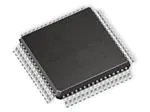
TDA7580
FM/AM digital IF sampling processor
Features
■
FM/AM IF sampling DSP
■
ON-CHIP analogue to digital converter for
10.7MHz IF signal conversion
■
FM channel equalization
■
FM adjacent channel suppression
■
Reception enhancement in multipath condition
■
Stereo decoder and weak signal processing
■
2 Channel serial audio interface (SAI) with
sample rate converter
■
I2C and buffer SPI control interfaces
■
RDS filter, demodulator & decoder
■
Inter processor transport interface for antenna
and tuner diversity
■
Front-end AGC feedback
Description
The TDA7580 is an integrated circuit
implementing an advanced mixed analogue and
digital solution, to perform the signal processing
Table 1.
u
d
o
Device summary
r
P
e
Part number
TDA7580
t
e
l
o
TDA758013TR
)
s
(
ct
LQFP64
c
u
d
e
t
le
)
s
t(
o
r
P
of an AM/FM channel. The HW & SW architecture
has been devised to perform a digital equalization
of the FM/AM channel, and a real rejection of
adjacent channels and any other signals,
interfering with the listening of the desired station.
In severe multiple path conditions, the reception is
improved to get high quality audio.
o
s
b
O
Package
Packing
LQFP64
Tube
LQFP64
Tape and reel
s
b
O
March 2007
Rev 5
1/39
www.st.com
1
�Contents
TDA7580
Contents
1
Overview . . . . . . . . . . . . . . . . . . . . . . . . . . . . . . . . . . . . . . . . . . . . . . . . . . 6
2
Block diagram and electrical specifications . . . . . . . . . . . . . . . . . . . . . . 7
2.1
Pin description . . . . . . . . . . . . . . . . . . . . . . . . . . . . . . . . . . . . . . . . . . . . . . 9
2.2
Electrical characteristics . . . . . . . . . . . . . . . . . . . . . . . . . . . . . . . . . . . . . . 14
3
SAI Interface . . . . . . . . . . . . . . . . . . . . . . . . . . . . . . . . . . . . . . . . . . . . . . 20
4
RDS SPI interface . . . . . . . . . . . . . . . . . . . . . . . . . . . . . . . . . . . . . . . . . . 22
5
BSPI interface . . . . . . . . . . . . . . . . . . . . . . . . . . . . . . . . . . . . . . . . . . . . . 24
6
Inter processor transport interface for antenna diversity . . . . . . . . . . 26
7
I2C timing . . . . . . . . . . . . . . . . . . . . . . . . . . . . . . . . . . . . . . . . . . . . . . . . . 27
8
Functional description . . . . . . . . . . . . . . . . . . . . . . . . . . . . . . . . . . . . . . 28
c
u
d
e
t
le
8.2
DSP peripherals . . . . . . . . . . . . . . . . . . . . . . . . . . . . . . . . . . . . . . . . . . . . 29
8.3
Clock generation unit (CGU) and oscillator . . . . . . . . . . . . . . . . . . . . . . . 29
8.4
Stereo decoder (HWSTER) . . . . . . . . . . . . . . . . . . . . . . . . . . . . . . . . . . . 29
8.5
Serial audio interface (SAI) . . . . . . . . . . . . . . . . . . . . . . . . . . . . . . . . . . . 30
8.6
I2C interfaces . . . . . . . . . . . . . . . . . . . . . . . . . . . . . . . . . . . . . . . . . . . . . . 30
)
s
(
ct
8.9
u
d
o
r
P
e
t
e
l
o
2/39
o
s
b
O
-
24 bit DSP core . . . . . . . . . . . . . . . . . . . . . . . . . . . . . . . . . . . . . . . . . . . . 28
8.8
9
o
r
P
8.1
8.7
s
b
O
)
s
t(
Serial peripheral interfaces . . . . . . . . . . . . . . . . . . . . . . . . . . . . . . . . . . . . 30
High speed serial synchronous interface (HS3I) . . . . . . . . . . . . . . . . . . . 31
Tuner AGC keying DAC (KEYDAC) . . . . . . . . . . . . . . . . . . . . . . . . . . . . . 31
8.10
Asynchronous sample rate converter (ASRC) . . . . . . . . . . . . . . . . . . . . . 31
8.11
IF band pass Σ Δ analogue to digital converter (IFADC) . . . . . . . . . . . . . 31
8.12
Digital down converter (DDC) . . . . . . . . . . . . . . . . . . . . . . . . . . . . . . . . . . 32
8.13
RDS . . . . . . . . . . . . . . . . . . . . . . . . . . . . . . . . . . . . . . . . . . . . . . . . . . . . . 32
8.14
AM/FM Detector (CORDIC) . . . . . . . . . . . . . . . . . . . . . . . . . . . . . . . . . . . 32
Application diagrams . . . . . . . . . . . . . . . . . . . . . . . . . . . . . . . . . . . . . . . 33
�TDA7580
Contents
9.1
Electrical application scheme . . . . . . . . . . . . . . . . . . . . . . . . . . . . . . . . . . 35
10
Package marking . . . . . . . . . . . . . . . . . . . . . . . . . . . . . . . . . . . . . . . . . . . 36
11
Package information . . . . . . . . . . . . . . . . . . . . . . . . . . . . . . . . . . . . . . . . 37
12
Revision history . . . . . . . . . . . . . . . . . . . . . . . . . . . . . . . . . . . . . . . . . . . 38
c
u
d
e
t
le
)
s
(
ct
)
s
t(
o
r
P
o
s
b
O
-
u
d
o
r
P
e
t
e
l
o
s
b
O
3/39
�List of tables
TDA7580
List of tables
Table 1.
Table 2.
Table 3.
Table 4.
Table 5.
Table 6.
Table 7.
Table 8.
Table 9.
Table 11.
Table 12.
Table 13.
Table 14.
Table 15.
Table 16.
Table 17.
Table 18.
Table 19.
Table 20.
Table 21.
Table 22.
Device summary . . . . . . . . . . . . . . . . . . . . . . . . . . . . . . . . . . . . . . . . . . . . . . . . . . . . . . . . . . 1
Absolute maximum ratings . . . . . . . . . . . . . . . . . . . . . . . . . . . . . . . . . . . . . . . . . . . . . . . . . . 7
Recommended DC operating conditions (Tj = -40°C to 125°C) . . . . . . . . . . . . . . . . . . . . . . 8
Thermal data. . . . . . . . . . . . . . . . . . . . . . . . . . . . . . . . . . . . . . . . . . . . . . . . . . . . . . . . . . . . . 8
Pin description . . . . . . . . . . . . . . . . . . . . . . . . . . . . . . . . . . . . . . . . . . . . . . . . . . . . . . . . . . . 9
General interface electrical characteristics . . . . . . . . . . . . . . . . . . . . . . . . . . . . . . . . . . . . . 14
Low voltage interface CMOS DC electrical characteristics. . . . . . . . . . . . . . . . . . . . . . . . . 15
High voltage CMOS interface DC electrical characteristics . . . . . . . . . . . . . . . . . . . . . . . . 15
Current consumption (Tj =-40°C to 125°C). . . . . . . . . . . . . . . . . . . . . . . . . . . . . . . . . . . . . 16
Crystal characteristics for 1 and 2 chip load . . . . . . . . . . . . . . . . . . . . . . . . . . . . . . . . . . . . 16
External clock signal on XTI . . . . . . . . . . . . . . . . . . . . . . . . . . . . . . . . . . . . . . . . . . . . . . . 16
DSP core (Tj =-40°C to 125°C . . . . . . . . . . . . . . . . . . . . . . . . . . . . . . . . . . . . . . . . . . . . . . 17
FM stereo decoder characteristics . . . . . . . . . . . . . . . . . . . . . . . . . . . . . . . . . . . . . . . . . . . 17
Sample rate converter . . . . . . . . . . . . . . . . . . . . . . . . . . . . . . . . . . . . . . . . . . . . . . . . . . . . 17
SPI and I2C timing table . . . . . . . . . . . . . . . . . . . . . . . . . . . . . . . . . . . . . . . . . . . . . . . . . . 19
SAI Timing table . . . . . . . . . . . . . . . . . . . . . . . . . . . . . . . . . . . . . . . . . . . . . . . . . . . . . . . . 20
RDS SPI timing table . . . . . . . . . . . . . . . . . . . . . . . . . . . . . . . . . . . . . . . . . . . . . . . . . . . . . 22
BSPI timing table . . . . . . . . . . . . . . . . . . . . . . . . . . . . . . . . . . . . . . . . . . . . . . . . . . . . . . . . 24
HS3I timing table . . . . . . . . . . . . . . . . . . . . . . . . . . . . . . . . . . . . . . . . . . . . . . . . . . . . . . . . 26
I2C BUS timing table . . . . . . . . . . . . . . . . . . . . . . . . . . . . . . . . . . . . . . . . . . . . . . . . . . . . . 27
Document revision history . . . . . . . . . . . . . . . . . . . . . . . . . . . . . . . . . . . . . . . . . . . . . . . . . 38
c
u
d
e
t
le
)
s
(
ct
u
d
o
r
P
e
t
e
l
o
s
b
O
4/39
o
s
b
O
-
o
r
P
)
s
t(
�TDA7580
List of figures
List of figures
Figure 1.
Figure 2.
Figure 3.
Figure 4.
Figure 5.
Figure 6.
Figure 7.
Figure 8.
Figure 9.
Figure 10.
Figure 11.
Figure 12.
Figure 13.
Figure 14.
Figure 15.
Figure 16.
Figure 17.
Figure 18.
Figure 19.
Figure 20.
Figure 21.
Figure 22.
Block diagram . . . . . . . . . . . . . . . . . . . . . . . . . . . . . . . . . . . . . . . . . . . . . . . . . . . . . . . . . . . . 7
PIN connection (top view) . . . . . . . . . . . . . . . . . . . . . . . . . . . . . . . . . . . . . . . . . . . . . . . . . . . 9
Power on and boot sequence using I2C . . . . . . . . . . . . . . . . . . . . . . . . . . . . . . . . . . . . . . . 18
Power on and boot sequence using SPI. . . . . . . . . . . . . . . . . . . . . . . . . . . . . . . . . . . . . . . 18
SAI Timings . . . . . . . . . . . . . . . . . . . . . . . . . . . . . . . . . . . . . . . . . . . . . . . . . . . . . . . . . . . . 20
SAI protocol (when: RLRS=0; RREL=0; RCKP=1; RDIR=0) . . . . . . . . . . . . . . . . . . . . . . . 20
SAI protocol (when: RLRS=1; RREL=0; RCKP=1; RDIR=1) . . . . . . . . . . . . . . . . . . . . . . . 21
SAI protocol (when: RLRS=0; RREL=0; RCKP=0; RDIR=0) . . . . . . . . . . . . . . . . . . . . . . . 21
SAI protocol (when: RLRS=0; RREL=1; RCKP=1; RDIR=0) . . . . . . . . . . . . . . . . . . . . . . . 21
RDS SPI timings . . . . . . . . . . . . . . . . . . . . . . . . . . . . . . . . . . . . . . . . . . . . . . . . . . . . . . . . . 22
RDS SPI clocking scheme . . . . . . . . . . . . . . . . . . . . . . . . . . . . . . . . . . . . . . . . . . . . . . . . . 23
BSPI timings . . . . . . . . . . . . . . . . . . . . . . . . . . . . . . . . . . . . . . . . . . . . . . . . . . . . . . . . . . . . 24
BSPI clocking scheme . . . . . . . . . . . . . . . . . . . . . . . . . . . . . . . . . . . . . . . . . . . . . . . . . . . . 25
High speed synchronous serial interface - HS3I . . . . . . . . . . . . . . . . . . . . . . . . . . . . . . . . . 26
HS3I clocking scheme. . . . . . . . . . . . . . . . . . . . . . . . . . . . . . . . . . . . . . . . . . . . . . . . . . . . . 26
DSP and RDS I2C BUS timings . . . . . . . . . . . . . . . . . . . . . . . . . . . . . . . . . . . . . . . . . . . . . 27
Radio mode with external slave audio DAC . . . . . . . . . . . . . . . . . . . . . . . . . . . . . . . . . . . . 33
Radio mode with external master audio device . . . . . . . . . . . . . . . . . . . . . . . . . . . . . . . . . 33
Audio mode with external slave audio device . . . . . . . . . . . . . . . . . . . . . . . . . . . . . . . . . . . 34
Application diagram example . . . . . . . . . . . . . . . . . . . . . . . . . . . . . . . . . . . . . . . . . . . . . . . 35
Package marking . . . . . . . . . . . . . . . . . . . . . . . . . . . . . . . . . . . . . . . . . . . . . . . . . . . . . . . . 36
Mechanical, data and package dimensions . . . . . . . . . . . . . . . . . . . . . . . . . . . . . . . . . . . . 37
c
u
d
e
t
le
)
s
(
ct
)
s
t(
o
r
P
o
s
b
O
-
u
d
o
r
P
e
t
e
l
o
s
b
O
5/39
�Overview
1
TDA7580
Overview
The algorithm is self-adaptive, thus it requires no “on-the-field” adjustments after the
parameters optimization.
The chip embeds a Band Pass Sigma Delta Analogue to Digital Converter for 10.7MHz IF
conversion from a “tuner device” (the TDA7515 is highly recommended).
The 24bit DSP allows flexibility in the algorithms implementation, thus giving some freedom
for customer required features. The total processing power offers a significant headroom for
customer’s software requirement, even when the channel equalization and the decoding
software is running. the program and data memory space can be loaded from an external
non volatile memory via I2C or SPI.
The oscillator module works with an external 74.1MHz quartz crystal. It has very low electro
magnetic interference, as it introduces very low distortion, and in any case harmonics fall
outside the radio bandwidth.
)
s
t(
The companion tuner device receives the reference clock through a differential ended
interface, which works off the oscillator module by properly dividing down the master clock
frequency. That allows the overall system saving an additional crystal for the tuner.
c
u
d
After the IF conversion, the digitized baseband signal passes through the base band
processing section, either FM or AM, depending on the listener selection. The FM base
band processing comprises of stereo decoder, spike detection and noise blanking. The AM
noise blanking is fully software implemented.
e
t
le
o
r
P
The internal RDS filter, demodulator and decoder features complete functions to have the
output data available through either I2C or SPI interface. No DSP support is needed but at
start-up, so that RDS can work in background and in parallel with other DSP processing.
This mode (RDS only) allows current consumption saving for low power application modes.
o
s
b
O
-
An I2C/SPI interface is available for any control and communication with the main micro, as
well as RDS data interface. The DSP SPI block embeds a 10 words FIFO for both transmit
and receive channels, to lighten the DSP task and frequently respond to the interrupt from
the control interface.
)
s
(
ct
Serial audio interface (SAI) is the ideal solution for the audio data transfer, both transmit and
receive: either master or slave. The flexibility of this module gives a wide choice of different
protocols, including I2S. Two fully independent bidirectional data channels, with separate
clocks allows the use of TDA7580 as general purpose digital audio processor.
u
d
o
r
P
e
A fully asynchronous sample rate converter (ASRC) is available as a peripheral prior to
sending audio data out via the SAI, so that internal audio sampling rate (~36kHz and
FM/AM mode) can be adapted by upconversion to any external rate.
t
e
l
o
bs
O
An inter processor transport interface (HS3I, high speed synchronous serial interface) is
also available for a modular system which implements Dual Tuner Diversity, thus enhancing
the overall system performance. It is about a synchronous serial interface which exchanges
data up to the MPX rate. It has been designed to reduce the electro magnetic interference
toward the sensitive analogue signal from the tuner.
General purpose I/O registers are connected to and controlled by the DSP, by means of
memory map.
A debug and test interface is available for on chip software debug as well as for internal
registers read/write operation.
6/39
�TDA7580
2
Block diagram and electrical specifications
Block diagram and electrical specifications
Figure 1.
Block diagram
RDS
A/D
I2C/SPI
I2C/SPI
HS3I
IF digital
SAI1
Signal processor
DAC
SAI0
CGU
SRC
c
u
d
Oscillator
Table 2.
Symbol
VDD
VDD3
e
t
le
Absolute maximum ratings
Parameter
Power supplies (1)
so
b
O
-
o
r
P
Nom. 1.8V
Nom. 3.3V
Analog input or output voltage belonging to 3.3V IO ring
(VDDSD, VDDOSC)
)
s
(
ct
Tstg
s
b
O
Unit
-0.5 to 2.5
-0.5 to 4.0
V
V
-0.5 to 4.0
V
Normal(2)
Failsafe(3)
-0.5 to 6.50
-0.5 to 3.80
V
V
All remaining digital input or output voltage
Nom. 1.8V
Nom. 3.3V
-0.5 to (VDD+0.5)
-0.5 to (VDD3+0.5)
V
Operating junction temperature range
-40 to 125
°C
Storage temperature
-55 to 150
°C
r
P
e
t
e
l
o
Value
Digital input or output voltage, 5V tolerant
u
d
o
Tj
)
s
t(
1. VDD3 refers to all of the nominal 3.3V power supplies (VDDH, VOSC, VDDSD). VDD refers to all of the nominal
1.8V power supplies (VDD, VMTR).
2. During Normal Mode operation VDD3 is always available as specified.
3. During Fail-safe Mode operation VDD3 may be not available.
Warning:
Operation at or beyond these limits may result in permanent
damage to the device. Normal operation is not guaranteed at
these extremes.
7/39
�Block diagram and electrical specifications
Table 3.
TDA7580
Recommended DC operating conditions (Tj = -40°C to 125°C)
Symbol
Parameter
Comment
Min.
Typ.
Max.
Unit
VDD
1.8V Power supply voltage
Core power supply
1.7
1.80
1.9
V
VDDH
3.3V Power supply voltage (1)
IO Rings power supply
(with GNDH)
3.15
3.30
3.45
V
VOSC
3.3V Power supply voltage (1)
Oscillator power supply
(GNDOSC)
3.15
3.30
3.45
V
VDDSD
3.3V Power supply voltage (1)
IF ADC power supply
(with GNDSD)
3.15
3.30
3.45
V
VMTR
1.8V Power supply voltage
DAC keying and tuner clock
power supply (with GNDMTR)
1.7
1.80
1.9
V
1. VDDH, VOSC, VDDSD are also indicated in this document as VDD3. All others as VDD.
Table 4.
Thermal data
Symbol
Rth j-amb
Parameter
Value
Thermal resistance junction to ambient
68
e
t
le
)
s
(
ct
u
d
o
r
P
e
t
e
l
o
s
b
O
8/39
o
s
b
O
-
o
r
P
c
u
d
)
s
t(
Unit
°C/W
�TDA7580
Pin description
GND
VDD
DBOUT1
DBRQ1
DBIN1
DBCK1
VDDH
GNDH
DBOUT0
DBRQ0
DBIN0
DBCK0
59
58
57
56
55
54
53
52
51
50
49
VDD
46
TST3_LRCKR
45
TST2_SCKR
44
LRCK_LRCKT
6
43
SCLK_SCKT
GNDSD
7
42
SDO0
GNDOSC
8
41
VDDH
XTI
9
40
GNDH
XTO
10
39
TST1_SDI1
VDDOSC
11
38
TST4_SDI0
VDDMTR
12
37
GPIO_SDO1
CKREFP
13
36
TESTN
CKREFN
14
35
GND
AGCKEY
15
34
VDD
GNDMTR
16
33
RESETN
DEBUG0
DEBUG1
SAI
VCMOP
VDDISO
5
60
GND
47
c
u
d
I
INN
GNDH
4
61
INP
VDDH
3
62
48
19 I 2C P/
/S RD
20
P S
VLO
VDDSD
2
63
1
IFADC
VHI
VCM
64
PIN connection (top view)
OSC.
Figure 2.
Tuner
2.1
Block diagram and electrical specifications
31
32
INT
ADDR_SD
27
VDDH
30
26
IQCH3
RDS_CS
25
IQCH2
29
24
IQCH1
RDS_INT
23
IQSYNC
28
22
VDD
GNDH
21
RDS
GND
SCL_SCK
18
SDA_MOSI
MISO
17
PROTSEL_SS
D
S
HS3I
e
t
le
)
s
t(
o
r
P
o
s
b
O
-
IFADC Modulator Power Supply pins pair
Oscillator Power Supply pins pair
Tuner Clock Out and AGC Keying DAC Power Supply pins pair
Core Logic 1.8V Power Supply pins pair
)
s
(
ct
I/O Ring 3.3V Power Supply pins pair
Table 5.
N°
1
u
d
o
Pin description
Name
r
P
e
t
e
l
o
VHI
s
b
O
Type
Description
Notes
A
It needs external
Internally generated IFADC Opamps
2.65V (@VDD=3.3V) reference voltage pin minimum 4.7μF ceramic
for external filtering
capacitor
2
VCM
A
Internally generated common mode 1.65V It needs external
(@VDD=3.3V) reference voltage pin for
minimum 10μF ceramic
external filtering
capacitor
3
VLO
A
Internally generated IFADC opamps
It needs external
0.65V (@VDD=3.3V) reference voltage pin minimum 4.7μF ceramic
for external filtering
capacitor
4
INP
A
Positive IF signal input from tuner
2.0Vpp @VDD=3.3V
5
INN
A
Negative IF signal input from tuner
2.0Vpp @VDD=3.3V
6
VCMOP
-
Not connected.
After
Reset
9/39
�Block diagram and electrical specifications
Table 5.
N°
TDA7580
Pin description (continued)
Name
Type
Description
After
Reset
Notes
7
GNDSD
G
IFADC modulator analogue ground
Clean ground, to be star
connected to voltage
regulator ground
8
GNDOSC
G
Oscillator ground
Clean ground, to be star
connected to voltage
regulator ground
9
XTI
I
High impedance oscillator input (quartz
connection) or clock input when in
Antenna Diversity slave mode
Maximum voltage swing
is VDD=3.3V
10
XTO
O
Low impedance oscillator output (quartz
connection)
11
VDDOSC
P
Oscillator power supply
3.3V
12
VDDMTR
P
Tuner reference clock and AGC keying
DAC power supply
1.8V
Tuner reference clock positive output.
FM 100kHz
AMEU 18kHz
With internal pull-up, on
at reset [PP]
Output
FM 100kHz
AMEU 18kHz
With internal pull-up, on
at reset [PP]
Output
13
14
CKREFP
B
CKREFN
B
e
t
le
Tuner reference clock negative output.
o
s
b
O
-
15
AGCKEY
A
DAC output for Tuner AGC keying
16
GNDMTR
G
Ground of the tuner reference clock buffer
and the AGC keying DAC
17
t
e
l
o
bs
18
SDA_MOSI
)
s
(
ct
u
d
o
r
P
e
PROTSEL_SS
o
r
P
1.5kohm ±30% output
impedance. 1Vpp ±1%
output dynamic range
B
DSP0 GPIO for control serial interface
(low: SPI or high: I2C) selection at device
Bootstrap.
In SPI protocol mode, after boot
procedure, SPI slave select, otherwise
DSP0 GPIO0
DSP0 GPIO0
5V tolerant
With internal pull-up, on
at reset [PP]
Input
B
Control serial interface and RDS IO:
- SPI mode: slave data in or master data
out for main SPI & RDS SPI data in
- I2C mode: data for main I2C or RDS I2C
5V tolerant
With internal pull-up, on
at reset [PP]
Input
DSP0 GPIO1
5V tolerant. With
internal pull-up, on at
reset [PP]
Input
5V tolerant. With
internal pull-up, on at
reset [PP]
Input
O
19
MISO
B
SPI slave data out or master data in for
main SPI and RDS SPI data out
20
SCL_SCK
B
Bit clock for Control Serial Interface and
RDS
10/39
c
u
d
)
s
t(
�TDA7580
Block diagram and electrical specifications
Table 5.
N°
Pin description (continued)
Name
Type
Description
After
Reset
Notes
21
GND
G
Digital core power ground
22
VDD
P
Digital core power supply
1.8V
B
High speed synchronous serial interface
(HS3I) clock if HS3I master mode, else
DSP1 GPIO or DSP1 debug port clock
(DBOUT1)
DSP1 GPIO0
5V tolerant. With
internal pull-up, on at
reset
Input
B
High speed synchronous serial interface
(HS3I) channel 1 data if HS3I master
mode, else DSP1 GPIO or DSP1 debug
port request (DBRQ1)
DSP1 GPIO1
5V tolerant. With
internal pull-up, on at
reset [PP]
Input
B
High speed synchronous serial interface
(HS3I) channel 2 data if HS3I master
mode, else DSP1 GPIO or DSP1 debug
port data In (DBIN1)
DSP1 GPIO2
5V tolerant. With
internal pull-down, on at
reset [PP]
Input
B
High speed synchronous serial interface
(HS3I) channel 3 data if HS3I master
mode, else DSP1 GPIO or DSP1 debug
port data out (DBCK1)
DSP1 GPIO3
5V tolerant
With internal pull-down,
on at reset [PP]
P
3.3V IO ring power supply (HS3I, I2C/SPI,
RDS, INT)
G
3.3V IO ring power ground (HS3I, I2C/SPI,
RDS, INT)
23
24
25
26
27
28
29
IQSYNC
IQCH1
IQCH2
IQCH3
VDDH
GNDH
RDS_INT
30
RDS_CS
31
INT
t
e
l
o
e
t
le
o
s
b
O
-
o
r
P
Input
B
RDS interrupt to external main
microprocessor in case of traffic
information
DSP1 GPIO4. 5V
tolerant, open drain
With internal pull-up, on
at reset [OD]
Input
B
RDS chip select. When RESETN rising, If DSP1 GPIO5. 5V
RDS_CS 0, the RDS’s SPI is selected;
tolerant. With internal
else RDS’s I2C
pull-up, on at reset [PP]
Input
I
DSP0 external interrupt
5V tolerant. With
internal pull-up, on at
reset
DSP0 GPIO2
5V tolerant
With internal pull-down,
on at reset [PP]
)
s
(
ct
u
d
o
r
P
e
c
u
d
)
s
t(
32
ADDR_SD
s
b
O
B
IFS chip master (Low) or slave (High)
mode selection, latched in upon RESETN
release. It selects the LSB of the I2C
addresses. Station detector output
33
RESETN
I
Chip hardware reset, active low
5V tolerant
With internal pull-up
34
VDD
P
Digital power supply
1.8V
35
GND
G
Digital power ground
36
TESTN
I
Test enable pin, active low
Input
With internal pull-up
11/39
�Block diagram and electrical specifications
Table 5.
Pin description (continued)
Notes
After
Reset
5V tolerant. DSP0
GPIO3. With internal
pull-up, on at reset [PP]
Input
B
5V tolerant. DSP0
Audio SAI0 data input or test selection pin
GPIO5. With internal
in test mode
pull-up, on at reset [PP]
Input
TST1_SDI1
B
DSP0 GPIO for boot selection or audio
SAI1 input. Test selection pin in test
mode.
Input
40
GNDH
G
3.3V IO ring power ground (audio SAI,
ResetN, test pins)
41
VDDH
P
3.3V IO ring power supply (audio SAI,
ResetN, test pins)
42
SDO0
B
Radio or audio SAI0 data output
5V tolerant. With
internal pull up, @0V at
reset [PP]
Output
5V tolerant
With internal pull up, on
at reset [PP]
Input
N°
Name
37
GPIO_SDO1
B
DSP0 GPIO for boot selection or audio
SAI0 output.
38
TST4_SDI0
39
Type
Description
5V tolerant. DSP0
GPIO4. With internal
pull-up, on at reset [PP]
c
u
d
)
s
t(
43
SCLK_SCKT
B
SAI0 receive and transmit bit clock
(master or slave with ASRC); SAI1
transmit bit clock
44
LRCK_LRCKT
B
SAI0 receive and transmit left/right clock
(master or slave with ASRC); SAI1
transmit left/right clock
5V tolerant
With internal pull up, on
at reset [PP]
Input
5V tolerant. DSP0
GPIO6. With internal
pull up, on at reset [PP]
Input
Input
e
t
le
o
s
b
O
-
o
r
P
45
TST2_SCKR
B
SAI0 Transmit bit clock; SAI1 receive and
transmit bit clock. Or test selection pin in
test mode
46
TST3_LRCKR
B
SAI0 Transmit LeftRight clock; SAI1
Receive and Transmit bit clock. Or Test
selection pin in Test Mode
DSP0 GPIO7. 5V
tolerant. With internal
pull up, on at reset [PP]
47
VDD
P
Digital core power supply
1.8V
48
GND
49
G
B
(s)
t
c
u
d
o
r
P
e
t
e
l
o
DBCK0
bs
O
TDA7580
Digital core power ground
Debug port clock of DSP0 (DBCK0)
DSP0 GPIO. 9. 5V
tolerant. With internal
pull down, on at reset
[PP]
Input
Input
50
DBIN0
B
Debug port data input of DSP0 (DBIN0)
DSP0 GPIO. 11. 5V
tolerant. With internal
pull down, on at reset
[PP]
51
DBRQ0
B
Debug port request of DSP0 (DBRQ0)
DSP0 GPIO. 5V tolerant
With internal pull up, on
at reset [PP]
Input
52
DBOUT0
B
Debug port data output of DSP0
(DBOUT0)
DSP0 GPIO10. 5V
tolerant. With internal
pull up, on at reset [PP]
Input
12/39
�TDA7580
Table 5.
N°
Block diagram and electrical specifications
Pin description (continued)
Name
Type
Description
After
Reset
Notes
53
GNDH
G
3.3V IO ring power ground (debug
interface, GPIO)
54
VDDH
P
3.3V IO ring power supply (Debug
interface, GPIO)
B
DSP1 debug port clock (DBCK1) if HS3I
master mode, else high speed
synchronous serial interface (HS3I)
channel3 data
DSP1 GPIO9. 5V
tolerant. With internal
pull down, on at reset
[PP]
Input
B
DSP1 GPIO or DSP1 debug port data in
(DBIN1) if HS3I master mode, else high
speed synchronous serial interface (HS3I)
channel2 data i
DSP1 GPIO11
5V tolerant
With internal pull down,
on at reset [PP]
Input
B
DSP1 GPIO or DSP1 debug port request
5V tolerant. With
(DBRQ1) if HS3I master mode, else high
internal pull up, on at
speed synchronous serial interface (HS3I)
reset [PP]
channel1 data
DSP1 GPIO10
5V tolerant
With internal pull up, on
at reset [PP]
1.8V
55
56
57
DBCK1
DBIN1
DBRQ1
58
DBOUT1
B
DSP1 GPIO or DSP1 debug port data out
(DBOUT1) if HS3I master mode, else high
speed synchronous serial interface (HS3I)
clock
59
VDD
P
Digital core power supply
60
GND
G
Digital core power ground
61
VDDISO
P
3.3V N-isolation biasing supply
62
GNDH
G
3.3V IO ring power ground
(modulator digital section)
63
VDDH
64
VDDSD
s
b
O
e
t
le
o
s
b
O
-
u
d
o
r
P
e
t
e
l
o
)
s
(
ct
c
u
d
P
3.3V IO ring power supply
(modulator digital section)
P
3.3V IFADC modulator analogue power
supply
)
s
t(
o
r
P
Input
Input
Clean 3.3V supply to be
star connected to
voltage regulator
Clean power supply, to
be star connected to
3.3V voltage regulator
I/O Type
I/O Definition and status
P: Power supply from voltage regulator
G: Power ground from voltage regulator
A: Analogue I/O
I: Digital input
O: Digital output
B: Bidirectional I/O
Z: high impedance (input)
O: logic low output
X: undefined output
1: logic high output
Output PP: Push pull / OD: Open drain
13/39
�Block diagram and electrical specifications
TDA7580
2.2
Electrical characteristics
Table 6.
General interface electrical characteristics
(Tj =-40°C to 125°C; VDD=1.8V, VDD3= 3.3V)
Symbol
Parameter
Test condition
Min.
Typ.
Max.
Unit
lilh
Low level input current
I/Os@VDD3 (absolute value)
Vi = 0V (1) (2) without pull-up-down
device
1
μA
lihh
High level input current
I/Os@VDD3 (absolute value)
Vi = VDD3 (1) (2) without pull-up-down
device
1
μA
lil
Low level input current
I/Os@VDD (absolute value)
Vi = 0V (1) (3) (4) without pull-up-down
device
1
μA
lih
High level input current
I/Os@VDD (absolute value)
Vi = VDD (1) (3) (4) without pull-up device
1
μA
Iipdh
Pull-down current I/Os @ VDD3
Vi = VDD3 (5) with pull-down device
85
μA
Iopuh
Pull-up current I/Os @ VDD3
Vi = 0V (6) with pull-up device
Iopul
Pull-up current I/Os @ VDD
Iaihop
Analogue pin sunk / drawn current Vi = VDD3
on pin1
Vi = 0V
Iacm
Analogue pin sunk / drawn current Vi = VDD3
on pin 2
Vi = 0V
Iail
Analogue pin sunk / drawn current Vi = VDD3
on pin 3
Vi = 0V
Iain
Analogue pin sunk / drawn current Vi = VDD3
on pin 4 and pin 5
Vi = 0V
Iaih6
Analogue pin current on pin 6
Iaik
Analogue pin sunk / drawn current Vi = VDD
on pin 15
Vi = 0V (spec absolute value)
Ioz
Tri-state output leakage
o
r
P
e
du
5V tolerant tri-state output
leakage
t
e
l
o
Ilatchup
s
b
O
60
-100
-70
-40
-30
μA
-20
μA
1.25
1.55
mA
o
r
P
-5.0
-3.75
mA
6.0
8.0
10.0
mA
-10.0
-8.0
-6.0
mA
3.75
5.0
6.25
mA
-1.55 -1.25 -0.95
mA
pull-up device
c
u
d
0.95
-6.25
e
t
le
)
s
t(
-40
so
b
O
-
24
32
40
μA
-40
-32
-24
μA
5
μA
1.6
mA
1
μA
Vo = 0V or VDD3 without pull up / down
device (1)
1
μA
Vo = 0V or VDD (1)
1
μA
Vo = 5V
80
μA
(s)
Vo = 0V or VDD3
ct
IozFT
Vesd
Vi = 0V
(3) with
35
0.8
1.2
I/O latch up current
V < 0V, V > VDD
200
mA
Electrostatic protection
Leakage, 1μA
2000
V
1. The leakage currents are generally very small,