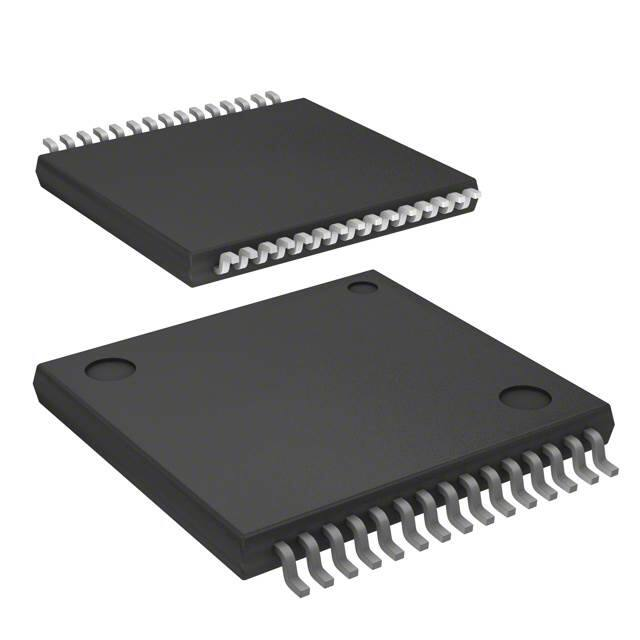
VND5E004C30
Double 4 mhigh-side driver with analog CurrentSense for
automotive applications
Datasheet - production data
0XOWL3RZHU6����
*$3*����������&)7
Features
Max transient supply voltage
VCC
41 V
Operating voltage range
VCC
4.5 to 28 V
Max on-state resistance (per ch.)
RON
4 m
Current limitation (typ)
ILIMH
90 A
Off-state supply current
IS
2
µA(1)
– Protection against loss of ground and loss
of VCC
– Overtemperature shutdown with auto
restart (thermal shutdown)
– Inrush current active management by
power limitation
– Reverse battery protection with self switchon of the Power MOSFET
– Electrostatic discharge protection
Applications
All types of resistive, inductive and capacitive
loads
1. Typical value with all loads connected
Suitable for power management applications
AEC-Q100 qualified
Description
General
– Very low standby current
– 3.0 V CMOS compatible inputs
– Optimized electromagnetic emissions
– Very low electromagnetic susceptibility
– Compliant with European directive
2002/95/EC
– Very low current sense leakage
The device is a double channel high-side driver
manufactured using ST proprietary VIPower®
M0-5 technology and housed in a
MultiPowerSO-30 package. The device is
designed to drive 12 V automotive grounded
loads, and to provide protection and diagnostics.
It also implements a 3 V and 5 V CMOScompatible interface for use with any
microcontroller.
Diagnostic functions
– Proportional load current sense
– High current sense precision for wide
currents range
– Diagnostic enable pin
– Off-state open-load detection
– Output short to VCC detection
– Overload and short to ground (power
limitation) indication
– Thermal shutdown indication
Protection
– Undervoltage shutdown
– Overvoltage clamp
– Load current limitation
– Self limiting of fast thermal transients
January 2017
This is information on a product in full production.
The device integrates advanced protective
functions such as load current limitation, inrush
and overload active management by power
limitation, overtemperature shut-off with autorestart and overvoltage active clamp. A dedicated
analog current sense pin is associated with every
output channel providing enhanced diagnostic
functions including fast detection of overload and
short-circuit to ground through power limitation
indication, overtemperature indication, shortcircuit to VCC diagnosis and on-state and off-state
open-load detection. The current sensing and
diagnostic feedback of the whole device can be
disabled by pulling the DE pin low to share the
external sense resistor with similar devices.
DocID027937 Rev 3
1/35
www.st.com
�Contents
VND5E004C30
Contents
1
Block diagram and pin configurations . . . . . . . . . . . . . . . . . . . . . . . . . . 5
2
Electrical specifications . . . . . . . . . . . . . . . . . . . . . . . . . . . . . . . . . . . . . . 7
3
2.1
Absolute maximum ratings . . . . . . . . . . . . . . . . . . . . . . . . . . . . . . . . . . . . . 7
2.2
Thermal data . . . . . . . . . . . . . . . . . . . . . . . . . . . . . . . . . . . . . . . . . . . . . . . 8
2.3
Electrical characteristics . . . . . . . . . . . . . . . . . . . . . . . . . . . . . . . . . . . . . . . 8
2.4
Waveforms . . . . . . . . . . . . . . . . . . . . . . . . . . . . . . . . . . . . . . . . . . . . . . . . 17
2.5
Electrical characteristics curves . . . . . . . . . . . . . . . . . . . . . . . . . . . . . . . . 20
Application information . . . . . . . . . . . . . . . . . . . . . . . . . . . . . . . . . . . . . 23
3.1
MCU I/Os protection . . . . . . . . . . . . . . . . . . . . . . . . . . . . . . . . . . . . . . . . . 23
3.2
Load dump protection . . . . . . . . . . . . . . . . . . . . . . . . . . . . . . . . . . . . . . . . 23
3.3
Current sense and diagnostic . . . . . . . . . . . . . . . . . . . . . . . . . . . . . . . . . . 24
3.3.1
3.4
4
Maximum demagnetization energy (VCC = 13.5 V) . . . . . . . . . . . . . . . . . 26
Package and PC board thermal data . . . . . . . . . . . . . . . . . . . . . . . . . . . 27
4.1
5
Short to VCC and off-state open-load detection . . . . . . . . . . . . . . . . . . 25
MultiPowerSO-30 thermal data . . . . . . . . . . . . . . . . . . . . . . . . . . . . . . . . 27
Package information . . . . . . . . . . . . . . . . . . . . . . . . . . . . . . . . . . . . . . . . 30
5.1
MultiPowerSO-30 package information . . . . . . . . . . . . . . . . . . . . . . . . . . 30
5.2
MultiPowerSO-30 packing information . . . . . . . . . . . . . . . . . . . . . . . . . . . 32
6
Order codes . . . . . . . . . . . . . . . . . . . . . . . . . . . . . . . . . . . . . . . . . . . . . . . 33
7
Revision history . . . . . . . . . . . . . . . . . . . . . . . . . . . . . . . . . . . . . . . . . . . 34
2/35
DocID027937 Rev 3
�VND5E004C30
List of tables
List of tables
Table 1.
Table 2.
Table 3.
Table 4.
Table 5.
Table 6.
Table 7.
Table 8.
Table 9.
Table 10.
Table 11.
Table 12.
Table 13.
Table 14.
Table 15.
Table 16.
Table 17.
Table 18.
Pin functions . . . . . . . . . . . . . . . . . . . . . . . . . . . . . . . . . . . . . . . . . . . . . . . . . . . . . . . . . . . . . 5
Suggested connections for unused and non connected pins . . . . . . . . . . . . . . . . . . . . . . . . 6
Absolute maximum ratings . . . . . . . . . . . . . . . . . . . . . . . . . . . . . . . . . . . . . . . . . . . . . . . . . . 7
Thermal data. . . . . . . . . . . . . . . . . . . . . . . . . . . . . . . . . . . . . . . . . . . . . . . . . . . . . . . . . . . . . 8
Power section . . . . . . . . . . . . . . . . . . . . . . . . . . . . . . . . . . . . . . . . . . . . . . . . . . . . . . . . . . . . 8
Switching (VCC = 13 V; Tj = 25 °C) . . . . . . . . . . . . . . . . . . . . . . . . . . . . . . . . . . . . . . . . . . . 9
Logic inputs. . . . . . . . . . . . . . . . . . . . . . . . . . . . . . . . . . . . . . . . . . . . . . . . . . . . . . . . . . . . . . 9
Protections and diagnostics . . . . . . . . . . . . . . . . . . . . . . . . . . . . . . . . . . . . . . . . . . . . . . . . 10
Current sense (8 V < VCC < 18 V) . . . . . . . . . . . . . . . . . . . . . . . . . . . . . . . . . . . . . . . . . . . 10
Open-load detection (8 V < VCC < 18 V; VDE = 5 V). . . . . . . . . . . . . . . . . . . . . . . . . . . . . . 11
Truth table. . . . . . . . . . . . . . . . . . . . . . . . . . . . . . . . . . . . . . . . . . . . . . . . . . . . . . . . . . . . . . 15
Electrical transient requirements (part 1/3) . . . . . . . . . . . . . . . . . . . . . . . . . . . . . . . . . . . . . 16
Electrical transient requirements (part 2/3) . . . . . . . . . . . . . . . . . . . . . . . . . . . . . . . . . . . . . 16
Electrical transient requirements (part 3/3) . . . . . . . . . . . . . . . . . . . . . . . . . . . . . . . . . . . . . 16
Thermal parameters for MultiPowerSO-30 . . . . . . . . . . . . . . . . . . . . . . . . . . . . . . . . . . . . . 29
MultiPowerSO-30 mechanical data . . . . . . . . . . . . . . . . . . . . . . . . . . . . . . . . . . . . . . . . . . 30
Device summary . . . . . . . . . . . . . . . . . . . . . . . . . . . . . . . . . . . . . . . . . . . . . . . . . . . . . . . . . 33
Document revision history . . . . . . . . . . . . . . . . . . . . . . . . . . . . . . . . . . . . . . . . . . . . . . . . . 34
DocID027937 Rev 3
3/35
3
�List of figures
VND5E004C30
List of figures
Figure 1.
Block diagram . . . . . . . . . . . . . . . . . . . . . . . . . . . . . . . . . . . . . . . . . . . . . . . . . . . . . . . . . . . . 5
Figure 2.
Configuration diagram (not to scale). . . . . . . . . . . . . . . . . . . . . . . . . . . . . . . . . . . . . . . . . . . 6
Figure 3.
Current and voltage conventions . . . . . . . . . . . . . . . . . . . . . . . . . . . . . . . . . . . . . . . . . . . . . 7
Figure 4.
CurrentSense delay characteristics . . . . . . . . . . . . . . . . . . . . . . . . . . . . . . . . . . . . . . . . . . 12
Figure 5.
Open-load off-state delay timing . . . . . . . . . . . . . . . . . . . . . . . . . . . . . . . . . . . . . . . . . . . . . 12
Figure 6.
Switching characteristics . . . . . . . . . . . . . . . . . . . . . . . . . . . . . . . . . . . . . . . . . . . . . . . . . . 13
Figure 7.
Delay response time between rising edge of output current and rising edge of
current sense (CS enabled) . . . . . . . . . . . . . . . . . . . . . . . . . . . . . . . . . . . . . . . . . . . . . . . . . . . . . . . . . . 13
Figure 8.
Output voltage drop limitation . . . . . . . . . . . . . . . . . . . . . . . . . . . . . . . . . . . . . . . . . . . . . . . 14
Figure 9.
IOUT/ISENSE vs IOUT . . . . . . . . . . . . . . . . . . . . . . . . . . . . . . . . . . . . . . . . . . . . . . . . . . . . . . 14
Figure 10. Maximum current sense ratio drift vs load current . . . . . . . . . . . . . . . . . . . . . . . . . . . . . . . 15
Figure 11. Normal operation . . . . . . . . . . . . . . . . . . . . . . . . . . . . . . . . . . . . . . . . . . . . . . . . . . . . . . . . 17
Figure 12. Overload or short to GND . . . . . . . . . . . . . . . . . . . . . . . . . . . . . . . . . . . . . . . . . . . . . . . . . . 17
Figure 13. Intermittent overload . . . . . . . . . . . . . . . . . . . . . . . . . . . . . . . . . . . . . . . . . . . . . . . . . . . . . . 18
Figure 14. Off-state open-load with external circuitry . . . . . . . . . . . . . . . . . . . . . . . . . . . . . . . . . . . . . 18
Figure 15. Short to VCC . . . . . . . . . . . . . . . . . . . . . . . . . . . . . . . . . . . . . . . . . . . . . . . . . . . . . . . . . . . . 19
Figure 16. TJ evolution in overload or short to GND . . . . . . . . . . . . . . . . . . . . . . . . . . . . . . . . . . . . . . 19
Figure 17. Off-state output current . . . . . . . . . . . . . . . . . . . . . . . . . . . . . . . . . . . . . . . . . . . . . . . . . . . . 20
Figure 18. High level input current . . . . . . . . . . . . . . . . . . . . . . . . . . . . . . . . . . . . . . . . . . . . . . . . . . . . 20
Figure 19. Input clamp voltage. . . . . . . . . . . . . . . . . . . . . . . . . . . . . . . . . . . . . . . . . . . . . . . . . . . . . . . 20
Figure 20. Input low level voltage . . . . . . . . . . . . . . . . . . . . . . . . . . . . . . . . . . . . . . . . . . . . . . . . . . . . 20
Figure 21. Input high level voltage . . . . . . . . . . . . . . . . . . . . . . . . . . . . . . . . . . . . . . . . . . . . . . . . . . . . 20
Figure 22. Input hysteresis voltage . . . . . . . . . . . . . . . . . . . . . . . . . . . . . . . . . . . . . . . . . . . . . . . . . . . 20
Figure 23. On-state resistance vs Tcase . . . . . . . . . . . . . . . . . . . . . . . . . . . . . . . . . . . . . . . . . . . . . . . . 21
Figure 24. On-state resistance vs VCC. . . . . . . . . . . . . . . . . . . . . . . . . . . . . . . . . . . . . . . . . . . . . . . . . 21
Figure 25. Undervoltage shutdown . . . . . . . . . . . . . . . . . . . . . . . . . . . . . . . . . . . . . . . . . . . . . . . . . . . 21
Figure 26. Turn-on voltage slope . . . . . . . . . . . . . . . . . . . . . . . . . . . . . . . . . . . . . . . . . . . . . . . . . . . . . 21
Figure 27. ILIMH vs Tcase . . . . . . . . . . . . . . . . . . . . . . . . . . . . . . . . . . . . . . . . . . . . . . . . . . . . . . . . . . . 21
Figure 28. Turn-off voltage slope . . . . . . . . . . . . . . . . . . . . . . . . . . . . . . . . . . . . . . . . . . . . . . . . . . . . . 21
Figure 29. DE high level voltage . . . . . . . . . . . . . . . . . . . . . . . . . . . . . . . . . . . . . . . . . . . . . . . . . . . . . 22
Figure 30. DE clamp voltage . . . . . . . . . . . . . . . . . . . . . . . . . . . . . . . . . . . . . . . . . . . . . . . . . . . . . . . . 22
Figure 31. DE low level voltage . . . . . . . . . . . . . . . . . . . . . . . . . . . . . . . . . . . . . . . . . . . . . . . . . . . . . . 22
Figure 32. Application schematic . . . . . . . . . . . . . . . . . . . . . . . . . . . . . . . . . . . . . . . . . . . . . . . . . . . . . 23
Figure 33. Current sense and diagnostics . . . . . . . . . . . . . . . . . . . . . . . . . . . . . . . . . . . . . . . . . . . . . 24
Figure 34. Maximum turn-off current versus inductance . . . . . . . . . . . . . . . . . . . . . . . . . . . . . . . . . . . 26
Figure 35. MultiPowerSO-30 PC board . . . . . . . . . . . . . . . . . . . . . . . . . . . . . . . . . . . . . . . . . . . . . . . . 27
Figure 36. Rthj-amb vs PCB copper area in open box free air condition (one channel ON) . . . . . . . . 27
Figure 37. MultiPowerSO-30 thermal impedance junction ambient single pulse (one channel ON) . . 28
Figure 38. Thermal fitting model of a double channel HSD in MultiPowerSO-30 . . . . . . . . . . . . . . . . 28
Figure 39. MultiPowerSO-30 package outline . . . . . . . . . . . . . . . . . . . . . . . . . . . . . . . . . . . . . . . . . . . 30
Figure 40. MultiPowerSO-30 tape and reel shipment (suffix “TR”) . . . . . . . . . . . . . . . . . . . . . . . . . . . 32
4/35
DocID027937 Rev 3
�VND5E004C30
1
Block diagram and pin configurations
Block diagram and pin configurations
Figure 1. Block diagram
9&&
5HYHUVH�
%DWWHU\�
3URWHFWLRQ
6LJQDO�&ODPS
8QGHUYROWDJH
,1�
&RQWURO� �'LDJQRVWLF��
&RQWURO� �'LDJQRVWLF��
3RZHU�
&ODPS
'5,9(5
,1�
&+�
�
921
/LPLWDWLRQ
2YHU�
WHPS�
&XUUHQW�
/LPLWDWLRQ
2))�6WDWH�
2SHQ�ORDG
'(
96(16(+
&6�
&XUUHQW
6HQVH
&+�
�
&6�
287�
287�
/2*,&
29(5/2$'�3527(&7,21
�$&7,9(�32:(5�/,0,7$7,21�
*1'
("1($'5�����
Table 1. Pin functions
Name
VCC
OUT1,2
Function
Battery connection
Power output
GND
Ground connection
IN1,2
Voltage controlled input pin with hysteresis, CMOS compatible, controls
output switch state
CS1,2
Analog current sense pin; delivers a current proportional to the load current
DE
Active high diagnostic enable pin
DocID027937 Rev 3
5/35
34
�Block diagram and pin configurations
VND5E004C30
Figure 2. Configuration diagram (not to scale)
��
�
7$$
'03�5&45�0/-:
'03�5&45�0/-:
/$
/$
(/%
%&
$4�
$4�
*/�
*/�
/$
'03�5&45�0/-:
'03�5&45�0/-:
7$$
7$$
)FBU�4MVH��
��
��
7$$
065�
065�
065�
065�
065�
065�
/$
065�
065�
065�
065�
065�
065�
7$$
("1(����������$'5
Table 2. Suggested connections for unused and non connected pins
Connection /
pin
CurrentSense
NC(1)
Output
Input
DE
For test only
Floating
Not allowed
X
X
X
X
X
To ground
Through 1 kΩ
resistor
X
Not
allowed
1. Not connected
6/35
DocID027937 Rev 3
Through
Through
10 kΩresistor 10 kΩresistor
Not allowed
�VND5E004C30
2
Electrical specifications
Electrical specifications
Figure 3. Current and voltage conventions
IS
VCC
IDE
VCC
IOUT1,2
DE
OUTPUT1,2
IIN1,2
VDE
INPUT1,2
VIN1,2
GND
CURRENT
SENSE1,2
ISENSE1,2
VOUT1,2
VSENSE1,2
IGND
2.1
Absolute maximum ratings
Applying stress which exceeds above the ratings listed in Table 3: Absolute maximum
ratings may cause permanent damage to the device. These are stress ratings only and
operation of the device at these or any other conditions above those indicated in the
Operating sections of this specification is not implied. Exposure to the conditions in this
section for extended periods may affect device reliability.
Table 3. Absolute maximum ratings
Symbol
Value
Unit
DC supply voltage
28
V
Transient supply voltage (T < 400 msRload > 0.5 Ω
41
V
-VCC
Reverse DC supply voltage
16
V
IOUT
DC output current
Internally limited
A
-IOUT
Reverse DC output current
70
A
VCC
VCCPK
Parameter
IIN
DC input current
-1 to 10
mA
IDE
DC diagnostic enable input current
-1 to 10
mA
VCSENSE Current sense maximum voltage (VCC > 0 V)
VCC - 41
+VCC
V
V
EMAX
Maximum switching energy (single pulse)
(L = 0.3 mH; RL = 0 Ω; Vbat = 13.5 V; Tjstart = 150 °C;
IOUT = IlimL(Typ.))
600
mJ
VESD
Electrostatic discharge
(Human Body Model: R = 1.5 kΩ C = 100 pF)
2000
V
VESD
Charge device model (CDM-AEC-Q100-011)
750
V
DocID027937 Rev 3
7/35
34
�Electrical specifications
VND5E004C30
Table 3. Absolute maximum ratings (continued)
Symbol
Tj
TSTG
2.2
Parameter
Value
Unit
Junction operating temperature
-40 to 150
°C
Storage temperature
-55 to 150
°C
Thermal data
Table 4. Thermal data
Symbol
Parameter
Max value
Unit
Rthj-case
Thermal resistance junction-case (with one channel ON)
0.35
°C/W
Rthj-amb
Thermal resistance junction-ambient
58(1)
°C/W
1. PCB FR4 area 58 mm x 58 mm, PCB thickness 2 mm, Cu thickness 35 µm, minimum pad layout
2.3
Electrical characteristics
Values specified in this section are for 8 V < VCC < 24 V, -40 °C < Tj < 150 °C, unless
otherwise stated.
Table 5. Power section
Symbol
Parameter
Test conditions
VCC
Operating supply voltage
VUSD
VUSDhyst
Min. Typ. Max. Unit
4.5
13
28
V
Undervoltage shutdown
3.5
4.5
V
Undervoltage shutdown
hysteresis
0.5
V
3
mΩ
IOUT = 15 A; Tj = 25 °C
RON
RON REV
Vclamp
IS
8/35
On-state
resistance(1)
IOUT = 15 A; Tj = 150 °C
6
mΩ
IOUT = 15 A; VCC = 5 V; Tj = 25 °C
6
mΩ
RDSon in reverse battery
condition
VCC = -13 V; IOUT = -15 A;
Tj = 25 °C
VCC clamp voltage
ICC = 20 mA; IOUT1,2 = 0 A
Supply current
3
46
52
V
Standby VDE = 0 V; VCC = 13 V;
Tj = 25 °C; VIN = 0;
VOUT = VSENSE = 0 V
2
5
µA
Off-state; VCC = 13 V; VDE = 5 V;
Tj = 25 °C;
VIN = VOUT = VSENSE = 0 V
10
15
µA
On-state; VCC = 13 V; VDE = 5 V;
VIN = 5 V; IOUT = 0 A
3.5
6
mA
DocID027937 Rev 3
41
mΩ
�VND5E004C30
Electrical specifications
Table 5. Power section (continued)
Symbol
IL(off)
Parameter
Test conditions
Off-state output current (1)
Min. Typ. Max. Unit
VIN = 0 V or VDE = 0 V; VOUT = 0 V;
VCC = 13 V; Tj = 25 °C
0
VIN = 0 V or VDE = 0 V; VOUT = 0 V;
VCC = 13 V; Tj = 125 °C
0
0.01
3
µA
5
µA
1. For each channel
Table 6. Switching (VCC = 13 V; Tj = 25 °C)
Symbol
Parameter
Test conditions
Min.
Typ.
Max.
Unit
td(on)
Turn-on delay time
RL = 0.87 Ω (see Figure 6)
—
25
—
µs
td(off)
Turn-off delay time
RL = 0.87 Ω (see Figure 6)
—
35
—
µs
(dVOUT/dt)on Turn-on voltage slope
RL = 0.87 Ω
—
See
Figure 26
—
Vµs
(dVOUT/dt)off Turn-off voltage slope
RL = 0.87 Ω
—
See
Figure 28
—
Vµs
WON
Switching energy
losses during twon
RL = 0.87 Ω(see Figure 6)
—
5.4
—
mJ
WOFF
Switching energy
losses during twoff
RL = 0.87 Ω(see Figure 6)
—
2.3
—
mJ
Typ.
Max.
Unit
0.9
V
Table 7. Logic inputs
Symbol
Parameter
VIL1,2
Input low level voltage
IIL1,2
Low level input current
VIH1,2
Input high level voltage
IIH1,2
High level input current
VI(hyst)1,2
Input hysteresis voltage
Input clamp voltage
VDEL
DE low level voltage
IDEL
DE low level current
VDEH
DE high level voltage
IDEH
DE high level current
VDE(hyst)
DE hysteresis voltage
DE clamp voltage
VIN = 0.9 V
Min.
1
µA
2.1
V
VIN = 2.1 V
10
0.25
IIN = 1 mA
VICL1,2
VDECL
Test conditions
V
5.5
IIN = -1 mA
7
-0.7
µA
2.1
V
10
0.25
IDE = -1 mA
DocID027937 Rev 3
V
1
VIN = 2.1 V
IDE = 1 mA
V
V
0.9
VIN = 0.9 V
µA
µA
V
5.5
7
-0.7
V
V
9/35
34
�Electrical specifications
VND5E004C30
Table 8. Protections and diagnostics
Symbol
Test conditions
VCC = 13 V
IlimH
Short circuit current
IlimL
Short circuit current
during thermal cycling
TTSD
Shutdown temperature
TR
Reset temperature
TRS
Thermal reset of
STATUS
THYST
VDEMAG
VON
Note:
Parameter
Min.
Typ.
Max.
Unit
65
90
130
A
130
A
5 V < VCC < 24 V
VCC = 13 V;
TR < Tj < TTSD
40
150
175
TRS+1
TRS+5
A
200
°C
°C
135
°C
Thermal hysteresis
(TTSD-TR)
Turn-off output voltage
clamp
IOUT = 2 A; VIN = 0;
L = 6 mH
Output voltage drop
limitation
IOUT = 1 A;
Tj = -40 °C to 150 °C
(see Figure 8)
7
°C
VCC-28 VCC-32 VCC-35
V
25
mV
To ensure long term reliability under heavy overload or short-circuit conditions, protection
and related diagnostic signals must be used together with a proper software strategy. If the
device is subjected to abnormal conditions, this software must limit the duration and number
of activation cycles.
Table 9. Current sense (8 V < VCC < 18 V)
Symbol
Test conditions
Min.
Typ.
Max. Unit
K0
IOUT/ISENSE
IOUT = 5 A; VSENSE = 4 V; VDE = 5 V;
Tj = -40 °C to 150 °C
Tj = 25 °C to 150 °C
K1
IOUT/ISENSE
IOUT = 10 A; VSENSE = 4 V; VDE = 5 V;
Tj = -40 °C to 150 °C
11830 16910 21990
Tj = 25 °C to 150 °C
12680 16910 21140
dK1/K1(1)
K2
dK2/K2(1)
K3
dK3/K3(1)
10/35
Parameter
Current sense ratio IOUT =10 A; VSENSE = 4 V; VDE = 5 V;
drift
Tj = -40 °C to 150 °C
IOUT/ISENSE
-14
14
IOUT = 15 A; VSENSE = 4 V; VDE= 5 V;
Tj = -40 °C to 150 °C
11760 16110 20460
Tj = 25 °C to 150 °C
13040 16110 19180
Current sense ratio IOUT = 15 A; VSENSE = 4 V;
drift
VDE = 5 V; Tj = -40 °C to 150 °C
kIOUT/ISENSE
11420 17580 23740
12130 17580 23030
-10
10
IOUT = 30 A; VSENSE = 4 V; VDE = 5 V;
Tj = -40 °C to 150 °C
13040 15520 18000
Tj = 25 °C to 150 °C
13810 15520 17230
Current sense ratio IOUT = 30 A; VSENSE = 4 V;
drift
VDE = 5 V; Tj = -40 °C to 150 °C
DocID027937 Rev 3
-5
5
—
—
%
—
%
—
%
�VND5E004C30
Electrical specifications
Table 9. Current sense (8 V < VCC < 18 V) (continued)
Symbol
Test conditions
Min.
IOUT = 0 A; VSENSE = 0 V; VDE = 0 V;
VIN = 0 V; Tj = -40 °C to 150 °C
0
1
µA
IOUT = 0 A; VSENSE = 0 V; VDE = 5 V;
VIN = 5 V; Tj = -40 °C to 150 °C
0
2
µA
IOUT = 15 A; VSENSE = 0 V;
VDE = 0 V; VIN = 5 V;
0
1
µA
Open-load onVIN = 5 V; 8 V < VCC < 18 V
state current
= 5 µA
I
detection threshold SENSE
10
150
mA
VSENSE
Max analog sense
output voltage
IOUT = 45 A; VCSD = 0 V;
RSENSE = 3.9 kΩ
5
VSENSEH
Analog sense
output voltage in
fault condition(2)
VCC =13 V; RSENSE = 3.9 kΩ
8
V
ISENSEH
Analog sense
output current in
fault condition(2)
VCC =13 V; VSENSE = 5 V
9
mA
Delay response
tDSENSE1H time from rising
edge of DE pin
VSENSE < 4 V; 5 A < IOUT < 30 A;
ISENSE = 90 % of ISENSE max
(see Figure 4)
50
100
µs
Delay response
tDSENSE1L time from falling
edge of DE pin
VSENSE < 4 V; 5 A < IOUT < 30 A;
ISENSE = 10 % of ISENSE max
(see Figure 4)
5
20
µs
VSENSE < 4 V; 5 A < IOUT < 30 A;
Delay response
ISENSE = 90 % of ISENSE max
tDSENSE2H time from rising
edge of INPUT pin VDE = 5 V (see Figure 4)
200
600
µs
VSENSE < 4 V; 5 A < Iout < 30 A;
Delay response
ISENSE = 10 % of ISENSE max
tDSENSE2L time from falling
edge of INPUT pin VDE = 5 V (see Figure 4)
100
250
µs
ISENSE0
IOL
Parameter
Analog sense
leakage current
Typ.
Max. Unit
V
1. Parameter guaranteed by design; not tested.
2. Fault condition includes: power limitation, overtemperature and open-load off-state detection.
Table 10. Open-load detection (8 V < VCC < 18 V; VDE = 5 V)
Symbol
Parameter
Test conditions
Min.
Typ.
Max. Unit
2
—
4
V
VOL
Open-load off-state voltage
detection threshold
VIN = 0 V, VDE = 5 V;
See Figure 5
tDSTKON
Output short circuit to VCC
detection delay at turn off
VDE = 5 V; See Figure 5
180
—
1200
µs
IL(off2)r
Off-state output current at
VOUT = 4 V
VIN = 0 V; VSENSE = 0 V;
VDE = 5 V;
VOUT rising from 0 V to 4 V
-120
—
90
µA
DocID027937 Rev 3
11/35
34
�Electrical specifications
VND5E004C30
Table 10. Open-load detection (8 V < VCC < 18 V; VDE = 5 V) (continued)
Symbol
Parameter
Test conditions
Min.
Typ.
Max. Unit
-50
—
90
µA
IL(off2)f
Off-state output current at
VOUT = 2 V
VIN = 0 V; VSENSE = VSENSEH;
VDE = 5 V;
VOUT falling from VCC to 2 V
td_vol
Delay response from output
rising edge to VSENSE rising
edge in open-load
VOUT = 4 V; VIN = 0 V;
VDE = 5 V;
VSENSE = 90 % of VSENSEH
—
20
µs
td_voh
Delay response from output VOUT = 2 V; VIN = 0V;
falling edge to VSENSE falling VDE = 5 V;
edge in open-load
VSENSE = 10 % of VSENSEH
—
20
µs
Figure 4. CurrentSense delay characteristics
,1387
'(
/2$'�&855(17
6(16(�&855(17
W'6(16(�+
W'6(16(�/
W'6(16(�+
W'6(16(�/
("1($'5�����
Figure 5. Open-load off-state delay timing
287387�678&.�$7�9&&
9,1
9287�!�92/
96(16(+
9&6
W'67.21
12/35
DocID027937 Rev 3
�VND5E004C30
Electrical specifications
Figure 6. Switching characteristics
9287
W:RQ
W:RII
���
���
G9287�GW�RII�
G9287�GW�RQ�
WU
���
WI
W
,1387
WG�RQ�
WG�RII�
W
*$3*&)7������
Figure 7. Delay response time between rising edge of output current and rising edge
of current sense (CS enabled)
9,1
ǻW'6(16(�+
W
,287
,2870$;
����,2870$;
W
,6(16(
,6(16(0$;
����,6(16(0$;
W
*$3*&)7������
DocID027937 Rev 3
13/35
34
�Electrical specifications
VND5E004C30
Figure 8. Output voltage drop limitation
9&&��9287
7M� �����&
7M� ����&
7M� �����&
921
,287
921�521�7�
$*�����9�
Figure 9. IOUT/ISENSE vs IOUT
,287�,6(16(
�����
$
�����
%
�����
�����
&
�����
�����
'
�����
(
�����
�
�
��
��
��
��
��
��
,287 �$�
*$3*&)7�����
Legend:
A: Max, Tj = -40 °C to 150 °C
B: Max, Tj = 25 °C to 150 °C
C: Typical, Tj = -40 °C to 150 °C
14/35
DocID027937 Rev 3
D: Min, Tj = 25 °C to 150 °C
E: Min, Tj = -40 °C to 150 °C
�VND5E004C30
Electrical specifications
Figure 10. Maximum current sense ratio drift vs load current
G.�.����
��
��
��
�
�
��
���
���
���
�
��
��
��
��
��
,287 �$�
��
*$3*&)7�����
1. Parameter guaranteed by design; not tested.
Table 11. Truth table
Enable
Input
Output
Sense
(VDE=5V)(1)
Normal operation
H
H
L
H
L
H
0
Nominal
Overtemperature
H
H
L
H
L
L
0
VSENSEH
Undervoltage
H
H
L
H
L
L
0
0
Overload
H
H
H
H
X (no power limitation)
Cycling (power limitation)
Nominal
VSENSEH
Short circuit to GND (power
limitation)
H
H
L
H
L
L
0
VSENSEH
Open-load off-state
(with external pull up)
H
L
H
VSENSEH
Short circuit to VCC (external
pull up disconnected)
H
H
L
H
H
H
VSENSEH
< Nominal
Negative output voltage
clamp
H
L
L
0
Conditions
1. If the VDE is low, the SENSE output is at a high impedance; its potential depends on leakage currents and
external circuit.
DocID027937 Rev 3
15/35
34
�Electrical specifications
VND5E004C30
Table 12. Electrical transient requirements (part 1/3)
ISO 7637-2:
2004(E)
Test levels(1)
Number of
pulses or
test times
Burst cycle/pulse
repetition time
Delays and
impedance
Test pulse
III
IV
1
-75 V
-100 V
5000
pulses
0.5 s
5s
2 ms, 10 Ω
2a
+37 V
+50 V
5000
pulses
0.2 s
5s
50 µs, 2 Ω
3a
-100 V
-150 V
1h
90 ms
100 ms
0.1 µs, 50 Ω
3b
+75 V
+100 V
1h
90 ms
100 ms
0.1 µs, 50 Ω
4
-6 V
-7 V
1 pulse
100 ms, 0.01 Ω
5b(2)
+65 V
+87 V
1 pulse
400 ms, 2 Ω
1. The above test levels must be considered referred to VCC = 13.5V except for pulse 5b.
2. Valid in case of external load dump clamp: 40V maximum referred to ground. The protection strategy
allows PowerMOS to be cyclically switched on during load dump, so distributing the load dump energy
along the time and to transfer a part of it to the load.
Table 13. Electrical transient requirements (part 2/3)
Test level results(1)
ISO 7637-2:
2004(E)
Test pulse
III
IV
1
C
C
2a
C
C
3a
C
C
3b
C
C
4
C
C
5b(2) (3)
C
C
1. The above test levels must be considered referred to VCC = 13.5V except for pulse 5b
2. Valid in case of external load dump clamp: 40V maximum referred to ground. The protection strategy
allows PowerMOS to be cyclically switched on during load dump, so distributing the load dump energy
along the time and to transfer a part of it to the load.
3. Suppressed load dump (pulse 5b) is withstood with a minimum load connected as specified in Table 3.
Table 14. Electrical transient requirements (part 3/3)
16/35
Class
Contents
C
All functions of the device are performed as designed after exposure to disturbance.
E
One or more functions of the device are not performed as designed after exposure
to disturbance and cannot be returned to proper operation without replacing the
device.
DocID027937 Rev 3
�VND5E004C30
2.4
Electrical specifications
Waveforms
Figure 11. Normal operation
,1387
1RPLQDO�ORDG
1RPLQDO�ORDG
,287
96(16(
9&6B',6
$*�����9�
Figure 12. Overload or short to GND
,1387
3RZHU�/LPLWDWLRQ
, /LP+��!
7KHUPDO�F\FOLQJ
, /LP/��!
,287
96(16(
9&6B',6
$*�����9�
DocID027937 Rev 3
17/35
34
�Electrical specifications
VND5E004C30
Figure 13. Intermittent overload
,1387
2YHUORDG
,/LP+ !
,/LP/ !
1RPLQDO�ORDG
,287
96(16(+ !
96(16(
9&6B',6
$*�����9�
Figure 14. Off-state open-load with external circuitry
,1387
9287��!�92/��
9287
92/
,287
96(16(+ !
W'67.�RQ�
96(16(
9&6B',6
$*�����9�
18/35
DocID027937 Rev 3
�VND5E004C30
Electrical specifications
Figure 15. Short to VCC
9287
5HVLVWLYH��
6KRUW�WR�9&&
+DUG
6KRUW�WR�9&&
92/
9287�!�92/
,287
W'67.�RQ�
W'67.�RQ�
9&6B',6
$*�����9�
Figure 16. TJ evolution in overload or short to GND
,1387
6HOI�OLPLWDWLRQ�RI��IDVW�WKHUPDO�WUDQVLHQWV
776'�
7+Q $ @
,LK�>X$@
����
�
���
����
�
7JO�����7
���
����
�
����
���
�
����
���
����
�
���
����
�
�
���
���
���
�
��
��
��
���
���
���
���
�
��
���
��
��
���
���
���
���
7F�> &@
7F� > &@
*$3*&)7�����
*$3*&)7�����
Figure 19. Input clamp voltage
Figure 20. Input low level voltage
9LO�>9@
9LFO�>9@
�
�
���
���
���
���
*JO���N"
���
���
���
���
�
�
���
���
���
���
���
���
���
���
�
���
���
�
��
��
��
���
���
���
�
���
���
���
�
��
7F�> &@
��
��
���
���
���
���
7F�>&@
*$3*&)7�����
*$3*&)7�����
Figure 21. Input high level voltage
Figure 22. Input hysteresis voltage
9LK\VW�>9@
9LK�>9@
�
�
���
���
���
�
���
���
���
�
���
���
���
���
�
���
���
���
�
�
���
���
�
��
��
��
7F�> &@
20/35
���
���
���
���
���
���
�
��
��
��
���
���
���
���
7F�> &@
*$3*&)7�����
DocID027937 Rev 3
*$3*&)7�����
�VND5E004C30
Electrical specifications
Figure 23. On-state resistance vs Tcase
Figure 24. On-state resistance vs VCC
5RQ�>P2KP@
5RQ�>P2KP@
�
��
��
��
�
��
5D�����¡$
5D�����¡$
,RXW ���$
9FF ���9
��
�
��
5D����¡$
5D�����¡$
��
��
�
��
�
�
�
���
���
�
��
��
��
���
���
���
�
���
�
��
��
��
��
��
��
��
9FF�>9@
7F�> &@
*$3*&)7�����
*$3*&)7�����
Figure 25. Undervoltage shutdown
Figure 26. Turn-on voltage slope
9XVG�>9@
�G9RXW�GW�2Q�>9�PV@
��
����
��
���
9FF ���9
5O �����ȍ�
���
��
���
��
���
�
���
���
�
���
�
���
�
���
�
�
���
���
�
��
��
��
���
���
���
���
���
���
�
��
��
��
���
���
���
���
7F�> &@
7F�> &@
*$3*&)7�����
*$3*&)7�����
Figure 27. ILIMH vs Tcase
Figure 28. Turn-off voltage slope
,OLPK�>$@
�G9RXW�GW�2II�>9�PV@
���
����
���
��
7DD����7
9FF ���9
5O �����ȍ�
���
���
��
���
��
���
���
��
���
���
��
���
�
��
���
���
�
��
��
��
���
���
���
���
���
���
�
��
��
��
���
���
���
���
7F�> &@
7F�>&@
*$3*&)7�����
DocID027937 Rev 3
*$3*&)7�����
21/35
34
�Electrical specifications
VND5E004C30
Figure 29. DE high level voltage
Figure 30. DE clamp voltage
9GHK�>9@
9GHFO�>9@
��
�
�
���
�
�
*JO���N"
�
���
�
�
�
�
���
�
�
�
���
�
�
�
���
���
�
��
��
��
���
���
���
���
*$3*&)7�����
Figure 31. DE low level voltage
9GHO�>9@
�
���
�
���
�
���
�
���
�
���
���
�
��
��
��
���
���
���
���
7F�> &@
*$3*&)7�����
22/35
���
���
�
��
��
��
���
���
���
���
7F�> &@
7F�> &@
DocID027937 Rev 3
*$3*&)7�����
�VND5E004C30
3
Application information
Application information
Figure 32. Application schematic
��9
9&&
5SURW
'(
'OG
-&8
5SURW
,1387
287387
5SURW
&855(17�6(16(
*1'
56(16(
&H[W
("1($'5�����
3.1
MCU I/Os protection
When negative transients are present on the VCC line, the control pins are pulled negative to
approximately -1.5 V.
ST suggests the insertion of resistors (Rprot) in the lines to prevent the microcontroller I/O
pins from latching up.
The values of these resistors provide a compromise between the leakage current of the
microcontroller, the current required by the HSD I/Os (input levels compatibility) and the
latch-up limit of the microcontroller I/Os.
-VCCpeak/Ilatchup Rprot (VOHµC-VIH) / IIHmax
Calculation example:
For VCCpeak= - 1.5V and Ilatchup 20mA; VOHµC 4.5V
75 Rprot 240k.
Recommended values: Rprot =10kCEXT=10nF
3.2
Load dump protection
Dld is necessary (Voltage Transient Suppressor) if the load dump peak voltage exceeds the
VCCPK maximum rating. The same applies if the device is subject to transients on the VCC
line that are greater than the ones shown in Table 12.
DocID027937 Rev 3
23/35
34
�Application information
3.3
VND5E004C30
Current sense and diagnostic
The current sense pin performs a double function (see Figure 33: Current sense and
diagnostics):
Current mirror of the load current in normal operation, delivering a current
proportional to the load current according to a known ratio KX.
The current ISENSE can be easily converted to a voltage VSENSE by means of an
external resistor RSENSE. Linearity between IOUT and VSENSE is ensured up to 5V
minimum (see parameter VSENSE in Table 9: Current sense (8 V < VCC < 18 V)). The
current sense accuracy depends on the output current (refer to current sense electrical
characteristics in Table 9).
Diagnostic flag in fault conditions, delivering a fixed voltage VSENSEH up to a
maximum current ISENSEH in case of the following fault conditions (refer to
Table 11: Truth table):
–
Power limitation activation
–
Overtemperature
–
Short to VCC in off-state
–
Open-load in off-state with additional external components.
A logic level low on the DE pin simultaneously sets all the current sense pins of the device in
a high impedance state, thus disabling the current monitoring and diagnostic detection. This
feature allows multiplexing of the microcontroller analog inputs by sharing the sense
resistance and ADC line among different devices.
Figure 33. Current sense and diagnostics
938
9%$7
9&&
0DLQ�026Q
��9
38B&0'
2YHUWHPSHUDWXUH
,287�.;
538
�
2/�2))
�
,6(16(+
92/
3ZUB/LP
287Q
,/RII�U
,/RII�I
,1387Q
96(16(+
'(
&855(17�
6(16(Q
53527
7R�X&�$'&
56(16(
*1'
/RDG
53'
96(16(
("1($'5�����
24/35
DocID027937 Rev 3
�VND5E004C30
3.3.1
Application information
Short to VCC and off-state open-load detection
Short to VCC
A short circuit between VCC and output is indicated by the relevant current sense pin set to
VSENSEH during the device off-state. Little or no current is delivered by the current sense
during the on-state depending on the nature of the short circuit.
Off-state open-load with external circuitry
Detection of an open-load in off mode requires an external pull-up resistor (RPU) connecting
the output to a positive supply voltage (VPU).
It is preferable that VPU be switched off during the module standby mode to avoid an
increase in the overall standby current consumption in normal conditions, that is, when the
load is connected.
An external pull down resistor (RPD) connected between output and GND is mandatory to
avoid misdetection in case of floating outputs in off-state (see Figure 33: Current sense and
diagnostics).
RPD must be selected in order to ensure VOUT < VOLmin unless pulled up by the external
circuitry:
V OUT
Pull-up_OFF
= R PD I L(off2)f V OLmin = 2V
RPD 22Kis recommended.
For proper open-load detection in off-state, the external pull-up resistor must be selected
according to the following formula:
V OUT
R PD V PU – R PU R PD I L(off2)r
= ------------------------------------------------------------------------------------- = V OLmax = 4V
R PU + R PD
Pull-up_ON
For the values of VOLmin,VOLmax, IL(off2)r and IL(off2)f see Table 10: Open-load detection
(8 V < VCC < 18 V; VDE = 5 V).
DocID027937 Rev 3
25/35
34
�Application information
3.4
VND5E004C30
Maximum demagnetization energy (VCC = 13.5 V)
Figure 34. Maximum turn-off current versus inductance
���
"
#
$
,��$�
��
�
�
��
���
/��P+�
("1($'5�����
A: Tjstart = 150 °C single pulse
B: Tjstart = 100 °C repetitive pulse
C: Tjstart = 125 °C repetitive pulse
9,1��,/
'HPDJQHWL]DWLRQ
'HPDJQHWL]DWLRQ
'HPDJQHWL]DWLRQ
W
*$3*&)7�����
1. Values are generated with RL = 0
In case of repetitive pulses, Tjstart (at beginning of each demagnetization) of every pulse must not exceed
the temperature specified above for curves A and B.
26/35
DocID027937 Rev 3
�VND5E004C30
Package and PC board thermal data
4
Package and PC board thermal data
4.1
MultiPowerSO-30 thermal data
Figure 35. MultiPowerSO-30 PC board
1. Layout condition of Rth and Zth measurements (PCB: double layer, thermal vias, FR4
area = 58 mm x 58 mm, PCB thickness = 2 mm, Cu thickness = 70 µm (front and back side), copper
areas: from minimum pad layout to 16 cm2).
Figure 36. Rthj-amb vs PCB copper area in open box free air condition (one channel ON)
RTHj_amb(°C/W)
60
55
50
45
40
35
0
1
2
3
4
5
PCB Cu heatsink area (cm^2)
DocID027937 Rev 3
27/35
34
�Package and PC board thermal data
VND5E004C30
Figure 37. MultiPowerSO-30 thermal impedance junction ambient single pulse (one
channel ON)
=7+��&�:�
���
����
���
��
)RRWSULQW
��FP�
��
�
���
����
�����
����
����
���
����
���
�
7LPH��V�
��
��
���
����
���
*$3*&)7�����
Figure 38. Thermal fitting model of a double channel HSD in MultiPowerSO-30
1. The fitting model is a simplified thermal tool and is valid for transient evolutions where the embedded
protection functions (power limitation or thermal cycling during thermal shutdown) are not triggered.
Equation 1: Pulse calculation formula
Z TH = R TH + Z THtp 1 –
where = t p T
28/35
DocID027937 Rev 3
�VND5E004C30
Package and PC board thermal data
Table 15. Thermal parameters for MultiPowerSO-30
Area/island (cm2)
Footprint
R1 (°C/W)
0.05
R2 (°C/W)
0.3
R3 (°C/W)
0.5
R4 (°C/W)
1.3
R5 (°C/W)
14
R6 (°C/W)
44.7
R7 (°C/W)
0.05
R8 (°C/W)
0.3
C1 (W.s/°C)
0.005
C2 (W.s/°C)
0.008
C3 (W.s/°C)
0.01
C4 (W.s/°C)
0.3
C5 (W.s/°C)
0.6
C6 (W.s/°C)
5
C7 (W.s/°C)
0.005
C8 (W.s/°C)
0.008
DocID027937 Rev 3
4
23.7
11
29/35
34
�Package information
5
VND5E004C30
Package information
In order to meet environmental requirements, ST offers these devices in different grades of
ECOPACK® packages, depending on their level of environmental compliance. ECOPACK®
specifications, grade definitions and product status are available at: www.st.com.
ECOPACK® is an ST trademark.
5.1
MultiPowerSO-30 package information
Figure 39. MultiPowerSO-30 package outline
*$3*����������06
Table 16. MultiPowerSO-30 mechanical data
Millimeters
Symbol
Min.
Typ.
A
30/35
Max.
2.35
A2
1.85
2.25
A3
0
0.1
B
0.42
0.58
C
0.23
0.32
D
17.1
E
18.85
E1
15.9
DocID027937 Rev 3
17.2
17.3
19.15
16
16.1
�VND5E004C30
Package information
Table 16. MultiPowerSO-30 mechanical data (continued)
Millimeters
Symbol
Min.
“e”
Typ.
1
F6
14.3
F7
5.45
F8
0.73
L
0.8
N
S
Max.
1.15
10 Deg
0 Deg
DocID027937 Rev 3
7 Deg
31/35
34
�Package information
5.2
VND5E004C30
MultiPowerSO-30 packing information
The devices are packed in tape and reel shipments (see Table 17: Device summary on
page 33).
Figure 40. MultiPowerSO-30 tape and reel shipment (suffix “TR”)
Reel dimension
Dimension
Base Q.ty
Bulk Q.ty
A (max)
B (min)
C (± 0.2)
D (min)
G (+ 2 / -0)
N (min)
T (max)
mm
1000
1000
330
1.5
13
20.2
32
100
38.4
Tape dimensions
According to Electronic Industries Association (EIA)
Standard 481 rev. A, Feb 1986
Description
Dimension
mm
Tape width
Tape Hole Spacing
Component Spacing
Hole Diameter
Hole Diameter
Hole Position
Compartment Depth
Hole Spacing
W
P0 (± 0.1)
P
D (± 0.1/-0)
D1 (min)
F (± 0.1)
K (max)
P1 (± 0.1)
32
4
24
1.5
2
14.2
2.2
2
End
Start
Top
cover
tape
No components
Components
No components
500 mm min
500 mm min
Empty components pockets
User direction of feed
32/35
DocID027937 Rev 3
�VND5E004C30
6
Order codes
Order codes
Table 17. Device summary
Order codes
Package
Tape and reel
MultiPowerSO-30
VND5E004C30TR-E
DocID027937 Rev 3
33/35
34
�Revision history
7
VND5E004C30
Revision history
Table 18. Document revision history
Date
Revision
09-Jun-2015
1
Initial release.
02-Nov-2015
2
Updated Table 17: Device summary
3
–
–
–
–
11-Jan-2017
34/35
Changes
Removed all information relative to tube packing of the product
Modified Section 5: Package information.
Added AEC-Q100 qualified in the Features section
Minor text edits throughout the document
DocID027937 Rev 3
�VND5E004C30
IMPORTANT NOTICE – PLEASE READ CAREFULLY
STMicroelectronics NV and its subsidiaries (“ST”) reserve the right to make changes, corrections, enhancements, modifications, and
improvements to ST products and/or to this document at any time without notice. Purchasers should obtain the latest relevant information on
ST products before placing orders. ST products are sold pursuant to ST’s terms and conditions of sale in place at the time of order
acknowledgement.
Purchasers are solely responsible for the choice, selection, and use of ST products and ST assumes no liability for application assistance or
the design of Purchasers’ products.
No license, express or implied, to any intellectual property right is granted by ST herein.
Resale of ST products with provisions different from the information set forth herein shall void any warranty granted by ST for such product.
ST and the ST logo are trademarks of ST. All other product or service names are the property of their respective owners.
Information in this document supersedes and replaces information previously supplied in any prior versions of this document.
© 2017 STMicroelectronics – All rights reserved
DocID027937 Rev 3
35/35
35
�