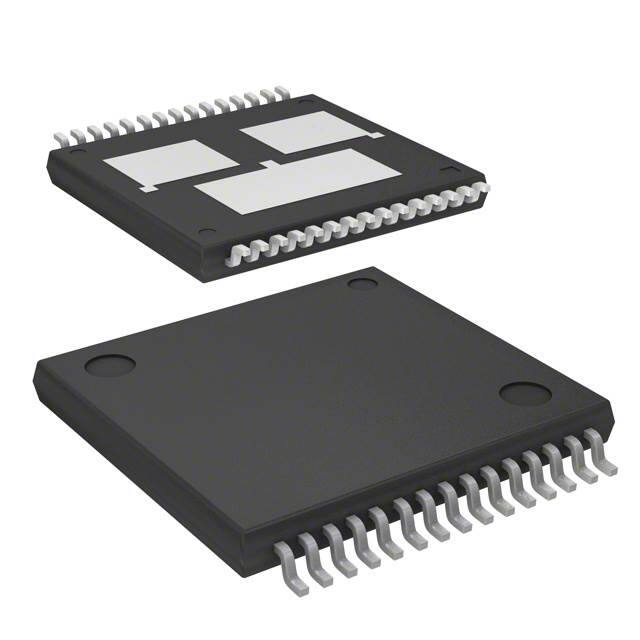
VNH2SP30-E
Automotive fully integrated H-bridge motor driver
Datasheet - production data
using STMicroelectronics well known and proven
proprietary VIPower™ M0 technology which
permits efficient integration on the same die of a
true power MOSFET with intelligent
signal/protection circuitry.
MultiPowerSO-30™
Features
Type
RDS(on)
Iout
Vccmax
VNH2SP30-E
19 mΩ max
(per leg)
30 A
41 V
AEC-Q100 qualified
5 V logic level compatible inputs
Undervoltage and overvoltage shutdown
Overvoltage clamp
Thermal shutdown
Cross-conduction protection
Linear current limiter
Very low standby power consumption
PWM operation up to 20 kHz
Protection against loss of ground and loss of
VCC
The low side switches are vertical MOSFETs
manufactured using STMicroelectronics
proprietary EHD (STripFET™) process. The three
die are assembled in a MultiPowerSO-30
package on electrically isolated leadframes. This
package, specifically designed for the harsh
automotive environments, offers improved
thermal performance thanks to exposed die pads.
Moreover, its fully symmetrical mechanical design
allows superior manufacturability at board level.
The input signals INA and INB can directly
interface with the microcontroller to select the
motor direction and brake condition. The
DIAGA/ENA or DIAGB/ENB, when connected to an
external pull-up resistor, enable one leg of the
bridge. They also provide a feedback digital
diagnostic signal. The normal operating condition
is explained in the truth table. The motor current
can be monitored with the CS pin by delivering a
current proportional to its value. The speed of the
motor can be controlled in all possible conditions
by the PWM up to 20 kHz. In all cases, a low level
state on the PWM pin will turn off both the LSA
and LSB switches. When PWM rises to a high
level, LSA or LSB turn on again depending on the
input pin state.
Current sense output proportional to motor
current
Table 1. Device summary
Order code
Package: ECOPACK®
Package
Tape and reel
Description
MultiPowerSO-30
VNH2SP30TR-E
The VNH2SP30-E is a full bridge motor driver
intended for a wide range of automotive
applications. The device incorporates a dual
monolithic high side driver and two low side
switches. The high side driver switch is designed
January 2017
This is information on a product in full production.
DocID10832 Rev 10
1/35
www.st.com
�Contents
VNH2SP30-E
Contents
1
Block diagram and pin description . . . . . . . . . . . . . . . . . . . . . . . . . . . . . 5
2
Electrical specifications . . . . . . . . . . . . . . . . . . . . . . . . . . . . . . . . . . . . . . 8
3
2.1
Absolute maximum ratings . . . . . . . . . . . . . . . . . . . . . . . . . . . . . . . . . . . . . 8
2.2
Electrical characteristics . . . . . . . . . . . . . . . . . . . . . . . . . . . . . . . . . . . . . . . 9
2.3
Electrical characteristics curves . . . . . . . . . . . . . . . . . . . . . . . . . . . . . . . . 17
Application information . . . . . . . . . . . . . . . . . . . . . . . . . . . . . . . . . . . . . 21
3.1
4
Package and PCB thermal data . . . . . . . . . . . . . . . . . . . . . . . . . . . . . . . 26
4.1
5
6
2/35
Reverse battery protection . . . . . . . . . . . . . . . . . . . . . . . . . . . . . . . . . . . . 22
PowerSSO-30 thermal data . . . . . . . . . . . . . . . . . . . . . . . . . . . . . . . . . . . 26
4.1.1
Thermal calculation in clockwise and anti-clockwise operation in steadystate mode . . . . . . . . . . . . . . . . . . . . . . . . . . . . . . . . . . . . . . . . . . . . . . . 27
4.1.2
Thermal resistance definitions (values according to the PCB heatsink
area) . . . . . . . . . . . . . . . . . . . . . . . . . . . . . . . . . . . . . . . . . . . . . . . . . . . 27
4.1.3
Thermal calculation in transient mode . . . . . . . . . . . . . . . . . . . . . . . . . . 27
4.1.4
Single pulse thermal impedance definition
(values according to the PCB heatsink area) . . . . . . . . . . . . . . . . . . . . 27
Package information . . . . . . . . . . . . . . . . . . . . . . . . . . . . . . . . . . . . . . . . 31
5.1
MultiPowerSO-30 package information . . . . . . . . . . . . . . . . . . . . . . . . . . 31
5.2
Packing information . . . . . . . . . . . . . . . . . . . . . . . . . . . . . . . . . . . . . . . . . 33
Revision history . . . . . . . . . . . . . . . . . . . . . . . . . . . . . . . . . . . . . . . . . . . 34
DocID10832 Rev 10
�VNH2SP30-E
List of tables
List of tables
Table 1.
Table 2.
Table 3.
Table 4.
Table 5.
Table 6.
Table 7.
Table 8.
Table 9.
Table 10.
Table 11.
Table 12.
Table 13.
Table 14.
Table 15.
Table 16.
Table 17.
Table 18.
Device summary . . . . . . . . . . . . . . . . . . . . . . . . . . . . . . . . . . . . . . . . . . . . . . . . . . . . . . . . . . 1
Block description. . . . . . . . . . . . . . . . . . . . . . . . . . . . . . . . . . . . . . . . . . . . . . . . . . . . . . . . . . 5
Pin definitions and functions . . . . . . . . . . . . . . . . . . . . . . . . . . . . . . . . . . . . . . . . . . . . . . . . . 6
Pin functions description . . . . . . . . . . . . . . . . . . . . . . . . . . . . . . . . . . . . . . . . . . . . . . . . . . . . 7
Absolute maximum ratings . . . . . . . . . . . . . . . . . . . . . . . . . . . . . . . . . . . . . . . . . . . . . . . . . . 8
Power section . . . . . . . . . . . . . . . . . . . . . . . . . . . . . . . . . . . . . . . . . . . . . . . . . . . . . . . . . . . . 9
Logic inputs (INA, INB, ENA, ENB) . . . . . . . . . . . . . . . . . . . . . . . . . . . . . . . . . . . . . . . . . . . 9
PWM . . . . . . . . . . . . . . . . . . . . . . . . . . . . . . . . . . . . . . . . . . . . . . . . . . . . . . . . . . . . . . . . . . 10
Switching (VCC = 13 V, RLOAD = 0.87 W , unless otherwise specified) . . . . . . . . . . . . . . . 10
Protection and diagnostic . . . . . . . . . . . . . . . . . . . . . . . . . . . . . . . . . . . . . . . . . . . . . . . . . . 11
Current sense (9 V < VCC < 16 V) . . . . . . . . . . . . . . . . . . . . . . . . . . . . . . . . . . . . . . . . . . . 12
Truth table in normal operating conditions . . . . . . . . . . . . . . . . . . . . . . . . . . . . . . . . . . . . . 15
Truth table in fault conditions (detected on OUTA). . . . . . . . . . . . . . . . . . . . . . . . . . . . . . . 15
Electrical transient requirements . . . . . . . . . . . . . . . . . . . . . . . . . . . . . . . . . . . . . . . . . . . . 16
Thermal calculation in clockwise and anti-clockwise operation in steady-state mode . . . . 27
Thermal parameters . . . . . . . . . . . . . . . . . . . . . . . . . . . . . . . . . . . . . . . . . . . . . . . . . . . . . . 29
MultiPowerSO-30 mechanical data . . . . . . . . . . . . . . . . . . . . . . . . . . . . . . . . . . . . . . . . . . 31
Document revision history . . . . . . . . . . . . . . . . . . . . . . . . . . . . . . . . . . . . . . . . . . . . . . . . . 34
DocID10832 Rev 10
3/35
3
�List of figures
VNH2SP30-E
List of figures
Figure 1.
Figure 2.
Figure 3.
Figure 4.
Figure 5.
Figure 6.
Figure 7.
Figure 8.
Figure 9.
Figure 10.
Figure 11.
Figure 12.
Figure 13.
Figure 14.
Figure 15.
Figure 16.
Figure 17.
Figure 18.
Figure 19.
Figure 20.
Figure 21.
Figure 22.
Figure 23.
Figure 24.
Figure 25.
Figure 26.
Figure 27.
Figure 28.
Figure 29.
Figure 30.
Figure 31.
Figure 32.
Figure 33.
Figure 34.
Figure 35.
Figure 36.
Figure 37.
Figure 38.
Figure 39.
Figure 40.
Figure 41.
Figure 42.
Figure 43.
Figure 44.
Figure 45.
Figure 46.
4/35
Block diagram . . . . . . . . . . . . . . . . . . . . . . . . . . . . . . . . . . . . . . . . . . . . . . . . . . . . . . . . . . . . 5
Configuration diagram (top view) . . . . . . . . . . . . . . . . . . . . . . . . . . . . . . . . . . . . . . . . . . . . . 6
Current and voltage conventions . . . . . . . . . . . . . . . . . . . . . . . . . . . . . . . . . . . . . . . . . . . . . 8
Definition of the delay times measurement . . . . . . . . . . . . . . . . . . . . . . . . . . . . . . . . . . . . 12
Definition of the low side switching times . . . . . . . . . . . . . . . . . . . . . . . . . . . . . . . . . . . . . . 13
Definition of the high side switching times . . . . . . . . . . . . . . . . . . . . . . . . . . . . . . . . . . . . . 13
Definition of dynamic cross conduction current during a PWM operation. . . . . . . . . . . . . . 14
On state supply current. . . . . . . . . . . . . . . . . . . . . . . . . . . . . . . . . . . . . . . . . . . . . . . . . . . . 17
Off state supply current. . . . . . . . . . . . . . . . . . . . . . . . . . . . . . . . . . . . . . . . . . . . . . . . . . . . 17
High level input current . . . . . . . . . . . . . . . . . . . . . . . . . . . . . . . . . . . . . . . . . . . . . . . . . . . . 17
Input clamp voltage. . . . . . . . . . . . . . . . . . . . . . . . . . . . . . . . . . . . . . . . . . . . . . . . . . . . . . . 17
Input high level voltage . . . . . . . . . . . . . . . . . . . . . . . . . . . . . . . . . . . . . . . . . . . . . . . . . . . . 17
Input low level voltage . . . . . . . . . . . . . . . . . . . . . . . . . . . . . . . . . . . . . . . . . . . . . . . . . . . . 17
Input hysteresis voltage . . . . . . . . . . . . . . . . . . . . . . . . . . . . . . . . . . . . . . . . . . . . . . . . . . . 18
High level enable pin current . . . . . . . . . . . . . . . . . . . . . . . . . . . . . . . . . . . . . . . . . . . . . . . 18
Delay time during change of operation mode . . . . . . . . . . . . . . . . . . . . . . . . . . . . . . . . . . . 18
Enable clamp voltage . . . . . . . . . . . . . . . . . . . . . . . . . . . . . . . . . . . . . . . . . . . . . . . . . . . . . 18
High level enable voltage . . . . . . . . . . . . . . . . . . . . . . . . . . . . . . . . . . . . . . . . . . . . . . . . . . 18
Low level enable voltage . . . . . . . . . . . . . . . . . . . . . . . . . . . . . . . . . . . . . . . . . . . . . . . . . . 18
PWM high level voltage . . . . . . . . . . . . . . . . . . . . . . . . . . . . . . . . . . . . . . . . . . . . . . . . . . . 19
PWM low level voltage . . . . . . . . . . . . . . . . . . . . . . . . . . . . . . . . . . . . . . . . . . . . . . . . . . . . 19
PWM high level current. . . . . . . . . . . . . . . . . . . . . . . . . . . . . . . . . . . . . . . . . . . . . . . . . . . . 19
Overvoltage shutdown . . . . . . . . . . . . . . . . . . . . . . . . . . . . . . . . . . . . . . . . . . . . . . . . . . . . 19
Undervoltage shutdown . . . . . . . . . . . . . . . . . . . . . . . . . . . . . . . . . . . . . . . . . . . . . . . . . . . 19
Current limitation. . . . . . . . . . . . . . . . . . . . . . . . . . . . . . . . . . . . . . . . . . . . . . . . . . . . . . . . . 19
On state high side resistance vs Tcase . . . . . . . . . . . . . . . . . . . . . . . . . . . . . . . . . . . . . . . 20
On state low side resistance vs Tcase . . . . . . . . . . . . . . . . . . . . . . . . . . . . . . . . . . . . . . . . 20
Turn-on delay time . . . . . . . . . . . . . . . . . . . . . . . . . . . . . . . . . . . . . . . . . . . . . . . . . . . . . . . 20
Turn-off delay time . . . . . . . . . . . . . . . . . . . . . . . . . . . . . . . . . . . . . . . . . . . . . . . . . . . . . . . 20
Output voltage rise time . . . . . . . . . . . . . . . . . . . . . . . . . . . . . . . . . . . . . . . . . . . . . . . . . . . 20
Output voltage fall time . . . . . . . . . . . . . . . . . . . . . . . . . . . . . . . . . . . . . . . . . . . . . . . . . . . . 20
Typical application circuit for DC to 20 kHz PWM operation short-circuit protection . . . . . 21
Behavior in fault condition (how a fault can be cleared) . . . . . . . . . . . . . . . . . . . . . . . . . . . 22
Half-bridge configuration. . . . . . . . . . . . . . . . . . . . . . . . . . . . . . . . . . . . . . . . . . . . . . . . . . . 23
Multi-motor configuration . . . . . . . . . . . . . . . . . . . . . . . . . . . . . . . . . . . . . . . . . . . . . . . . . . 23
Waveforms in full bridge operation . . . . . . . . . . . . . . . . . . . . . . . . . . . . . . . . . . . . . . . . . . . 24
Waveforms in full bridge operation (continued) . . . . . . . . . . . . . . . . . . . . . . . . . . . . . . . . . 25
MultiPowerSO-30™ PC board . . . . . . . . . . . . . . . . . . . . . . . . . . . . . . . . . . . . . . . . . . . . . . 26
Chipset configuration . . . . . . . . . . . . . . . . . . . . . . . . . . . . . . . . . . . . . . . . . . . . . . . . . . . . . 26
Auto and mutual Rthj-amb vs PCB copper area in open box free air condition . . . . . . . . . 26
MultiPowerSO-30 HSD thermal impedance junction ambient single pulse . . . . . . . . . . . . 28
MultiPowerSO-30 LSD thermal impedance junction ambient single pulse . . . . . . . . . . . . . 28
Thermal fitting model of an H-bridge in MultiPowerSO-30 . . . . . . . . . . . . . . . . . . . . . . . . . 29
MultiPowerSO-30 package outline . . . . . . . . . . . . . . . . . . . . . . . . . . . . . . . . . . . . . . . . . . . 31
MultiPowerSO-30 suggested pad layout . . . . . . . . . . . . . . . . . . . . . . . . . . . . . . . . . . . . . . 32
MultiPowerSO-30 tape and reel shipment (suffix “TR”) . . . . . . . . . . . . . . . . . . . . . . . . . . . 33
DocID10832 Rev 10
�VNH2SP30-E
1
Block diagram and pin description
Block diagram and pin description
Figure 1. Block diagram
VCC
OVERTEMPERATURE A
OV + UV
OVERTEMPERATURE B
CLAMP HSA
HSA
CLAMP HSB
DRIVER
HSA
CURRENT
LIMITATION A
OUTA
CURRENT
LIMITATION B
1/K
1/K
CLAMP LSA
LSA
GNDA
HSB
DRIVER
HSB
LOGIC
OUTB
CLAMP LSB
DRIVER
LSB
DRIVER
LSA
DIAGA/ENA INA
CS
PWM INB DIAGB/ENB
LSB
GNDB
Table 2. Block description
Name
Description
Logic control
Allows the turn-on and the turn-off of the high side and the low side switches
according to the truth table
Overvoltage +
undervoltage
Shuts down the device outside the range [5.5V..16V] for the battery voltage
High side and low
side clamp voltage
Protects the high side and the low side switches from the high voltage on the
battery line in all configurations for the motor
High side and low
side driver
Drives the gate of the concerned switch to allow a proper RDS(on) for the leg of
the bridge
Linear current limiter
Limits the motor current by reducing the high side switch gate-source voltage
when short-circuit to ground occurs
Overtemperature
protection
In case of short-circuit with the increase of the junction’s temperature, shuts
down the concerned high side to prevent its degradation and to protect the die
Fault detection
Signals an abnormal behavior of the switches in the half-bridge A or B by
pulling low the concerned ENx/DIAGx pin
DocID10832 Rev 10
5/35
34
�Block diagram and pin description
VNH2SP30-E
Figure 2. Configuration diagram (top view)
OUTA
Nc
VCC
Nc
1
30
OUTA
Heat Slug3
INA
ENA/DIAGA
Nc
PWM
GNDA
OUTA
Nc
VCC
VCC
Heat Slug1
CS
ENB/DIAGB
INB
Nc
VCC
Nc
OUTB
OUTA
Nc
GNDA
GNDA
Nc
OUTB
OUTB
Heat Slug2
15
16
GNDB
GNDB
GNDB
Nc
OUTB
Table 3. Pin definitions and functions
Pin no.
1, 25, 30
Symbol
Function
OUTA, Heat Slug3 Source of high side switch A / Drain of low side switch A
2, 4, 7, 12, 14,
NC
17, 22, 24, 29
Not connected
3, 13, 23
VCC, Heat Slug1
Drain of high side switches and power supply voltage
6
ENA/DIAGA
Status of high side and low side switches A; open drain output
5
INA
Clockwise input
8
PWM
PWM input
9
CS
Output of current sense
11
INB
Counter clockwise input
10
ENB/DIAGB
Status of high side and low side switches B; open drain output
15, 16, 21
OUTB, Heat Slug2 Source of high side switch B / Drain of low side switch B
26, 27, 28
GNDA
Source of low side switch A(1)
18, 19, 20
GNDB
Source of low side switch B(1)
1. GNDA and GNDB must be externally connected together.
6/35
DocID10832 Rev 10
�VNH2SP30-E
Block diagram and pin description
Table 4. Pin functions description
Name
VCC
Description
Battery connection
GNDA, GNDB Power grounds; must always be externally connected together
OUTA, OUTB
Power connections to the motor
INA, INB
Voltage controlled input pins with hysteresis, CMOS compatible. These two pins
control the state of the bridge in normal operation according to the truth table (brake
to VCC, brake to GND, clockwise and counterclockwise).
PWM
Voltage controlled input pin with hysteresis, CMOS compatible. Gates of low side
FETs are modulated by the PWM signal during their ON phase allowing speed control
of the motor.
ENA/DIAGA,
ENB/DIAGB
Open drain bidirectional logic pins. These pins must be connected to an external pull
up resistor. When externally pulled low, they disable half-bridge A or B. In case of
fault detection (thermal shutdown of a high side FET or excessive ON state voltage
drop across a low side FET), these pins are pulled low by the device (see truth table
in fault condition).
CS
Analog current sense output. This output sources a current proportional to the motor
current. The information can be read back as an analog voltage across an external
resistor.
DocID10832 Rev 10
7/35
34
�Electrical specifications
2
VNH2SP30-E
Electrical specifications
Figure 3. Current and voltage conventions
IS
VCC
IINA
VCC
INA
IINB
INB
IENA
OUTB
DIAGB/ENB
VINA
PWM
VINB
VENA
CS
DIAGA/ENA
IENB
IOUTB
VOUTA
ISENSE
VSENSE
VOUTB
GNDA GNDB
Ipw
GND
VENB
Vpw
2.1
IOUTA
OUTA
IGND
Absolute maximum ratings
Table 5. Absolute maximum ratings
Symbol
8/35
Parameter
Value
Unit
V
VCC
Supply voltage
+41
Imax
Maximum output current (continuous)
30
IR
Reverse output current (continuous)
-30
IIN
Input current (INA and INB pins)
10
IEN
Enable input current (DIAGA/ENA and DIAGB/ENB pins)
10
Ipw
PWM input current
10
VCS
Current sense maximum voltage
VESD
Electrostatic discharge (R = 1.5k, C = 100pF)
– CS pin
– logic pins
– output pins: OUTA, OUTB, VCC
Tj
Junction operating temperature
Tc
Case operating temperature
-40 to 150
TSTG
Storage temperature
-55 to 150
DocID10832 Rev 10
A
mA
-3/+15
V
2
4
5
kV
kV
kV
Internally limited
°C
�VNH2SP30-E
2.2
Electrical specifications
Electrical characteristics
VCC = 9V up to 16 V; -40°C < TJ < 150°C, unless otherwise specified.
Table 6. Power section
Symbol
VCC
IS
Parameter
Test conditions
Operating supply
voltage
Min Typ Max Unit
5.5
16
V
30
60
µA
µA
mA
On state:
INA or INB = 5V, no PWM
10
mA
Off state with all Fault Cleared & ENx=0
INA = INB = PWM = 0; Tj = 25°C; VCC = 13V
INA = INB = PWM = 0
Off state: INA = INB = PWM = 0
Supply current
12
2
RONHS
Static high side
resistance
IOUT = 15A; Tj = 25°C
14
IOUT = 15A; Tj = -40 to 150°C
28
RONLS
Static low side
resistance
IOUT = 15A; Tj = 25°C
5
IOUT = 15A; Tj = -40 to 150°C
10
Vf
High side freewheeling diode
forward voltage
IL(off)
High side off state
output current
(per channel)
IRM
Dynamic crossconduction current
If = 15A
0.8
1.1
Tj = 25°C; VOUTX = ENX = 0V; VCC = 13V
3
Tj = 125°C; VOUTX = ENX = 0V; VCC = 13V
5
IOUT = 15A (see Figure 7)
0.7
m
V
µA
A
Table 7. Logic inputs (INA, INB, ENA, ENB)
Symbol
Parameter
Test conditions
Min Typ Max Unit
VIL
Input low level voltage
VIH
Input high level voltage
VIHYST
Input hysteresis voltage
VICL
Input clamp voltage
IINL
Input low current
VIN = 1.25V
IINH
Input high current
VIN = 3.25V
10
VDIAG
Enable output low level
voltage
Fault operation (DIAGX/ENX pin acts as
an output pin); IEN = 1mA
0.4
1.25
Normal operation (DIAGX/ENX pin acts
as an input pin)
3.25
0.5
V
IIN = 1mA
5.5
IIN = -1mA
-1.0 -0.7 -0.3
DocID10832 Rev 10
6.3
7.5
1
µA
V
9/35
34
�Electrical specifications
VNH2SP30-E
Table 8. PWM
Symbol
Parameter
Test conditions
Vpwl
PWM low level voltage
Ipwl
PWM pin current
Vpwh
PWM high level voltage
Ipwh
PWM pin current
Vpwhhyst
PWM hysteresis voltage
Vpwcl
PWM clamp voltage
CINPWM
PWM pin input
capacitance
Min
Vpw = 1.25V
Typ
Max
Unit
1.25
V
1
µA
3.25
V
Vpw = 3.25V
10
µA
V
0.5
Ipw = 1mA
VCC + 0.3
VCC + 0.7
VCC + 1.0
Ipw = -1mA
-6.0
-4.5
-3.0
VIN = 2.5V
25
pF
Table 9. Switching (VCC = 13 V, RLOAD = 0.87 , unless otherwise specified)
Symbol
Parameter
Test conditions
Min
Typ
0
Max
Unit
20
kHz
f
PWM frequency
td(on)
Turn-on delay time
Input rise time < 1µs
(see Figure 6)
250
td(off)
Turn-off delay time
Input rise time < 1µs
(see Figure 6)
250
tr
Rise time
(see Figure 5)
1
1.6
tf
Fall time
(see Figure 5)
1.2
2.4
tDEL
Delay time during change
of operating mode
(see Figure 4)
600
1800
trr
High side free wheeling
diode reverse recovery
time
(see Figure 7)
toff(min)(1) PWM minimum off time
9V < VCC < 16V; Tj = 25°C;
L = 250µH; IOUT = 15A
300
110
ns
6
1. To avoid false short to battery detection during PWM operation, the PWM signal must be low for a time
longer than 6 µs.
10/35
DocID10832 Rev 10
µs
µs
�VNH2SP30-E
Electrical specifications
Table 10. Protection and diagnostic
Symbol
VUSD
Parameter
Test conditions
Min
Typ
Undervoltage shutdown
Max
Unit
5.5
Undervoltage reset
4.7
V
VOV
Overvoltage shutdown
16
19
22
ILIM
High side current limitation
30
50
70
A
VCLP
Total clamp voltage (VCC to GND)
IOUT = 15A
43
48
54
V
TTSD
Thermal shutdown temperature
VIN = 3.25V
150
175
200
TTR
Thermal reset temperature
THYST
Thermal hysteresis
7
DocID10832 Rev 10
°C
135
15
11/35
34
�Electrical specifications
VNH2SP30-E
Table 11. Current sense (9 V < VCC < 16 V)
Symbol
Parameter
Test conditions
Min
Typ
Max
K1
IOUT/ISENSE
IOUT = 30A; RSENSE = 1.5k;
Tj = -40 to 150°C
9665 11370
13075
K2
IOUT/ISENSE
IOUT = 8A; RSENSE = 1.5k;
Tj = -40 to 150°C
9096 11370
13644
= 30A; RSENSE = 1.5k;
I
dK1 / K1(1) Analog sense current drift OUT
Tj = -40 to 150°C
-8
+8
I
> 8A; RSENSE = 1.5k;
dK2 / K2(1) Analog sense current drift OUT
Tj = -40 to 150°C
-10
+10
0
65
ISENSEO
Analog sense leakage
current
IOUT = 0A; VSENSE = 0V;
Tj = -40 to 150°C
%
1. Analog sense current drift is deviation of factor K for a given device over (-40 °C to 150 °C and 9
V < VCC < 16 V) with respect to its value measured at Tj = 25°C, VCC = 13 V.
Figure 4. Definition of the delay times measurement
VINA
t
VINB
t
PWM
t
ILOAD
tDEL
tDEL
t
12/35
DocID10832 Rev 10
Unit
µA
�VNH2SP30-E
Electrical specifications
Figure 5. Definition of the low side switching times
PWM
t
VOUTA, B
90%
tf
80%
20%
10%
tr
t
Figure 6. Definition of the high side switching times
VINA
tD(off)
tD(on)
t
VOUTA
90%
10%
t
DocID10832 Rev 10
13/35
34
�Electrical specifications
VNH2SP30-E
Figure 7. Definition of dynamic cross conduction current during a PWM operation
INA = 1, INB = 0
PWM
t
IMOTOR
t
VOUTB
t
ICC
IRM
t
trr
14/35
DocID10832 Rev 10
�VNH2SP30-E
Electrical specifications
Table 12. Truth table in normal operating conditions
INA INB
DIAGA/ENA
DIAGB/ENB
OUTA
1
1
H
0
1
1
0
OUTB
1
L
0
H
L
H
L
CS
High Imp.
ISENSE = IOUT/K
High imp.
Operating mode
Brake to VCC
Clockwise (CW)
Counterclockwise (CCW)
Brake to GND
Table 13. Truth table in fault conditions (detected on OUTA)
INA
1
0
INB
DIAGA/ENA
DIAGB/ENB
H
0
L
1
1
0
0
H
OPEN
0
1
L
OPEN
1
0
Fault Information
Note:
OUTB
1
X
X
OUTA
CS
High Imp.
IOUTB/K
High Imp.
H
IOUTB/K
L
High Imp.
Protection Action
The saturation detection on the low side power MOSFET is possible only if the impedance
of the short-circuit from the output to the battery is less than 100 mΩ when the device is
supplied with a battery voltage of 13.5 V.
DocID10832 Rev 10
15/35
34
�Electrical specifications
VNH2SP30-E
Table 14. Electrical transient requirements
ISO T/R - 7637/1
Test level
Test level
Test level
Test level
Test levels
test pulse
I
II
III
IV
delays and impedance
1
-25V
-50V
-75V
-100V
2ms, 10
2
+25V
+50V
+75V
+100V
0.2ms, 10
3a
-25V
-50V
-100V
-150V
3b
+25V
+50V
+75V
+100V
4
-4V
-5V
-6V
-7V
100ms, 0.01
5
+26.5V
+46.5V
+66.5V
+86.5V
400ms, 2
0.1µs, 50
ISO T/R - 7637/1
Test levels
Test levels
Test levels
Test levels
test pulse
result I
result II
result III
result IV
C
C
C
E
E
E
1
2
3a
3b
C
4
5(1)
1. For load dump exceeding the above value a centralized suppressor must be adopted.
Class
16/35
Contents
C
All functions of the device are performed as designed after exposure to
disturbance.
E
One or more functions of the device are not performed as designed after
exposure to disturbance and cannot be returned to proper operation without
replacing the device.
DocID10832 Rev 10
�VNH2SP30-E
2.3
Electrical specifications
Electrical characteristics curves
Figure 8. On state supply current
Is (mA)
Figure 9. Off state supply current
Is (µA)
6
50
5.5
45
Vcc=13V
INA or INB=5V
5
Vcc=13V
40
4.5
35
4
3.5
30
3
25
2.5
20
2
15
1.5
10
1
5
0.5
0
0
-50
-25
0
25
50
75
100
125
150
175
-50
-25
0
25
Tc (°C)
75
100
125
150
175
Tc (°C)
Figure 10. High level input current
Iinh (µA)
Figure 11. Input clamp voltage
Vicl (V)
5
8
4.5
7.75
Vin=3.25V
4
50
Iin =1mA
7.5
7.25
3.5
7
3
6.75
2.5
6.5
2
6.25
6
1.5
5.75
1
5.5
0.5
5.25
0
5
-50
-25
0
25
50
75
100
125
150
175
-50
-25
0
25
Tc (°C)
50
75
100
125
150
175
Tc (°C)
Figure 12. Input high level voltage
Vih (V)
Figure 13. Input low level voltage
Vil (V)
3
3
2.9
2.75
2.8
2.5
2.7
2.25
2.6
2.5
2
2.4
1.75
2.3
1.5
2.2
1.25
2.1
2
1
-50
-25
0
25
50
75
100
125
150
175
Tc (°C)
-50
-25
0
25
50
75
100
125
150
175
Tc (°C)
DocID10832 Rev 10
17/35
34
�Electrical specifications
VNH2SP30-E
Figure 14. Input hysteresis voltage
Figure 15. High level enable pin current
Vihyst (V)
Ienh (µA)
2
8
1.75
7
Vcc=13V
Ven=3.25V
1.5
6
1.25
5
1
4
0.75
3
0.5
2
0.25
1
0
0
-50
-25
0
25
50
75
100
125
150
-50
175
-25
0
25
50
75
100
125
150
175
Tc (°C)
Tc (°C)
Figure 16. Delay time during change of
operation mode
Figure 17. Enable clamp voltage
tdel (µs)
Vencl (V)
1000
-0.2
900
-0.3
Ien=-1mA
800
-0.4
700
-0.5
600
500
-0.6
400
-0.7
300
-0.8
200
-0.9
100
0
-1
-50
-25
0
25
50
75
100
125
150
175
-50
-25
0
25
Tc (°C)
75
100
125
150
175
Tc (°C)
Figure 18. High level enable voltage
Venh (V)
Figure 19. Low level enable voltage
Venl (V)
3.6
3
3.4
2.8
Vcc=9V
3.2
Vcc=9V
2.6
3
2.4
2.8
2.2
2.6
2
2.4
1.8
2.2
1.6
2
1.4
1.8
1.2
1.6
1
-50
-25
0
25
50
75
100
125
150
175
-50
Tc (°C)
18/35
50
-25
0
25
50
75
Tc (°C)
DocID10832 Rev 10
100
125
150
175
�VNH2SP30-E
Electrical specifications
Figure 20. PWM high level voltage
Vpwh (V)
Figure 21. PWM low level voltage
Vpwl (V)
5
2.6
4.5
2.4
Vcc=9V
4
Vcc=9V
2.2
3.5
2
3
2.5
1.8
2
1.6
1.5
1.4
1
1.2
0.5
0
1
-50
-25
0
25
50
75
100
125
150
175
-50
-25
0
25
Tc (°C)
50
75
100
125
150
175
Tc (°C)
Figure 22. PWM high level current
Ipwh (µA)
Figure 23. Overvoltage shutdown
Vov (V)
8
30
7
27.5
Vcc=9V
Vpw=3.25V
6
25
5
22.5
4
20
3
17.5
2
15
1
12.5
0
10
-50
-25
0
25
50
75
100
125
150
175
-50
-25
0
25
Tc (°C)
50
75
100
125
150
175
Tc (°C)
Figure 24. Undervoltage shutdown
Figure 25. Current limitation
Vusd(V)
Ilim (A)
8
80
75
7
70
6
65
5
60
4
55
50
3
45
2
40
1
35
0
30
-50
-25
0
25
50
75
100
125
150
175
-50
Tc (°C)
-25
0
25
50
75
100
125
150
175
Tc (°C)
DocID10832 Rev 10
19/35
34
�Electrical specifications
VNH2SP30-E
Figure 26. On state high side resistance vs Tcase Figure 27. On state low side resistance vs Tcase
Ronhs (mOhm)
Ronls (mOhm)
40
9
8
35
Vcc=9V; 16V
Iout=15A
30
Vcc=9V; 16V
Iout=15A
7
6
25
5
20
4
15
3
10
2
5
1
0
0
-50
-25
0
25
50
75
100
125
150
175
-50
-25
0
25
Tc (°C)
50
75
100
125
150
175
Tc (°C)
Figure 28. Turn-on delay time
Figure 29. Turn-off delay time
td(on) (µs)
td(off) (µs)
260
200
240
190
220
180
200
170
180
160
160
150
140
140
120
130
100
120
80
110
60
100
-50
-25
0
25
50
75
100
125
150
175
-50
-25
0
25
Tc (°C)
50
75
100
125
150
175
Tc (°C)
Figure 30. Output voltage rise time
tr (µs)
Figure 31. Output voltage fall time
tf (µs)
2
8
1.8
7
1.6
6
1.4
5
1.2
4
1
3
0.8
2
0.6
1
0.4
0.2
0
-50
-25
0
25
50
75
100
125
150
175
-50
Tc (°C)
20/35
-25
0
25
50
75
Tc (°C)
DocID10832 Rev 10
100
125
150
175
�VNH2SP30-E
3
Application information
Application information
In normal operating conditions the DIAGX/ENX pin is considered as an input pin by the
device. This pin must be externally pulled high.
PWM pin usage: in all cases, a “0” on the PWM pin will turn off both LSA and LSB switches.
When PWM rises back to “1”, LSA or LSB turn on again depending on the input pin state.
Figure 32. Typical application circuit for DC to 20 kHz PWM operation short-circuit
protection
VCC
Reg 5V
+5V
+ 5V
VCC
3.3K
3.3K
DIAGB/ENB
1K
DIAGA/ENA
1K
1K
HSA
HSB
PWM
C
OUTA
1K
10K
33nF
OUTB
INA
CS
LSA
LSB
INB
M
1K
C
1.5K
GNDB
GNDA
100K
S
G
b) N MOSFET
D
Note:
The value of the blocking capacitor (C) depends on the application conditions and defines
the voltage and current ripple on the supply line at PWM operation. Stored energy from the
motor inductance may fly back into the blocking capacitor if the bridge driver goes into tristate. This causes a hazardous overvoltage if the capacitor is not large enough. As a basic
guideline, 500 µF per 10 A load current is recommended.
In case of a fault condition, the DIAGX/ENX pin is considered an output pin by the
device.The fault conditions are:
overtemperature on one or both high sides
short to battery condition on the output (saturation detection on the low side power
MOSFET)
Possible origins of fault conditions may be:
OUTA is shorted to ground → overtemperature detection on high side A.
OUTA is shorted to VCC → low side power MOSFET saturation detection.
When a fault condition is detected, the user can be informed of which power element is in
fault by monitoring the INA, INB, DIAGA/ENA and DIAGB/ENB pins.
DocID10832 Rev 10
21/35
34
�Application information
VNH2SP30-E
In any case, when a fault is detected, the faulty leg of the bridge is latched off. To turn on the
respective output (OUTX) again, the input signal must rise from low to high level.
Figure 33. Behavior in fault condition (how a fault can be cleared)
INA
INB
DIAGA
ENA
DIAGB
ENB
Device Unlatched
Device Latched
Device Latched
IoutA outB
FAULTA
(Internal Signal)
FAULTB
tDEL
(Internal Signal)
Normal
Operation
Note:
OUT B shorted
to VCC
Fault Cleared
tDEL
Stby (*)
Normal
Operation
OUTB shorted Fault Cleared
to GND
Normal
Operation
In case of the fault condition is not removed, the procedure for unlatching and sending the
device into Stby mode is:
- Clear the fault in the device (toggle : INA if ENA=0 or INB if ENB=0)
- Pull low all inputs, PWM and Diag/EN pins within tDEL.
If the Diag/En pins are already low, PWM=0, the fault can be cleared simply toggling the
input. The device will enter Stby mode as soon as the fault is cleared.
3.1
Reverse battery protection
Three possible solutions can be considered:
22/35
1.
a Schottky diode D connected to VCC pin
2.
an N-channel MOSFET connected to the GND pin (see Figure 32: Typical application
circuit for DC to 20 kHz PWM operation short-circuit protection on page 21)
3.
a P-channel MOSFET connected to the VCC pin
DocID10832 Rev 10
�VNH2SP30-E
Application information
The device sustains no more than -30 A in reverse battery conditions because of the two
body diodes of the power MOSFETs. Additionally, in reverse battery condition the I/Os of the
VNH2SP30-E are pulled down to the VCC line (approximately -1.5 V). A series resistor must
be inserted to limit the current sunk from the microcontroller I/Os. If IRmax is the maximum
target reverse current through µC I/Os, the series resistor is:
Figure 34. Half-bridge configuration
VCC
INA
INB
DIAGA/ENA
DIAGB/ENB
PWM
INA
INB
DIAGA/ENA
DIAGB/ENB
PWM
OUTA
GNDA
Note:
M
OUTB
GNDA
GNDB
OUTB
OUTA
GNDB
The VNH2SP30-E can be used as a high power half-bridge driver achieving an On
resistance per leg of 9.5 mΩ.
Figure 35. Multi-motor configuration
VCC
INA
INB
DIAGA/ENA
DIAGB/ENB
PWM
INA
INB
DIAGA/ENA
DIAGB/ENB
PWM
OUTA
OUTB
GNDA
M2
GNDA
GNDB
M1
Note:
OUTB
OUTA
GNDB
M3
The VNH2SP30-E can easily be designed in multi-motor driving applications such as seat
positioning systems where only one motor must be driven at a time. The DIAGX/ENX pins
allow the unused half-bridges to be put into high impedance.
DocID10832 Rev 10
23/35
34
�Application information
VNH2SP30-E
Figure 36. Waveforms in full bridge operation
NORMAL OPERATION (DIAGA/ENA = 1, DIAGB/ENB = 1)
LOAD CONNECTED BETWEEN OUTA, OUTB
DIAGA/ENA
DIAGB/ENB
INA
INB
PWM
OUTA
OUTB
IOUTA->OUTB
CS (*)
tDEL
tDEL
(*) CS BEHAVIOR DURING PWM MODE WILL DEPEND ON PWM FREQUENCY AND DUTY CYCLE.
NORMAL OPERATION (DIAGA/ENA = 1, DIAGB/ENB = 0 and DIAGA/ENA = 0, DIAGB/ENB = 1)
LOAD CONNECTED BETWEEN OUTA, OUTB
DIAGA/ENA
DIAGB/ENB
INA
INB
PWM
OUTA
OUTB
IOUTA->OUTB
CS
CURRENT LIMITATION/THERMAL SHUTDOWN or OUTA SHORTED TO GROUND
INA
INB
ILIM
IOUTA->OUTB
TTSD
TTR
Tj > TTR
Tj
DIAGA/ENA
DIAGB/ENB
CS
normal operation
24/35
OUTA shorted to ground
DocID10832 Rev 10
normal operation
�VNH2SP30-E
Application information
Figure 37. Waveforms in full bridge operation (continued)
OUTA shorted to VCC and undervoltage shutdown
INA
INB
undefined
OUTA
OUTB
undefined
IOUTA->OUTB
DIAGB/ENB
DIAGA/ENA
CS
V < nominal
normal operation
OUTA shorted to VCC
DocID10832 Rev 10
normal operation
undervoltage shutdown
25/35
34
�Package and PCB thermal data
VNH2SP30-E
4
Package and PCB thermal data
4.1
PowerSSO-30 thermal data
Figure 38. MultiPowerSO-30™ PC board
Note:
Layout condition of Rth and Zth measurements (PCB FR4 area = 58 mm x 58 mm, PCB
thickness = 2mm. Cu thickness = 35 µm, Copper areas: from minimum pad layout to
16 cm2).
Figure 39. Chipset configuration
HIGH SIDE
CHIP
HSAB
LOW SIDE
CHIP A
LOW SIDE
CHIP B
LSA
LSB
Figure 40. Auto and mutual Rthj-amb vs PCB copper area in open box free air condition
45
R thH S
R thLS
R thH SLS
R thLSLS
40
35
30
25
20
°C/W
15
10
5
0
0
5
10
15
c m 2 o f C u a re a (re fe r to P C B la yo u t)
26/35
DocID10832 Rev 10
20
�VNH2SP30-E
4.1.1
Package and PCB thermal data
Thermal calculation in clockwise and anti-clockwise operation in
steady-state mode
Table 15. Thermal calculation in clockwise and anti-clockwise operation in steadystate mode
HSA HSB LSA LSB
4.1.2
TjHSAB
TjLSA
TjLSB
ON OFF OFF ON
PdHSA x RthHS + PdLSB PdHSA x RthHSLS +
x RthHSLS + Tamb
PdLSB x RthLSLS + Tamb
PdHSA x RthHSLS + PdLSB
x RthLS + Tamb
OFF ON
PdHSB x RthHS + PdLSA PdHSB x RthHSLS +
x RthHSLS + Tamb
PdLSA x RthLS + Tamb
PdHSB x RthHSLS + PdLSA
x RthLSLS + Tamb
ON OFF
Thermal resistance definitions (values according to the PCB heatsink
area)
RthHS = RthHSA = RthHSB = High Side Chip Thermal Resistance Junction to Ambient (HSA or
HSB in ON state)
RthLS = RthLSA = RthLSB = Low Side Chip Thermal Resistance Junction to Ambient
RthHSLS = RthHSALSB = RthHSBLSA = Mutual Thermal Resistance Junction to Ambient
between High Side and Low Side Chips
RthLSLS = RthLSALSB = Mutual Thermal Resistance Junction to Ambient between Low Side
Chips
4.1.3
Thermal calculation in transient mode(a)
TjHSAB = ZthHS x PdHSAB + ZthHSLS x (PdLSA + PdLSB) + Tamb
TjLSA = ZthHSLS x PdHSAB + ZthLS x PdLSA + ZthLSLS x PdLSB + Tamb
TjLSB = ZthHSLS x PdHSAB + ZthLSLS x PdLSA + ZthLS x PdLSB + Tamb
4.1.4
Single pulse thermal impedance definition
(values according to the PCB heatsink area)
ZthHS = High Side Chip Thermal Impedance Junction to Ambient
ZthLS = ZthLSA = ZthLSB = Low Side Chip Thermal Impedance Junction to Ambient
ZthHSLS = ZthHSABLSA = ZthHSABLSB = Mutual Thermal Impedance Junction to Ambient
between High Side and Low Side Chips
ZthLSLS = ZthLSALSB = Mutual Thermal Impedance Junction to Ambient between Low Side
Chips
a.
Calculation is valid in any dynamic operating condition. Pd values set by user.
DocID10832 Rev 10
27/35
34
�Package and PCB thermal data
VNH2SP30-E
Equation 1: pulse calculation formula
Z TH = R TH Þ + Z THtp 1 –
where = t p T
Figure 41. MultiPowerSO-30 HSD thermal impedance junction ambient single pulse
100
Footprint
4 cm2
8 cm2
16 cm2
ZthHS
Footprint
4 cm2
8 cm2
16 cm2
10
°C/W
ZthHSLS
1
0 .1
0 .0 0 1
0 .0 1
0 .1
t i m e ( se c )
1
10
100
1000
Figure 42. MultiPowerSO-30 LSD thermal impedance junction ambient single pulse
100
Footprint
4 cm2
8 cm2
16 cm2
ZthLS
Footprint
4 cm2
8 cm2
16 cm2
10
°C/W
ZthLSLS
1
0 .1
0 .0 0 1
28/35
0 .0 1
0 .1
t i m e ( se c )
1
DocID10832 Rev 10
10
100
1000
�VNH2SP30-E
Package and PCB thermal data
Figure 43. Thermal fitting model of an H-bridge in MultiPowerSO-30
Table 16. Thermal parameters(1)
Area/island (cm2)
Footprint
R1 = R7 (°C/W)
0.05
R2 = R8 (°C/W)
0.3
R3 (°C/W)
0.5
R4 (°C/W)
1.3
R5 (°C/W)
14
R6 (°C/W)
44.7
R9 = R15 (°C/W)
0.2
R10 = R16 (°C/W)
0.4
R11 = R17 (°C/W)
0.8
R12 = R18 (°C/W)
1.5
R13 = R19 (°C/W)
20
R14 = R20 (°C/W)
46.9
R21 = R22 = R23 (°C/W)
115
C1 = C7 (W.s/°C)
0.005
C2 = C8 (W.s/°C)
0.008
C3 = C11 = C17 (W.s/°C)
0.01
C4 = C13 = C19 (W.s/°C)
0.3
C5 (W.s/°C)
0.6
C6 (W.s/°C)
5
C9 = C15 (W.s/°C)
4
8
16
39.1
31.6
23.7
36.1
30.4
20.8
7
9
11
0.003
DocID10832 Rev 10
29/35
34
�Package and PCB thermal data
VNH2SP30-E
Table 16. Thermal parameters(1) (continued)
Area/island (cm2)
Footprint
C10 = C16 (W.s/°C)
0.006
C12 = C18 (W.s/°C)
0.075
C14 = C20 (W.s/°C)
2.5
4
8
16
3.5
4.5
5.5
1. The blank space means that the value is the same as the previous one.
30/35
DocID10832 Rev 10
�VNH2SP30-E
5
Package information
Package information
In order to meet environmental requirements, ST offers these devices in different grades of
ECOPACK® packages, depending on their level of environmental compliance. ECOPACK®
specifications, grade definitions and product status are available at: www.st.com.
ECOPACK® is an ST trademark.
5.1
MultiPowerSO-30 package information
Figure 44. MultiPowerSO-30 package outline
Table 17. MultiPowerSO-30 mechanical data
Millimeters
Symbol
Min
Typ
A
Max
2.35
A2
1.85
2.25
A3
0
0.1
B
0.42
0.58
C
0.23
0.32
D
17.1
E
18.85
DocID10832 Rev 10
17.2
17.3
19.15
31/35
34
�Package information
VNH2SP30-E
Table 17. MultiPowerSO-30 mechanical data (continued)
Millimeters
Symbol
E1
Min
Typ
Max
15.9
16
16.1
e
1
F1
5.55
6.05
F2
4.6
5.1
F3
9.6
10.1
L
0.8
1.15
N
S
10deg
0deg
Figure 45. MultiPowerSO-30 suggested pad layout
32/35
DocID10832 Rev 10
7deg
�VNH2SP30-E
Package information
5.2
Packing information
Note:
The devices are packed in tape and reel shipments (see Table 1: Device summary on
page 1).
Figure 46. MultiPowerSO-30 tape and reel shipment (suffix “TR”)
Reel dimensions
Dimension
mm
Base Q.ty
1000
Bulk Q.ty
1000
A (max)
330
B (min)
1.5
C (± 0.2)
13
D (min)
20.2
G (+ 2 / -0)
32
N (min)
100
T (max)
38.4
Tape dimensions
According to Electronic Industries Association
(EIA) Standard 481 rev. A, Feb 1986
Description
Dimension
mm
Tape width
Tape Hole Spacing
Component Spacing
Hole Diameter
Hole Diameter
Hole Position
Compartment Depth
Hole Spacing
W
P0 (± 0.1)
P
D (± 0.1/-0)
D1 (min)
F (± 0.1)
K (max)
P1 (± 0.1)
32
4
24
1.5
2
14.2
2.2
2
End
Start
Top
cover
tape
No components
Components
No components
500 mm min
500 mm min
Empty components pockets
User direction of feed
DocID10832 Rev 10
33/35
34
�Revision history
6
VNH2SP30-E
Revision history
Table 18. Document revision history
Date
Revision
Sep-2004
1
First issue
Dec- 2004
2
Inserted toff(min) test condition modification and note
Modified IRM figure number
Feb-2005
3
Minor changes
Apr-2005
4
Public release
01-Sep-2006
5
Document converted into new ST corporate template.
Added table of contents, list of tables and list of figures
Removed figure number from package outline on page 1
Changed Features on page 1 to add ECOPACK® package
Added Section 1: Block diagram and pin description on page 5
Added Section 2.2: Electrical characteristics on page 9
Added “low” and “high” to parameters for IINL and IINH in Table 6 on
page 9
Inserted note in Figure 32 on page 22
Added vertical limitation line to left side arrow of tD(off) to Figure 7 on
page 14
Added Section 4.1: PowerSSO-30 thermal data on page 27
Added Section 5: Package and packing information on page 32
Added Section 5.3: Packing information on page 34
Updated disclaimer (last page) to include a mention about the use of
ST products in automotive applications
15-May-2007
6
Document reformatted and converted into new ST template.
06-Feb-2008
7
Corrected Heat Slug numbers in Table 2: Pin definitions and
functions.
02-Oct-2008
8
Added new information in Table 5: Power section
Added Figure 33: Behavior in fault condition (How a fault can be
cleared)
20-Sep-2013
9
Updated Disclaimer.
10
–
–
–
–
11-Jan-2017
34/35
Description of changes
Removed all information relative to tube packing of the product
Modified Section 5: Package information
Added AEC-Q100 qualified in the Features section
Minor text edits throughout the document
DocID10832 Rev 10
�VNH2SP30-E
IMPORTANT NOTICE – PLEASE READ CAREFULLY
STMicroelectronics NV and its subsidiaries (“ST”) reserve the right to make changes, corrections, enhancements, modifications, and
improvements to ST products and/or to this document at any time without notice. Purchasers should obtain the latest relevant information on
ST products before placing orders. ST products are sold pursuant to ST’s terms and conditions of sale in place at the time of order
acknowledgement.
Purchasers are solely responsible for the choice, selection, and use of ST products and ST assumes no liability for application assistance or
the design of Purchasers’ products.
No license, express or implied, to any intellectual property right is granted by ST herein.
Resale of ST products with provisions different from the information set forth herein shall void any warranty granted by ST for such product.
ST and the ST logo are trademarks of ST. All other product or service names are the property of their respective owners.
Information in this document supersedes and replaces information previously supplied in any prior versions of this document.
© 2017 STMicroelectronics – All rights reserved
DocID10832 Rev 10
35/35
35
�