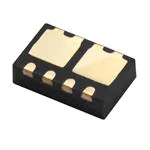
Si5922DU
www.vishay.com
Vishay Siliconix
Dual N-Channel 30 V (D-S) MOSFET
FEATURES
PowerPAK® ChipFET® Dual
• TrenchFET® power MOSFET
D1
D1
8
D2
7
D2
6
5
9
1.
m
1
m
3.0
mm
Top View
• 100 % Rg and UIS tested
1
2 S
1
3
4 S G1
2
G2
Bottom View
Marking code: CH
• DC/DC power supply
30
RDS(on) max. (Ω) at VGS = 10 V
0.0192
RDS(on) max. (Ω) at VGS = 6 V
0.0220
RDS(on) max. (Ω) at VGS = 4.5 V
0.0245
Qg typ. (nC)
ID (A) a
Configuration
• Material categorization: for definitions of compliance
please see www.vishay.com/doc?99912
APPLICATIONS
PRODUCT SUMMARY
VDS (V)
• New thermally enhanced PowerPAK®
ChipFET® package
- Small footprint area
- Low on-resistance
- Thin 0.8 mm profile
D1
4.7
G1
6
D2
G2
Dual
N-Channel MOSFET
N-Channel MOSFET
S1
S2
ORDERING INFORMATION
Package
PowerPAK ChipFET
Lead (Pb)-free and halogen-free
Si5922DU-T1-GE3
ABSOLUTE MAXIMUM RATINGS (TA = 25 °C, unless otherwise noted)
PARAMETER
SYMBOL
LIMIT
Drain-source voltage
VDS
30
Gate-source voltage
VGS
+20 / -16
Continuous drain current (TJ = 150 °C)
TA = 25 °C
ID
Continuous source-drain diode current
Single pulse avalanche current
Avalanche energy
IDM
TC = 25 °C
TA = 25 °C
L = 0.1 mH
IS
IAS
EAS
TC = 25 °C
Maximum power dissipation
TC = 70 °C
TA = 25 °C
TA = 70 °C
6a
6 a, b, c
6 a, b, c
TA = 70 °C
Pulsed drain current (t = 100 μs)
V
6a
TC = 25 °C
TC = 70 °C
UNIT
24
A
6a
1.9 b, c
10
5
mJ
10.4
PD
6.7
2.3 b, c
W
1.5 b, c
Operating junction and storage temperature range
TJ, Tstg
-55 to +150
°C
260
Soldering recommendations (peak temperature) d, e
Notes
a. Package limited
b. Surface mounted on 1" x 1" FR4 board
c. t = 5 s
d. See solder profile (www.vishay.com/doc?73257). The PowerPAK ChipFET is a leadless package. The end of the lead terminal is exposed
copper (not plated) as a result of the singulation process in manufacturing. A solder fillet at the exposed copper tip cannot be guaranteed
and is not required to ensure adequate bottom side solder interconnection
e. Rework conditions: manual soldering with a soldering iron is not recommended for leadless components
S22-0374-Rev. B, 25-Apr-2022
Document Number: 76056
1
For technical questions, contact: pmostechsupport@vishay.com
THIS DOCUMENT IS SUBJECT TO CHANGE WITHOUT NOTICE. THE PRODUCTS DESCRIBED HEREIN AND THIS DOCUMENT
ARE SUBJECT TO SPECIFIC DISCLAIMERS, SET FORTH AT www.vishay.com/doc?91000
�Si5922DU
www.vishay.com
Vishay Siliconix
THERMAL RESISTANCE RATINGS
PARAMETER
Maximum junction-to-ambient a, b
Maximum junction-to-case (drain)
t≤5s
Steady state
SYMBOL
RthJA
RthJC
TYPICAL
43
9.5
MAXIMUM
55
12
UNIT
°C/W
Notes
a. Surface mounted on 1" x 1" FR4 board
b. Maximum under steady state conditions is 105 °C/W
SPECIFICATIONS (TJ = 25 °C, unless otherwise noted)
PARAMETER
Static
Drain-source breakdown voltage
VDS temperature coefficient
VGS(th) temperature coefficient
Gate-source threshold voltage
Gate-source leakage
SYMBOL
TEST CONDITIONS
MIN.
TYP.
MAX.
UNIT
VDS
ΔVDS/TJ
ΔVGS(th)/TJ
VGS(th)
IGSS
VGS = 0 V, ID = 250 μA
30
1.2
5
-
14.3
-4.7
0.0155
0.0170
0.0190
22
2.2
± 100
1
10
0.0192
0.0220
0.0245
-
V
1.3
-
765
225
14
0.018
10
4.7
2.2
0.65
6.5
6.3
6
25
15
10
17
45
16
27
0.036
15
7.1
12.6
15
50
30
20
35
90
30
50
-
0.81
21
10
12
9
6
24
1.2
40
20
-
Zero gate voltage drain current
IDSS
On-state drain current a
ID(on)
Drain-source on-state resistance a
Forward transconductance a
Dynamic b
Input capacitance
Output capacitance
Reverse transfer capacitance
Crss/Ciss ratio
Total gate charge
Gate-source charge
Gate-drain charge
Output charge
Gate resistance
Turn-on delay time
Rise time
Turn-off delay time
Fall time
Turn-on delay time
Rise time
Turn-off delay time
Fall time
Drain-Source Body Diode Characteristics
Continuous source-drain diode current
Pulse diode forward current (t = 100 μs)
Body diode voltage
Body diode reverse recovery time
Body diode reverse recovery charge
Reverse recovery fall time
Reverse recovery rise time
ID = 250 μA
VDS = VGS, ID = 250 μA
VDS = 0 V, VGS = +20 V / -16 V
VDS = 30 V, VGS = 0 V.
VDS = 30 V, VGS = 0 V, TJ = 55 °C
VDS ≥ 5 V, VGS = 10 V
VGS = 10 V, ID = 5 A
VGS = 6 V, ID = 4 A
VGS = 4.5 V, ID = 4 A
VDS = 10 V, ID = 5 A
RDS(on)
gfs
Ciss
Coss
Crss
VDS = 15 V, VGS = 0 V, f = 1 MHz
VDS = 15 V, VGS = 10 V, ID = 5 A
Qg
Qgs
Qgd
Qoss
Rg
td(on)
tr
td(off)
tf
td(on)
tr
td(off)
tf
VDS = 15 V, VGS = 4.5 V, ID = 5 A
IS
ISM
VSD
trr
Qrr
ta
tb
TC = 25 °C
VDS = 15 V, VGS = 0 V
f = 1 MHz
VDD = 15 V, RL = 3 Ω,
ID ≅ 5 A, VGEN = 10 V, Rg = 1 Ω
VDD = 15 V, RL = 3 Ω,
ID ≅ 5 A, VGEN = 4.5 V, Rg = 1 Ω
IS = 5 A, VGS = 0 V
IF = 5 A, dI/dt = 100 A/μs, TJ = 25 °C
mV/°C
V
nA
μA
A
Ω
S
pF
-
nC
Ω
ns
A
V
ns
nC
ns
Notes
a. Pulse test; pulse width ≤ 300 μs, duty cycle ≤ 2 %
b. Guaranteed by design, not subject to production testing
Stresses beyond those listed under “Absolute Maximum Ratings” may cause permanent damage to the device. These are stress ratings only, and functional operation
of the device at these or any other conditions beyond those indicated in the operational sections of the specifications is not implied. Exposure to absolute maximum
rating conditions for extended periods may affect device reliability.
S22-0374-Rev. B, 25-Apr-2022
Document Number: 76056
2
For technical questions, contact: pmostechsupport@vishay.com
THIS DOCUMENT IS SUBJECT TO CHANGE WITHOUT NOTICE. THE PRODUCTS DESCRIBED HEREIN AND THIS DOCUMENT
ARE SUBJECT TO SPECIFIC DISCLAIMERS, SET FORTH AT www.vishay.com/doc?91000
�Si5922DU
www.vishay.com
Vishay Siliconix
TYPICAL CHARACTERISTICS (25 °C, unless otherwise noted)
Axis Title
Axis Title
25
25
10000
10000
VGS = 10 V thru 4 V
10
100
5
1000
15
1st line
2nd line
1000
VGS = 3 V
15
2nd line
ID - Drain Current (A)
20
1st line
2nd line
2nd line
ID - Drain Current (A)
20
TC = 25 °C
10
100
5
TC = 125 °C
0
0
0.5
1
1.5
2
2.5
TC = -55 °C
0
10
3
10
0
1
2
3
VDS - Drain-to-Source Voltage (V)
2nd line
VGS - Gate-to-Source Voltage (V)
2nd line
Output Characteristics
Transfer Characteristics
Axis Title
4
Axis Title
10000
0.030
10000
900
0.020
100
0.015
VGS = 10 V
1000
600
1st line
2nd line
1000
VGS = 6 V
VGS = 4.5 V
2nd line
C - Capacitance (pF)
750
0.025
1st line
2nd line
2nd line
RDS(on) - On-Resistance (Ω)
Ciss
Coss
450
300
100
150
Crss
0.010
0
10
5
10
15
20
25
10
0
5
10
ID - Drain Current (A)
2nd line
VDS - Drain-to-Source Voltage (V)
2nd line
On-Resistance vs. Drain Current and Gate Voltage
Capacitance
1.5
VDS = 15 V
8
1000
1st line
2nd line
VDS = 7.5 V
6
VDS = 24 V
4
100
2
0
10
0
3
6
9
12
2nd line
RDS(on) - On-Resistance (Normalized)
10000
ID = 5 A
20
Axis Title
Axis Title
10
2nd line
VGS - Gate-to-Source Voltage (V)
15
10000
ID = 5 A
1.4
VGS = 10 V; 6 V
1.3
1000
1.2
VGS = 4.5 V
1.1
1.0
100
0.9
0.8
0.7
10
-50
-25
0
25
50
75
100 125 150
Qg - Total Gate Charge (nC)
2nd line
TJ - Junction Temperature (°C)
2nd line
Gate Charge
On-Resistance vs. Junction Temperature
S22-0374-Rev. B, 25-Apr-2022
1st line
2nd line
0
Document Number: 76056
3
For technical questions, contact: pmostechsupport@vishay.com
THIS DOCUMENT IS SUBJECT TO CHANGE WITHOUT NOTICE. THE PRODUCTS DESCRIBED HEREIN AND THIS DOCUMENT
ARE SUBJECT TO SPECIFIC DISCLAIMERS, SET FORTH AT www.vishay.com/doc?91000
�Si5922DU
www.vishay.com
Vishay Siliconix
TYPICAL CHARACTERISTICS (25 °C, unless otherwise noted)
Axis Title
Axis Title
10000
1
100
0.1
0.03
0.2
0.4
0.6
0.8
1.0
TJ = 150 °C
0.02
100
TJ = 25 °C
0.01
10
0
1000
0.04
1st line
2nd line
1000
TJ = 25 °C
ID = 5 A
0.05
2nd line
RDS(on) - On-Resistance (Ω)
TJ = 150 °C
10
10000
0.06
1st line
2nd line
2nd line
IS - Source Current (A)
100
0
0
1.2
2
4
6
8
10
10
VSD - Source-to-Drain Voltage (V)
2nd line
VGS - Gate-to-Source Voltage (V)
2nd line
Source-Drain Diode Forward Voltage
On-Resistance vs. Gate-to-Source Voltage
Axis Title
1.8
30
10000
1.7
25
1.5
1000
20
Power (W)
1.4
1st line
2nd line
2nd line
VGS(th) (V)
1.6
1.3
1.2
100
ID = 250 μA
1.1
15
10
1.0
5
0.9
0.8
10
-50
-25
0
25
50
75
0
0.001 0.01
100 125 150
0.1
TJ - Temperature (°C)
2nd line
Threshold Voltage
1
Time (s)
10
100
1000
Single Pulse Power, Junction-to-Ambient
Axis Title
10000
100
10
100 μs
1
1000
1st line
2nd line
2nd line
ID - Drain Current (A)
Limited by RDS(on) (1)
1 ms
10 ms
100 ms
1s
10 s
DC
0.1
TA = 25 °C
Single pulse
0.01
100
10
0.1
(1)
1
10
100
VDS - Drain-to-Source Voltage (V)
VGS > minimum VGS at which RDS(on) is specified
Safe Operating Area
S22-0374-Rev. B, 25-Apr-2022
Document Number: 76056
4
For technical questions, contact: pmostechsupport@vishay.com
THIS DOCUMENT IS SUBJECT TO CHANGE WITHOUT NOTICE. THE PRODUCTS DESCRIBED HEREIN AND THIS DOCUMENT
ARE SUBJECT TO SPECIFIC DISCLAIMERS, SET FORTH AT www.vishay.com/doc?91000
�Si5922DU
www.vishay.com
Vishay Siliconix
TYPICAL CHARACTERISTICS (25 °C, unless otherwise noted)
Axis Title
25
12
10000
10
10
100
Package limited
5
Power Dissipation (W)
1000
15
1st line
2nd line
2nd line
ID - Drain Current (A)
20
8
6
4
2
0
10
0
25
50
75
100
125
150
0
25
50
75
100
125
TC - Case Temperature (°C)
2nd line
TC - Case Temperature (°C)
Current Derating a
Power Derating
150
Note
a. The power dissipation PD is based on TJ (max.) = 150 °C, using junction-to-case thermal resistance, and is more useful in settling the upper
dissipation limit for cases where additional heatsinking is used. It is used to determine the current rating, when this rating falls below the
package limit
S22-0374-Rev. B, 25-Apr-2022
Document Number: 76056
5
For technical questions, contact: pmostechsupport@vishay.com
THIS DOCUMENT IS SUBJECT TO CHANGE WITHOUT NOTICE. THE PRODUCTS DESCRIBED HEREIN AND THIS DOCUMENT
ARE SUBJECT TO SPECIFIC DISCLAIMERS, SET FORTH AT www.vishay.com/doc?91000
�Si5922DU
www.vishay.com
Vishay Siliconix
TYPICAL CHARACTERISTICS (25 °C, unless otherwise noted)
Normalized Effective Transient
Thermal Impedance
1
Duty Cycle = 0.5
0.2
0.1
Notes:
0.1
PDM
t1
0.05
t2
t
1. Duty Cycle, D = t1
2
2. Per Unit Base = R thJA = 105 °C/W
0.02
3. TJM - TA = PDM Z thJA(t)
4. Surface Mounted
Single Pulse
0.01
10-4
10-3
10-2
10-1
1
10
100
1000
Square Wave Pulse Duration (s)
Normalized Thermal Transient Impedance, Junction-to-Ambient
Normalized Effective Transient
Thermal Impedance
1
Duty Cycle = 0.5
0.2
0.05
0.1
Single Pulse
0.01
10-4
0.02
10-3
10-2
10-1
1
Square Wave Pulse Duration (s)
Normalized Thermal Transient Impedance, Junction-to-Case
Vishay Siliconix maintains worldwide manufacturing capability. Products may be manufactured at one of several qualified locations. Reliability data for Silicon
Technology and Package Reliability represent a composite of all qualified locations. For related documents such as package/tape drawings, part marking, and
reliability data, see www.vishay.com/ppg?76056.
S22-0374-Rev. B, 25-Apr-2022
Document Number: 76056
6
For technical questions, contact: pmostechsupport@vishay.com
THIS DOCUMENT IS SUBJECT TO CHANGE WITHOUT NOTICE. THE PRODUCTS DESCRIBED HEREIN AND THIS DOCUMENT
ARE SUBJECT TO SPECIFIC DISCLAIMERS, SET FORTH AT www.vishay.com/doc?91000
�Package Information
www.vishay.com
Vishay Siliconix
PowerPAK® ChipFET® Case Outline
D
(7)
(6)
(5)
(1)
(2)
(3)
(4)
E
(8)
Pin #1
indicator
Side view of single
e
b
H
D1
D(2)
D2
K
D(3)
L
G(4)
K1
D2
SI(1)
GI(2)
S2(3)
D1(8)
D1(7)
D2(6)
Detail Z
G2(4)
K2
L
D(1)
A1
C
A
Z
Side view of dual
E1
E2
E3
H
D3
D(8)
D(7)
D(6)
S(5)
K3
Backside view of dual pad
Backside view of single pad
DIM.
D2(5)
MILLIMETERS
INCHES
MIN.
NOM.
MAX.
MIN.
NOM.
MAX.
A
0.70
0.75
0.85
0.028
0.030
0.033
A1
0
-
0.05
0
-
0.002
b
0.25
0.30
0.35
0.010
0.012
0.014
C
0.15
0.20
0.25
0.006
0.008
0.010
D
2.92
3.00
3.08
0.115
0.118
0.121
D1
1.75
1.87
2.00
0.069
0.074
0.079
D2
1.07
1.20
1.32
0.042
0.047
0.052
D3
0.20
0.25
0.30
0.008
0.010
0.012
E
1.82
1.90
1.98
0.072
0.075
0.078
E1
1.38
1.50
1.63
0.054
0.059
0.064
E2
0.92
1.05
1.17
0.036
0.041
0.046
E3
0.45
0.50
0.55
0.018
0.020
0.022
e
0.65 BSC
0.026 BSC
H
0.15
0.20
0.25
0.006
0.008
0.010
K
0.25
-
-
0.010
-
-
K1
0.30
-
-
0.012
-
-
K2
0.20
-
-
0.008
-
-
K3
0.20
-
-
0.008
-
-
L
0.30
0.35
0.40
0.012
0.014
0.016
C14-0630-Rev. E, 21-Jul-14
DWG: 5940
Note
• Millimeters will govern
Document Number: 73203
1
For technical questions, contact: pmostechsupport@vishay.com
THIS DOCUMENT IS SUBJECT TO CHANGE WITHOUT NOTICE. THE PRODUCTS DESCRIBED HEREIN AND THIS DOCUMENT
ARE SUBJECT TO SPECIFIC DISCLAIMERS, SET FORTH AT www.vishay.com/doc?91000
Revision: 21-Jul-14
�Application Note 826
Vishay Siliconix
RECOMMENDED MINIMUM PADS FOR PowerPAK® ChipFET® Single
0.225
(0.009)
0.350
(0.014)
0.650
(0.026)
0.200
(0.008)
0.300
(0.012)
0.300
(0.012)
0.100
(0.004)
1.500
(0.059)
1.900
(0.075)
0.250
(0.010)
0.500
(0.020)
0.350
(0.014)
0.350
(0.014)
1.870
(0.074)
0.305
(0.012)
2.575
(0.101)
Recommended Minimum Pads
Dimensions in mm/(Inches)
Return to Index
APPLICATION NOTE
Document Number: 69948
Revision: 21-Jan-08
www.vishay.com
9
�Legal Disclaimer Notice
www.vishay.com
Vishay
Disclaimer
ALL PRODUCT, PRODUCT SPECIFICATIONS AND DATA ARE SUBJECT TO CHANGE WITHOUT NOTICE TO IMPROVE
RELIABILITY, FUNCTION OR DESIGN OR OTHERWISE.
Vishay Intertechnology, Inc., its affiliates, agents, and employees, and all persons acting on its or their behalf (collectively,
“Vishay”), disclaim any and all liability for any errors, inaccuracies or incompleteness contained in any datasheet or in any other
disclosure relating to any product.
Vishay makes no warranty, representation or guarantee regarding the suitability of the products for any particular purpose or
the continuing production of any product. To the maximum extent permitted by applicable law, Vishay disclaims (i) any and all
liability arising out of the application or use of any product, (ii) any and all liability, including without limitation special,
consequential or incidental damages, and (iii) any and all implied warranties, including warranties of fitness for particular
purpose, non-infringement and merchantability.
Statements regarding the suitability of products for certain types of applications are based on Vishay's knowledge of typical
requirements that are often placed on Vishay products in generic applications. Such statements are not binding statements
about the suitability of products for a particular application. It is the customer's responsibility to validate that a particular product
with the properties described in the product specification is suitable for use in a particular application. Parameters provided in
datasheets and / or specifications may vary in different applications and performance may vary over time. All operating
parameters, including typical parameters, must be validated for each customer application by the customer's technical experts.
Product specifications do not expand or otherwise modify Vishay's terms and conditions of purchase, including but not limited
to the warranty expressed therein.
Hyperlinks included in this datasheet may direct users to third-party websites. These links are provided as a convenience and
for informational purposes only. Inclusion of these hyperlinks does not constitute an endorsement or an approval by Vishay of
any of the products, services or opinions of the corporation, organization or individual associated with the third-party website.
Vishay disclaims any and all liability and bears no responsibility for the accuracy, legality or content of the third-party website
or for that of subsequent links.
Except as expressly indicated in writing, Vishay products are not designed for use in medical, life-saving, or life-sustaining
applications or for any other application in which the failure of the Vishay product could result in personal injury or death.
Customers using or selling Vishay products not expressly indicated for use in such applications do so at their own risk. Please
contact authorized Vishay personnel to obtain written terms and conditions regarding products designed for such applications.
No license, express or implied, by estoppel or otherwise, to any intellectual property rights is granted by this document or by
any conduct of Vishay. Product names and markings noted herein may be trademarks of their respective owners.
© 2022 VISHAY INTERTECHNOLOGY, INC. ALL RIGHTS RESERVED
Revision: 01-Jan-2022
1
Document Number: 91000
�