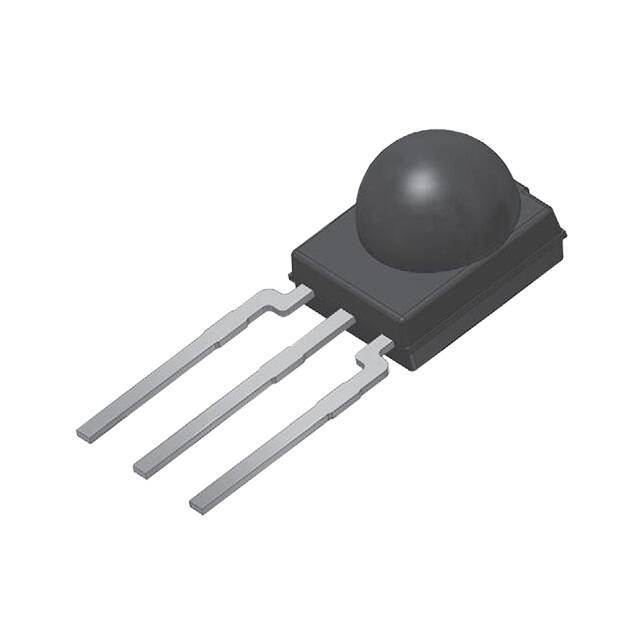
TSOP943.., TSOP945..
www.vishay.com
Vishay Semiconductors
IR Receiver Modules for Remote Control Systems
FEATURES
• Improved dark sensitivity
• Improved immunity against optical noise
• Very low supply current
•
•
•
•
•
1
2
3
16672
Photo detector and preamplifier in one package
Internal filter for PCM frequency
Supply voltage: 2.0 V to 3.6 V
Insensitive to supply voltage ripple and noise
Material categorization:
for definitions of compliance please see
www.vishay.com/doc?99912
LINKS TO ADDITIONAL RESOURCES
MECHANICAL DATA
3D 3D
Product Page
3D Models
Holders
Bends and Cuts
Calculators
Marking
1 = OUT, 2 = GND, 3 = VS
Packages
ORDERING CODE
TSOP943.., TSOP945.. - 2160 pieces in tubes
DESCRIPTION
BLOCK DIAGRAM
The TSOP94... series devices are the latest generation
miniaturized IR receiver modules for infrared remote control
systems. These series provide improvements in sensitivity
to remote control signals in dark ambient as well as in
sensitivity in the presence of optical disturbances e.g. from
CFLs.
VS
30 kΩ
OUT
Input
The devices contain a PIN diode and a preamplifier
assembled on a lead frame. The epoxy package contains an
IR filter. The demodulated output signal can be directly
connected to a microprocessor for decoding.
Band
pass
AGC
Demodulator
GND
PIN
The TSOP943.. and TSOP945.., series devices are designed
to receive short burst codes (6 or more carrier cycles per
burst). The third digit designates the AGC level (AGC3 or
AGC5) and the last two digits designate the band-pass
frequency (see table below). The higher the AGC, the better
noise is suppressed, but the lower the code compatibility.
AGC3 provides enhanced noise suppression and AGC5
provides maximized noise suppression. Generally, we
advise to select the highest AGC that satisfactorily receives
the desired remote code.
Control circuit
16833-22
APPLICATION CIRCUIT
17170-12
These components have not been qualified to automotive
specifications.
R1
IR receiver
VS
Circuit
Transmitter
with
TSALxxxx
+ VS
C1
μC
OUT
GND
VO
GND
R1 and C1 recommended to reduce supply ripple for VS < 2.2 V
Rev. 1.5, 14-Dec-2021
1
Document Number: 82835
THIS DOCUMENT IS SUBJECT TO CHANGE WITHOUT NOTICE. THE PRODUCTS DESCRIBED HEREIN AND THIS DOCUMENT
ARE SUBJECT TO SPECIFIC DISCLAIMERS, SET FORTH AT www.vishay.com/doc?91000
�TSOP943.., TSOP945..
www.vishay.com
Vishay Semiconductors
PARTS TABLE
ENHANCED NOISE SUPPRESSION
(AGC3)
MAXIMIZED NOISE SUPPRESSION
(AGC5)
30 kHz
TSOP94330
TSOP94530
33 kHz
TSOP94333
TSOP94533
36 kHz
TSOP94336 (1)(5)
TSOP94536
38 kHz
TSOP94338 (2)(4)
TSOP94538
40 kHz
TSOP94340
TSOP94540
56 kHz
TSOP94356
TSOP94556 (3)
AGC
Carrier frequency
Package
Mold
Pinning
1 = OUT, 2 = GND, 3 = VS
Dimensions (mm)
6.0 W x 6.95 H x 5.6 D
Mounting
Leaded
Application
Remote control
(1)
Best choice for
Special options
RCMM
(2)
RECS-80 Code
(3)
r-map
(4)
(5)
XMP-1, XMP-2
MCIR
• Narrow optical filter: www.vishay.com/doc?81590
• Wide optical filter: www.vishay.com/doc?82726
Note
• 30 kHz and 33 kHz only available on written request
ABSOLUTE MAXIMUM RATINGS
PARAMETER
SYMBOL
VALUE
Supply voltage
TEST CONDITION
VS
-0.3 to +3.6
UNIT
V
Supply current
IS
3
mA
Output voltage
VO
-0.3 to (VS + 0.3)
V
Output current
IO
5
mA
Junction temperature
Tj
100
°C
Storage temperature range
Tstg
-25 to +85
°C
Operating temperature range
Tamb
-25 to +85
°C
Tamb ≤ 85 °C
Ptot
10
mW
t ≤ 10 s, 1 mm from case
Tsd
260
°C
Power consumption
Soldering temperature
Note
• Stresses beyond those listed under “Absolute Maximum Ratings” may cause permanent damage to the device. This is a stress rating only
and functional operation of the device at these or any other conditions beyond those indicated in the operational sections of this specification
is not implied. Exposure to absolute maximum rating conditions for extended periods may affect the device reliability
ELECTRICAL AND OPTICAL CHARACTERISTICS (Tamb = 25 °C, unless otherwise specified)
PARAMETER
Supply current
TEST CONDITION
SYMBOL
MIN.
TYP.
MAX.
Ev = 0, VS = 3.3 V
ISD
0.25
0.37
0.45
mA
Ev = 40 klx, sunlight
ISH
-
0.50
-
mA
Supply voltage
UNIT
VS
2.0
-
3.6
V
Transmission distance
Ev = 0, test signal see Fig. 1,
IR diode TSAL6200, IF = 50 mA
d
-
32
-
m
Output voltage low
IOSL = 0.5 mA, Ee = 0.7 mW/m2,
test signal see Fig. 1
VOSL
-
-
100
mV
Minimum irradiance
Test signal: XMP code
Ee min.
-
0.07
0.15
mW/m2
Maximum irradiance
tpi - 3.0/f0 < tpo < tpi + 3.5/f0,
test signal see Fig. 1
Ee max.
30
-
-
W/m2
Angle of half transmission
distance
ϕ1/2
-
± 45
-
°
Directivity
Rev. 1.5, 14-Dec-2021
2
Document Number: 82835
THIS DOCUMENT IS SUBJECT TO CHANGE WITHOUT NOTICE. THE PRODUCTS DESCRIBED HEREIN AND THIS DOCUMENT
ARE SUBJECT TO SPECIFIC DISCLAIMERS, SET FORTH AT www.vishay.com/doc?91000
�TSOP943.., TSOP945..
www.vishay.com
Vishay Semiconductors
TYPICAL CHARACTERISTICS (Tamb = 25 °C, unless otherwise specified)
Axis Title
Optical Test Signal
(IR diode TSAL6200, N = 6 pulses, f = f0, T = 10 ms)
Ee
1.0
10000
t
tpi (1)
T
(1)
tpi ≥ 6/f0
Output Signal
VO
(2)
(3)
VOH
4/f0 < td < 10/f0
tpi - 3.0/f0 < tpo < tpi + 3.5/f0
0.8
ton
0.7
1000
0.6
0.5
1st line
2nd line
2nd line
ton, toff - Output Pulse Width (ms)
0.9
toff
0.4
100
0.3
0.2
λ = 950 nm,
optical test signal, Fig. 3
0.1
10
10 000 100 000
0
VOL
td (2)
0.1
t
tpo (3)
1
10
Fig. 4 - Pulse-Width vs. Irradiance in Dark Ambient
Fig. 1 - Output Delay and Pulse-Width
Axis Title
Axis Title
10000
1st line
2nd line
0.15
Input burst length
100
0.10
λ = 950 nm,
optical test signal, Fig. 1
10
100 000
0
0.1
1000
0.6
100
0.4
f = f0 ± 5 %
∆f (3 dB) = f0/10
0.2
10
0
0.7
0.9
1.1
1.3
Ee - Irradiance (mW/m2)
f/f0 - Relative Frequency
Fig. 2 - Pulse-Width vs. Irradiance in Dark Ambient
Fig. 5 - Frequency Dependence of Responsivity
Axis Title
Optical Test Signal
600 µs
4
t
600 µs
t = 60 ms
VO
1000
0.8
94 8134
Output Signal, (see Fig. 4)
VOH
VOL
t on
t off
3
Wavelength of ambient
illumination: λ = 950 nm
1000
2
100
1
0
0.01
t
10
0.1
1
10
100
Ee - Ambient DC Irradiance (W/m2)
Fig. 6 - Sensitivity in Bright Ambient
Fig. 3 - Test Signal
Rev. 1.5, 14-Dec-2021
10000
Correlation with ambient light sources:
10 W/m2 = 1.4 klx (std. ilum. A, T = 2855 K)
10 W/m2 = 8.2 klx (daylight, T = 5900 K)
1st line
2nd line
Ee
10
1.0
1st line
2nd line
1000
2nd line
Ee min. - Threshold Irradiance (mW/m2)
2nd line
tpo - Output Pulse Width (ms)
Output pulse width
0.20
10000
1.2
2nd line
Ee min./Ee - Relative Responsivity
0.30
0.05
1000
Ee - Irradiance (mW/m2)
14337-5
0.25
100
3
Document Number: 82835
THIS DOCUMENT IS SUBJECT TO CHANGE WITHOUT NOTICE. THE PRODUCTS DESCRIBED HEREIN AND THIS DOCUMENT
ARE SUBJECT TO SPECIFIC DISCLAIMERS, SET FORTH AT www.vishay.com/doc?91000
�TSOP943.., TSOP945..
www.vishay.com
Vishay Semiconductors
Axis Title
Axis Title
10000
1.0
0.8
f = f0
f = 30 kHz
f = 10 kHz
f = 100 Hz
0.7
0.6
0.5
1000
0.4
100
0.3
0.2
0.1
10
1000
0
1
10
100
10000
0.9
0.8
0.7
1000
0.6
1st line
2nd line
2nd line
S(λ)rel. - Relative Spectral Sensitivity
0.9
1st line
2nd line
0.5
0.4
100
0.3
0.2
0.1
0
750
850
950
λ - Wavelength (nm)
Fig. 7 - Sensitivity vs. Supply Voltage Disturbances
Fig. 10 - Relative Spectral Sensitivity vs. Wavelength
Axis Title
Axis0°
Title 10°
20°
30°
10000
f = 38 kHz, Ee = 2 mW/m2
0.9
0.8
0.7
0.6
0.4
2nd line
2nd line
0.5
40°
1.0
1000
1st line
2nd line
2nd line
Maximum Envelope Duty Cycle
10
1150
∆VS RMS - AC Voltage on DC Supply Voltage (mV)
1.0
0.9
50°
0.8
60°
100
0.3
TSOP943..
70°
0.7
0.2
0.1
80°
TSOP945..
10
0
0
20
40
60
80
100
120
0.6
140
0.4
0.2
0
0.2
0.4
Burst Length (Number of Cycles/Burst)
drel. - Relative Transmission Distance
Fig. 8 - Max. Envelope Duty Cycle vs. Burst Length
Fig. 11 - Directivity
10000
1st line
2nd line
0.15
100
0.10
0.05
10
0
-10
10
30
50
70
0.25
1000
0.20
1st line
2nd line
2nd line
Ee min. - Threshold Irradiance (mW/m2)
1000
0.20
10000
0.30
0.25
-30
0.6
Axis Title
Axis Title
0.30
2nd line
Ee min. - Threshold Irradiance (mW/m2)
1050
2nd line
2nd line
2nd line
Ee min. - Threshold Irradiance (mW/m2)
1.0
0.15
100
0.10
0.05
10
0
1.0
90
1.5
2.0
2.5
3.0
3.5
4.0
Tamb - Ambient Temperature (°C)
VS - Supply Voltage (V)
Fig. 9 - Sensitivity vs. Ambient Temperature
Fig. 12 - Sensitivity vs. Supply Voltage
Rev. 1.5, 14-Dec-2021
4
Document Number: 82835
THIS DOCUMENT IS SUBJECT TO CHANGE WITHOUT NOTICE. THE PRODUCTS DESCRIBED HEREIN AND THIS DOCUMENT
ARE SUBJECT TO SPECIFIC DISCLAIMERS, SET FORTH AT www.vishay.com/doc?91000
�TSOP943.., TSOP945..
www.vishay.com
Vishay Semiconductors
SUITABLE DATA FORMAT
Axis Title
This series is designed to suppress spurious output pulses
due to noise or disturbance signals. The devices can
distinguish data signals from noise due to differences in
frequency, burst length, and envelope duty cycle. The data
signal should be close to the device’s band-pass center
frequency (e.g. 38 kHz) and fulfill the conditions in the table
below.
10000
7
6
When a data signal is applied to the product in the presence
of a disturbance, the sensitivity of the receiver is
automatically reduced by the AGC to insure that no spurious
pulses are present at the receiver’s output. Some examples
which are suppressed are:
1000
1st line
2nd line
2nd line
IR Signal Amplitude
5
4
3
100
2
1
• DC light (e.g. from tungsten bulbs sunlight)
10
0
0
• Continuous signals at any frequency
5
15
20
Time (ms)
16920
• Strongly or weakly modulated patterns from fluorescent
lamps with electronic ballasts (see Fig. 13 or Fig. 14)
10
Fig. 13 - IR Emission from Fluorescent Lamp
With Low Modulation
Axis Title
10000
40
2nd line
IR Signal Amplitude
20
1000
1st line
2nd line
0
-20
100
-40
10
-60
0
5
10
15
20
Time (ms)
16921
Fig. 14 - IR Emission from Fluorescent Lamp
With High Modulation
TSOP943..
TSOP945..
Minimum burst length
6 cycles/burst
6 cycles/burst
After each burst of length
A gap time is required of
6 to 20 cycles
≥ 8 cycles
6 to 38 cycles
≥ 8 cycles
20 cycles
> 6 x burst length
38 cycles
> 20 ms
2500
2500
For bursts greater than
a minimum gap time in the data stream is needed of
Maximum number of continuous short bursts/second
RCMM code
Preferred
Yes
XMP-1 code
Preferred
Yes
r-map code
Yes
Preferred
RECS-80 code
Preferred
Yes
MCIR
Preferred
Yes
Fig. 13 and Fig. 14
Fig. 13 and Fig. 14
Suppression of interference from fluorescent lamps
Note
• For data formats with long bursts (more than 10 carrier cycles) please see the datasheet for TSOP942.., TSOP944.., or TSOP946..
Rev. 1.5, 14-Dec-2021
5
Document Number: 82835
THIS DOCUMENT IS SUBJECT TO CHANGE WITHOUT NOTICE. THE PRODUCTS DESCRIBED HEREIN AND THIS DOCUMENT
ARE SUBJECT TO SPECIFIC DISCLAIMERS, SET FORTH AT www.vishay.com/doc?91000
�TSOP943.., TSOP945..
www.vishay.com
Vishay Semiconductors
PACKAGE DIMENSIONS in millimeters
3.9
1
1
30.5 ± 0.5
(5.55)
8.25
6.95
5.3
6
0.85 max.
0.89
0.5 max.
2.54 nom.
1.3
0.7 max.
4.1
2.54 nom.
5.6
marking area
Not indicated tolerances ± 0.2
technical drawings
according to DIN
specifications
R 2.5
Drawing-No.: 6.550-5169.01-4
Issue: 9; 03.11.10
13655
Rev. 1.5, 14-Dec-2021
6
Document Number: 82835
THIS DOCUMENT IS SUBJECT TO CHANGE WITHOUT NOTICE. THE PRODUCTS DESCRIBED HEREIN AND THIS DOCUMENT
ARE SUBJECT TO SPECIFIC DISCLAIMERS, SET FORTH AT www.vishay.com/doc?91000
�Legal Disclaimer Notice
www.vishay.com
Vishay
Disclaimer
ALL PRODUCT, PRODUCT SPECIFICATIONS AND DATA ARE SUBJECT TO CHANGE WITHOUT NOTICE TO IMPROVE
RELIABILITY, FUNCTION OR DESIGN OR OTHERWISE.
Vishay Intertechnology, Inc., its affiliates, agents, and employees, and all persons acting on its or their behalf (collectively,
“Vishay”), disclaim any and all liability for any errors, inaccuracies or incompleteness contained in any datasheet or in any other
disclosure relating to any product.
Vishay makes no warranty, representation or guarantee regarding the suitability of the products for any particular purpose or
the continuing production of any product. To the maximum extent permitted by applicable law, Vishay disclaims (i) any and all
liability arising out of the application or use of any product, (ii) any and all liability, including without limitation special,
consequential or incidental damages, and (iii) any and all implied warranties, including warranties of fitness for particular
purpose, non-infringement and merchantability.
Statements regarding the suitability of products for certain types of applications are based on Vishay's knowledge of typical
requirements that are often placed on Vishay products in generic applications. Such statements are not binding statements
about the suitability of products for a particular application. It is the customer's responsibility to validate that a particular product
with the properties described in the product specification is suitable for use in a particular application. Parameters provided in
datasheets and / or specifications may vary in different applications and performance may vary over time. All operating
parameters, including typical parameters, must be validated for each customer application by the customer's technical experts.
Product specifications do not expand or otherwise modify Vishay's terms and conditions of purchase, including but not limited
to the warranty expressed therein.
Hyperlinks included in this datasheet may direct users to third-party websites. These links are provided as a convenience and
for informational purposes only. Inclusion of these hyperlinks does not constitute an endorsement or an approval by Vishay of
any of the products, services or opinions of the corporation, organization or individual associated with the third-party website.
Vishay disclaims any and all liability and bears no responsibility for the accuracy, legality or content of the third-party website
or for that of subsequent links.
Except as expressly indicated in writing, Vishay products are not designed for use in medical, life-saving, or life-sustaining
applications or for any other application in which the failure of the Vishay product could result in personal injury or death.
Customers using or selling Vishay products not expressly indicated for use in such applications do so at their own risk. Please
contact authorized Vishay personnel to obtain written terms and conditions regarding products designed for such applications.
No license, express or implied, by estoppel or otherwise, to any intellectual property rights is granted by this document or by
any conduct of Vishay. Product names and markings noted herein may be trademarks of their respective owners.
© 2021 VISHAY INTERTECHNOLOGY, INC. ALL RIGHTS RESERVED
Revision: 09-Jul-2021
1
Document Number: 91000
�