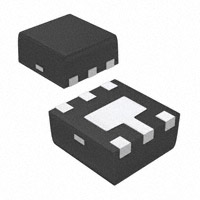
VBUS054B-HS3
Vishay Semiconductors
4-Line BUS-port ESD-protection
Features
•
•
•
•
•
Ultra compact LLP75-6A package
4-line USB ESD-protection
Low leakage current
Low load capacitance CD = 0.8 pF
ESD-protection to IEC 61000-4-2
± 15 kV contact discharge
± 15 kV air discharge
• Lead (Pb)-free component
• Component in accordance to RoHS 2002/95/EC
and WEEE 2002/96/EC
6
5
4
1
2
3
19957
20397
1
Marking (example only)
XX
YY
Dot = Pin 1 marking
XX = Date code
YY = Type code (see table below)
21001
Ordering Information
Ordering code
Taped units per reel
(8 mm tape on 7" reel)
Minimum order quantity
VBUS054B-HS3-GS08
3000
15 000
Device name
VBUS054B-HS3
Package Data
Package
name
Marking
code
Weight
Molding compound
flammability rating
Moisture sensitivity level
Soldering conditions
LLP75-6A
U6
5.1 mg
UL 94 V-0
MSL level 1
(according J-STD-020)
260 °C/10 s at terminals
Device name
VBUS054B-HS3
Absolute Maximum Ratings
Rating
Peak pulse current
Peak pulse power
ESD immunity
Operating temperature
Storage temperature
Test conditions
Symbol
Value
Unit
Pin 1, 3, 4 or 6 to pin 2
acc. IEC 61000-4-5; tP = 8/20 µs; single shot
IPPM
3
A
Pin 5 to pin 2
acc. IEC 61000-4-5; tP = 8/20 µs; single shot
IPPM
10
A
Pin 1, 3, 4 or 6 to pin 2
acc. IEC 61000-4-5; tP = 8/20 µs; single shot
PPP
45
W
Pin 5 to pin 2
acc. IEC 61000-4-5; tP = 8/20 µs; single shot
PPP
200
W
Contact discharge acc. IEC 61000-4-2; 10 pulses
VESD
± 15
kV
Air discharge acc. IEC 61000-4-2; 10 pulses
VESD
± 15
kV
Junction temperature
TJ
- 40 to + 125
°C
TSTG
- 55 to + 150
°C
* Please see document “Vishay Green and Halogen-Free Definitions (5-2008)” http://www.vishay.com/doc?99902
Document Number 81586
Rev. 1.4, 07-Oct-08
For technical support, please contact: ESD-Protection@vishay.com
www.vishay.com
1
�VBUS054B-HS3
Vishay Semiconductors
Electrical Characteristics
Ratings at 25 °C, ambient temperature unless otherwise specified
VBUS054B-HS3
Parameter
Test conditions/remarks
Symbol
Number of line which can be protected
N lines
Reverse stand-off voltage
at IR = 0.1 µA
Pin 1, 3, 4 or 6 to pin 2
VRWM
Reverse current
at VIN = VRWM = 5 V
Pin 1, 3, 4 or 6 to pin 2
IR
at IR = 1 mA
Pin 5 to pin 2
VBR
at IR = 1 mA
Pin 1, 3, 4 or 6 to pin 2
VBR
Reverse clamping voltage
at IPP = 3 A; Pin 1, 3, 4 or 6 to pin 2;
acc. IEC 61000-4-5
Forward clamping voltage
Protection paths
Reverse breakdown voltage
Capacitance
Line symmetry
Supply line capacitance
www.vishay.com
2
Min.
Typ.
Max.
Unit
4
lines
5
V
< 0.01
0.1
µA
6.3
7.1
8
V
6.9
7.9
8.7
V
VC
15
V
at IF = 3 A; Pin 2 to pin 1, 3, 4 or 6;
acc. IEC 61000-4-5
VF
5
V
Pin 1, 3, 4 or 6 to pin 2
VIN (at pin 1, 3, 4 or 6) = 0 V and
VBUS (at pin 5) = 5 V; f = 1 MHz
CD
0.8
1
pF
Pin 1, 3, 4 or 6 to pin 2
VIN (at pin 1, 3, 4 or 6) = 2.5 V and
VBUS (at pin 5) = 5 V; f = 1 MHz
CD
0.5
0.8
pF
Difference of the line capacitances
dCD
0.05
pF
Pin 5 to pin 2
at VR = 0 V; f = 1 MHz
CZD
For technical support, please contact: ESD-Protection@vishay.com
110
pF
Document Number 81586
Rev. 1.4, 07-Oct-08
�VBUS054B-HS3
Vishay Semiconductors
Typical Characteristics
Tamb = 25 °C, unless otherwise specified
100
8 µs to 100 %
100 %
Pin 2 to Pin 5
10
I F (mA)
80 %
IPPM
60 %
20 µs to 50 %
1
Pin 2 to Pin 1, 3, 4 or 6
40 %
0.1
20 %
0.01
0.001
0.5
0%
0
10
20548
20
30
40
Figure 1. 8/20 µs Peak Pulse Current Wave Form
acc. IEC 61000-4-5
0.7
0.8
0.9
1.1
1.2
Figure 4. Typical Forward Current IF vs. Forward Voltage VF
9
Pin 1, 3, 4 or 6 to Pin 2
Rise time = 0.7 ns to 1 ns
8
100 %
7
80 %
Pin 5 to Pin 2
VR (V)
6
60 %
53 %
5
4
40 %
3
27 %
2
20 %
1
0
0.01
0%
- 10 0 10 20 30 40 50 60 70 80 90 100
Figure 2. ESD Discharge Current Wave Form
acc. IEC 61000-4-2 (330 Ω/150 pF)
1.0
1
10
100
1000 10000
I R (µA)
Figure 5. Typical Reverse Voltage VR vs. Reverse Current IR
20
f = 1 MHz; V BUS (at Pin 5) = 5 V
0.9
0.1
20551
Time (ns)
20557
Measured acc. IEC 61000-4-5
(8/20 µs - wave form)
15
0.8
Pin 1, 3, 4 or 6 to Pin 2
0.7
10
Pin 1, 3, 4 or 6 to Pin 2
0.6
VC (V)
C IN (pF)
1
VF (V)
120 %
Discharge Current IESD
0.6
20550
Time (µs)
0.5
Pin 5 to Pin 2
5
0.4
VC
Pin 2 to Pin 5
0
0.3
0.2
-5
Pin 2 to Pin 1, 3, 4 or 6
0.1
- 10
0.0
0
1
20549
2
3
4
5
V IN (V)
Figure 3. Typical Input Capacitance CIN at Pin 1, 3, 4, or 6 vs.
Input Voltage VIN
Document Number 81586
Rev. 1.4, 07-Oct-08
0
6
1
20552
2
3
4
IPP (A)
Figure 6. Typical Peak Clamping Voltage VCvs.
Peak Pulse Current IPP
For technical support, please contact: ESD-Protection@vishay.com
www.vishay.com
3
�VBUS054B-HS3
Vishay Semiconductors
120
200
acc. IEC 61000-4-2
+ 8 kV
contact discharge
Pin 1, 3, 4 or 6 to Pin 2
150
100
80
VC-ESD (V)
VC-ESD (V)
100
60
Pin 1, 3, 4, 6 to Pin 2
40
50
acc. IEC 61000-4-2
contact discharge VC-ESD
0
- 50
- 100
20
- 150
0
- 20
- 10 0
- 200
10 20 30 40 50 60 70 80 90
20553
0
Figure 7. Typical Clamping Performance at + 8 kV
Contact Discharge (acc. IEC 61000-4-2)
15
20
140
Pin 1, 3, 4 or 6 to Pin 2
acc. IEC 61000-4-2
contact discharge
120
100
VC-ESD (V)
- 20
VC-ESD (V)
10
VESD (kV)
Figure 9. Typical Peak Clamping Voltage at ESD
Contact Discharge (acc. IEC 61000-4-2)
20
- 40
- 60
- 80
acc. IEC 61000-4-2
- 8 kV
contact discharge
- 100
- 120
Pin 5 to Pin 2
80
60
40
20
VC-ESD
0
- 20
- 40
- 140
- 160
- 10 0
5
20555
t (ns)
0
Pin 2 to Pin 1, 3, 4 or 6
- 250
Pin 2 to Pin 5
- 60
- 80
0
10 20 30 40 50 60 70 80 90
20554
Figure 8. Typical Clamping Performance at - 8 kV
Contact Discharge (acc. IEC 61000-4-2)
5
10
15
20
VESD (kV)
20556
t (ns)
Figure 10. Typical Peak Clamping Voltage at ESD
Contact Discharge (acc. IEC 61000-4-2)
Application Note:
With the VBUS054B-HS3 a double, high speed USB-port or up to 4 other high speed signal or data lines can
be protected against transient voltage signals. Negative transients will be clamped close below the ground level
while positive transients will be clamped close above the 5 V working range. An avalanche diode clamps the
supply line (VBUS at pin 5) to ground (pin 2). The high speed data lines, D1+, D2+, D1- and D2-, are connected
to pin 1, 3, 4 and 6. As long as the signal voltage on the data lines is between the ground- and the VBUS-level,
the low capacitance PN-diodes offer a very high isolation to VBUS, ground and to the other data lines. But as
soon as any transient signal exceeds this working range, one of the PN-diodes starts working in the forward
mode and clamps the transient to ground or to the avalanche breakthrough voltage level of the Z-diode
between pin 5 and pin 2.
t
w
i
n
U
S
B
P
o
r
t
VBUS
D1+
D16
5
4
1
2
3
R
E
C
E
I
V
E
R
IC
D2+
D2GND
20399
www.vishay.com
4
For technical support, please contact: ESD-Protection@vishay.com
Document Number 81586
Rev. 1.4, 07-Oct-08
�VBUS054B-HS3
Vishay Semiconductors
Background knowledge:
A zener- or avalanche diode is an ideal device for "cutting" or "clamping" voltage spikes or voltage transients
down to low and uncritical voltage values. The breakthrough voltage can easily be adjusted by the chiptechnology to any desired value within a wide range. Up to about 6 V the "zener-effect" (tunnel-effect) is
responsible for the breakthrough characteristic. Above 6 V the so-called "avalanche-effect" is responsible. This
is a more abrupt breakthrough phenomenon. Because of the typical "Z-shape" of the current-voltage-curve of
such diodes, these diodes are generally called "Z-diode" (= zener or avalanche diodes). An equally important
parameter for a protection diode is the ESD- and surge-power that allows the diode to short current in the pulse
to ground without being destroyed.
This requirement can be adjusted by the size of the silicon chip (crystal). The bigger the active area the higher
the current that the diode can short to ground.
But the active area is also responsible for the diode capacitance - the bigger the area the higher the
capacitance.
The dilemma is that a lot of applications require an effective protection against more then 8 kV ESD while the
capacitance must be lower then 5 pF! This is well out of the normal range of a Z-diode. However, a Protection
diode with a low capacitance PN-diode (switching diode or junction diode) in series with a Z-diode, can fulfil
both requirements simultaneously: low capacitance AND high ESD- and/or surge immunity become possible!
A small signal (Vpp < 100 mV) just sees the low capacitance of the PN-diode, while the big capacitance of the
Z-diode in series remains "invisible".
D
ZD
C D = 0.4 pF
C TOT
CZ D = 110 pF
20400
I/O
Such a constellation with a Z-diode and a small
PN-diode (with low capacitance) in series (anti-serial)
is a real unidirectional protection device. The
clamping current can only flow in one direction
(forward) in the PN-diode. The reverse path is
blocked.
D
ZD
Gnd
20401
Another PN-diode "opens" the back path so that the
protection device becomes bidirectional! Because the
clamping voltage levels in forward and reverse
directions are different, such a protection device has
a Bidirectional and Asymmetrical clamping behaviour
(BiAs) just like a single Z-diode.
Document Number 81586
Rev. 1.4, 07-Oct-08
I/O
D1
D2
ZD
Gnd
For technical support, please contact: ESD-Protection@vishay.com
20404
www.vishay.com
5
�VBUS054B-HS3
Vishay Semiconductors
One mode of use is,…
in the very first moment before any pulses have
arrived, all three diodes are completely discharged
(so the diode capacitances are empty of charge) the
first signal pulse with an amplitude > 0.5 V will drive
the upper PN-diode (D1) in a forward direction and
"sees" the empty capacitance of the Z-diode (ZD).
Depending on the duration of this pulse and the pause
to the next one the Z-diodes capacitance can be
charged up so that the next pulse "sees" a lower
capacitance. After some pulses the big Z-diode could
be completely charged up so that the following pulses
just see the small capacitance of both PN-diodes.
For some application this can work perfectly.....
For others applications the capacitance must be the
same all the time from the first till the last pulse.
For these applications the appropriate mode of use is
to connect the Z-diode to the supply voltage.
In this mode the Z-diode is charged up immediately by
the supply voltage and both PN-diodes are always
used in reverse. This keeps their capacitance at a
minimum.
www.vishay.com
6
D1
ZD
I/O
D2
Gnd
20405
VBUS
D1
ZD
I/O
D2
Gnd
For technical support, please contact: ESD-Protection@vishay.com
20406
Document Number 81586
Rev. 1.4, 07-Oct-08
�VBUS054B-HS3
Vishay Semiconductors
Package Dimensions in millimeters (inches): LLP75-6A
18058
Document Number 81586
Rev. 1.4, 07-Oct-08
For technical support, please contact: ESD-Protection@vishay.com
www.vishay.com
7
�Legal Disclaimer Notice
www.vishay.com
Vishay
Disclaimer
ALL PRODUCT, PRODUCT SPECIFICATIONS AND DATA ARE SUBJECT TO CHANGE WITHOUT NOTICE TO IMPROVE
RELIABILITY, FUNCTION OR DESIGN OR OTHERWISE.
Vishay Intertechnology, Inc., its affiliates, agents, and employees, and all persons acting on its or their behalf (collectively,
“Vishay”), disclaim any and all liability for any errors, inaccuracies or incompleteness contained in any datasheet or in any other
disclosure relating to any product.
Vishay makes no warranty, representation or guarantee regarding the suitability of the products for any particular purpose or
the continuing production of any product. To the maximum extent permitted by applicable law, Vishay disclaims (i) any and all
liability arising out of the application or use of any product, (ii) any and all liability, including without limitation special,
consequential or incidental damages, and (iii) any and all implied warranties, including warranties of fitness for particular
purpose, non-infringement and merchantability.
Statements regarding the suitability of products for certain types of applications are based on Vishay’s knowledge of typical
requirements that are often placed on Vishay products in generic applications. Such statements are not binding statements
about the suitability of products for a particular application. It is the customer’s responsibility to validate that a particular
product with the properties described in the product specification is suitable for use in a particular application. Parameters
provided in datasheets and/or specifications may vary in different applications and performance may vary over time. All
operating parameters, including typical parameters, must be validated for each customer application by the customer’s
technical experts. Product specifications do not expand or otherwise modify Vishay’s terms and conditions of purchase,
including but not limited to the warranty expressed therein.
Except as expressly indicated in writing, Vishay products are not designed for use in medical, life-saving, or life-sustaining
applications or for any other application in which the failure of the Vishay product could result in personal injury or death.
Customers using or selling Vishay products not expressly indicated for use in such applications do so at their own risk and agree
to fully indemnify and hold Vishay and its distributors harmless from and against any and all claims, liabilities, expenses and
damages arising or resulting in connection with such use or sale, including attorneys fees, even if such claim alleges that Vishay
or its distributor was negligent regarding the design or manufacture of the part. Please contact authorized Vishay personnel to
obtain written terms and conditions regarding products designed for such applications.
No license, express or implied, by estoppel or otherwise, to any intellectual property rights is granted by this document or by
any conduct of Vishay. Product names and markings noted herein may be trademarks of their respective owners.
Material Category Policy
Vishay Intertechnology, Inc. hereby certifies that all its products that are identified as RoHS-Compliant fulfill the
definitions and restrictions defined under Directive 2011/65/EU of The European Parliament and of the Council
of June 8, 2011 on the restriction of the use of certain hazardous substances in electrical and electronic equipment
(EEE) - recast, unless otherwise specified as non-compliant.
Please note that some Vishay documentation may still make reference to RoHS Directive 2002/95/EC. We confirm that
all the products identified as being compliant to Directive 2002/95/EC conform to Directive 2011/65/EU.
Revision: 12-Mar-12
1
Document Number: 91000
�