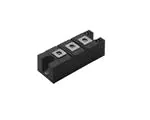
VS-VSKT152/04PbF
www.vishay.com
Vishay Semiconductors
Thyristor/Thyristor, 150 A
(INT-A-PAK Power Module)
FEATURES
• Electrically isolated by DBC ceramic (AI2O3)
• 3500 VRMS isolating voltage
• Industrial standard package
• High surge capability
• Glass passivated chips
• Simple mounting
• UL approved file E78996
• Designed and qualified for multiple level
• Material categorization: for definitions of compliance
please see www.vishay.com/doc?99912
INT-A-PAK
APPLICATIONS
PRIMARY CHARACTERISTICS
IT(AV)
150 A
Type
Modules - thyristor, standard
Package
INT-A-PAK
• Battery charges
• Welders
• Power converters
MAJOR RATINGS AND CHARACTERISTICS
SYMBOL
CHARACTERISTICS
IT(AV)
85 °C
IT(RMS)
VALUES
UNITS
150
A
330
ITSM
I2t
50 Hz
4000
60 Hz
4200
50 Hz
80
60 Hz
73
I2t
VDRM/VRRM
A
kA2s
800
kA2s
400
V
TStg
Range
-40 to +150
TJ
Range
-40 to +125
°C
ELECTRICAL SPECIFICATIONS
VOLTAGE RATINGS
TYPE NUMBER
VS-VSKT152/04PbF
VRRM/VDRM, MAXIMUM REPETITIVE
PEAK REVERSE VOLTAGE
V
VRSM/VDSM, MAXIMUM NON-REPETITIVE
PEAK REVERSE VOLTAGE
V
IRRM/IDRM
AT 125 °C
mA
400
500
50
Revision: 27-Jul-2018
Document Number: 94514
1
For technical questions within your region: DiodesAmericas@vishay.com, DiodesAsia@vishay.com, DiodesEurope@vishay.com
THIS DOCUMENT IS SUBJECT TO CHANGE WITHOUT NOTICE. THE PRODUCTS DESCRIBED HEREIN AND THIS DOCUMENT
ARE SUBJECT TO SPECIFIC DISCLAIMERS, SET FORTH AT www.vishay.com/doc?91000
�VS-VSKT152/04PbF
www.vishay.com
Vishay Semiconductors
ON-STATE CONDUCTION
PARAMETER
SYMBOL
Maximum average on-state current
at case temperature
Maximum RMS on-state current
IT(AV)
IT(RMS)
TEST CONDITIONS
180° conduction half sine wave
As AC switch
t = 10 ms
Maximum peak, one-cycle
on-state, non-repetitive
surge current
ITSM
t = 8.3 ms
t = 10 ms
t = 8.3 ms
t = 10 ms
Maximum I2t for fusing
I2t
t = 8.3 ms
t = 10 ms
t = 8.3 ms
Maximum
I2t
for fusing
I2t
Value of threshold voltage
VT(TO)
On-state slope resistance
rt
Maximum on-state voltage drop
VTM
VALUES
UNITS
150
A
85
°C
330
4000
No voltage
reapplied
100 % VRRM
reapplied
No voltage
reapplied
4200
A
3350
Sine half wave,
initial TJ =
TJ maximum
100 % VRRM
reapplied
t = 0.1 ms to 10 ms, no voltage reapplied
3500
80
73
56
kA2s
51
800
kA2s
0.82
V
1.44
m
Ipk = x IT(AV), TJ = 25 °C
1.48
V
200
400
TJ maximum
Maximum holding current
IH
TJ = 25 °C, anode supply = 6 V,
resistive load, gate open circuit
Maximum latching current
IL
TJ = 25 °C, anode supply = 6 V, resistive load
mA
SWITCHING
PARAMETER
SYMBOL
Typical delay time
tgd
Typical rise time
tgr
Typical turn-off time
tq
TEST CONDITIONS
TJ = 25 °C
Gate current = 1 A, dlg/dt = 1 A/μs
Vd = 0.67 % VDRM
ITM = 300 A, - dl/dt = 15 A/μs; TJ = TJ maximum
VR = 50 V; dV/dt = 20 V/μs; gate 0 V, 100
VALUES
UNITS
1
2
μs
50 to 200
BLOCKING
PARAMETER
Maximum peak reverse and
off-state leakage current
RMS insulation voltage
Critical rate of rise of off-state voltage
SYMBOL
IRRM,
IDRM
TEST CONDITIONS
TJ = 125 °C
VALUES
UNITS
50
mA
VINS
50 Hz, circuit to base, all terminals shorted, t = 1 s
3500
V
dV/dt
TJ = TJ maximum, exponential to 67 % rated VDRM
1000
V/μs
Revision: 27-Jul-2018
Document Number: 94514
2
For technical questions within your region: DiodesAmericas@vishay.com, DiodesAsia@vishay.com, DiodesEurope@vishay.com
THIS DOCUMENT IS SUBJECT TO CHANGE WITHOUT NOTICE. THE PRODUCTS DESCRIBED HEREIN AND THIS DOCUMENT
ARE SUBJECT TO SPECIFIC DISCLAIMERS, SET FORTH AT www.vishay.com/doc?91000
�VS-VSKT152/04PbF
www.vishay.com
Vishay Semiconductors
TRIGGERING
PARAMETER
SYMBOL
Maximum peak gate power
Maximum average gate power
Maximum peak gate current
TEST CONDITIONS
VALUES
PGM
tp 5 ms, TJ = TJ maximum
12
PG(AV)
f = 50 Hz, TJ = TJ maximum
3
Maximum peak negative
gate voltage
- VGT
tp 5 ms, TJ = TJ maximum
VGT
4
TJ = 25 °C
Anode supply = 6 V,
resistive load; Ra = 1
TJ = TJ maximum
IGT
Maximum gate voltage
that will not trigger
VGD
Maximum gate current
that will not trigger
IGD
Maximum rate of rise of
turned-on current
dI/dt
V
2.5
TJ = - 40 °C
Maximum required DC gate
current to trigger
A
10
TJ = - 40 °C
Maximum required DC gate
voltage to trigger
W
3
IGM
UNITS
1.7
270
TJ = 25 °C
150
TJ = TJ maximum
80
mA
0.3
V
10
mA
300
A/μs
VALUES
UNITS
TJ = TJ maximum, rated VDRM applied
TJ = TJ maximum, ITM = 400 A rated VDRM applied
THERMAL AND MECHANICAL SPECIFICATIONS
PARAMETER
SYMBOL
Maximum junction operating
temperature range
TEST CONDITIONS
TJ
-40 to +125
Maximum storage
temperature range
TStg
-40 to +150
Maximum thermal resistance,
junction to case per junction
RthJC
DC operation
0.18
Maximum thermal resistance,
case to heatsink per module
RthCS
Mounting surface smooth, flat and greased
0.05
Mounting
torque ± 10 %
°C
K/W
IAP to heatsink
A mounting compound is recommended and
the torque should be rechecked after a period of
3 hours to allow for the spread of the compound.
Lubricated threads.
busbar to IAP
Approximate weight
4 to 6
Nm
200
g
7.1
oz.
Case style
INT-A-PAK
R CONDUCTION PER JUNCTION
SINUSOIDAL CONDUCTION
AT TJ MAXIMUM
DEVICES
VSKT152/04PbF
RECTANGULAR CONDUCTION
AT TJ MAXIMUM
UNITS
180°
120°
90°
60°
30°
180°
120°
90°
60°
30°
0.007
0.010
0.013
0.016
0.017
0.009
0.012
0.014
0.016
0.017
K/W
Note
• Table shows the increment of thermal resistance RthJC when devices operate at different conduction angles than DC
Revision: 27-Jul-2018
Document Number: 94514
3
For technical questions within your region: DiodesAmericas@vishay.com, DiodesAsia@vishay.com, DiodesEurope@vishay.com
THIS DOCUMENT IS SUBJECT TO CHANGE WITHOUT NOTICE. THE PRODUCTS DESCRIBED HEREIN AND THIS DOCUMENT
ARE SUBJECT TO SPECIFIC DISCLAIMERS, SET FORTH AT www.vishay.com/doc?91000
�VS-VSKT152/04PbF
130
Vishay Semiconductors
VSKT152
RthJC (DC) = 0.182 K/W
120
110
Conduction Angle
100
30˚
60˚
90
90˚
120˚
180˚
80
0
20 40 60 80 100 120 140 160
Maximum Average On-state Power Loss (W)
Maximum Allowable Case Temperature (°C)
www.vishay.com
300
DC
180˚
120˚
90˚
60˚
30˚
250
200
150 RMS Limit
100
Conduction Period
VSKT152
Tj = 125˚C
50
0
0
50
Average On-state Current (A)
Peak Half Sine Wave On-state Current (A)
VSKT152
RthJC (DC) = 0.182 K/W
120
110
Conduction Period
100
30˚
90
60˚
80
90˚
120˚
70
180˚
DC
60
0
50
100
150
200
Maximum Average On-state Power Loss (W)
Fig. 2 - Current Ratings Characteristics
180˚
120˚
90˚
60˚
30˚
200
180
160
140
120
RMS Limit
100
80
Conduction Angle
60
40
VSKT152
Tj = 125˚C
20
0
0
3600
200
250
20 40 60 80 100 120 140 160
Average On-state Current (A)
Fig. 3 - Forward Power Loss Characteristics
At Any Rated Load Condition And With
Rated Vrrm Applied Following Surge.
Initial Tj = 125˚C
@ 60 Hz 0.0083 s
@ 50 Hz 0.0100 s
3400
3200
3000
2800
2600
2400
2200
2000
VSKT152
Per Junction
1800
1600
1
250
Average On-state Current (A)
220
150
Fig. 4 - Forward Power Loss Characteristics
10
100
Number Of Equal Amplitude Half Cycle Current Pulses (N)
Fig. 5 - Maximum Non-Repetitive Surge Current
Peak Half Sine Wave On-state Current (A)
Maximum Allowable Case Temperature (°C)
Fig. 1 - Current Ratings Characteristics
130
100
Average On-state Current (A)
4500
Maximum Non Repetitive Surge Current
Versus Pulse Train Duration. Control
4000 Of Conduction May Not Be Maintained.
Initial Tj = 125˚C
No Voltage Reapplied
3500
Rated Vrrm Reapplied
3000
2500
2000
VSKT152
Per Junction
1500
0.01
0.1
1
Pulse Train Duration (s)
Fig. 6 - Maximum Non-Repetitive Surge Current
Revision: 27-Jul-2018
Document Number: 94514
4
For technical questions within your region: DiodesAmericas@vishay.com, DiodesAsia@vishay.com, DiodesEurope@vishay.com
THIS DOCUMENT IS SUBJECT TO CHANGE WITHOUT NOTICE. THE PRODUCTS DESCRIBED HEREIN AND THIS DOCUMENT
ARE SUBJECT TO SPECIFIC DISCLAIMERS, SET FORTH AT www.vishay.com/doc?91000
�VS-VSKT152/04PbF
Vishay Semiconductors
500
0.2
5K
/W
0.4
K/W
VSKT152
Per Module
Tj = 125˚C
200
R
elta
-D
Conduction Angle
300
K/W
0.
12
K/
0.1
6K W
/W
180˚
120˚
90˚
60˚
30˚
400
.01
=0
SA
Rth
/W
4K
0.0
W
K/
08
0.
Maximum Total On-state Power Loss (W)
www.vishay.com
0.6
K/W
1 K/W
100
0
0
0
100 150 200 250 300 350
50
Total RMS Output Current (A)
25
50
75
100
125
Maximum Allowable Ambient Temperature (°C)
Fig. 7 - On-State Power Loss Characteristics
0.
08
600
K/
W
0.1
2K
/W
400
R
elta
-D
180˚
(Sine)
180˚
(Rect)
500
/W
1K
0.0
700
=
SA
Rth
800
/W
4K
0.0
Maximum Total Power Loss (W)
900
0.2
K/W
0.35
K/W
300
2 x VSKT152
Single Phase Bridge
Connected
Tj = 125˚C
200
100
0.6 K/W
0
0
50
100
150
200
250
Total Output Current (A)
0
300
25
50
75
100
125
Maximum Allowable Ambient Temperature (°C)
Fig. 8 - On-State Power Loss Characteristics
A
hS
Rt
1200
=
120˚
(Rect)
600
R
800
ta
el
-D
0.0
8K
/W
0.1
K/W
W
K/
1000
04
0.
Maximum Total Power Loss (W)
1400
0.1
6K
/W
400
0.25
K/W
0.4 K
/W
200
1 K/W
0
0
100
200
300
400
Total Output Current (A)
0
500
25
50
75
100
125
Maximum Allowable Ambient Temperature (°C)
Fig. 9 - On-State Power Loss Characteristics
Revision: 27-Jul-2018
Document Number: 94514
5
For technical questions within your region: DiodesAmericas@vishay.com, DiodesAsia@vishay.com, DiodesEurope@vishay.com
THIS DOCUMENT IS SUBJECT TO CHANGE WITHOUT NOTICE. THE PRODUCTS DESCRIBED HEREIN AND THIS DOCUMENT
ARE SUBJECT TO SPECIFIC DISCLAIMERS, SET FORTH AT www.vishay.com/doc?91000
�VS-VSKT152/04PbF
www.vishay.com
Transient Thermal Impedance Z thJC (K/W)
Vishay Semiconductors
Instantaneous On-state Current (A)
1000
100
Tj = 25˚C
10
Tj = 125˚C
VSKT152
Per Junction
1
0.5
1
1.5
2
2.5
1
Steady State Value
RthJC = 0.182 K/W
(DC Operation)
0.1
0.01
VSKT152
0.001
0.001
Instantaneous On-state Voltage (V)
Fig. 10 - On-State Voltage Drop Characteristics
10
Rectangular gate pulse
a)Recommended load line for
rated di/dt: 20 V, 20 ohms
tr = 0.5 µs, tp >= 6 µs
b)Recommended load line for
= 6 µs
1
(1) PGM = 200 W, tp = 300 µs
(2) PGM = 60 W, tp = 1 ms
(3) PGM = 30 W, tp = 2 ms
(4) PGM = 12 W, tp = 5 ms
(a)
TJ = 125 ˚C
TJ = -40 ˚C
(b)
1
0.1
Fig. 11 - Thermal Impedance ZthJC Characteristics
TJ = 25 ˚C
Instantaneous Gate Voltage (V)
100
0.01
Square Wave Pulse Duration (s)
(4)
(3) (2)
(1)
VGD
IGD
0.1
0.001
0.01
Frequency Limited by PG(AV)
VSKT152
0.1
1
10
100
1000
Instantaneous Gate Current (A)
Fig. 12 - Gate Characteristics
Revision: 27-Jul-2018
Document Number: 94514
6
For technical questions within your region: DiodesAmericas@vishay.com, DiodesAsia@vishay.com, DiodesEurope@vishay.com
THIS DOCUMENT IS SUBJECT TO CHANGE WITHOUT NOTICE. THE PRODUCTS DESCRIBED HEREIN AND THIS DOCUMENT
ARE SUBJECT TO SPECIFIC DISCLAIMERS, SET FORTH AT www.vishay.com/doc?91000
�VS-VSKT152/04PbF
www.vishay.com
Vishay Semiconductors
ORDERING INFORMATION TABLE
Device code
VS-VS KT
2
1
152
04
PbF
3
4
5
1
-
Vishay Semiconductors product
2
-
Circuit configuration
3
4
-
Current rating
Voltage rating (04 = 400 V)
5
-
PbF = Lead (Pb)-free
Note
• To order the optional hardware go to www.vishay.com/doc?95172
CIRCUIT CONFIGURATION
CIRCUIT DESCRIPTION
CIRCUIT
CONFIGURATION CODE
CIRCUIT DRAWING
~
2
+
1
1
T
2
Two SCRs doubler circuit
3
5
7
4
6
3 5 7
4 6
LINKS TO RELATED DOCUMENTS
Dimensions
www.vishay.com/doc?95067
Revision: 27-Jul-2018
Document Number: 94514
7
For technical questions within your region: DiodesAmericas@vishay.com, DiodesAsia@vishay.com, DiodesEurope@vishay.com
THIS DOCUMENT IS SUBJECT TO CHANGE WITHOUT NOTICE. THE PRODUCTS DESCRIBED HEREIN AND THIS DOCUMENT
ARE SUBJECT TO SPECIFIC DISCLAIMERS, SET FORTH AT www.vishay.com/doc?91000
�Outline Dimensions
Vishay Semiconductors
INT-A-PAK IGBT/Thyristor
29 (1.15)
28 (1.10)
9 (0.33)
30 (1.18)
7 (0.28)
DIMENSIONS in millimeters (inches)
Ø 6.5 (0.25 DIA)
80 (3.15)
23 (0.91)
7
6
4
5 (0.20)
5
23 (0.91)
1
3 screws M6 x 10
2
2.8 x 0.8
(0.11 x 0.03)
14.5 (0.57)
35 (1.38)
17 (0.67)
3
66 (2.60)
37 (1.44)
94 (3.70)
Document Number: 95067
Revision: 15-Feb-08
For technical questions, contact: indmodules@vishay.com
www.vishay.com
1
�Legal Disclaimer Notice
www.vishay.com
Vishay
Disclaimer
ALL PRODUCT, PRODUCT SPECIFICATIONS AND DATA ARE SUBJECT TO CHANGE WITHOUT NOTICE TO IMPROVE
RELIABILITY, FUNCTION OR DESIGN OR OTHERWISE.
Vishay Intertechnology, Inc., its affiliates, agents, and employees, and all persons acting on its or their behalf (collectively,
“Vishay”), disclaim any and all liability for any errors, inaccuracies or incompleteness contained in any datasheet or in any other
disclosure relating to any product.
Vishay makes no warranty, representation or guarantee regarding the suitability of the products for any particular purpose or
the continuing production of any product. To the maximum extent permitted by applicable law, Vishay disclaims (i) any and all
liability arising out of the application or use of any product, (ii) any and all liability, including without limitation special,
consequential or incidental damages, and (iii) any and all implied warranties, including warranties of fitness for particular
purpose, non-infringement and merchantability.
Statements regarding the suitability of products for certain types of applications are based on Vishay's knowledge of typical
requirements that are often placed on Vishay products in generic applications. Such statements are not binding statements
about the suitability of products for a particular application. It is the customer's responsibility to validate that a particular product
with the properties described in the product specification is suitable for use in a particular application. Parameters provided in
datasheets and / or specifications may vary in different applications and performance may vary over time. All operating
parameters, including typical parameters, must be validated for each customer application by the customer's technical experts.
Product specifications do not expand or otherwise modify Vishay's terms and conditions of purchase, including but not limited
to the warranty expressed therein.
Hyperlinks included in this datasheet may direct users to third-party websites. These links are provided as a convenience and
for informational purposes only. Inclusion of these hyperlinks does not constitute an endorsement or an approval by Vishay of
any of the products, services or opinions of the corporation, organization or individual associated with the third-party website.
Vishay disclaims any and all liability and bears no responsibility for the accuracy, legality or content of the third-party website
or for that of subsequent links.
Except as expressly indicated in writing, Vishay products are not designed for use in medical, life-saving, or life-sustaining
applications or for any other application in which the failure of the Vishay product could result in personal injury or death.
Customers using or selling Vishay products not expressly indicated for use in such applications do so at their own risk. Please
contact authorized Vishay personnel to obtain written terms and conditions regarding products designed for such applications.
No license, express or implied, by estoppel or otherwise, to any intellectual property rights is granted by this document or by
any conduct of Vishay. Product names and markings noted herein may be trademarks of their respective owners.
© 2022 VISHAY INTERTECHNOLOGY, INC. ALL RIGHTS RESERVED
Revision: 01-Jan-2022
1
Document Number: 91000
�