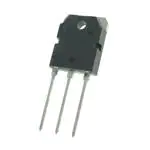
2SK3128
TOSHIBA Field Effect Transistor Silicon N Channel MOS Type (π-MOSVI)
2SK3128
Chopper Regulator, DC−DC Converter and Motor Drive
Applications
z Low drain-source ON resistance
: RDS (ON) = 9.5 mΩ (typ.)
z High forward transfer admittance
: |Yfs| = 40 S (typ.)
z Low leakage current
: IDSS = 100 µA (max) (VDS = 30 V)
z Enhancement mode
: Vth = 1.5~3.0 V (VDS = 10 V, ID = 1 mA)
Unit: mm
Absolute Maximum Ratings (Ta = 25°C)
Characteristics
Symbol
Rating
Unit
Drain−source voltage
VDSS
30
V
Drain−gate voltage (RGS = 20 kΩ)
VDGR
30
V
Gate−source voltage
VGSS
±20
V
ID
60
A
IDP
180
A
Drain power dissipation (Tc = 25°C)
PD
150
W
Single pulse avalanche energy
(Note 2)
EAS
411
mJ
Avalanche current
IAR
60
A
Repetitive avalanche energy (Note 3)
EAR
1.5
mJ
TOSHIBA
Weight: 4.6 g (typ.)
Drain current
DC
(Note 1)
Pulse (Note 1)
Channel temperature
Tch
150
°C
Storage temperature range
Tstg
−55~150
°C
1. GATE
2. DRAIN (HEAT SINK)
3. SOURCE
JEDEC
―
JEITA
―
2-16C1B
Note: Using continuously under heavy loads (e.g. the application of high temperature/current/voltage and the significant change in
temperature, etc.) may cause this product to decrease in the reliability significantly even if the operating conditions (i.e.
operating temperature/current/voltage, etc.) are within the absolute maximum ratings. Please design the appropriate
reliability upon reviewing the Toshiba Semiconductor Reliability Handbook (“Handling Precautions”/Derating Concept and
Methods) and individual reliability data (i.e. reliability test report and estimated failure rate, etc).
Thermal Characteristics
Characteristics
Symbol
Max
Unit
Thermal reverse, channel to case
Rth (ch−c)
1.0
°C / W
Thermal reverse, channel to ambient
Rth (ch−a)
50
°C / W
Note 1: Ensure that the channel temperature does not exceed 150°C.
Note 2: VDD = 25 V, Tch = 25°C (initial), L = 82 µH, RG = 25 Ω, IAR = 60 A
Note 3: Repetitive rating: pulse width limited by maximum channel temperature
This transistor is an electrostatic-sensitive device.
Please handle with caution.
1
2006-11-16
�2SK3128
Electrical Characteristics (Ta = 25°C)
Characteristics
Symbol
Test Condition
Min
Typ.
Max
Unit
Gate leakage current
IGSS
VGS = ±16 V, VDS = 0 V
—
—
±10
µA
Drain cut−off current
IDSS
VDS = 30 V, VGS = 0 V
—
—
100
µA
V (BR) DSS
ID = 10 mA, VGS = 0 V
30
—
—
V
Vth
VDS = 10 V, ID = 1 mA
1.5
—
3.0
V
Drain−source ON resistance
RDS (ON)
VGS = 10 V, ID = 30 A
—
9.5
12
mΩ
Forward transfer admittance
|Yfs|
VDS = 10 V, ID = 30 A
20
40
—
S
Input capacitance
Ciss
—
2300
—
Reverse transfer capacitance
Crss
—
380
—
Output capacitance
Coss
—
1100
—
tr
—
12
—
ton
—
25
—
tf
—
75
—
toff
—
200
—
—
66
—
—
45
—
—
21
—
Drain−source breakdown voltage
Gate threshold voltage
Rise time
Turn−on time
VDS = 10 V, VGS = 0 V, f = 1 MHz
pF
ns
Switching time
Fall time
Turn−off time
Total gate charge (Gate−source
plus gate−drain)
Qg
Gate−source charge
Qgs
Gate−drain (“miller”) charge
Qgd
VDD ≈ 24 V, VGS = 10 V, ID = 60 A
nC
Source−Drain Ratings and Characteristics (Ta = 25°C)
Characteristics
Symbol
Test Condition
Min
Typ.
Max
Unit
Continuous drain reverse current
(Note 1)
IDR
—
—
—
60
A
Pulse drain reverse current
(Note 1)
IDRP
—
—
—
180
A
Forward voltage (diode)
VDSF
—
—
−1.5
V
Reverse recovery time
trr
—
150
—
ns
Reverse recovery charge
Qrr
—
0.26
—
µC
IDR = 60 A, VGS = 0 V
IDR = 60 A, VGS = 0 V, dIDR / dt = 50 A / µs
Marking
TOSHIBA
K3128
Part No. (or abbreviation code)
Lot No.
A line indicates
lead (Pb)-free package or
lead (Pb)-free finish.
2
2006-11-16
�2SK3128
RESTRICTIONS ON PRODUCT USE
030619EAA
• The information contained herein is subject to change without notice.
• The information contained herein is presented only as a guide for the applications of our products. No
responsibility is assumed by TOSHIBA for any infringements of patents or other rights of the third parties which
may result from its use. No license is granted by implication or otherwise under any patent or patent rights of
TOSHIBA or others.
• TOSHIBA is continually working to improve the quality and reliability of its products. Nevertheless, semiconductor
devices in general can malfunction or fail due to their inherent electrical sensitivity and vulnerability to physical
stress. It is the responsibility of the buyer, when utilizing TOSHIBA products, to comply with the standards of
safety in making a safe design for the entire system, and to avoid situations in which a malfunction or failure of
such TOSHIBA products could cause loss of human life, bodily injury or damage to property.
In developing your designs, please ensure that TOSHIBA products are used within specified operating ranges as
set forth in the most recent TOSHIBA products specifications. Also, please keep in mind the precautions and
conditions set forth in the “Handling Guide for Semiconductor Devices,” or “TOSHIBA Semiconductor Reliability
Handbook” etc..
• The TOSHIBA products listed in this document are intended for usage in general electronics applications
(computer, personal equipment, office equipment, measuring equipment, industrial robotics, domestic appliances,
etc.). These TOSHIBA products are neither intended nor warranted for usage in equipment that requires
extraordinarily high quality and/or reliability or a malfunction or failure of which may cause loss of human life or
bodily injury (“Unintended Usage”). Unintended Usage include atomic energy control instruments, airplane or
spaceship instruments, transportation instruments, traffic signal instruments, combustion control instruments,
medical instruments, all types of safety devices, etc.. Unintended Usage of TOSHIBA products listed in this
document shall be made at the customer’s own risk.
• TOSHIBA products should not be embedded to the downstream products which are prohibited to be produced
and sold, under any law and regulations.
3
2006-11-16
�