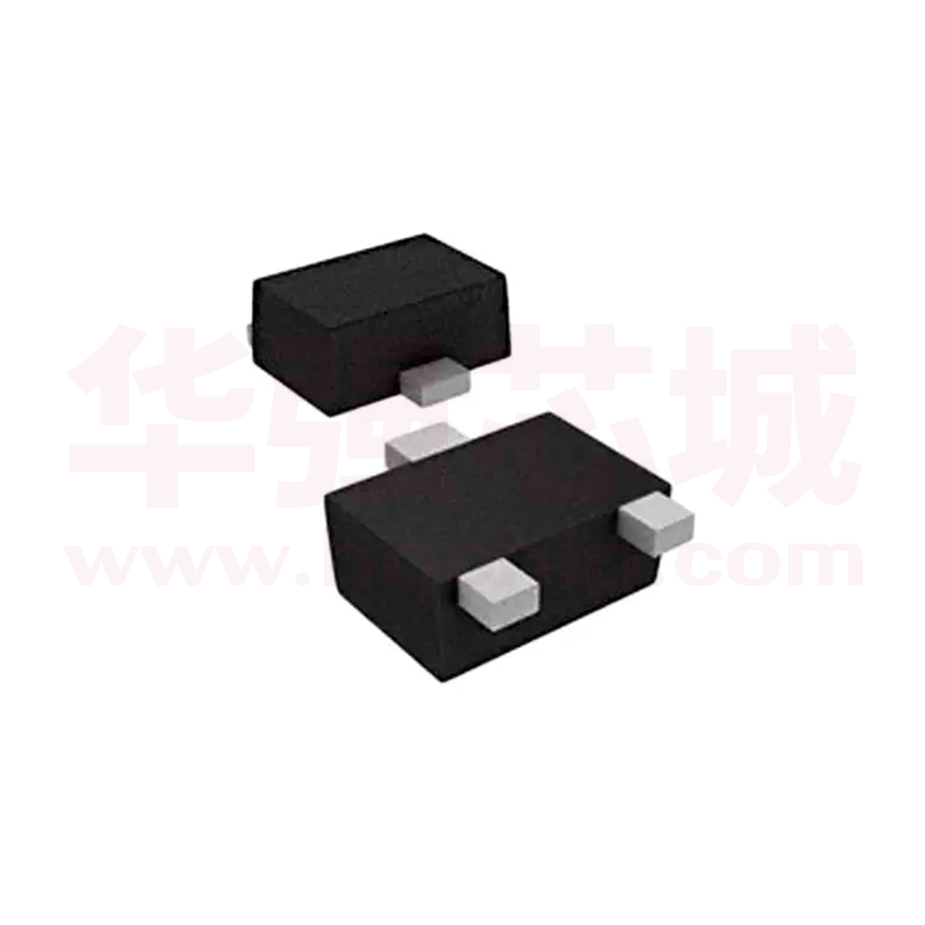
SSM3J56MFV
TOSHIBA Field-Effect Transistor Silicon P-Channel MOS Type (U-MOSⅥ)
SSM3J56MFV
○ Load Switching Applications
•
•
1.2 V drive
Low ON-resistance: RDS(ON) = 390 mΩ (max) (@VGS = -4.5 V)
RDS(ON) = 480 mΩ (max) (@VGS = -2.5 V)
RDS(ON) = 660 mΩ (max) (@VGS = -1.8 V)
RDS(ON) = 900 mΩ (max) (@VGS = -1.5 V)
RDS(ON) = 4000 mΩ (max) (@VGS = -1.2 V)
Unit: mm
Absolute Maximum Ratings (Ta = 25°C)
Characteristic
Symbol
Rating
Drain-Source voltage
VDSS
-20
V
Gate-Source voltage
VGSS
±8
V
Drain current
DC
ID (Note 1)
-800
Pulse
IDP (Note 1)
-1600
PD (Note 2)
150
PD (Note 3)
500
Power dissipation
t < 5s
Unit
mA
1.Gate
mW
2.Source
800
3.Drain
Channel temperature
Tch
150
°C
Storage temperature range
Tstg
−55 to 150
°C
VESM
JEDEC
―
Note: Using continuously under heavy loads (e.g. the application of high
temperature/current/voltage and the significant change in temperature,
JEITA
―
etc.) may cause this product to decrease in the reliability significantly even
TOSHIBA
2-1L1B
if the operating conditions (i.e. operating temperature/current/voltage, etc.)
are within the absolute maximum ratings.
Weight: 1.5mg (typ.)
Please design the appropriate reliability upon reviewing the Toshiba
Semiconductor Reliability Handbook (“Handling Precautions”/“Derating Concept and Methods”) and individual
reliability data (i.e. reliability test report and estimated failure rate, etc).
Note 1: The channel temperature should not exceed 150°C during use.
Note 2: Mounted on a FR4 board.
(25.4 mm × 25.4 mm × 1.6 mm, Cu Pad: 0.585 mm2)
Note 3: Mounted on a FR4 board.
(25.4 mm × 25.4 mm × 1.6 mm, Cu Pad: 645 mm2)
Marking
Equivalent Circuit (top view)
3
3
PW
1
2
1
2
Handling Precaution
When handling individual devices that are not yet mounted on a circuit board, make sure that the environment is
protected against electrostatic discharge. Operators should wear antistatic clothing, and containers and other objects that
come into direct contact with devices should be made of antistatic materials.
Thermal resistance Rth (ch-a) and Power dissipation PD vary depending on board material, board area, board thickness
and pad area. When using this device, please take heat dissipation into consideration.
Start of commercial production
2011-05
1
2014-03-01
�SSM3J56MFV
Electrical Characteristics (Ta = 25°C)
Characteristic
Drain-source breakdown voltage
Symbol
Test Conditions
V (BR) DSS ID = -1 mA, VGS = 0 V
V (BR) DSX ID = -1 mA, VGS = 5 V
.(Note 5)
Min
Typ.
Max
Unit
-20
⎯
⎯
V
-15
⎯
⎯
V
Drain cut-off current
IDSS
VDS = -20 V, VGS = 0 V
⎯
⎯
-1
μA
Gate leakage current
IGSS
VGS = ±8 V, VDS = 0 V
⎯
⎯
±1
μA
Vth
VDS = -3 V, ID = -1 mA
Gate threshold voltage
⏐Yfs⏐
Forward transfer admittance
Drain–source ON-resistance
RDS (ON)
Input capacitance
Ciss
Output capacitance
Coss
⎯
-1.0
V
(Note 4)
0.5
1.0
⎯
S
ID = -800 mA, VGS = -4.5 V
(Note 4)
⎯
310
390
ID = -500 mA, VGS = -2.5 V
(Note 4)
⎯
380
480
ID = -200 mA, VGS = -1.8 V
(Note 4)
⎯
470
660
ID = -100 mA, VGS = -1.5 V
(Note 4)
⎯
560
900
ID = -10 mA, VGS = -1.2 V
(Note 4)
⎯
770
4000
⎯
100
⎯
VDS = -10 V, VGS = 0 V, f = 1 MHz
⎯
16
⎯
⎯
10
⎯
ton
VDD = -10 V, ID = -200 mA
⎯
8
⎯
Turn-off time
toff
VGS = 0 to -2.5 V, RG = 50 Ω
⎯
26
⎯
⎯
1.6
⎯
⎯
0.2
⎯
⎯
0.4
⎯
⎯
0.9
1.2
Crss
Total gate charge
Qg
Gate-source charge
Qgs1
Gate-drain charge
Qgd
Drain-source forward voltage
VDSF
VDD = -10 V, ID = -800 mA,
VGS = -4.5 V
ID = 800 mA, VGS = 0 V
(Note 4)
mΩ
pF
Turn-on time
Reverse transfer capacitance
Switching time
-0.3
VDS = -3 V, ID = -100 mA
ns
nC
V
Note 4: Pulse test
Note 5: If a forward bias is applied between gate and source, this device enters V(BR)DSX mode.
Note that the drain-source breakdown voltage is lowered in this mode.
Switching Time Test Circuit
(a) Test Circuit
0V
(b) VIN
90%
OUT
0
IN
10%
−2.5 V
RG
−2.5V
10 μs
RL
VDD
(c) VOUT
VDD = -10 V
RG = 50 Ω
Duty ≤ 1%
VIN: tr, tf < 5 ns
Common Source
Ta = 25°C
VDS (ON)
90%
10%
VDD
tr
ton
tf
toff
Notice on Usage
Vth can be expressed as the voltage between gate and source when the low operating current value is ID = -1 mA for
this product. For normal switching operation, VGS (on) requires a higher voltage than Vth and VGS (off) requires a lower
voltage than Vth. (The relationship can be established as follows: VGS (off) < Vth < VGS (on).)
Take this into consideration when using the device.
2
2014-03-01
�SSM3J56MFV
ID – VDS
ID – VGS
-2.0
-10
-2.5 V
-1.8 V
-1.5 V
ID
Drain current
Drain current
-1
(A)
-1.5
ID
(A)
-4.5 V
-1.0
VGS = -1.2 V
-0.5
0
Common Source
Ta = 25 °C
Pulse test
0
-0.5
-1.0
Drain–source voltage
Ta = 100 °C
-0.01
25 °C
-25 °C
-0.001
Common Source
VDS = -3 V
Pulse test
-0.0001
0
-1.5
VDS
-0.1
(V)
-1.0
Gate–source voltage
1.6
ID = -10 mA
Common Source
Pulse test
Drain–source ON-resistance
RDS (ON) (Ω)
Drain–source ON-resistance
RDS (ON) (Ω)
VGS
(V)
RDS (ON) – VGS
RDS (ON) – VGS
1.6
-2.0
1.2
0.8
25 °C
Ta = 100 °C
0.4
ID = -800 mA
Common Source
Pulse test
1.2
0.8
25 °C
Ta = 100 °C
0.4
-25 °C
-25 °C
0
0
-4
-2
-6
Gate–source voltage
VGS
0
-8
0
-2
Drain–source ON-resistance
RDS (ON) (Ω)
Drain–source ON-resistance
RDS (ON) (Ω)
-200 mA / -1.8 V
-100 mA / -1.5 V
-10 mA / -1.2 V
0.4
ID = -800 mA / VGS = -4.5 V
-500 mA / -2.5 V
-1.2 V
50
Ambient temperature
100
0.8
-1.8 V
-2.5 V
0.4
VGS = -4.5 V
Ta
0
150
(°C)
-1.5 V
12
0
0
(V)
RDS (ON) – ID
Common Source
Pulse test
0
−50
VGS
-8
1.6
1.2
0.8
-6
Gate–source voltage
(V)
RDS (ON) – Ta
1.6
-4
-0.5
-1.0
Drain current
3
Common Source
Ta = 25 °C
Pulse test
-1.5
ID
-2.0
(A)
2014-03-01
�SSM3J56MFV
Vth – Ta
(S)
-0.5
0
−50
0
50
100
Ambient temperature
Ta
150
3
1
-25 °C
Ta =100 °C
0.01
(pF)
C
100
0.5
1.0
ID
VDS
-10
(A)
Ciss
30
10
Coss
Crss
Common Source
Ta = 25°C
f = 1 MHz
VGS = 0 V
1
-0.1
1.5
-1
-10
Drain–source voltage
(V)
-100
VDS
(V)
Dynamic Input Characteristic
t – ID
1000
-8
VGS
Gate–source voltage
toff
Common Source
ID = -800 mA
Ta = 25°C
(V)
Common Source
VDD = -10 V
VGS = 0 to -2.5 V
Ta = 25 °C
RG = 50 Ω
t
100
-1
-0.1
-0.01
C – VDS
3
Drain–source voltage
(ns)
0.01
-0.001
25 °C
0.001
0
Switching time
0.03
300
Capacitance
(A)
IDR
Drain reverse current
IDR
S
0.1
0.1
1000
D
G
0.3
Drain current
Common Source
VGS = 0 V
Pulse test
1
Common Source
VDS = -3 V
Ta = 25°C
Pulse test
(°C)
IDR – VDS
10
|Yfs| – ID
10
⎪Yfs⎪
Gate threshold voltage
Vth (V)
Common Source
VDS = -3 V
ID = -1 mA
Forward transfer admittance
-1.0
tf
10
ton
-6
VDD = - 10 V
-4
VDD = - 16 V
-2
tr
1
-0.01
0
-0.1
Drain current
-1
ID
-10
0
1
2
Total Gate Charge
3
Qg
4
(nC)
(A)
4
2014-03-01
�SSM3J56MFV
PD – Ta
600
b
Drain power dissipation PD (mW)
Transient thermal impedance Rth (°C/W)
Rth – tw
1000
a
100
10
Single pulse
a: Mounted on FR4 board
2
(25.4 mm × 25.4 mm × 1.6 mm, Cu Pad: 645 mm )
b: Mounted on FR4 board
2
(25.4 mm × 25.4 mm × 1.6 mm, Cu Pad: 0.585 mm )
1
0.001
0.01
0.1
1
Pulse Width
10
100
500
400
300
200
tw (s)
b
100
0
0
1000
a: Mounted on FR4 board
(25.4mm × 25.4mm × 1.6mm,
Cu Pad : 645 mm2)
b: Mounted on FR4 board
(25.4mm × 25.4mm × 1.6mm,
Cu Pad : 0.585 mm2)
a
50
Ambient temperature
5
100
Ta
150
(°C)
2014-03-01
�SSM3J56MFV
RESTRICTIONS ON PRODUCT USE
• Toshiba Corporation, and its subsidiaries and affiliates (collectively "TOSHIBA"), reserve the right to make changes to the information
in this document, and related hardware, software and systems (collectively "Product") without notice.
• This document and any information herein may not be reproduced without prior written permission from TOSHIBA. Even with
TOSHIBA's written permission, reproduction is permissible only if reproduction is without alteration/omission.
• Though TOSHIBA works continually to improve Product's quality and reliability, Product can malfunction or fail. Customers are
responsible for complying with safety standards and for providing adequate designs and safeguards for their hardware, software and
systems which minimize risk and avoid situations in which a malfunction or failure of Product could cause loss of human life, bodily
injury or damage to property, including data loss or corruption. Before customers use the Product, create designs including the
Product, or incorporate the Product into their own applications, customers must also refer to and comply with (a) the latest versions of
all relevant TOSHIBA information, including without limitation, this document, the specifications, the data sheets and application notes
for Product and the precautions and conditions set forth in the "TOSHIBA Semiconductor Reliability Handbook" and (b) the
instructions for the application with which the Product will be used with or for. Customers are solely responsible for all aspects of their
own product design or applications, including but not limited to (a) determining the appropriateness of the use of this Product in such
design or applications; (b) evaluating and determining the applicability of any information contained in this document, or in charts,
diagrams, programs, algorithms, sample application circuits, or any other referenced documents; and (c) validating all operating
parameters for such designs and applications. TOSHIBA ASSUMES NO LIABILITY FOR CUSTOMERS' PRODUCT DESIGN OR
APPLICATIONS.
• PRODUCT IS NEITHER INTENDED NOR WARRANTED FOR USE IN EQUIPMENTS OR SYSTEMS THAT REQUIRE
EXTRAORDINARILY HIGH LEVELS OF QUALITY AND/OR RELIABILITY, AND/OR A MALFUNCTION OR FAILURE OF WHICH
MAY CAUSE LOSS OF HUMAN LIFE, BODILY INJURY, SERIOUS PROPERTY DAMAGE AND/OR SERIOUS PUBLIC IMPACT
("UNINTENDED USE"). Except for specific applications as expressly stated in this document, Unintended Use includes, without
limitation, equipment used in nuclear facilities, equipment used in the aerospace industry, medical equipment, equipment used for
automobiles, trains, ships and other transportation, traffic signaling equipment, equipment used to control combustions or explosions,
safety devices, elevators and escalators, devices related to electric power, and equipment used in finance-related fields. IF YOU USE
PRODUCT FOR UNINTENDED USE, TOSHIBA ASSUMES NO LIABILITY FOR PRODUCT. For details, please contact your
TOSHIBA sales representative.
• Do not disassemble, analyze, reverse-engineer, alter, modify, translate or copy Product, whether in whole or in part.
• Product shall not be used for or incorporated into any products or systems whose manufacture, use, or sale is prohibited under any
applicable laws or regulations.
• The information contained herein is presented only as guidance for Product use. No responsibility is assumed by TOSHIBA for any
infringement of patents or any other intellectual property rights of third parties that may result from the use of Product. No license to
any intellectual property right is granted by this document, whether express or implied, by estoppel or otherwise.
• ABSENT A WRITTEN SIGNED AGREEMENT, EXCEPT AS PROVIDED IN THE RELEVANT TERMS AND CONDITIONS OF SALE
FOR PRODUCT, AND TO THE MAXIMUM EXTENT ALLOWABLE BY LAW, TOSHIBA (1) ASSUMES NO LIABILITY
WHATSOEVER, INCLUDING WITHOUT LIMITATION, INDIRECT, CONSEQUENTIAL, SPECIAL, OR INCIDENTAL DAMAGES OR
LOSS, INCLUDING WITHOUT LIMITATION, LOSS OF PROFITS, LOSS OF OPPORTUNITIES, BUSINESS INTERRUPTION AND
LOSS OF DATA, AND (2) DISCLAIMS ANY AND ALL EXPRESS OR IMPLIED WARRANTIES AND CONDITIONS RELATED TO
SALE, USE OF PRODUCT, OR INFORMATION, INCLUDING WARRANTIES OR CONDITIONS OF MERCHANTABILITY, FITNESS
FOR A PARTICULAR PURPOSE, ACCURACY OF INFORMATION, OR NONINFRINGEMENT.
• Do not use or otherwise make available Product or related software or technology for any military purposes, including without
limitation, for the design, development, use, stockpiling or manufacturing of nuclear, chemical, or biological weapons or missile
technology products (mass destruction weapons). Product and related software and technology may be controlled under the
applicable export laws and regulations including, without limitation, the Japanese Foreign Exchange and Foreign Trade Law and the
U.S. Export Administration Regulations. Export and re-export of Product or related software or technology are strictly prohibited
except in compliance with all applicable export laws and regulations.
• Please contact your TOSHIBA sales representative for details as to environmental matters such as the RoHS compatibility of Product.
Please use Product in compliance with all applicable laws and regulations that regulate the inclusion or use of controlled substances,
including without limitation, the EU RoHS Directive. TOSHIBA ASSUMES NO LIABILITY FOR DAMAGES OR LOSSES
OCCURRING AS A RESULT OF NONCOMPLIANCE WITH APPLICABLE LAWS AND REGULATIONS.
6
2014-03-01
�